Rehman Baba Express Disaster Near Multan: 5 Dead, 30 Injured in Early-Morning Derailment
The Karachi to Peshawar Rehman Baba Express derailed near Multan at dawn, killing 5 and injuring 30. What happened, the rescue story and the questions.
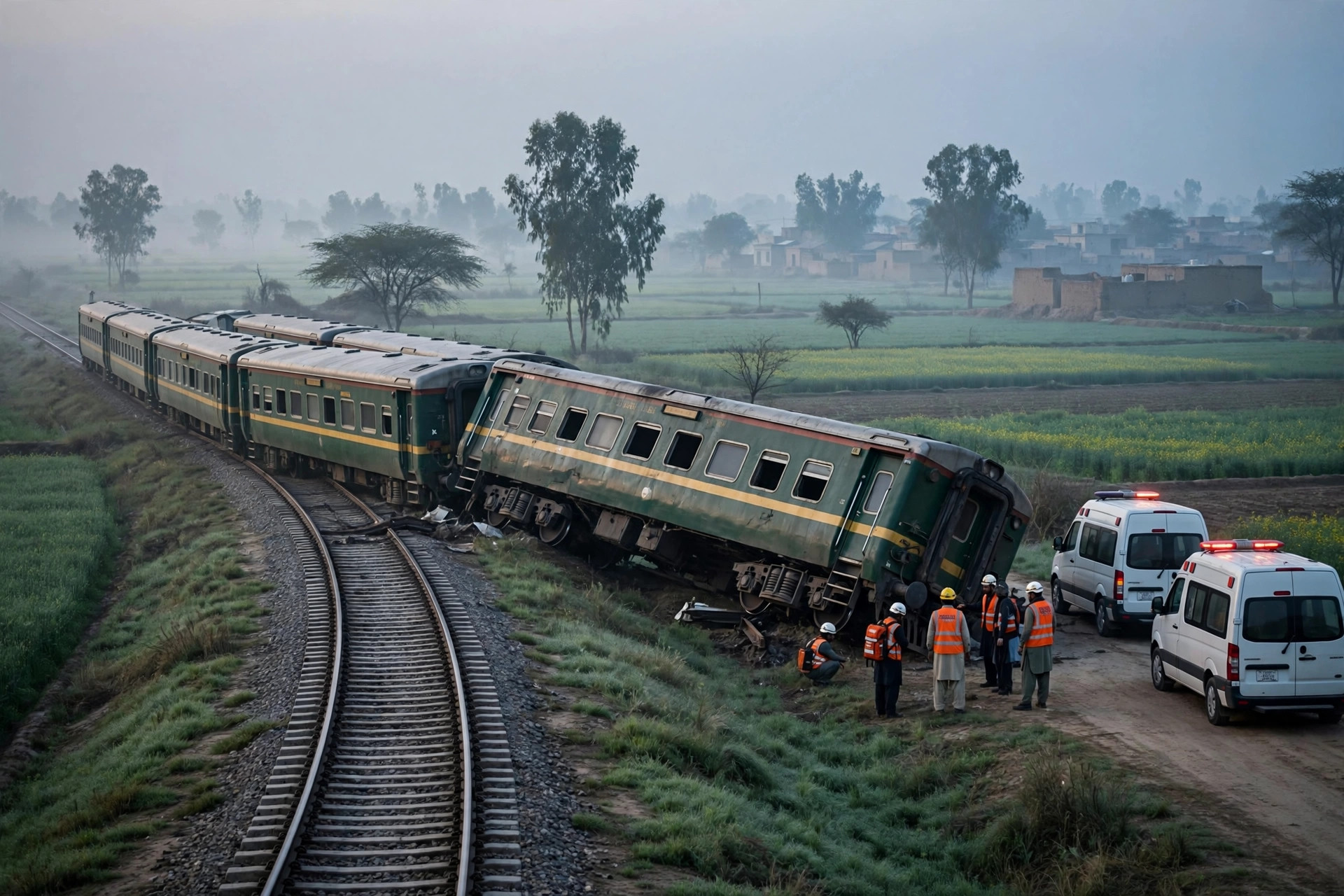
Most of the passengers were fast asleep when it happened. It was around 5:15 on Tuesday morning, October 13, and the Rehman Baba Express was moving through the darkness of southern Punjab, carrying families, workers, students and elderly travellers from Karachi towards Peshawar — one of the longest and most loved train journeys in Pakistan. Many people on board had been travelling all night. Some were close to their stop. Others still had many hours to go.
Then, near Sher Shah Bridge in Multan, something went terribly wrong. Coaches of the train left the track with a violent jolt, and the quiet darkness of early morning turned into screams, dust, broken glass and confusion. According to police, at least five people were killed and around 30 were injured in the derailment. Within minutes, rescue teams, police and local people were rushing towards the wreckage, because in those first moments, every single minute can mean the difference between life and death.
This is the story of what happened that morning, how the rescue unfolded, and the hard questions Pakistan is once again asking about the safety of its railways.
What Happened in Those Early Minutes
The Rehman Baba Express, named after the famous Pashto Sufi poet Rehman Baba, runs between Karachi in the south and Peshawar in the north-west. It is a train that connects the whole country in one journey. According to a Pakistan Railways spokesperson, around 500 passengers were on board when the accident happened near Sher Shah railway station in Multan district, in Punjab province.
The train’s driver, Rizwan Abbas, later described the moment to reporters. He said the train was travelling at about 100 kilometres per hour, the signal was clear, and everything seemed normal. But as the train passed through the Sher Shah station area, he suddenly felt a strong push from behind. He applied the brakes and managed to stop the train. When he stepped out of the locomotive and looked back, he saw the horrible scene: the passenger coaches had come off the tracks and were lying scattered beside the line. The driver maintained that the train itself was in working order.
In total, 14 coaches of the express derailed near the bridge, according to officials. Think about that scene for a moment. A train that only moments earlier was full of sleeping people was suddenly standing broken in the fields outside Multan, with passengers trapped inside twisted coaches, calling for help in the dark.
The Rescue: A Race Against Time
Rescue work began quickly, but it was not easy. Coaches had fallen off the track, and some passengers were stuck inside. Rescue officials said that 13 coaches were cleared one by one, while difficult work continued inside one remaining coach, where at least one passenger was reported to be trapped as workers struggled to reach him.
A relief train and a medical van were sent from Multan to the accident site to help the teams on the ground. Because of the wreckage, train traffic on both the up and down tracks was suspended, which disrupted rail services on this busy route for many hours.
As always in Pakistan, the first helpers were ordinary people from nearby areas — farmers, shopkeepers, travellers on the road — running towards the sound of the crash before the official teams even arrived. Then came the rescue workers, police, railway staff and hospital teams, all working together while families across the country waited for a phone call, praying it was good news.
By the time the sun was fully up, the cleared coaches stood silent, and passengers who escaped injury were sitting beside the track with their bags and belongings, waiting to be taken onward. For them, the journey had ended in the worst possible way — but they were alive, and many of them knew how lucky they were.
The Injured at Nishtar Hospital
The injured passengers were shifted to Nishtar Hospital in Multan, the biggest hospital of the region, where doctors and medical staff treated them. According to police, around 30 people were injured, though some officials later gave slightly higher figures as more people were brought in — something that often happens in the confusion of a large accident.
Prime Minister Shehbaz Sharif expressed grief over the loss of life and directed the authorities to speed up the rescue operation and to make sure the injured received the best possible medical treatment without any delay. President Asif Ali Zardari also expressed grief over the incident and gave similar directions for the care of the injured.
The Railways Minister said compensation would be paid to the families of those who died and to the injured passengers, in accordance with the Pakistan Railways insurance policy. Meanwhile, the Multan Commissioner, Amir Karim Khan, visited the accident site, met the affected passengers and their families, and directed officials to arrange temporary accommodation, transport and breakfast for the stranded travellers who had lost their train but still had to reach their homes.
For the families of the five people who died, however, no arrangement can repair what was lost on that track. A journey that began with plans — a wedding to attend, a job to join, a family to meet — ended at a hospital desk and a phone call that nobody ever wants to receive.
What Could Have Caused It?
This is the question everyone is asking, and the honest answer right now is: we do not know yet. The cause of the derailment has not been officially established, Pakistan Railways has said, and more details are expected as the investigation moves forward.
Railways Minister Hanif Abbasi has appointed the Federal Government Inspector of Railways as the inquiry officer to probe the incident. According to Dawn, an initial investigation report by Pakistan Railways suggested that the derailment was likely caused by a fault in a passenger coach — but this is only an early finding, not a final conclusion.
One detail has received a lot of attention. A passenger told reporters that workers had repaired the nuts and bolts of coach number nine near Rohri, a station the train passed earlier in its journey. This claim has not been independently verified, and it is not clear whether that repair had anything to do with the accident. It is important to treat it as exactly what it is: one passenger’s claim, which investigators will have to check.
It is also worth noting that the figures in the first hours were not the same everywhere. The railways minister initially confirmed four deaths, while police and railway officials reported five. Such differences are common in the early hours of a disaster, when counting is still going on. What is certain is that lives were lost, dozens were hurt, and a full and honest inquiry is now owed to every family involved.
A Painful Pattern: Pakistan’s Railway Safety Question
Sadly, this is not the first time Pakistan has woken up to news like this. In August 2023, the Hazara Express derailed near Nawabshah in Sindh. At least 30 people were killed and more than 100 were injured in that accident, which raised serious concerns about railway safety and maintenance across the country.
Train accidents are, sadly, not rare in Pakistan. News agencies have long reported that the railway system is struggling with old tracks, ageing equipment and decades of low investment. Ordinary Pakistanis still love the train — it is cheaper than the bus for long journeys, more comfortable for families, and full of memories for anyone who grew up travelling between Karachi, Lahore, Multan and Peshawar. But love for the railway cannot replace the hard work of maintaining it.
Every accident brings the same promises: an inquiry, compensation, better safety. The families of the victims will hope that this time the questions are answered fully — what failed, who was responsible, and what will change so another train, on another dark morning, does not end the same way.
Frequently Asked Questions
What happened to the Rehman Baba Express?
The Rehman Baba Express, travelling from Karachi to Peshawar, derailed at around 5:15 a.m. on Tuesday, October 13, 2026, near Sher Shah Bridge in Multan. According to officials, 14 coaches came off the track while around 500 passengers were on board.
How many people were killed and injured?
According to police, at least five people were killed and around 30 were injured. Some officials later gave slightly different figures, which is common in the early hours of a major accident.
What caused the derailment?
The cause has not been officially established yet. The Railways Minister has appointed the Federal Government Inspector of Railways to lead an inquiry. An initial railways report suggested a possible fault in a passenger coach, and one passenger’s unverified claim about a repair to coach number nine is also expected to be checked by investigators.
Where were the injured taken, and what help was announced?
The injured were shifted to Nishtar Hospital in Multan. The Prime Minister directed the best possible medical care for them, and the Railways Minister announced compensation for the deceased and injured under the Pakistan Railways insurance policy. Stranded passengers were provided temporary accommodation, transport and food arrangements by the local administration.
For now, the tracks near Sher Shah have fallen quiet again, but the questions have not. Pakistan’s railway carries millions of ordinary people who trust it with their lives every single day. The least they deserve is a journey that brings them home. Our thoughts are with the families who lost their loved ones near Multan, and with every injured passenger recovering at Nishtar Hospital tonight.