René Magritte: The Life Story Behind the Surreal Painter
In this post
René Magritte painted ordinary things in a way that made them feel strange, and strange things in a way that made them feel ordinary. A bowler hat, a green apple, a pipe, a window, a cloud: these are the objects in his pictures, and they are painted with the calm, careful skill of a man who could have painted a postcard. The strangeness is not in the paint. It is in the idea. A pipe with the words “this is not a pipe” underneath it, a man whose face is hidden by an apple, a night sky above a brightly lit street: Magritte asks the viewer to stop and think, and then to think again, because the picture does not mean what it first seems to mean.
He was born in Belgium, in a small town, and he grew up in a family that moved often and that knew sadness early. His mother died when he was thirteen, and that loss has been talked about a great deal in writing about Magritte, sometimes too much, and sometimes in ways that are not fair to the man or to his mother. What is certain is that he became a painter who loved mystery, who loved words, and who loved the quiet joke of a picture that looks normal and is not. He lived through two world wars, he worked in advertising to pay the bills, and he painted, slowly and steadily, until he became one of the most famous Surrealists in the world.
Magritte did not paint like a dreamer who throws paint at a canvas. He painted like a thinker who plans a picture in his head, writes down the idea, and then paints it as clearly as he can. That clarity is his signature. A child can understand a Magritte picture at first glance, and an adult can spend an hour thinking about it and still not be sure what it means. That double quality, simple to see and hard to explain, is why his work is on posters, on book covers, and in museums, and why people who know nothing about Surrealism still know his green apple.
A Boy in Lessines and a Family That Moved
René François Ghislain Magritte was born on 21 November 1898 in Lessines, a town in Belgium, the eldest of three sons. His father, Léopold Magritte, was a tailor and a businessman who ran a factory making hats and other goods, and his mother, Régina Bertinchamps, was a milliner who made hats. The family was comfortable, but not rich, and they moved several times during René’s childhood, living in Lessines, in Gilly, and in other towns in Belgium. Young René went to school, he drew, and he showed an early interest in art, but his childhood was not a happy one in the usual sense, because his mother suffered from depression and, in 1912, when René was thirteen, she died. She had gone missing, and her body was later found in a river. The details of that death have been repeated many times, and they have often been linked to his later pictures of veiled faces and covered heads, but Magritte himself rarely spoke about it, and it is not fair to explain his whole art by one sad event. He was a man, not a case study, and his pictures came from many sources, not only from grief.
As a boy he was interested in drawing, in films, and in the illustrated magazines of the time, and he was particularly fond of the detective stories and adventure tales that filled the popular press. He liked the idea of a mystery, of a story where things are not what they seem, and that liking stayed with him. He also liked to play with words, and to think about how a word and a picture can mean different things. Those interests, which seem small in a child, became the foundation of his art as an adult. He did not become a painter because of one event. He became a painter because he loved pictures, and because he loved to think.
When he finished school, he went to Brussels to study at the Académie Royale des Beaux-Arts, where he learned to draw and to paint in the academic style of the time. He was a good student, but he was not a star, and he did not stand out for his technical skill alone. What stood out was his way of thinking. He was interested in ideas, in poetry, and in the new art coming from Paris, and he began to meet other young artists and writers in Brussels who shared those interests. He also began to work in advertising, designing posters and advertisements, a job that taught him how to make a clear, simple image that could be understood at a glance. That skill, learned in advertising, would become the core of his painting.
In 1922 he married Georgette Berger, a woman he had known since childhood, and she became his partner for life. Georgette was not only his wife. She was his model, his helper, and his first reader, the person who saw his pictures before anyone else and who told him what she thought. They lived together in Brussels for most of their lives, in a small house that is now a museum, and their life was quiet, orderly, and devoted to work. Magritte was not a bohemian who lived in chaos. He was a man who liked routine, who painted in the morning, who walked his dog, and who went to bed early. That ordinariness is important, because his pictures are about ordinary things, and they came from an ordinary life.
Advertising, Posters, and Learning to Be Clear
In the 1920s Magritte worked as a commercial artist, designing posters, advertisements, and book covers for a living. He worked for a wallpaper company, for a fashion house, and for other businesses, and he learned how to make an image that would catch the eye of a person walking past a shop window. The work was not glamorous, and it was not what he wanted to do for the rest of his life, but it taught him a great deal. He learned that a picture should be clear, that a message should be simple, and that a clever idea is worth more than a lot of decoration. Those lessons stayed with him when he began to paint for himself.
He also began to paint in the style that would make him famous, using flat areas of colour, careful drawing, and a calm, almost photographic realism. His early Surrealist pictures from the mid-1920s show a man, a woman, a landscape, and a word, arranged in a way that does not make sense at first, but that feels like a dream. He was influenced by the Italian painter Giorgio de Chirico, who painted empty streets and strange statues, and by the French Surrealists, who were interested in dreams and the unconscious mind. Magritte took what he needed from them, but he did not copy them. He painted in his own way, with a Belgian sense of humour and a love of words.
In 1926 he had his first solo exhibition in Brussels, and in 1927 he showed his work in Paris. The exhibitions were not great successes in terms of sales, but they put his name in front of the right people, and they showed that he was a serious artist, not only a commercial designer. He also began to write, publishing short texts and poems that explained his ideas about painting, about language, and about mystery. He believed that a picture should make the viewer think, and that thinking was as important as looking. That belief set him apart from many painters, who thought that a picture should only be looked at, not thought about.
Money was tight in those years, and Magritte and Georgette lived simply. He painted at night, after his day job, and he kept his pictures in a small studio. He was not famous, and he was not rich, but he was working, and he was building a body of work that would later be recognised as one of the most original in modern art. The advertising years were not wasted years. They were the years when he learned to be clear, and clarity became his greatest strength.
The Treachery of Images and a Pipe That Is Not a Pipe
In 1929 Magritte painted The Treachery of Images, a picture that shows a pipe, painted in a realistic style, with the words “Ceci n’est pas une pipe” written underneath, which means “This is not a pipe” in French. The picture is a joke, and it is also a serious point about art and about language. The pipe in the picture is not a real pipe. It is a painting of a pipe, and you cannot smoke it, and you cannot hold it. Magritte was saying that a picture is not the thing it shows, and that we should not confuse an image with reality. That idea seems simple now, but in 1929 it was shocking, and it has been talked about ever since by philosophers, by teachers, and by anyone who thinks about how pictures work.
The picture is also a good example of Magritte’s method. He painted the pipe as clearly as he could, with no tricks, no rough brushwork, and no distortion. The trick is in the words, not in the paint. He wanted the viewer to look at a perfectly normal pipe, and then to read the words, and then to feel confused, because the words say the opposite of what the eyes see. That confusion is the point. Magritte believed that mystery is not something you add to a picture with strange shapes. It is something you find in ordinary things, if you look at them carefully enough.
He painted many pictures like this, in which a word and an image do not match, or in which an object is shown in the wrong place, or in the wrong size. A rock floats in the sky, a fish swims through a room, a man looks in a mirror and sees the back of his head. These pictures are not dreams, exactly, because they are painted too clearly to be dreams. They are puzzles, and Magritte liked puzzles. He liked to set a problem for the viewer, and to let the viewer solve it, or fail to solve it, and to enjoy the trying. That is why his work is so popular: it invites the viewer in, instead of shutting the viewer out.
The Treachery of Images is now in the Los Angeles County Museum of Art, and it is one of the most reproduced pictures in the world. It has been copied, parodied, and used in advertisements, in textbooks, and in cartoons, and each copy proves Magritte’s point again: a copy of a pipe is not a pipe, and a copy of a picture is not the picture. He would have liked that, I think, because he loved a joke that proved itself every time it was told.
The Son of Man and the Bowler Hat
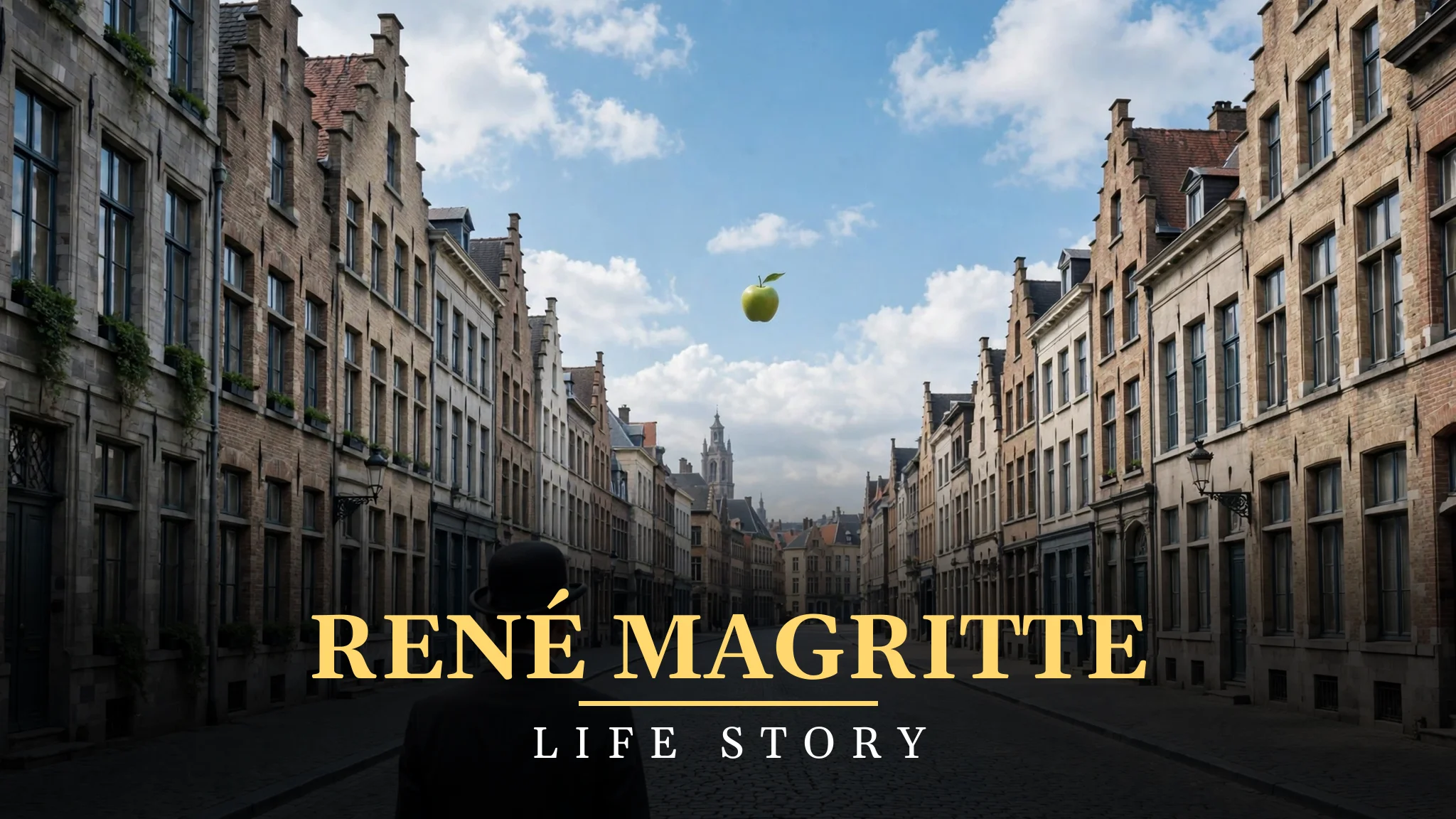
In 1964 Magritte painted The Son of Man, a self-portrait that shows a man in a dark suit and a bowler hat, standing in front of a low wall, with the sea and a cloudy sky behind him, and a green apple floating in front of his face, hiding it. The picture is one of the most famous self-portraits in modern art, and it is also one of the strangest, because the man in it cannot be seen. His face is hidden, his identity is hidden, and the viewer is left to wonder who he is. Magritte said that the picture was about the way we see the world, and about how we always want to see what is hidden, and how the hidden thing is often more interesting than the thing we can see.
The bowler hat had been in Magritte’s pictures for many years before The Son of Man. It was the hat of a middle-class Belgian man, the kind of hat his father might have worn, the kind of hat a man wears to work. Magritte used it as a sign, a way of saying that the man in the picture is ordinary, not a hero, not a king, not a saint. He is a man like any other, and the strangeness of the picture comes from the fact that an ordinary man is standing in front of a sea, with an apple in front of his face. That contrast, between the ordinary and the strange, is the heart of Magritte’s art.
The Son of Man was painted as a self-portrait, but Magritte did not paint his own face. He painted a man who could be anyone, and that is the point. He was not interested in showing what he looked like. He was interested in showing what it feels like to be a person whose face is hidden, whose thoughts are hidden, and who is always partly a mystery, even to himself. The picture has been used in films, in advertisements, and in popular culture, and it has become a symbol of mystery itself. People who have never heard of Magritte know the man with the apple, and they know that the apple is hiding something.
He painted other pictures with the same man, in the same hat, standing in different places, looking at different things, and each time the hat makes the man both familiar and strange. That is a clever trick, and it is also a deep one. Magritte believed that we all wear a kind of hat, a kind of mask, and that we all hide our faces, even when we think we are showing them. The bowler hat is not only a hat. It is a reminder that every person is a mystery, including the person looking in the mirror.
War, the Sunny Period, and a Quiet Return
The Second World War changed Magritte’s life and his work in a way that surprises people who only know his dark, mysterious pictures. When Belgium was occupied by Germany in 1940, Magritte and Georgette stayed in Brussels, and he found it hard to paint the dark, strange pictures he had painted before the war. He began to paint in a brighter style, using the colours of the French Impressionists, painting landscapes, seascapes, and nudes in a soft, sunny way. This period is often called his sunny period, or his Renoir period, because he was influenced by the painter Pierre-Auguste Renoir, and it lasted from about 1943 to 1947. The pictures from this time are cheerful, and they are very different from the work he is famous for, but they show a man who wanted to find light in a dark time.
After the war, Magritte returned to his old style, painting the bowler-hatted men, the floating rocks, and the impossible windows that made him famous. He also began to make sculptures, casting his most famous images, like the pipe and the apple, in bronze, so that they could stand in a square or a garden. He worked steadily, and his reputation grew. He had exhibitions in New York, in London, and in Paris, and his work was bought by museums and by collectors. He was no longer a young man painting at night after a day job. He was a famous artist, and he was respected around the world.
He also worked in advertising again in the 1950s, designing posters for companies, and he enjoyed the work, because it allowed him to use his clear style for a practical purpose. He did not see a difference between a painting and a poster, if both were made with care and with a good idea. That attitude, which came from his early years in advertising, stayed with him. He believed that art should be clear, and that a good idea is a good idea, whether it is on a canvas or on a poster in a shop window.
Magritte died on 15 August 1967 in Brussels, at the age of sixty-eight, after a long illness. He had been ill for some time, and he died at home, with Georgette beside him. His death was reported around the world, and his work has only grown in fame since. He left behind a large body of work, and a house in Brussels that is now a museum, where visitors can see the small rooms in which he painted, and the ordinary life that produced such extraordinary pictures.
Empire of Light and the Last Pictures
One of Magritte’s most loved pictures is Empire of Light, painted in several versions between 1949 and 1964, which shows a quiet street at night, with houses lit by lamps, and a bright blue sky with white clouds above. The picture is impossible, because it is day and night at the same time, and yet it feels calm, as if the impossible were normal. That is Magritte’s gift: he takes an impossible idea and paints it so clearly that the viewer accepts it, at least for a moment, and then wonders why it feels so strange. The picture is now in museums in Brussels, New York, and other cities, and it is one of his most reproduced works.
His last pictures continued the same themes: a man in a bowler hat, a window that opens onto a painting, a rock that floats, a bird that becomes a sky. He did not change his style in his last years, and he did not need to. He had found a language that worked, and he used it to say new things, even in his sixties. He painted slowly, and he thought carefully about each picture, and he often made several versions of the same idea, changing a detail, a colour, or a word, until the picture felt right. That patience is part of why his work feels so calm, even when the idea is strange.
Why Magritte Still Puzzles Us
Magritte’s work is now in museums around the world, and it is used in schools, in books, and in films to teach people about Surrealism, about language, and about the way pictures work. His green apple, his bowler hat, and his pipe have become part of popular culture, and they are recognised by people who have never been to a museum. That fame is a sign of how clear his pictures are, and how deep his ideas are. A picture that can be understood by a child and argued about by a philosopher is a rare thing, and Magritte made many such pictures.
His influence can be seen in advertising, in design, and in film, where directors use his images to show mystery and to make the viewer think. His work has also been used to talk about the difference between a picture and reality, a question that has become more important in a world full of photographs, videos, and images that can be faked. Magritte asked that question in 1929, with a pipe, and we are still asking it today, with every image we see on a screen. That is why his work still matters, and why it will keep mattering as long as people look at pictures and wonder what they mean.
My Take:
I think Magritte is the funniest serious painter I know, and I mean that as a compliment. He paints a pipe and writes underneath it that it is not a pipe, and for a moment I feel tricked, and then I feel clever for understanding the trick, and then I feel confused again, because the trick is also true. That feeling, of being tricked and then enlightened, is a rare pleasure, and Magritte gives it to me again and again. He does not paint to show off his skill. He paints to make me think, and I like a painter who respects my brain enough to give it a puzzle.
What I admire most is his clarity. He paints a bowler hat, a green apple, and a sea, and he paints them so clearly that a child could copy them. There is no rough brushwork, no blur, no hiding behind technique. The clarity is the point, because it makes the strangeness stand out. If he had painted the apple in a rough, messy way, I could say that the picture is strange because the paint is strange. But he paints it clearly, and so the strangeness must be in the idea, not in the paint. That is a brave choice, because it means the idea has to carry the whole picture, and Magritte’s ideas are strong enough to do that.
I also admire his ordinary life. He lived in a small house in Brussels, he painted in the morning, he walked his dog, and he went to bed early. He was not a wild artist who lived in chaos, and he did not need drama to make great art. He made great art from a quiet, orderly life, and that is encouraging to me, because most of us live quiet, orderly lives, and we often think that a quiet life cannot produce anything important. Magritte proves that it can. He took the ordinary things of his life, a hat, an apple, a window, and he turned them into pictures that the whole world knows. That is a lesson about looking closely at what is around you, not about waiting for a dramatic life to happen.
His advertising years are a part of his story that I think about a lot, because they show that a job that seems unimportant can teach you something important. He designed posters and advertisements, and he learned how to make a clear image that a person walking past a shop could understand in a second. That skill became the core of his painting. I think many people look down on commercial work, as if it were not real art, but Magritte shows that it can be a school, and a good one. He learned to be clear, he learned to be simple, and he learned to respect the viewer, and those are lessons that many fine artists never learn.
The story of his mother is one I want to handle carefully, because it has been told too often and too simply. His mother died when he was thirteen, and her body was found in a river, and many writers have said that his pictures of veiled faces come from that event. I do not think that is fair, and I do not think it is true in the simple way it is often told. Magritte himself rarely spoke about his mother, and he did not explain his pictures by her death. I think we should respect his silence, and we should not turn a sad family event into a simple explanation for a lifetime of art. His pictures came from many things: from books, from films, from advertising, from his wife, from his friends, and from his own thinking. To reduce them to one event is to make his art smaller than it is.
I love The Son of Man, but I also find it a little sad. The man in the picture is wearing a suit and a bowler hat, and he is standing in front of a sea, and his face is hidden by an apple. I look at that picture and I think about how often I hide my own face, not with an apple, but with politeness, with silence, with a smile that does not mean what I feel. Magritte paints that hiding, and he makes it visible, and that is a kind of honesty. He is saying that we all hide, and that the hiding is part of who we are. I find that both sad and comforting, because it means I am not alone in hiding, and that the man in the picture, who could be anyone, is also me.
The sunny period during the war is another part of his story that moves me. When Belgium was occupied, Magritte stopped painting dark, mysterious pictures and began to paint bright, sunny landscapes in the style of Renoir. Some critics have said that this was a mistake, or a step backwards, but I do not think so. I think it was a human response to a dark time. He wanted light, and he painted light. That is not a failure of art. It is a sign that art is made by a person, and that a person in wartime needs light as much as anyone else. I respect him for painting what he needed, not what the art world expected him to paint.
I also think about his wife Georgette, and about how much of his work depended on her. She was his model, his helper, and his first critic, and she lived with him in that small house for more than forty years. That kind of partnership is often invisible in stories of great artists, but it matters. Magritte was not a lone genius. He was a man with a wife who believed in him, who sat for his pictures, and who kept the house running while he painted. I think we should remember Georgette, and the many partners like her, who make art possible by doing the ordinary work that allows the extraordinary work to happen.
Empire of Light is the picture I would show to someone who has never seen a Magritte, because it is the calmest and the strangest at the same time. A street at night, with lamps lit, and a blue sky with clouds above, day and night together, and yet the picture feels peaceful. I look at it and I feel as if I am dreaming, but a calm dream, not a frightening one. That calm is rare in Surrealism, which is often loud and shocking, and it is one of the reasons I love Magritte. He does not shout. He whispers, and the whisper stays with me longer than a shout would.
I do not think every Magritte is perfect, and I do not think his work is all equal. Some of the pictures feel like jokes that only work once, and some of the word pictures feel clever rather than deep. I say that because I think it is important to be honest, even about an artist I admire. His best work, The Treachery of Images, The Son of Man, and Empire of Light, is so strong that it does not need every picture to be a masterpiece. The peaks are high enough, and the ideas in those peaks are enough to carry his name.
What I take from his life is a lesson about looking and about thinking. Magritte looked at a pipe and saw that it was not a pipe. He looked at a man and saw that his face was hidden. He looked at a street and saw that it could be day and night at the same time. He did not accept what his eyes told him at first glance. He stopped, he thought, and he painted what he thought. That is a useful habit, not only for looking at art, but for looking at the world. How many things do we accept at first glance, without stopping to think? Magritte reminds me to stop, to look again, and to ask whether the thing I see is really the thing I think it is.
I also think about how his work has become part of popular culture, on posters, on mugs, on book covers, and I have mixed feelings about that. On the one hand, it is good that so many people know his apple and his hat, and that a child can recognise them. On the other hand, it is sad that a picture about mystery has become a decoration, because the mystery is the point, and a decoration does not ask you to think. I hope that when people see a Magritte on a mug, they stop for a moment and wonder what it means, and that the mug becomes a starting point, not an ending point. Magritte would have liked that, I think, because he loved a picture that made people think, even if it was on a mug.
If I could ask Magritte one question, I would ask him what he saw when he looked out of his window in Brussels. I think he would say that he saw a street, a sky, and a man in a bowler hat, and that he saw that the street was both day and night, and that the man was both there and not there. That is a way of seeing the world that I want to keep. A window is not only a window. It is a picture, waiting. A pipe is not only a pipe. It is a question, waiting. A life is not only a list of dates and jobs. It is a mystery, waiting to be looked at carefully, and Magritte spent his life looking carefully, and painting what he saw.
In the end, I think Magritte teaches me that ordinary things are not ordinary, and that a hat, an apple, and a pipe can be enough to make great art, if you look at them with a clear eye and a curious mind. He did not need a grand subject, he did not need a dramatic life, and he did not need to shout. He needed a small house, a wife who believed in him, a clear style, and a good idea, and he had all of those. I hope the reader looks at his pictures again, not as posters, but as puzzles, and takes the time to solve them, or to enjoy not solving them. That is what Magritte wanted, I think: not an answer, but a question, asked clearly, and left open for the viewer to think about.
I also want to say something about Belgium, and about how Magritte’s work belongs to a small country that is often overlooked. He was Belgian, he lived in Brussels, and he painted in French, in a country that is divided by language and by history. His work is not French, and it is not Dutch. It is Belgian, in the sense that it is quiet, clear, and a little strange, and that it comes from a place that is used to being in between. I like that, because it reminds me that great art does not only come from Paris or New York. It can come from a small house in Brussels, from a man who paints in the morning and walks his dog in the afternoon, and who leaves behind pictures that the whole world still puzzles over.
I also think about his time in advertising, and about how it taught him to respect the viewer. A poster has to be understood in a second, by a person walking past a shop, and Magritte learned that lesson, and he used it in his paintings, making them clear, simple, and easy to see, even when the idea was strange. That respect for the viewer is rare in modern art, where many painters seem to want to confuse the audience, or to make them feel stupid. Magritte did the opposite. He made his pictures clear, and he invited the viewer in, and he trusted them to think. I am grateful for that trust, because it makes looking at his work a pleasure, not a test.
There is a lesson in his quiet life that I want to keep, about how a person can be famous and still live simply. He lived in a small house, he painted in the morning, he walked his dog, and he went to bed early, and he did that even when he was famous, even when his pictures were selling for large sums. He did not buy a palace, he did not become a celebrity, and he did not change his habits. That steadiness is admirable, because fame can change a person, and it often does, making them restless, and unhappy. Magritte stayed steady, and his work stayed steady, and that is a good way to live, I think: to keep your habits, to keep your home, and to let the work speak, while you live quietly.
I think about the word “surreal” and about how Magritte’s work is often called surreal, even though it is painted so clearly that it does not look like a dream. A dream is blurry, and strange, and hard to remember, but a Magritte is clear, and sharp, and easy to remember. That is the paradox of his work, and it is why I love it. He paints a clear picture of an impossible thing, and the clarity makes the impossibility feel real, at least for a moment. I look at Empire of Light, with its day sky and its night street, and I believe it, for a moment, and then I realise it cannot be true, and that moment of belief, followed by doubt, is the pleasure of his work. He gives me a clear picture, and then he takes it away, and I am left thinking.
Finally, I want to say something about his wife Georgette, and about how she sat for his pictures, and how she was his first reader. She saw his work before anyone else, and she told him what she thought, and that kind of honest feedback, from a person you trust, is invaluable for an artist. I think about the people in my own life who give me honest feedback, and I am grateful to them, because without them, I would not know when my work is good, and when it is not. Magritte had Georgette, and she helped him, for more than forty years, and his pictures are better because of her. That is a partnership I admire, and one I want to remember.
Frequently Asked Questions
What does “Ceci n’est pas une pipe” mean?
The words under Magritte’s pipe mean “This is not a pipe” in French. Magritte was pointing out that the picture is a painting of a pipe, not a real pipe, and that we should not confuse an image with the real thing.
Who is the man with the bowler hat and the green apple?
The man is in The Son of Man, painted in 1964, which is a self-portrait by Magritte. He wears a dark suit and a bowler hat, stands before the sea, and a green apple floats in front of his face, hiding it.
When was René Magritte born?
René Magritte was born on 21 November 1898 in Lessines, Belgium. He studied in Brussels, worked in advertising, and became one of the leading Surrealist painters.
What is Empire of Light by Magritte?
Empire of Light is a series of paintings from 1949 to 1964 showing a quiet street at night with lamps lit, under a bright blue daytime sky. It shows day and night at the same time, which is impossible in real life.
Why did Magritte paint in a bright style during the war?
During the Second World War, when Belgium was occupied, Magritte painted brighter, sunnier pictures influenced by Renoir, in what is called his sunny period. He later returned to his darker, mysterious style after the war.
Where is Magritte’s house now?
Magritte lived for most of his life in a small house in Brussels with his wife Georgette. The house is now the René Magritte Museum, where visitors can see the rooms in which he lived and painted.


