Renny Harlin: The Life Story Behind Finland's Hollywood Director
In this post
Renny Harlin is a director who loves big action. His films are about men hanging from cliffs, about planes in danger, about sharks in a laboratory, about heroes who run, jump, and fight their way out of trouble. He made Die Hard 2, about a policeman trying to save an airport, Cliffhanger, about a mountain climber trying to save people in the snow, The Long Kiss Goodnight, about a woman who discovers she was a spy, and Deep Blue Sea, about sharks that become too clever. His films are loud, fast, and fun, and they have been watched by millions of people around the world.
He was born in Riihimäki, a small town in Finland, and he grew up in a home where film mattered. He made short films as a teenager, he studied at university, and he came to Hollywood with almost nothing, with a dream of making big American films. He did it, and he became one of the most successful Finnish directors in Hollywood, a man who directed some of the biggest action films of the 1990s. That journey shaped him, and it is why his story is so inspiring.
What makes his story worth telling is the energy in it. He did not wait for permission to make films. He made them, he sold them, he went to Hollywood, and he worked his way up, one film at a time, until he was directing stars like Sylvester Stallone, Bruce Willis, and Samuel L. Jackson. This is the story of a Finnish boy who became a Hollywood action director, by being bold, by being hardworking, and by never giving up.
A Childhood in Riihimäki
Renny Harlin was born on 15 March 1959 in Riihimäki, Finland. His birth name was Renny Lauri Mauritz Harjola, and he later changed his last name to Harlin. Riihimäki is a small town in the south of Finland, known for its railway, its glass factory, and its quiet streets. Renny grew up there with his family, and his childhood was full of school, of the outdoors, and of the Finnish landscape. His father was a doctor, his mother was a nurse, and the family lived a simple, honest life.
As a child, Renny was energetic and restless. He liked to watch films, he liked to make up stories, and he liked to think about how a film could make you feel excited. He was not a quiet child who sat and read all day. He was a child who wanted to move, to run, to climb, and to see what he could do. He loved American films, especially action films, and he dreamed of making films like the ones he saw on the screen, films with car chases, with explosions, and with heroes who saved the day.
When he was a teenager, he began to make short films of his own, using a camera and friends as actors. He made films about action, about adventure, and about the things he loved. He was not yet a professional, but he was learning, and he was having fun. He also studied at the University of Helsinki, where he studied literature and film, and he worked in the Finnish film industry, learning how films were made, and how to sell them. He was a young man with a dream, and he was willing to work hard to make it come true.
His family supported him, but they also wanted him to have a stable life. They encouraged him to study, to think about his future, and to make his own choices. That support gave him confidence, and it also gave him a sense of balance that would help him later, when he went to Hollywood and the work became harder and the pressure became greater. He was a Finnish boy with an American dream, and he was ready to chase it.
Short Films, Finland and the First Features
Renny began his film career in Finland, making short films and working in the Finnish film industry. He directed a short film called Born American in 1986, which was his first feature film, about a group of American tourists in Finland who get into trouble. The film was a low-budget action film, and it was a success in Finland, but it was also controversial, because it showed violence and because it was made with American actors in Finland. Renny was twenty-seven years old, and he had made a film that was unlike anything in Finnish cinema, a film that was bold, loud, and American in style.
He went on to make other films in Finland, and he began to build a reputation as a director who could make action films, who could work with a small budget, and who could make a film that was exciting to watch. He was not interested in making quiet, artistic films like many other Finnish directors. He wanted to make films that were fun, that were fast, and that made audiences sit on the edge of their seats. That choice set him apart, and it is why he was noticed by people in Hollywood.
In the late 1980s, Renny moved to the United States, to Los Angeles, with almost nothing, with a dream of making Hollywood films. He did not have a job, he did not have a studio behind him, and he did not have a lot of money. He had a reel of his work, a lot of energy, and a belief in himself. He showed his films to producers, he met people, and he worked hard to get a chance. It was a difficult time, but he did not give up. He kept going, kept meeting people, and kept believing that he could make it in Hollywood.
His big break came when he was offered the chance to direct A Nightmare on Elm Street 4: The Dream Master in 1988, a horror film in the popular series about Freddy Krueger. The film was a success, it made a lot of money, and it showed that Renny could direct a Hollywood film, with American actors, on a Hollywood budget, and make it work. He was twenty-nine years old, and he was now a Hollywood director. He had come a long way from Riihimäki, and he had done it by being bold and by working hard.
A Nightmare on Elm Street and the Hollywood Break
A Nightmare on Elm Street 4: The Dream Master, released in 1988, was Renny’s first Hollywood film, and it was a turning point in his career. The film was part of a popular horror series, about a killer named Freddy Krueger who haunts teenagers in their dreams. Renny directed it with energy, with style, and with a sense of fun, and the film became the highest-grossing film in the series at that time. It showed that he could handle a big production, that he could work with a studio, and that he could deliver a film that audiences loved.
After Elm Street, Renny was offered more Hollywood films, and he began to work with bigger stars and bigger budgets. He directed The Adventures of Ford Fairlane in 1990, a comedy with Andrew Dice Clay, and then he was offered Die Hard 2 in 1990, one of the biggest action films of the year, with Bruce Willis as John McClane, a policeman who must save an airport from terrorists on Christmas Eve. Die Hard 2 was a huge success, it made a lot of money, and it made Renny one of the most in-demand action directors in Hollywood. He was thirty-one years old, and he was directing the biggest films in the world.
Die Hard 2 was a hard film to make, with a large cast, with stunts, with explosions, and with a tight schedule, but Renny handled it with confidence and with skill. He had learned how to direct action, how to work with stunt performers, how to make a scene exciting, and how to keep the audience engaged. He was a director who loved action, and it showed in his work. He was not afraid of big scenes, of danger, or of hard work. He embraced them, and he made films that were thrilling to watch.
His success in Hollywood was a remarkable achievement for a Finnish director. He had come from a small town in Finland, with no connections in Hollywood, and he had become one of the most successful action directors of his time. He was proud of that, and he often talked about Finland, about its culture, and about the way it shaped him. He was a Finnish director who worked in Hollywood, not a director who had left Finland behind. He carried his Finnish roots with him, even in the biggest Hollywood productions.
Cliffhanger, The Long Kiss Goodnight and Peak Action
In 1993, Renny directed Cliffhanger, a film with Sylvester Stallone as Gabe Walker, a mountain climber in the Rocky Mountains who must save people after a plane crash, and who discovers that the crash was part of a robbery. The film was shot in the Italian Alps, with real mountains, real snow, and real danger, and it became one of the most famous action films of the 1990s. It was a huge success, it made a lot of money, and it was praised for its stunts, its scenery, and its excitement. Renny had made a film that was both thrilling and beautiful, and it became a classic of the action genre.
He went on to direct The Long Kiss Goodnight in 1996, a film with Geena Davis as Samantha Caine, a woman who has lost her memory and who discovers that she was once a spy, and Samuel L. Jackson as a private detective who helps her. The film was a stylish and fun action film, with a strong female lead, and it was praised for its energy and its humour. It was not as successful at the box office as Cliffhanger, but it became a cult film, loved by fans who appreciated its boldness and its originality. Renny had shown that he could make an action film with a woman at its centre, and that he could do it with style and with heart.
He also directed Cutthroat Island in 1995, a pirate film with Geena Davis, which was a famous failure at the box office, one of the biggest flops in Hollywood history, and which bankrupted the studio that made it. Renny has talked about that film with honesty, saying that it was a hard experience, that he learned a great deal from it, and that it taught him about the risks of making big films. He did not hide from the failure. He faced it, and he kept going. That honesty is a big part of who he is, and it is why his story is so interesting.
In 1999, he directed Deep Blue Sea, a film about a group of scientists in an underwater laboratory who make sharks smarter, and who must fight for their lives when the sharks escape. The film was a success, it was fun, it was scary, and it was loved by audiences. It showed that Renny could make a film about sharks, about science, and about survival, and make it exciting. He was still one of the most in-demand action directors in Hollywood, and he was still making films that audiences loved.
Later Films, China and a Long Career
After Deep Blue Sea, Renny continued to work in Hollywood, directing films like Driven in 2001, about car racing, with Sylvester Stallone, and The Covenant in 2006, a film about young men with supernatural powers, and Cleaner in 2007, a film with Samuel L. Jackson. He also directed films in other countries, including 12 Rounds in 2009, and The Legend of Hercules in 2014, a film about the Greek hero. He was working in many genres, in many countries, and with many different kinds of actors, and he was doing it with the same energy and the same love of action that he had brought to his first films.
In the 2010s, Renny began to work in China, directing films like Skiptrace in 2016, with Jackie Chan, a comedy action film about a detective and a gambler who travel across China, and Legend of the Ancient Sword in 2018, a fantasy film based on a Chinese video game. He was becoming an international director, working in Hollywood, in Finland, and in China, and he was learning about new cultures, new audiences, and new ways of making films. That willingness to move, to learn, and to adapt is one of the reasons his career has lasted for so long.
He also returned to Finland to make films, including a film about the Finnish war hero, and he has continued to work in his home country, supporting Finnish cinema and helping young Finnish directors. He is proud of Finland, and he often talks about it, about its nature, about its people, and about the way it shaped him. He is a Finnish director who works in the world, not a director who has left Finland behind. He carries his Finnish roots with him, even in the biggest productions in China and in Hollywood.
In recent years, he has continued to direct films, including The Misfits in 2021, and The Strangers trilogy, a series of horror films released in 2024 and 2025, about a couple who are terrorised by strangers in a remote house. He is now in his sixties, and he is still working, still learning, and still choosing projects that interest him. His career is a model of longevity, of energy, and of a director who loves action and who never stops.
A Finnish Director in Hollywood
Renny Harlin’s story is, in the end, a story about dreams. He dreamed of making big American action films, and he did it. He dreamed of working with stars like Sylvester Stallone and Bruce Willis, and he did it. He dreamed of directing films that would be watched by millions of people, and he did it. That is a remarkable achievement, and it is why his story is so inspiring. He shows that a boy from a small town in Finland can go to Hollywood and make it, if he is bold, if he works hard, and if he never gives up.
He has won awards in Finland, and he has been recognised as one of the most successful Finnish directors in history. He is respected by directors and by actors around the world, for his energy, for his skill, and for his love of action. But he does not talk much about awards. He talks about the work, about the stunts, about the actors, and about the joy of making a film that excites an audience. That focus on the work, rather than on the prizes, is a big part of who he is.
He lives in Finland and in America, and he moves between the two with ease. He is a Finnish director who works in the world, and he is proud of that. He is also a father, a husband, and a man who values his family and his simple life. He gives interviews when he has a new film, he talks about his work with passion and with humour, and then he goes home to his family and his life. That balance is important to him, and it is one of the reasons his films feel so full of life.
As he moves into his sixties, Renny is still a working director, still choosing projects, still learning. His story is not finished, and his fans wait with hope for whatever he does next. He is a director, a dreamer, and a man who came from a small town in Finland and conquered Hollywood, and his story is one of the most inspiring in European film. He shows that a big dream, pursued with energy and with courage, can come true.
Driven, The Covenant and Working With Stars
After Deep Blue Sea, Renny Harlin continued to direct big films in Hollywood. In 2001, he directed Driven, a film about car racing, with Sylvester Stallone as a veteran driver who comes out of retirement to help a young driver. The film was full of speed, of crashes, and of excitement, and it showed Renny’s love of action and his skill at filming it. He knew how to make a car chase feel thrilling, how to use the camera to capture speed, and how to keep the audience on the edge of their seats. It was a film that was made for people who love racing, and it was loved by them.
In 2006, he directed The Covenant, a film about four young men at a boarding school who have supernatural powers, and who must fight an evil force. The film was a thriller, with young actors, and it was a success with teenage audiences. It showed that Renny could work with young stars, in a new genre, and make a film that was fun and exciting. He was not stuck in one kind of action film. He could make a racing film, a pirate film, a shark film, and a supernatural thriller, and make them all feel like his films, with his energy and his style.
He also directed Cleaner in 2007, a film with Samuel L. Jackson as a man who cleans up crime scenes, and who discovers a secret that puts his life in danger. The film was a thriller, and it showed Renny’s ability to work with a great actor like Samuel L. Jackson, and to tell a story that was both exciting and thoughtful. He was becoming a director who could work in many genres, with many kinds of actors, and who could bring his love of action to each one. That versatility is rare, and it is one of the reasons his career has lasted for so long.
He has worked with some of the biggest stars in Hollywood, including Bruce Willis, Sylvester Stallone, Geena Davis, Samuel L. Jackson, and Jackie Chan, and he has earned their respect for his professionalism, his energy, and his skill. Actors like working with him, because he is clear about what he wants, because he is prepared, and because he creates a fun atmosphere on set. That reputation is a big part of his success, and it is why studios keep hiring him, even after more than thirty years in Hollywood.
My Take:
When I think about Renny Harlin, the first thing I feel is excitement. His films are not quiet or slow. They are loud, fast, and full of action, and they make me sit on the edge of my seat. When I watch Cliffhanger, I feel like I am hanging from a cliff myself, with the wind in my face and the snow below me. When I watch Die Hard 2, I feel like I am in an airport on Christmas Eve, with terrorists everywhere and a policeman trying to save the day. That excitement is a gift, and it is why I admire him. He makes films that are fun, and fun is important. Not every film has to be serious. Some films should just be thrilling, and Renny knows how to make a thrilling film.
I admire his journey most of all, because it starts with a boy in a small town in Finland who loved American action films, and who dreamed of making them himself. He did not have connections in Hollywood. He did not have a lot of money. He had a camera, a lot of energy, and a belief in himself. He made short films, he went to Los Angeles, he showed his work to producers, and he kept going until someone gave him a chance. That is a lesson for all of us. You do not need to be born in Hollywood to make it in Hollywood. You need to work hard, to be bold, and to never give up. Renny did that, and I respect him for it.
What moves me about Cliffhanger is the way it shows the beauty of the mountains. The film was shot in the Italian Alps, with real snow, real cliffs, and real danger, and it is one of the most beautiful action films I have ever seen. Renny did not just film the action. He filmed the landscape, the light, the snow, and he made the mountains a character in the film. That is a sign of a director who loves the world, who sees beauty even in a dangerous place, and who wants the audience to see it too. I think about that when I watch his films, and I feel grateful for the beauty he shows me, even in the middle of a chase.
I also think about Cutthroat Island, and how honest Renny has been about its failure. It was one of the biggest flops in Hollywood history, and it bankrupted a studio. Many directors would hide from that, would pretend it did not happen, or would blame someone else. Renny did not do that. He talked about it, he said he learned from it, and he kept going. That takes courage, and it is a lesson for all of us. Failure is painful, but it is not final. You can learn from it, you can work your way out of it, and you can come back stronger. Renny did that, and his story gives me hope when I fail at something.
I love the way he works with stars. He directed Sylvester Stallone in Cliffhanger, Bruce Willis in Die Hard 2, Geena Davis in The Long Kiss Goodnight, and Samuel L. Jackson in Deep Blue Sea, and he did it with a respect for the actors and for the audience. He did not try to make himself the star. He let the actors be the stars, and he focused on making a good film. That is a kind of humility that is rare in Hollywood, where many directors want to be famous themselves. Renny wants the film to be famous, not himself, and I respect that.
If I have a sadness in his story, it is that action directors are not always given the respect they deserve. People talk about art films, about serious dramas, and they sometimes look down on action films as if they are not real cinema. I think that is unfair, because making a good action film is very hard. It requires skill, timing, courage, and a deep understanding of how to excite an audience. Renny is a master of that, and he deserves more credit than he sometimes gets. I hope that more people learn to appreciate action films as art, and to see the skill in what Renny does.
I also learn from him that energy matters. His films are full of energy, and that energy comes from him, from his love of film, from his excitement about action. When I watch his films, I feel that energy, and it makes me feel alive. That is a valuable thing in a world that can feel slow and boring. Renny reminds me to be energetic, to be bold, and to chase what I love, even if it seems impossible. That is a lesson I want to carry with me.
For a young reader, I think the lesson from Renny is simple: dream big, work hard, and do not be afraid of action. He dreamed of Hollywood, and he went there, and he made it. He did not wait for permission. He made films, he sold them, and he kept going. If you have a big dream, do not wait. Start where you are, with what you have, and keep going. That is what Renny did, and it is why his story is so inspiring. A boy from Riihimäki became a Hollywood director, and that tells me that anyone, from anywhere, can achieve a big dream.
In the end, I think Renny Harlin is a reminder that cinema can be fun. It can be thrilling, it can be exciting, and it can make you feel alive. His films do that, and I am grateful for them. I hope he keeps making them for many years to come, in Hollywood, in Finland, in China, and wherever his dreams take him. The world needs more directors like him, directors who love action, who love audiences, and who never give up. When I watch his films, I do not just see a story. I see a man who loves his work, and who does it with all his heart and all his energy.
I also think about his work in China, and how it shows his willingness to learn. He directed Skiptrace with Jackie Chan, a comedy action film, and Legend of the Ancient Sword, a fantasy film based on a Chinese video game, and he did it in a country where he did not speak the language, where the culture was different, and where the film industry worked in a different way. That takes courage, and it takes a willingness to be a beginner again, even when you are a famous director. Renny did it, and he learned from it, and he came back a better director. I respect that, because many people are afraid to be beginners. They want to stay where they are comfortable. Renny is not afraid to be uncomfortable, and that is why his career has lasted so long.
There is another side to him that I want to mention, and that is his love of Finland. He often talks about Riihimäki, about its railway, about its glass factory, and about the way it shaped him. He is proud of being Finnish, and he carries that pride with him, even in Hollywood. He has returned to Finland to make films, he has supported Finnish cinema, and he has helped young Finnish directors. That loyalty to his home is a beautiful thing, and it is one that I admire. He did not forget where he came from, even when he became famous in Hollywood. He kept his roots, and he kept coming back to them.
I also think about the stunts in his films, and how much skill they require. Cliffhanger was filmed in the Italian Alps, with real mountains, real snow, and real danger, and the stunts were performed by real people, risking their lives to make the film exciting. Renny respects those stunt performers, and he works closely with them, making sure they are safe, and making sure the audience feels the danger without anyone getting hurt. That respect for the people who do the dangerous work is a sign of a good director, and it is one that many people do not see. He sees it, and he honours it, and I respect him for that.
I think about the young filmmakers who look at Renny and see a role model. They see a boy from a small town in Finland who loved American action films, who made short films, who went to Los Angeles, and who became a Hollywood director. That story tells them that they do not have to be born in Hollywood to make it there. They can come from anywhere, they can work hard, and they can achieve a big dream. I hope those young filmmakers remember that, and I hope they keep going when they face hard times. Renny did, and his story proves that it is possible.
I also want to say something about his energy, because it is contagious. When I watch his interviews, I see a man who is excited about film, who loves to talk about action, about stunts, about stars, and about the joy of making a movie. That excitement is infectious, and it makes me feel excited too. In a world where many people are tired and cynical, Renny is energetic and enthusiastic, and that is a gift. He reminds me to be enthusiastic about the things I love, to chase them with energy, and to never lose that excitement, no matter how old I get.
I also think about the way he has adapted to new kinds of film, from horror to action to fantasy, and how he has done it without losing his energy. He directed The Strangers trilogy in his sixties, a series of horror films about a couple terrorised by strangers, and he did it with the same excitement he brought to Die Hard 2 in his thirties. That is remarkable, because many directors slow down, or repeat themselves, or lose their passion. Renny has not lost his passion. He is still excited, still energetic, and still eager to make the next film. That enthusiasm is a gift, and it is one that I hope he keeps for many years to come, because the world needs more directors who love their work as much as he does.
I also think about the way he has kept his sense of fun, even after more than thirty years in Hollywood. He still talks about action films with the excitement of a teenager in Riihimäki, still laughs about stunts, still dreams about the next big scene. That joy is rare, and it is one that many people lose as they get older and more successful. Renny has not lost it. He is still the boy who loved American action films, and he is still making them, with the same energy and the same smile. I hope he keeps that joy, because it is what makes his films feel alive, and it is what makes audiences love them.
I also think about the way he has worked with stunt performers, the men and women who risk their lives to make his films exciting. He respects them, he listens to them, and he makes sure they are safe, even when the scene looks dangerous. That respect is a sign of a good director, and it is one that many people do not see. The stunts in Cliffhanger, in Die Hard 2, and in Deep Blue Sea were performed by real people, and Renny honours their work by filming it well and by giving them credit. I respect him for that, because a film is made by many people, not just by the stars, and the people who do the dangerous work deserve to be recognised.
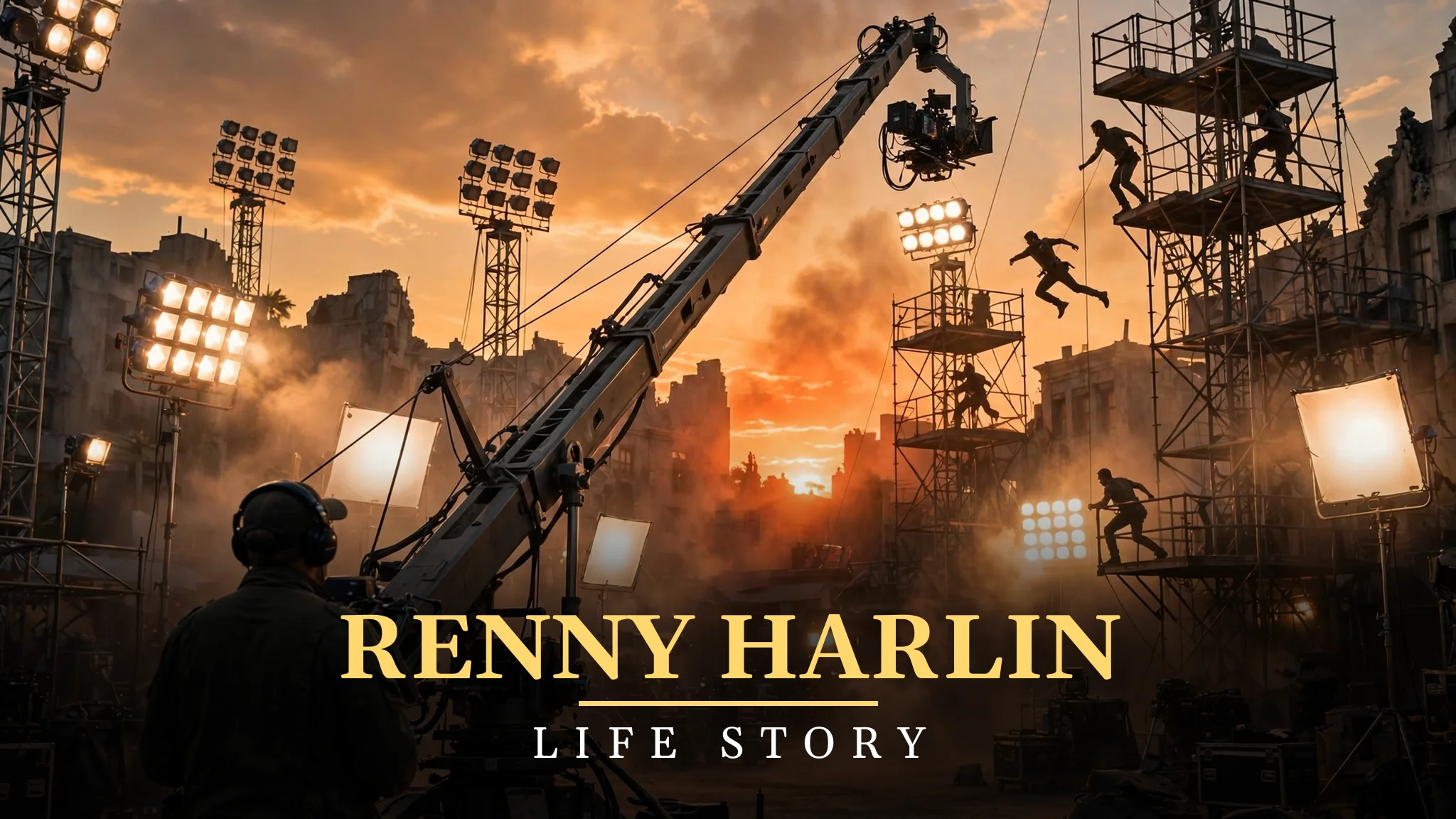
One more thought stays with me. I think about the action set in the image, with its camera crane, its bright lights, and its stunt performers in the air at sunset, and how it fits Renny. His films are like that set: big, bright, full of people working together, and full of danger and excitement. But they are also beautiful, like the sunset behind the set, and they make you want to watch. I hope he keeps building those sets, keeps filming those stunts, and keeps showing the world what Finnish energy can do in Hollywood. He is a director, but he is also a dreamer, and that is the best kind of director.
Frequently Asked Questions
Where was Renny Harlin born and how old is he?
Renny Harlin was born Renny Lauri Mauritz Harjola on 15 March 1959 in Riihimaki, Finland, which makes him 67 years old in 2026. He grew up in Riihimaki, studied at the University of Helsinki, and moved to Los Angeles in the late 1980s.
What is Renny Harlin most famous for?
He is most famous for directing Die Hard 2 in 1990, Cliffhanger in 1993, The Long Kiss Goodnight in 1996, and Deep Blue Sea in 1999. These are some of the biggest action films of the 1990s, with stars like Bruce Willis, Sylvester Stallone, and Samuel L. Jackson.
What was Renny Harlin’s first Hollywood film?
His first Hollywood film was A Nightmare on Elm Street 4: The Dream Master in 1988, which became the highest-grossing film in the series at that time. It showed he could direct a Hollywood production and opened the door to Die Hard 2.
What is Cliffhanger about?
Cliffhanger, released in 1993, is about Gabe Walker, a mountain climber played by Sylvester Stallone, who must save people after a plane crash in the Rocky Mountains and discovers the crash was part of a robbery. It was filmed in the Italian Alps.
What happened with Cutthroat Island?
Cutthroat Island, released in 1995, was a pirate film with Geena Davis that became one of the biggest box office failures in Hollywood history and bankrupted the studio that made it. Renny has talked honestly about learning from the experience and keeping going.
Has Renny Harlin worked in China?
Yes, he has directed films in China, including Skiptrace in 2016 with Jackie Chan, a comedy action film, and Legend of the Ancient Sword in 2018, a fantasy film based on a Chinese video game. He works in Hollywood, Finland, and China.
Is Renny Harlin still directing?
Yes, he is still directing in his sixties, including The Misfits in 2021 and The Strangers trilogy, a series of horror films released in 2024 and 2025. He continues to choose action and thriller projects in many countries.


