Ricardo Arjona: The Life Story Behind Guatemala's Beloved Songwriter
In this post
- A Boy From Jocotenango
- Teacher, Basketball Player, and a Dream of Music
- Jesus, Verbo No Sustantivo and the First Breakthrough
- Historia de Taxi, Mujeres, and the Peak Years
- El Problema, Minutos, and a Songwriter at His Peak
- Fuiste Tu, Metamorfosis, and Independence
- The Poet of Latin Music and His Legacy
- My Take:
Ricardo Arjona is one of the greatest songwriters in the Spanish-speaking world, and his songs are like short stories set to music. He writes about taxi drivers, about women, about love, about his country, and about the small moments of ordinary life, and he does it with words that are poetic, clever, and full of feeling. Millions of people across Latin America know his songs by heart, and they sing them as if the stories were their own.
He was born in Jocotenango, a small town in Guatemala, and he grew up as a teacher and a basketball player before he became a singer. He moved to Mexico with little money, he sang in small bars, and he waited for years before the world heard his voice. When success came, it came because his words were true, and because his stories spoke to people who had lived them.
What makes his story worth telling is the way he turned everyday life into poetry. He did not sing about fame or about luxury. He sang about a taxi ride, about a woman at a window, about a love that ended, and about a country that he missed. This is the story of how a teacher from Guatemala became one of the most loved songwriters in Latin music, and how he did it with words alone.
His concerts today are a world away from the small bars where he began, and yet the heart of the show has not changed. He still stands on stage with his guitar, he still tells stories, and he still watches the crowd the way he watched the small crowds at those early shows. The stages are bigger, the lights are brighter, and the crowds are larger, but the feeling is the same, and that is why his fans keep coming back to hear him tell his stories.
A Boy From Jocotenango
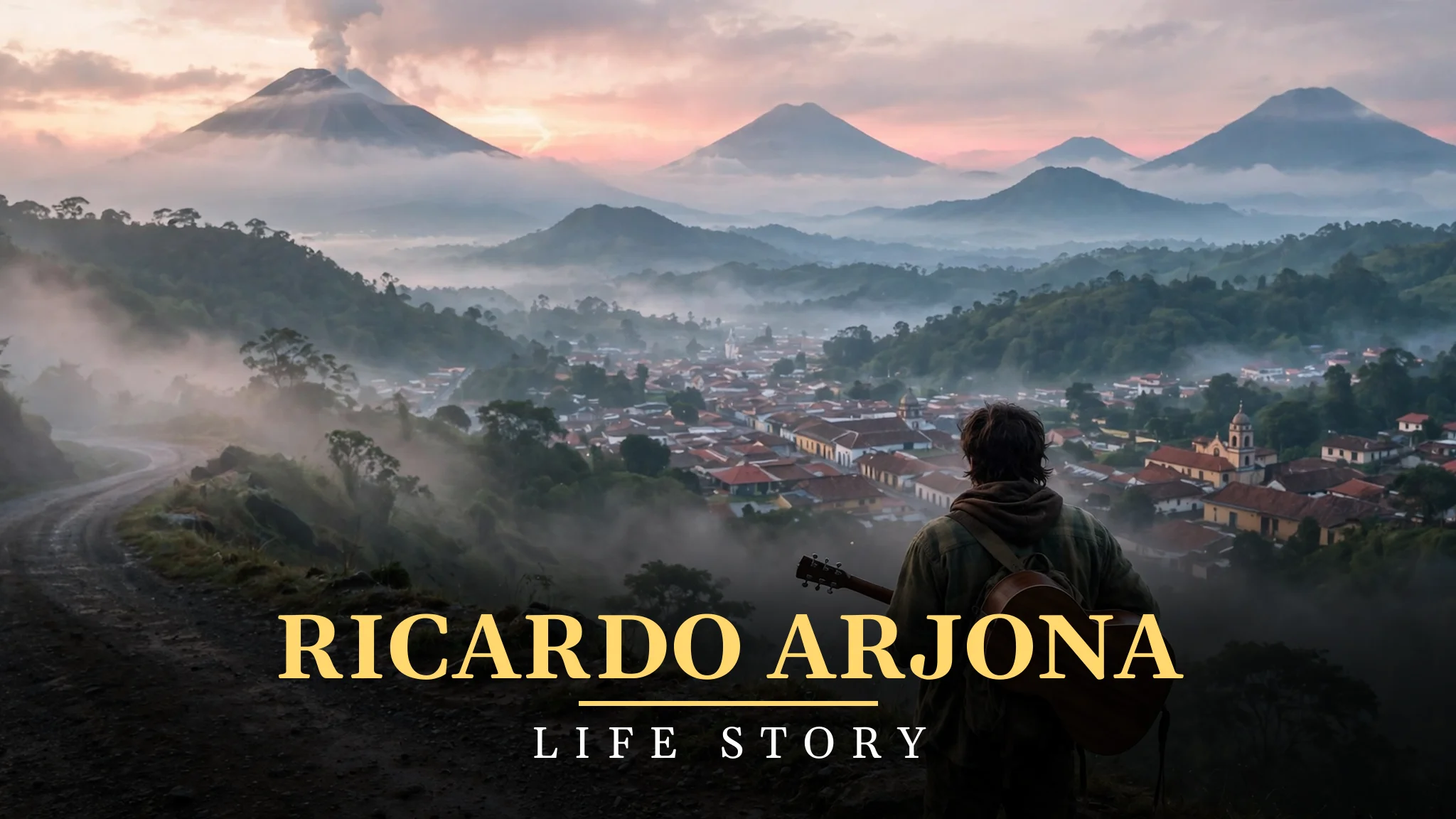
Edgar Ricardo Arjona Morales was born on 19 January 1964 in Jocotenango, a small town in the department of Sacatepequez, near the old colonial city of Antigua, in Guatemala. Jocotenango is a quiet town, surrounded by volcanoes and green hills, and life there is simple and close to the land. Ricardo grew up in that world, and music was part of his daily life from the time he was a small child.
His father was a teacher, and his mother worked at home, and the family valued learning, books, and hard work. Ricardo grew up with books around him, and he learned to love words, to read, and to write. He was a good student, and he loved to learn, but music was always in his heart, and he sang at home, at school, and at family parties.
As a boy, he was tall, athletic, and full of energy, and he loved basketball. He played for his school, and later for the national team of Guatemala, and he dreamed of a life in sports. But music kept pulling him back, and he wrote songs, he played the guitar, and he sang for anyone who would listen. His voice was not the loudest, but his words were special, and people who heard him knew that he was a writer as much as a singer.
Jocotenango also taught him about the life of ordinary Guatemalan people. He saw families working hard, mothers raising children on small incomes, and young people dreaming of a better life. Those sights stayed with him, and they gave his songs a sense of reality. When he sang about love, about work, and about his country, he was singing about the world he grew up in.
The town in those years was full of music, and Ricardo heard it everywhere. There were guitars playing at festivals, there were radios playing songs in the shops, and there were parties where people danced late into the night. That world gave him a sense of who he was, and it shaped the songwriter he would become.
He also learned to work hard, because life in a small town is not easy, and a boy must learn to stand up for himself. Ricardo learned that lesson early, and it stayed with him. When he later faced the hard parts of the music business, he remembered where he came from, and he kept going.
Teacher, Basketball Player, and a Dream of Music
As a young man, Ricardo became a schoolteacher, following in his father’s footsteps, and he taught children in Guatemala. Teaching gave him a steady job, and it gave him a way to serve his community, but his heart was in music, and he kept writing songs, playing the guitar, and dreaming of a life on stage.
He also played basketball at a high level, and he was a member of the Guatemalan national basketball team. He was tall, strong, and disciplined, and he loved the game, but he knew that basketball was not his future. Music was his future, and he could feel it pulling him away from the classroom and from the court, toward a life that was uncertain but true to who he was.
He began to sing in small bars and at local events, and he recorded his first songs. His first album, Dejame Decir Que Te Amo, was released in 1985, but it did not make him famous. He was still unknown, and he had little money, but he had a voice, a guitar, and a notebook full of songs, and he kept going.
He decided to move to Mexico, because Mexico was the centre of Latin music, and he believed that his songs could find an audience there. The move was hard, and he arrived with little money, but he had his guitar and his dreams, and he sang wherever he could, in bars, in small clubs, and on the street.
Those years in Mexico were not easy, and there were many days when the dream felt far away. But Ricardo kept writing, kept singing, and kept believing in his words. He knew that a songwriter is made in the hard years, when nobody is listening, and he used those years to learn his craft, to sharpen his words, and to become the writer he was meant to be.
He also learned the value of patience in those years, because a career in music does not come in a week. He sang when nobody was listening, he wrote when nobody was reading, and he kept going because the music itself gave him joy. That patience is one of the reasons his career has lasted for so long.
Jesus, Verbo No Sustantivo and the First Breakthrough
In 1988, Ricardo Arjona released the album Jesus, Verbo No Sustantivo, and the title song became his first major hit. The song was bold, because it talked about religion in a way that was honest and questioning, and it showed that Arjona was not afraid to write about hard subjects. The song was played on the radio across Latin America, and people began to know his name.
The album also showed his style, because his songs were like stories, with characters, with dialogue, and with a twist at the end. He wrote about ordinary people, about their loves, their pains, and their dreams, and he did it with words that were poetic and clever. That style became his signature, and it is one of the reasons his fans love him.
The breakthrough was not easy, and there were still many hard days ahead, but Arjona had found his voice, and he knew what he wanted to say. He kept writing, kept recording, and kept touring, and his audience grew with every album.
He also learned to trust his own judgement, because a songwriter who listens to everyone will lose his own voice. Arjona listened to his fans, he listened to his producers, but he kept his own words at the centre. That trust in himself is one of the reasons his songs sound like no one else’s, and it is one of the reasons his fans trust him. He was no longer an unknown singer from Guatemala. He was a songwriter with something to say, and Latin America was listening.
He also began to work with better producers, and he learned how to record his songs with a fuller sound. He kept his words at the centre, but he added arrangements that made the songs richer, and that helped them reach a wider audience. Those lessons made his later albums stronger, because he knew how to build a record around a story.
The years after the breakthrough were years of growth, and Arjona used them to write more, to travel more, and to learn more about the world. He sang in many countries, he met his fans, and he learned that his songs spoke to people in many different places, because the feelings in them were the same everywhere.
He also learned how to handle fame, because a singer who writes honest songs will always face criticism, and Arjona faced it with courage. He did not change his words to please the critics. He kept writing what he believed, and his fans respected him for it.
Historia de Taxi, Mujeres, and the Peak Years
In 1994, Ricardo Arjona released the album Historias, and it included the song Historia de Taxi, one of his most famous works. The song tells the story of a taxi driver who picks up a woman late at night, and the two of them talk, and the story ends with a twist that surprises the listener. The song became a hit across Latin America, and it showed Arjona at his best, as a storyteller who could turn a taxi ride into poetry.
The album also included Senora de las Cuatro Decadas, a song about a woman in her forties, and it became another hit. The song was tender, respectful, and full of feeling, and it showed that Arjona could write about women with a depth and a care that few songwriters could match. His fans loved him for that, because he sang about women as real people, not as objects.
He also released the song Mujeres, a song that celebrates women in all their forms, and it became one of his most loved works. The song is playful, clever, and full of admiration, and it is still sung at concerts today. Arjona’s songs about women are famous, and they have made him one of the most respected songwriters in Latin music.
His albums sold in large numbers, and he toured across Latin America, the United States, and Europe. His concerts filled stadiums and arenas, and his fans sang every word. A Ricardo Arjona concert is a night of stories, of poetry, and of songs that speak to the heart, and his fans come to listen, not only to dance.
He also won awards, including a Grammy Award and Latin Grammy Awards, and those honours showed that the music world took him seriously, not only as a popular singer, but as a real artist. He was at the peak of his career, and he was one of the most famous songwriters in the Spanish-speaking world.
He also became a voice for Guatemala, because his songs spoke about his country with love and with honesty. He sang about its volcanoes, its towns, and its people, and he carried Guatemala with him to every stage. That pride made his fans in Guatemala love him more, because they saw their own country in his songs.
The peak years also brought him wealth, and he used it to take care of his family and to build a better life. He has spoken about the importance of family, and about the debt he owes to his parents, who worked hard to give their children a better life. He never forgot that, and he stayed close to his family even as his fame grew.
El Problema, Minutos, and a Songwriter at His Peak
In the years that followed, Arjona released more hits, including El Problema, a song about a love that has become a problem, and Minutos, a song about time and about the moments that matter. These songs were played on the radio, at concerts, and in homes across Latin America, and they showed that Arjona could write about any subject and make it feel true.
His album Adentro, released in 2005, won a Grammy Award for Best Latin Pop Album, and it was one of the highest honours of his career. The album showed his growth as an artist, because it was more mature, more reflective, and more personal than his earlier work. He was no longer only a storyteller. He was a man writing about his own life, his own loves, and his own country.
He also released the album 5to Piso in 2008, and Poquita Ropa in 2010, and each one added to his fame. His songs were still poetic, still clever, and still full of feeling, and his fans loved him for that consistency. He did not chase fashion, and he did not change his style to please the radio. He wrote what he believed, and the world followed him.
During those years, he also worked with other major artists, and he recorded duets and collaborations that brought his music to new audiences. He sang with stars from many different styles, and each collaboration showed a new side of his voice. He was not afraid to try new things, and that openness kept his work fresh.
He also became a symbol of Guatemalan pride, because he had taken the music of his country and carried it to the world. In Guatemala, people saw him as a hero, and in Latin America, people saw him as one of the great songwriters of their time. That double love is a rare thing, and it is one of the reasons his career has lasted so long.
The years at his peak also taught him about the pressure of fame, because a singer who writes honest songs will always face criticism, and Arjona faced it with courage. He did not change his words, and he did not apologise for his stories. He kept writing, and his fans respected him for it.
Fuiste Tu, Metamorfosis, and Independence
In 2011, Arjona released the album Independiente, and it included the song Fuiste Tu, a duet with the Guatemalan singer Gaby Moreno. The song was a beautiful, tender ballad about a love that changed a life, and it became one of his most loved works. The two voices together, Arjona’s deep voice and Moreno’s sweet voice, made the song feel like a conversation between two people who had loved and lost.
The album was also important because Arjona released it on his own label, Metamorfosis, which he had founded. He had decided to take control of his own career, to make his own records, and to sell them on his own terms. That decision showed his independence, and it showed that he was not only a singer. He was also a businessman who understood the value of his work.
He has continued to release albums on his own label, including Viaje in 2014, Circo Soledad in 2017, and Blanco y Negro in 2020. Each album has shown a new side of his writing, and each one has been loved by his fans. He has kept his words at the centre, and he has kept his independence, and that is why his career has lasted.
He has also toured the world, performing for crowds that sing every word. His concerts are still full of fans who have grown up with his songs, and who bring their children to hear them. A Ricardo Arjona concert is a place where generations meet, and where stories are shared in song.
He has also used his fame to help others, and he has spoken about the importance of education, of reading, and of believing in yourself. He was a teacher, and he has never forgotten that, and he wants young people in Guatemala to have a chance to learn, to read, and to dream.
Today, Ricardo Arjona stands as one of the greatest songwriters in Latin music. He took the stories of ordinary life, he turned them into poetry, and he shared them with the world. His story is still being written, and his fans are waiting to see what he will write next.
The Poet of Latin Music and His Legacy
Ricardo Arjona’s legacy is easy to see, because his songs are still sung across Latin America, at concerts, in homes, and on the radio. Historia de Taxi, Mujeres, Fuiste Tu, El Problema, and his other hits are now classics, and young singers still learn them, cover them, and play them. A song that is sung by a new generation becomes part of a country’s history, and Arjona’s songs have become part of Latin America’s history.
His legacy is also in the way he writes. He showed that a song can be a story, that a lyric can be poetry, and that a singer can be a writer. He opened the door for many songwriters who came after him, and they have said so in interviews. A writer who opens a door for others leaves a mark that is bigger than his own hits.
He has also shown that a singer from a small country can become a world star, and that a voice from Guatemala can be heard in every Spanish-speaking country. That is a powerful message for young people in Guatemala and in other small countries. Your birthplace does not decide your future. Your words do.
His words, his stories, and his honesty are the heart of his legacy. He writes with feeling, he tells the truth, and he respects his listeners, and his fans love him for all of it. He is not only a singer. He is a poet, a teacher, and a voice for the people of Latin America.
The story of Ricardo Arjona is, in the end, a story about a teacher from Jocotenango who became a poet of Latin music, who turned everyday life into songs, and who shared them with the world. That is a beautiful story, and it is one that will be told for a long time.
My Take:
When I think about Ricardo Arjona, the first thing that comes to my mind is his words, because he is a writer first and a singer second, and his words are like poetry. He writes about a taxi driver, about a woman at a window, about a love that ended, and he does it with a care that few songwriters can match. I admire that, because in a world of simple songs, Arjona writes songs that make you think, and that is a rare gift.
I admire his voice, because it is deep, warm, and full of feeling, and it carries his words with a weight that makes them matter. He does not sing loudly, and he does not show off. He sings as if he is telling a story to a friend, and that makes his songs feel personal. When I hear Historia de Taxi, I feel as if I am sitting in the taxi with the driver, listening to his story, and that is the mark of a great storyteller.
I also admire his past as a teacher, because it shows in his songs. A teacher knows how to explain, how to tell a story, and how to make a listener understand, and Arjona does all of that in his music. He was a teacher before he was a star, and he has never forgotten that, and his songs teach as well as they entertain.
What I find most interesting about him is the way he writes about women. His songs about women are famous, and they are tender, respectful, and full of admiration. He writes about a woman in her forties, about a mother, about a lover, and he does it with a depth that few male singers can match. I think that is a beautiful thing, because it shows that a man can sing about women with respect, and that respect is part of his art.
I think about Historia de Taxi, because that song is a perfect example of what Arjona does best. It is a story with a beginning, a middle, and a twist at the end, and it turns an ordinary taxi ride into a moment of poetry. I think that is a wonderful thing, because it shows that poetry is not only in books. It is in the street, in a taxi, and in the life of ordinary people, if a writer knows how to see it.
I also think about his independence, because he founded his own label, Metamorfosis, and he took control of his own career. That takes courage, because a singer who leaves a big record company must build his own road. Arjona did that, and he proved that an artist can be independent and still be successful. I respect that, because it shows that he values his art more than his comfort.
There is something I keep returning to, and it is his country, Guatemala. He is proud of Guatemala, and he sings about it, and he carries it with him wherever he goes. In a world where many stars forget their roots, Arjona remembers his, and he honours the small town of Jocotenango in his songs and in his life. That is a beautiful thing, and it is one of the reasons his fans love him.
I think about the young people in Guatemala who watch Arjona and see themselves. A teacher from a small town became a world star, and that tells them that they can dream big too. They do not need to be rich, and they do not need to be famous to start. They need words, a guitar, and a dream, and Arjona shows them that those things are enough.
If I have a criticism, it is a small one. I sometimes wish Arjona would sing more simply, because his words are sometimes so clever that they are hard to understand. His fans love his poetry, but a simpler song can also be beautiful, and I think he could reach even more people if he sometimes wrote with fewer words. He has the talent to do both, and I hope he tries it.
I also think about the way he handles fame, because he is a private man, and he does not seek the spotlight. He lets his songs speak for him, and he keeps his family close. I think that is a wise choice, because fame is a loud world, and a writer needs quiet to write. Arjona protects his quiet, and his songs are better for it.
What can a reader learn from Ricardo Arjona? I think the lesson is about words. He shows that words matter, that a song can be a story, and that a story can change the way a person sees the world. That is a lesson for anyone who writes, who sings, or who simply loves to read. Words are not only for talking. They are for telling the truth, and Arjona tells the truth with his.
I also learn from him that ordinary life is worth singing about. He does not sing about fame or about luxury. He sings about a taxi, about a woman, about a love that ended, and about a country that he misses. That is a lesson for all of us. The small moments of life are the ones that matter, and a writer who sees them can turn them into art.
I think about his future, because he is still writing, still singing, and still bringing his stories to his fans. He has written for decades, he has won the highest honours, and he is still loved. I hope he keeps writing for many more years, because the world needs his words.
I think about the listeners, because Arjona’s songs fill quiet rooms in a way that few other songs can. When his music comes on, people do not dance wildly. They listen, they think, and they feel, and for a few minutes, the whole room becomes one story. That is a gift, and Arjona gives it every time he sings.
I also think about the way his music makes people feel at home, even when they are far from home. A Guatemalan living in the United States or in Mexico can hear an Arjona song and feel close to the volcanoes, to the town, and to the language of home. That is a powerful thing, because music can carry a person home in a way that nothing else can.
When I listen to Ricardo Arjona now, I hear a man who writes with feeling, who sings with heart, and who loves his country with all his soul. I hear Jocotenango, I hear Guatemala, and I hear the sound of a poet who turned everyday life into songs. That is why his fans love him, and that is why I think his story matters.
I also think about the way he plays basketball, because it shows that a person can have many talents, and that a life can have many chapters. He was a teacher, a basketball player, and a singer, and he did all of those things well. That is a reminder that a person is not only one thing, and that a life can be rich in many ways.
I think about the duet Fuiste Tu, because it is a song about a love that changed a life, and it is one of the most beautiful songs in Latin music. When Arjona and Gaby Moreno sing together, it feels like a conversation between two people who have loved and lost, and that is a feeling that everyone knows. That is why the song is loved, and that is why it will be sung for many years.
I also think about the way his songs are passed down, because a father who listened to Arjona as a young man now plays Arjona for his own children, and the children listen too. That is how a legacy is built, not in a year, but in a generation, and Arjona has built a legacy that will last for many generations.
Finally, I think his story is a reminder that words are powerful. He took a taxi ride, he turned it into a song, and the song became a classic. That is a beautiful story, and it is one that will be told for a long time.
I think about the volcanoes of Guatemala, because they stand behind Arjona’s story like silent witnesses. He grew up in their shadow, and he carries them in his songs. A singer who grows up near volcanoes learns that the earth is strong and alive, and Arjona’s songs are strong and alive in the same way.
I also think about the classroom, because Arjona was a teacher, and a teacher learns to listen to children, to understand their dreams, and to help them grow. Those lessons stayed with him, and they made him a songwriter who listens to his fans and who writes for them, not only for himself.
I think about the basketball court, because it taught him discipline, teamwork, and the value of practice. A basketball player must train every day, must work with a team, and must keep going when the game is hard. Arjona carried those lessons into music, and they made him a stronger artist.
I also think about Mexico, because it was there that Arjona learned to be a professional singer. He arrived with little money, he sang in small bars, and he waited for his chance. Those years were hard, but they taught him patience, and patience is a lesson that many young singers never learn.
I think about the song Mujeres, because it is a celebration of women, and it shows that Arjona respects women deeply. He writes about them with admiration, with humour, and with love, and his fans love him for that. In a music world where women are often treated as objects, Arjona treats them as people, and that matters.
I also think about the way his songs are used in everyday life, because an Arjona song is played at weddings, at dinners, and in cars, and it becomes part of the memory of those moments. A song that is played at a happy moment becomes part of that happiness, and Arjona’s songs have become part of many happy memories.
I think about the future of Latin songwriting, because Arjona is one of the writers who will decide where it goes next. He has shown that a song can be a story, that a lyric can be poetry, and that a singer can be a writer. The young songwriters who follow him will build on what he did.
Finally, I think about the man himself, standing on a stage with his guitar, telling a story about a taxi driver, with a crowd listening quietly before him, and I think that is a beautiful picture. A teacher from Jocotenango became a poet of Latin music, and he did it with words alone.
When I look at the whole of his career, I see a man who started as a teacher, who played basketball, who sang in small bars, and who became one of the greatest songwriters in the Spanish-speaking world. He did it with words, with stories, and with a heart that never forgot Guatemala, and that is a story worth telling, because it proves that a teacher with a guitar and a notebook full of songs can change the way a whole continent hears its own life, and that words, when they are true, can travel further than any voice alone.
I will keep listening to his songs, because they remind me that everyday life is full of poetry, that a taxi ride can be a story, and that a teacher from a small town can become a voice for millions of people, and that his stories will keep being sung for many years, by fans who hear in his words the sound of their own lives.
Frequently Asked Questions
Where was Ricardo Arjona born? Ricardo Arjona was born as Edgar Ricardo Arjona Morales on 19 January 1964 in Jocotenango, in the department of Sacatepequez, in Guatemala, near the city of Antigua.
What is Ricardo Arjona’s most famous song? His most famous songs include Historia de Taxi, Mujeres, Senora de las Cuatro Decadas, El Problema, and Fuiste Tu with Gaby Moreno. Historia de Taxi is one of his signature songs.
Was Ricardo Arjona a teacher and a basketball player? Yes, before he became a singer, Ricardo Arjona worked as a schoolteacher in Guatemala, and he played basketball for the Guatemalan national team.
Has Ricardo Arjona won a Grammy? Yes, Ricardo Arjona has won a Grammy Award for Best Latin Pop Album for Adentro, and he has also won Latin Grammy Awards for his songwriting and his albums.
What is Metamorfosis? Metamorfosis is the independent record label that Ricardo Arjona founded. He has released his albums on his own label since Independiente in 2011.
Is Ricardo Arjona still performing? Yes, Ricardo Arjona is still performing and recording. He tours across Latin America, the United States, and Europe, and his concerts are still full of fans who sing every word.


