Richard Griffiths: The Life Story Behind the Beloved Character Actor
In this post
Richard Griffiths filled a stage the way a good fire fills a room, with warmth first and noise second. He was a large man, and he knew it, and he used his size the way a clever actor uses anything: as a tool, not as a joke. He could be terrifying, as Uncle Vernon in the Harry Potter films, and he could be tender, as Hector the teacher in The History Boys, and the distance between those two men was the measure of his talent. Audiences loved him because he never seemed to be acting at them. He seemed to be living in front of them, and inviting them to live there too.
He was born in Thornaby-on-Tees, in the north-east of England, on 31 July 1947, and his childhood was unlike almost any other actor’s. Both of his parents were deaf. His father was a steelworker, his mother kept the house, and the family communicated in sign language. Richard learned to sign before he learned to speak properly, and he grew up translating the hearing world for his parents and the silent world for everyone else. He learned to watch faces, to read hands, and to understand what people meant when their words did not quite match their feelings.
That early life gave him two things that no drama school can teach. The first was an understanding of people who are different, and a refusal to treat difference as a joke. The second was a physical expressiveness, a sense that the body speaks as clearly as the voice, and that an actor who can use both is twice as powerful. He carried those lessons into every part he played. When he played a bully, you could see the fear underneath. When he played a kind man, you could see the effort it cost him to stay kind.
He trained at the Manchester Polytechnic School of Theatre, and he worked his way through the repertory system, playing in theatres across the country, learning his trade in front of audiences who would tell him, loudly, if he was not good enough. He was good enough. He built a stage career that other actors envied, and then, in his forties, he became a film actor too, and then, in his fifties, he became famous to children all over the world as the worst uncle in literature. He did all of it without ever losing the warmth that had made him a stage favourite, and without ever forgetting the silent house in Thornaby where he had learned to listen with his eyes.
Growing Up in a Silent House
Thornaby-on-Tees sits on the River Tees, in a part of England that made steel and ships and not much fuss about either. The Griffiths house was a working-class house, and it was a quiet one, not because the family had nothing to say, but because two of its three members could not hear. Richard’s parents, both deaf from birth, used British Sign Language, and their son became their bridge to the hearing world. He answered the door, he made telephone calls for them, he translated conversations in shops and at the doctor’s surgery, and he did it from the age when most children are still learning to tie their shoes.
It was a responsibility, and it was also an education. A child who translates for his parents learns to watch people with unusual care. He learns that a raised eyebrow means one thing and a tightened mouth means another, and that the truth of a conversation is often in the hands and the face rather than in the words. Griffiths later said that this was where his acting began, in the business of watching and understanding, and it is easy to believe him. His performances are full of small physical details, a hand that hesitates, a head that tilts, a body that leans in before the voice follows.
He also learned, early, that deafness is not a lack. His parents were capable, funny, and stubborn, and they ran their lives without apology. He grew up with no patience for people who pitied them, and no patience for jokes at their expense. That respect for difference stayed with him, and it shaped the way he played characters who were outsiders, or difficult, or simply larger than the room allowed. He never played a man as a caricature. He played him as a person, with reasons.
School in Thornaby was ordinary, and Griffiths was not, at first, an obvious candidate for the stage. He was big, he was loud, and he was funny, and teachers noticed that he could hold a room. He began acting in school and in youth theatre, and he found that the stage was a place where his size and his voice were advantages rather than problems. He applied to drama school, and he was accepted at Manchester Polytechnic, where he trained in the late 1960s and learned the craft properly: voice, movement, text, and the discipline of working in a company.
Manchester, Repertory, and Learning the Trade
Drama school in Manchester suited Griffiths. The city was working-class, plain-spoken, and unimpressed by London manners, and he fitted in. He trained hard, and he left with a clear sense of what kind of actor he wanted to be: a company actor, one who made the whole play better, not a star who needed the play to serve him. That attitude would define his career, and it would make him one of the most popular colleagues in the profession.
He worked in repertory theatre, the system in which a company of actors performs a different play every few weeks, learning lines at speed and playing to audiences who know the plays well. It is the hardest school in British acting, and it is the best one, because it teaches an actor to be ready for anything. Griffiths played in theatres in the north and the Midlands, taking the parts that came, and he learned how to play comedy and tragedy in the same week, sometimes on the same day.
He moved to London and worked with the Royal Shakespeare Company and the National Theatre, and he built a reputation as a reliable, inventive character actor, one who could take a small part and make it the part the audience remembered. Directors liked him because he was prepared, because he listened, and because he never tried to steal a scene that did not belong to him. Actors liked him because he was generous, because he gave them room, and because he made the work fun.
His early stage work included seasons with the Royal Shakespeare Company and the National Theatre, and it established him as a serious stage actor, not just a funny one. He could play authority, he could play menace, and he could play vulnerability, and he could move between them in a single scene. The stage was his first home, and it remained his home even when the films came, and he returned to it whenever he could, because it was where he felt most like himself.
Uncle Monty and the Cult of Withnail
In 1987, Griffiths played Uncle Monty in Withnail and I, Bruce Robinson’s black comedy about two out-of-work actors in 1969 London who go to the country for a weekend and find that the country does not want them. Monty is a large, flamboyant, wealthy homosexual who invites the two young men to his cottage and then makes an unwanted advance on one of them, and Griffiths played him with a mixture of charm, menace, and sadness that made the character unforgettable.
The film was not a hit when it opened. It found its audience slowly, on video and on late-night television, and it became a cult classic, quoted by students and actors for decades. Monty’s lines are still repeated, and Griffiths’s performance is still studied, because it shows how to play a character who is funny and frightening at the same time, without ever making him a joke. Monty is ridiculous, and he is also lonely, and Griffiths let the audience see both, which is why the performance lasts.
The part also showed something important about Griffiths: he was not afraid of playing a character the audience might dislike. He trusted the writing, he trusted his own instincts, and he played Monty as a person, not as a type. That trust is what made the performance work, and it is what made directors want him for the difficult parts, the ones that other actors turned down because they were too big, too odd, or too uncomfortable.
He had already appeared in films by then, including Gandhi in 1982, in which he played a small part, and Chariots of Fire in 1981, and The French Lieutenant’s Woman in the same year, and Ragtime in 1981. These were not starring roles, and they were not meant to be. They were the work of a character actor building a film career, one good part at a time, and Griffiths was content with that. He liked being part of a strong cast, and he liked the variety, and he was in no hurry to be famous.
Pie in the Sky and a Television Favourite
In 1994, Griffiths took the leading role in Pie in the Sky, a BBC television series in which he played Henry Crabbe, a police detective who wants to retire and run a restaurant, and who keeps being dragged back into solving crimes. The series ran for five seasons, until 1997, and it made him a familiar face in millions of homes. Crabbe is a gentle man, a good cook, and a reluctant detective, and Griffiths played him with a warmth that made the show feel like a visit from a friend.
The part suited him because it let him be funny and kind at the same time, and because it was built around his size and his presence rather than in spite of them. Crabbe is a large man who loves food, and the show never pretended otherwise, and Griffiths never apologised for it. He cooked on screen, he ate on screen, and he solved crimes between courses, and the audience loved him for it. It was a reminder that a leading man does not have to look like a film star. He has to look like a person, and Griffiths looked like a person.
He worked steadily on television through the 1990s, in dramas and comedies, and he built a reputation as an actor who could carry a series without ever making it about himself. He was a professional, he knew his lines, he was kind to the crew, and he made the work better for everyone around him. That reputation matters more in television than any award, because a series runs for months, and a difficult actor can ruin it. Griffiths was the opposite of difficult, and producers knew it.
He also appeared in films through the decade, in small and large parts, and he kept working on stage, because the stage was where he recharged. A television series can be exhausting, and a film can be boring, with long waits between scenes, but a play is alive every night, and Griffiths needed that aliveness. He would finish a television job and go straight back to the theatre, and he would be happier there than anywhere else. He played in productions in London and in the regions, and he was known for arriving early, for knowing his lines, and for helping the younger actors in the company, who often said that working with him was the best training they ever had. He gave his time freely, and he gave it without making a fuss about it, which is the kind of generosity that actors remember for the rest of their lives.
Hector, The History Boys, and the Highest Honours
In 2004, Griffiths played Hector in The History Boys, Alan Bennett’s play about a group of bright sixth-form boys in Sheffield in the 1980s and the teachers who try, in very different ways, to get them into Oxford and Cambridge. Hector is a teacher of French and English who loves poetry, who loves his boys, and who is also a flawed man, with a habit of touching his pupils that the play does not excuse. It is one of the most difficult parts in modern British theatre, and Griffiths played it with a tenderness and an honesty that made audiences love a man they could not entirely approve of.
The play was a triumph. It opened at the National Theatre, it transferred to Broadway, and Griffiths won the Laurence Olivier Award for Best Actor in London and the Tony Award for Best Actor in New York. He also won the Drama Desk Award, and the production was celebrated as one of the great stage events of the decade. The film version followed in 2006, with Griffiths repeating the role, and it brought Hector to a wider audience, who found the same warmth and the same complexity on screen.
What made the performance so powerful was the way Griffiths played Hector’s love of learning. Hector believes that education is not about passing exams, but about carrying poetry and history with you for the rest of your life, and Griffiths made that belief feel real, not sentimental. He spoke the lines as if he had lived them, and the boys in the play, and the audience in the theatre, believed him. It was the performance of his life, and he knew it, and he played it with a generosity that made the whole company better.
He was fifty-seven when he played Hector, and the awards came late in his career, which made them sweeter. He had spent decades being the reliable character actor, the man who made other people look good, and now he was the centre of the play, and he was magnificent in it. The History Boys is now remembered as one of the great British plays of its time, and Griffiths’s Hector is the reason why.
Uncle Vernon and Five Films of Harry Potter
In 2001, Griffiths was cast as Vernon Dursley in Harry Potter and the Philosopher’s Stone, the first of the Harry Potter films, and he played the part in five of the eight films, appearing in 2001, 2002, 2004, 2007, and 2010. Vernon is Harry’s uncle, a large, blustering, cruel man who keeps Harry in a cupboard under the stairs and who treats magic as an embarrassment to be locked away. It is a part that could easily become a cartoon, and Griffiths played it as a man, not as a monster.
Vernon is frightened, and Griffiths let the audience see the fear. He is a man who has built his life around being normal, around a neat house, a good job, and a son who is just like him, and Harry threatens all of it, simply by existing. Griffiths played that threat with a bluster that was funny and with a meanness that was real, and children who watched the films understood Vernon at once: he was the adult who did not listen, who did not care, and who was always wrong.
The films made him famous to a generation of children who had never seen The History Boys or Withnail and I, and he took the fame lightly. He knew that Vernon was a small part in a large story, and he played it as such, giving the young actors room and giving the audience exactly what the story needed. He was kind to the children on set, and they remembered it, and Daniel Radcliffe spoke warmly about him in later years, as did the other young actors who worked with him.
He also knew that Vernon would be the part he was remembered for by many people, and he did not mind. He had played Hector, he had played Monty, and he had played Crabbe, and Vernon was another part, another person, another chance to do the work well. That was how he saw it, and that was how he played it, with total commitment and with no vanity at all.
A Marriage, a Generous Heart, and the End
Griffiths was married to the actress Heather Gibson from 1980 until his death in 2013, a marriage of thirty-three years that was built on a shared love of theatre and a shared understanding of the actor’s life. They had no children, and they lived quietly, in London and in the countryside, and they worked together when they could. Heather was a constant presence in his life, and he spoke about her with a warmth that was rare for a man who guarded his privacy.
He was known, among actors, for his generosity. He helped younger actors, he gave his time to students, and he was famous for a moment in a theatre when a mobile phone rang during a performance and he stopped the play to deal with it, because he believed that an audience owed the actors its attention. The story is told and retold, and it says something true about him: he took the work seriously, and he expected other people to take it seriously too, and he was not afraid to say so.
He died on 28 March 2013, at the age of sixty-five, after complications following heart surgery, and the tributes that followed were full of the same words: kind, generous, funny, and brilliant. Alan Bennett wrote about him with affection, and Daniel Radcliffe spoke about how much he had learned from him, and the theatre world mourned a man who had been, for decades, one of its most reliable and most loved figures.
What he left behind is a body of work that is unusually wide and unusually warm. A flamboyant uncle in a cult film, a gentle detective who loved to cook, a teacher who loved poetry, and a cruel uncle in a children’s film: the parts have little in common except the man who played them, and the kindness he brought to each one. He grew up in a silent house, and he spent his life making himself heard, not by shouting, but by listening, by watching, and by giving every character he played the dignity of being a person. That is a rare gift, and it is why he is still missed.
My Take:
When I think about Richard Griffiths, the first thing I feel is warmth, because he was the kind of actor who made me feel safe when he appeared on screen. I have watched many actors who try to impress me with big gestures and loud speeches, and I have forgotten most of them. Griffiths did the opposite. He was large, he was funny, and he was kind, and he let the character speak for itself. When I see him as Hector in The History Boys, I feel as if I know that teacher, and I trust him. That trust is hard to earn, and Griffiths earned it in every scene he played.
I think his performance as Hector is one of the greatest things ever seen on the British stage, and I feel sad that many people will never see it. A stage performance happens once, in a room, with real people breathing the same air as the actors, and Griffiths’ Hector was the kind of work that stays in a person’s memory for years. I wish more people had seen him live on stage, because then they would grasp why fellow actors spoke of him with such respect. His screen work is wonderful, but his stage work is where his craft was made.
I admire the way he played Uncle Vernon in Harry Potter, because it would have been easy to make Vernon a simple villain. Griffiths did not do that. He played him as a man who is afraid of what he does not understand, and who tries to control Harry because he is afraid of magic. I watched those films and I felt that Vernon was a real person, not just a character in a book. He shouts, he is rude, and he is foolish, yet you can see the fear underneath, and that makes him human. That is what a great actor does.
I also think about his childhood with deaf parents, and I admire how that experience shaped him. He learned sign language as a child, he learned how to communicate without words, and he learned how to watch faces and understand feelings from a look. I think that gave him a special sensitivity that other actors do not have. He understood that people express themselves in many ways, and he brought that understanding to every role he played. That gift came from his family, and it gave his work a depth and honesty it would not otherwise have had.
What moves me most in his story is his generosity to young actors. He helped them, he shared stories, and he made them feel valued, even when they were nervous or unsure. I think that is a rare and beautiful quality, because many famous actors are too busy to help others. Griffiths was not. He took time for young people, and he taught them by example how to be a professional. I think that kind of teaching is more important than any award, because it passes the craft on to the next generation.
I also think about his role as Uncle Monty in Withnail and I, and I smile when I remember it. He plays a large and flamboyant man who invites two actors to his cottage, and the film is funny because he plays it with such honesty. He does not try too hard to be funny. He just is funny, because he understands the character and the situation. I think that is the best kind of comedy, the kind that comes from truth, and Griffiths was a master of it.
I think about his marriage to Heather Gibson, and I admire the quiet strength of their partnership. They were married for more than thirty years, and they shared a love of the theatre and a love of each other. I think that is a beautiful story, because it shows that love does not need a big show. It needs patience, kindness, and a willingness to stay. Griffiths stayed, and Heather stayed, and that is a kind of love that I admire deeply.
I also think about his size, and how he never let it define him. He was a large man, and directors often cast him as a large character, but he played kings, teachers, fathers, and villains, and each time he made the character feel like a real person. I think that is an important lesson for anyone who feels different because of how they look. You do not need to hide who you are. You can use who you are to make your work stronger, and Griffiths did that better than almost anyone.
I think his story teaches us about the value of the theatre, and about the value of working in a company. He learned his craft at RADA and at the National Theatre, and he learned how to work with other actors as part of a team. I hope young actors look at his career and understand that the theatre is the best school for an actor, and that playing many different roles in a company can teach you more than any single film role.
I also feel that his work in Gandhi and in Chariots of Fire is underrated, and I wish more people would watch those early films. He played small parts with warmth and humour, and he showed that a good film needs good actors in every part, not just in the leading roles. I think that is a generous kind of acting, and it is one that I respect. He did not need to be the star. He was happy to make the film better by being in it.
When I look back at his later work, I see a performer who never stopped developing. He played in Hugo, in Episodes, and in other productions when he was in his sixties, and he was still able to surprise an audience. I think that is a hopeful message for older people, because it shows that life does not end at sixty. It can keep growing richer and more interesting, if you go on learning and go on working.
I think about his death in 2013, and I feel sad that we have lost such a great actor. He was only sixty-five, and he had so much more to give. Yet I also feel glad that he lived a full life, and that he left so much work behind for us to enjoy. His films, his television dramas, and the memories of his stage performances will stay with us, and new audiences will discover him for years to come. That is a fine legacy, and few actors leave anything to match it.
I also think about the young actors in The History Boys, and how lucky they were to work with him. He guided them by example, showing them how to work properly, how to stay kind, and how to take joy in the job. Teaching the craft that way counts for more than any award, because it hands the work on to the next generation and keeps theatre and film alive.
In the end, I think Richard Griffiths’ story is about talent, kindness, and generosity. He never ran after fame, never ran after money, and never ran after the easy parts. He chased good work, and he found it, again and again, for more than forty years. He played teachers and uncles, villains and fathers, and he played them all with a warmth and a power that made audiences love him. I admire him for it, and his life feels like a lesson for anyone who hopes to do something well.
One more thought stays with me, and it is about the quiet power of his voice. I have heard many loud actors, and I have forgotten most of them. Griffiths’ voice was rich and warm, and it stayed with you. It is the voice of a person who has read the words, understood them, and made them his own. To me that is acting at its best, and living at its best too: honest, not loud, not showy.
I also think about how he made Uncle Vernon feel like a real uncle to a whole generation of children. Many children who read Harry Potter will picture Griffiths’ face when they think of Vernon, and that is a wonderful thing. He gave them a villain who was funny and frightening, and he made the Dursley home feel like a real place. That seems to me a gift that will endure for many years.
I also think about his love of the theatre, and how he kept returning to the stage even when film made him famous. He understood that the theatre is where an actor learns, and where an actor grows, and he never forgot that. I hope young actors look at his career and understand that the stage is not a stepping stone to film. It is a home, and it is a place where great work happens every night.
What his life leaves me with is this: a career built on genuine skill can outlive any short spell in the spotlight. He worked for more than forty years, he played hundreds of roles, and he left a legacy that will be remembered for a long time. I am glad that I have had the chance to learn from his life, and I hope that other people will learn from it too, because it shows what happens when talent meets hard work, and when kindness meets generosity.
I also think about the boy from Thornaby who grew up with deaf parents, and how far he travelled from that small beginning. He became an Olivier and Tony winner, he became Hector, and he became one of the most loved actors in Britain, yet he never forgot where he came from. There is a good lesson there for anyone who leaves home after a dream: you can go far, you can change, and you can still carry the best of home with you.
One last idea remains with me, and it is about the way he listened during a performance. In every performance I have read about, he listened to the actors beside him as if their words truly mattered. That is an uncommon talent, and it lifts every scene he was in. I think we could all learn from it, in our own lives, to listen more and to speak less, and to give other people the same attention that Griffiths gave to his fellow actors.
I also think of the many tributes written after he died, and how nearly all of them spoke about his kindness. He was not just a great actor. He was a fine man, and those who knew him will miss the man just as much as they miss the actor. That is the finest kind of legacy, and it is one I would like to leave in my own life.
One more lesson I take from him is about not being afraid to be yourself. He was a large man with a loud laugh, and he did not try to be small or quiet to fit what other people expected. He was himself, on stage and off it, and that honesty made his performances feel true. I think we should all try to be more like that, to be ourselves, and to trust that our own voice is enough.
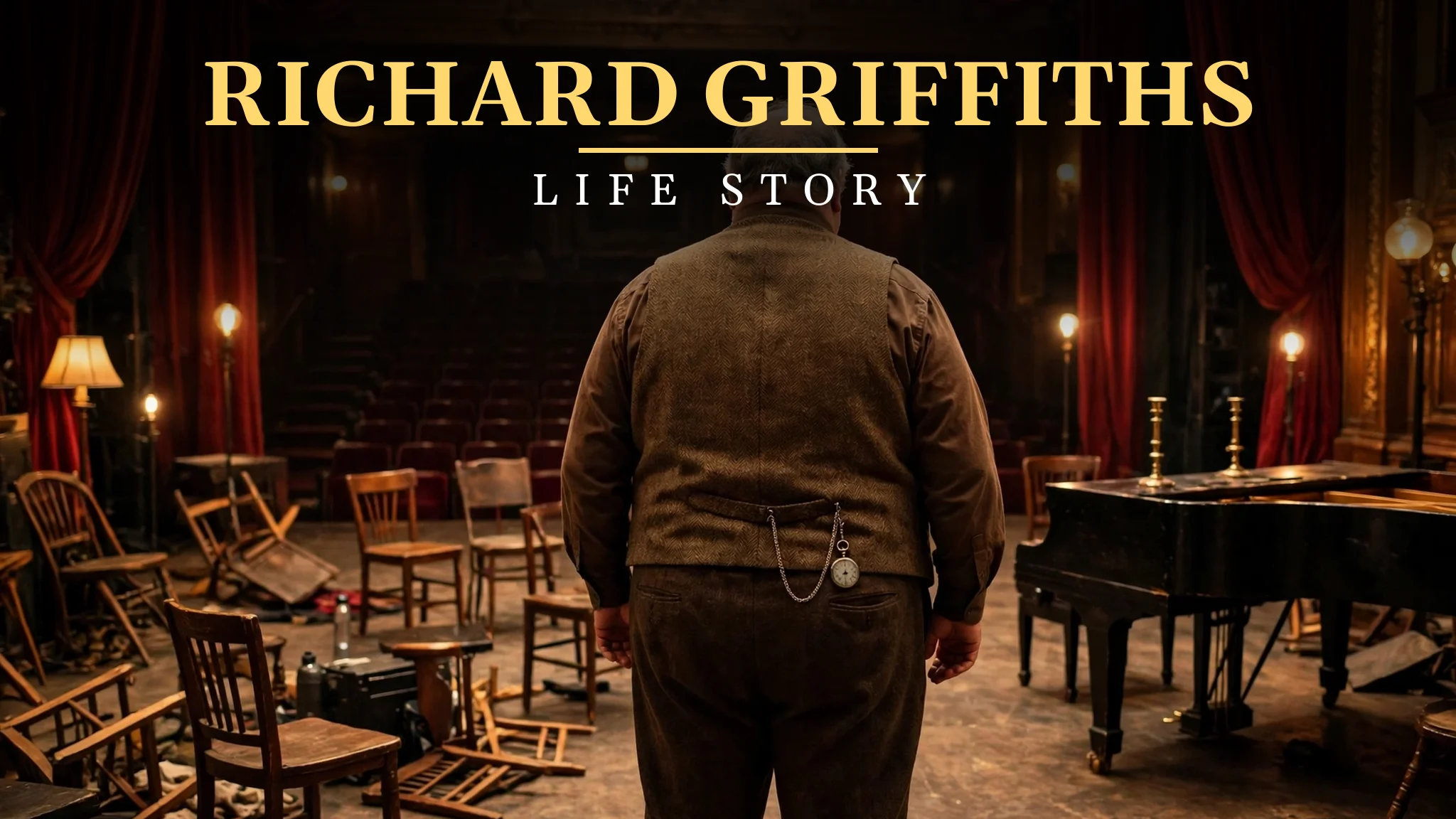
Finally, I think about the image of him standing on a theatre stage, in a waistcoat, with red curtains around him and a piano nearby. It is a fitting image for a man who loved the theatre, and for a man who understood that a stage is a place where stories come to life. He knew that people are not simple, and that even the most ordinary person can have an extraordinary heart. That is a truth worth remembering, and it is one that Griffiths’ life and work teach us well.
Frequently Asked Questions
Why was Richard Griffiths’ Hector in The History Boys so loved?
He played a teacher who loves poetry and history and who tries to inspire his students, winning Olivier and Tony Awards for a warm and honest performance.
How did Richard Griffiths become Uncle Vernon in Harry Potter?
He was cast in 2001 for the first film and played Vernon Dursley in five films, bringing comedy and menace to Harry’s cruel uncle.
What was Richard Griffiths’ famous role in Withnail and I?
He played Uncle Monty, a large and flamboyant man who invites two actors to his country cottage, in a performance still quoted by fans today.
Did Richard Griffiths grow up with deaf parents?
Yes, both of his parents were deaf, so he learned sign language as a child and learned to communicate with his hands as well as with his voice.
Was Richard Griffiths married?
Yes, he was married to the actress Heather Gibson from 1980 until his death in 2013, a long and happy marriage built on a shared love of theatre.
What awards did Richard Griffiths win for The History Boys?
He won the Laurence Olivier Award in London and the Tony Award in New York for Best Actor for playing Hector on stage.
When did Richard Griffiths die?
He died on 28 March 2013 at the age of sixty-five after complications following heart surgery, and he was mourned by actors and fans around the world.


