Roald Dahl: The Life Story Behind the Beloved Storyteller
In this post
Roald Dahl wrote stories that children love because he never talked down to them. He knew that children understand more than adults think, that they know when an adult is cruel, when a teacher is unfair, when a parent is selfish, and that they love, more than anything, a story in which a small, clever child outwits a large, stupid adult, in which a giant is kind, in which a witch is defeated, in which chocolate can be magic, and in which a peach can be as big as a house. Charlie and the Chocolate Factory, James and the Giant Peach, Matilda, The BFG, The Witches, Fantastic Mr Fox: these are not gentle, safe stories. They are funny, dark, rude, surprising, and, underneath, deeply moral, because Dahl believed, always, that children deserve the truth, even when the truth is that adults can be terrible, and that a child, with courage and with cleverness, can win.
Dahl was not, in his own life, a gentle man in the simple sense. He was a wartime pilot who was shot down, he was a spy, he was a businessman, he was a father who lost a daughter, he was a husband, he was a man who wrote in a small hut in his garden, in a chair, with a pencil, on yellow paper, and who, in that hut, created a world that millions of children have lived in, and still live in, today. He died in 1990, at the age of seventy-four, and his books are still read, still loved, still made into films and plays, and still, today, among the most popular children’s books in the world.
This is the story of a man who was, in many ways, a large child himself, a man who never quite grew up, who kept, all his life, a child’s sense of wonder, a child’s sense of injustice, and a child’s delight in a rude word, a funny name, a surprising twist, and who turned that delight into stories that have, for more than sixty years, made children laugh, made them think, and made them believe that being small does not mean being powerless.
Llandaff, Norway and a Boy Who Loved Sweets
Roald Dahl was born on 13 September 1916 in Llandaff, near Cardiff, in Wales, the son of Harald Dahl, a Norwegian shipbroker, and Sofie Magdalene Hesselberg, also Norwegian, who had come to Britain to live and work. He was named after Roald Amundsen, the Norwegian explorer who was the first man to reach the South Pole, a name that, in a way, predicted a life of adventure, of travel, of going to strange places and coming home with stories. His father died in 1920, when Roald was three, from pneumonia, and his older sister, Astri, died the same year, from appendicitis, losses that marked Dahl deeply, and that, in his later stories, appear, in different forms, as the loss of parents, as the cruelty of adults, as the sadness that children carry, often without understanding it.
His mother, Sofie, was a strong, loving woman, who raised Roald and his siblings alone, who told them Norwegian stories, who took them to Norway every summer, to visit family, to swim, to fish, to live in a country that Dahl loved, and that, in his books, appears as a place of magic, of giants, of witches, of a different, older world. She was, by all accounts, a wonderful storyteller herself, and Dahl learned, from her, that a story should be told well, that it should have a beginning, a middle and an end, and that it should, above all, be interesting, because a boring story is worse than no story at all.
He was sent to school in England, first to a preparatory school, and then to Repton, a public school in Derbyshire, where he was, by his own account, unhappy. Repton was, in Dahl’s telling, a cruel place, full of bullying, of beatings, of masters who were unkind, and of a system, known as fagging, in which younger boys had to serve older boys, a system that Dahl hated, and that he later wrote about, in his autobiography Boy, and in his stories, in which adults, especially teachers and headmasters, are often cruel, stupid and deserving of punishment. The most famous story from his school days, and one he told many times, was about a chocolate company, Cadbury, that sent new chocolates to the school for the boys to taste and to judge, a memory that, years later, became the seed for Charlie and the Chocolate Factory, a book about a chocolate factory, about a mysterious owner, Willy Wonka, and about a boy who wins a golden ticket.
He left Repton in 1934, at the age of eighteen, and, instead of going to university, he joined the Shell Oil Company, a decision that surprised his teachers, who thought he should go to Oxford or Cambridge, but that suited Dahl, who wanted adventure, who wanted to travel, who wanted to see the world, and who was, in many ways, a practical young man, a man who wanted to earn a living, to be independent, and to live, not only to study. Shell sent him to East Africa, to Kenya and Tanganyika, now Tanzania, where he lived for three years, in a world of heat, of animals, of a different culture, and where he learned, as he had learned in Norway, that the world is larger, stranger and more interesting than school had taught him.
Africa, the RAF and a Crash in the Desert
In Africa, Dahl worked for Shell, he sold oil, he travelled, he hunted, he lived, in many ways, a colonial life, a life that, by modern standards, was part of a system that was unfair, and that Dahl, in later life, did not defend. He was, at the time, a young man in his early twenties, enjoying adventure, enjoying freedom, and not yet thinking, in the way he would later think, about the politics of empire. When the Second World War began in 1939, he joined the Royal Air Force, the RAF, he learned to fly, he became a fighter pilot, and he was sent to the Middle East, to Libya and to Greece, to fight in a war that was, for him, both terrifying and exhilarating.
In 1940, he was flying a Gladiator biplane over Libya, in the desert, when his plane crashed, after he ran out of fuel, or after he was shot, accounts differ, and he was badly injured, with a fractured skull, a broken nose, and temporary blindness. He was rescued by soldiers, he was taken to hospital, he recovered, slowly, and he returned to flying, in Greece, where he fought in the Battle of Athens, and where he was, again, in danger, and where he learned, first-hand, what war feels like, what it is to be afraid, to be brave, to lose friends, and to survive when others do not. He was, by the end of the war, a squadron leader, a man who had flown in combat, who had been wounded, who had been decorated, and who had, in many ways, grown up, from a boy who loved sweets into a man who had seen death, and who had lived to tell about it.
After the war, he was sent to Washington, in the United States, as an assistant air attache, a diplomatic job, in which he met important people, in which he learned about politics, and in which he began, almost by accident, to write. He met the writer C.S. Forester, who encouraged him to write down his war stories, and Dahl wrote a story about his crash, a story that was published in the Saturday Evening Post, and that became his first published work. It was a small beginning, but it was a beginning, and it showed Dahl, and others, that he could write, that he had a voice, that he could tell a story in a way that made people listen.
He also, in Washington, worked, in secret, for British intelligence, a fact that was not widely known in his lifetime, and that has, since his death, been written about by biographers. He was, in effect, a spy, a man who passed information, who met people, who used his charm and his position to help Britain in the war, and that experience, of living a double life, of being, on the surface, a diplomat, and underneath, something else, is, in many ways, a Dahl story in itself: a man who is not quite what he seems, who has a secret, who is cleverer than he looks.
Washington, Writing and a First Book for Children
After the war, Dahl returned to Britain, he married Patricia Neal, an American actress, in 1953, a beautiful, talented woman who would win an Academy Award, and they settled in England, in a house called Gipsy House, in Great Missenden, in Buckinghamshire, a village that would become, in Dahl’s life, his home, his refuge, and the place where he wrote most of his books. They had five children, Olivia, Tessa, Theo, Ophelia and Lucy, and Dahl, who had, until then, written mostly for adults, short stories that were clever, dark, funny, and often about murder, about revenge, about clever men outwitting stupid men, began, in the 1960s, to write for children, partly because his own children asked him to tell them stories, and partly because he discovered, in telling those stories, a voice that was, in many ways, his truest voice.
His first children’s book, The Gremlins, was published in 1943, during the war, and was not a great success, but his second, James and the Giant Peach, published in 1961, was a success, and it showed what Dahl could do for children: take a small, unhappy boy, James, whose parents have died, who lives with two cruel aunts, Spiker and Sponge, who finds a peach that grows to the size of a house, who climbs inside it, who meets a grasshopper, a centipede, a spider, a ladybird, and who travels, in the peach, across the Atlantic, to New York, to a new life. It is a funny, strange, dark story, and it is, underneath, a story about a child who escapes cruelty, who finds friends, and who, in the end, is happy, not because the world is kind, but because he is brave, and because he has friends who help him.
He followed James with Charlie and the Chocolate Factory in 1964, a book that became his most famous, a book about Charlie Bucket, a poor boy who lives with his parents and grandparents in a small house, who loves chocolate, who finds a golden ticket in a chocolate bar, and who wins a tour of Willy Wonka’s chocolate factory, a magical, strange, wonderful place, where chocolate rivers flow, where Oompa-Loompas sing, where other children, Augustus Gloop, Veruca Salt, Violet Beauregarde, Mike Teavee, are punished, in funny, terrible ways, for their greed, their selfishness, their rudeness, and where Charlie, who is kind, who is honest, who is grateful, wins, in the end, the factory itself. The book was a huge success, it has been made into films, into a musical, into a play, and it is still, today, one of the most loved children’s books in the world.
Gipsy House, the Writing Hut and the Daily Work
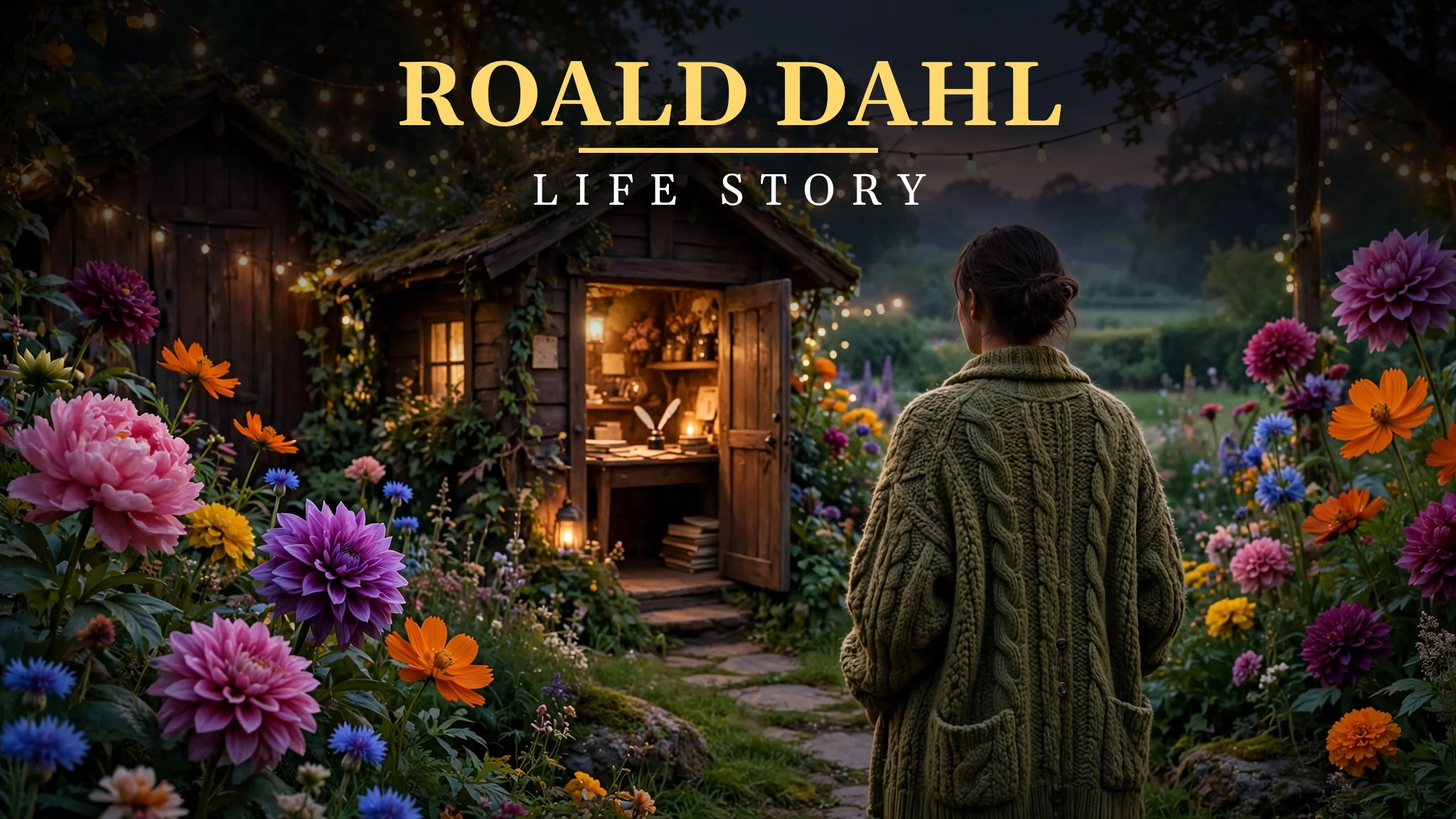
Dahl wrote in a small hut in the garden of Gipsy House, a hut he called his Gipsy House, or his writing hut, a small, brick building with a chair, a desk, a lamp, and a view of the garden, where he would go every morning, after breakfast, and write, for hours, in pencil, on yellow paper, in a notebook balanced on his lap, because he had, since his crash, a back that hurt, and he could not sit at a desk for long. He wrote, in that hut, for thirty years, and he produced, in that hut, most of his best books, in a routine that was, in many ways, simple: write in the morning, have lunch, write in the afternoon, have tea, and, in the evening, be with his family, tell stories, live a normal life, and then, the next day, do it again.
His illustrator, Quentin Blake, became, in the 1970s, his most important collaborator, a man whose drawings, loose, funny, scribbly, full of life, matched Dahl’s words perfectly, and who illustrated many of Dahl’s books, including The BFG, Matilda, The Witches, and others, in a partnership that is now one of the most famous in children’s literature. Blake’s drawings did not just illustrate Dahl’s stories. They added to them, they made the characters funnier, stranger, more alive, and Dahl, who was, by all accounts, a demanding author, trusted Blake completely, and gave him freedom to draw as he liked, a freedom that Blake used brilliantly.
Dahl’s books in the 1970s and 1980s included Fantastic Mr Fox in 1970, about a clever fox who outwits three cruel farmers, Danny, the Champion of the World in 1975, about a boy and his father who poach pheasants, The Enormous Crocodile in 1978, The Twits in 1980, about a horrible couple who play cruel tricks on each other, George’s Marvellous Medicine in 1981, about a boy who makes a magic medicine for his grandmother, The BFG in 1982, about a Big Friendly Giant who catches dreams and gives them to children, The Witches in 1983, about witches who hate children and who are defeated by a boy and his grandmother, and Matilda in 1988, about a brilliant girl with horrible parents and a horrible headmistress, Miss Trunchbull, who discovers she has telekinetic powers, who uses them to help her kind teacher, Miss Honey, and who, in the end, is adopted by Miss Honey and lives happily. Matilda is, for many readers, Dahl’s greatest book, a book about a child who loves books, who is smarter than the adults around her, and who, in the end, wins, not by being good in the simple sense, but by being clever, by being brave, and by refusing to accept that adults are always right.
Loss, Family and the Sadness Behind the Laughter
Behind Dahl’s funny, dark stories was a life that was, in many ways, sad. His daughter Olivia died in 1962, at the age of seven, from measles encephalitis, a complication of measles, a death that devastated Dahl and Patricia Neal, and that Dahl never fully recovered from. He wrote about Olivia, in later years, with great sadness, and he became, after her death, a passionate supporter of measles vaccination, writing a letter, in 1986, urging parents to vaccinate their children, a letter that is still, today, read and quoted, because it is a father’s plea, a father’s grief, turned into a public warning. His son Theo was, as a baby, hit by a taxi in New York, and suffered brain damage, and Dahl, who was, by then, a famous writer, worked with doctors, with engineers, to develop a device, the Wade-Dahl-Till valve, a valve to drain fluid from the brain, a device that helped Theo, and that helped thousands of other children, a fact that Dahl was, rightly, proud of, though he rarely talked about it in public.
His marriage to Patricia Neal ended in divorce in 1983, after thirty years, a divorce that was, for both of them, sad, and that was, in part, caused by Dahl’s infidelities, by his difficult temper, and by the strains of a life lived in public, with fame, with money, with the pressure of being a famous writer. He married Felicity Crosland in 1983, a woman who had been a friend, who became his wife, who cared for him in his last years, and who, after his death, has worked to preserve his legacy, to keep his books in print, to support the Roald Dahl Museum in Great Missenden, and to make sure that children continue to read his stories.
Dahl himself was, by many accounts, a difficult man, a man who could be charming, funny, generous, and also, at times, rude, arrogant, and, in his views about some groups, prejudiced in ways that are, today, rightly criticised. It is important to say this plainly, because Dahl’s books are loved, and Dahl himself was, in some of his opinions, wrong, and his later comments about certain peoples have caused, since his death, a great deal of debate, and have led, in some cases, to his books being edited, to remove language that is now considered offensive. That debate is still going on, and it is a debate that deserves to be had honestly, without pretending that Dahl was a saint, and without pretending that his books are not, in themselves, wonderful, funny, and important for children. Both things can be true: that Dahl wrote great books, and that Dahl, as a man, held views that were wrong, and that we should, today, read his books with open eyes, and talk about those views with children, honestly, rather than hiding them.
The Last Books, Matilda and a Legacy for Children
In his last years, Dahl continued to write, though more slowly, and he published Matilda in 1988, two years before his death, a book that is, in many ways, his farewell to children, a book about a girl who loves books, who is, in the end, saved by a teacher who loves her, and who saves her teacher in return. It is a beautiful, funny, sad book, and it is, for many readers, the book that sums up Dahl’s belief: that children are clever, that adults can be cruel, that books can save you, and that a kind teacher can change a life. He died on 23 November 1990 in Oxford, at the age of seventy-four, from a rare blood disease, myelodysplastic syndrome, after a period of illness, and he was buried in Great Missenden, in the churchyard, with, so the story goes, his favourite things: chocolate, pencils, a bottle of Burgundy, and a power saw, a collection that tells you a great deal about the man: he loved chocolate, he loved writing, he loved wine, and he loved making things with his hands.
His books have, since his death, become even more popular, through films, through plays, through musicals, through the Roald Dahl Museum, through Roald Dahl Day, celebrated every year on his birthday, 13 September, and through the love of millions of children, and adults, who read his stories, who laugh at them, who are frightened by them, and who, in the end, remember them for the rest of their lives. The BFG, Matilda, Charlie, James, Fantastic Mr Fox, The Witches: these are characters who live, in the imagination of children, as real people, as friends, as heroes, and that is, in the end, the greatest legacy a children’s writer can leave: not awards, not money, not fame, but characters who live in children’s minds, long after the book is closed.
Dahl’s books are still, today, read in schools, in homes, in libraries, in many languages, and they are still, today, among the first books that many children love, the first books that make them laugh out loud, the first books that make them want to read another, and another, and that is, in the end, the greatest gift a children’s writer can give: not a single story, but a love of stories, a love of reading, a love that will last a lifetime, long after the child has grown up, long after the book is closed, and long after Dahl himself is gone.
My Take:
I think Roald Dahl is the writer who understood children best, and I do not mean that in a sentimental way. I mean that he understood that children are not innocent in the simple sense, that they know when adults are lying, that they know when a teacher is cruel, that they know when a parent is selfish, and that they love, more than anything, a story in which a child wins, not by being good in a boring way, but by being clever, by being brave, by being a little bit rude, and by outwitting an adult who deserves to be outwitted. That is a deep understanding, and it is why his books still work, sixty years after they were written, when so many other children’s books from his time feel dated, feel safe, feel as if they were written by adults who had forgotten what it was like to be a child.
What I admire most about Dahl is his voice. He writes in short sentences, in funny words, in made-up words, in words that sound good when you say them aloud, and he writes, always, as if he is talking directly to a child, not down to a child, but to a child, as an equal, as a friend, as a person who knows a secret and wants to share it. When he writes about a giant peach, about a chocolate factory, about a big friendly giant who catches dreams in a jar, he writes with a delight that is infectious, a delight that makes you, as a reader, feel as if you are discovering something wonderful, for the first time, even if you are an adult reading to a child, even if you have read the book before. That delight is rare, and it is why his books are read aloud, again and again, in homes and in schools, all over the world.
I also think about his school days at Repton, and about how much they shaped him, because it is clear, from Boy, his autobiography, and from his stories, that school was, for Dahl, a cruel place, a place of bullying, of beatings, of masters who were unkind, and of a system that taught him, early, that adults can be terrible, and that children need to be clever to survive them. Miss Trunchbull, in Matilda, is not an invention from nothing. She is a memory, a memory of a headmaster, of a teacher, of an adult who used power to hurt children, and Dahl turned that memory into a character who is both terrifying and funny, a character who children love to hate, and who, in the end, is defeated by a small girl with a clever mind. That is a powerful lesson for children: that a cruel adult can be defeated, that you do not have to accept cruelty, that you can fight back, with your mind, with your friends, with your courage.
His time as a pilot, and his crash in the desert, is the part of his life I find most surprising, because it shows a different Dahl, a Dahl who was not a children’s writer but a young man in a war, a man who was injured, who was blind for a time, who recovered, who flew again, and who, in many ways, grew up in that war, from a boy who loved sweets into a man who had seen death. That experience, of being hurt, of being afraid, of surviving, is, I think, in his books, in the way his heroes are hurt, are afraid, and survive, in the way James loses his parents, in the way Charlie is poor, in the way Matilda is unloved, and in the way they all, in the end, find a way through. Dahl knew, from his own life, that life can hurt you, and he did not hide that from children. He told them, in stories, that life hurts, and that you can survive it, and that is a kind, honest message, one that many children’s writers are afraid to give.
The loss of his daughter Olivia is the part of his story that moves me most, and that I find hardest to write about, because it is a father’s grief, a grief that never goes away, a grief that Dahl carried for the rest of his life, and that he turned, in 1986, into a letter urging parents to vaccinate their children against measles, a letter that is still read today, because it is not a lecture, it is a father’s plea, a man saying, I lost my daughter, please do not lose yours. That letter is, in many ways, the most important thing Dahl ever wrote, more important than any of his stories, because it is a real, human, painful attempt to save other children, to make something good come from a terrible loss. I think that letter deserves to be remembered alongside his books, because it shows that Dahl, who wrote funny stories about witches and giants, was also a man who knew real sadness, and who tried, in his own way, to help.
I think about his writing hut, and about his routine, and I love the image of a man going to a small hut in his garden, every morning, sitting in a chair, writing in pencil on yellow paper, because it is a simple, humble image, a man doing his work, day after day, without fuss, without a grand office, without a computer, just a pencil, a paper, and a story in his head. That is a lesson for anyone who wants to write: you do not need a perfect place, you do not need perfect tools, you need a routine, a chair, a pencil, and a willingness to show up, every day, and to write, even when it is hard, even when you do not feel like it. Dahl showed up, for thirty years, in that hut, and he produced books that will last for a hundred years, and that is a testament to the power of showing up.
Quentin Blake’s drawings are, for me, inseparable from Dahl’s words, because Blake drew Dahl’s characters in a way that made them funnier, stranger, more alive, with loose lines, with big noses, with wild hair, with a sense of movement that matches Dahl’s sense of humour. When I think of the BFG, I think of Blake’s drawing, tall, thin, with big ears, with a kind face, and when I think of Miss Trunchbull, I think of Blake’s drawing, large, terrifying, with a stern face. That partnership, between a writer and an illustrator who trusted each other, who gave each other freedom, is a model for collaboration, and it is one of the reasons Dahl’s books are so loved: they are not only stories, they are pictures, they are a world you can see as well as read.
Matilda is the book I love most, and I love it for a simple reason: it is about a girl who loves books, who is smarter than the adults around her, who is, in the end, saved by a teacher who loves her, and who saves her teacher in return. That is a story about the power of reading, about the power of a kind teacher, and about the power of a child who refuses to accept that she is stupid, that she is worthless, that she should be quiet. Matilda reads Dickens, she reads Austen, she reads books that are too old for her, and she understands them, because she is clever, and because books do not care how old you are, they only care that you read them. That is a message I would give to any child, and to any adult: read, read widely, read what you love, and do not let anyone tell you that you are too young, or too old, or too anything, to read a good book.
I do not think Dahl was a perfect man, and I do not think his books are perfect, and I want to say that plainly, because it is important, especially today, to talk honestly about writers we love. Dahl held views, in his later life, about certain peoples, that were prejudiced, that were wrong, and that have, rightly, been criticised, and his books, in some editions, have been edited to remove language that is now considered offensive. I think that debate is important, and I think it should be had, with children, honestly, because children deserve to know that a writer can write wonderful stories and also hold wrong views, and that we can love the stories and, at the same time, say that the views were wrong. That is not a contradiction. It is a part of growing up, of learning to think for yourself, of learning that even people you admire can be wrong, and that you can admire their work and disagree with them at the same time.
If I could show one Dahl book to a child who had never read him, I would show Charlie and the Chocolate Factory, because it is funny, because it is magical, because it is about a poor boy who wins, and because it is, in many ways, the perfect Dahl book: a kind hero, cruel villains, a magical place, a funny owner, and a happy ending that feels earned, not given. Then I would show Matilda, because it is about books, about a girl who loves reading, and about a teacher who changes a life, and then I would show The BFG, because it is about a giant who is kind, who catches dreams, who is, in many ways, Dahl himself, a large man with a kind heart, who tells stories to children, and who, in the end, is loved for it.
I think about his death, in 1990, at seventy-four, and about the things he was buried with, chocolate, pencils, a bottle of wine, a power saw, and I smile, because those things tell you, in a few objects, who Dahl was: a man who loved chocolate, who loved writing, who loved wine, and who loved making things, a man who was, in many ways, a large child, a man who never quite grew up, and who, because he never grew up, could write for children in a way that adults who have grown up completely cannot. That is his gift, and it is a gift that will last, as long as children read, as long as they laugh at a rude word, as long as they love a story about a small person who wins against a large, cruel adult.
In the end, I think Dahl’s legacy is simple: he told children the truth, that adults can be cruel, that life can be hard, that you can be small and still win, and he told it in stories that are funny, dark, surprising, and, underneath, deeply kind. He told children that they matter, that their cleverness matters, that their courage matters, and that a book can save you, as books saved Matilda, as stories saved James, as a golden ticket saved Charlie. That is a legacy that is still, today, urgently needed, in a world where children are often told to be quiet, to be good, to accept what adults say, and Dahl tells them, instead, to be clever, to be brave, to read, and to fight back, with humour, with imagination, and with hope. That is a wonderful legacy, and it is one that I, as a reader, am grateful for, every time I pick up one of his books.
I also think about Dahl’s short stories for adults, because they are often forgotten today, in the shadow of his children’s books, but they are, in many ways, just as good, and just as Dahl. They are clever, dark, funny stories about murder, about revenge, about a man who bets his finger, about a woman who kills her husband with a leg of lamb and then feeds it to the detectives, stories that show Dahl’s gift for a twist, for a surprise ending, for a joke that is also a little bit cruel. Those stories, collected in books like Someone Like You and Kiss Kiss, are still read by adults, still loved, and they show that Dahl was not only a children’s writer, but a writer, in the full sense, a man who could write for anyone, about anything, and make it interesting, make it funny, make it surprising. I recommend them to adults who love Dahl’s children’s books, because they show a different Dahl, a darker Dahl, and a Dahl who is, in many ways, just as brilliant.
There is a final thought about Dahl and about reading, and it is this: that Dahl believed, deeply, that books can save children, that a child who reads, who loves books, who finds, in a library, in a classroom, in a bedroom, a story that speaks to them, is a child who will survive, who will grow up, who will, in the end, be okay, even if the adults around them are cruel, even if the world is hard. Matilda is saved by books, by Miss Honey, by her own cleverness, and that is not a fairy tale. It is a truth, a truth that many children know, that many adults know, that a book, at the right moment, can change a life, can give hope, can show a different world, and can, in the end, save you. Dahl knew that, because books had saved him, in school, in war, in life, and he wrote, in his books, to save other children, in the same way.
Frequently Asked Questions
What is Roald Dahl’s most famous book?
Charlie and the Chocolate Factory from 1964, about Charlie Bucket, Willy Wonka and a golden ticket tour of a magical chocolate factory, is his most famous book, though Matilda, James and the Giant Peach, The BFG and The Witches are also among his best-loved works.
Where did Roald Dahl write his books?
He wrote in a small hut in the garden of his home, Gipsy House, in Great Missenden, Buckinghamshire, sitting in a chair with a notebook on his lap, writing in pencil on yellow paper, a routine he kept for about thirty years.
Was Roald Dahl a pilot in the Second World War?
Yes, he joined the Royal Air Force, became a fighter pilot, was badly injured in a crash in the Libyan desert in 1940, recovered, flew in Greece, and later worked in Washington, where he began writing his war stories for publication.
Who illustrated Roald Dahl’s books?
Quentin Blake illustrated many of his best-known books, including The BFG, Matilda, The Witches and The Twits, with loose, funny drawings that matched Dahl’s humour and became inseparable from the stories for millions of readers.
What happened to Roald Dahl’s daughter Olivia?
Olivia Dahl died in 1962 at the age of seven from measles encephalitis, a complication of measles, a loss that devastated Dahl, and in 1986 he wrote a famous letter urging parents to vaccinate their children against measles.
When did Roald Dahl die?
He died on 23 November 1990 in Oxford, at the age of seventy-four, from a rare blood disease, and he was buried in Great Missenden, with, by tradition, chocolate, pencils, a bottle of Burgundy and a power saw among his favourite things.
Why do some people criticise Roald Dahl today?
Some of his later views about certain peoples were prejudiced and are rightly criticised, and some editions of his books have been edited to remove language now considered offensive, a debate that continues about how to read loved books honestly while acknowledging a writer’s faults.


