Robert Duvall: The Life Story Behind the Godfather Star
In this post
- A Navy Family and an Army Son
- New York Theatre and Boo Radley
- The Godfather and Tom Hagen
- Apocalypse Now and the Wild Colonel
- Tender Mercies and the Oscar
- A Long Life of Work and the Tango
- MASH, The Conversation, and the 1970s
- Open Range, The Judge, and Working Into His Nineties
- Secondhand Lions, Assassination Tango, and the Director
- My Take:
Robert Duvall is one of the great actors of American film, and yet he has never behaved like a star. He is quiet, he is private, and he lets his work speak for him. He has played a silent neighbour, a loyal lawyer, a wild colonel, a broken singer, and a country preacher, and each time he disappears so fully into the role that you forget you are watching an actor at all. That is his gift, and it is why directors have trusted him for more than sixty years.
He began in New York, in small theatre productions, sharing rooms with other young actors who would also become famous. He served in the Army, he studied acting, and he waited patiently for his chance. When it came, in a small role in To Kill a Mockingbird, he made the most of it, and he never stopped working after that.
His story runs from California and Maryland to the biggest films ever made, from the Corleone family to the battlefields of Vietnam, from a country singer’s comeback to the pulpit of a small-town church. It is the story of a craftsman, a man who loved acting for its own sake, and who built one of the finest careers in the history of film.
A Navy Family and an Army Son
Robert Selden Duvall was born on 5 January 1931 in San Diego, California. His father, William, was a rear admiral in the United States Navy, and his mother, Mildred, was an amateur actress. The family moved often, as navy families do, and Robert grew up in several places before settling in Annapolis, Maryland, where his father was based. He was the second of three sons, and the household was disciplined, orderly, and shaped by military life.
As a boy, he was not loud or showy. He liked to watch people, and he liked to listen. His mother’s interest in acting gave him an early sense of the stage, but his father’s world was one of duty and order. That mix stayed with him. He became an actor who was disciplined in his work, and who treated each role like a job to be done properly, not like a chance to show off.
After school, he went to Principia College in Illinois, where he studied drama, and he later served in the United States Army for a short time. The Army gave him a taste of military life from the inside, and it also gave him time to think about what he wanted to do next. When his service ended, he moved to New York City to study acting in earnest. He was in his twenties, he had very little money, and he was starting from nothing, but he knew what he wanted.
New York in the 1950s was full of young actors trying to make it, and Duvall was one of them. He studied at the Neighborhood Playhouse, and he shared an apartment with Dustin Hoffman and Gene Hackman, two other young actors who were also struggling. The three of them would sit and talk about acting, about the parts they wanted, and about the future they hoped for. None of them knew then that all three would become famous.
New York Theatre and Boo Radley
Duvall worked in the theatre in New York through the late 1950s, taking small parts and learning his craft on the stage. He appeared in plays off-Broadway, and he worked in television, where young actors could earn a living while they waited for a break. He was patient, and he was willing to take small roles, because he believed that good work would lead to more good work. He did not chase fame. He chased the craft.
His film debut came in 1962, when he played Arthur “Boo” Radley in To Kill a Mockingbird, based on the novel by Harper Lee. Boo is a quiet, mysterious neighbour who rarely leaves his house, and Duvall played him with almost no dialogue at all. He appeared only in a few scenes, but his performance was unforgettable. He made Boo seem gentle, frightened, and kind, and audiences remembered him long after the film ended. It was a remarkable first film role, and it showed what he could do with very little.
In the years that followed, he took supporting roles in films such as Captain Newman, M.D. and The Chase, and he worked steadily in television. He played in westerns, in dramas, and in crime stories, and he built a reputation as a reliable actor who could play almost any kind of man. Directors noticed that he never overacted, and that he always seemed real. He was the kind of actor who made the star look better, because he never tried to steal a scene.
The 1960s were slow years, but they were important. He learned how film worked, he learned how to work with different directors, and he learned how to make a small part matter. By the end of the decade, he was ready for the roles that would make him famous, and he had the skill to carry them.
The Godfather and Tom Hagen
In 1972, Duvall played Tom Hagen in The Godfather, the loyal lawyer and adopted son of the Corleone family. The film, directed by Francis Ford Coppola, became one of the most famous films ever made, and Duvall’s performance was at its heart. Tom Hagen is a calm, careful man, a German-Irish outsider in an Italian family, and he is the one who thinks clearly when everyone else is angry. Duvall played him with a quiet strength that made the character feel real and trustworthy.
He returned to the role in The Godfather Part II in 1974, and his work in the two films brought him an Academy Award nomination for Best Supporting Actor. The Godfather films made him known around the world, and they gave him a place in film history that no one could take away. He had gone from a small part in To Kill a Mockingbird to one of the great films of all time, and he had done it by staying true to his quiet, careful style.
In the same period, he appeared in other important films, including The Conversation in 1974, also directed by Coppola, and Network in 1976, a sharp film about television news. He played strong, intelligent men, and he made each one different. He was not a star who played the same role again and again. He was a character actor who could change completely from film to film, and audiences trusted him to do so.
The Godfather years also brought him into contact with the greatest actors and directors of his time. He worked with Marlon Brando, Al Pacino, and many others, and he learned from them. But he never lost his own way of working. He stayed quiet, he stayed prepared, and he stayed focused on the role in front of him.
Apocalypse Now and the Wild Colonel
In 1979, Duvall played Lieutenant Colonel Bill Kilgore in Apocalypse Now, Coppola’s epic film about the Vietnam War. Kilgore is a fearless, almost joyful commander who loves war, surfing, and the smell of battle, and Duvall played him with a wild energy that was very different from the calm Tom Hagen. His most famous scene, in which he talks about loving the smell of napalm in the morning, became one of the most quoted moments in film history.
The role brought him another Academy Award nomination, and it showed a new side of him. He could be loud, strange, and frightening, as well as quiet and thoughtful. He had the range to play almost any kind of man, and directors began to offer him even more varied parts. He was no longer just the calm lawyer. He was an actor who could do anything.
In the years around Apocalypse Now, he appeared in The Great Santini in 1979, playing a tough Marine pilot and father, a role that brought him another Academy Award nomination. He played the part with a hard edge, showing a man who was a hero in the air and a bully at home. It was a difficult role, and he played it without softening the character. Audiences could see both the strength and the cruelty in the man, and that honesty made the performance powerful.
He also appeared in True Confessions in 1981, playing a police detective opposite Robert De Niro, who played his brother, a priest. He was at the height of his powers, and he was working with the best directors in the world. He had become one of the most respected actors in Hollywood, and he had done it without ever seeking the spotlight for himself.
Tender Mercies and the Oscar
In 1983, Duvall starred in Tender Mercies, playing Mac Sledge, a broken country singer who has lost his career, his family, and his way in life. The film is quiet and slow, and it asks the actor to show a man who is rebuilding his life one small step at a time. Duvall played the part with a tenderness and a truth that moved audiences deeply. He sang the songs himself, and he made Mac feel like a real man, not like a movie character.
He won the Academy Award for Best Actor for the role, and it was the highest honour of his career. He had been nominated many times before, and he had waited a long time for the award. The win was a recognition of his whole career, not just of one film. It said that his quiet, honest way of acting mattered, and that the film world had finally given him the praise he deserved.
In the years that followed, he continued to take strong roles. He played in The Natural in 1984, a baseball film, and in many other pictures that showed his range. He also began to direct, and he made The Apostle in 1997, a film about a preacher who leaves his old life behind and starts a new church in a small town. He wrote, directed, and starred in the film, and it brought him another Academy Award nomination for Best Actor. The Apostle was a deeply personal project, and it showed his love for the American South and for the power of faith.
He also appeared in the television miniseries Lonesome Dove in 1989, playing Augustus McCrae, a former Texas Ranger, opposite Tommy Lee Jones. The series was a huge success, and his performance as the talkative, charming Gus became one of the most loved of his career. It showed that he could be funny and warm as well as serious, and it gave him a new audience on television.
A Long Life of Work and the Tango
In his later years, Duvall kept working steadily, taking roles in films such as A Civil Action in 1998, Gone in 60 Seconds in 2000, Secondhand Lions in 2003, and The Judge in 2014, where he played a tough judge opposite Robert Downey Jr. His performance in The Judge brought him another Academy Award nomination, when he was in his eighties, proving that his talent had not faded with age. He was still one of the finest actors working in film.
He also became known for his love of tango dancing. He and his wife, Luciana Pedraza, whom he married in 2005, have danced tango in Argentina and around the world, and he has spoken about how the dance keeps him young. He has also been a supporter of tango culture, and he has helped to bring Argentine dancers to the United States. It is a passion that suits him: tango is disciplined, precise, and full of feeling, just like his acting.
His personal life has been quiet. He was married three times before his marriage to Luciana, and he has no children. He has lived for many years in Virginia, on a farm, where he keeps horses and enjoys a simple life away from Hollywood. He has said that he prefers the country to the city, and that the farm gives him peace. He has never been a man who needed fame to be happy.
Today, Robert Duvall stands as one of the greatest actors in the history of American film. He has been nominated for seven Academy Awards, and he has won one. He has played in some of the most important films ever made, and he has done so with a quiet, honest style that has never changed. He is a craftsman, a gentleman, and a reminder that great acting does not need to shout.
MASH, The Conversation, and the 1970s
In 1970, Duvall played Major Frank Burns in MASH, Robert Altman’s film about doctors in a mobile army hospital during the Korean War. Burns is a stiff, self-righteous surgeon who takes himself very seriously, and Duvall played him with a comic stiffness that made the character both funny and sad. The film was a huge success, and it showed that Duvall could be funny as well as serious. He was not only a dramatic actor. He could play a man who is ridiculous, and he could do it without making the character a joke.
He also appeared in The Conversation in 1974, directed by Francis Ford Coppola, playing the director of a surveillance company, a small but important role in a film about privacy and guilt. The film is now seen as a masterpiece, and Duvall’s quiet, professional manner suited it perfectly. He played a man who is used to listening to other people’s secrets, and he made the character feel cold and efficient.
In 1976, he played Frank Hackett in Network, a sharp, angry film about television news, where he played a network executive who cares more about ratings than about truth. The film won Academy Awards, and Duvall’s performance as a smooth, ruthless businessman showed another side of his talent. He could play a man in a suit, in an office, with the same truth he brought to a cowboy or a soldier.
He also appeared in The Eagle Has Landed in 1976, a war film about a German plot to kill Winston Churchill, and in many other films of the decade. He was one of the busiest actors in Hollywood, and he was building a reputation as a man who could play almost anything. He was not a star in the usual sense, but he was an actor whom every director wanted, because he made every film better.
What is striking about these roles is how varied they are. Frank Burns is a comic fool. The man in The Conversation is a cold professional. Frank Hackett is a ruthless executive. Duvall played all three with the same quiet honesty, and he made each one feel like a real person. That is the mark of a great character actor: the face changes, the voice changes, and the truth stays the same.
Open Range, The Judge, and Working Into His Nineties
In 2003, Duvall played Boss Spearman in Open Range, a western directed by and starring Kevin Costner, about two free-range cattlemen who take on a corrupt rancher. Boss is an older man, wise, calm, and dangerous when he needs to be, and Duvall played him with a warmth and a strength that made the film feel real. He was in his seventies, and he was still playing cowboys with the same energy he had brought to Lonesome Dove fourteen years earlier.
He also appeared in Secondhand Lions in 2003, playing Hub, an old man with a mysterious past, opposite Michael Caine, and in A Civil Action in 1998, playing a lawyer. He took strong roles in films of many kinds, and he kept working, year after year, because he loved the work and because directors kept calling him.
In 2014, he played Joseph Palmer in The Judge, a tough, ageing judge who is accused of murder, opposite Robert Downey Jr., who plays his son. The role was powerful and painful, and it brought Duvall another Academy Award nomination, his seventh, when he was eighty-three years old. He played the judge as a man who is proud, stubborn, and frightened, and the scenes between him and Downey are some of the finest in the film. It proved that his talent had not faded with age.
He also appeared in Widows in 2018, playing a powerful political figure, and in many other films in his eighties and nineties. He has worked for more than sixty years, and he has never stopped. He is one of the few actors who can say that he has worked in every decade from the 1960s to the 2020s, and that he has been respected in each one. That longevity is a remarkable achievement, and it is a sign of how deeply he loves his craft.
Secondhand Lions, Assassination Tango, and the Director
In 2002, Duvall directed and starred in Assassination Tango, a film about a hitman who travels to Argentina and who falls in love with tango dancing. The film was a personal project, and it showed his love of Argentina, of tango, and of the culture he had come to know through his wife Luciana. He played John J., a quiet, professional killer who finds a new life in Buenos Aires, and he directed the film with the same care he brought to The Apostle. It was not a commercial hit, but it was a film made with love, and it showed that Duvall was still willing to take risks in his seventies.
In 2003, he played Hub in Secondhand Lions, opposite Michael Caine, a film about two old uncles who take in their nephew for a summer and who teach him about life, adventure, and courage. Hub is a man with a mysterious past, a man who has lived a wild life, and Duvall played him with a warmth and a humour that made the character one of the most loved of his later career. He was in his seventies, and he was still playing men with a past, men who had stories to tell, and he told those stories with the same honesty he had always had.
In 2006, he played Prentice Ritter in Broken Trail, a television western about two cowboys driving horses across the West, and his performance won him an Emmy Award. The role was a perfect fit for him, because Ritter is a quiet, honourable man, and Duvall played him with a dignity that made the miniseries feel real. He was a western actor again, and he was as good at it as he had been in Lonesome Dove seventeen years earlier.
In 2009, he played Felix Bush in Get Low, a film about an old hermit who plans his own funeral party so that people can tell him stories about his life. The role was quiet, sad, and funny, and Duvall played Felix as a man who has lived a long, hard life and who wants to make peace with it before he dies. It was one of the finest performances of his later years, and it showed that he could still carry a film on his own, even in his late seventies. He was not a young man anymore. He was an old man with a story to tell, and he told it beautifully.
My Take:
When I think about Robert Duvall, the first word that comes to mind is honest. He does not act like he is performing. He acts like he is living. When he plays Tom Hagen in The Godfather, I believe he is a lawyer who has spent his life trying to keep a violent family from falling apart. When he plays Mac Sledge in Tender Mercies, I believe he is a broken singer who is trying to be a better man. That belief is the hardest thing in acting, and Duvall makes it look easy.
I admire how he started. He shared an apartment in New York with Dustin Hoffman and Gene Hackman, and all three of them were broke, all three of them were hungry, and all three of them believed they could make it. That is a remarkable thing to think about: three young men in one small apartment, all of them later becoming famous. I think it tells me something about that time in New York, and about the kind of people who were drawn to acting then. They were serious, they were hungry, and they were willing to work for years before anyone noticed them. Duvall was the quietest of the three, and in some ways he is the one who stayed truest to that early seriousness.
What I find most interesting about his career is how many great films he has been in. To Kill a Mockingbird, The Godfather, The Godfather Part II, The Conversation, Network, Apocalypse Now, Tender Mercies, The Apostle, Lonesome Dove. That is an extraordinary list. Most actors are lucky to be in one great film. Duvall has been in many, and in each one he gave a performance that people still talk about. I think that is because directors trusted him. They knew that if they gave him a part, he would do the work, he would learn the character, and he would not let them down.
The Godfather is the film I think about most, because Tom Hagen is such a difficult character to play. He is not Italian, he is not a killer, and he is not the boss. He is the man who thinks, the man who advises, the man who keeps the family together with his mind. That is a hard role, because it does not give the actor big scenes or loud speeches. Duvall played it with a calm that made the character feel strong. He did not need to shout to show power. He showed it by being the only person in the room who was thinking clearly. I think that is a lesson in itself: real power is often quiet.
I also think about Apocalypse Now, because it shows the opposite side of him. Kilgore is loud, wild, and almost joyful about war. He loves the smell of napalm, he loves surfing, and he loves the fight. Duvall played that part with a freedom that surprised people who only knew him as Tom Hagen. It showed that he could be strange and frightening as well as calm and thoughtful. That range is rare, and it is why he has lasted so long. He can play almost any kind of man, and he can make each one feel real.
Tender Mercies is the film that moves me most. It is a quiet film about a man who has lost everything and who is trying to start again. Duvall plays Mac Sledge as a man who does not talk much, who does not explain himself, and who slowly learns to love again. He sang the songs himself, and he made the character feel like a real country singer, not like an actor pretending to be one. When he won the Oscar for that role, I felt it was right, because it was a reward for a lifetime of quiet, honest work, not just for one film.
There is something sad in his story too, and it is the sadness of the characters he plays. Mac Sledge has lost his daughter. The preacher in The Apostle has lost his old life. Gus McCrae in Lonesome Dove is a man who knows that the old West is ending. Duvall seems drawn to men who are losing something, or who have already lost it, and who are trying to find a way forward. I think that is because he understands loss. He has lived a long life, he has seen friends and colleagues pass away, and he knows that nothing lasts forever. That knowledge gives his acting a depth that younger actors cannot fake.
I admire his directing work, especially The Apostle. It is a film about faith, about a man who makes a terrible mistake and then tries to rebuild his life by preaching in a small town. Duvall wrote it, directed it, and starred in it, and he did it because he cared about the story, not because it would make money. That is a brave thing to do. Many actors never direct, because it is hard and risky. Duvall did it, and he made a film that people still talk about today. I think it shows that he is not just an actor. He is a storyteller, and he cares about the American South, about faith, and about redemption.
Another thing I notice is his love of tango. It might seem like a small detail, but I think it tells me something important. Tango is a dance that needs discipline, patience, and feeling, and Duvall has all three. He dances with his wife in Argentina, and he has helped to bring tango to America. That is not the hobby of a man who is tired. It is the hobby of a man who is still learning, still moving, and still curious about the world. I love that he found a passion outside of acting, and that he has kept it alive into his nineties.
If I have a criticism, it is that he has sometimes been too quiet for his own good. He has never promoted himself, he has never chased fame, and he has never made a show of his talent. That is admirable, but it also means that many people do not know how great he is. He is not as famous as some actors who have done far less, because he never asked for attention. I think that is a shame, but I also think it is his choice, and I respect it. He chose the work over the fame, and the work is what lasts.
I also think about his farm in Virginia, and how he has lived there for many years, away from Hollywood. He keeps horses, he enjoys the country, and he lives a simple life. That suits him. He is not a man who needs bright lights and big parties. He needs quiet, space, and time to think. I think that quiet life is the reason his acting has stayed so honest. He never lost touch with ordinary life, and ordinary life is what his characters come from.
For a young reader, I think the lesson of his life is about patience and craft. He did not become famous quickly. He worked in the theatre, he took small parts, he shared an apartment with two other struggling actors, and he waited. He learned his craft, one role at a time, and when his chance came, he was ready. That is a slow way to build a career, but it is a strong way, and it lasts. A person who learns the craft well can work for sixty years. A person who only chases fame will fade quickly.
I also think his story teaches something about humility. He has been in some of the greatest films ever made, he has won an Oscar, and he has been nominated seven times, but he still behaves like a working actor. He does not act like a star. He acts like a man who is lucky to have work, and who wants to do it well. That humility is rare, and it is beautiful. It reminds me that true greatness does not need to announce itself. It just does the work, and lets the work speak.
When I look at his whole career, I see a man who gave everything to acting, and who asked for very little in return. He played the lawyer, the colonel, the singer, the preacher, and the cowboy, and he made each one feel like a real person. He did not shout, he did not show off, and he did not pretend. He just told the truth, one role at a time, for more than sixty years. That is a remarkable life, and it is why I think Robert Duvall is one of the greatest actors who ever lived.
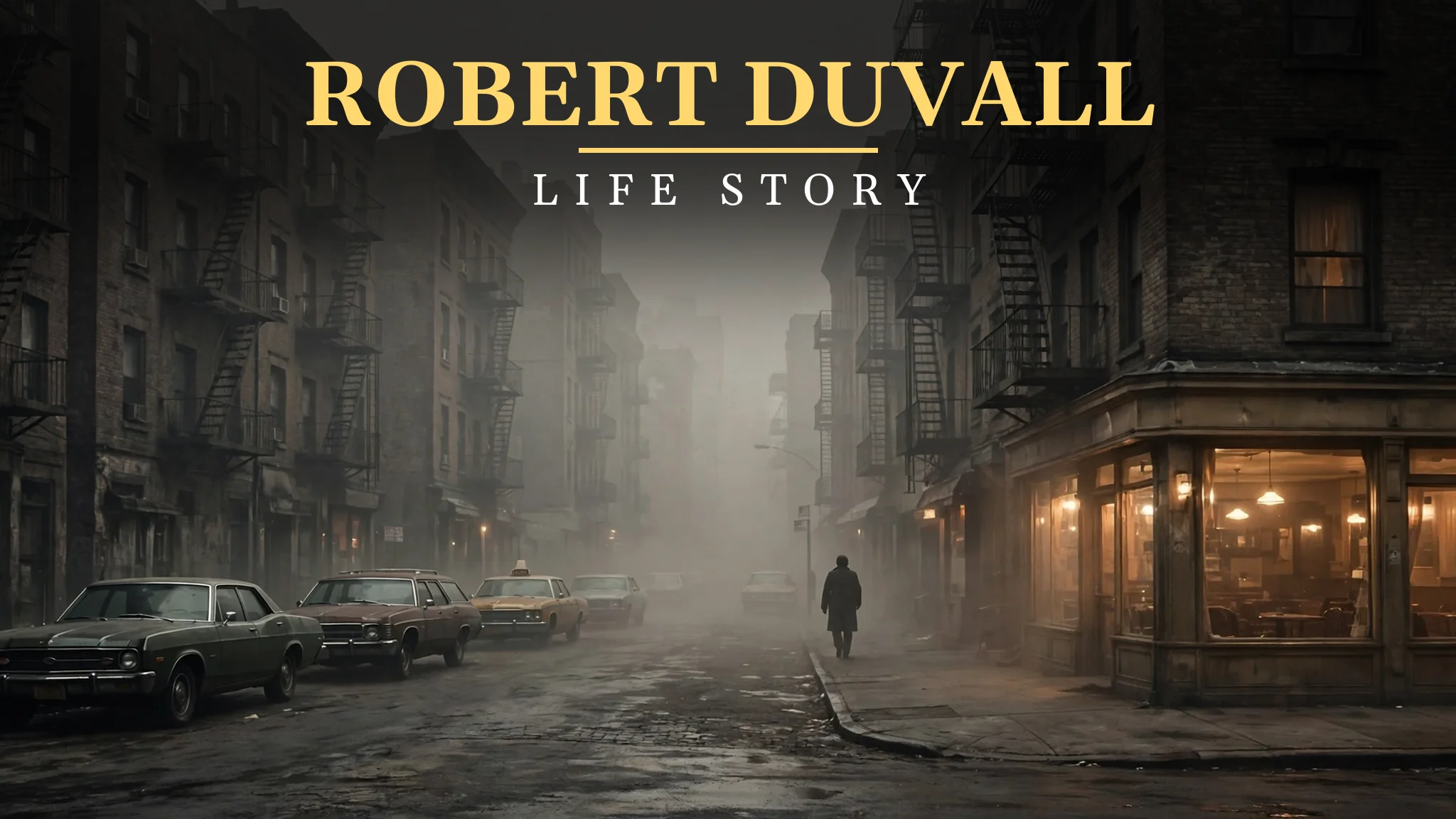
One more thought stays with me. When I picture him, I picture the foggy street in the image for this story: one man in a dark coat, walking alone through the mist, with a warm light glowing from a cafe window. That is a good picture of his career, because he has always walked alone, quietly, through the fog of Hollywood, and he has never needed anyone to light his way. He has found his own light, in the work itself, and that light has never gone out.
I also think about his role in MASH, because it shows a side of him that people forget. He plays Major Frank Burns, a stiff, self-righteous surgeon, and he plays him with a comic stiffness that is both funny and sad. It is a very different kind of performance from Tom Hagen or Mac Sledge, and it proves that he could be funny as well as serious. I love that he could play a man who is ridiculous, and do it without making the character a joke. He treats every character with respect, even the foolish ones, and that respect is what makes his acting so human.
Another thing I notice is his work in Open Range, when he was already in his seventies. He plays Boss Spearman, an old cattleman, and he plays the part with a warmth and a strength that makes the film feel real. He is not a young cowboy anymore. He is an old man who has seen a lot, and who knows how to handle himself. I think that performance is beautiful, because it shows an actor growing old gracefully, and using his age as a strength rather than hiding it. He does not pretend to be young. He plays his age, and he plays it well.
When I think about his seventh Oscar nomination, for The Judge, at eighty-three, I feel a deep admiration. Most actors are forgotten by that age. Duvall was still being nominated for the highest honour in film, and he was still giving performances that moved audiences. That is not luck. That is a lifetime of hard work, discipline, and love for the craft. He never stopped learning, he never stopped working, and he never lost his honesty. That is why he is still here, still respected, and still loved, after more than sixty years.
I also think about Get Low, because it is one of his finest late performances, and many people have never seen it. He plays Felix Bush, an old hermit who plans his own funeral party so that people can tell him stories about his life. It is a quiet, sad, and funny film, and Duvall plays Felix as a man who has lived a long, hard life and who wants to make peace with it. He is in his late seventies, and he is not a young cowboy anymore. He is an old man with a story to tell, and he tells it beautifully. I think that performance is a perfect example of what he does best: he plays a real man, with a real past, and he makes the audience care about him.
Another thing I notice is Broken Trail, the television western where he won an Emmy Award. He plays Prentice Ritter, a quiet, honourable cowboy, and he plays the part with a dignity that makes the whole story feel real. He was seventy-five when he made it, and he was still playing cowboys with the same energy he had brought to Lonesome Dove. That is a remarkable thing. Most actors slow down as they get older. Duvall kept going, and he kept winning awards, because he never stopped caring about the work. He treated every role, large or small, with the same seriousness, and that is why he is still respected today.
Frequently Asked Questions
Where was Robert Duvall born?
Robert Duvall was born on 5 January 1931 in San Diego, California, the son of a navy rear admiral and an amateur actress. He grew up in several places before settling in Annapolis, Maryland, and he later studied drama at Principia College in Illinois.
Who did Robert Duvall play in The Godfather?
He played Tom Hagen, the Corleone family’s loyal lawyer and adopted son, in The Godfather in 1972 and The Godfather Part II in 1974. His calm, careful performance brought him an Academy Award nomination for Best Supporting Actor.
What film won Robert Duvall his Oscar?
He won the Academy Award for Best Actor for Tender Mercies in 1983, playing Mac Sledge, a broken country singer who rebuilds his life. He sang the songs himself, and the quiet, honest performance is widely seen as one of the finest of his career.
What is the famous line from Apocalypse Now?
In Apocalypse Now from 1979, his character Lieutenant Colonel Bill Kilgore says he loves the smell of napalm in the morning. The line became one of the most quoted moments in film history, and the role brought Duvall another Oscar nomination.
Did Robert Duvall direct The Apostle?
Yes, he wrote, directed, and starred in The Apostle in 1997, playing a preacher who starts a new church in a small town after leaving his old life behind. The deeply personal film brought him another Academy Award nomination for Best Actor.
What was Robert Duvall’s first film role?
His film debut was as Arthur “Boo” Radley in To Kill a Mockingbird in 1962, a quiet neighbour who appears in only a few scenes and speaks almost no dialogue. The performance was unforgettable, and it launched a film career that has lasted more than sixty years.
Does Robert Duvall love tango dancing?
Yes, he is a passionate tango dancer, and he and his wife Luciana Pedraza have danced in Argentina and around the world. He has also helped bring Argentine tango dancers to the United States, and the dance is one of his great loves outside of acting.


