Robert Irwin: The Life Story Behind the Wildlife Star
In this post
Robert Irwin was only two years old when his father died. He was too young to remember Steve Irwin in the way his sister Bindi does, and he has grown up with a father he knows mostly through films, through stories, and through the love of his family. Yet he has become, in his own way, the most like his father of anyone in the family. He has the same energy, the same joy, the same love of animals, and the same way of talking to a camera as if he were talking to a friend. He is a wildlife photographer, a television presenter, and a conservationist, and he is carrying on his father’s work in a way that is entirely his own.
He was born in Queensland in 2003, and he grew up in Australia Zoo, surrounded by crocodiles, koalas, kangaroos, and snakes. He appeared on television with his family from the time he was a small child, and he learned about wildlife by living with it. He discovered photography as a teenager, and he found that he had a gift for it. He could capture a moment in the wild, a look in an animal’s eye, a light at sunset, and he could share it with the world. His photographs have won awards, and they have been seen by millions of people.
What makes his story worth telling is the way he has grown up in the shadow of a famous father, and the way he has found his own light. He is not trying to be Steve Irwin. He is trying to be Robert Irwin, and he is doing it with honesty, with humour, and with a deep love of the natural world. This is the story of how a boy who lost his father at two became one of the most loved young wildlife stars in the world.
A Boy Who Lost His Father at Two
Robert Clarence Irwin was born on 1 December 2003 in Buderim, Queensland, Australia. His father was Steve Irwin, the Crocodile Hunter, and his mother was Terri Irwin, an American woman who had come to Australia and married Steve. His sister Bindi was five years older than him, and the family lived in Australia Zoo, the wildlife park in Beerwah that his parents had built. He was a baby when his father was at the height of his fame, and he was only two when his father died.
He was too young to remember his father in the way most children remember a parent. He has said in interviews that he knows his father through films, through photographs, and through the stories his mother and sister tell him. He has watched The Crocodile Hunter many times, and he has learned about his father by watching him on screen, by hearing his voice, and by seeing the way he loved animals. It is a strange way to know a father, but it is the way he has known his, and he has made peace with it.
As a small child he was curious, funny, and full of energy, just like his father. He was holding snakes, feeding animals, and appearing on camera before he could read. He learned about wildlife from his mother and his sister, and he learned to respect animals, to understand their behaviour, and to never take them for granted. His mother taught him to be caring, and his sister taught him to be brave, and together they gave him a childhood that was full of love, even without his father there.
School was a part of his life too, but it was a different kind of school. He was home schooled for much of his childhood, so that he could travel with his family and work in the zoo, and he learned about the world by living in it. He learned about animals by working with them, he learned about people by meeting visitors at the zoo, and he learned about television by being on it. It was an education that no classroom could give, and it shaped him into the young man he became.
Growing Up in Australia Zoo
Robert Irwin grew up in Australia Zoo, and the zoo was his playground, his classroom, and his home. He knew every animal by name, he knew every path in the park, and he knew the keepers who worked there as if they were family. He fed crocodiles, he held koalas, he worked with snakes, and he learned to handle animals with the same care and respect his father had shown. He was a natural with animals, and people who watched him work said that he had his father’s gift.
He appeared on television with his family from a young age, in episodes of Crikey! It’s the Irwins, the series that followed the family as they worked at the zoo. He was funny, he was honest, and he was real, and audiences loved him for it. He did not try to be a star. He tried to be himself, and he was, and that was enough. He was a boy who loved animals, and who loved to share that love with other people.
As he grew older, he began to take on more responsibility at the zoo. He worked with the keepers, he helped with feeding, and he learned about conservation, about breeding programmes, and about the work of protecting endangered animals. He was not a child who was pushed into performing. He was a young man who was doing the work he loved, and who was sharing it with the world. He was learning, he was growing, and he was building a career that would last.
The zoo also gave him a sense of family. His mother Terri ran the zoo, his sister Bindi worked there, and his brother-in-law Chandler worked there too. They were a team, and they worked together every day, caring for animals and for visitors. It was a life that was full, and it was a life that was built on love, on hard work, and on a shared purpose. He was lucky to grow up in such a place, and he knew it.
Discovering Photography
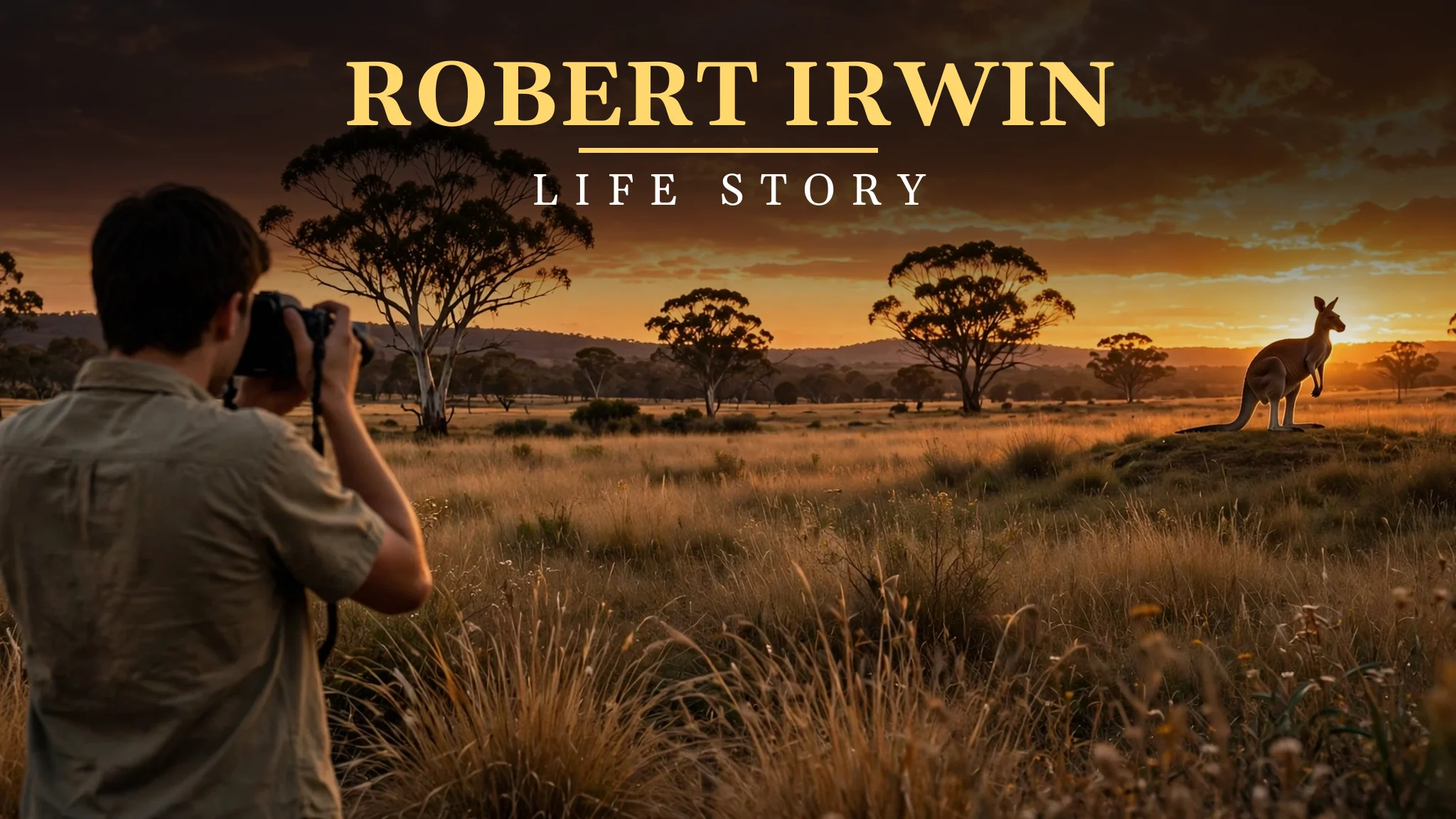
As a teenager, Robert Irwin discovered photography, and he found that he had a gift for it. He began to take photographs of animals in the wild, in Australia and in Africa, and he learned to wait for the right light, the right moment, and the right look in an animal’s eye. He was patient, he was observant, and he had an eye for beauty that surprised people who knew him only as a television presenter. His photographs were not snapshots. They were works of art, and they showed the world in a new way.
His photographs began to win awards, including prizes in wildlife photography competitions, and they were published in magazines and shown in exhibitions. He travelled to Africa to photograph lions, elephants, and other animals in the wild, and he shared his work on social media, where millions of people followed him. He was not only a presenter. He was an artist, and he was using his art to tell people about the beauty of the natural world and the need to protect it.
Photography gave him a new way to carry on his father’s work. His father had used television to show people wildlife, and Robert was using photography to do the same thing, in a quieter and more personal way. He did not shout about animals. He showed them, in a photograph that could make a person stop, look, and feel something. It was a different approach, but it had the same goal, to make people care about the natural world.
He has said that photography is his passion, and that it is the thing he loves most, after the animals themselves. He carries a camera wherever he goes, and he is always looking for the next shot, the next moment, the next animal that will tell a story. It is a life that suits him, because it lets him be alone in nature, watching, waiting, and learning, and then sharing what he has seen with the world.
Television and a New Generation
Robert Irwin became a television presenter in his own right, appearing in Crikey! It’s the Irwins, and in other programmes that followed the family at Australia Zoo. He was funny, he was honest, and he was real, and audiences loved him for it. He did not try to be his father. He tried to be himself, and he was, and that was enough. He was a young man who loved animals, and who loved to share that love with other people, and he did it with a humour and a warmth that were entirely his own.
He also became a co-host of the Australian version of I’m a Celebrity… Get Me Out of Here!, a reality show filmed in the jungle, where he worked alongside Julia Morris. The role showed a different side of him, as a presenter who could be funny, quick, and kind, even in difficult conditions. It brought him to a new audience, people who had never seen his wildlife work, and who now knew him as a young man with a bright future in television.
He has also appeared on talk shows in America and in Australia, where he has talked about wildlife, about his father, and about his own life. He is a natural on camera, and he has his father’s gift for making people listen. He does not lecture. He tells stories, he laughs, and he shares his love of animals in a way that makes people want to learn more. It is a gift, and it is one that he uses well.
In the years that followed, he continued to work in television, in photography, and in conservation. He was an actor, a presenter, and a photographer, and he was building a career that was based on the work itself, not only on his famous name. He was a young man who had grown up in the shadow of a legend, and who was finding his own light, one photograph, one show, and one animal at a time.
A Young Man Finding His Own Way
Robert Irwin is now a young adult, and he is finding his own way in the world. He continues to work at Australia Zoo, with his mother Terri, his sister Bindi, and his brother-in-law Chandler, and he continues to speak about conservation, about wildlife, and about the importance of protecting the natural world. He is a photographer, a presenter, and a conservationist, and he carries all of those roles with grace and with humour.
He has spoken about his father in interviews, and he has said that he feels his father’s presence when he works with animals, and that he tries to live in a way that would make his father proud. He has also said that he does not feel pressure to be his father, and that he is happy to be himself. It is a mature view for a young man, and it shows that he has thought deeply about who he is and what he wants to do with his life.
He has also spoken about the importance of mental health, and about the need for young people to talk about their feelings. He has been open about the fact that growing up without a father was hard, and that he has had to work through grief in his own way. That honesty has earned him respect from young people around the world who have lost a parent, and who see in him a person who understands what they are going through.
Today he is seen as one of the most loved young wildlife stars in the world. He has millions of followers on social media, he has won photography awards, and he has built a career that is entirely his own. His work is not over, and he continues to take on new projects, both at Australia Zoo and around the world. He is a young man who lost his father at two, and who has grown up to be strong, kind, and full of purpose.
Africa, the Wild, and the Camera
Robert Irwin has travelled to Africa many times to photograph wildlife in the wild, and those trips have shaped him as a photographer and as a person. He has photographed lions at dawn, elephants at a waterhole, and birds in flight, and he has learned to wait for hours, sometimes for days, for the right moment. Africa is a very different place from Australia Zoo, and it taught him that wild animals are not pets, and that the wild is not a zoo. It is a place of beauty and of danger, and a photographer must respect it, or it will not give him its secrets.
He has said that Africa changed the way he sees the world, because it showed him how big the natural world is, and how small we are inside it. He has photographed animals that are endangered, and he has seen the damage that people have done to their homes. That has made him more determined to speak about conservation, not only in Australia, but around the world. He does not only take photographs. He tells the story behind them, about the animal, about its home, and about what is being done to protect it.
He has also worked with conservation groups in Africa, learning from rangers, from scientists, and from local people who live alongside wildlife every day. He has listened to them, and he has tried to understand their lives, because he knows that conservation only works when local people are part of it. He is not a tourist with a camera. He is a young man who wants to learn, and who wants to help, and people in Africa have welcomed him because of that.
His photographs from Africa have been shown in exhibitions, published in magazines, and shared with millions of people on social media. They are not only beautiful. They are a call to action, a reminder that these animals exist, that they are in danger, and that we must protect them. He has used his art to do what his father did with television, to make people care, and he has done it in his own way, quietly, patiently, and with great skill.
The Photographer Who Speaks for the Wild
Robert Irwin has also become known for the way he speaks about his photographs, telling the story of each one, where it was taken, what the animal was doing, and why it matters. He does not only show a picture. He tells you what it took to get it, how long he waited, how the light changed, and how the animal looked at him. That storytelling makes the photograph come alive, and it makes the audience feel as if they were there with him, in the grass, at dawn, waiting for a lion to wake up.
He has spoken at photography festivals, at schools, and at conservation events, sharing his work and his love of the natural world. He is a natural speaker, funny and honest, and he makes people laugh while he teaches them. He does not lecture. He tells stories, and the stories stay with you long after the talk is over. It is a gift he shares with his father, the gift of making people listen, and he uses it well.
He has also used social media to share his photographs, and he has millions of followers who wait for his next post. He shares not only the finished photograph, but the story behind it, the failures, the long waits, and the moments when everything went wrong. That honesty is rare, and it is why people trust him. He does not pretend that photography is easy. He shows how hard it is, and how rewarding it is when it works.
His work as a photographer is still growing, and he is still learning. He is a young man, and he has many years ahead of him, and many photographs still to take. He is building a body of work that is entirely his own, and it is a body of work that will be remembered, not because of his name, but because of its beauty, its honesty, and its love for the wild.
The Young Man Who Teaches Others
Robert Irwin has become a teacher in his own right, even though he is still young. He speaks at schools, at photography festivals, and at conservation events, telling young people about wildlife, about photography, and about the importance of protecting the natural world. He does not lecture. He tells stories, he shows photographs, and he makes the audience laugh, and they listen because he is honest, funny, and real. He has inspired thousands of young people to pick up a camera, to go outside, and to look at the world with fresh eyes.
He has also worked with his sister Bindi to teach children at Australia Zoo, showing them how to handle animals safely, how to respect wildlife, and how to care for the natural world. He is patient with children, and he answers their questions with care, because he remembers what it was like to be a child in the zoo, full of questions, and full of wonder. He gives them the same gift his parents gave him, a love of animals, and a belief that they can make a difference.
He continues to learn himself, from photographers, from rangers, and from scientists, and he shares what he learns with his audience. He is a student and a teacher at the same time, and that is a good place to be, because it keeps him humble, and it keeps him growing. He will keep teaching, and he will keep learning, for many years to come, and the world will be better for it.
He has also begun to work on larger photography projects, including books and exhibitions that bring his work to people who have never been to Africa or to Australia Zoo. He spends months planning a trip, researching the animals he wants to photograph, and learning about the light, the land, and the seasons. It is slow work, and it is often lonely, but he loves it, because it lets him be alone in nature, watching, waiting, and learning, and then sharing what he has seen with the world.
He has said that his dream is to photograph every great wild place on earth, and to show people why those places matter. It is a big dream, and it will take him many years, but he is young, and he is patient, and he has already begun. Each trip teaches him something new, and each photograph tells a story that only he could tell, because he was there, in the grass, at dawn, waiting for the light.
My Take:
When I think about Robert Irwin, the first thing I feel is admiration for the way he has grown up without a father and still found his own way. He was only two when Steve died, and he has had to know his father through films and stories, not through memories. That is a hard thing for a child, and it is a hard thing for a young man. He could have been angry, or bitter, or lost. He was none of those things. He was curious, he was funny, and he was full of love for animals, just like his father. I think that takes a special kind of strength, and I think it is a lesson for anyone who has lost a parent young.
I admire his photography most of all, because it is his own thing. He did not have to become a photographer. He could have stayed on television, doing what his father did, and no one would have blamed him. Instead he picked up a camera, he went out into the wild, and he learned to see the world in a new way. His photographs are beautiful, and they show animals in a way that makes you stop and look. I think that is a gift, and I think it is one that he has worked hard to develop. He did not inherit it. He earned it, by waiting, by watching, and by learning.
I also admire the way he talks about his father. He does not pretend that he remembers him, and he does not pretend that it is easy. He says that he knows his father through films, and that he feels his presence when he works with animals. I think that is an honest thing to say, and I think it helps other young people who have lost a parent to know that they are not alone. He is not afraid to be honest about grief, and that honesty is a form of kindness.
What I find sad in his story is that he never really knew his father, and that he will never have the memories that Bindi has. Bindi was eight, and she remembers holding his hand, and hearing his voice, and laughing with him. Robert was two, and he does not have those memories. He has films, and he has stories, but he does not have the feeling of being held by his father. That is a sad thing, and it is worth remembering. He has done his best with what he has, and he has done it well, but it is still a loss, and it is still hard.
I think about his childhood in the zoo, and I am moved by the way he grew up surrounded by animals. He was holding snakes, feeding koalas, and appearing on television before he could read. That is a childhood unlike any other, and it gave him a love of wildlife that is deep and real. He did not learn about animals from a book. He learned about them by living with them, and that is a gift that no classroom can give. He has carried that gift with him throughout his life.
I also think about his work on I’m a Celebrity, and about the way it showed a different side of him. He was funny, he was quick, and he was kind, even in difficult conditions. I liked that, because it showed that he is not only a wildlife man. He is a presenter, a young man with a bright future in television, and he can do many things. He is not limited by his name. He is building a career that is his own, and he is doing it with humour and with grace.
There is a lesson in his story about finding your own way. He grew up in the shadow of a legend, and he could easily have tried to copy his father, to be a second Steve Irwin. He did not. He found photography, he found his own voice, and he built a life that is his. I think that is a useful lesson for anyone who grows up in the shadow of a famous parent. You do not have to be them. You can be yourself, and you can honour them by being the best version of yourself, not a copy of them.
I think many young people today want everything at once, and they are disappointed when it does not come. His story says that it is all right to take your time, to learn your craft, and to wait for the right moment. He worked in the zoo for years, building his skills, and then he found photography. Then he worked for many more years, and he is still working today. Each step took time, and each step was worth it.
I also think about his family, and about the fact that he has a mother and a sister who love him, and who have helped him to grow up strong. Terri and Bindi have been there for him, and they have given him a family that is full of love. I think that is a beautiful thing, to have a family that supports you, even when life is hard. He is lucky to have them, and he knows it.
If I could ask him one question, I would ask him what photograph he is most proud of, and why. I wonder if it is a lion in Africa, or a kangaroo at sunset, or a small animal that no one else noticed. I think he would say that each photograph tells a story, and that he is proud of them all, because each one taught him something different. I think that is a good answer, and I think it tells us a great deal about him.
I think his story teaches me that it is possible to grow up without a father and still become a strong and kind man. He lost his father at two, and he has grown up to be a person who loves animals, who loves his family, and who wants to protect the natural world. That takes strength, and it takes courage, and it takes a willingness to be honest about grief. He has done that, and he has done it well. That is why I admire him.
In the end, I think his legacy will be a simple one. He will be remembered as a photographer, for the young man who captured animals in a way that made people stop and look, and he will be remembered as a presenter, for the young man who carried on his father’s work in his own way. I think that is a good legacy, and I think it is one that will last. He has given the world a gift that is honest and beautiful, and he has done it with love.
I also want to say that I admire the way he has stayed true to himself. He could have moved to Hollywood and stayed there, and he could have changed himself to fit the Hollywood idea of a star. He did not. He stayed in Queensland, he worked at Australia Zoo, and he kept his roots. I think that matters, because it shows young people that they do not need to leave their home behind to succeed. They can go out into the world, and they can come back, and they can be proud of where they come from.
His story is not a story of perfect success. It is a story of loss, of love, and of a life lived with purpose. I think that is a story worth telling, and I think it is a story worth remembering. He is a reminder that the best lives are not always the easiest ones, and that the most honest lives are the ones that help us most. I will keep watching his work, and I will keep admiring the way he lives, because he lives it with honesty, with care, and with a deep love for the natural world.
I keep coming back to his camera, because it is the thing that makes him different from his father, and the thing that makes him himself. Steve used television, loud and joyful, to show people wildlife. Robert uses a photograph, quiet and patient, to do the same thing. He waits for hours in the grass, he watches the light change, and he takes one picture that says more than a thousand words. I think that takes a different kind of courage, the courage to be still, to be patient, and to trust that the moment will come. He has that courage, and it shows in every photograph he takes.
Another thing I notice is how he talks about his father without pretending to remember him. He says he knows Steve through films and stories, and that he feels his presence when he works with animals. That honesty is rare, and it helps other young people who have lost a parent to know they are not alone. He does not make up memories. He tells the truth, that he was two, that he does not remember, and that he has built a relationship with his father through the work, through the zoo, and through the love of his family. That is a brave thing to say, and it is a kind thing to say.
I also think about his trips to Africa, and about what they taught him. He went to photograph lions and elephants, and he came back with a deeper understanding of how big the world is, and how much of it is in danger. He did not only take photographs. He listened to rangers, he learned from local people, and he came home determined to do more. That is a mature way to travel, not as a tourist, but as a student, and it shows that he is thinking deeply about conservation, not only in Australia, but everywhere.
There is one more lesson I take from him, and it is about finding your own light. He grew up in the shadow of a legend, and he could easily have tried to copy his father, to be a second Steve Irwin. He did not. He found photography, he found his own voice, and he built a life that is his. That is a useful lesson for anyone who grows up in the shadow of a famous parent. You do not have to be them. You can be yourself, and you can honour them by being the best version of yourself, not a copy of them.
I also think about the young photographers who follow him on social media, and about what they learn from his work. They see a young man who waits for hours for one photograph, who respects the animal, and who tells the story behind the picture, and they want to do the same. He is teaching them, without ever calling himself a teacher, that photography is not about the camera. It is about patience, about respect, and about love for the wild. That is a lesson that will stay with them, long after they have forgotten the details of his photographs.
I also think about his sister Bindi, and about the bond between them. They grew up together in the zoo, they lost their father together, and they have carried on his work together, each in their own way. She dances and presents, he photographs and presents, and together they keep the family dream alive. That is a beautiful thing, to see a brother and sister support each other, and to know that the love they share is stronger than the loss they suffered. It is a family that has been through the hardest thing, and has come out stronger for it.
I also think about the simple act of waiting, and about what it teaches a person. He waits for hours in the grass for one photograph, and most of the time nothing happens, and he waits anyway. That patience is a form of respect, for the animal, for the land, and for the moment itself. It is a lesson that applies far beyond photography, because so much of life is waiting, and doing it well, with attention and with care, is a skill worth learning. He has learned it young, and it will serve him for the rest of his life.
Frequently Asked Questions
How old was Robert Irwin when his father Steve died? He was only two years old when Steve Irwin died on 4 September 2006. He has said he knows his father mostly through films, photographs, and stories from his mother and sister, rather than through his own memories, and he has grown up with that loss throughout his life.
What is Robert Irwin best known for besides television? He is best known as a wildlife photographer, and his photographs of animals in Australia and Africa have won awards and been published in magazines and shown in exhibitions. He shares his work with millions of followers on social media, using photography to show people the beauty of the natural world.
What television shows has Robert Irwin appeared in? He has appeared in Crikey! It’s the Irwins, the series that follows his family at Australia Zoo, and he became a co-host of the Australian version of I’m a Celebrity… Get Me Out of Here!, working alongside Julia Morris in the jungle. He has also appeared on talk shows in America and Australia.
Where was Robert Irwin born and where did he grow up? He was born on 1 December 2003 in Buderim, Queensland, and he grew up in Australia Zoo in Beerwah, where his parents had built the wildlife park. He was home schooled for much of his childhood so he could travel with his family and work in the zoo.
Who are Robert Irwin’s family members? His mother is Terri Irwin, who runs Australia Zoo, his sister is Bindi Irwin, a wildlife conservationist and television presenter, and his brother-in-law is Chandler Powell, Bindi’s husband. They all work together at Australia Zoo and share a love of wildlife.
Does Robert Irwin try to copy his father Steve? He has said he does not feel pressure to be his father and is happy to be himself, finding his own path through photography and presenting. He feels his father’s presence when he works with animals, but he has built a career that is entirely his own, with his own voice and style.


