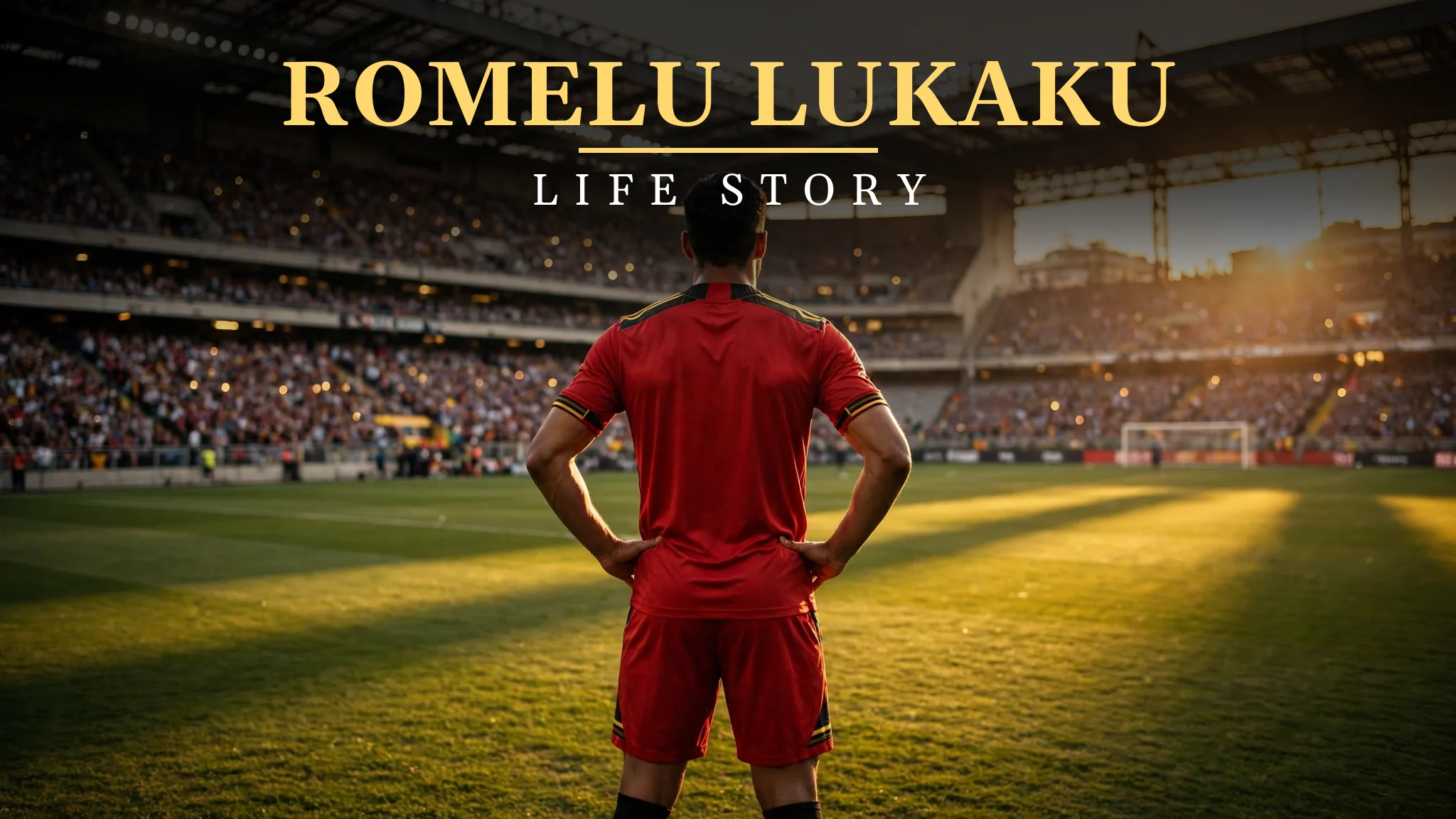
Romelu Lukaku: The Life Story Behind Belgium's Powerful Striker
In this post
- A Hungry Childhood in Antwerp
- Anderlecht: A Teenage Star in Belgium
- Chelsea, Loans, and Learning the English Game
- Manchester United and the Weight of Expectation
- Inter Milan: The Best Years and a League Title
- The Second Chelsea Spell, Loans, and Napoli
- Belgium’s Record Scorer and the Fight Against Racism
- What Lukaku’s Hunger Teaches Us
- Napoli and the Reunion With Conte
- My Take:
Romelu Lukaku remembers being hungry. He has spoken about it openly, about the days when there was no food in the house, about the glass of water his mother gave him to fill his stomach, and about the promise he made to himself, as a boy, that he would change his family’s life through football. That hunger never left him. It is in the way he plays: strong, direct, and determined, a striker who fights for every ball as if it matters more than the last one. It is also in the way he has lived his career: through criticism, through doubt, and through moves that did not work, he has kept going, kept scoring, and kept proving people wrong.
He was born in Antwerp, in Belgium, to parents from Congo, and his father, Roger, had been a professional footballer. The family did not have much money, and Lukaku grew up understanding that football was not a hobby. It was a chance, perhaps the only chance, to give his family a better life. He was big for his age, and he scored goals from the moment he started playing. At Anderlecht, he made his debut at sixteen, and he became the top scorer in Belgium at seventeen. It was the start of a career that would take him to Chelsea, to Everton, to Manchester United, to Inter Milan, and to Napoli, and that would make him the greatest goalscorer in the history of the Belgium national team.
What makes his story different from other strikers is that he has never been loved in the way that other great strikers are loved. He has been criticised for his first touch, for his weight, for his movement, and for his failures in big games. He has been racially abused, and he has spoken out against it with courage. He has been sold, loaned, and doubted, and each time he has come back and scored goals. His story is not a story of easy success. It is a story of a man who was hungry as a boy, and who has stayed hungry as a man, and who refuses to let other people’s opinions decide what he can do.
A Hungry Childhood in Antwerp
Romelu Menama Lukaku Bolingoli was born on 13 May 1993 in Antwerp, Belgium. His father, Roger Lukaku, had played professional football in Belgium and in Congo, and his mother, Adolphine, looked after the family. He had a younger brother, Jordan, who also became a professional footballer. The family lived in a poor area of Antwerp, and money was often short. Lukaku has spoken about coming home from school and finding that there was no food, and about his mother mixing water with milk to make it last longer. He has said that he knew, even as a child, that he had to do something to help his family, and that football was the way.
He started playing football at a young age, for a local club called Rupel Boom, and then for Lierse, a bigger club in Belgium. He was much bigger and stronger than other boys his age, and he scored goals easily. But his size also caused problems. Other parents and coaches accused him of lying about his age, because they could not believe that a boy of his size was really as young as he said he was. His mother had to bring his birth certificate to games to prove that he was telling the truth. It was a humiliating experience for a boy, and it taught him early that people would doubt him, and that he would have to prove himself again and again.
He joined the youth academy of Anderlecht, the biggest club in Belgium, when he was thirteen, and he worked his way through the system. He was a striker who could score with his left foot and his right foot, who could head the ball, and who could hold the ball up with his back to goal. He was not a fancy player. He did not dribble past five men. He was a powerful player, a direct player, and he scored goals. The coaches at Anderlecht saw that, and they gave him his chance. He made his first-team debut in May 2009, when he was sixteen years old, and he scored his first goal soon after. The boy who had been hungry was now a professional footballer, and his family’s life was beginning to change.
Anderlecht: A Teenage Star in Belgium
At Anderlecht, Lukaku became a star very quickly. In the 2009-10 season, when he was sixteen and seventeen, he was the top scorer in the Belgian league, with fifteen goals, and he helped Anderlecht win the title. It was an extraordinary achievement for a teenager, and it made him one of the most talked-about young players in Europe. He was big, he was strong, and he scored goals, and clubs from England, Spain, and Italy were watching him. He played in the Europa League, and he scored goals against teams from bigger leagues, showing that he could do it at a higher level.
He stayed at Anderlecht for two more seasons, and he continued to score. He won another league title, and he became the player the fans loved most, because he was one of their own, a boy from Antwerp who had come through the academy and who played with passion. He was still a teenager, but he was already the leader of the attack, and he carried the hopes of the club on his shoulders. He also made his debut for Belgium in 2010, when he was seventeen, and he scored his first international goals soon after. It was clear that he was going to be a star, and that he would not stay in Belgium for long.
In the summer of 2011, when he was eighteen, he joined Chelsea, in England, for a fee of around eighteen million pounds. It was a huge move for a young man, and it was a dream come true, because Chelsea were one of the best clubs in the world. But it was also a difficult move, because Chelsea had Didier Drogba, one of the great strikers of his generation, and Lukaku was not going to play ahead of him. He would have to wait, to learn, and to prove himself in a new country, in a new league, and in a new language. The hungry boy from Antwerp was now in London, and his real education was about to begin.
Chelsea, Loans, and Learning the English Game
Lukaku’s first spell at Chelsea was frustrating. He played only a handful of games in his first season, and he did not score. He was young, he was behind Drogba, and the manager did not trust him in big games. He was loaned to West Bromwich Albion for the 2012-13 season, and there he found his feet. He scored seventeen goals in the Premier League, including a hat-trick against Manchester United on the last day of the season, in a 5-5 draw that is still remembered. It was a performance that showed he could score in England, against the best teams, and it gave him confidence.
The next season, he was loaned to Everton, and he scored fifteen goals in the league. Everton wanted to sign him permanently, and in the summer of 2014, they did, for a club-record fee of twenty-eight million pounds. At Everton, he became the main striker, and he scored goals season after season. He scored twenty-five goals in all competitions in the 2016-17 season, and he was one of the top scorers in the Premier League. He was still only twenty-three, and he was already one of the most feared strikers in England. He was strong, he was fast for his size, and he had learned to link up with his teammates, to hold the ball, and to bring others into the game.
But he wanted more. Everton were a good club, but they were not winning trophies, and Lukaku wanted to win. He wanted to play in the Champions League, and he wanted to be at a club that could challenge for the title. In the summer of 2017, Manchester United came for him, and he joined them for a fee of seventy-five million pounds. It was a huge step, and it was a chance to prove that he could score goals at the very top, for one of the biggest clubs in the world. He started well, scoring goals in his first games, but his time at United would be mixed, and it would teach him a hard lesson about pressure and expectation.
Manchester United and the Weight of Expectation
At Manchester United, Lukaku scored twenty-seven goals in his first season, in all competitions, which is a good return for a striker. But the team was not winning the league, and the fans and the press expected more. They criticised his first touch, they said he was too heavy, and they said he did not score in big games. Some of the criticism was fair, because he did miss chances, and he did struggle against the best defences. But some of it was unfair, and it was cruel, because he was a young man playing for a club in a difficult period, with managers changing and with no clear plan.
In his second season, his form dipped, and he scored fewer goals. He was dropped from the team, and he was unhappy. He felt that the club did not believe in him, and that the fans did not appreciate him. He also felt that he was being judged more harshly than other players, because of his size, because of his background, and because of the colour of his skin. He has spoken about the racism he faced in football, and about the monkey chants he heard in stadiums, and he has said that it hurt him, and that it made him stronger. He decided to leave United, and in the summer of 2019, he joined Inter Milan, in Italy, for a fee of around seventy-four million euros. It was a fresh start, in a new country, with a new manager, and it would become the best period of his club career.
Inter Milan: The Best Years and a League Title
At Inter, Lukaku found a manager who believed in him: Antonio Conte. Conte had wanted to sign him for years, and he built the team around him. He played Lukaku alongside Lautaro Martínez, a young Argentine striker, and the two of them formed a partnership that was one of the best in Europe. Lukaku scored goals, he made assists, and he played with a confidence that he had not shown at United. He was the leader of the attack, and the Inter fans loved him, because he played with passion and with power, and because he scored in the big games, including against Juventus and AC Milan.
In the 2020-21 season, Inter won the Italian league title, their first in eleven years, and Lukaku was named the best player in Serie A. He scored twenty-four goals in the league, and he made eleven assists, which is a remarkable number for a striker. He was, by common consent, the best striker in Italy, and one of the best in Europe. He had proved, once and for all, that he could lead a team to a title, and that he could score goals at the highest level. It was the happiest time of his career, and he spoke about how much he loved Inter, the fans, and the city of Milan.
But football is a business, and Inter were in financial trouble. In the summer of 2021, Chelsea came back for him, offering a fee of almost one hundred million pounds, and Inter, who needed the money, sold him. Lukaku did not want to leave, and he said so, but the club had made its decision. He returned to Chelsea, to the club where his English career had begun, and he hoped to win the Premier League. It was a move that would not work out, and it would become one of the most disappointing chapters of his career.
The Second Chelsea Spell, Loans, and Napoli
Lukaku’s second spell at Chelsea was a disaster. He started well, scoring goals in his first games, but then he was injured, and he lost his place in the team. The manager, Thomas Tuchel, did not play him in the way Conte had played him at Inter, and Lukaku struggled. He gave an interview in which he said he was unhappy, and that he wanted to return to Inter, and the interview made things worse. The Chelsea fans turned against him, the club fined him, and he was dropped from the team. He scored only eight goals in the league that season, and it was clear that the move had been a mistake.
He returned to Inter on loan for the 2022-23 season, and he played in the Champions League final, where Inter lost to Manchester City. He missed chances in that final, and he was criticised again, but he had helped Inter reach the final, and he had scored important goals along the way. The next season, he was loaned to Roma, where he played under José Mourinho, and he scored goals in Serie A and in Europe. He was still a good striker, but he was no longer the player he had been in his first spell at Inter. The years of criticism, of moves, and of loans had taken their toll.
In the summer of 2024, he joined Napoli, permanently, reuniting with Antonio Conte, the manager who had brought the best out of him at Inter. It was a fresh start, in a familiar system, with a manager who trusted him. He scored goals, he helped Napoli challenge for the title, and he showed that, at thirty-one, he still had a great deal to offer. It was a reminder that a player’s career is long, and that a bad move does not have to be the end. Lukaku had been written off many times, and he had come back many times, and Napoli was another comeback, another chance to prove that he was still one of the best strikers in Europe.
Belgium’s Record Scorer and the Fight Against Racism
While his club career went up and down, his career with Belgium was a story of steady success. He made his debut in 2010, and he became the team’s main striker for more than a decade. He played at the World Cup in Brazil in 2014, where he scored a goal in the knockout stage, and he played at the European Championship in France in 2016. At the World Cup in Russia in 2018, he scored four goals, and Belgium finished third, their best ever result. He scored goals in every tournament, and he became the all-time top scorer for Belgium, passing the records of the players who had come before him.
He has scored more than eighty goals for Belgium, which is a remarkable achievement, and he is one of the most capped players in the country’s history. He has played with Eden Hazard, Kevin De Bruyne, and Thibaut Courtois, in a golden generation that gave Belgium its best years, even if they never won a major trophy. Lukaku’s goals were the foundation of that team’s success, and without him, Belgium would not have been as feared. He was the striker who could score against any defence, and his record speaks for itself.
He has also been a voice against racism in football. He has spoken about the abuse he has faced, about the monkey chants, and about the need for football to do more to protect black players. He has said that players should walk off the pitch if they are abused, and that clubs and federations should take stronger action. He has used his platform to speak out, and he has done so with courage, because speaking out can make a player a target. He did it anyway, because he believes it matters, and because he wants the next generation of black players to have a better experience than he did.
What Lukaku’s Hunger Teaches Us
Lukaku’s story is a story about hunger, in every sense of the word. He was hungry as a boy, and that hunger made him determined. He was hungry as a player, and that hunger made him score goals. He is still hungry, at thirty-one, and that hunger keeps him going, even after all the criticism and all the setbacks. He has never been the most elegant striker, and he has never been the most loved, but he has always been one of the most determined, and that determination has taken him further than many more talented players.
He teaches a lesson about resilience. He has been criticised, he has been sold, he has been loaned, and he has been abused, and he has kept going. He has not given up, he has not hidden, and he has not stopped scoring. That is a lesson for anyone who faces criticism in their life. Other people’s opinions do not have to decide what you can do. You can decide for yourself, by working, by believing, and by refusing to quit. Lukaku has done that, again and again, and that is why his story matters, even if he never wins the Ballon d’Or or the World Cup.
Napoli and the Reunion With Conte
When Lukaku joined Napoli in the summer of 2024, it was a reunion with the manager who had brought the best out of him. Antonio Conte had been his manager at Inter, where Lukaku had his best season, and now Conte was at Napoli, and he wanted Lukaku again. It was a fresh start, in a familiar system, with a manager who trusted him. Conte played him as the main striker, he gave him the freedom to hold the ball up, to link the play, and to score, and Lukaku repaid him with goals. He scored in his first games, he helped Napoli challenge for the title, and he showed that, at thirty-one, he still had a great deal to offer.
It was also a chance to prove that the bad years were behind him. He had been criticised at Chelsea, he had been loaned to Inter and to Roma, and many people said he was finished. At Napoli, he proved them wrong again, as he had done many times before. He scored goals, he worked hard, and he played with the hunger that had defined his whole career. The Napoli fans loved him, because he played with passion, because he fought for every ball, and because he scored. It was a reminder that a player’s career is long, and that a bad move does not have to be the end. Lukaku had been written off many times, and he had come back many times, and Napoli was another comeback, another chance to show that he was still one of the best strikers in Europe.
My Take:
I think Romelu Lukaku is one of the most misunderstood footballers of his generation, and I say that because I have watched people criticise him for years, and I have never understood why the criticism is so harsh. He scores goals. He has scored goals everywhere he has played: in Belgium, in England, in Italy, and for his country. He is the top scorer in the history of Belgium, with more than eighty goals. He has won league titles, he has played in a Champions League final, and he has been one of the best strikers in Europe. And yet, people talk about him as if he is a failure. I do not understand it, and I think it says more about the people who criticise him than it does about him.
What I admire most is his hunger. He was hungry as a boy, literally hungry, with no food in the house, and he promised himself that he would change his family’s life. He did. He became a professional footballer, he earned money, and he gave his family a better life. That is not a small thing. That is a great thing. And the hunger did not go away when he became rich. He still plays like a man who is hungry, who fights for every ball, who runs for every chance, and who refuses to give up. I think that hunger is his greatest quality, and it is the reason he has scored so many goals. He wants it more than most players, because he remembers what it was like to have nothing.
I also think about the way he was treated as a boy, when people accused him of lying about his age because he was so big. His mother had to bring his birth certificate to games to prove that he was really as young as he said he was. That is a humiliating thing for a child, and it must have hurt him deeply. But he did not let it stop him. He kept playing, he kept scoring, and he proved, again and again, that he was who he said he was. I think that experience taught him a lesson that has stayed with him: people will doubt you, and you will have to prove yourself, not once, but many times. He has proved himself many times, and he is still proving himself, at Napoli, at thirty-one.
His time at Inter, under Antonio Conte, is the part of his career I admire most, because it shows what he can do when a manager believes in him. Conte built the team around him, he gave him confidence, and Lukaku repaid him with goals, assists, and a league title. He was named the best player in Italy, and he was, for a season, one of the best strikers in the world. That is what happens when a player is trusted. He plays with freedom, he plays with confidence, and he plays at his best. I think every player needs a manager who believes in him, and Lukaku found that manager in Conte, twice, at Inter and at Napoli. I am glad they are together again, because Conte knows how to get the best out of him.
I am honest about his weaknesses too. His first touch can be heavy, and he does miss chances that he should score. He missed chances in the Champions League final in 2023, and those misses cost Inter the trophy. I will not pretend that did not happen. He is not a perfect striker, and he never has been. But no striker is perfect. Every striker misses chances. The difference is that Lukaku’s misses are remembered, while other strikers’ misses are forgotten. I think that is unfair, and I think it is because people have already decided what they think of him, and they look for evidence to support their opinion. If you think he is clumsy, you will remember the chances he missed. If you think he is great, you will remember the goals he scored. I choose to remember the goals, because there have been so many of them.
The racism he has faced is the part of his story that makes me angriest. He has been abused in stadiums, he has heard monkey chants, and he has been treated as less than human because of the colour of his skin. That is wrong, and it is shameful, and football has not done enough to stop it. Lukaku has spoken out about it, with courage, and he has said that players should walk off the pitch if they are abused. I agree with him. No player should have to play while people are shouting racist abuse at him. I admire him for speaking out, because it is not easy to do, and it can make you a target. He did it anyway, because he believes it is right, and because he wants the game to be better for the next generation.
I also think about his second spell at Chelsea, and how badly it went. He returned to Chelsea for almost one hundred million pounds, and he scored only eight league goals. It was a disaster, and I think both sides share the blame. Chelsea bought him, but they did not play him in the way Conte had played him at Inter. Tuchel wanted a different kind of striker, and Lukaku did not fit. Lukaku gave an interview in which he said he was unhappy, and that made things worse. It was a mess, and it hurt his reputation. But I do not think one bad season should define a career. He had been brilliant at Inter, and he was brilliant again at Napoli, and the Chelsea season was an exception, not the rule. People who judge him only by that season are not being fair.
What I learn from Lukaku is that resilience matters more than talent. He has been criticised, sold, loaned, and abused, and he has kept going. He has not given up, he has not hidden, and he has not stopped scoring. That is a lesson for anyone who faces criticism in their life. You do not have to listen to the people who doubt you. You can keep working, keep believing, and keep proving them wrong. Lukaku has proved people wrong many times, and I think he will prove them wrong again, because that is what he does. He is a man who was hungry as a boy, and who is still hungry now, and hunger is a powerful thing.
I also learn something about the importance of a manager who believes in you. At Inter, Conte believed in him, and he was the best player in Italy. At United, the managers did not always believe in him, and he struggled. At Chelsea, Tuchel did not believe in him, and he failed. At Napoli, Conte believes in him again, and he is scoring again. That pattern is clear, and it tells me that a player’s form is not only about the player. It is also about the manager, the system, and the trust. When Lukaku is trusted, he is a great striker. When he is not trusted, he is an ordinary one. I think clubs should remember that when they buy a player. It is not enough to pay a lot of money. You have to build a team around him, and you have to believe in him.
I think about his record for Belgium, and I am proud of it for him. More than eighty goals for his country, the top scorer in Belgian history, and a player who has led his country to third place at a World Cup. That is a legacy that no one can take away from him. He may never win the Ballon d’Or, and he may never win the World Cup, but he will always be Belgium’s greatest goalscorer, and that is a title that matters. When Belgian children grow up and learn about their football history, they will learn about Lukaku, and they will see a man who scored goals for his country for more than a decade, and who did it with pride.
If I could say one thing to the people who criticise him, I would say this: look at the numbers. Look at the goals. Look at the titles. Look at the record for Belgium. A player who has done all of that is not a failure. He is a success, and he deserves respect. You do not have to love his style, and you do not have to think he is the best striker in the world, but you should respect what he has achieved, because it is a great deal. He came from a poor childhood in Antwerp, and he became one of the best strikers in Europe. That is a story worth respecting, and it is a story worth telling.
In the end, I will remember Lukaku as a fighter. He fought for food as a boy, he fought for a place in the team as a teenager, he fought against racism as a man, and he fought against criticism throughout his career. He is still fighting, at Napoli, at thirty-one, and I hope he keeps fighting, because fighters like him are rare in football. The game needs players who do not give up, who keep going when it is hard, and who score goals when people say they cannot. Lukaku is one of those players, and I admire him for it, more than I admire many players who had easier careers and who were loved more.
I also hope that young players from poor backgrounds hear his story and feel hope. He was hungry, he was doubted, and he was told he was lying about his age. He did not give up. He worked, he scored, and he changed his family’s life. That is a message that matters, not only in football, but in life. Where you start does not decide where you finish. What you do, how hard you work, and how much you believe, matters more. Lukaku believed, and he worked, and he finished as one of the great strikers of his generation. That is a legacy to be proud of.
Finally, I want to say that I think history will be kinder to Lukaku than the present has been. When he retires, and people look back at his career, they will see the goals, the titles, and the record for Belgium, and they will wonder why he was criticised so much. They will see a striker who scored more than three hundred goals in his career, who won league titles in Belgium and Italy, and who led his country to third place at a World Cup. That is a great career, by any measure, and I think future fans will recognise it. I hope Lukaku knows that, and I hope he is proud of what he has done, because he should be.
I also think about his mother, Adolphine, and the role she played in his life. She gave him water when there was no food, she brought his birth certificate to games to prove his age, and she supported him through everything. She is the hero of his story, as much as he is, because without her, he would not have made it. He has spoken about her with love, and he has said that everything he does is for his family. I think that is a beautiful thing, and it is part of why his story matters. He did not play only for himself. He played for his mother, for his father, and for his brother, and he changed their lives through football. That is a greater achievement than any trophy.
There is one more thing I want to say, and it is about his voice against racism. He has spoken out, again and again, about the abuse he has faced, and about the need for football to do more. He has said that players should walk off the pitch, and that clubs should be punished. Some people said he should just play football and not talk about politics. I disagree. Football is part of life, and racism is part of life, and a player who speaks out is doing the right thing. Lukaku spoke out, and he did it with courage, and I respect him for it. He used his platform to help others, and that is a legacy that matters more than any goal.
Frequently Asked Questions
When was Romelu Lukaku born and where did he grow up?
Romelu Lukaku was born on 13 May 1993 in Antwerp, Belgium, to parents from Congo. He grew up in a poor area of the city, and he has spoken about going hungry as a child, which drove him to succeed through football.
Which clubs has Romelu Lukaku played for?
He has played for Anderlecht, Chelsea, West Bromwich Albion on loan, Everton, Manchester United, Inter Milan, Roma on loan, and Napoli. His best years were at Inter under Antonio Conte, where he won the Italian league title in 2021.
Is Romelu Lukaku Belgium’s top scorer?
Yes, he is the all-time top scorer for Belgium, with more than eighty goals. He made his debut in 2010, played at the World Cups in 2014, 2018, and 2022, and helped Belgium finish third at the 2018 World Cup in Russia.
Why did Lukaku’s second spell at Chelsea go so badly?
He returned to Chelsea in 2021 for almost one hundred million pounds, but he struggled with injuries, did not fit the manager’s system, and gave an interview saying he was unhappy and wanted to return to Inter. He scored only eight league goals that season before leaving on loan.
What has Lukaku said about racism in football?
He has spoken out strongly against racist abuse, saying players should walk off the pitch if they are abused and that football must do more to protect black players. He has faced monkey chants himself and has used his platform to call for stronger action.
How many goals did Lukaku score in his best Inter season?
In the 2020-21 season, when Inter won the league title, he scored twenty-four goals in Serie A and made eleven assists. He was named the best player in the league that season.
Where does Romelu Lukaku play now?
In the summer of 2024, he joined Napoli, reuniting with Antonio Conte, the manager who brought the best out of him at Inter. He has scored goals for Napoli and helped them challenge for the Italian title.


