Rubén Rada: The Life Story Behind Uruguay's Music Legend
In this post
Rubén Rada is the sound of Uruguay at its happiest and its proudest. When he plays, the drums of candombe lead the way, and everything else follows: the bass, the guitar, the horns, and his own warm, smiling voice. He is an Afro-Uruguayan musician, and his life story is the story of a music that began in the streets and the neighbourhoods of Montevideo and grew into something the whole world recognises. For more than sixty years he has been singing, drumming, and laughing on stage, and he has never lost the joy that made him start.
He was born in Montevideo in 1943, and he grew up with the sound of the drums all around him. Candombe is the music of the Afro-Uruguayan community, played on three kinds of drums called chico, repique, and piano, and it is the heartbeat of the Uruguayan carnival. Rada learned that rhythm as a child, and he carried it with him into every kind of music he touched afterwards: rock, jazz, funk, pop, and the songs he wrote for children. He did not keep candombe in a museum. He took it out into the world and let it dance with everything else.
What makes Rada special is not only his music but his spirit. He is known as a man who smiles, who jokes, and who makes an audience feel like family. He has lived through hard times in Uruguay, including years of military rule, and he has lived abroad in Argentina and the United States, but he always came back to the music of his home. He has worked with some of the greatest musicians of Latin America, he has made dozens of albums, and he is still performing in his eighties, still drumming, still singing, and still making people dance. This is the story of how a boy from Montevideo became the living voice of candombe.
Growing Up With the Drums of Montevideo
Rubén Rada was born on 16 July 1943 in Montevideo, the capital of Uruguay. He was born into an Afro-Uruguayan family, and his full name is Omar Rubén Rada Silva. From the time he was a small boy, music was part of daily life. The neighbourhoods of Montevideo had a strong Afro-Uruguayan culture, and the sound of the drums was everywhere: at carnival, at street parties, and at gatherings of friends and family. Rada listened to those drums, and he learned to play them, and the rhythm became part of him in a way that never left.
Candombe is not just a style of music. It is a history. It was brought to Uruguay by enslaved Africans centuries ago, and it survived through the generations as a way of keeping a community together. The drums speak to each other, and the dancers answer, and the whole thing is a conversation. Rada grew up inside that conversation, and he understood from an early age that music was not only entertainment. It was identity. It was a way of saying who you are and where you come from, and it was a way of being proud of it.
As a teenager, Rada began to play in bands. He was drawn to the drums, but he was also drawn to singing, and he had a natural gift for both. He listened to the music that was coming from the United States and from Britain: jazz, rock and roll, and the new sounds of the 1960s. He did not see any conflict between those sounds and the candombe of his childhood. To him, they were all music, and they could all live together in the same song. That open way of listening would shape his whole career.
Montevideo in the 1960s was a lively place for a young musician. There were clubs, there were dances, and there were bands playing every kind of music. Rada moved through that world with energy and charm, and people noticed him. He was young, he was talented, and he had a smile that made audiences warm to him at once. He was learning his craft night by night, and he was also learning something else: that a musician who can make people dance and make people think at the same time is a rare and valuable thing.
Los Hot Blowers and the First Steps on Stage
Rada’s first important band was Los Hot Blowers, a group he joined as a young man in the 1960s. The band played a mix of jazz and popular music, and Rada sang and played drums with them. It was his first taste of professional music, and it taught him how a band works: how to rehearse, how to perform, how to listen to the other musicians, and how to win over an audience that does not know you yet. He was still very young, but he was learning fast.
After Los Hot Blowers, Rada became part of one of the most important groups in Uruguayan music history: El Kinto Conjunto, which he formed with Eduardo Mateo, another great Uruguayan musician. El Kinto was a small band with a big idea. They mixed candombe with rock, with jazz, and with the new sounds coming from Britain and the United States, and they created something that had never been heard before in Uruguay. The band did not last long, and it did not sell many records at the time, but its influence was enormous. Musicians who heard El Kinto never forgot it, and the band is now remembered as a turning point in Uruguayan music.
Rada’s work with El Kinto showed the world what he could do. He could take the drums of his childhood and put them next to an electric guitar, and it sounded natural. He could sing a song that was both a candombe and a rock song, and it made sense. That ability to mix things that other people thought could not be mixed became the centre of his music. He was not a purist who believed that candombe had to stay exactly as it was. He believed that candombe was alive, and that living things grow and change.
In the late 1960s, Rada began his solo career, and he released his first records under his own name. The songs were full of the energy he had learned on stage, and they showed a singer who was confident and original. He was no longer just a member of a band. He was Rubén Rada, and he was beginning to build a name that would last for decades. The road ahead was long, and it would take him far from home, but the drums of Montevideo would travel with him everywhere he went.
Candombe Meets Rock, Jazz, and the World
In the 1970s, Rada’s music grew bolder and more international. He began to mix candombe with funk, with jazz, and with rock, and he created a sound that was entirely his own. His albums from this period are full of energy, humour, and rhythm, and they show a musician who is not afraid to try anything. He sang in Spanish, he played drums, and he led bands that could make a room dance within seconds of the first note. People who heard him for the first time often said the same thing: they had never heard anything quite like it.
One of his most loved songs is Cha-cha, muchacha, a joyful song that became a classic in Uruguay and beyond. Another is Ayer te vi, a song that shows his softer side, with a melody that stays in the mind. These songs are not complicated, and that is part of their power. They are direct, warm, and full of life, and they work as well in a small club as they do in a big stadium. Rada has always understood that a great song does not need to be difficult. It needs to be true, and it needs to move the people who hear it.
During these years, Rada also began to travel and to live abroad. He spent time in Argentina, where he worked with many important musicians, and he spent time in the United States, where he played with jazz musicians and learned even more about the music of the world. Living abroad changed him, but it did not change his roots. Wherever he went, he carried candombe with him, and he introduced it to audiences who had never heard it before. He became an ambassador for Uruguayan music without ever trying to be one. He simply played, and people listened.
The 1970s were also a difficult time for Uruguay. The country was moving towards military rule, and many artists and musicians found life hard. Rada kept working, but the times were tense, and many of his friends and fellow musicians left the country. He understood that music could not fix everything, but he also understood that music could keep a community alive, and that it could give people joy when joy was hard to find. That belief stayed with him through the darkest years.
Rada has also been important as a songwriter in his own right, not only as a performer. His songs have a direct and honest way with words, and they often talk about daily life, about love, about friendship, and about the neighbourhoods of Montevideo. He writes in a Spanish that is warm and close to the way people actually speak, and that is part of why his songs are so loved. They do not sound like they were written in a distant studio. They sound like they were written on a street corner, in a kitchen, or at a party, and that closeness is something a listener feels at once. A song that sounds like real life is a song that stays in real life.
His influence on other musicians is hard to measure, because it is everywhere. Almost every Uruguayan musician who mixes candombe with other styles is walking on a road that Rada helped to build. He showed that it was possible to be proud of your roots and open to the world at the same time, and that the two things do not fight each other. They help each other. A musician who knows where he comes from can travel further, because he always knows the way home, and Rada has proved that again and again.
He has also been a generous collaborator, always ready to play with musicians younger than himself and to learn from them. Many older stars become closed and protective, but Rada has stayed open, and that openness is one of the reasons his music never sounds old. He listens to the young, he tries their ideas, and he lets their energy into his songs, and in return he gives them his experience and his rhythm. That exchange between the generations is at the heart of his long career, and it is a model for any artist who wants to last.
Hard Years, Exile, and the Return Home
Uruguay fell under military rule in 1973, and the years that followed were hard for artists. Censorship, fear, and the loss of friends changed the country, and many musicians went into exile. Rada spent long periods outside Uruguay, living and working in Argentina and in the United States, and those years were a mix of success and sadness. He was making music and meeting new audiences, but he was far from home, and home was going through a painful time. He kept in touch with the musicians who had stayed, and he kept writing songs that carried the sound of Montevideo, even when he was playing them in Buenos Aires or New York.
Living in the United States gave Rada a chance to work with jazz musicians, and his music became even richer. He learned new rhythms, new harmonies, and new ways of leading a band, and he brought all of that back into his own songs. He was not a man who stood still. Every new place taught him something, and every new musician he met added something to his sound. But the heart of the music stayed the same: the drums, the voice, and the joy.
When democracy returned to Uruguay in the 1980s, Rada came home, and his return was a happy moment for the country. He was welcomed as a legend, and he began a new chapter in his career, playing big concerts, recording new albums, and working with a new generation of Uruguayan musicians. He was no longer a young man, but his energy had not faded. If anything, it had grown, because he was home, and he was playing for the people who had loved his music from the beginning.
The years after his return were some of the most productive of his life. He made albums, he played on television, he worked in theatre, and he became a familiar face to a whole new generation. Young people who had not been born when he started were now dancing to his songs, and they were learning about candombe through him. He had become a bridge between the old Uruguay and the new one, and he carried that role with grace and humour.
The Voice of the Carnival and the Stage
One place where Rada has always belonged is the carnival of Montevideo, the long summer festival where the streets fill with drums, dancers, and colour. Carnival in Uruguay is not a small party. It lasts for weeks, and it is one of the longest carnivals in the world. The heart of it is the llamada, the parade of the candombe groups, where the drums walk through the streets and the whole neighbourhood follows. Rada grew up with that sound, and he has returned to it again and again throughout his life, not as a visitor but as one of its own people. When he plays at carnival time, he is not performing a tradition from the outside. He is living inside it.
The carnival is also a place where the Afro-Uruguayan community shows its pride to the whole country. For centuries, that community was pushed to the edges of Uruguayan life, and its music was treated as something small or strange. Carnival turned that around, because for a few weeks every year, the drums were at the centre of everything, and everyone listened. Rada understood that power from the time he was a boy, and he carried it into his whole career. He did not only play candombe at carnival. He played it on television, on big stages, and in other countries, so that the pride of carnival could be felt all year round.
Rada has also been a man of the theatre and of television, and those stages taught him different skills. On television, he learned how to talk to an audience that was sitting at home, and how to be funny and warm in a small space. In the theatre, he learned how to hold a room with his voice and his presence alone, without a big band behind him. These were not side jobs for him. They were part of the same work: the work of reaching people and making them feel something. A musician who can do that on a street, on a stage, and on a screen is a rare artist, and Rada is one of them.
He has also written songs for children, and that work shows another side of him. Children’s songs are hard to write well, because they have to be simple without being silly, and they have to be fun without being empty. Rada’s songs for children are full of rhythm and humour, and they teach children about music without lecturing them. Many Uruguayan children have grown up singing his songs, and that means his music is now part of childhood itself, which is a beautiful kind of legacy. A song that a child sings is a song that will live for a very long time.
Through all of these stages, the carnival, the theatre, the television studio, and the classroom, Rada has kept the same quality: he is present. He is not thinking about the next thing while he is doing this thing. He is there, with the people in front of him, and he gives them his full attention. That is why his audiences love him. They can feel that he is not performing at them. He is performing with them, and the difference is everything.
The Later Years and the Love of a Nation
In the decades that followed, Rada became one of the most loved figures in Uruguay. He made many more albums, including records that mixed candombe with pop, with rock, and with the music of his grandchildren’s generation. He worked with his children, who are also musicians, and the Rada family became a musical family in the truest sense. His son Matías and his daughter Julieta have both made their own music, and Rada has always been proud of them, and happy to share a stage with them.
He also became a popular figure on television and in the theatre, where his humour and his warmth made him a natural performer. He has acted, he has hosted shows, and he has been a judge on music programmes, where young singers look up to him as a master. He takes that role seriously, but he also takes it lightly. He does not lecture young musicians. He encourages them, he laughs with them, and he reminds them that music should be fun, even when it is serious work.
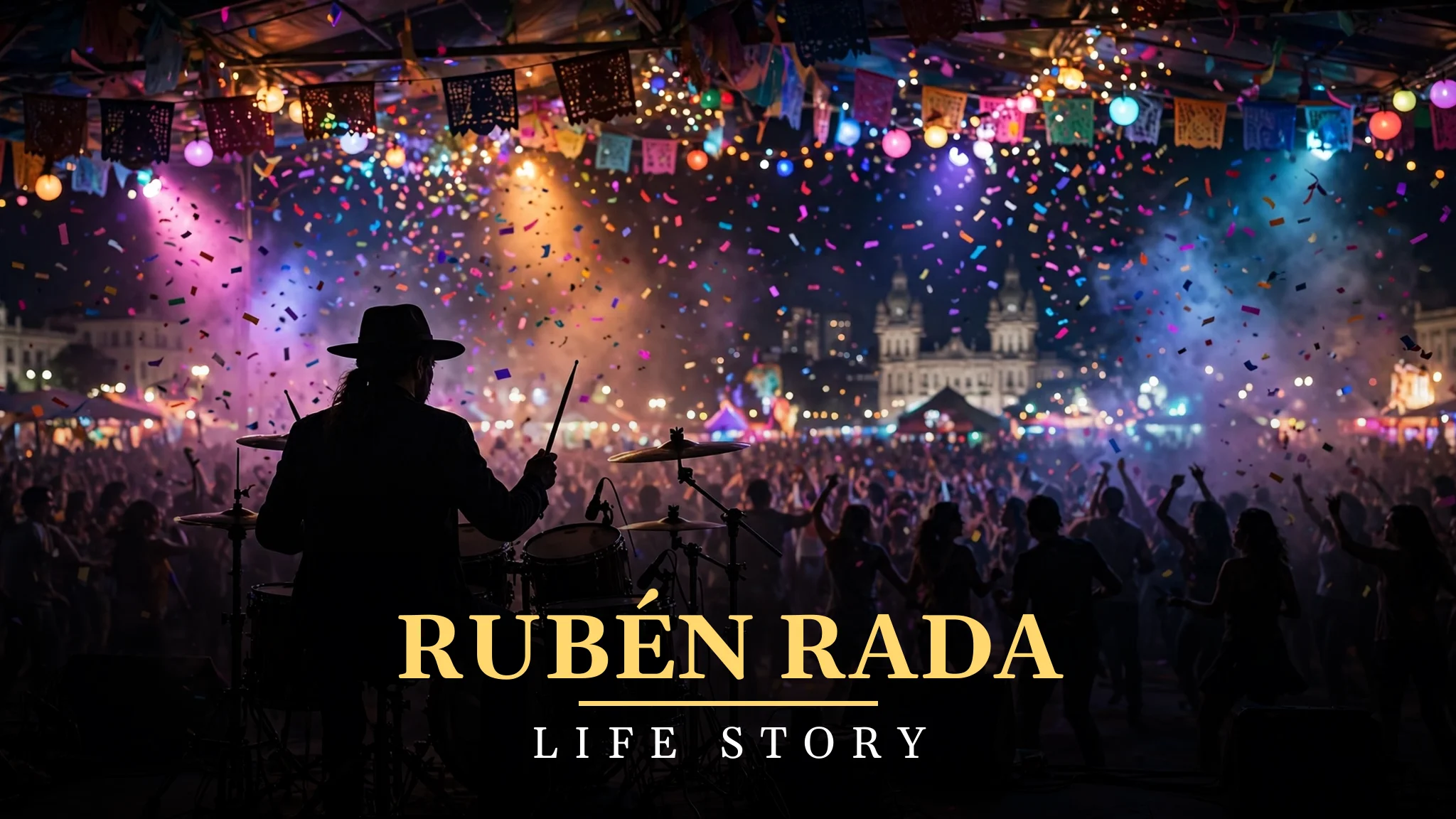
Rada’s concerts in his seventies and eighties have been remarkable. He still drums, he still sings, and he still moves with an energy that surprises people half his age. Audiences of all ages come to see him, from grandparents who danced to his songs in the 1970s to children who are hearing candombe for the first time. That is a rare thing in music, and it says something important about his work: it is not tied to one fashion or one decade. It is tied to rhythm, to joy, and to the sound of home.
He has received many honours in Uruguay and beyond, and he is widely regarded as a national treasure. But the honours are not what matter most to him. What matters is the music, and the people who dance to it, and the drums that have been with him since he was a boy in Montevideo. He has spent a lifetime proving that the music of a small community can speak to the whole world, and that a man who stays true to his roots can go further than a man who chases every fashion.
My Take:
I love Rubén Rada, and I love him for a simple reason: he makes happiness feel serious. That sounds strange, but I mean it. Most people think that happy music is light music, and that serious music has to be sad or angry. Rada proves that idea wrong. His music is joyful, it is full of drums and laughter, and it is also deeply serious, because it carries the history of a whole community. When he plays candombe, he is not just making people dance. He is keeping a history alive, and he is saying that the history of Afro-Uruguayan people matters, and that it deserves to be heard. That is serious work, and he does it with a smile, which makes it even more powerful.
I think about his childhood a lot. He grew up with the drums, and the drums were not a hobby. They were part of who he was, part of his family, part of his neighbourhood. I think many of us have something like that in our own lives: a sound, a smell, a place from childhood that shaped us without us knowing it. Rada was lucky, because he knew what his thing was, and he never let it go. He took the drums with him into rock, into jazz, into funk, and into pop, and the drums survived every journey. That tells me that the things we learn as children are stronger than we think, and that if we stay loyal to them, they will carry us through a whole life.
What impresses me most is that he never made candombe smaller to make it fit in. He did not water it down. He did not hide the drums to please a record company. He put the drums at the front, and he let the rest of the music follow. That takes confidence, because the easy thing would have been to make his music sound like everyone else’s. He chose the hard thing, which was to sound like himself, and the world came to him in the end. I think that is a lesson for anyone who has something of their own: do not make it smaller to fit in. Make it bigger, and let people come to you.
I also admire the way he handled the hard years. Uruguay went through a dark time, and many artists left, and many suffered. Rada kept going. He played in other countries, he learned new things, and he came home when he could. He did not become bitter, and he did not stop smiling. I think that is a choice, not an accident. He chose joy, even when joy was hard to find, and he shared that joy with other people. That is not a small thing. In hard times, a person who can make other people smile is doing important work, and Rada has been doing that work for more than sixty years.
I think about his age, too. He is in his eighties now, and he is still performing, still drumming, still singing. That is extraordinary, and it makes me think about what it means to love your work. Most people slow down, and they should, but Rada seems to get his energy from the music itself. The stage gives him life, and the audience gives him life, and he gives it back. I think the lesson is that if you find work you truly love, and you do it with other people, it can keep you young in a way that nothing else can. It is not about money, and it is not about fame. It is about the feeling of being alive in a room full of people who are alive with you.
There is something else I admire, which is his generosity. He has worked with his children, he has encouraged young musicians, and he has never acted like a star who is above everyone else. He is a master, but he behaves like a friend. I think that is why young people love him. They do not feel that he is talking down to them. They feel that he is inviting them in. That is the best kind of teacher: someone who opens a door and says, come in, there is room for you here. Rada has been opening that door for decades, and many young Uruguayan musicians have walked through it.
I feel sad when I think about how little the world knows about candombe outside Uruguay. It is a beautiful music, with a deep history, and it deserves to be as famous as samba or tango. Rada has done more than anyone to carry it to the world, but the work is not finished. I hope that people who read this story will listen to his music and then listen to other candombe musicians, and that they will learn about the Afro-Uruguayan community that created this sound. Music is a good way to learn about people, because it goes straight to the heart, and it does not need a lecture.
If I could meet Rada, I would not ask him about fame or about awards. I would ask him about the drums. I would ask him what it felt like to hear them as a boy, and what he feels now when he picks up the drumsticks at eighty years old. I think he would smile, and I think he would say something simple, and that simple thing would be the truth. The drums are home. The drums are joy. The drums are life. That is enough, and it has always been enough.
For a reader who has never heard him, I would say this: put on Cha-cha, muchacha, and let it play. Do not analyse it. Just listen, and let your body move. Then listen to Ayer te vi, and notice how the same man can make you dance and make you feel quiet and thoughtful in the same evening. That is the range of a great musician, and Rada has it. He is not only a drummer, and he is not only a singer. He is a whole world of music in one man, and that world is open to anyone who wants to enter it.
I finish thinking about Rada with a feeling of gratitude and a feeling of hope. I am grateful that a boy from Montevideo stayed loyal to the drums of his childhood and turned them into a gift for the world. I am hopeful because his story shows that a culture can survive hard times, that a community can keep its music alive, and that joy is not a luxury. Joy is a form of strength, and Rada has been strong for a very long time. Long may he play, and long may the drums sound.
I also want to say something about the way Rada treats the past. He does not treat candombe as a museum piece, something to be kept behind glass and looked at but never touched. He treats it as a living thing, something that grows and changes and meets new sounds. That is the right way to treat a tradition, I think. A tradition that never changes will die, because people will stop caring about it. A tradition that changes too much will lose itself. Rada has found the balance. He has let candombe meet rock, jazz, funk, and pop, and candombe has stayed itself through all of it. That is a difficult balance to find, and he has held it for sixty years.
I think about the young Afro-Uruguayan children who see Rada on television or on stage, and I think about what that means to them. They see a man who looks like them, who comes from where they come from, and who is loved by the whole country. That matters more than any speech about equality. A child who sees that can believe that their own music, their own story, and their own face belong at the centre of the country, not at the edge of it. Rada has given that gift to generations of children, and he has done it simply by being himself, loudly and proudly, for a very long time.
There is also a lesson in his humour. Rada is a funny man, and his concerts are full of laughter. I think humour is underrated as a strength. A person who can make people laugh can also make people listen, and a person who can make people listen can change their minds. Rada has used humour to open doors that would have stayed closed to a more serious man. He has made audiences who knew nothing about candombe fall in love with it, and he did it by making them smile first. That is a clever and generous way to work, and it is one of the reasons his career has lasted so long.
When I think about the whole of his life, from the boy listening to the drums in Montevideo to the old man still drumming in his eighties, I see a circle. He started with the drums, he travelled the world, he learned everything he could, and he came back to the drums. The circle is complete, but it is not closed. His children are musicians, his grandchildren are growing up with music, and the young people he has encouraged are making their own songs. The circle keeps growing, and that is the best ending any artist can hope for. I also think Rada teaches us something about growing old well. In a world that worships youth, he shows that an old artist can still be joyful, still be curious, and still be loved. He does not pretend to be young. He is old, and he is proud of it, and he uses his age as a strength. He has stories, he has memories, and he has a lifetime of music inside him, and all of that makes his concerts richer, not poorer. I hope that when I am old, I can carry my own years the way he carries his: lightly, proudly, and with a drum in my hands.
One last thought stays with me. Rada’s life is proof that a small country can produce a giant, and that a music born in a neighbourhood can belong to the world. Uruguay is a small place, and candombe is the music of a small community inside it, but Rada took that music and made it universal. He did it without leaving his roots behind, and without making his roots smaller. He simply played, and sang, and smiled, and the world listened. That is a story worth telling, and it is a story worth remembering, because it tells all of us that where we come from is not a limit. It is a beginning. I also admire how Rada handles fame. He is a national treasure in Uruguay, but he behaves like a neighbour, not like a monument. He talks to people, he laughs with them, and he never acts as if his fame makes him different from the people who listen to him. That humility is not an act. It comes from a man who knows that music belongs to everyone, and that a musician is only the person who carries it for a while. I think that attitude is why his fame has lasted. People do not only love his songs. They love him, and they feel that he loves them back.
Thinking about Rada makes me want to listen more carefully to the music of my own home, wherever that is, and to the music of other people’s homes too. His life shows that the most local sound can become the most universal, if it is played with honesty and joy. The drums of Montevideo were once the music of one neighbourhood. Now they are the music of a whole country, and they are known in many countries beyond it. That journey began with one boy who listened, and it continues every time someone picks up a drum and plays. That is a beautiful thought, and it is the thought I will carry with me from his story.
Frequently Asked Questions
How did Rubén Rada first become famous in Uruguay?
He first became known as a young singer and drummer in Los Hot Blowers in the 1960s, and then as a member of El Kinto Conjunto with Eduardo Mateo. El Kinto mixed candombe with rock and jazz, and it became a landmark in Uruguayan music. His solo career followed, and songs like Cha-cha, muchacha made his name known to a wide audience.
What exactly is candombe, the music Rada is known for?
Candombe is the drum music of the Afro-Uruguayan community, played on three kinds of drums called chico, repique, and piano. It grew from the traditions of enslaved Africans brought to Uruguay centuries ago. It is the central music of the Uruguayan carnival, and it is played in street parades called llamadas. Rada has spent his life bringing candombe into rock, jazz, funk, and pop.
Which Rubén Rada songs should a new listener hear first?
Start with Cha-cha, muchacha, his joyful classic, and then listen to Ayer te vi for a softer, more melodic side. After that, try his albums from the 1970s and his later records with his family. His concerts are also a good way in, because his live shows capture the energy and warmth of his music.
Did Rubén Rada live outside Uruguay during his career?
Yes, he spent long periods living and working in Argentina and in the United States, especially during the hard years of military rule in Uruguay. He worked with jazz musicians in the United States and with many Latin American artists in Argentina. He returned to Uruguay after democracy came back, and he has been based there since.
Are Rubén Rada’s children musicians too?
Yes, his son Matías Rada and his daughter Julieta Rada are both musicians, and he has performed and recorded with them. The Rada family is one of the best-known musical families in Uruguay. He is proud of his children, and he often shares the stage with them at concerts.
Is Rubén Rada still performing in his eighties?
Yes, he still performs, sings, and plays drums at concerts in Uruguay and abroad. His shows bring together audiences of all ages, from people who have followed him since the 1960s to young listeners hearing candombe for the first time. His energy on stage is widely admired.


