Ruslana: The Life Story Behind Ukraine's Wild Dances Star
In this post
- A Girl From Lviv
- Music School, Choir, and the Carpathians
- Dyki Tantsi and the Wild Sound
- Eurovision 2004 and the Victory
- After Eurovision: Music and a Public Voice
- What Her Story Means Today
- Amazonka, Eyforiya, and New Sounds
- A Public Voice Beyond Music
- Ruslana in the War Years
- The Fire That Does Not Go Out
- The Dances That Made Europe Move
- My Take:
Ruslana is the singer who made the whole of Europe dance to a Ukrainian rhythm. In 2004, she stood on the Eurovision stage in Istanbul, in a wild costume, with drums beating and dancers moving, and she sang “Wild Dances”, a song inspired by the music of the Hutsul people of the Carpathian Mountains. She won, and Ukraine won Eurovision for the first time. It was a victory of energy, of fire, and of a culture that Europe had never seen on that stage before.
She was born in Lviv in 1973, she studied music, she sang in a children’s choir, and she built a career as a singer, a songwriter, and a producer in Ukraine. Her album Dyki Tantsi, which means Wild Dances, became a huge success, and her style, a mix of pop, folk, and rock, with drums, with dance, and with the spirit of the mountains, made her different from every other singer in Europe.
Her story is also a story about a woman who cares deeply about her country. During the Euromaidan protests in 2013 and 2014, she was on the stage in Kyiv, singing, speaking, and supporting the people. She has used her fame to speak for Ukraine, for its culture, and for its freedom. This is the story of Ruslana, the wild dancer from Lviv, who brought the fire of the Carpathians to the world.
A Girl From Lviv
Ruslana Stepanivna Lyzhychko was born on 24 May 1973 in Lviv, a beautiful city in western Ukraine, then part of the Soviet Union. Lviv is a city of old streets, of churches, of coffee houses, and of music, and Ruslana grew up in that world. Her mother was a musician, and her father was an engineer, and the family loved music. Ruslana sang as a child, she took part in a children’s choir, and she showed a strong voice and a strong energy early.
As a girl, she was lively, bold, and full of life. She liked to sing, to dance, and to perform, and she was not afraid to be noticed. She took part in school concerts, she sang in festivals, and she dreamed of a life on stage. Her energy was unusual, even as a child, and people who saw her perform remembered her. She was not a quiet singer. She was a force, and that force later became the heart of her performances.
She studied music in Lviv, at a music school, and she learned to sing, to play the piano, and to understand music. She also studied at the Lviv Conservatory, where she trained as a conductor and as a singer. That training gave her a deep knowledge of music, and it taught her how to lead a performance, how to work with musicians, and how to create a show. She was not only a singer. She was a musician who understood music from the inside.
Lviv gave her a strong sense of Ukrainian culture. Western Ukraine is a place where Ukrainian language, Ukrainian songs, and Ukrainian traditions are strong, and Ruslana grew up in that world. She learned Ukrainian folk songs, she heard the music of the Carpathians, and she fell in love with the wild and free spirit of the mountains. That love later became the centre of her most famous work.
Music School, Choir, and the Carpathians
After her early years in Lviv, Ruslana continued her music studies, and she began to perform more. She sang in choirs, she took part in festivals, and she won prizes for her singing. She was a talented young musician, and she was building a career in Ukraine, a country that was becoming independent after the fall of the Soviet Union in 1991. It was an exciting time, and young artists like Ruslana felt that they could create a new Ukrainian music, free and modern, but rooted in their own culture.
She also began to explore the music of the Hutsul people, who live in the Carpathian Mountains in western Ukraine. The Hutsuls have a rich culture of music, dance, and costume, with drums, with flutes, and with wild and joyful songs. Ruslana fell in love with that music, and she began to study it, to learn its rhythms, and to bring it into her own songs. She visited the Carpathians, she met Hutsul musicians, and she learned from them. That journey into the mountains changed her music, and it gave her a sound that was entirely her own.
Her early albums in Ukraine, including Myt Vesny and Dyki Tantsi, showed her style: pop music with a folk heart, with drums, with energy, and with a voice that was strong and wild. She wrote her own songs, she produced her own music, and she created her own stage shows. She was not a singer who waited for someone else to tell her what to do. She was an artist who made her own path, and who knew what she wanted.
The Carpathians became her inspiration, and her home. She sang about the mountains, about the forests, about the fire, and about the freedom of the wild. Her music was not about a city, or about a quiet love. It was about nature, about energy, and about a people who live close to the land. That is why her songs feel so alive, and why they make people want to dance.
Dyki Tantsi and the Wild Sound
In 2003, Ruslana released the album Dyki Tantsi, which means Wild Dances, in Ukraine. The album was a huge success, and it became one of the best selling albums in Ukrainian history. It mixed pop, rock, and Hutsul folk music, with drums, with chanting, and with Ruslana’s powerful voice. The title song, “Wild Dances”, was a hit in Ukraine, and it was a song that made people move. It was fast, it was loud, and it was full of joy.
The album showed Ruslana at her best: a singer, a songwriter, and a producer who knew how to make a sound that was both modern and ancient, both pop and folk. She did not copy Western pop music. She took Ukrainian folk music and made it modern, and she took modern pop music and gave it a Ukrainian heart. That mix was new, and it was exciting, and audiences in Ukraine loved it.
Dyki Tantsi also showed her as a performer. Her concerts were wild and energetic, with dancers, with drums, with fire, and with Ruslana at the centre, singing, dancing, and leading the crowd. She did not stand still and sing. She moved, she danced, she shouted, and she made the audience move with her. Her shows were a celebration, and they were unlike anything else in Ukrainian pop music.
The success of Dyki Tantsi in Ukraine led to her being chosen to represent Ukraine at Eurovision in 2004. The album had already made her a star at home, and Eurovision would make her a star across Europe. She was ready, because she had already built a sound, a style, and a show that were entirely her own.
Eurovision 2004 and the Victory
In 2004, Ruslana represented Ukraine at the Eurovision Song Contest in Istanbul, Turkey, with the song “Wild Dances”. She performed with dancers, with drums, and with a wild energy that filled the stage. She wore a costume inspired by Hutsul folk dress, with leather, with fur, and with bold colours, and she sang and danced with a power that the audience had never seen before. The performance was a sensation, and it won the contest.
Ukraine won Eurovision for the first time, with 280 points, ahead of Serbia and Montenegro and Greece. It was a great victory, and it made Ruslana famous across Europe. “Wild Dances” became a hit in many countries, and it was played on radio stations everywhere. People who had never heard Ukrainian folk music before now knew it, and they loved it. Ruslana had brought the Carpathians to Europe, and Europe had danced to them.
Her victory was also important for Ukraine. The country had become independent only thirteen years earlier, and Eurovision was a chance to show the world what Ukraine was: a country with a rich culture, with beautiful music, and with a strong and joyful spirit. Ruslana’s win gave Ukrainians a sense of pride, and it put Ukraine on the map of European pop music. She was not just a singer. She was an ambassador for her country, and she carried that role with energy and with love.
After Eurovision, Ruslana toured Europe, she released an English version of her album, Wild Dances, and she became known in many countries. Her songs were played in clubs, on the radio, and at parties, and her name was known to Eurovision fans everywhere. She had taken a Ukrainian folk sound and made it a European hit, and that is a rare achievement.
After Eurovision: Music and a Public Voice
After her Eurovision victory, Ruslana continued to make music, to tour, and to perform. She released new albums, including Amazonka and Eyforiya, and she experimented with new sounds, with rock, with pop, and with electronic music. She also worked as a producer, and she helped other Ukrainian artists. Her concerts remained wild and energetic, and her fans stayed loyal to her.
She also became more involved in public life. In 2006, she was elected to the Ukrainian parliament, as a member of the Our Ukraine party, and she served as a deputy for a time. She wanted to use her fame to help her country, and to work for its culture and its future. Her time in politics was short, but it showed that she cared about Ukraine beyond music, and that she was willing to take on a public role.
Her most important public role came during the Euromaidan protests in late 2013 and early 2014, when Ukrainians protested in Kyiv against the government’s decision to turn away from Europe. Ruslana was on the Maidan stage, night after night, singing, speaking, and supporting the protesters. She became one of the faces of the protests, and her voice, her energy, and her courage inspired many people. She sang for the crowd, she talked to them, and she stayed with them through the cold winter nights, when the protests were at their most dangerous.
After Euromaidan, and after Russia’s annexation of Crimea and the war in eastern Ukraine, Ruslana continued to speak for Ukraine. She performed in concerts to support the country, she spoke to international audiences about Ukraine, and she used her fame to raise awareness. She is not only a singer. She is a public voice for Ukraine, and she has used that voice with courage and with love.
What Her Story Means Today
Today, Ruslana is one of the most famous singers in Ukraine, and one of the most loved Eurovision winners of all time. Her song “Wild Dances” is still played, still danced to, and still remembered as a moment when Ukrainian culture filled a European stage. She is a singer, a songwriter, a producer, and a public figure who has used her fame to support her country.
Her story matters because it shows the power of folk music, of a culture that is rooted in the land, and of a singer who is not afraid to be wild. Ruslana did not try to be a quiet pop star. She was loud, she was energetic, and she was proud of her Ukrainian roots. That pride made her famous, and it made Ukraine proud. Her victory in 2004 was not just a win in a song contest. It was a win for Ukrainian culture, and for the idea that a small country can make the whole of Europe dance.
She is still performing, still singing, and still speaking for Ukraine, especially since the full scale invasion in 2022. Her voice, her energy, and her courage are still there, and her songs still carry the fire of the Carpathians. Ruslana’s story is a story of music, of mountains, and of a woman who brought her people’s songs to the world, and who never stopped singing for her country.
Amazonka, Eyforiya, and New Sounds
After Eurovision, Ruslana released the album Amazonka in 2008, a work that continued her wild and energetic style, with strong drums, with rock guitars, and with her powerful voice. The album showed that she was not a one hit singer. She was an artist with a clear vision, who could make album after album of music that was her own. Her songs in these years were bold, they were full of energy, and they kept the fire of the Carpathians alive in her music.
She also released the album Eyforiya in 2013, which means Euphoria, and it showed a new side of her: more electronic, more modern, and more experimental. She worked with producers from other countries, she tried new sounds, and she showed that she was not afraid to change. Her music has always been about energy, and Eyforiya kept that energy, but it gave it a new form, with beats, with synths, and with a sound that was made for dancing.
Her concerts in these years remained wild and joyful, with dancers, with drums, and with Ruslana at the centre, singing and dancing with a power that filled the hall. She did not slow down, and she did not become a quiet singer. She stayed true to her style, loud, free, and full of life, and her fans loved her for it. A Ruslana concert is a celebration, and people leave it feeling happy, energised, and proud to be Ukrainian.
A Public Voice Beyond Music
Ruslana’s public life has grown beyond music, and she has become a voice for Ukraine in many ways. She has spoken at international events, she has met with leaders and with activists, and she has used her fame to raise awareness about Ukraine, about its culture, and about its struggle for freedom. She is not a politician, but she is a public figure, and she takes that role seriously.
She has also worked on projects to support Ukrainian culture, including programmes for children, for young musicians, and for the preservation of folk music. She believes that Ukrainian culture is a treasure, and that it must be protected, taught, and shared. Her work in this area is quiet and steady, and it does not always make headlines, but it matters to the people it helps, especially to young Ukrainians who are learning about their own traditions.
In recent years, she has also worked on music projects that bring together artists from different countries, showing that music can cross borders and bring people together. She believes in the power of music to heal, to unite, and to give hope, and she has used her voice to do that, in Ukraine and abroad. Her story is not only about a singer. It is about a woman who uses her art to serve her country, and who never stops believing in the power of a song.
Ruslana in the War Years
Since the full scale invasion of Ukraine in 2022, Ruslana has used her voice and her energy to support her country. She has performed in charity concerts, she has spoken to audiences around the world about Ukraine, and she has sung for soldiers, for refugees, and for families who have lost their homes. Her music, which was always about energy and joy, has become a source of strength in a time of war, and her concerts have become moments when Ukrainians can feel together, can sing together, and can remember that their culture is alive, even in the darkest times.
She has also worked to keep Ukrainian folk music alive, teaching young people about the songs of the Carpathians, about the Hutsul traditions, and about the importance of knowing where you come from. That work is quiet and steady, and it does not always make headlines, but it matters, because a country’s culture is part of its identity, and when that culture is under attack, keeping it alive is an act of resistance. Ruslana understands that, and she has made it part of her life’s work.
Her performances during the war have been emotional, and they have shown a singer who is not afraid to sing in hard times. She sings for Ukraine, and Ukraine sings with her, and that shared singing is a source of hope for many people. Her wild dances, which once filled Eurovision stages, now fill charity concerts and community halls, and they carry the same message: life goes on, music goes on, and Ukraine goes on. That message is powerful, and it is one that Ruslana delivers with all her heart.
The Fire That Does Not Go Out
Ruslana’s fire, the fire of the Carpathians, of the drums, and of the wild dances, has not gone out. It burns in her concerts, in her songs, and in her work for Ukraine, and it is a fire that gives warmth and light to everyone who hears her. A singer’s fire is not only about energy. It is about belief, about the belief that music matters, that culture matters, and that joy matters, even in the hardest times. Ruslana believes that, and she sings it, with all her heart.
Her legacy is also in the young Ukrainian artists she has inspired, who have seen her wild dances and who have wanted to make music that is just as bold, just as Ukrainian, and just as alive. She showed them that a Ukrainian singer can win Eurovision, can fill stadiums, and can make the whole of Europe dance. That example is powerful, and it will inspire young musicians for many years to come, because it shows that your own culture, your own mountains, and your own songs can take you to the world.
Today, Ruslana is still singing, still dancing, and still sharing the fire of the Carpathians with the world. Her story is a story of music, of mountains, and of a woman who brought her people’s songs to Europe and who never stopped singing for her country. That story is not over, and its fire will keep burning, as long as people dance to her songs and sing along with her.
The Dances That Made Europe Move
Ruslana’s performances are famous for their energy, and for the way she moves on stage. She does not stand still. She dances, she jumps, she spins, and she leads her dancers in routines inspired by Hutsul folk dance, with fast steps, with strong rhythms, and with a joy that fills the hall. Her dancing is part of her music, and it is part of why her concerts are so loved. People do not just listen to Ruslana. They watch her, they move with her, and they feel the energy of the Carpathians in their own bodies.
Her Eurovision performance in Istanbul is still remembered as one of the most energetic in the contest’s history, and it set a standard for what a Eurovision performance could be. She showed that a singer could also be a dancer, a performer, and a force of nature, all at once, and that a stage could be filled with fire, with drums, and with joy. That performance changed Eurovision, and it changed the way many singers think about their own shows.
My Take:
When I think about Ruslana, I think about fire. Her music is full of fire, of drums, of dancing, and of energy that makes you want to move. “Wild Dances” is not a quiet song. It is a loud song, a fast song, and a joyful song, and when I hear it, I feel the mountains, the forests, and the wild spirit of the Carpathians. I admire that, because it is brave to be loud and wild in a world where so much pop music is smooth and safe. Ruslana was not safe. She was wild, and she was proud of it, and Europe loved her for it.
I admire her Eurovision victory, because it was a victory for a culture that many people in Europe had never heard. Before 2004, how many people in Europe knew about Hutsul music, or about the Carpathian Mountains, or about Ukrainian folk songs? Very few. Ruslana brought all of that to Istanbul, on a stage watched by millions, and she made it exciting, modern, and fun. That is a great achievement for a singer, and for a country. She did not hide her roots. She showed them, with pride, and she won. I think that is a lesson for any artist: do not hide where you come from. Show it, and the world may love it.
What I find most moving in her story is her role during Euromaidan. In the winter of 2013 and 2014, when Ukrainians were protesting in Kyiv, Ruslana was on the stage, night after night, singing and speaking to the crowd. It was cold, it was dangerous, and people were dying, but she stayed. I think about that courage, and I respect it deeply. A singer can entertain people, and that is wonderful. A singer who stands with her people in a dangerous time, who sings for them and speaks for them, is doing something even more wonderful. Ruslana did that, and she did it with her whole heart.
I also think about her music, and about the way she mixes folk and pop. She did not copy Western pop music. She took the music of her own people, the Hutsuls, and she made it modern. She added drums, she added rock, she added dance, and she created a sound that was entirely her own. That takes creativity and courage, because it is easier to copy what is already popular. Ruslana did not copy. She created, and her creation won Eurovision. I admire that originality, and I hope young musicians learn from it: your own culture is not a burden. It is a treasure, and if you use it well, it can make you famous.
If I have a worry about her story, it is the worry that wild energy can be hard to sustain. Ruslana’s music is loud, fast, and physical, and that takes a lot of energy to perform, night after night, year after year. As she gets older, that energy may change, and her music may need to change with it. I hope she finds new ways to sing, new songs to write, and new ways to share her culture, because her voice and her spirit are too important to lose. A wild dancer can become a wise singer, and I believe Ruslana can make that change, if she chooses to.
I think about her time in parliament, because it shows another side of her. She wanted to help her country, not only with music, but with politics, and she took on a public role. Her time in politics was short, and she later said that it was not the right place for her. I respect her honesty about that. It takes courage to try something, to learn that it is not for you, and to say so openly. She tried, she learned, and she returned to music, where her true power lies. That is a wise choice, and it shows that she knows herself.
Another thing I notice is her work as a producer and as a mentor. She has helped other Ukrainian artists, she has produced music, and she has shared her experience with young singers. That generosity matters, because it shows that she cares about Ukrainian music as a whole, not just about her own career. She wants Ukrainian culture to grow, and she works to make that happen. I respect that, because a star who helps others is a star who understands that fame is not only about herself.
I also think about her in the war. Since 2022, she has performed for Ukraine, she has spoken to the world, and she has used her voice to support her country. That is a continuation of what she did during Euromaidan: standing with her people, singing for them, and speaking for them. I am grateful to her for that, and I think about the Ukrainians who hear her songs in a time of war, and who find strength in them. Music can give strength when words fail, and Ruslana’s music does that.
In the end, what I take from Ruslana is a lesson about pride and about energy. She is proud of her Ukrainian roots, proud of the Carpathians, proud of the Hutsul music, and she turned that pride into a song that made Europe dance. She is energetic, wild, and free, and she brings that energy to everything she does, from a concert stage to a protest stage. That energy is a gift, and it is why she is loved. I hope she keeps singing, keeps dancing, and keeps sharing the fire of the Carpathians with the world, because the world needs that fire, now more than ever.
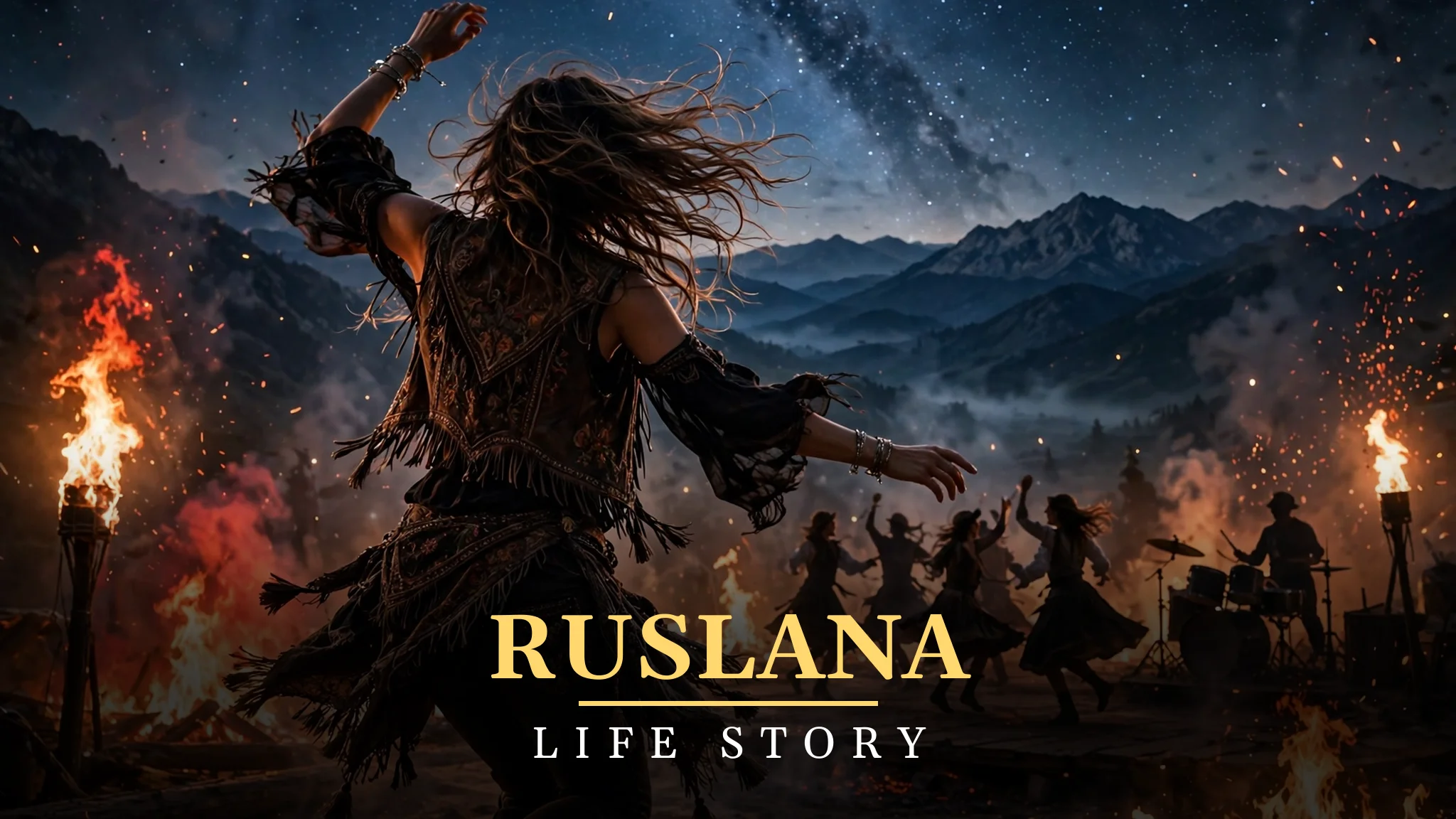
One more thought stays with me. When I picture Ruslana, I do not picture her in a quiet studio, or in a parliament building. I picture her dancing by a fire, under a starry sky, in the mountains, with her arms raised, her hair flying, and drums beating behind her. That picture is wild, and it is beautiful, and it is the heart of her music. It shows a woman who is free, who is joyful, and who is connected to the land she loves. I will always remember that picture, and I will always remember “Wild Dances”, and I believe the world will remember Ruslana for as long as people love to dance.
I also think about the drums in her music, because they are the heartbeat of her songs. The drums in “Wild Dances” are loud, fast, and joyful, and they make you want to move. Drums are one of the oldest instruments in the world, and they speak to something deep in us, something that does not need words. Ruslana understands that, and she uses drums to connect her audience to the ancient music of the Carpathians, and to the wild spirit of the mountains. When I hear those drums, I feel alive, and I think many people feel the same way.
Another thing I notice is her costume, because it is part of her art. She wears clothes inspired by Hutsul folk dress, with leather, with fur, with bold colours, and with patterns that come from the mountains. Those costumes are not just for show. They are a statement: I am Ukrainian, I am proud of my culture, and I will show it to the world. That pride is beautiful, and it is brave, because it is easier to wear a simple dress and sing a simple song. Ruslana chose to be wild, to be bold, and to be herself, and Europe loved her for it.
I think about the young Ukrainians who watch Ruslana and who feel proud of their culture. A young person in Lviv, in Kyiv, or in a small village, who sees Ruslana on stage, singing about the Carpathians, feels that their own culture matters, that their own songs matter, and that they can be proud of where they come from. That pride is important, especially in a time of war, when a country’s culture is under attack. Ruslana’s music is a reminder that Ukrainian culture is alive, strong, and beautiful, and that it cannot be taken away.
There is something else I keep returning to, and it is the idea of joy in hard times. Ruslana’s music is joyful, even when the world is hard, and that joy is a form of resistance. To dance, to sing, and to be happy, when your country is at war, is a brave thing to do, because it says that life goes on, that culture goes on, and that the enemy cannot take away your joy. I admire that, and I think Ruslana understands it deeply. Her wild dances are not only entertainment. They are a celebration of life, and a refusal to give up.
In the end, I believe Ruslana will be remembered as the singer who made Europe dance to a Ukrainian rhythm, and as a woman who stood with her people in their hardest times. Her songs are wild, her energy is boundless, and her love for Ukraine is clear in everything she does. She is a dancer, a singer, and a voice for her country, and she does all three with a fire that does not go out. I am grateful to her for “Wild Dances”, for her courage on the Maidan, and for the joy she brings to her music, and I hope she keeps dancing, keeps singing, and keeps sharing the fire of the Carpathians with the world.
I think about the Carpathian Mountains, and about how they live in Ruslana’s music. The mountains, the forests, the rivers, and the fire are not just a background for her songs. They are the heart of them, and they give her music a wild and free spirit that no other singer has. When I hear her songs, I feel the mountains, and I feel the joy of dancing by a fire under the stars. That feeling is rare, and it is beautiful, and it is why her music lasts.
I also think about the young Ukrainians who learn Hutsul songs because of Ruslana, and who feel proud of their culture because of her. A singer who teaches a new generation to love their own traditions is doing important work, and Ruslana does that work with energy and with love. Her music is not only entertainment. It is education, it is memory, and it is a gift to the future of Ukraine.
Looking back, I see Ruslana most clearly on a stage in Istanbul, in 2004, singing and dancing with a power that filled the hall and made Europe move. That night showed what she is: a singer, a dancer, and a proud Ukrainian, all at once. Her fire has not gone out since then, and I believe it never will, as long as people dance to her songs and sing along with her.
I think about the joy in Ruslana’s music, and about how important joy is in hard times. To dance, to sing, and to be happy, when your country is at war, is a brave thing to do, because it says that life goes on, that culture goes on, and that the enemy cannot take away your joy. Ruslana’s wild dances are a celebration of life, and a refusal to give up, and that is why they matter now more than ever.
What stays with me most is her courage on the Maidan, in the cold winter of 2013, singing for people who were risking everything for their country. A singer who stands with her people in danger is doing more than entertaining them. She is sharing their hope, and that hope is the truest part of her music.
I think about the word fire, and about how it runs through Ruslana’s whole story. The fire of the Carpathians, of the drums, and of the wild dances is still burning in her music, and it gives warmth and light to everyone who hears her. That fire is her gift, and it will keep burning as long as people dance to her songs and sing along with her, in Ukraine and around the world.
In the end, I will remember Ruslana as the wild dancer from Lviv, the singer who made Europe dance to a Ukrainian rhythm, and a woman who stood with her people in their hardest times. Her fire has not gone out, and I believe it never will.
Frequently Asked Questions
When was Ruslana born?
She was born on 24 May 1973 in Lviv, Ukraine. Her mother was a musician, and she studied music in Lviv, including at the Lviv Conservatory.
What song did Ruslana win Eurovision with?
She won Eurovision 2004 in Istanbul with “Wild Dances”, a song inspired by Hutsul folk music from the Carpathian Mountains. It was Ukraine’s first Eurovision victory.
What does Dyki Tantsi mean?
Dyki Tantsi means Wild Dances in Ukrainian. It is the title of her 2003 album, which became one of the best selling albums in Ukrainian history.
What is Hutsul music?
Hutsul music is the folk music of the Hutsul people, who live in the Carpathian Mountains in western Ukraine. It features drums, flutes, and wild, joyful songs, and it inspired Ruslana’s sound.
What did Ruslana do during Euromaidan?
During the Euromaidan protests in Kyiv in late 2013 and early 2014, she was on the Maidan stage night after night, singing, speaking, and supporting the protesters through the cold and dangerous winter.
Is Ruslana still performing today?
Yes, she continues to perform, to make music, and to speak for Ukraine, especially since the full scale invasion in 2022, using her fame to support her country.


