Russell Crowe: The Life Story Behind Gladiator
In this post
- A Childhood in Wellington and Sydney
- Romper Stomper and the Arrival of a Dangerous Talent
- The Insider, Gladiator, and the Oscar
- Master and Commander, Cinderella Man, and the Years of Range
- Les Misérables, Man of Steel, and the Second Act
- Family, Rugby, and Life in the Australian Bush
- The Loudest Voice, Unhinged, and the Character Actor Years
- Music, the Bands, and the Performer Who Never Stopped Singing
- The Actor Who Became a Storyteller
- My Take:
A Childhood in Wellington and Sydney
Russell Ira Crowe was born on 7 April 1964 in Wellington, New Zealand, and he grew up in a world that was closer to film sets than to ordinary life. His parents, Jocelyn and John Crowe, worked as film set caterers, providing food for cast and crew on productions in New Zealand and Australia, and the young Russell spent his childhood around cameras, actors and the organised chaos of a film set. When he was four years old, the family moved to Sydney, Australia, and he grew up in the city’s northern suburbs, attending school and playing sport, but always with the film world in the background. He appeared as a child actor in the Australian television series Spyforce in 1972, when he was eight, and he performed in the stage musical Grease, but he did not think of acting as a career. He left school at sixteen, worked in a series of jobs, and tried his hand at music, forming a band and performing in pubs and clubs around Sydney. He also worked as a busker, singing on the streets for money, and he has said that those years taught him how to perform for an audience that did not have to listen, a lesson that stayed with him. His cousin, Martin Crowe, was one of New Zealand’s greatest cricketers, and his uncle, Dave Crowe, played cricket for New Zealand as well, so sport was in the family, but Russell’s path led elsewhere. He returned to acting in his early twenties, taking classes and auditioning for roles in Australian television and theatre, and he was cast in the stage production of The Rocky Horror Show in 1986, playing the role of Eddie and Dr Scott, a job that required him to sing, to act and to be larger than life on stage. It was the beginning of a career that would take him from Sydney to Hollywood, and from a child on a film set to one of the most famous actors in the world.
Romper Stomper and the Arrival of a Dangerous Talent
Crowe’s breakthrough came in 1992, with the Australian film Romper Stomper, directed by Geoffrey Wright, in which he played Hando, the violent leader of a gang of neo-Nazi skinheads in Melbourne. The film was shocking, brutal and deeply controversial, and Crowe’s performance was terrifying, because he made Hando charismatic as well as violent, a man who could charm his followers and destroy his enemies in the same scene. The film won awards at festivals in Australia and abroad, and it announced Crowe as an actor of extraordinary power, one who was willing to play characters that other actors would refuse. He followed it with The Sum of Us in 1994, playing Jeff, a young gay man whose father, played by Jack Thompson, accepts his sexuality, a film that showed a completely different side of him, tender and vulnerable, and that proved he was not limited to violent roles. He appeared in the western The Quick and the Dead in 1995, opposite Sharon Stone and Gene Hackman, and in the science-fiction film Virtuosity in the same year, playing a virtual-reality killer opposite Denzel Washington. He moved to the United States in the mid-1990s, and he worked steadily in films that did not always show his talent, including the thriller No Way Back in 1995 and the drama Breaking Up in 1997. But Hollywood was watching, and in 1997 he was cast in the film that would change his life: L.A. Confidential, directed by Curtis Hanson, in which he played Bud White, a violent, honourable detective in 1950s Los Angeles, opposite Guy Pearce, Kevin Spacey and Kim Basinger. The film was a critical and commercial success, earning nine Academy Award nominations and winning two, and Crowe’s performance as a man who beats suspects but protects women was praised as one of the best of the year. He had arrived in Hollywood, and he had arrived as a serious actor rather than as a movie star.
The Insider, Gladiator, and the Oscar
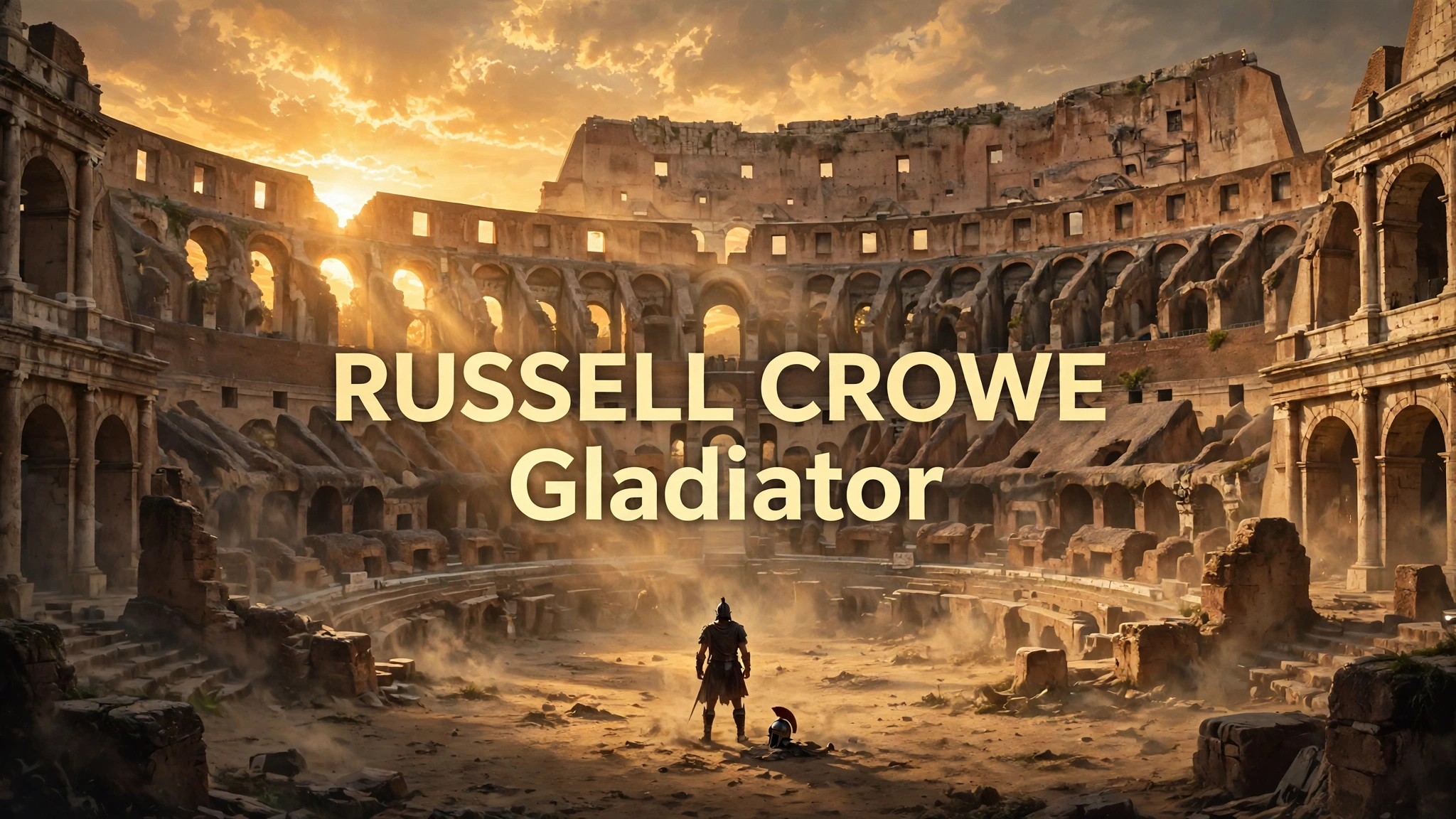
The three years from 1999 to 2001 were the most remarkable of Crowe’s career, because he made three films in a row that were among the finest of their years. In 1999 he played Jeffrey Wigand in The Insider, directed by Michael Mann, the true story of a tobacco executive who revealed that cigarette companies knew their products were addictive. Crowe gained weight for the role, he changed his voice and his posture, and he played Wigand as a quiet, frightened man who finds the courage to tell the truth, and the performance earned him his first Academy Award nomination for Best Actor. In 2000 he played Maximus in Gladiator, directed by Ridley Scott, a Roman general who is betrayed by the emperor’s son, Commodus, loses his family, becomes a slave and a gladiator, and fights his way to revenge in the Colosseum. The film was a global phenomenon, earning more than 460 million dollars worldwide and winning five Academy Awards, including Best Picture, and Crowe won the Oscar for Best Actor, the first of his career. He prepared for the role by training for months, learning to fight with a sword, riding horses, and building the physical presence of a Roman soldier, and his performance combined rage and grief in a way that made Maximus one of the most loved characters in modern cinema. The line, Are you not entertained, became one of the most quoted in film history. In 2001 he played the mathematician John Nash in A Beautiful Mind, directed by Ron Howard, the true story of a brilliant man who struggles with schizophrenia and who wins the Nobel Prize. Crowe’s performance was subtle and heartbreaking, showing Nash’s genius and his illness with equal honesty, and it earned him his third consecutive Academy Award nomination, as well as the BAFTA and the Golden Globe for Best Actor. Three films, three nominations, one win, and a place among the greatest actors of his generation, all in the space of three years. It was a run that very few actors have ever matched.
Master and Commander, Cinderella Man, and the Years of Range
After A Beautiful Mind, Crowe chose roles that showed his range, and he worked with directors who trusted him to carry large, ambitious films. In 2003 he played Captain Jack Aubrey in Master and Commander: The Far Side of the World, directed by Peter Weir, a film about a British naval captain during the Napoleonic Wars, based on the novels of Patrick O’Brian. The film was praised for its authenticity, for the way it showed life on a warship, and for Crowe’s performance as a captain who is both a warrior and a musician, a man who plays the violin with his ship’s doctor in the quiet moments between battles. The film earned ten Academy Award nominations, including Best Picture, and it remains one of the finest naval films ever made. In 2005 he played the boxer James J. Braddock in Cinderella Man, directed by Ron Howard, the true story of a Depression-era fighter who returns to the ring to feed his family and who beats the champion Max Baer. Crowe lost weight for the role, he trained as a boxer, and he played Braddock as a gentle, decent man who fights because he has no choice, and the performance was praised as one of the best of his career. He appeared in A Good Year in 2006, a romantic comedy directed by Ridley Scott, and in American Gangster in 2007, playing the detective Richie Roberts opposite Denzel Washington’s drug lord Frank Lucas, a film that earned more than 266 million dollars worldwide. He played a journalist in State of Play in 2009, a Robin Hood in Ridley Scott’s Robin Hood in 2010, and a detective in The Next Three Days in the same year. He was working constantly, choosing big films and working with major directors, and he was one of the highest-paid actors in the world. But the years after Gladiator also brought difficulties, including a famous incident in 2005 when he threw a telephone at a hotel employee in New York, an episode that damaged his public image and that he has spoken about with regret.
Les Misérables, Man of Steel, and the Second Act
In 2012, Crowe took on one of the most controversial roles of his career, playing Inspector Javert in the film version of Les Misérables, directed by Tom Hooper, opposite Hugh Jackman as Jean Valjean and Anne Hathaway as Fantine. Javert is a singing role, and Crowe’s singing was criticised by many reviewers, who said that his voice was not strong enough for the part, but he defended his performance, saying that Javert is not a singer but a man who sings because the story demands it, and that the rawness of his voice suited the character. The film was a commercial success, earning more than 440 million dollars worldwide and winning three Academy Awards, and Crowe’s performance, whatever its flaws, showed his willingness to take risks that other leading men would refuse. In 2013 he played Jor-El, the father of Superman, in Man of Steel, directed by Zack Snyder, a role that required him to bring gravity and warmth to a character who appears only briefly, and in 2014 he played Noah in Darren Aronofsky’s Noah, a film about the biblical flood that divided audiences and critics. In 2016 he appeared in The Nice Guys, a comedy directed by Shane Black, playing Jackson Healy, a private detective opposite Ryan Gosling, and his comic timing surprised audiences who knew him only as a dramatic actor. He also directed his first film, The Water Diviner, in 2014, a story about an Australian father who travels to Turkey after the First World War to find his sons, a film that was a success in Australia and that showed his interest in directing. In 2022 he appeared as Zeus in Thor: Love and Thunder, playing the Greek god with a comic accent and a sense of fun that delighted audiences. He has continued to work in film and television, including the series The Loudest Voice in 2019, in which he played the Fox News chief Roger Ailes, a performance that earned him a Golden Globe, and the film The Pope’s Exorcist in 2023, in which he played a priest. His second act has been defined by variety, by a willingness to play supporting roles and to take on projects that interest him rather than projects that flatter him.
Family, Rugby, and Life in the Australian Bush
Away from the cameras, Crowe has built a life that is deeply rooted in Australia. He married the Australian singer and actress Danielle Spencer in April 2003, in a ceremony at his farm in Nana Glen, New South Wales, and the couple had two sons, Charles, born in 2003, and Tennyson, born in 2006. The marriage ended in divorce in 2018, after the couple had separated in 2012, and Crowe has spoken about the difficulty of the separation and about his love for his sons. He lives on a farm in Nana Glen, in the hills behind Coffs Harbour, where he keeps cattle and where he escapes from the film world, and he has said that the farm is the place where he feels most himself. He is a passionate supporter of the South Sydney Rabbitohs, the rugby league club, and in 2006 he became a co-owner of the club with the businessman Peter Holmes à Court, investing his own money to save the club from financial difficulty. In 2014 the Rabbitohs won the premiership, their first in forty-three years, and Crowe was in the stands, crying with joy, a moment that meant as much to him as any film award. He has also been involved in music throughout his career, performing with his band, 30 Odd Foot of Grunts, and later with The Ordinary Fear of God, and he has recorded albums and toured in Australia. He is known for his generosity to friends and to crew members, for his loyalty to the people he works with, and for a temper that has sometimes got him into trouble, most famously in the telephone incident of 2005, for which he apologised and paid a fine. He is a complex man, a farmer and a movie star, a singer and an Oscar winner, and his life in the Australian bush is as much a part of his story as his life in Hollywood.
The Loudest Voice, Unhinged, and the Character Actor Years
The years from 2018 onwards showed a different Russell Crowe, a man who was no longer chasing leading-man roles and who was instead choosing character parts that interested him. In 2018 he appeared in Boy Erased, playing Marshall Eamons, a Baptist pastor whose son is sent to conversion therapy, a role that required him to show a father’s love and a father’s blindness at the same time, and critics praised him for a performance that was quiet and heartbreaking. In 2019 he played Roger Ailes, the founder of Fox News, in the television series The Loudest Voice, and the transformation was extraordinary: he gained weight, he wore prosthetics, he changed his voice, and he became a man who built a media empire on anger and fear. The performance won him the Golden Globe for Best Actor in a miniseries, and it was praised as one of the finest television performances of the year. In 2020 he played Tom Cooper in Unhinged, a thriller about a man who becomes violent after a road-rage incident, a film that was released during the pandemic and that showed Crowe willing to play a villain without glamour or excuse. In 2023 he played Father Gabriele Amorth in The Pope’s Exorcist, a horror film based on the real priest who performed exorcisms for the Vatican, and he played the role with a warmth and a humour that surprised audiences who expected a grim horror film. He appeared in Land of Bad in 2024, playing a drone pilot, and in Kraven the Hunter in the same year, playing the father of the title character. These roles are not the ones that will define his career, but they show a working actor who is still curious, still willing to take risks, and still capable of surprising an audience. He has also returned to the stage and to music, touring with his band and performing in concerts in Australia, and he has spoken about wanting to direct again, about stories he still wants to tell. The leading man has become a character actor, and the character actor is, in many ways, more interesting than the leading man ever was.
Music, the Bands, and the Performer Who Never Stopped Singing
Music has been part of Crowe’s life since he was a teenager busking on the streets of Sydney, and it has never left him. In the 1990s he formed the band 30 Odd Foot of Grunts, named after a phrase in a song, and the band recorded three albums, Gaslight in 1998, Bastard Life or Clarity in 2001, and Other Ways of Speaking in 2003, and toured in Australia and in the United States. The music was rock, rough and heartfelt, and Crowe sang with a voice that was more honest than polished, a voice that belonged to a man who had sung in pubs rather than in studios. He later performed with a new band, The Ordinary Fear of God, and he has continued to tour and to record, playing in small venues and in large halls, and treating music as a joy rather than as a career. He has said that music is the part of his life that belongs entirely to him, that nobody can take it away, and that the stage, whether it is a theatre or a pub, is where he feels most alive. His singing in Les Misérables was criticised, but his singing on stage, in his own concerts, has been praised by audiences who understand that a rock singer is not an opera singer and should not be judged as one. He has also used music to raise money for charity, performing in benefit concerts and supporting causes in Australia and in New Zealand. The farm in Nana Glen has a recording studio, and he has spent time there writing songs and working on new material, a reminder that the man who played Maximus is also a man who writes songs in a shed in the Australian bush. Music is the thread that runs through his whole life, from the busker in Sydney to the Oscar winner in Hollywood to the farmer in Nana Glen, and it is the part of his story that is most often overlooked.
The Actor Who Became a Storyteller
There is a final chapter to Crowe’s story that is still being written, and it is the chapter in which the actor becomes a storyteller in the fullest sense. He has spoken about wanting to direct more films, about scripts he is developing, and about the Australian stories he believes deserve to be told on screen. He has also spoken about the importance of supporting young Australian actors and filmmakers, and about the need for Australia to tell its own stories rather than waiting for Hollywood to tell them. He remains a working actor, a farmer, a musician, a rugby supporter and a father, and he moves between those lives with an ease that few people can manage. The boy who grew up on film sets, who busked on the streets of Sydney, who played a skinhead in Melbourne and a gladiator in Rome, has become a man who contains all of those lives at once, and who is still, at sixty, looking for the next story worth telling. That restlessness is the truest thing about him, and it is why his career, for all its triumphs and its troubles, feels unfinished in the best possible way.
The gladiator, the mathematician, the captain, the farmer and the singer are all the same man, and that man is still working.
His story, like his best performances, does not end with a single triumph but with a man still standing, still learning, and still ready for the next role.
That is enough, and it is everything.
The story goes on.
My Take:
I have always found Russell Crowe fascinating because he is the opposite of what a movie star is supposed to be. Movie stars are supposed to be charming, diplomatic, easy to work with, and careful about their image. Crowe is none of those things, at least not all the time, and yet he became one of the biggest stars in the world. When I think about his career, I think about the three years from 1999 to 2001, when he made The Insider, Gladiator and A Beautiful Mind, three films that could not be more different from one another, and he was extraordinary in all three. In The Insider he is quiet, frightened and overweight, a man who has lost everything and is trying to tell the truth. In Gladiator he is a warrior, a general, a slave, a man of rage and grief who fills the Colosseum with his presence. In A Beautiful Mind he is a genius who is losing his mind, a man who sees things that are not there and who has to learn to live with his illness. Those are three different men, and Crowe played all three without a trace of the others showing through. That is not stardom. That is acting, of the highest order, and it is why those three years will be remembered as one of the great runs in film history. I do not think there is another actor alive who could have played all three roles in three years and been convincing in each one.
What I admire most about Crowe is his physical commitment to a role, because it is a kind of honesty that cannot be faked. For The Insider he gained weight and changed the way he moved, so that Jeffrey Wigand looked like a man who had been beaten down by life. For Gladiator he trained for months, learned to fight with a sword, and built the body of a Roman soldier, so that Maximus looked like a man who could survive the arena. For Cinderella Man he lost weight and trained as a boxer, so that James Braddock looked like a man who was hungry in every sense of the word. For A Beautiful Mind he studied John Nash’s mannerisms, his walk, his way of speaking, and he built a performance from observation rather than from imagination. This is old-fashioned acting, the kind that requires months of work before the camera rolls, and it is increasingly rare in an age when actors are expected to move from one film to the next without preparation. Crowe’s preparation is the reason his performances feel real, because the body remembers what the mind has learned, and the camera sees the difference between an actor who has done the work and an actor who has not. I think young actors should study his preparation, because it is the least glamorous and most important part of the job.
I also think his temper deserves an honest discussion, because it is part of his story and because it has shaped his career. The telephone incident in 2005, when he threw a phone at a hotel employee in New York, was inexcusable, and Crowe has said so himself, apologising and paying a fine. But it was not an isolated moment. He has had confrontations with journalists, with producers, with people who worked for him, and he has a reputation in Hollywood for being difficult, for being demanding, for being unwilling to suffer fools. I do not want to excuse that behaviour, because throwing a telephone at someone is wrong no matter who you are, but I do want to understand it, because the same qualities that make him difficult also make him great. He is demanding because he cares about the work, he is impatient because he has no tolerance for laziness, and he is blunt because he does not know how to pretend. In an industry that rewards diplomacy and punishes honesty, that bluntness has cost him roles and relationships, and it has also earned him the loyalty of the people who work with him, because they know that when he fights for a film, he is fighting for the film rather than for himself. I think that is a complicated legacy, and I do not want to simplify it into a single judgement. He is a difficult man and a great actor, and both things are true at the same time.
His love of Australia is another part of his story that I find moving, because it shows a man who never forgot where he came from. He could have lived in Los Angeles, in a mansion in Beverly Hills, surrounded by the film industry, and many actors in his position do exactly that. Instead he lives on a farm in Nana Glen, in the hills behind Coffs Harbour, where he keeps cattle and where the nearest film set is hundreds of miles away. He bought into the South Sydney Rabbitohs when the club was in trouble, he invested his own money, and he cried in the stands when they won the premiership in 2014, after forty-three years without a title. That is not the behaviour of a man who is using Australia as a backdrop. That is the behaviour of a man who belongs to a place, who cares about its teams and its people, and who measures his life by something other than box office. I think that rootedness is part of why his performances feel so grounded, because he has a life outside the film world, a life that reminds him who he is when the cameras stop. A lot of actors lose themselves in Hollywood, because there is nothing outside the work to hold them. Crowe has the farm, the rugby club, the music, and the sons, and those things have kept him honest.
I want to say something about his directing as well, because The Water Diviner is a film that deserves more attention than it received. It is the story of an Australian father who travels to Turkey after the First World War to find the bodies of his sons, and it is a film about grief, about reconciliation, and about the shared suffering of Australian and Turkish soldiers at Gallipoli. Crowe directed it with a sensitivity that surprised critics who knew him only as an actor, and the film was a success in Australia, winning awards and finding an audience. He has said that directing taught him how much he did not know about filmmaking, and that the experience made him a better actor, because he understood for the first time what a director needs from a performer. I think that humility is important, because it shows a man who is still learning, still curious, and still willing to be a beginner at something new. The best actors are the ones who never stop learning, and Crowe, for all his reputation as a difficult man, has never stopped learning.
What stays with me, finally, is the image of Maximus in the Colosseum, turning to the crowd and asking, Are you not entertained, and the crowd roaring back. That scene is the centre of Crowe’s career, because it captures everything about him: the rage, the grief, the physical power, and the strange, uncomfortable truth that the audience is complicit in the violence it watches. Gladiator is not just a great film. It is a film about what it means to be watched, to be used, to be turned into entertainment, and Crowe’s performance makes that question impossible to ignore. He has spent the years since Gladiator trying to answer that question in different ways, by playing quiet men and loud men, by directing, by singing, by farming, by supporting a rugby club, and by being himself, difficult and generous and talented all at once. I do not think he has answered the question, and I do not think anyone can, but I admire him for asking it, and for asking it with his whole body and his whole life. That is why I will keep watching whatever he does next, even when it fails, because the failure of a man who tries is more interesting than the success of a man who does not.
I want to say more about Bud White, because L.A. Confidential is the film that made me take Crowe seriously, and it is a performance that deserves a closer look. Bud White is a detective who beats suspects, who breaks the rules, and who is also the only honest man in a corrupt police force. That contradiction is the whole character, and Crowe plays it without resolving it, without telling the audience whether to admire Bud or to condemn him. He lets the contradiction sit there, uncomfortable and unresolved, and the audience has to do the work of deciding what they think. That is brave acting, because most actors would choose a side, would signal to the audience how they should feel, would make Bud either a hero or a villain. Crowe refuses to choose, and the refusal makes the performance last. I have watched L.A. Confidential many times, and every time I see something new in Bud White, a small gesture, a look, a moment of tenderness that I had missed before. That is the mark of a great performance: it does not exhaust itself on first viewing, but grows richer each time you return to it.
Master and Commander deserves a mention too, because it is a film that people forget when they list Crowe’s best work, and it should not be forgotten. Captain Jack Aubrey is a man who lives by a code, who loves his ship and his men, and who plays the violin with his friend Stephen Maturin in the quiet moments between battles. Crowe plays him with a warmth and a humour that his other roles do not show, and the scenes of Aubrey and Maturin making music together are among the most beautiful in his career, because they show a man who is more than a warrior. I think those scenes matter because they show Crowe’s range in a way that Gladiator does not, because they show him being gentle, being funny, being a friend, and doing it without any of the rage that defines Maximus. The film itself was a commercial disappointment, earning less than its budget in some markets, and a sequel was never made, which is a shame, because Aubrey and Maturin deserved more films. But the performance remains, and it is one of the finest in Crowe’s career, a reminder that he is not just a man of violence but a man of music, of friendship, and of quiet joy.
I also think about the physical transformations, because they tell a story about dedication that words cannot. Crowe has gained and lost weight for roles, he has built muscle and lost it, he has changed his hair, his voice, his walk, and he has done it again and again, for decades. That kind of transformation is hard on the body, and it is hard on the mind, because it requires an actor to live inside a different body for months at a time. I admire it, but I also worry about it, because the industry asks actors to do this and then judges them for the way they look when they are not filming. Crowe has been criticised for his weight in recent years, by people who seem to forget that the weight was often part of a role, and that an actor’s body is a tool rather than a fashion statement. I think the criticism says more about the industry than about Crowe, because it shows how quickly the world forgets that the man who played Maximus is a human being who ages, who gains weight, who lives on a farm and eats well. He has never pretended to be a model, and he should not have to.
Finally, I think about South Sydney, because it is the part of his life that makes me smile the most. Here is a man who has won an Oscar, who has played a Roman general and a Nobel Prize winner, and the thing that made him cry with joy was a rugby league team winning a premiership after forty-three years. That tells you everything about his values. The Rabbitohs are not a global brand. They are a working-class club from Redfern in Sydney, a club that was kicked out of the competition in 1999 and that fought its way back, and Crowe’s decision to buy into the club and to save it was an act of loyalty to a community rather than an investment. When they won in 2014, he was in the stands, crying, hugging strangers, and celebrating like a fan rather than like a movie star. I love that image, because it shows a man who knows what matters to him, and who is not embarrassed to care about something as simple as a football team. That is the Russell Crowe I admire most: not the Oscar winner, not the gladiator, but the fan in the stands, crying because his team finally won.
Frequently Asked Questions
What was Russell Crowe’s childhood like?
Russell Crowe was born in 1964 in Wellington, New Zealand, and moved with his family to Australia when he was four. His parents worked in film catering, so he grew up around movie sets and film crews.
What makes Russell Crowe different from other stars?
Crowe’s acting is intense and physical, built on a deep voice and a stare that can fill a cinema. He prepares by immersing himself in a character’s world, whether it is ancient Rome or a 1950s newsroom.
How did Russell Crowe become famous?
His Hollywood breakthrough came with L.A. Confidential in 1997, a crime drama now considered a classic. He was nominated for an Academy Award for The Insider in 1999.
What awards has Russell Crowe won?
Crowe’s Maximus is one of the great screen heroes, and his line about being entertained is quoted everywhere. He is one of the few actors to be nominated for three Academy Awards in a row.
What is Russell Crowe’s most famous role?
Crowe’s Maximus is one of the great screen heroes, and his line about being entertained is quoted everywhere. He is one of the few actors to be nominated for three Academy Awards in a row.


