Ruth Gordon: The Life Story Behind Hollywood's Beloved Character Star
In this post
Ruth Gordon was a woman who refused to grow old in the way the world expected her to grow old. She was an actress in her teens, a writer in her forties, and a film star in her seventies, and at every stage she brought the same energy, the same sharp wit, and the same refusal to be ignored. She played grandmothers, neighbours, and eccentrics, but she never played them as small or dull people. She played them as women with opinions, with desires, and with a life of their own.
She was born in Massachusetts, and she grew up in a small town where the theatre seemed like a distant dream, yet she found her way to it through sheer determination. She moved to New York, she worked on the stage, she wrote plays and films with her husband, and she built a career that lasted for more than seventy years. She was not a star who burned brightly for a short time. She was a worker who kept going, kept learning, and kept surprising people.
What makes her story worth telling is the second half of it, the part where most actresses are told that their careers are over. Ruth Gordon’s best-known film roles came when she was in her late sixties and seventies, in Rosemary’s Baby and in Harold and Maude, and she played them with a joy and a boldness that made younger audiences fall in love with her. This is the story of a woman who never stopped, and who proved that age is not the end of a life, but a new beginning.
A Quincy Childhood and a Dream of the Stage
Ruth Gordon Jones was born on 30 October 1896 in Quincy, Massachusetts, a town near Boston. Her father was a sea captain, and her mother was a homemaker, and the family lived a quiet and respectable life. Ruth was a lively child, with a quick mind and a strong imagination, and she loved to read, to act out stories, and to make people laugh. She was not a shy girl. She was a girl who liked to be noticed, and who liked to tell stories in her own way.
She attended school in Quincy, and she began to take part in school plays, where she discovered that she loved the feeling of being on a stage. She liked the way a play could take a room full of people and make them laugh or cry, and she liked the work of learning a character and finding the right way to play it. She was not dreaming of fame in a vague way. She was thinking seriously about acting as a life, as something she could do for many years if she worked hard enough.
When she was nineteen, she moved to New York to study acting at the American Academy of Dramatic Arts, one of the most respected schools in the city. New York in the 1910s was a hard place for a young actress, with many talented people competing for work, but Ruth was determined. She took small roles, she learned from every production, and she built a reputation as an actress who was reliable, funny, and brave. She was not the most beautiful actress in New York, but she was one of the most interesting, and directors noticed that.
She made her Broadway debut in 1915, and she began to work steadily in the theatre. She appeared in plays, she learned the craft of acting, and she began to understand that a career in the theatre was not only about talent. It was about showing up, about working hard, and about being willing to take risks. Those lessons stayed with her for the rest of her life, and they helped her build a career that lasted for more than seventy years.
The Stage, Silent Films, and a Writer’s Life
In the 1920s and 1930s, Ruth Gordon worked in the theatre in New York and in London, and she became known as a stage actress with a sharp wit and a strong presence. She appeared in plays by well-known writers, and she earned praise for her ability to play both comedy and drama. She was not a leading lady in the usual sense. She was a character actress, and she brought depth and humour to every role she played, even when the part was small.
She also appeared in silent films, though her film work in those early years was limited. She was more interested in the stage, and in the live feeling of a play, than in the camera. She liked the way a theatre audience responded in real time, and she liked the chance to grow a character night after night. Film was a different kind of work, and she would return to it much later in her life, when she was older and when the roles suited her better.
In the 1940s, she began a new chapter in her life as a writer. She married the writer Garson Kanin in 1942, and together they wrote plays and films that became famous. They wrote the screenplays for Adam’s Rib in 1949 and Pat and Mike in 1952, both starring Katharine Hepburn and Spencer Tracy, and they wrote other films and plays that showed their wit and their understanding of men and women. Ruth was not only an actress. She was a writer with a sharp eye for dialogue, and she knew how people really talked, how they argued, and how they made up.
Their partnership was a creative one, built on mutual respect and on a shared love of the theatre and of film. They worked together for many years, and they supported each other’s work. Ruth continued to act, and she continued to write, and she found that writing gave her a new way to tell stories. She was a woman who could do many things, and she did them all with energy and with humour. She was not content to be only one thing, and that refusal to be limited is part of what makes her story so interesting.
A Late Film Career Begins
In the 1960s, Ruth Gordon returned to film acting in a serious way, and she found that the roles she was offered suited her perfectly. She was in her late sixties, and she was playing women who were older, wiser, and more eccentric than the leading ladies of Hollywood. She brought a lifetime of experience to those roles, and she played them with a joy that made audiences love her. She was not trying to look young. She was celebrating what it meant to be old, and she did it with a boldness that was rare in Hollywood.
Her great film role came in 1968, in Rosemary’s Baby, directed by Roman Polanski, where she played Minnie Castevet, the cheerful and nosy neighbour who turns out to be part of a dark conspiracy. The role was perfect for her. Minnie is friendly, talkative, and funny, and she hides a sinister purpose behind her smile. Ruth played her with a warmth that made the character even more frightening, because the audience liked her even as they began to suspect her. Her performance earned her the Academy Award for Best Supporting Actress, when she was seventy-two years old.
Winning the Oscar was a moment of triumph, not only for her, but for every older actress who had been told that her career was over. She accepted the award with humour and grace, and she spoke about the long road that had brought her to that moment. She was not a young star. She was a woman who had worked for more than fifty years, and who had finally been recognised for her film work. The Oscar did not change her. It simply confirmed what people who had seen her on stage had known for decades: she was a great actress.
After the Oscar, she worked steadily in film, and she became a familiar face to a new generation of moviegoers. She appeared in films such as Where’s Poppa? in 1970, and in other comedies and dramas that used her wit and her energy. She was not a background actress. She was a star, and directors sought her out for roles that needed a strong and funny older woman. She was enjoying her late career, and she was doing some of her best work.
Harold and Maude and a New Kind of Love Story
The film that made Ruth Gordon a legend for a younger generation was Harold and Maude, released in 1971, when she was seventy-four years old. She played Maude, a seventy-nine-year-old woman who lives life with joy, freedom, and a refusal to follow the rules, and who becomes the friend and the love of Harold, a young man obsessed with death. The film was a dark comedy, and it was unlike anything else in Hollywood at the time. It was about life, death, love, and freedom, and Ruth played Maude with a lightness and a wisdom that made the film unforgettable.
Maude is a character who steals cars, who plants trees, who dances, and who teaches Harold to enjoy life instead of fearing death. Ruth played her with a smile, a twinkle in her eye, and a deep understanding of what it means to live fully. She was not playing a sweet old lady. She was playing a rebel, a woman who had lived through hard times and who had decided to live on her own terms. Audiences loved her, and the film became a cult classic, watched and loved by generations of young people who saw in Maude a model of how to live.
The film was not a great success when it was first released, but it grew in reputation over the years, and it is now regarded as one of the most beloved films of the 1970s. Ruth’s performance is at the heart of it, and it is a performance that could only have been given by an actress of her age and experience. She brought a lifetime of joy, sorrow, and wisdom to the role, and she made Maude feel like a real person, not only a character in a film. She was seventy-four, and she was playing a woman who was still learning, still loving, and still living fully.
She continued to work in film and television after Harold and Maude, and she remained a beloved figure. She appeared in films such as Every Which Way But Loose in 1978, opposite Clint Eastwood, where she played his mother, and she brought humour and warmth to the role. She was a woman who could work with anyone, from young directors to old stars, and she did it with grace and with professionalism. She was not slowing down. She was still growing, still learning, and still surprising people.
Writing, Acting, and a Life That Never Slowed Down
In her later years, Ruth Gordon continued to act and to write, and she remained a vibrant presence in the entertainment world. She wrote a memoir, My Side, published in 1976, in which she told the story of her life in her own words, with humour and honesty. The book was praised for its candour and its wit, and it became a valuable record of a life that had spanned the most dramatic decades of American theatre and film. She was in her late seventies when the book was published, and she was still speaking clearly about what she had lived through.
She also continued to appear on television, where she gave strong performances in dramas and comedies. She was known for her preparation, for her ability to listen to other actors, and for her willingness to take risks. She did not play safe. She chose roles that asked her to show vulnerability, humour, and strength, and she did not hide behind a polished surface. Her performances felt lived-in, as if she had known the character for a long time, and that quality made her stand out even in small parts.
She died on 28 August 1985 in Edgartown, Massachusetts, at the age of eighty-eight, after a long and remarkable life. Her death was mourned across America, and tributes came from actors, directors, and audiences who had admired her work for decades. She was buried in Massachusetts, and her legacy was remembered in the many performances, plays, and films she had left behind. She had worked for more than seventy years, from the stage in 1915 to film in the 1970s, and she had done it with energy, wit, and a refusal to give up.
She is remembered today as an actress who won an Oscar at seventy-two, as the star of Harold and Maude at seventy-four, and as a writer who helped create some of the most beloved films of the 1940s and 1950s. But she is also remembered as a woman who lived fully, who loved deeply, and who never stopped learning. That is a legacy that does not fade, and it is why her name is still spoken with affection.
What Her Life Still Means
Ruth Gordon’s story matters because it shows that a career does not have to end when you get older. She did her best film work in her seventies, and she proved that age can bring depth, wisdom, and joy to a performance. She showed that older women are not only grandmothers in the background. They are people with full lives, with opinions, with desires, and with stories to tell. That lesson is still relevant today, when Hollywood often forgets older actresses.
Her influence can be seen in the work of actresses who admire her courage and her humour. She showed that it is possible to be funny, bold, and free at any age, and that a woman’s life does not stop being interesting when she turns sixty or seventy. She also showed that a person can have many careers in one lifetime, as an actress, a writer, and a star, and that each career can feed the next one. That is a hopeful message for anyone who feels that their best years are behind them.
She is remembered for Rosemary’s Baby, for Harold and Maude, for Adam’s Rib, and for many other works, but she is also remembered for the way she lived: with energy, with wit, and with a refusal to be ignored. She was a woman who never stopped, and that is the heart of her story.
A Writer’s Eye for How People Really Talk
Ruth Gordon’s writing is one of the most important parts of her story, and it is easy to overlook it when we focus on her film roles in her seventies. She wrote plays and films with her husband, Garson Kanin, and their work shows a deep understanding of how men and women really talk to each other, how they argue, how they flirt, and how they make up after a fight. Adam’s Rib, which they wrote in 1949, is a film about a married couple who are lawyers on opposite sides of a case, and it is funny because the dialogue feels real, because the characters sound like people who know each other well, and because the jokes come from character, not from clever lines alone. That kind of writing takes a writer who has listened carefully to real people, and Ruth had spent her whole life listening.
She began writing in the 1940s, when she was already a successful stage actress, and she found that writing gave her a different kind of freedom. As an actress, she had to wait for someone to give her a part. As a writer, she could create the part herself, and she could write the kind of women she wanted to play, women who were smart, funny, and strong. She wrote with Garson, and their partnership was built on a shared love of theatre, on mutual respect, and on a willingness to argue about a line until it was right. They were not a couple who agreed on everything. They were a couple who pushed each other to do better work, and that pushing made their films and plays stronger.
Pat and Mike, which they wrote in 1952, is another example of their skill. It is a film about a woman athlete and a sports promoter, and it is funny because it shows a woman who is better at sports than the men around her, and who is not afraid to be strong. Katharine Hepburn played the lead, and she brought a physical energy to the role that made the film feel fresh and modern. Ruth understood Hepburn, she understood what made her funny, and she wrote a part that allowed her to show her strength, her wit, and her vulnerability. That understanding came from Ruth’s own life, as a woman who had been strong, funny, and a little bit different from other actresses of her time.
Her writing also included plays, including The Actress, which was based on her own life and which told the story of a young woman who wants to become an actress, against her father’s wishes. The play was personal, and it showed Ruth’s willingness to write about her own experience, about the struggle to be taken seriously, and about the joy of finding your place in the theatre. She was not afraid to be honest about her life, and that honesty made her writing feel true. She wrote about what she knew, and she wrote it with humour and with warmth, and audiences responded to it because they recognised themselves in her stories.
In her later years, she wrote a memoir, My Side, in which she told the story of her life with the same wit and honesty she had brought to her plays and films. The book is funny, it is candid, and it is full of stories about the theatre, about Hollywood, and about the people she had known. She wrote it when she was in her late seventies, and she was still speaking clearly about what she had lived through, still laughing, and still learning. Her writing, like her acting, was a way of staying alive, of staying curious, and of sharing what she had learned with others. That is a legacy that goes beyond any single film or play, and it is one that should be remembered alongside her Oscar win.
My Take:
I think Ruth Gordon’s story is one of the most joyful stories I have read in this batch, and I say that because she was joyful herself. She was not a person who complained about getting older. She celebrated it, she used it, and she turned it into some of the best work of her life. I admire that attitude deeply, because so many people are afraid of ageing, and so many industries treat older people as if they have nothing left to offer. She proved them wrong, and she did it with a smile.
What moves me most is Harold and Maude. I have seen the film described many times, but I keep thinking about what it must have felt like to watch it in 1971, when Ruth was seventy-four and playing a woman who steals cars, plants trees, and teaches a young man to live. That is not a role for a sweet old lady. That is a role for a rebel, and she played it as a rebel, with joy and with freedom. I think that performance matters because it shows that an older woman can be the centre of a love story, can be funny and bold, and can teach a young person how to live. That is a powerful idea, and it is still rare in film today.
I also think about Rosemary’s Baby, and I am struck by how different that role is from Maude. In one film, she is a sinister neighbour hiding a dark secret behind a friendly smile. In the other, she is a free spirit teaching a young man to love life. She played both roles with the same skill, the same warmth, and the same attention to detail, and she made both characters feel real. That range is remarkable, and it shows that she was not a one-note actress. She was a great actress, and she could do comedy, drama, and horror, all with the same honesty.
Her work as a writer also impresses me. She wrote Adam’s Rib and Pat and Mike with her husband, Garson Kanin, and those films are still loved today for their wit and their understanding of men and women. I think writing gave her a different kind of power, a power to shape stories, not only to perform in them. She was not content to wait for someone to give her a good part. She wrote good parts, and she wrote them with a sharp eye for how people really talk. That is a lesson I want to remember: if the work you want does not exist, make it yourself.
I am also struck by how long her career lasted. She made her Broadway debut in 1915, and she was still acting in films in the late 1970s, more than sixty years later. I try to imagine what that means, to work in the theatre when it was the centre of American entertainment, to live through silent films, talking films, television, and the New Hollywood of the 1970s, and to still be relevant in each era. That is not luck. That is hard work, adaptability, and a willingness to keep learning. She did not stop, and she did not become bitter. She kept going, and she kept growing.
What I learn from her is that age is not a reason to stop. She won her Oscar at seventy-two, she starred in Harold and Maude at seventy-four, and she wrote a memoir at seventy-nine. I think we are often told that our best years are in our twenties and thirties, but her life shows that our best years can come much later, if we keep working and keep learning. That is a hopeful message, and it is one I want to carry with me, especially when I feel that time is passing too quickly.
I also learn from her that humour is a form of strength. She was funny, she was witty, and she used humour to face hard times, to make people laugh, and to tell the truth about life. She did not hide behind a serious face. She laughed, she joked, and she made other people laugh, and that laughter was a way of saying that life is worth living, even when it is hard. I think that is a brave way to live, and it is a way I admire.
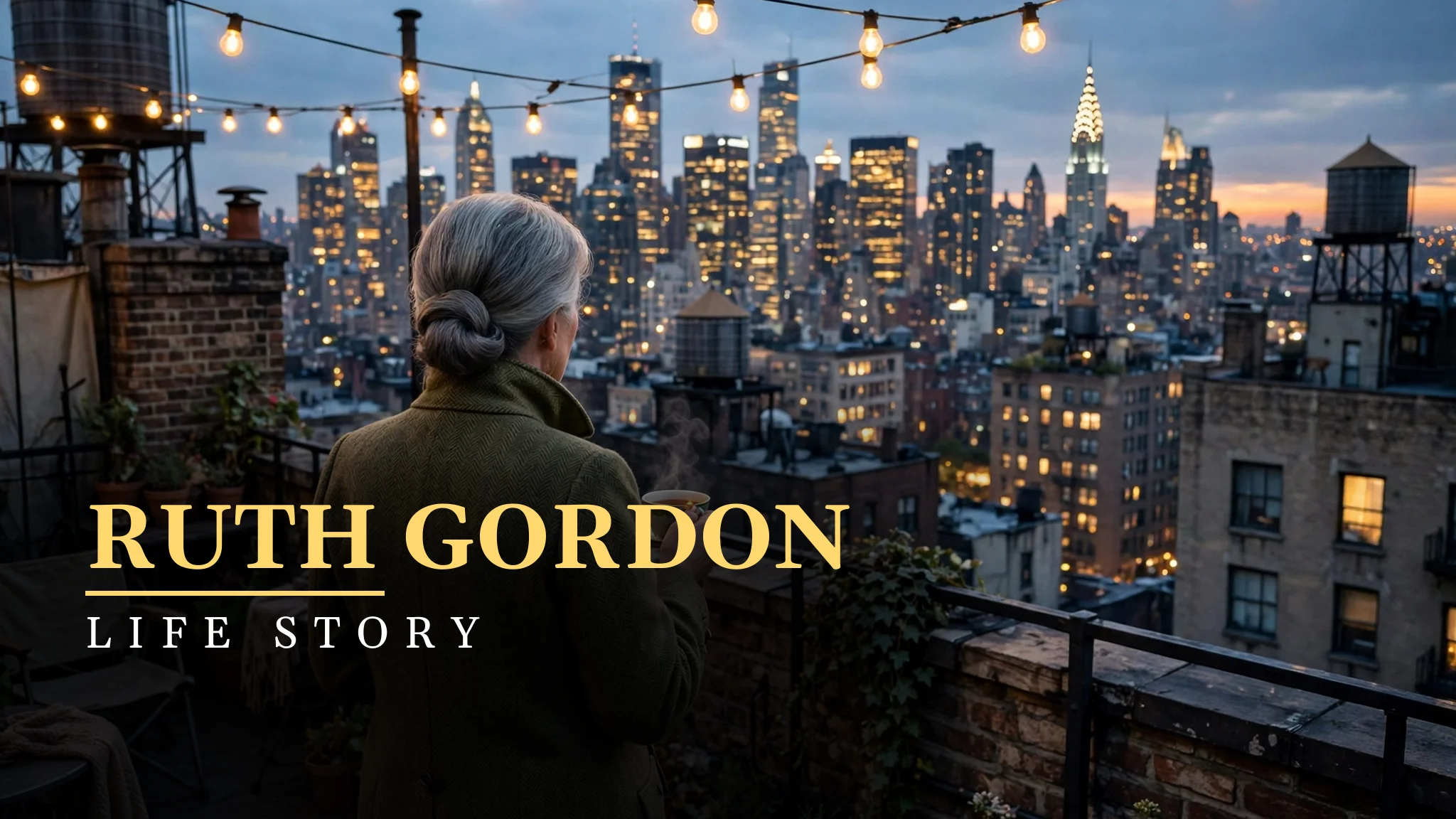
When I think of Ruth Gordon now, I think of an older woman on a rooftop in New York at dusk, holding a cup of tea and looking out at the city lights. She is not sad. She is thinking, she is remembering, and she is enjoying the moment. That image stays with me, because it captures her thoughtfulness, her humour, and her love of life. She was a woman who looked at the world and found it interesting, even when she was old, and that curiosity kept her alive.
I hope readers who meet her for the first time will watch Harold and Maude, and I hope they will watch Rosemary’s Baby, and I hope they will read her memoir. I hope they will see that she was more than a funny old lady. She was a great actress, a great writer, and a great liver of life, and she was a woman who refused to be made small by age. That is why I think her story matters, and that is why I think it will still matter many years from now, when the films she appeared in are still being watched by new generations.
In the end, I think Ruth Gordon teaches us that life does not end at sixty, or at seventy, or at eighty. It continues, and it can be full of joy, love, and work, if we are willing to keep going. She kept going, and she did it with a smile, and that is a life worth celebrating. I will remember her as Maude, as Minnie, as a writer, and as a woman who never stopped living, and I will remember that she showed us how to grow old with grace, humour, and courage.
I also think about how Ruth Gordon handled being a woman in a world that often told women to be quiet, to be sweet, and to not make a fuss. She was not quiet, she was not always sweet, and she made a fuss when she needed to, and she did it with humour. She wrote plays, she acted in films, she won an Oscar at seventy-two, and she starred in a love story at seventy-four, and she did it all without apologising for being herself. I think that is a powerful example for any woman who has been told to be smaller than she is. Be yourself, be loud if you are loud, and find the place where your voice is valued. She found that place, first on stage, then in writing, then on film, and she kept finding it, again and again.
Another thought that stays with me is her relationship with Garson Kanin, and the way two writers built a life together around stories. They argued, they laughed, they wrote, and they supported each other, and their partnership lasted for more than forty years. I think that kind of creative partnership is rare, and it is valuable, because it means that you have someone who understands your work, who challenges you to do better, and who celebrates your successes with you. She had that, and it gave her a foundation that made her long career possible. She was not alone in her work. She had a partner, and that partner helped her grow.
I also wonder what she would think of the way older women are shown on screen today, where there are more roles for older actresses than there were in her time, but where ageism is still a problem. I think she would be pleased that things have improved, but I also think she would remind us that there is still work to do, and that older women deserve to be shown as full people, with desires, with humour, and with stories to tell, not only as grandmothers in the background. She played Maude and Minnie as full people, and she would want younger actresses to have the same chance. Her life is a reminder that age is not a reason to stop, and that a woman’s story does not end at sixty or seventy.
When I think of Ruth now, I do not only think of Harold and Maude. I think of a woman in her seventies, sitting at a typewriter, writing a play, laughing at a line she has just written, and thinking about how to make it even funnier. That image stays with me, because it captures her joy, her creativity, and her refusal to stop learning. She was a writer, an actress, and a liver of life, and she did all three with energy and with humour, until the very end. That is a life I admire, and a life I am glad to have learned about.
I hope that people who read her story will watch Harold and Maude, will read Adam’s Rib, and will understand that she was more than a funny old lady. She was a great writer, a great actress, and a woman who lived fully, loved deeply, and never stopped growing. Her life is proof that it is never too late to do your best work, and that a long life, lived with humour and courage, is a life well lived.
I also think about how Ruth Gordon’s story is told today, and how often it is reduced to Harold and Maude, as if that one film were her whole life. Harold and Maude is wonderful, but it is only part of her story. She was also a writer, a stage actress, a mother, and a woman who worked for more than seventy years, and each of those parts matters. I think we should tell her whole story, not only the famous part, so that young people can see that a life is made of many chapters, and that each chapter can be important, even if it is not the most famous one. Her writing, her stage work, and her early films are all part of who she was, and they deserve to be remembered alongside her later fame.
I also want to remember her humour, because it was not only a tool for making people laugh. It was a way of facing life, of dealing with hard times, and of staying curious about the world. She laughed at herself, she laughed with others, and she used humour to tell the truth about things that were difficult to say seriously. That kind of humour is brave, and it is generous, because it invites other people to laugh with you, rather than at you. She did that for more than seventy years, and she never lost her ability to find something funny in a situation, even when the situation was hard. That is a gift I admire, and a gift I want to remember.
I also think about her age, and about how she proved that age is not a barrier to doing great work. She won her Oscar at seventy-two, she starred in Harold and Maude at seventy-four, and she wrote a memoir at seventy-nine, and she did it all with energy and with joy. I think that is a hopeful message for anyone who feels that they are too old to start something new, or too old to be noticed. You are never too old, if you keep learning, keep working, and keep sharing what you love. She proved that, and she proved it with a smile that is still remembered today.
I also think about how Ruth Gordon’s long life, from 1896 to 1985, gave her a view of American entertainment that few people have ever had. She saw the theatre when it was the centre of popular culture, she saw silent films, talking films, radio, and television, and she worked in each of them, adapting to new technology without losing her love for the craft. That adaptability is a lesson for anyone who worries that change will leave them behind. She did not fear change. She learned from it, she used it, and she kept growing, even when the world around her was changing faster than she could have imagined as a young girl in Quincy.
Frequently Asked Questions
What role won Ruth Gordon her Academy Award?
Ruth Gordon won the Academy Award for Best Supporting Actress for Rosemary’s Baby in 1968, playing Minnie Castevet, the cheerful neighbour who is part of a dark conspiracy. She was seventy-two years old when she won. Her performance was praised for its warmth and its sinister undertone, and it became one of the most famous supporting roles of the 1960s.
Why is Harold and Maude so important in Ruth Gordon’s career?
Harold and Maude, released in 1971 when she was seventy-four, made her a legend for a younger generation. She played Maude, a seventy-nine-year-old free spirit who teaches a young man obsessed with death to enjoy life. The film became a cult classic, and her joyful and rebellious performance is still loved by audiences today.
Did Ruth Gordon also work as a writer?
Yes, she wrote plays and films with her husband, Garson Kanin, including the screenplays for Adam’s Rib in 1949 and Pat and Mike in 1952, both starring Katharine Hepburn and Spencer Tracy. Her writing showed a sharp eye for dialogue and for how men and women really talk. She was both an actress and a writer throughout her career.
How long did Ruth Gordon’s career last?
Her career lasted for more than seventy years, from her Broadway debut in 1915 to film roles in the late 1970s. She worked on stage, in silent films, in writing, and in sound films, and she did her best-known film work in her seventies. Her long career is one of the longest in American entertainment history.
Was Ruth Gordon married?
Yes, she was married to the writer Garson Kanin from 1942 until her death in 1985. They worked together as writers and supported each other’s careers. Their partnership was built on mutual respect and a shared love of theatre and film, and it lasted for more than forty years.
When did Ruth Gordon die, and how old was she?
Ruth Gordon was born on 30 October 1896 in Quincy, Massachusetts, and she died on 28 August 1985 in Edgartown, Massachusetts, at the age of eighty-eight. She had worked for more than seventy years, and she is remembered as an actress, writer, and star of Harold and Maude and Rosemary’s Baby.


