Saber Rebai: The Life Story Behind Tunisia's Prince of Arab Song
In this post
- A Boy From Sfax With a Love of the Oud
- Study in Tunis and the Making of a Professional
- Cairo, Sidi Mansour, and the Breakthrough
- Atahadda El Aalam and the Prince at His Peak
- Carthage, The Voice, and a Singer on the Big Stage
- The Later Years and a Voice That Endures
- A Prince Whose Songs Belong to Everyone
- My Take:
Saber Rebai is known as the prince of Arab song, a title that fits a singer whose voice is smooth, powerful, and full of the romance that defines the best of Arabic music. He was born in Sfax, in Tunisia, he studied music in Tunis, and he became a star in Cairo and across the Arab world, with songs such as “Sidi Mansour”, “Barshalo”, and “Atahadda El Aalam” that are still played today. His singing is elegant and controlled, and his concerts, in great halls and ancient amphitheatres, are events that audiences remember for years.
What makes Saber’s story special is the combination of talent and training. He did not become famous by accident. He studied music seriously, he learned the oud, and he built his voice through years of practice, and that foundation gave his singing a quality that many pop stars lack, a sense of craft and of tradition that makes his songs feel both modern and timeless. He is a singer who respects the art of Arab song, and who has carried it forward for more than thirty years.
His life has had moments of great triumph, in Cairo, in Carthage, and on television as a judge, and moments when he had to prove himself again, but his voice has remained, and his place as a prince of Arab song is secure. This is the story of how a boy from Sfax became one of the most loved singers in the Arab world.
A Boy From Sfax With a Love of the Oud
Saber Rebai was born on 13 March 1967 in Sfax, the second city of Tunisia, a port on the Mediterranean coast known for its olive groves, its fishing boats, and its strong, proud people. Sfax is a city of work and of tradition, where families are close, where music is part of daily life, and where a child growing up can hear the songs of Tunisia in the streets, in the cafes, and at home. Saber grew up inside that sound, in a family that loved music, and he learned to sing the songs he heard, first quietly and then with more confidence, as his voice grew stronger.
As a boy he was drawn to the oud, the pear-shaped stringed instrument that is at the heart of Arab music, and he learned to play it with a dedication that surprised the adults around him. The oud is not an easy instrument, and it requires years of practice to play well, but Saber practised, and the instrument became a part of him, a way to understand melody, rhythm, and the feeling of a song. He also learned to sing, and his voice, warm and clear, fitted the oud perfectly, creating a sound that was both traditional and personal.
School was a normal part of his early life, and he balanced his studies with his love of music, playing the oud at home and singing at family gatherings, where friends and relatives would ask him to perform. Those small performances were his first stage, and they taught him how to play and sing for people who knew him, which is in some ways harder than performing for strangers. A family audience is honest, and it does not applaud out of politeness alone. Saber learned to hold that kind of audience, and that skill stayed with him when the audience grew much larger.
Sfax itself shaped his character in a particular way. The city is known for its hard work, its independence, and its pride, and a boy growing up there learns to be serious, to work hard, and to respect tradition. Saber carried those values into his music, and they are audible in his singing, in the care he takes with every note, and in the respect he shows for the songs he performs. He did not become a star by being loud or shocking. He became a star by being good, by working hard, and by singing with a quality that listeners recognised as special.
By the time he was a teenager, Saber knew that music was more than a hobby. It was the thing he wanted to do with his life, and he began to think about how to make that happen. In Tunisia, the path for a serious young musician runs through the Higher Institute of Music in Tunis, where the traditions of Arab music are taught, and Saber decided to take that path, to leave Sfax and to study music in the capital, a decision that would change his life forever.
Study in Tunis and the Making of a Professional
Saber Rebai moved to Tunis to study at the Higher Institute of Music, a school where young musicians learn the theory, the history, and the practice of Arab music, and where a talented student can build the foundation for a professional career. Tunis was a different world from Sfax, a bigger city full of musicians, composers, and singers, and a young man arriving there had to be talented, determined, and hard-working to be noticed. Saber was all three, and he threw himself into his studies, learning the oud, the scales, and the rhythms of Arab song, and practising his voice until it was ready for a professional stage.
His talent was noticed in Tunis, and he began to perform, to take part in concerts and competitions, and to build a reputation as a young singer with a beautiful voice and a serious approach to music. Those early performances were a test, because a singer in Tunis is judged by the highest standards, and the audience is used to hearing the best of Tunisian and Arab music. Saber passed that test, with a voice that was warm and controlled, and with a style that was elegant and honest, and his name began to be known in Tunisian music circles.
The years of study in Tunis were also years of growth as a person, as Saber learned to live far from home, to make his own decisions, and to build a career in a city that was both exciting and demanding. He was a young man on his own in a big city, and that independence gave his songs a new depth, a feeling of a person who had left home and who was finding his own way in the world. That feeling is audible in his music, in the way he sings about love and longing as if he knows them from his own life.
He also learned from the great Tunisian and Arab singers, from the tradition of the oud and of classical Arab song, and from the modern pop of his own generation, and he began to shape a style that was his own, a mix of Tunisian warmth and Egyptian romance, with a modern production that kept his songs fresh. That style would become his trademark, and it is the reason his songs are still recognised today, as Saber Rebai songs, with a sound that belongs to no one else.
By the end of his time as a student, Saber was ready to become a professional singer, with a voice, a repertoire, and a reputation that was growing in Tunisia and beyond. He had come a long way from Sfax, and he had done it by studying hard, by playing well, and by refusing to give up, even when the road was long and the competition was fierce. The next step was Cairo, the centre of Arab music, where the greatest singers are made.
Cairo, Sidi Mansour, and the Breakthrough
Saber Rebai’s breakthrough came when he moved to Cairo and began to work in the Egyptian music world, where his voice and his training made him stand out among the many singers competing for attention. Cairo in the 1990s was the centre of Arab pop, a city full of composers, producers, and studios, and a singer who could succeed there could become famous across the whole Arab world. Saber succeeded, with a series of songs that showed off his voice and his style, and that made his name known from Tunisia to the Gulf.
The most famous of those songs was “Sidi Mansour”, a track that became one of his signature works and a hit across the Arab world. The song’s title refers to a saint, Sidi Mansour, and its melody is both traditional and modern, with a rhythm that makes people want to dance and a vocal performance that shows off Saber’s gift for long, controlled notes. It was played on radio, at weddings, and at concerts, and it became the song that everyone associated with his name, a track that defined him for a whole generation of listeners.
Other songs from the same period added to the picture, including “Barshalo”, a song whose title is a Tunisian word, and which carried the flavour of his home country into the wider Arab world. The song was a hit, and it showed that Saber could bring Tunisian music to a broader audience, without losing the colour and the feeling of his roots. Together, “Sidi Mansour” and “Barshalo” established Saber as a leading singer, a voice that could be trusted to make a hit, and a performer who could hold a stage in any Arab country.
The fame that came with these songs brought him to bigger stages, to concerts in Egypt, in Tunisia, and in other Arab countries, where audiences came to hear him sing live, and where they sang along to the songs they knew by heart. A live Saber Rebai concert is an elegant, emotional event, with the singer in a suit, with his band, and with a voice that fills the hall, and with the audience responding with the same warmth, clapping, singing, and calling for more. Those concerts kept his connection with his fans alive, and they proved that his music had a lasting place in Arab pop.
By the end of this period, Saber was no longer a student from Sfax. He was a star, with hit songs, with albums, and with a fan base that stretched across the Arab world, and he had shown that a Tunisian singer, trained in the traditions of Arab music, could become a prince of song, a title that his fans gave him with love and with respect.
Atahadda El Aalam and the Prince at His Peak
One of the most important moments in Saber Rebai’s career came with the song “Atahadda El Aalam”, which means “I challenge the world”, a powerful, romantic track that became one of his biggest hits and a defining song of his career. The song’s title is a statement of confidence, of a singer who is willing to face the world for love, and Saber’s performance of it, with a voice that is both strong and tender, made it unforgettable. It was played on radio across the Arab world, and it became a song that people associated with Saber at his peak, a prince of song who was not afraid to challenge the world.
The success of “Atahadda El Aalam” brought Saber to a new level of fame, with concerts in great halls, with television appearances, and with a name known to millions of listeners who had not heard him before. It was a peak, a moment when everything came together, the voice, the songs, the production, and the audience, and it remains the song that many fans think of when they think of Saber at his best. It was also a sign that he had grown as an artist, from a young singer in Tunis to a mature star who could carry a whole concert on his own.
His work in the years around this peak also included albums that showed his range, with songs that moved between romantic ballads, dance tracks, and traditional Arab music, and that proved he could do more than one kind of song. He worked with composers and writers who understood his voice, and he chose material that allowed him to show both the softness and the strength of his singing. The result was a body of work that felt like a single, coherent story, told song by song, about love, about longing, and about hope.
The peak years also brought him awards, honours, and recognition from the music world, and he became a respected figure in Arab pop, a singer whose opinion mattered, and whose presence at an event gave it weight. Younger singers looked up to him, and they sought his advice and his approval, knowing that he had lived through the golden age of Arab pop and that he carried its traditions with him. That role, as a senior singer, is one that many great artists take on, and Saber filled it with grace.
By the end of this period, Saber had established himself as one of the leading singers in the Arab world, with a career that had lasted for more than twenty years, with a set of hit songs, and with a reputation for elegance and warmth that few singers could match. He had also shown that a singer from Tunisia could reach the highest levels of Arab music, and that a voice trained in the traditions of the oud could be heard across a whole region.
Carthage, The Voice, and a Singer on the Big Stage
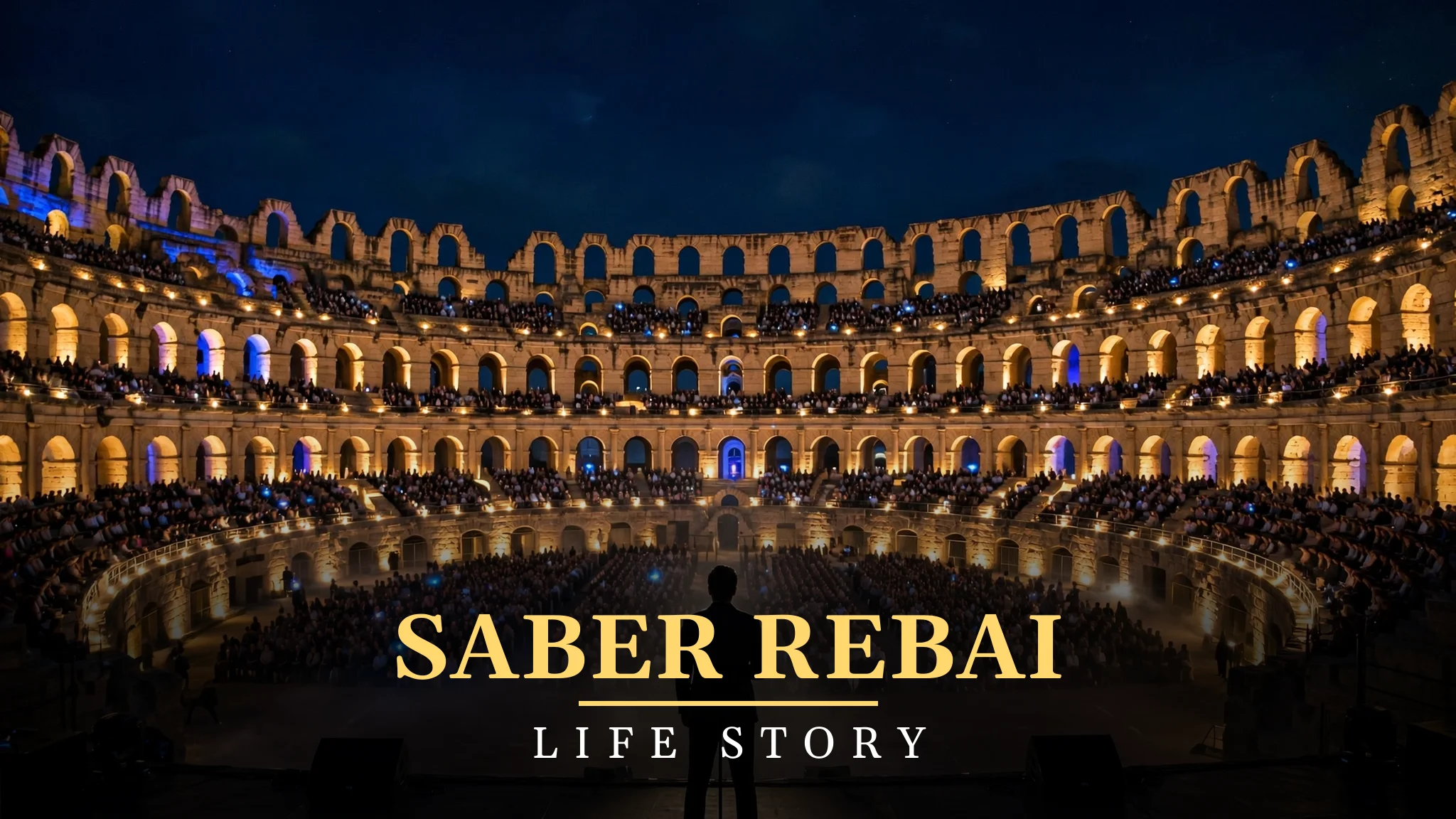
Saber Rebai’s career has been marked by performances at some of the most important venues in the Arab world, including the ancient amphitheatre of Carthage, in Tunisia, where he has performed many times, and where his concerts are events that draw thousands of listeners. Carthage is a historic place, a Roman amphitheatre that has hosted the greatest singers of the Arab world, and to perform there is an honour, a sign that a singer has reached the highest level. Saber’s concerts at Carthage are remembered for their elegance, their emotion, and the way his voice fills the ancient stones, as if the past and the present were meeting in a single song.
He also became known to a new generation through his work as a judge on The Voice Arabia, the television talent show where he sat alongside other stars, listening to young singers and helping them to grow. That role brought him to millions of viewers who had not seen him perform live, and it showed a different side of him, a warm, encouraging mentor who understood the fear and the hope of a young singer on a big stage. Young contestants who worked with him learned not only about technique but about how to carry a career, how to choose songs, and how to stay true to yourself, and that teaching is a lasting part of his legacy.
His work on television also kept his name alive in a music world that was changing, with streaming, with social media, and with new stars appearing every year, and it showed that he was willing to adapt, to be visible in new ways, and to stay in touch with his fans through the internet and through television. He understood that a career in the modern world requires a singer to be present in many places, and he learned those ways, even as he kept his focus on the music itself.
The big stages, from Carthage to The Voice, are a sign of how far Saber has come, from a boy in Sfax with an oud to a prince of Arab song who is known across a whole region. Those stages are not given lightly. They are earned, through years of work, of singing well, and of building a reputation that audiences trust, and Saber earned them, song by song, concert by concert, over more than thirty years.
The Later Years and a Voice That Endures
In the years that followed his peak, Saber Rebai continued to record and to perform, releasing new albums and new songs that showed a singer who was still growing, still willing to try new sounds, and still capable of moving an audience. His later work included songs with a more modern pop sound, as well as tracks that returned to the romantic style that had made him famous, and that mix showed a mature artist who was comfortable with his legacy and who was still interested in the future. He did not try to copy his early hits. He tried to make new music that was honest, and that honesty kept his fans engaged.
He also continued to perform live, at concerts and festivals in Tunisia, in Egypt, and in other Arab countries, where audiences came to hear him sing his old hits and his new songs, and where they responded with the same warmth they had shown for decades. A Saber concert in his later years was a celebration, a chance for fans to hear a voice they had loved for a long time, and to sing along to songs that were part of their own lives. Those concerts kept his connection with his audience alive, and they reminded everyone why his music mattered.
His personal life in these years was kept largely private, and he focused on his family and his music rather than on public controversy, a choice that many fans respect, because it shows a singer who values his art over fame. He had lived a full life, with love, with success, and with the pressure of being a public figure, and he had learned to value the simple things, the songs, the audiences, and the moments when his voice filled a hall and made people feel. That simplicity, after a life of great success, is a sign of wisdom.
By the end of the 2010s, Saber was recognised as one of the most enduring voices in Arab music, a singer whose career had lasted for more than thirty years, and whose songs were still played, still loved, and still part of the daily life of millions of listeners. He had also shown that a singer could grow older without losing his relevance, and that a mature artist could make music that was as fresh and as honest as the work of his youth.
A Prince Whose Songs Belong to Everyone
Saber Rebai’s title, prince of Arab song, is not only a compliment. It is a description of the way his music belongs to everyone, to listeners in Tunisia, in Egypt, in the Gulf, and in the diaspora, who all hear in his voice a singer who sings for them. His songs are played at weddings, on the radio, and in homes across the Arab world, and they have become part of the shared culture of a region that is often divided by borders but united by song. That universality is the mark of a great singer, and it is the reason his music will keep being heard for a long time.
His legacy is still being written, because he is still active, still singing, and still making music, but its shape is already clear. He opened a door for other Tunisian singers, he carried the tradition of the oud into modern pop, and he showed that a singer trained in the classical traditions of Arab music could become a star in the modern world. That example matters, because it tells young musicians that training and tradition are not a burden. They are a foundation, and a singer who builds on them can reach the highest levels.
For a young singer in Sfax today, Saber’s story is a reminder that a career in music can start with an oud and a song, and that it can grow if the singer is willing to study, to work, and to stay true to who he is, even when the road is long and the future is uncertain. That message is hopeful, and it is one that Saber’s life makes real, in a way that no speech or slogan could.
My Take:
I think Saber Rebai is one of the most elegant singers in this whole set, and I mean that in the best sense. His voice is smooth, his style is controlled, and his concerts are events that feel like a celebration of Arab song at its finest. I admire that elegance, because it is not easy to achieve. It comes from years of study, from learning the oud, from practising a voice until it is ready, and from a respect for the tradition of Arab music that many pop stars do not have. Saber has that respect, and it is audible in every song he sings, in the care he takes with every note, and in the way he treats a song as a work of art rather than a product to be sold quickly.
What I admire most about him is the training, the years he spent at the Higher Institute of Music in Tunis, learning the theory and the practice of Arab song. That kind of training is often overlooked in a world that celebrates singers who become famous overnight, but it is the foundation of a lasting career. Saber built his career on that foundation, and it shows, in the quality of his voice, in the choice of his songs, and in the longevity of his fame. I think about how many young singers today skip that training, and how much they lose by doing so, and I respect Saber for taking the longer, harder road, because it gave him a career that has lasted for more than thirty years.
His song “Sidi Mansour” is the one I think about most, because it is a perfect example of what he can do. The song is both traditional and modern, with a rhythm that makes people want to dance and a vocal performance that shows off his gift for long, controlled notes, and it became a hit across the Arab world, from Tunisia to the Gulf. I think about how many people must have heard that song at a wedding, in a car, or on the radio, and felt that it was written for them, and that feeling is the reason a song becomes a classic. Saber did not write a song for a chart. He sang a song that belonged to his culture, and the chart followed, because the song was true.
The song “Atahadda El Aalam” interests me for a different reason, because its title means “I challenge the world”, and that is a bold statement for a singer to make. It is a song about love, about a man who is willing to face the world for the person he loves, and Saber sings it with a confidence that makes the listener believe him. I think that confidence is a key part of his art, not arrogance, but a quiet, steady belief in himself and in his music. He does not shout his confidence. He sings it, with a voice that is both strong and tender, and that combination is what makes him a prince of song, not a king who demands obedience, but a prince who earns love through his art.
I also think about his performances at Carthage, in the ancient amphitheatre where the greatest singers of the Arab world have performed, and I find that image deeply moving. To stand in a place that is thousands of years old, and to sing a song that is both old and new, is a powerful thing, and Saber has done it many times, with a voice that fills the stones and makes the past feel alive. I think about the audiences who have sat in that amphitheatre, listening to him, and I wonder what they felt, hearing a Tunisian singer, from Sfax, singing in a place that has heard so many great voices before him. They must have felt proud, and they must have felt that their culture was alive, and that feeling is a gift that Saber gave them.
His work as a judge on The Voice Arabia also interests me, because it shows a singer who is willing to share what he has learned, to help young artists, and to give back to the music world that gave him so much. That generosity is a sign of a mature artist, one who understands that a career is not only about your own success, but about the singers who come after you. Saber has done that work with warmth and honesty, and young singers who worked with him have learned not only about technique but about how to carry a career with dignity. I respect that, because it is easy to keep your knowledge to yourself, and it is harder to share it, especially with singers who might one day take your place.
If I am honest, I do not think every song he made was perfect, and I do not think his later albums had the same impact as “Sidi Mansour” or “Atahadda El Aalam”. That is normal for any singer with a career that lasted for decades. The point is not that every song was a hit. The point is that he kept singing, kept performing, and kept his connection with his audience, and that the best of his work remains among the finest romantic songs in Arab music. A career is judged by its peaks, and Saber’s peaks were very high, and they are the reason his name is still known and loved today.
I think about the young singers in Tunisia today who look at Saber and see a path. They see a man who came from Sfax, who studied music in Tunis, and who became a star in Cairo, and they see that it is possible to build a career on training, on hard work, and on a voice that is honest. That example matters, because it shows that success does not have to come from a television contest or a viral video. It can come from study, from practice, and from a love of music that is deep enough to carry a person through a long career. Saber is proof of that, and his story will encourage young musicians for many years.
There is a part of his story that makes me think about the oud, and about what it means to learn an instrument that is at the heart of Arab music. The oud is not a fashionable instrument, and it is not easy to play, but Saber learned it, and it gave him a understanding of melody and rhythm that a singer who only sings does not have. I think that understanding is audible in his singing, in the way he phrases a line, in the way he holds a note, and in the way he makes a song feel complete. The oud taught him to listen, and listening is the most important skill a singer can have, because a singer who listens to the music will sing it truly.
In the end, I think Saber Rebai’s story is about a voice that was trained, a talent that was nurtured, and a career that was built slowly, song by song, concert by concert, over more than thirty years. He did not become famous overnight, and he did not lose his fame overnight. He built it, and he kept it, by singing well, by respecting his art, and by staying true to himself. That is a hopeful message for any young musician, that a career can be built on work and on talent, and that it can last, if the singer is willing to keep working and to keep learning.
I hope his songs keep being played, and I hope young Arab singers today know his name and understand what he achieved. He was not only a great romantic singer. He was a bridge between Tunisia and Egypt, between tradition and modern pop, and between a young boy with an oud in Sfax and a prince of song on the biggest stages in the Arab world. His life is a reminder that a singer can be more than a performer. He can be a keeper of a tradition, a voice for a people, and a singer whose songs become part of other people’s lives. That is a beautiful legacy, and I am grateful for it.
I want to end by thinking about the listener who hears a Saber Rebai song for the first time today, at a wedding, on the radio, or in a quiet moment at home, and who feels a sudden sense of warmth, as if someone were singing directly to them about love. That feeling is the heart of his art, and it is the reason his music matters. He does not sing to impress. He sings to connect, and that connection, between a singer and a listener, is the most important thing in music. I hope that connection keeps growing, and I hope Saber keeps singing, because the world needs more voices like his, elegant, honest, and true.
I also think about the title prince of Arab song, and about how well it fits him, not because he is royal, but because he carries himself with a dignity that is rare in the music world. He does not chase controversy, he does not make a scene, and he does not try to be shocking. He sings, and he lets his voice do the work, and that quiet dignity is a form of royalty, a royalty of art rather than of birth. I think that is a beautiful thing, and it is one of the reasons his fans love him so deeply, because they know that his songs come from a place of respect, for the music, for the audience, and for himself.
I also think about the oud, and about how an instrument can teach a singer to listen. Saber learned the oud as a boy in Sfax, and that learning gave him an understanding of melody that a singer who only sings does not have. The oud is a quiet instrument, played close to the body, and it requires patience, practice, and a willingness to listen to every note. Those qualities are audible in Saber’s singing, in the way he phrases a line and holds a note, and they are the reason his voice feels so complete. I hope young musicians today learn an instrument as Saber did, because it will make them better singers, and better listeners, for the rest of their lives.
Finally, I want to say that his story gives me hope for the future of Arab music, and for the future of trained, serious singers in a world that often rewards the loudest and the most fashionable. Saber shows that a singer who studies, who practises, and who respects tradition can build a career that lasts for decades, and that a voice trained in the classical traditions can still be heard in the modern world. That hope is important, because it tells young artists that their training matters, and that their hard work will be rewarded, even if it takes time. I hope his songs keep encouraging those young singers, and I hope Saber keeps singing, because the world needs more voices like his, elegant, honest, and true.
I also think about the way his songs will age, and about whether a young listener ten years from now will still feel the romance in “Sidi Mansour”. I believe they will, because Saber’s best songs are not built on a fashion that fades. They are built on a smooth voice, a beautiful melody, and a feeling of love that does not go out of date, and those things travel well across time. A romantic song, sung truly, will mean as much to a young Arab listener in ten years as it does today, because the feeling behind it does not change. That is the test of a great song, and Saber’s best work passes it with ease.
One last thought stays with me, about the city of Sfax itself, with its port, its olive groves, and its proud people, and about how a singer can carry a whole city in his voice. Saber carries Sfax with him, in his sound and in his pride, and when listeners in other countries hear his songs, they hear a little of that city too. That is a beautiful thing for a singer to do, to make a place audible, and I hope he keeps doing it, song after song, for many years to come.
Frequently Asked Questions
When was Saber Rebai born?
Saber Rebai was born on 13 March 1967 in Sfax, Tunisia. He grew up in Sfax, where he learned to play the oud, before moving to Tunis to study music.
What is Saber Rebai’s most famous song?
“Sidi Mansour” is his best-known song, a hit that became a signature work across the Arab world. “Barshalo” and “Atahadda El Aalam” are also among the tracks his fans know best.
What does the title prince of Arab song mean?
Saber Rebai is called the prince of Arab song because of his elegant, powerful voice and his leading place in romantic Arab music. The title reflects his training, his style and his long career.
Did Saber Rebai study music?
Yes, he studied at the Higher Institute of Music in Tunis, where he learned the oud and the traditions of Arab music. That training gave his singing a quality that many pop stars lack.
Was Saber Rebai a judge on The Voice?
Yes, he has served as a judge and mentor on The Voice Arabia, where he helped young singers and shared his experience with a new generation of Arab artists.
Is Saber Rebai still performing?
Yes, he remains active as a singer, performing at concerts and festivals in Tunisia, Egypt and other Arab countries, including the famous amphitheatre of Carthage.


