Sakis Rouvas: The Life Story Behind Greece's Pop Star
In this post
- A Boy From Corfu With Big Dreams
- First Records and the Start of Fame
- Eurovision 2004 and Shake It
- Acting, Television, and a Star Beyond Music
- Family Life With Katia Zygouli
- Hard Times and Staying at the Top
- What Sakis Rouvas Means to Greek Pop
- The Energy of a Live Show
- The X Factor, The Voice, and a Coach Who Listens
- My Take:
Sakis Rouvas is one of the most famous male pop stars in Greece, and for more than thirty years he has been a singer, a dancer, an actor, and a television host. He is known for his strong voice, his energy on stage, and his ability to make a concert feel like a party. When he sings, he moves, he dances, and he talks to the crowd, and the audience feels that he is giving everything he has. He has sold many albums, he has filled large concert halls, and he has represented Greece at the Eurovision Song Contest.
He was born on the island of Corfu, a beautiful island in the west of Greece, and he grew up in a family that loved music and sport. As a young man, he was good at sport, and he also loved to sing and to dance. He moved to Athens when he was still young, and he began to work in music, singing in clubs and learning how to perform. He did not become a star in one night. He worked step by step, and he learned how to be a performer who could sing, dance, and act.
What makes his story interesting is the way he has stayed popular for so long in a country where pop stars come and go quickly. He has changed his sound, he has tried new styles, and he has worked in television and in film, but he has always kept his place as one of the biggest names in Greek pop. He has also built a family life with his partner Katia Zygouli, and he has become a father of four children. This is the story of how a boy from Corfu became one of the most loved stars in Greece.
A Boy From Corfu With Big Dreams
Sakis Rouvas was born on 5 January 1972 in Corfu, an island in the Ionian Sea in western Greece. Corfu is known for its green hills, its old town, and its sea, and it is a place where music and dance are part of everyday life. Sakis grew up there, and he was a lively and active child. He liked sport, he liked music, and he liked to be in front of people. He was not a quiet boy. He was a boy who wanted to perform.
As a young man, he was good at sport, and he took part in athletics. He also sang and danced, and he began to think about a life in music. Corfu was a small place for a young man with big dreams, and he knew that if he wanted to become a singer, he would have to move to Athens, where the music business was. It was a big step, and it meant leaving his family and his island, but he was ready to try.
He moved to Athens when he was still a teenager, and he began to look for work in music. He sang in clubs, he took part in shows, and he learned how the music world worked. Athens was a big city, and it was full of singers who wanted the same chance. Sakis had to work hard to be noticed, and he did. He had a good voice, he had energy, and he had a way of moving on stage that people remembered.
In those early years, he also learned how to be a professional. He learned how to rehearse, how to work with musicians, and how to handle a live audience. He was young, and he was learning fast, and he was not afraid of hard work. The boy from Corfu was becoming a singer in Athens, and he was ready for his first big chance.
First Records and the Start of Fame
Sakis Rouvas released his first album in 1991, when he was nineteen years old, and it began to make his name known in Greece. The album had pop songs with a modern sound, and it showed that he was a young singer with energy and talent. He was not yet a huge star, but people began to notice him, and his songs were played on the radio. He was on his way.
He followed his first album with more records in the early 1990s, and his fame grew. He sang songs that were catchy and modern, and he performed them with dance and movement. He was different from many Greek singers of the time, because he was a pop star who danced as well as sang. He wore modern clothes, he moved on stage, and he gave his concerts a feeling of a party. Young people liked him, and they came to his shows in large numbers.
He also began to appear on television, and he became a familiar face to people all over Greece. He was handsome, he was talented, and he was hard-working, and he was building a career that would last. He worked with good composers and producers, and he chose songs that fitted his voice and his style. Each new album brought him closer to the top of Greek pop music.
By the mid-1990s, Sakis Rouvas was no longer a new singer. He was a star, and he was one of the most popular male singers in Greece. He had albums, he had hits, and he had fans who waited for his next record. He had found his sound, and he had found his audience. The boy from Corfu had become a pop star in Athens, and the best years of his career were still ahead of him.
Eurovision 2004 and Shake It
In 2004, Sakis Rouvas represented Greece at the Eurovision Song Contest in Istanbul, Turkey, with the song Shake It. It was a fast and lively dance song, and he performed it with energy, dancing on stage and singing with confidence. The song finished in third place, which was a very good result for Greece, and it made him known to audiences across Europe. People who had never heard of him before saw him on television and remembered him.
The Eurovision performance was important because it showed the world that Greek pop could be modern and exciting. Sakis did not sing a slow or traditional song. He sang a dance song, he danced, and he gave a show that was full of life. It was the kind of performance that Eurovision audiences love, and it helped Greece to do well in the contest. It also helped Sakis to become even more famous in Greece, where people were proud of his result.
After Eurovision, his career grew even bigger. He released more albums, and his songs were played on the radio every day. He gave large concerts, and he filled halls and open-air venues. He was at the height of his fame, and he was one of the biggest stars in Greece. He had shown that he could stand on a big international stage and perform with confidence, and that gave him a new level of respect.
He returned to Eurovision in 2009, when the contest was held in Moscow, Russia. That year, he did two things. He was one of the hosts of the contest, presenting the shows with a smile and with professionalism, and he also sang for Greece with the song This Is Our Night. It was a rare honour to both host and compete, and it showed how much Eurovision trusted him. His song finished in seventh place, and his work as a host was praised by many people.
Acting, Television, and a Star Beyond Music
Sakis Rouvas did not only sing. He also acted in films and on television, and he showed that he could do more than one thing. He starred in the film Alter Ego in 2007, playing a rock star, and he appeared in other films and television shows. Acting was a new challenge for him, and it showed his range as a performer. He was not only a singer. He was an entertainer who could act as well.
He also became a television host, presenting music shows and entertainment programmes in Greece. He was good at talking to people, he was warm and friendly, and he knew how to make a show feel alive. He hosted the Greek version of The X Factor, and he worked as a coach on The Voice of Greece, helping young singers to learn and to perform. He shared what he had learned in his own career, and young singers looked up to him.
His work on television made him known to a new generation of viewers, including young people who had not been born when he first became famous. He was still a pop star, but he was also a television star, and that helped him to stay popular for a long time. He did not disappear when the music business changed. He changed with it, and he found new ways to reach his audience.
He also took part in theatre, and he showed that he could perform on stage in a different way. He was willing to try new things, and he was willing to learn new skills. That is not easy for a famous singer, because it means starting again in a new field, but Sakis did it with courage and with hard work. He proved that he was more than a pop singer. He was a performer in the full sense of the word.
Family Life With Katia Zygouli
Sakis Rouvas has built a family life with Katia Zygouli, a model and actress, and they have four children together. Their family is well known in Greece, and people are interested in their life, but they have tried to protect their children’s privacy while still being open with their fans. Sakis has spoken about his children with love, and he has said that being a father is the most important thing in his life.
Being a father of four and a pop star at the same time is not easy. He has to balance concerts and recordings with family life, and he has to be at home as well as on stage. He has tried to do both, and he has shown that a man can be a star and a father, and that he can take both roles seriously. His fans respect him for it, and they like to see him as a family man as well as a singer.
His relationship with Katia Zygouli has lasted for many years, and they have built a home together. They have faced the pressure of being in public, and they have dealt with it by keeping their private life as private as they can. They do not share everything, and they do not make their family into a show. That is a wise choice, and it has helped them to keep their family strong.
Through his family life, Sakis Rouvas has shown a different side of himself. On stage, he is energetic and loud. At home, he is a father who looks after his children. Both sides are real, and both sides matter. His story is not only about hits and concerts. It is also about a man who has built a family, and who has tried to be a good father while still being a star.
Hard Times and Staying at the Top
A long career is never easy, and Sakis Rouvas has faced hard times as well as good times. The music business in Greece has changed a great deal since he started in 1991. The way people listen to music has changed, the record business has changed, and new singers have come and gone. Many stars from the 1990s have faded away, but Sakis has stayed. That has taken work, and it has taken the ability to change.
He has had to deal with the pressure of being famous for more than thirty years. People have opinions about his songs, his looks, and his life, and he has had to live with that. He has also had to deal with the physical demands of being a performer who dances and sings on stage. That is hard work, and it takes a fit and healthy body. He has looked after himself, and he has kept his energy, and that has helped him to keep performing.
He has also faced times when his music was less popular, and when new styles became fashionable. He did not give up. He made new albums, he tried new sounds, and he kept working with young composers and producers. He was willing to learn from new people, and he was willing to change his sound. That is not easy for a star who has been successful for a long time, but he did it, and it kept him popular.
Through these hard times, his fans stayed with him. They came to his concerts, they bought his albums, and they sang his songs. That loyalty was important, because it showed that his music meant something real to people. He was not only a star of one decade. He was a singer who had been part of people’s lives for many years, and they did not want to let him go.
What Sakis Rouvas Means to Greek Pop
Today, Sakis Rouvas is seen as one of the most important male pop stars in the history of Greek music. He has been singing for more than thirty years, and he is still active. His songs are played on the radio, his concerts are still popular, and his name is known to almost everyone in Greece. He is a singer who started as a young man from Corfu, and who built a career that has lasted longer than most.
His music matters because it is happy and energetic. It is made for dancing, for summer, and for celebration, and it brings people together. His songs have been played at parties, at weddings, and in clubs, and they are part of the sound of modern Greece. When people hear his songs, they remember good times, and that is a gift that a singer can give.
He has also been important because he showed that a Greek pop star could be a complete entertainer. He could sing, he could dance, he could act, and he could host a television show. He was not only a voice. He was a performer, and he showed young singers in Greece that they could do more than one thing. That is an important example, and it has influenced many young artists.
His legacy is not only his hits. It is also his example as a working singer, a father, and a man who has stayed at the top for more than thirty years. He has worked hard, he has changed with the times, and he has kept his fans with him. His story is still going on, and his fans are still listening, still dancing, and still waiting for his next song.
The Energy of a Live Show
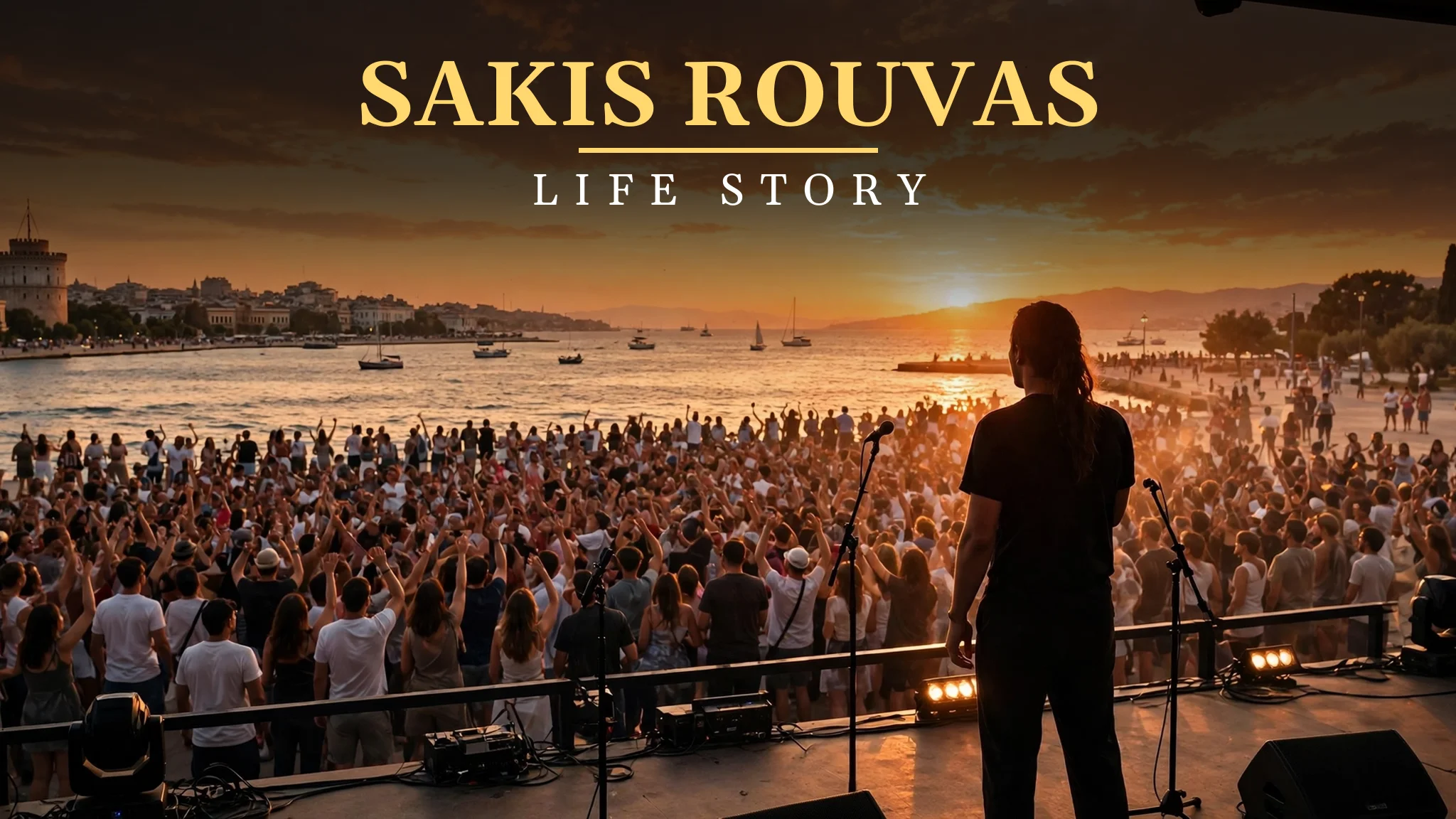
Sakis Rouvas is known above all for his live shows, and anyone who has seen him perform will remember the energy, the dancing, and the feeling that the whole hall is alive. He does not stand still and sing. He moves across the stage, he dances with his band, he talks to the audience, and he makes each person in the crowd feel as if the show is for them. His concerts are long, loud, and full of joy, and they are the reason his fans come back again and again. A record can be played at home, but a Sakis Rouvas concert is something you have to experience in person.
His dancing is a big part of that energy, and it is something he has worked on for many years. He learned to dance as well as to sing, and he practises his moves, his steps, and his timing, so that his performances look smooth and natural. He is a fit and strong performer, and he takes care of his body, because he knows that a show like his needs stamina. He sings and dances at the same time, which is very hard, and he does it for hours, night after night, when he is on tour. That is a level of professionalism that few singers can match.
He also knows how to choose songs for a concert, how to start with a fast song, how to slow down for a love song, and how to finish with a big, joyful song that makes everyone stand up and dance. He reads the audience, he watches their faces, and he changes his performance to fit the mood of the night. That is a skill that only comes from many years on stage, and Sakis has it. His concerts feel personal, even in a large hall, because he is always looking at the crowd, always talking to them, and always giving them his best.
That live energy has kept him popular for more than thirty years, because people do not only want to hear a song on the radio. They want to be part of a show, to dance, to sing along, and to feel alive for a few hours. Sakis Rouvas gives them that, and he has given it to generations of fans in Greece and in other countries. His live shows are his greatest gift, and they are the reason his name is still one of the biggest in Greek pop.
The X Factor, The Voice, and a Coach Who Listens
Sakis Rouvas has also been a coach and judge on Greek television, and that work has shown a different side of him, a patient and thoughtful side that audiences do not always see in his concerts. He was a judge on the Greek version of The X Factor, and a coach on The Voice of Greece, where he worked with young singers, listened to their voices, and helped them to choose songs, to rehearse, and to perform with confidence. He was kind but honest, and he told them what they needed to improve without making them feel small. Young singers trusted him, because he had been young himself, he had moved to Athens with a dream, and he knew what it was like to start from nothing.
His television work also made him known to a new generation of viewers, including young people who had not been born when he first became famous. They saw him on television, they liked his warmth and his humour, and then they discovered his music. That is a wonderful way for an older star to reach young listeners, and it shows that Sakis is not afraid of new media. He uses television, he uses social media, and he stays in touch with his fans in new ways, while still giving concerts and making new music. That balance has helped him to stay popular for more than thirty years.
My Take:
When I think about Sakis Rouvas, I think about energy, and I think that is the first thing that comes to mind. He is a singer who gives everything on stage, who dances, who moves, and who makes a concert feel alive. I have seen many singers who stand still and sing well, and that is fine, but Sakis is different. He performs with his whole body, and he wants the audience to feel happy and alive. I respect that, because it takes a lot of work to sing and dance at the same time, and it takes a lot of courage to do it in front of thousands of people.
I also think about where he started, on the island of Corfu, and I find that interesting. Corfu is a beautiful place, but it is a small place for a young man with big dreams. He left his island, he moved to Athens, and he tried to become a singer. That takes courage, and it takes belief in yourself. Many young people have a dream like that, and many of them stay at home because they are afraid. Sakis went, and he worked, and he learned, and he built a career from nothing. That part of his story feels human to me.
What I like most about his music is that it is made for joy. His songs are fast, they are bright, and they make people want to dance. When I hear Shake It, I think of summer, of a party, of friends dancing together. That is a good thing for a singer to give. Life is hard for many people, and a song that makes them smile is not a small thing. It is a real gift, and Sakis Rouvas has given it again and again for more than thirty years.
I also think about his Eurovision performances, and I find them interesting because they show two different parts of his career. In 2004, he was a singer, and he finished third with Shake It. In 2009, he was both a host and a singer, and he showed that he could do two jobs at the same time. That is rare, and it shows how much trust Eurovision had in him. He was not only a singer. He was a presenter, a host, and a star, and he did it all with a smile.
There is something I admire about his work on television, especially on The Voice of Greece. He could have stayed only on stage, singing his own songs, but he chose to sit with young singers and help them to learn. He knows what it is like to be young, to move to Athens, to sing in small clubs, and to try again after a record does not sell. That experience is valuable, and he shares it with young people who need it. I think that is a generous thing to do, and it shows that he cares about music, not only about himself.
I also think about his family life, and I like that he has built a family with Katia Zygouli and their four children. Being a father of four is a big job, and being a pop star is also a big job, and he has tried to do both. He has spoken about his children with love, and he has said that being a father is the most important thing in his life. I think that is a good thing to hear from a famous man, because it shows that fame is not the only thing that matters. Family matters too, and he has not forgotten that.
When I think about his acting, I think it shows that he is willing to try new things. He starred in Alter Ego, he acted in films and on television, and he took part in theatre. That takes courage, because acting is a different skill, and it could have failed. He tried it anyway, and it added something new to his career. I think that is a good lesson for anyone. If you only do what you already know, you will never learn what else you can do.
I also think about how long he has stayed popular, and I find that impressive. Many pop stars from the 1990s have faded away, but Sakis is still here. He has changed his sound, he has worked with new composers, and he has found new ways to reach his audience. That is not luck. That is work, and it is the kind of work that is easy to admire but hard to do. He had to keep learning, keep changing, and keep showing up, year after year.
There is a sad part too, and it is that the music business is hard, and it is always looking for the next young star. Even a singer as successful as Sakis has to keep proving himself again and again. That pressure must be tiring, and I think he has handled it well, by making new albums and by staying on television, but I wish the business was kinder to singers who have already proved themselves. He has proved himself many times, and he should not have to prove it again and again.
I also think about his dancing, and I think it is part of what makes him special. He is not only a singer. He is a dancer, and he moves on stage in a way that makes a concert feel alive. That takes a fit body, and it takes practice, and he has kept it up for more than thirty years. I think that is impressive, because many singers stop dancing as they get older, but he has kept his energy. That tells me that he looks after himself, and that he takes his work seriously.
When I compare him with other Greek pop stars, what stands out is his range. He can sing, dance, act, and host, and he can do each of them well. He is not stuck in one style, and he is not afraid to try new things. That range is rare, and it is one of the reasons his career has lasted so long. He could change, and his fans changed with him, and that is a hard thing to do.
For a young reader, I think the lesson from Sakis Rouvas is simple. Work hard, be ready to try new things, and do not be afraid to move. He left Corfu, he moved to Athens, he tried singing, dancing, acting, and hosting, and he built a long career. He did not become a star in one night, and he did not stay a star by doing nothing. He worked for more than thirty years, and he is still working. That is the lesson I take from his story.
I keep thinking about his concerts, and about the happiness they bring. He has sung for thousands of people, and he has made them dance and sing along. That is a wonderful thing to do with a life. He has not only made records. He has made memories for people, and those memories will stay with them long after the concert is over. I think that is the best kind of legacy for a pop singer.
In the end, I think Sakis Rouvas teaches us that a performer can be many things at once. He is a singer, a dancer, an actor, a host, and a father, and he has done each of those things with care. He has spent more than thirty years making people happy, and he has done it with energy, with honesty, and with love for his fans. I would rather be remembered like that, for the joy I gave, than for a single famous moment, and I believe he would say the same.
I also think about his live shows, and about how much energy they take. He sings, he dances, and he performs for hours, and he does it night after night. That is hard work, and it takes a fit body and a strong will. I think many people do not realise how hard it is to be a performer like Sakis, because they only see the bright lights and the applause. Behind that, there is rehearsal, practice, and a great deal of effort. He has done that for more than thirty years, and I respect him for it.
I think about his dancing again, and I realise that it is part of what makes him different from other Greek singers. Many singers stand still and sing well, but Sakis dances, and he makes a concert feel like a party. That is a special skill, and it is a skill that he has worked on for many years. He did not become a dancer by accident. He practised, he learned, and he kept his body strong. That is a lesson in itself: if you want to be good at something, you have to work at it every day.
Another thing I notice is how he has stayed humble in a way, even though he is a huge star. He talks to his fans, he thanks them, and he does not act as if he is above them. That matters, because fame can make people proud, but Sakis has stayed warm and close to his audience. I think that is part of why his fans have stayed with him for so long, because they feel that he cares about them, and that he is grateful for their support.
I also think about the future, and about what his career will look like in ten more years. I believe he will still be singing, still dancing, and still giving concerts, because that is what he loves to do. He is not a singer who will retire quietly. He is a performer who loves the stage, and who will keep performing as long as he can. I hope he does, and I hope his fans keep coming, because his shows bring joy to people, and joy is a precious thing.
In the end, I keep coming back to the idea of a complete entertainer. Sakis can sing, dance, act, and host, and he can do each of them well. That is rare, and it is a gift that he has used wisely. He has not wasted his talent, and he has not stayed in one place. He has tried new things, he has learned new skills, and he has kept growing. That is a story that gives hope to anyone who wants to do more than one thing, and it is a story that I will remember.
I also think about his television work, and I like that he helps young singers on The Voice of Greece. He could have stayed only on stage, but he chose to sit with young people and help them learn. That is a generous thing to do, and it shows that he cares about music, not only about himself. He knows what it is like to be young, to move to a big city, and to try to become a singer, and he shares that experience with people who need it. I think that is one of the best things a famous singer can do.
I think about his patience as a coach, too, and I respect it. He does not shout at young singers, and he does not make them feel small. He listens, he encourages them, and he tells them the truth in a kind way. That is a good way to teach, and it is a way that helps young people to grow. He is a star, but he is also a teacher, and that makes his legacy even stronger. I hope young singers learn from him, not only how to sing, but how to be kind and patient with others.
Another thing I notice is how television has helped him to reach new fans. Young people who see him on The Voice may not know his old songs, but they like him, and then they discover his music. That is a smart way to stay relevant, and it shows that he is not afraid of change. He uses new media, he stays in touch with his fans, and he keeps learning. That is a lesson for any artist: do not be afraid of new things. Try them, learn from them, and use them to reach new people.
I also think about the future, and about what his career will look like in the years ahead. I believe he will still be singing, still coaching, and still performing, because that is what he loves. He is a performer who loves the stage and loves helping others, and he will keep doing both as long as he can. I hope he does, because his work brings joy to people, and joy is a precious thing that the world needs more of.
In the end, I keep coming back to versatility. He can sing, dance, act, host, and coach, and he can do each of them well. That is rare, and it is a gift that he has used wisely. He has not wasted his talent, and he has not stayed in one place. He has tried new things, he has learned new skills, and he has kept growing for more than thirty years. That is a story that gives hope to anyone who wants to do more than one thing, and it is a story that I will remember for a long time.
Frequently Asked Questions
Where was Sakis Rouvas born?
Sakis Rouvas was born on 5 January 1972 in Corfu, Greece, and he moved to Athens as a young man to start his music career.
When did Sakis Rouvas first become famous?
He released his first album in 1991 when he was nineteen, and he became one of the most popular male pop singers in Greece through the 1990s with a string of hit albums and songs.
What did Sakis Rouvas do at Eurovision?
He represented Greece in 2004 with Shake It, finishing third, and in 2009 he both hosted the contest in Moscow and sang for Greece with This Is Our Night, finishing seventh.
Has Sakis Rouvas acted in films?
Yes, he starred in the film Alter Ego in 2007 and has acted in other films, television shows, and theatre, showing that he is an actor as well as a singer.
Who is Sakis Rouvas’s partner and how many children do they have?
His partner is Katia Zygouli, a model and actress, and they have four children together, and he has spoken about fatherhood as the most important part of his life.
Is Sakis Rouvas still performing today?
Yes, he is still active, giving concerts, releasing new music, and working on television in Greece, including as a coach on The Voice of Greece.


