Salif Keita: The Life Story Behind Mali's Golden Voice
In this post
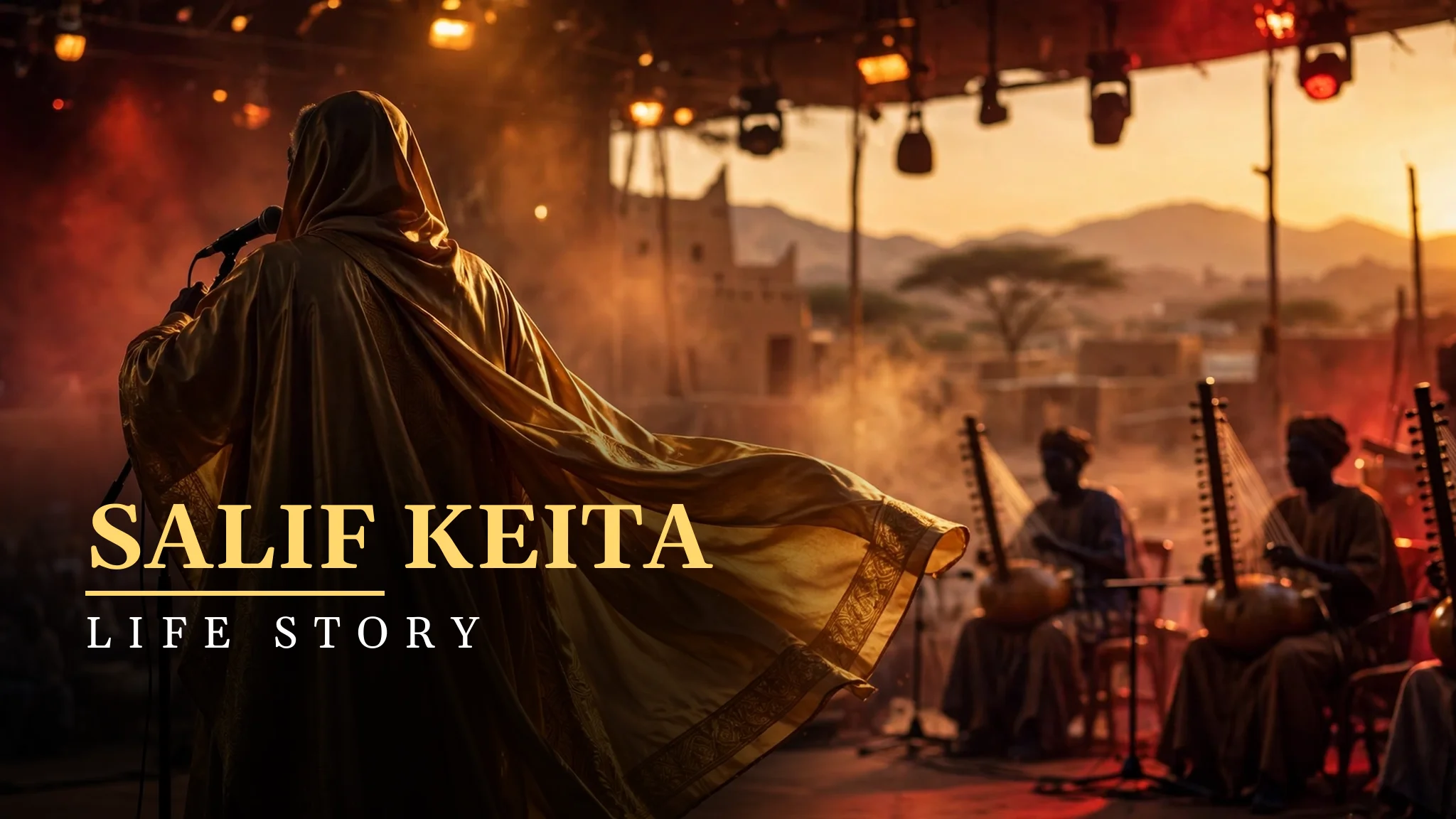
Some voices are beautiful. A few voices are unforgettable. Salif Keita has one of the unforgettable kind: high, clear, and full of feeling, a voice that can make a simple melody sound like a prayer. He is known as the Golden Voice of Africa, and the name is not an exaggeration. For more than fifty years, his singing has carried the music of Mali to the world, and his life has been a story of turning rejection into triumph.
He was born on 25 August 1949 in Djoliba, a village on the Niger River in Mali. He was born into a family that traced its line back to Sunjata Keita, the founder of the Mali Empire, and that royal blood should have been a blessing. Instead, his life began with a difficulty that shaped everything that followed. He was born with albinism, and in the Mali of his childhood, that made him an outsider in his own family and in his own village. The boy who would become the Golden Voice began his life as a boy who was told he did not belong.
This is the story of how that boy left his village, found his voice in Bamako, conquered Paris, and returned to Mali as one of its greatest artists. It is a story about music, but it is also a story about dignity: about a man who refused to accept the place the world had given him, and who made a new place for himself with his voice alone.
Djoliba: A Prince Born Different
Salif Keita was born on 25 August 1949 in Djoliba, Mali, a village on the banks of the Niger River. His family was a noble one, descended from Sunjata Keita, the great king who founded the Mali Empire in the thirteenth century. In the old world of Mali, that descent meant honour, respect, and a place at the top of society. A child born into such a family was expected to live a life of dignity and privilege. Salif’s life did not follow that expectation, and the reason was visible from the day he was born.
He was born with albinism, a condition that leaves the skin, hair, and eyes without pigment. In many parts of Africa, including Mali in the 1950s, albinism was misunderstood, and people born with it faced fear, superstition, and rejection. In Salif’s own family, his birth was seen as a bad sign, and he was treated as an outsider. He was not welcomed in the way a prince should have been welcomed. He was, in the words of his own story, a child who did not fit, and the pain of that rejection stayed with him for the rest of his life.
The village of Djoliba was a place of farming, fishing, and music, and Salif grew up hearing the songs of the griots, the hereditary musicians and storytellers of West Africa. The griots carried the history of Mali in their songs, and their music was the memory of the empire. Salif loved that music, but the rules of his society said that a noble should not become a musician. Music was the work of griots, not of princes. A boy from a noble family who wanted to sing was breaking a rule, and Salif was already breaking rules by being born different. He decided to break one more.
As a child, he was often alone. He was not accepted by his family in the usual way, and he was not accepted by the village in the usual way. He found comfort in music, in the songs he heard, and in the sound of his own voice. His voice was unusual, even as a boy: high, clear, and strong, with a quality that made people stop and listen. It was a gift, and it was a gift that did not care about the colour of his skin or the rules of his family. It was simply there, waiting to be used.
When he was eighteen, he made a decision that changed his life. He left Djoliba and went to Bamako, the capital of Mali, to become a musician. He left behind his family, his village, and the life that had been planned for him. He went to the city with little money and no guarantee of success, but he went with a voice, and with a determination to be heard. That journey, from a village on the Niger to the capital, was the first step in a career that would take him around the world.
Bamako, the Rail Band, and the First Fame
In Bamako, Salif Keita joined the Rail Band, one of the great bands of Mali. The Rail Band was the house band of the Buffet Hotel de la Gare, a hotel at the railway station in Bamako, and it was a school for the best musicians in the country. The band played a mix of traditional Malian music, Cuban rhythms, and modern pop, and its members included some of the most talented singers and guitarists in West Africa. For a young man from Djoliba, joining the Rail Band was like joining a university of music.
Salif sang with the Rail Band in the early 1970s, and his voice quickly became known in Bamako. Audiences who heard him were struck by the beauty of his singing, and by the emotion in it. He did not sing like other singers. His voice was higher, clearer, and more piercing, and it carried a sadness that came from his own life. He sang about love, about Africa, and about the pain of being an outsider, and listeners who had never met him felt that they understood him. His voice was a bridge between his life and theirs.
After the Rail Band, he joined Les Ambassadeurs, another great Malian band, and he continued to build his reputation. Les Ambassadeurs was a band of stars, and Salif was one of its brightest. The band performed in Bamako and toured in West Africa, and its music was a mix of Malian tradition and modern sounds. Salif’s singing was at the centre of it, and his name became known beyond Mali. He was no longer a boy from Djoliba who had been rejected. He was a singer whose voice was recognised across the region.
The Bamako years were also years of learning. Salif learned how to perform, how to work with a band, and how to write songs that spoke to an audience. He learned the business of music, and he learned how to survive as an artist in a country where the music business was small and where a singer had to work hard to make a living. He also learned that his voice was his greatest asset, and that it could take him further than Bamako if he was willing to travel.
By the early 1980s, he had become a well-known singer in Mali, but he wanted more. He wanted to reach the world, and he knew that the world was listening to African music in Paris. He decided to go there, and the decision would lead to the next stage of his career: the albums that made him a global star.
Paris and Soro: The World Hears the Golden Voice
In 1984, Salif Keita moved to Paris, and the move changed his career. Paris was the centre of African music in Europe, and its studios were full of musicians from across the continent. A singer in Paris could record with the best producers, perform for audiences from many countries, and reach listeners far beyond Africa. Salif arrived with a reputation from Mali, and he set out to build a new one in Europe.
His first major album in Paris was Soro, released in 1987. The album was a breakthrough, and it introduced his voice to a global audience. Its songs mixed traditional Malian sounds with modern production, and its melodies were beautiful and memorable. The album’s best-known song, Madan, became a hit, and it was played on radio stations in Europe and beyond. Soro showed that Salif’s music could work in a modern studio without losing its Malian soul. It was a record that belonged to both worlds, and it was a success in both.
The album’s success made Salif a star in the world music scene. He was invited to perform at festivals across Europe, and his concerts drew audiences who had never been to Mali but who understood his music. His voice, which had once been a source of pain in his village, was now a source of joy for listeners around the world. The boy who had been rejected was now celebrated, and the celebration was based on the very thing that had made him different: his voice, and the emotion in it.
He followed Soro with more albums, including Ko-Yan in 1989 and Amen in 1991, and each one added to his reputation. He worked with musicians from many countries, and his music became a meeting place for African and Western sounds. He was not a singer who copied Western pop. He was a singer who brought Malian music to the West, and who showed Western audiences that African music could be both traditional and modern, both beautiful and powerful.
The Paris years also brought him recognition from the wider music world. He was nominated for Grammy Awards, and his albums were praised by critics and by other musicians. He became known as the Golden Voice of Africa, a title that reflected both the beauty of his singing and the importance of his work. He had come a long way from Djoliba, and the journey was not over. He still had more to give, and he still had a home to return to.
Moffou, M’Bemba, and the Return to Mali
After years in Paris, Salif Keita returned to Mali and built a new life there. He founded the Moffou club in Bamako, a venue that became a centre for live music in the city, and he released the album Moffou in 2002. The album was a return to his roots, with a sound that was closer to traditional Malian music than his Paris records had been. It was also a critical success, and it showed that he had not forgotten where he came from. The club and the album were both acts of homecoming, and they were both signs that Salif’s story had come full circle.
He continued to record, releasing M’Bemba in 2005, an album that paid tribute to the music of his youth and to the great singers who had inspired him. The album’s title refers to a term of respect, and the record was a gesture of gratitude to the tradition that had made him. He also released Un Autre Blanc in 2018, an album whose title, meaning Another White, referred directly to his albinism and to his life as an outsider. It was a bold and honest record, and it showed that he was still willing to sing about the most painful parts of his life, even after decades of success.
The return to Mali also gave him a new role: that of an advocate for people with albinism. He had lived the pain of rejection, and he knew what it meant to be treated as different. He used his fame to speak about that pain, and to campaign for the rights and the safety of people with albinism in Mali and across Africa. He founded the Salif Keita Global Foundation, which works to support people with albinism and to fight the discrimination and violence they face. That work is as important as his music, and it is a part of his legacy that goes beyond the stage.
His later years also brought him honours and recognition from Mali and from the world. He is regarded as one of the greatest singers in African history, and his name is mentioned alongside the other great voices of the continent. He has performed at festivals, at concerts, and at events that celebrate African music, and his voice remains strong. A singer who began his life as an outsider has become a symbol of Mali, and his story is told to young Malians as an example of what is possible.
Today, Salif Keita lives in Mali, and he remains active as a singer and as an advocate. His voice is still heard, his club is still a centre for music in Bamako, and his foundation is still working for people with albinism. The boy from Djoliba who was told he did not belong has become a man who belongs to the whole world, and his story is one of the most inspiring in African music.
The Voice and the Message
Salif Keita’s music is not only beautiful. It is also meaningful. His songs speak about love, about Africa, about the pain of being different, and about the hope of a better world. They are sung in Bambara, in French, and in other languages, and they carry the rhythms of Mali in every note. His voice is the centre of the music, and it is a voice that can express joy and sadness in the same song. That is a rare gift, and it is the reason his music has lasted for so long.
His songs also carry the history of Mali. The griot tradition, the empire of Sunjata Keita, and the music of the Niger River are all present in his work, even when the production is modern. He is a singer who knows where he comes from, and who carries that knowledge into every performance. A listener who hears Salif Keita hears Mali, not only in the language and the rhythm, but in the feeling of the music. That feeling is one of pride, of history, and of a deep connection to the land.
His advocacy work is a part of his music as well. When he sings about being different, he is singing about his own life, and about the lives of people with albinism who face discrimination and danger. His foundation’s work is an extension of his songs: it is the same message, carried into the world in a different form. A singer who uses his fame to help others is a singer who understands that music is not only entertainment. It is also a responsibility, and Salif has taken that responsibility seriously.
His influence on other artists is also clear. Young Malian singers look to him as an example, and they learn from his voice, his songs, and his career. He showed them that a Malian singer could be heard around the world, and that a singer from a small village could become a global star. He also showed them that a singer could be honest about his pain, and that honesty could make the music stronger, not weaker. That lesson is one that will last as long as his songs do.
What His Life Teaches
Salif Keita’s life teaches a lesson that goes beyond music. It teaches that a person who is rejected can still succeed, and that a person who is told he does not belong can still make a place for himself. He was born with albinism, in a family and a society that did not accept him, and he was told that he could not be a musician because of his birth. He refused to accept those limits, and he built a career that proved them wrong. That is a lesson for anyone who has ever been told that they do not fit.
It also teaches that a voice can be a form of power. Salif did not have money, he did not have a privileged position, and he did not have the support of his family. He had a voice, and he used it. That voice took him from Djoliba to Bamako, from Bamako to Paris, and from Paris back to Mali as a hero. It is a reminder that talent, when it is real and when it is worked on with discipline, can overcome obstacles that seem impossible.
His story also teaches that success is not only about personal achievement. Salif used his success to help others, through his foundation and through his advocacy for people with albinism. He did not forget the pain of his childhood, and he did not use his fame only for himself. He used it to make the world a little safer for people who face the same rejection he faced. That is a generous way to live, and it is one that makes his legacy larger than his music alone.
Today, his name is known around the world, and his voice is still heard. The Golden Voice of Africa is not only a title. It is a description of a life: a life that began in rejection, that found its voice in music, and that ended in triumph, not only for the singer, but for the people he helped along the way. That is a story worth telling, and it is a story worth remembering.
The Foundation and the Fight for People with Albinism
Salif Keita’s advocacy work deserves its own place in his story, because it is as important as his music. He founded the Salif Keita Global Foundation to support people with albinism in Mali and across Africa, and to fight the discrimination and violence they face. People with albinism in many African countries are at risk: they face superstition, they are excluded from schools and jobs, and in some places they face physical danger, because of false beliefs about their bodies. Salif knew that danger from his own childhood, and he used his fame to speak against it. His foundation works to protect people with albinism, to give them access to education and health care, and to change the way society sees them. That work is not a side project. It is a central part of his life, and it is a part of his legacy that will outlast his songs.
The foundation’s work is also personal. Salif does not speak about albinism as an outsider. He speaks about it as a man who lived it, who was rejected by his own family, and who knows what that rejection feels like. That personal knowledge gives his words a weight that no one else can give them. When he speaks, people listen, because they know he is telling the truth about his own life. His advocacy is an extension of his music: it is the same message, carried into the world in a different form, and it is a message of dignity for people who have been denied it.
The Voice That Crossed the Ocean
Salif Keita’s voice has been heard on every continent, and its journey is worth tracing. From the Rail Band in Bamako to the studios of Paris, from festival stages in Europe to concert halls in America, his singing has travelled further than most African voices ever travel. What is remarkable is that the voice did not change to suit those places. It remained the voice of Djoliba, high and clear, and the world came to it. That is a rare achievement for a singer, and it is one that speaks to the universality of his music. A voice that is truly honest does not need translation, and Salif’s voice has never needed it.
My Take:
When I think about Salif Keita, I do not think first about his albums or his awards. I think about a boy in Djoliba who was told he did not belong, and who decided to sing anyway. That image stays with me, because it is a powerful one. A child who is rejected by his own family has two choices: he can accept the rejection, or he can refuse it. Salif refused it, and he refused it with the only tool he had: his voice. I find that deeply moving, because it shows that a human being can answer rejection with beauty, and that beauty can be stronger than rejection.
What I admire most about his voice is its honesty. When he sings, I do not hear a singer who is showing off. I hear a singer who is telling the truth about his life. The sadness in his voice is real, because it comes from a real life of pain. The joy in his voice is also real, because it comes from a real life of triumph. That combination — sadness and joy in the same voice — is what makes his music so powerful. I think young singers should listen to him, not only to learn how to sing, but to learn how to be honest in their singing. A voice that is honest will always be more moving than a voice that is only technically perfect.
I also think about his family, and about the pain of being rejected by the people who should have loved him most. That is a wound that does not heal easily, and I respect the way Salif carried it. He did not become bitter, and he did not spend his life seeking revenge. He became a singer, and he used his music to build a new family: the family of his band, his audience, and the people who loved his voice. That is a generous response to rejection, and it is one I admire. He did not let the rejection define him. He defined himself, through his work.
His decision to leave Djoliba at eighteen is another moment I think about. It takes courage to leave home, especially when home has not been kind to you. It takes even more courage to leave with no money and no guarantee of success, and to go to a big city where nobody knows your name. Salif did that, and he did it because he believed in his voice. I think that belief is the most important thing in his story. He believed that his voice mattered, even when the people around him did not. That belief carried him from Djoliba to Bamako, and from Bamako to Paris, and it is the reason his story exists at all.
The Rail Band years are important to me too, because they show how a great singer is made. Salif did not become a star overnight. He learned his craft in a band, playing night after night, learning from other musicians, and building his voice through hard work. That is the unglamorous part of a music career, and it is the part that young people rarely see. They see the star on the stage, but they do not see the years of practice that came before it. Salif’s story shows those years clearly, and it shows that a great voice is not only a gift. It is also the result of work.
Soro is the album I return to most often, because it is the moment when the world heard him. Madan is a beautiful song, and it is a song that shows everything Salif does well: a strong melody, a clear voice, and a feeling that is both joyful and sad. When I listen to it, I think about the journey that led to it: from a village on the Niger, through Bamako, to a studio in Paris. That journey is in the music, even if you do not know the story. You can hear the distance travelled, and you can hear the home that was left behind. That is what great music does: it carries a life inside it.
I also respect his work for people with albinism, and I think it is the most important part of his legacy. It is one thing to sing about being different. It is another thing to build a foundation, to campaign for safety, and to use your fame to protect people who are in danger. Salif did that, and he did it because he knew the pain from the inside. He did not speak about albinism as an outsider. He spoke about it as a man who had lived it, and that gave his words a weight that no one else could give them. I hope his foundation continues its work for many years, because the need for it has not gone away.
I will be honest about something: I do not think every Salif Keita album is as strong as Soro and Moffou. Some of his later records are good, but they do not have the same impact as the early ones. That is normal for a career that has lasted for fifty years. What matters is that he kept singing, and that he kept singing about the things that mattered to him. A singer who keeps his message for fifty years is a singer who believes in it, and I respect that belief more than I respect any single album.
What I learn from his life is that rejection is not the end of a story. It can be the beginning of one. Salif was rejected, and he turned that rejection into a career, into a voice, and into a mission to help others. That is a lesson for anyone who has ever been told that they do not belong. You do not have to accept the place the world gives you. You can make a new place, with your talent, your work, and your courage. Salif did that, and his life is the proof that it can be done.
I think about the young people with albinism in Mali today, and about what Salif means to them. They look at him and see a man who looks like them, who faced what they face, and who became a star. That is a powerful example. It tells them that they are not cursed, that they are not outsiders, and that they can succeed. I hope that message reaches every child with albinism in Africa, because it is a message that can change a life. Salif’s voice is not only music. It is also a message of hope, and hope is a valuable thing.
In the end, I think Salif Keita’s story is a story about dignity. He was born into a noble family, but his dignity did not come from his blood. It came from his voice, from his work, and from his refusal to accept rejection. He earned his dignity, and he earned it in the hardest way possible: by singing, when the world told him to be silent. I hope he keeps singing, because the world still needs voices that refuse to be silent, and that remind us that beauty can come from the places we least expect.
I also think about the Moffou club in Bamako, and about what it means to build a place for music in your own city. A club is not only a venue. It is a home for musicians, a place where young artists can perform, and a place where audiences can hear live music. Salif built Moffou, and he gave Bamako a home for its music. That is a generous act, and it is one that shows his commitment to Mali. He could have built his club in Paris, where the money is, but he built it in Bamako, where his heart is. I respect that deeply, because it tells young Malian musicians that their city matters, and that their music matters enough to have a home.
His album Un Autre Blanc is another record I think about, because its title, meaning Another White, is a direct reference to his albinism. It takes courage to name an album after the very thing that caused you pain, and Salif did it without bitterness. He turned a word that had been used to reject him into a title that he chose for himself, and that is a powerful act. It says that he is no longer defined by other people’s words. He defines himself, and he does it with his music. I find that inspiring, because it shows that a person can take back the language that hurt him and make it his own.
I think about the young people with albinism in Mali today, and about what Salif means to them. They look at him and see a man who looks like them, who faced what they face, and who became a star. That is a powerful example. It tells them that they are not cursed, that they are not outsiders, and that they can succeed. I hope that message reaches every child with albinism in Africa, because it is a message that can change a life. Salif’s voice is not only music. It is also a message of hope, and hope is a valuable thing. His foundation carries that message into schools, into villages, and into the lives of people who need it most.
The Rail Band years are another part of his story that stays with me. A band like the Rail Band is a school, and Salif learned his craft there, night after night, playing for audiences at the Buffet Hotel de la Gare. That is the unglamorous part of a music career, and it is the part that young people rarely see. They see the star on the stage, but they do not see the years of practice that came before it. Salif’s story shows those years clearly, and it shows that a great voice is not only a gift. It is also the result of work, of discipline, and of patience. I hope young singers hear that lesson, because it is one of the most important in music.
I also think about his return to Mali, and about what it meant to come home after years in Paris. He could have stayed in France, where his career was secure, but he came back, he built a club, and he invested in his country. That decision tells me something about his character. He did not see Mali as a place to leave behind. He saw it as a place to build in, and he built. That is a lesson for artists everywhere: home is not a limitation. It is a source of strength, and it is the thing that makes your work different from everyone else’s. Salif’s home gave him his voice, and his voice gave his home a star.
In the end, I keep coming back to the same image: a boy in Djoliba who was told he did not belong, and who decided to sing anyway. That boy became the Golden Voice of Africa, and his voice is still heard today. I hope he keeps singing, and I hope his foundation keeps working, because the world still needs voices that refuse to be silent, and that remind us that beauty can come from the places we least expect. That is the legacy of Salif Keita, and it is a legacy to be proud of.
I also think about the griot tradition, and about how Salif’s story relates to it. In Mali, music was traditionally the work of griots, and a noble was not supposed to become a musician. Salif broke that rule, and in breaking it, he changed the rule for everyone who came after him. A boy from a noble family who becomes a singer is a boy who says that talent matters more than birth, and that a voice matters more than a title. That is a radical idea, and it is one that Salif lived. I hope young Malians hear that lesson, because it tells them that they are not bound by the place they were born into. They can choose their own path, and their talent can be their guide.
There is one more thing I want to say about dignity. Salif’s dignity did not come from his family, or from his awards, or from his fame. It came from his voice, from his work, and from his refusal to accept rejection. He earned his dignity, and he earned it in the hardest way possible: by singing, when the world told him to be silent. I hope that dignity inspires everyone who has ever been told that they do not belong, because it shows that belonging is not something the world gives you. It is something you make for yourself, with your talent, your work, and your courage.
Frequently Asked Questions
Where was Salif Keita born?
Salif Keita was born on 25 August 1949 in Djoliba, a village on the Niger River in Mali. He was born into a family descended from Sunjata Keita, founder of the Mali Empire.
Why is Salif Keita called the Golden Voice of Africa?
He earned the title because of the beauty and clarity of his singing voice. His high, clear voice became one of the most recognised sounds in African music.
What is albinism, and how did it affect Salif Keita’s life?
Albinism is a condition that leaves the skin, hair and eyes without pigment. Salif was born with it, and in his childhood he faced rejection and superstition because of it. He later became an advocate for people with albinism.
Which album made Salif Keita famous around the world?
Soro, released in 1987 after he moved to Paris, was his international breakthrough. It included the hit song Madan and introduced his voice to audiences far beyond Mali.
What bands did Salif Keita sing with in Mali?
In Bamako he sang with the Rail Band and later with Les Ambassadeurs, two of the great bands of Mali in the 1970s. Both helped him build his reputation as a singer.
What is the Moffou club?
Moffou is a music club founded by Salif Keita in Bamako, Mali. It became a centre for live music in the city, and he also released an album called Moffou in 2002.
Is Salif Keita still active?
Yes, he continues to sing and to work as an advocate for people with albinism through the Salif Keita Global Foundation, and he released the album Un Autre Blanc in 2018.


