Sam Shepard: The Life Story Behind Hollywood's Cowboy Star
In this post
- A Farm Boy in California
- New York, Off-Off-Broadway, and the Young Playwright
- Buried Child, True West, and the Pulitzer
- The Right Stuff and Chuck Yeager
- Jessica Lange, Family, and the Later Plays
- Illness, the Final Years, and a Lasting Legacy
- Fool for Love, A Lie of the Mind, and the Later Plays
- The Notebook, Mud, and the Old Man of the Screen
- Cold in July, Midnight Special, and the Final Films
- My Take:
Sam Shepard was two artists in one man. He was a playwright who wrote about the American family, the open road, and the men who could not stay in one place, and he was an actor who played cowboys, pilots, and fathers with a quiet, weathered truth. He won a Pulitzer Prize for his plays, he was nominated for an Oscar for his acting, and he wrote some of the most important American plays of the twentieth century. Few people have done both things so well.
He grew up in California, the son of a farmer and a teacher, and he left home young to find a life in the theatre in New York. He wrote plays in the off-off-Broadway world, he acted in films, he played drums in a band, and he lived the restless life he wrote about. He was a cowboy, a writer, and a wanderer, all at once.
His story runs from a farm in California to the stages of New York, from the desert to the moon, from a play about two brothers in a kitchen to a film about the first men in space. It is the story of a true American voice, a man who understood the country he came from, and who wrote about it with love, anger, and honesty.
A Farm Boy in California
Samuel Shepard Rogers was born on 7 November 1943 at Fort Sheridan, Illinois, where his father was serving in the Army Air Forces. His father later became a farmer and a teacher, and his mother was also a teacher. The family moved to California when Sam was young, and he grew up on a farm in Duarte, in the San Gabriel Valley, where he worked with animals, rode horses, and learned the life of the land.
As a boy, he was restless and curious. He liked to read, he liked to be outdoors, and he did not fit easily into the ordinary life of school. He was a dreamer, and he wanted to see more of the world than the farm could offer. He also learned to play the drums, and music became a lifelong love. He was a boy who lived between two worlds: the quiet life of the farm, and the wide, open world beyond it.
He went to high school in Duarte, and he later went to college for a short time, studying agriculture, but he soon left. He did not want to be a farmer. He wanted to be an artist, and he wanted to live a life that was bigger than the one he had been born into. He left California and travelled east, looking for a place where he could write, act, and make a new life for himself.
The farm years gave him his voice. He wrote about the West, about the desert, about fathers and sons, and about men who could not stay still, because he had lived that life. He knew what it felt like to work the land, to ride a horse, and to dream of leaving. That knowledge stayed in his plays and in his acting for the rest of his life.
New York, Off-Off-Broadway, and the Young Playwright
In the early 1960s, Shepard arrived in New York, where he found work as a busboy and as a stable hand, and where he began to write plays. He became part of the off-off-Broadway world, a small, experimental theatre scene where young writers could put on plays with very little money and very little fear. He wrote quickly, and he wrote a lot, producing many short plays that were strange, funny, and full of energy.
He also acted in plays, and he played drums in a rock band called The Holy Modal Rounders, a group that was part of the folk and rock scene of the time. He was a young man trying everything, and he was learning fast. He wrote about cowboys, about rock and roll, about families falling apart, and about the American dream, and his plays began to draw attention from people who saw something new in his voice.
He met the actress O-Lan Jones, whom he married in 1969, and they had a son, Jesse. He also worked with the director Joseph Chaikin and with many other young artists who were changing American theatre. He was not a traditional playwright. He wrote plays that felt like music, like dreams, and like the open road, and he did it in a language that was plain, direct, and American.
The New York years were hard, and they were exciting. He had very little money, and he worked many jobs to survive, but he was writing, and he was learning. He was becoming a voice, and that voice would soon be heard far beyond the small theatres where he began.
Buried Child, True West, and the Pulitzer
In the 1970s, Shepard’s plays began to reach a wider audience. He wrote Curse of the Starving Class in 1977, a play about a family falling apart on a farm in California, and he wrote Buried Child in 1978, a dark and strange play about a family hiding a terrible secret. Buried Child won the Pulitzer Prize for Drama in 1979, and it made Shepard one of the most important playwrights in America.
He followed it with True West in 1980, a play about two brothers, one a writer and one a drifter, who meet in their mother’s house in California and who slowly swap lives. The play is funny, violent, and sad, and it is now seen as one of the great American plays. It has been performed around the world, and it remains one of his most loved works. He also wrote Fool for Love in 1983, a play about two lovers in a motel room in the desert, and it too became a classic.
His plays were about the American family, about fathers who leave, about sons who cannot stay, and about the dream of the West that keeps pulling people forward. He wrote in a language that was simple and direct, but that carried a deep sadness underneath. He understood that the American dream could be both beautiful and destructive, and he wrote about both sides with honesty.
He also began to act in films during these years, appearing in Days of Heaven in 1978, a beautiful film by Terrence Malick about workers in the Texas wheat fields. He played a farmer, and he brought a quiet, grounded truth to the role. He was not a trained film actor, but he had a presence that the camera loved, and directors began to offer him more parts.
The Right Stuff and Chuck Yeager
Shepard’s most famous film role came in 1983, when he played Chuck Yeager in The Right Stuff, the story of the first American test pilots and astronauts. Yeager was a legendary pilot, the first man to break the sound barrier, and Shepard played him with a calm, fearless manner that made the character feel real. He did not play Yeager as a hero. He played him as a man who loved to fly, who was not afraid, and who did his job without making a fuss about it.
The performance brought him an Academy Award nomination for Best Supporting Actor, and it made him known to audiences around the world. He had gone from a playwright in small New York theatres to an Oscar-nominated actor in a major film, and he had done it by being himself. He was a man from the West, and he played a man from the West, and the audience believed him.
In the years that followed, he appeared in many films, including Paris, Texas in 1984, a film he wrote, about a man who walks out of the desert and tries to find his family. The film won the top prize at the Cannes Film Festival, and it is now seen as a masterpiece. He also appeared in Frances in 1982, playing the lover of the actress Frances Farmer, and in many other films that showed his range as an actor.
He continued to write plays as well, and he balanced the two careers for many years. He was a playwright who acted, and an actor who wrote, and he did both with the same honesty and the same love of the American West. That balance made him unique, and it is why his story is so different from the stories of other actors.
Jessica Lange, Family, and the Later Plays
In the early 1980s, Shepard began a long relationship with the actress Jessica Lange, and the two were together for nearly thirty years, until 2009. They had two children, Hannah and Samuel, and they lived together in Minnesota and in New Mexico, far from Hollywood. Shepard loved the open spaces of the West, and he found a home there, where he could write, ride horses, and live a quiet life away from the spotlight.
He continued to write plays throughout these years, including A Lie of the Mind in 1985, a play about two families joined by violence and love, and many other works that were performed in New York and around the world. He was a prolific writer, and he never stopped. He wrote about the same themes again and again: family, the West, fathers and sons, and the restless desire to move on. But he wrote about them in new ways each time, and his plays remained fresh and powerful.
He also continued to act in films, appearing in Black Hawk Down in 2001, playing a general, in The Notebook in 2004, playing a father, and in Mud in 2012, playing an old man on a river in Arkansas. He was a character actor now, a man whose face told a story before he said a word, and directors valued him for the depth he brought to every part.
He also wrote a song with Bob Dylan, “Brownsville Girl,” which appeared on Dylan’s album Knocked Out Loaded in 1986. The song is long, strange, and beautiful, and it shows Shepard’s love of music and of storytelling. He was a man of many talents, and he used them all.
Illness, the Final Years, and a Lasting Legacy
In his later years, Shepard’s health began to fail. He was diagnosed with amyotrophic lateral sclerosis, known as ALS, a disease that slowly takes away the ability to move and to speak. It was a cruel illness for a writer and an actor, a man whose life was built on words and on movement. He faced it with the same quiet courage he had shown throughout his life, and he continued to write as long as he could.
He died on 27 July 2017, at his home in Kentucky, at the age of seventy-three. He was surrounded by his family, and his death was mourned by writers, actors, and audiences around the world. Tributes came from many people who had worked with him, all of whom spoke about his talent, his kindness, and his deep understanding of America.
He left behind a body of work that is still performed and studied today. His plays, including True West, Buried Child, and Fool for Love, are taught in schools and performed in theatres around the world. His films, including The Right Stuff and Paris, Texas, are still watched and loved. He was a playwright, an actor, a writer, and a musician, and he did all of those things with a rare honesty.
Today, Sam Shepard stands as one of the great American artists of the twentieth century. He wrote about the country he came from, about the families who lived in it, and about the men who could not stay in one place. He understood America, and he wrote about it with love and with anger, and that is why his work still matters.
Fool for Love, A Lie of the Mind, and the Later Plays
In 1983, Shepard wrote Fool for Love, a play about two lovers, Eddie and May, who meet in a motel room in the Mojave Desert and who cannot live with each other or without each other. The play is intense, funny, and painful, and it is now seen as one of his finest works. He later played Eddie himself in the film version in 1985, directed by Robert Altman, and he showed that he could act his own words as well as write them. The play is about love as a kind of madness, and it is one of the most performed of all his plays.
In 1985, he wrote A Lie of the Mind, a long, complex play about two families joined by violence, love, and betrayal. The play is one of his largest and most ambitious works, and it showed that he was not only a writer of short, sharp plays. He could write a big, sprawling story, with many characters, and he could make it feel like a single, living thing. The play was performed in New York and in London, and it remains one of his most respected works.
He continued to write plays throughout the 1990s and 2000s, including Simpatico in 1994, The Late Henry Moss in 2000, The God of Hell in 2004, Kicking a Dead Horse in 2007, and Ages of the Moon in 2009. Each one returned to his great themes: family, the West, fathers and sons, and the restless desire to move on. But each one found a new way to tell the story, and his plays remained fresh and powerful, even as he grew older.
He also wrote prose, including Motel Chronicles in 1982, a book of short pieces about life on the road, and several collections of stories. He wrote about motels, about highways, about men who drive all night, and about the America he saw from the road. His prose is plain and direct, like his plays, and it carries the same sadness underneath. He was a writer who could work in any form, and he used them all to tell the same story: the story of a country that is always moving, and of the people who cannot stay still.
The Notebook, Mud, and the Old Man of the Screen
In his later years as an actor, Shepard became the old man of the American screen, a figure whose face told a story before he said a word. In 2004, he played Frank Calhoun in The Notebook, the father of a young man who falls in love with a girl from a richer family. The film was a romantic hit, and Shepard played the father with a warmth and a wisdom that made the character feel real. He was not a young cowboy anymore. He was a father, and he played the part with the same honesty he had brought to his earliest roles.
In 2007, he played Frank James in The Assassination of Jesse James by the Coward Robert Ford, a film about the famous outlaw and the man who killed him. The role was small but powerful, and Shepard played Frank as a tired, haunted man who has seen too much. He was a western actor now, not because he wore a cowboy hat, but because his face carried the history of the West in it.
In 2012, he played Tom Blankenship in Mud, a film about two boys who find a fugitive hiding on an island in Arkansas. Tom is an old man who lives on the river, and Shepard played him with a quiet, weathered truth that made the character feel like a real person. He was in his late sixties, and he was still playing men of the land, men who understood rivers, boats, and the open sky. It was a fitting role for a man who had spent his life writing about the West.
He also appeared in August: Osage County in 2013, playing Beverly Weston, a poet who disappears at the start of the film, and in Cold in July in 2014, playing a pig farmer who helps a man in trouble. He worked steadily into his seventies, and he brought the same depth to every part. He was a character actor now, a man whose presence made every film better, and directors valued him for the weight he carried.
Cold in July, Midnight Special, and the Final Films
In 2014, Shepard played Russel in Cold in July, a thriller about a man who kills an intruder in his home and who becomes entangled in a dark conspiracy. Russel is a pig farmer who helps the hero, and Shepard played him with a quiet, dangerous manner that made the character feel real. He was in his seventies, and he was still playing men of the land, men who understood violence, loyalty, and the hard choices that life demands. It was a fitting role for a man who had spent his life writing about such men.
In 2016, he played Calvin Meyer in Midnight Special, a science fiction film about a boy with strange powers and the people who try to protect him. Meyer is an old man who knows the boy’s secret, and Shepard played him with a warmth and a wisdom that made the character feel like a grandfather. It was a small role, but it was deeply moving, and it showed that Shepard could still command the screen with a quiet look or a few soft words. He was seventy-two years old, and he was still working, still learning, and still surprising audiences.
His final film role came in Never Here in 2017, a thriller about an artist who witnesses a crime, in which he played a small but important part. He was already ill with ALS, and he worked as long as he could, because he loved the work and because the work was his life. He died in July 2017, only a few months after the film was finished, and his death was mourned by writers, actors, and audiences around the world.
He also left behind a final novel, The One Inside, published in 2017, a book about a man looking back on his life, his loves, and his failures. The book is quiet, sad, and beautiful, and it reads like a farewell, a man saying goodbye to the world he loved. It is a fitting end to a writing career that spanned more than fifty years, from the small theatres of New York to the biggest stages in the world. He was a writer until the very end, and his words remain.
My Take:
When I think about Sam Shepard, the first thing I feel is the open road. His plays are full of men who want to leave, who want to drive, who want to find something better over the next hill. That restlessness is the heart of his work, and it is the heart of his life. He left the farm in California, he went to New York, he travelled, he wrote, he acted, and he never really settled down. I find that restlessness beautiful and sad at the same time, because it is a very American feeling, and Shepard understood it better than anyone.
I admire how he started. He was a farm boy, the son of a farmer and a teacher, and he left home with very little. He worked as a busboy, he worked in stables, and he wrote plays in small theatres where almost no one saw them. He did not wait for permission. He just wrote, and he kept writing, until people began to notice. That is a brave way to begin, because there was no safety in it. He could have failed, and no one would have known. But he did not fail. He kept writing, and his plays became famous, and he won a Pulitzer Prize. I think that is a powerful lesson: if you have something to say, say it, even if no one is listening yet.
What I find most interesting is that he was two artists at once. He was a playwright and an actor, and he was great at both. Most people are lucky to be good at one thing. Shepard was great at two, and he did them both for many years. His plays, like True West and Buried Child, are now seen as classics, and his acting, as Chuck Yeager in The Right Stuff, earned him an Oscar nomination. That is an extraordinary achievement, and it shows how deep his talent was. He did not just write about the West. He lived it, and he played it, and he understood it from the inside.
True West is the play I think about most, because it is about two brothers who swap lives. One is a writer, safe and settled, and the other is a drifter, wild and free. By the end of the play, they have become each other, and neither one is happy. I think that play is about Shepard himself. He was both brothers: the writer who wanted a quiet life, and the drifter who wanted to keep moving. He lived both lives, and he wrote about the tension between them. That is why the play feels so true. It is not just a story about two men. It is a story about one man, torn in two.
I also think about The Right Stuff, because his performance as Chuck Yeager is so perfect. Yeager was a real man, a pilot who broke the sound barrier, and Shepard played him with a calm that made the character feel real. He did not play Yeager as a hero. He played him as a man who loved to fly, who was not afraid, and who did his job without fuss. That is a very American kind of heroism, and Shepard understood it because he was that kind of man himself. He was not loud. He was not showy. He just did the work, and he did it well.
There is something sad in his story, and it is the sadness of his plays. His families fall apart. His fathers leave. His sons cannot stay. The American dream, in his plays, is both beautiful and destructive. It promises freedom, but it also promises loneliness. I think Shepard knew that sadness from his own life. His father was a difficult man, and Shepard wrote about fathers again and again, trying to understand them. That search for understanding is at the heart of his work, and it is why his plays still move people today.
I admire his relationship with Jessica Lange, which lasted for nearly thirty years. They lived together in Minnesota and New Mexico, far from Hollywood, and they raised two children. It was a long, serious relationship, and it gave him a home, even though he was a restless man. I think that home mattered. A man who is always moving needs a place to come back to, and Lange gave him that place. Their life together was not perfect, and it ended in 2009, but it lasted for a long time, and it produced a family and a body of work that still matters.
Another thing I notice is his love of the West. He lived in New Mexico, he rode horses, and he wrote about the desert, the plains, and the open road. He was not a Hollywood writer. He was a Western writer, and he understood the land in a way that city writers do not. His plays are full of the West: the heat, the dust, the wide sky, and the feeling that there is always something beyond the horizon. That sense of place is what makes his work so powerful. He wrote about a real place, and he made it feel like the whole of America.
His illness, ALS, is the saddest part of his story. It is a disease that takes away movement and speech, and for a writer and an actor, that is a cruel fate. He faced it quietly, and he continued to write as long as he could. I think about how hard that must have been, to have so much to say and to lose the ability to say it. He died in 2017, at seventy-three, and his death was a loss for American theatre and film. But his work remains, and it will be performed for many years to come.
If I have a criticism, it is that some of his plays are difficult to watch. They are strange, they are violent, and they do not always make sense in a simple way. Some audiences find them confusing, and I understand that. His plays are not easy entertainment. They are challenging, and they ask the audience to think and to feel at the same time. I think that is a strength, not a weakness, but it means that his work is not for everyone. He wrote for people who were willing to listen carefully, and that is a smaller audience than the one that watches a simple film.
I also think about his work with Bob Dylan, and the song “Brownsville Girl.” It is a long, rambling song about a man who remembers a film and a woman, and it shows Shepard’s love of storytelling. He was a writer who could work in any form: plays, films, songs, and books. That versatility is rare, and it is a sign of how deep his talent was. He did not just write plays. He wrote stories, in whatever form they needed to take.
For a young reader, I think the lesson of his life is about following your own voice. He did not write plays like other people. He wrote plays that sounded like him, in a language that was plain, direct, and American. He did not try to copy anyone else. He trusted his own voice, and that voice became one of the most important in American theatre. That is a useful lesson: do not try to sound like someone else. Sound like yourself, and people will listen.
I also think his story teaches something about hard work. He wrote many plays, he acted in many films, and he kept working for more than fifty years. He did not become famous overnight. He wrote in small theatres, he took small film parts, and he built his career one piece at a time. That slow, steady work is what made him great. A person who works every day, even when no one is watching, will go further than a person who waits for fame to find them.
When I look at his whole life, I see a man who was a farmer’s son, a playwright, an actor, a musician, and a father, and who did all of those things with honesty and with love. He wrote about America, he acted in its films, and he lived its restless spirit. He died too soon, but his work remains, and it will keep speaking to people for a long time.
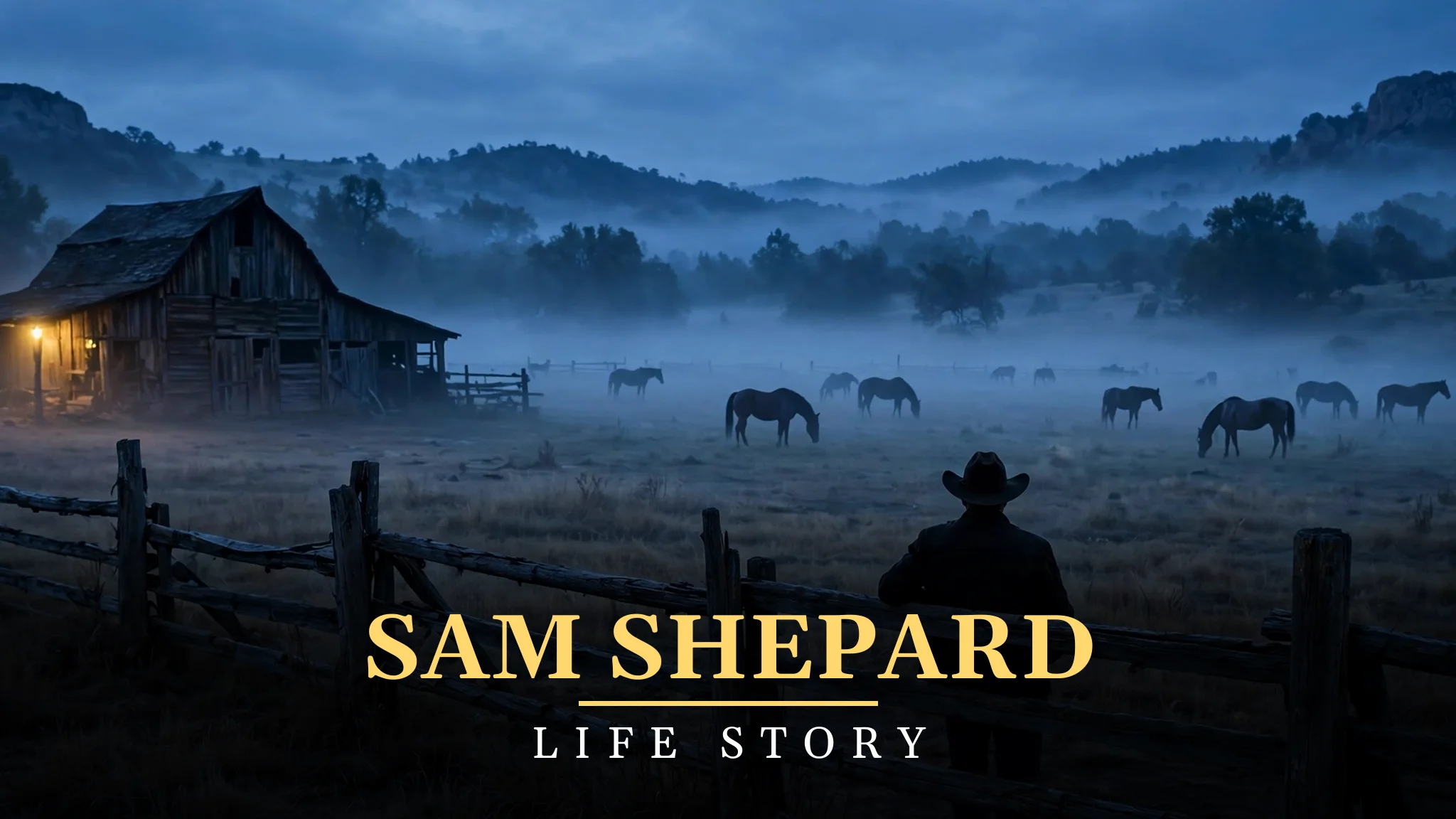
One more thought stays with me. When I picture him, I picture the ranch in the image for this story: a man in a cowboy hat, leaning on a fence at dawn, watching horses in the mist, with an old barn glowing in the distance. That is a good picture of his life, because he was always watching, always thinking, and always looking out at the wide, open land, wondering what was beyond the next hill.
I also think about Fool for Love, because it is one of his finest plays, and it shows what he understood about love. Eddie and May are two people who cannot live with each other and cannot live without each other, and they meet in a motel room in the desert and tear each other apart. It is funny, it is violent, and it is sad, and it feels true. I think Shepard understood that love is not always kind, and that it can be a kind of madness. He wrote about that madness with honesty, and he did not soften it. That is a brave thing to do, and it is why his plays still move people today.
Another thing I notice is his prose, especially Motel Chronicles, a book about life on the road. He wrote about motels, highways, and men who drive all night, and he wrote in a plain, direct style that carries a deep sadness underneath. I love that he could write in any form: plays, films, songs, and books. He was not just a playwright. He was a writer, and he used whatever form the story needed. That versatility is rare, and it is a sign of how deep his talent was. He did not just write plays. He wrote America, in whatever form it took.
I think about Mud as well, because it is a beautiful late performance. He plays Tom Blankenship, an old man who lives on a river in Arkansas, and he plays the part with a quiet, weathered truth. He is in his late sixties, and he is not a young cowboy anymore. He is an old man who understands rivers, boats, and the open sky. I think that role is a fitting end to his acting career, because it shows a man who has come home to the land, after a lifetime of wandering. He is still restless, but he is also at peace, and that balance is deeply moving.
When I look at his whole life, I see a man who was always moving, always writing, and always looking for something beyond the next hill. He left the farm, he went to New York, he wrote plays, he acted in films, he lived in New Mexico, and he never really settled down. That restlessness is the heart of his work, and it is the heart of his life. He understood that America is a country of people who keep moving, and he wrote about them with love, with anger, and with honesty. That is why his work still matters, and why it will keep mattering for a long time.
I also think about Cold in July, because it shows that he was still playing men of the land in his seventies. He plays Russel, a pig farmer who helps a man in trouble, and he plays the part with a quiet, dangerous manner that makes the character feel real. He is not a young cowboy anymore. He is an old man who understands violence, loyalty, and the hard choices that life demands. I think that role is a fitting one for him, because it shows a man who has lived a long life, who has seen a lot, and who still knows how to act when it matters. He was a writer who understood such men, and he was an actor who could play them, and that combination is rare.
Another thing I notice is his final novel, The One Inside, published in 2017, the year he died. It is a book about a man looking back on his life, his loves, and his failures, and it reads like a farewell. He was ill with ALS, he was losing his ability to move and to speak, and he still wrote, because writing was his life. That takes a remarkable courage. Most people would have stopped. Shepard kept going, right up to the end, because he had something to say, and he was not going to let his illness silence him. I think that is the most moving part of his story. He was a writer until the very end, and his words remain, even though he is gone.
Frequently Asked Questions
Where was Sam Shepard born and raised?
Sam Shepard was born on 7 November 1943 at Fort Sheridan, Illinois, and he grew up on a farm in Duarte, California, where his father was a farmer and teacher. The farm life, horses, and open land shaped the plays and films he made for the rest of his life.
What play won Sam Shepard the Pulitzer Prize?
His play Buried Child, written in 1978, won the Pulitzer Prize for Drama in 1979. The dark, strange play about a family hiding a terrible secret made him one of the most important playwrights in America.
What is True West about?
True West, written in 1980, is about two brothers, one a writer and one a drifter, who meet in their mother’s house in California and slowly swap lives. The funny, violent, and sad play is now seen as one of the great American plays.
Who did Sam Shepard play in The Right Stuff?
In The Right Stuff from 1983, he played Chuck Yeager, the legendary pilot who was the first man to break the sound barrier. His calm, fearless performance brought him an Academy Award nomination for Best Supporting Actor.
Did Sam Shepard write Paris, Texas?
Yes, he wrote the screenplay for Paris, Texas in 1984, a film about a man who walks out of the desert and tries to find his family. The film won the top prize at the Cannes Film Festival and is now seen as a masterpiece.
How long was Sam Shepard with Jessica Lange?
He was in a relationship with the actress Jessica Lange for nearly thirty years, from the early 1980s until 2009, and they had two children, Hannah and Samuel. They lived together in Minnesota and New Mexico, far from Hollywood.
What illness did Sam Shepard die from?
He died on 27 July 2017, at his home in Kentucky, at the age of seventy-three, after living with amyotrophic lateral sclerosis, known as ALS, a disease that slowly takes away movement and speech. He continued to write for as long as he could.


