Sam Smith: The Life Story Behind the Voice
In this post
- Growing Up in Bishop’s Stortford, England
- Latch, Disclosure, and the Breakthrough
- In the Lonely Hour, Stay With Me, and the Grammy Sweep
- Writing’s on the Wall, The Thrill of It All, and Bond
- Love Goes, Unholy, and Reinvention
- Identity, Pronouns, and Life in the Spotlight
- The Voice, the Soul, and the Songwriting
- Legacy: The Voice That Changed Pop
- My Take:
Growing Up in Bishop’s Stortford, England
Samuel Frederick Smith was born on May 19, 1992, in London, England, and was raised in the town of Bishop’s Stortford, in Hertfordshire, in a household that was loving, musical, and supportive, with a father, Frederick Smith, a businessman, and a mother, Kate Cassidy, a banker, who was dismissed from her job, reportedly after her employers claimed she spent too much time promoting her son’s music career, a story that Sam has spoken about with gratitude, with humour, and with a willingness to be honest about the sacrifices his family made, for him, and for his dreams. He attended St Mary’s Catholic School in Bishop’s Stortford, where he was a singer, a performer, and a young person who was already dreaming of becoming a star, a person who could make music that touched people, that made them feel, and that told the truth about who he was, where he came from, and what he dreamed of becoming. He was a teenager with a voice, with a talent, and with a passion, that was obvious, to everyone who heard him sing, and that would become the foundation of his career, and that would take him, from Bishop’s Stortford, to London, to the world, and to the top of the charts, in a way that no one, including Sam himself, could have predicted.
He began singing at a young age, in school, in church, and in local productions, and he was trained by Joanna Eden, a jazz singer, who taught him, who mentored him, and who recognised his talent, a voice that was powerful, that was soulful, and that was unmistakable, a voice that sounded like no one else, and that was instantly recognisable, even after a single line. He was a member of the Bishop’s Stortford Junior Operatics, and he performed in local theatre, and he was a person who loved to sing, who loved to perform, and who was determined to make it, in music, in a way that was his own, and that was built on his talent, on his training, and on his understanding of music, as both an art and a science. He was a kid who was different, who was musical, who was obsessed with music, and who was not always popular, but who was passionate, who was talented, and who was determined to make it, in music, in a way that was his own, and that was built on his talent, on his hard work, and on a belief in himself, that has never wavered, even when the world doubted him, even when it was difficult, and even when he wanted to give up.
His early life was also shaped by his family, by the support they gave him, by the sacrifices they made, and by the way they shaped him, into the person he is today, a person who is grateful, who is humble, and who is determined to make the most of the gift he was given, a gift that he does not take for granted, and that he works hard, every day, to honour, to develop, and to share with the world. Sam has spoken about his childhood with fondness, about the town, about the schools, about the sense of community, and about the feeling of belonging, in a place where everyone knew each other, where family was everything, and where music was a part of everyday life, from the radio, from his parents, and from the singing he did, at school, at church, and at home, a person who was surrounded by music, from the very beginning, and who knew, from a young age, that music was what he wanted to do, for the rest of his life.
Latch, Disclosure, and the Breakthrough
Sam Smith’s breakthrough came in 2012, when he was featured on Latch, a song by the electronic duo Disclosure, a track that became a hit, reaching the top ten in the United Kingdom, and that introduced Sam’s voice to the world, a voice that was powerful, soulful, and unmistakable, and that made listeners stop, pay attention, and ask, who is that singer? The song was a global hit, played everywhere, and loved by audiences, who recognised something special, in the voice, in the melody, and in the emotion, and that became a favourite with audiences, who loved its groove, its energy, and its honesty. Latch was a turning point, not just for Sam Smith, but for his career, because it proved that he could sing, that he could make a hit, and that he was not just a local singer, but a real artist, a real talent, and a real star, who was here to stay, with a career that was built on talent, on hard work, and on a connection with his audience that was deep, real, and lasting.
In 2013, Sam Smith was featured on La La La, a song by Naughty Boy, which reached number one in the United Kingdom, and became a global hit, and that established Sam as a major star, a person who could make a hit, not just as a featured artist, but as a singer, a performer, and a storyteller, who was here to stay, with a career that was built on talent, on hard work, and on a commitment to making music that matters. The song’s success, its time on the charts, and the affection it won from audiences, all show Sam’s talent, his ability to sing a song, that is both catchy and meaningful, both commercial and personal, and that speaks to the experiences of his generation, in a way that is both private and public. La La La was a hit, but it was also deeply personal, a work that allowed Sam to process his experiences, to talk about his feelings, and to move forward, and it showed him as an artist maturing with every record, unafraid to be honest, fully and unapologetically, even when that self was different from the pop star the world had known, even when it meant taking a risk, and even when it meant losing some fans, and gaining others.
Latch changed everything, but not in the way people usually describe a breakthrough. Sam did not arrive with a marketing campaign or a radio push; they arrived as a voice on someone else’s record, and the voice was so striking that listeners went looking for the singer. Disclosure’s track climbed the charts, and suddenly a twenty-year-old from Bishop’s Stortford was fielding calls from every label in London. The BBC named them its Sound of 2014, and the BRITs gave them the Critics’ Choice award, two honours that have a habit of predicting stardom, and in this case they were right. What made the moment special was its purity: no image overhaul, no manufactured backstory, just a remarkable voice on a great song, and an audience that recognised both. Sam had spent years singing in school halls and local theatre, and all that practice was suddenly paying off in the most public way possible.
In the Lonely Hour, Stay With Me, and the Grammy Sweep
Sam Smith’s debut studio album, In the Lonely Hour, was released in May 2014, and it debuted at number one in the United Kingdom, and at number two on the Billboard 200, featuring the hits Stay With Me, I’m Not the Only One, and Money on My Mind, and it earned praise from audiences and critics alike, praised by critics as a strong debut, a album that showcased Sam’s voice, his songwriting, and his ability to make an album, from start to finish, that was worth listening to, and who could do it with a sound that was entirely his own, a mix of pop, soul, and R&B, that was both commercial and artistic, and that proved he was not a one-hit wonder, not a featured artist, but a real artist, a songwriter, and a performer, who was here to stay, with a career that was built on talent, on hard work, and on a connection with his audience that was deep, real, and lasting. Stay With Me, in particular, became one of the year’s defining ballads, reaching number one, and becoming a global hit, played on radio stations everywhere, and cherished by listeners around the world, a song about love, about longing, and about the feeling of wanting someone to stay, that resonated with millions of people, who recognised their own lives in its verses, in its melody, and in its emotion.
The album’s success was recognised at the Grammy Awards in 2015, where Sam Smith won four awards, including Record of the Year and Song of the Year for Stay With Me, Best New Artist, and Best Pop Vocal Album for In the Lonely Hour, a sweep that was historic, that made Sam one of the most awarded artists of the night, and that established him as a major star, a person who had gone from Bishop’s Stortford to the Grammy stage, in less than three years, and who was doing it with a sound that was both pop and soul, both modern and timeless, and that moved listeners who were looking for something honest and unadorned, and who wanted something quieter, something more thoughtful, and something more beautiful. The Grammy wins were a validation, a recognition, and a sign that Sam Smith was not just a pop star, but a serious artist, a songwriter, and a performer, who was here to stay, with a career that was built on talent, on hard work, and on a commitment to making music that matters, music that is honest, and music that is true to who he is, as an artist and as a person.
I’m Not the Only One, another hit from the album, also became a favourite, a song about infidelity, about the pain of being cheated on, and about the realisation that you are not the only one, that resonated with millions of people, who had been through the same thing, and who found comfort, in the song, in its honesty, and in its humour. The song’s success, its place on the charts, and its love from audiences, are a testament to Sam’s talent as a songwriter, his ability to write a pop song that is both catchy and meaningful, both commercial and personal, and that speaks to the experiences of his generation, in a way that is both specific and universal. In the Lonely Hour is not just an album; it is a classic, a work that will be remembered, long after the charts have changed, and long after the awards have been won, because it is about more than a voice, it is about love, about loss, and about the feeling of being alone, in a crowded room, and that is a universal experience, one that everyone has had, and one that the album captured, perfectly, in its lyrics, in its melody, and in its emotion.
Writing’s on the Wall, The Thrill of It All, and Bond
In 2015, Sam Smith recorded Writing’s on the Wall, the theme song for Spectre, the twenty-fourth James Bond film, a song that became the first Bond theme to reach number one in the United Kingdom, and that won the Academy Award for Best Original Song, and the Golden Globe for Best Original Song, making Sam the first openly gay artist to win an Oscar for Best Original Song, and establishing him as a major star, a person who could write a Bond theme, a song that is both cinematic and personal, both dramatic and intimate, and that resonated with audiences around the world, who loved its melody, its message, and its emotion. The song was a commercial success, but it was also a personal one, a work that allowed Sam to process his experiences, to talk about his feelings, and to move forward, and it showed him as an artist growing wiser, maturing steadily maturing, and who was not afraid to be himself, fully and unapologetically, even when that self was different from the pop star the world had known, even when it meant taking a risk, and even when it meant losing some fans, and gaining others. Writing’s on the Wall is a song that will be remembered, not just as a Bond theme, but as a moment, a turning point, in Sam Smith’s career, a moment when a pop star became a film star, a songwriter, and a cultural figure, all at once.
The Thrill of It All arrived in November 2017 carrying a weight that debut albums never have: the weight of expectation. Sam had won four Grammys, sold millions of records, and become the voice of a generation’s heartbreak, and the question hanging over the follow-up was whether lightning could strike twice. The answer was a record that sounded like a singer who had learned to trust his instincts, opening with Too Good at Goodbyes, a song about being so practised at leaving that it has become a reflex, and moving through Pray, a gospel-tinged plea, and Baby, You Make Me Crazy, a track that swung where the debut had wept. The album debuted at number one on both sides of the Atlantic, and it proved something important: Sam was not a one-album story. The heartbreak was still there, but it was joined by something new, a sense of control, of a singer who knew exactly what his voice could do and was no longer afraid to use it.
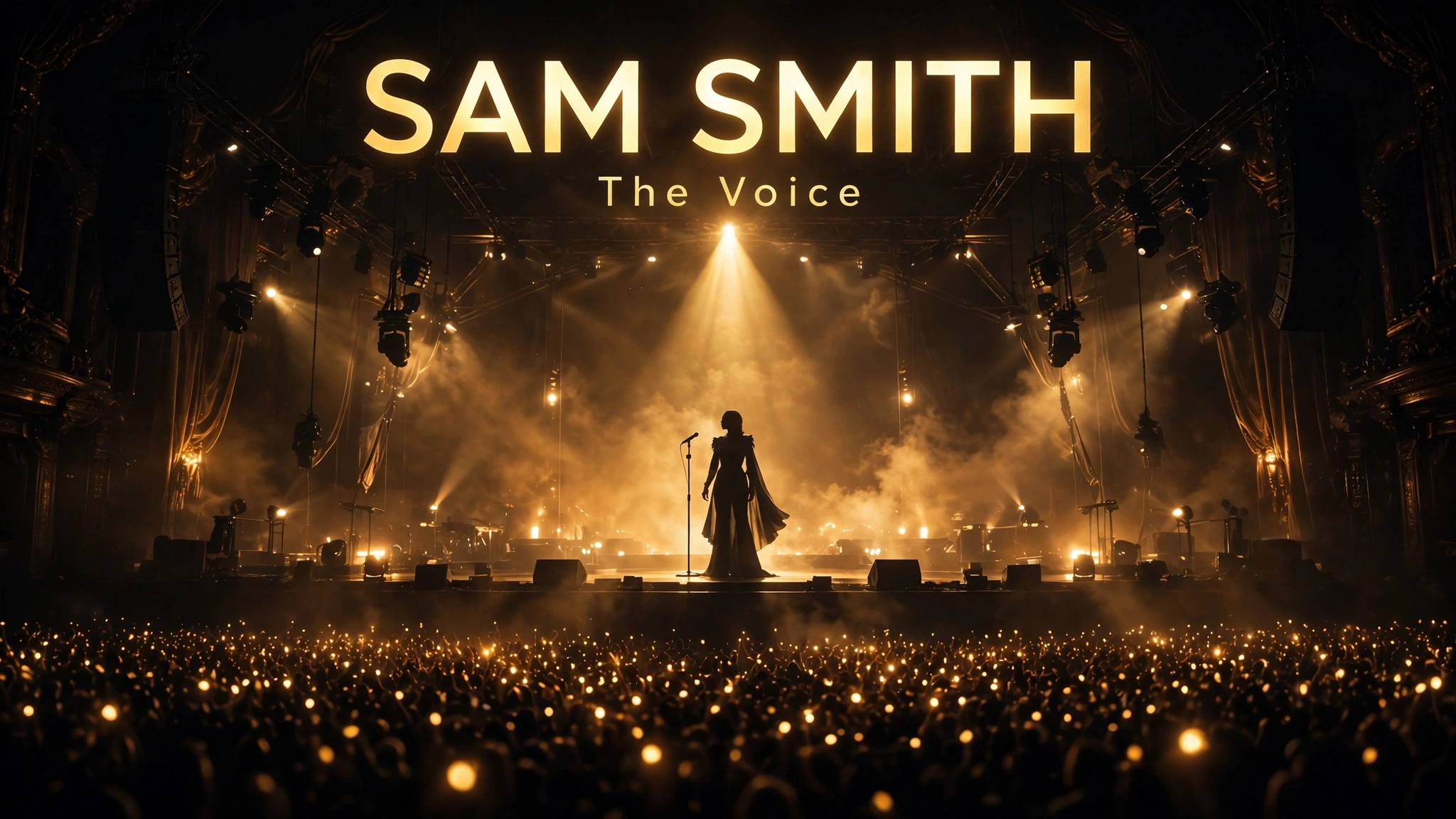
Sam’s concerts are built around the one thing nobody can argue with: the voice. There are no elaborate dance routines, no costume changes every song, just a singer, a band, and a room full of people who know every word. The In the Lonely Hour tour took that simplicity around the world, and the venues kept getting bigger, from theatres to arenas, without the show losing its warmth. On the Gloria tour, the staging grew bolder, with theatrical costumes and set pieces that matched the album’s drama, but the centre of the show never changed: Sam standing at the microphone, singing like the room was a church. Fans talk about the concerts the way people talk about weddings, as nights they will remember, and that is because a great voice, heard live and up close, is one of the few things in pop that cannot be faked.
Love Goes, Unholy, and Reinvention
In October 2020, Sam Smith released Love Goes, his third studio album, featuring the hits Diamonds, My Oasis, featuring Burna Boy, and Kids Again, and it debuted in the top ten, and was praised for its honesty, its production, and its willingness to be vulnerable, to talk about love, about heartbreak, and about the search for meaning, in a way that was both intimate and universal. The album was originally titled To Die For, but it was renamed, in response to the COVID-19 pandemic, a decision that showed Sam’s sensitivity, his awareness, and his willingness to be thoughtful, about the world around him, and about the impact of his work, on his audience, and on the public, and that is a part of what makes him special, a person who is not afraid to be vulnerable, to admit his flaws, and to tell the truth, even when the truth is difficult, and even when it means changing a title, changing a plan, and changing a direction, for the sake of being respectful, for the sake of being kind, and for the sake of being honest, about the world, and about the people in it.
His fourth studio album, Gloria, was released in January 2023, and it debuted at number one in the United Kingdom, featuring the hits Unholy, featuring Kim Petras, I’m Not Here to Make Friends, and Gimme, featuring Jessie Reyez and Koffee, and it was a commercial and critical success, praised by critics as a bold, experimental album, that showcased Sam’s growth as an artist, as a singer, and as a performer, and that proved he could reach the summit again with the next album, and that he was no fleeting voice, but a singer with a career ahead of them. Unholy, in particular, became one of the year’s most-loved ballads, reaching number one, and becoming a global hit, played everywhere, and loved by audiences around the world, a song about infidelity, about the pain of being cheated on, and about the realisation that you are not the only one, that resonated with millions of people, who recognised something of themselves in its lyrics, in its melody, and in its emotion. The song won the Grammy Award for Best Pop Duo/Group Performance, making Kim Petras the first openly transgender artist to win a Grammy, and making Sam Smith a part of history, a person who has used his platform to make a difference, to break barriers, and to help others, who are struggling with the same things, to feel less alone, to seek help, and to know that it is okay to be yourself, fully and unapologetically.
Gloria, released in January 2023, was the sound of an artist refusing to repeat themselves. After three albums of heartbreak ballads, Sam made a record that was darker, stranger, and more electronic, with songs about desire, jealousy, and nightlife that would have been unthinkable on In the Lonely Hour. Unholy, the duet with Kim Petras, led the charge, a hypnotic track about infidelity that topped charts around the world and won a Grammy, making Petras the first openly transgender artist to win the award. The rest of the album followed its lead: I’m Not Here to Make Friends was pure attitude, Gimme was playful and swaggering, and the whole record felt like a night out rather than a night in. Some longtime fans were surprised, but most understood: Sam had spent a decade singing about being left, and now they were singing about wanting, and that shift, from sadness to appetite, was long overdue.
Identity, Pronouns, and Life in the Spotlight
Sam Smith has been open about his identity, about being gay, and about being non-binary, and he has spoken about it with a honesty that is unusual for a star of his stature. He came out as gay in 2014, in an interview with The Fader, and he announced, in 2019, that he is non-binary, and that his pronouns are they/them, a decision that was met with support, with understanding, and with praise, from fans, from fellow artists, and from the media, who recognised the courage it took, to be honest, to be yourself, and to live your truth, in a world that often demands conformity, that often punishes difference, and that often makes it difficult, to be who you are. Sam has spoken about his identity with honesty, about the journey, about the struggles, and about the importance of being yourself, and that openness is a part of his story that resonates with many fans, who see in him a person who is like them, who struggles with the same things they do, and who is not afraid to talk about it, to share it, and to use his platform, to help others, who are struggling with the same things, to feel less alone, to seek help, and to know that it is okay to be yourself, fully and unapologetically, even when the world does not understand.
Body image is something Sam has discussed with unusual candour for a pop star. In 2019 they posted a shirtless photograph on social media, explaining that they had spent years hiding their body and were tired of doing so, and the post was shared widely, praised by fans and by body-positivity campaigners alike. Sam has spoken about the pressure to look a certain way in an industry that photographs everything, about the diets and the self-consciousness, and about the slow work of accepting a body that does not fit the pop-star template. That honesty matters because it is rare: most stars either stay silent or pretend the pressure does not exist, and Sam chose to name it. For fans who struggle with the same feelings, hearing a Grammy winner say it out loud is a reminder that the problem is the industry’s idea of beauty, not their own reflection.
Life after Gloria has been a mix of touring, recording, and living in the open. The Gloria tour took the album’s theatrical world to arenas around the globe, with staging and costumes that matched the record’s drama, and audiences who sang every word of Unholy back at the stage. Sam has also kept collaborating, appearing on tracks with artists from different corners of pop, and has spoken about new music in the works, though in typical fashion, without rushing it or revealing more than a hint. What is striking about this stage of the career is how settled it feels: the questions about identity, about pronouns, about belonging, have been answered in public, and the artist who emerges is one who seems comfortable in their own skin at last. The voice is still the centre of everything, and as long as it is, Sam Smith will have an audience waiting to hear what it says next.
The Voice, the Soul, and the Songwriting
There are voices you recognise in a single note, and Sam Smith’s is one of them. It is a soulful tenor with a falsetto that seems to come from nowhere, capable of whispering a verse and then lifting a chorus into the rafters without ever sounding strained. The gospel influence is audible in the way they hold a note, letting it tremble slightly before resolving, and the soul influence is audible in the phrasing, which bends around the beat rather than marching on it. Listen to Stay With Me and you hear a singer who trusts the melody to do the work, who does not decorate a song that does not need decorating. That restraint is what separates a great singer from a loud one, and it is why Sam’s voice works as well on a Bond theme as it does on a dance track. It is an instrument built for emotion, and it has never once been out of tune with the feeling of the song.
Writing songs, for Sam, is closer to keeping a diary than to building a product. The lyrics read like pages torn from a journal: honest, specific, and sometimes painfully direct, about love that did not last, about wanting someone who does not want you back, about the loneliness of a hotel room after a show. Stay With Me was written, by Sam’s own account, in about forty minutes with Jimmy Napes and Tourist, a song that arrived almost fully formed because the feeling behind it was so clear. That speed is a sign of how Sam writes: the emotion comes first, the words follow, and the craft is in knowing when to stop. Napes has been a constant collaborator, and together they have built a sound that is spare and elegant, piano and voice and very little else, because when the song is true, it does not need much help.
The sound Sam makes comes from a long line of soul singers, and they have never hidden the debt. Growing up, they listened to the great voices, the ones that could make a simple melody feel like a prayer, and they studied how those singers used space, silence, and dynamics to make a listener feel something. You can hear it in the way Sam approaches a ballad: the verse is quiet, almost spoken, and the chorus opens up like a window, letting the emotion flood in. That is a soul singer’s technique, learned from records rather than from a classroom, and it is what gives Sam’s music its timeless quality. Pop trends come and go, but a voice that understands soul will always find an audience, because the feeling it carries is older than any chart, and it speaks to something in listeners that never goes out of style.
Legacy: The Voice That Changed Pop
Sam Smith’s legacy is that of the voice that changed pop, a person who was discovered through a feature, who became famous through a song, and who proved that a soulful voice, a honest song, and a commitment to being yourself, could top the charts, could win Grammys, and could change the sound of pop music, not just for a moment, but for a generation. He is a Grammy-winning artist, a chart-topping singer, and a cultural figure, with ballads that defined a moment, from Stay With Me to Too Good at Goodbyes to Unholy to Writing’s on the Wall, and with listeners who have stayed loyal through every reinvention. His albums, from In the Lonely Hour to The Thrill of It All to Love Goes to Gloria, are a body of work that is diverse, that is creative, and that reflects his growth as an artist, from a teenager singing in Bishop’s Stortford to a global superstar who fills arenas, and who is in control of his own career, his own music, and his own future. He is a link between soul and pop, a bridge between the past and the present, and that bridge is a testament to his talent and his vision, a vision that is both personal and universal, a story about a boy from Bishop’s Stortford who dreamed of becoming a star, and who did, against all odds, and on his own terms.
Sam’s influence is in the singers who now write ballads like diary entries, trusting that honesty, sung plainly, will find its audience without any decoration at all. He is a voice for LGBTQ+ rights, a person who has used his platform to advocate for equality, for acceptance, and for the right to be yourself, and that advocacy is a part of his legacy that will be remembered, long after the songs have faded, because it is about more than music, it is about saving lives, about helping people, and about making the world a kinder, more understanding place.
Sam Smith’s story is still unfolding, and it is unfolding in a way that is braver than most pop careers dare to be. They have used their platform to talk about identity, about pronouns, and about the right to be yourself, and they have done it in public, in real time, without waiting for the world to catch up. What their career proves is that a voice, when it is honest, can change the conversation, and that a singer who tells the truth about who they are will find an audience that stays. They have won Grammys, Oscars, and the love of millions, and they have done it without ever pretending to be someone else. The boy from Bishop’s Stortford who sang in school became a voice for a generation, and that voice is still singing.
My Take:
Stay With Me and the Song That Made Him a Star
When I think about Sam Smith, I think about Stay With Me, not just as a song, but as a moment, a time in 2014 when a ballad, about love, about longing, and about the feeling of wanting someone to stay, became a global hit, reaching number one, and becoming one of the biggest songs of the year, played everywhere, from radio to clubs to social media, and that made Sam Smith a superstar, a solo artist who could top the charts, who could fill arenas, and who could do it with a song that was entirely his own, a mix of pop and soul, that was both catchy and emotional, and that resonated with audiences who recognised something of themselves in its lyrics, in its melody, and in its emotion. I remember hearing Stay With Me for the first time, with its opening, Guess it’s true, I’m not good at a one-night stand, but I still need love cause I’m just a man, and thinking that this was a song that was going to be huge, because it was honest, because it was relatable, and because it captured a feeling that many people have had, the feeling of wanting someone to stay, of wanting to be loved, and of being afraid to be alone, and that honesty, that relatability, is what makes the song so powerful, so lasting, and so beloved, more than ten years after it was released.
What impresses me most about Stay With Me is its simplicity. The song is built on a simple piano melody, a gospel-influenced chorus, and Sam’s voice, and it does not try to be more than it is, it does not add unnecessary production, it does not chase a trend, it simply is, a beautiful, sad song about love, and that simplicity is its strength, a sign of a songwriter who trusts his material, who trusts his voice, and who trusts the audience to listen, to pay attention, and to feel. The song’s lyrics, with their message of longing, of wanting someone to stay, and of the fear of being alone, are both specific and universal, and they make the listener feel as though they are hearing a real story, a real person, and a real pain, not a fictional one, but a lived one, and that honesty is what makes the song so powerful, so relatable, and so lasting. Stay With Me is not just a hit; it is a classic, a song that will be played for years to come, whenever people need to be reminded that love hurts, that longing is real, and that music can help, can heal, and can make you feel less alone.
I also think about the music video for Stay With Me, with its story, with Sam singing in a church, and about the way the video became as famous as the song, a work of art that was both a short film and a pop video, and that showcased Sam as a visual artist, a person who thinks about every aspect of his work, from the sound to the visuals to the fashion, and who creates a experience that is immersive, that is total, and that is unforgettable. The video is a perfect complement to the song, a visual representation of its themes, and it shows Sam as a performer, an actor, and a storyteller, a person who can do it all, and who does it with a charm, a humour, and a talent that are unmistakable. Stay With Me is not just a song; it is a world, a film, and a feeling, all at once, and that completeness is why it became a hit, and why it will be remembered.
One more thing about Stay With Me stays with me, and it is the way the song’s success was driven by the audience, by the fans, by the people who heard it, who loved it, and who shared it, rather than by radio or by a label, and that is a sign of a new era in music, an era in which the audience, not the industry, decides what is a hit, and in which artists like Sam, who understand the internet, who understand social media, and who connect directly with their fans, can build a career, a fanbase, and a legacy, without waiting for permission, without conforming, and without compromising. Stay With Me is a fan-driven hit, a proof that the audience matters, and that a singer who listens to his fans, who respects them, will be rewarded with their loyalty, and with their love, and that is a lesson worth learning, for any artist, in any era, that the fans are the most important part of a career, and that without them, there is no career at all.
Unholy and the Song That Changed Everything
Unholy, Sam Smith’s collaboration with Kim Petras, released in 2022, is in my opinion one of the most important pop songs of the last decade, not just because it was a hit, but because it was bold, because it was experimental, because it was about infidelity, about the pain of being cheated on, and about the realisation that you are not the only one, and because it did so in a way that was both personal and universal, that resonated with millions of people, who recognised something of themselves in its lyrics, in its story, and in its emotion. The song, with its opening, Lucky, lucky, you’re so lucky, became an anthem, a declaration, and a statement of self-respect, a song that told listeners they deserved better, that they should not settle for someone who only wants attention, and that they should know their worth, and that message, that empowerment, is a powerful thing, and one that has helped many of Sam’s fans, who have spoken about the song as a favourite, as a reminder that they are worthy, and that they should not accept less than they deserve, in love, in life, and in any relationship.
What I admire most about Unholy is the courage behind it. Sam Smith was a pop star, at the top of his game, with millions of fans, with a career that was built on being perfect, on being charming, and on being a ballad singer, and he chose to release a song that was dark, that was electronic, that was experimental, and that was different from anything he had done before, and that choice, that risk, was brave, because it risked his image, it risked his fame, and it risked the expectations that the industry, and the audience, had of him. He did it anyway, because he believed in it, because he wanted to be honest, and because he knew that his fans needed to hear it, that they were ready for it, and that they would love it, if he was true to himself, and that courage, that honesty, is a part of what makes Sam Smith special, a person who is not afraid to be vulnerable, to admit his flaws, and to tell the truth, even when the truth is difficult, and even when it means risking everything he has built, for the sake of being honest, and for the sake of helping others.
I also think about the production of Unholy, with its dark, electronic sound, its hypnotic beat, and its anthemic chorus, and about the way the song builds, from a quiet beginning to a soaring, powerful climax, mirroring the experience of infidelity, the feeling of being betrayed, and the determination to keep going, to fight, and to survive. The song is not just a ballad; it is a electronic song, a pop song, and an anthem, all at once, and that versatility is a sign of a great songwriter, a person who can take a personal experience, and turn it into a song that is both intimate and epic, both quiet and loud, and that resonates with audiences of all ages, of all backgrounds, and of all experiences. Unholy is a song that will be remembered, not just as a hit, but as a moment, a turning point, in pop music, a moment when a pop star made a dark, electronic song, and changed the sound of pop, for himself, for his fans, and for the industry, forever.
Writing’s on the Wall, Bond, and the Oscar
Sam Smith’s Writing’s on the Wall, the theme song for Spectre, the twenty-fourth James Bond film, released in 2015, is in my opinion one of the most important songs in recent pop music, because he was a pop star, at the top of his game, with millions of fans, with a career that was built on being perfect, on being charming, and on being a ballad singer, and he chose to write a Bond theme, a song that is both cinematic and personal, both dramatic and intimate, and that choice, that risk, was brave, because it risked his image, it risked his fame, and it risked the expectations that the industry, and the audience, had of him. He did it anyway, because he believed in it, because he wanted to be honest, and because he knew that his fans needed to hear it, that they were ready for it, and that they would love it, if he was true to himself, and that courage, that honesty, is a part of what makes Sam Smith special, a person who is not afraid to be vulnerable, to admit his flaws, and to tell the truth, even when the truth is difficult, and even when it means risking everything he has built, for the sake of being honest, and for the sake of helping others.
What I find most admirable about Writing’s on the Wall is the way Sam handled it, with a humility, with a grace, and with a talent that was remarkable, given the pressure, the media coverage, and the expectations of fans who had been waiting for a Bond theme, and who were excited to hear it, to love it, and to be part of the film, that would become a hit. He explained, he performed, and he was clear about why he was doing it, about the Bond tradition, about the honour, and about the responsibility, of writing a Bond theme, and that clarity, that honesty, is a part of what makes him special, a person who is not afraid to be vulnerable, to admit his struggles, and to tell the truth, even when the truth is difficult, and even when it means facing criticism, facing scepticism, and facing the consequences of his decision. He did it anyway, because he knew it was right, because he knew he loved it, and because he understood that a career is not worth your fear, that fame is not worth your silence, and that the best thing you can do, for yourself and for your fans, is to be open, to be honest, and to be yourself, fully and unapologetically, even when that means taking a risk, even when that means writing a Bond theme, and even when that means winning an Oscar, in the short term, for the sake of the long term.
I also think about the Oscar win itself, with Sam Smith becoming the first openly gay artist to win an Oscar for Best Original Song, and about the way the win was celebrated, as a moment, a turning point, and a sign of progress, for LGBTQ+ artists, for the industry, and for the world, and that is a powerful thing, and one that has helped many of Sam’s fans, who have spoken about the win as a moment of inspiration, a proof that it is possible to be yourself, to be honest, and to be successful, even when the world does not understand, even when it is difficult, and even when it feels impossible. The Oscar is a comeback, but it is also a rebirth, a new chapter, and a sign of an artist who is not content to rest on his past successes, but who is looking forward, to new sounds, new stories, and new chapters, in a career that is still evolving, still surprising, and still entirely his own. That is a powerful thing, and it is a story worth telling, a story about a pop star who wrote a Bond theme, who won an Oscar, and who came back, stronger, wiser, and more honest than before.
What I Take Away From His Story
When I look at Sam Smith’s whole career, from a boy in Bishop’s Stortford singing in school to a global pop star who fills arenas, what stays with me is the voice, the fact that he is one of the few pop stars who is truly a singer, who began singing at a young age, who was trained by a jazz singer, and who has made the voice a central part of his identity, his music, and his performances. That is a rare thing, a sign of a talent that is deep, that is trained, and that is entirely his own, a talent that has made him one of the most respected pop stars of his generation, with a career that is built on talent, on hard work, and on a commitment to making music that matters. His story is not just about one artist; it is about the power of a voice, about the importance of singing, and about the way that talent, that discipline, and that love of music, can take you further than anyone expects, and that the best careers are built not in a moment but over a lifetime of making music that matters, music that is honest, and music that is true to who you are.
I also think his story is a reminder that identity matters, that being open about being gay, about being non-binary, and about using they/them pronouns, is not a weakness, but a strength, and that audiences respond to honesty, to music that feels real, that feels like a diary, and that feels like a conversation with a friend. Sam’s music is honest, it is vulnerable, and it is real, and that is why it resonates with millions of people, who see in him a person who is like them, who struggles with the same things they do, and who is not afraid to talk about it. That honesty is a gift, and it is one that has helped many of his fans, and that has made his music more than entertainment, but a form of healing, a way to feel less alone, and a reminder that it is okay to struggle, and that it is okay to ask for help, and that is a legacy that will be remembered, long after the songs have faded, because it is about more than music, it is about saving lives, about helping people, and about making the world a kinder, more understanding place.
Finally, I want to say that I am looking forward to what comes next for him, because he is an artist who is still growing, still learning, and still finding new ways to make music. His album Gloria, his tours, and his work as a person, as an LGBTQ+ advocate, and as a musician, all suggest a person who is not content to rest on his past successes, but who is looking forward, to the next song, the next album, the next project, and who is doing it with a curiosity and a creativity that are infectious. His story is one of the great stories in modern pop music, a story about a boy from Bishop’s Stortford who became a pop star, and it is a story that is still being written. I will be watching, and listening, because if his past is any guide, the next chapters will be as surprising, as heartfelt, and as compelling as the ones that came before, and that is a promise worth holding on to.
One last thought stays with me, and it is about the voice, about the boy in Bishop’s Stortford who began singing at a young age, and about the dream that started it all, a dream of becoming a singer, a performer, and a storyteller, a dream that he has realised, through hard work, through talent, and through a belief in himself, that has never wavered, even when the world doubted him, even when it was difficult, and even when he wanted to give up. That voice, that dream, is the foundation of Sam Smith’s story, a story about a boy who loved music, who taught himself to sing, and who shared that love with the world, through features, through albums, and through arenas, and that is a story that will be remembered, long after the charts have changed, and long after the awards have been won, because it is about more than music, it is about the power of a dream, and the courage to follow it, wherever it leads.
Frequently Asked Questions
How did Sam Smith become famous?
Sam Smith became famous as the featured vocalist on Disclosure’s Latch in 2012 and Naughty Boy’s La La La in 2013, which reached number one in the UK. His debut album In the Lonely Hour followed in 2014.
What is Sam Smith’s biggest song?
His biggest songs include Stay With Me, I’m Not the Only One, Too Good at Goodbyes, Writing’s on the Wall, and Unholy with Kim Petras, which reached number one and won a Grammy.
Where is Sam Smith from?
Sam Smith was born in London, England, on May 19, 1992, and was raised in Bishop’s Stortford, Hertfordshire. They were trained by jazz singer Joanna Eden.
What are Sam Smith’s pronouns?
Sam Smith is non-binary and uses they/them pronouns, which they announced in 2019. They came out as gay in 2014.
Did Sam Smith win an Oscar?
Yes, Sam Smith won the Academy Award for Best Original Song for Writing’s on the Wall, the theme from the James Bond film Spectre, in 2016. It was the first Bond theme to reach number one in the UK.
What are Sam Smith’s best albums?
His best albums include In the Lonely Hour from 2014, The Thrill of It All from 2017, Love Goes from 2020, and Gloria from 2023. In the Lonely Hour won four Grammys.


