Sandra Hüller: The Life Story Behind the Anatomy of a Fall Star
In this post
- Suhl and a Childhood in East Germany
- Berlin, Theatre, and the Craft of Acting
- Requiem and the First Great Film Role
- Toni Erdmann and a Film the World Loved
- Anatomy of a Fall and The Zone of Interest: A Remarkable Year
- Theatre, Television, and a Life in Acting
- What Sandra Hüller Means to World Cinema
- My Take:
Some actresses are easy to watch. They are charming, they are funny, and they make the audience feel comfortable. Sandra Hüller is not always easy to watch, and that is why she is great. She plays women who are difficult, who are angry, who are funny in a strange way, and who do things that the audience does not expect. She makes you think, she makes you feel uncomfortable, and she makes you remember her long after the film has ended. That is a rare kind of acting, and it has made her one of the most respected actresses in the world.
She was born in Suhl, in what was then East Germany, in 1978, and she grew up in a country that was changing fast. When she was a child, East Germany still existed, with its own rules, its own walls, and its own way of life. When she was a teenager, the Wall fell, and Germany became one country again, with new freedoms and new problems. That experience, of growing up in a world that changed completely, gave her a view of people that is deep and serious, a view that she brings to every role she plays.
Her best known films include Requiem, Toni Erdmann, Anatomy of a Fall, and The Zone of Interest, films that are very different from each other, but that share one thing, a woman at the centre who is played with honesty, with courage, and with a refusal to be simple. In 2023, she had a year that few actresses ever have, with two films at the Cannes Film Festival, both of which became among the most talked about films of the year, and with an Academy Award nomination for Best Actress. That year made her known around the world, but she had been a great actress for many years before it.
This is the story of Sandra Hüller, from a small town in East Germany to the largest stages in world cinema, through theatre, through difficult roles, and through a year that changed her life. It is a story about a woman who does not seek fame, who seeks truth, and who has found it in some of the most powerful films of our time.
Suhl and a Childhood in East Germany
Sandra Hüller was born on 30 April 1978 in Suhl, a town in Thuringia, in what was then the German Democratic Republic, or East Germany. Suhl was a small industrial town, known for its weapons factories and its quiet streets, and it was far from the bright lights of Berlin or Munich. Hüller grew up in a world that was ordered and controlled, where the state decided many things, and where people learned to be careful about what they said and what they did. That world shaped her, even though it disappeared when she was still young.
She was eleven years old when the Berlin Wall fell in 1989, and twelve when Germany was reunified in 1990. For a child, that change must have felt enormous, as if the whole world had turned upside down in a single year. The rules changed, the shops changed, the television changed, and the future changed. She grew up in a time of change, and she learned to watch people carefully, to see how they adapt, how they cope, and how they keep going when the world around them is different. That watching became the base of her acting.
As a teenager, she began to act, first in school and then in more serious settings, and she found that the stage gave her a place to explore the questions she had about people. She was not a child who wanted to be famous. She was a child who wanted to understand, who wanted to know why people do what they do, and who found that acting was a way to ask those questions in a safe place. That curiosity stayed with her, and it made her want to study acting properly, to learn the craft, and to make it her life.
When she was older, she applied to the Ernst Busch Academy of Dramatic Arts in Berlin, the same school that had trained many great German actors, including Nina Hoss. The school is known for its strict training, for its focus on the body, the voice, and the mind, and for its belief that an actor must be both an artist and a worker. Hüller was accepted, and she began a training that would shape her for the rest of her career. She learned discipline, she learned technique, and she learned that a great performance is not an accident. It is the result of hard work and of a deep understanding of the character.
Berlin, Theatre, and the Craft of Acting
At the Ernst Busch Academy in Berlin, Hüller studied acting in a serious and demanding way. Berlin in the late 1990s was a city full of energy, with the Wall newly fallen, with East and West coming together, and with a cultural life that was full of new ideas. The city was a perfect place for a young actress to learn, because it was full of theatres, of films, and of people who were trying to make sense of a new Germany. Hüller took that energy with her, and she used it to build a strong base for her career.
She began to work on the stage, first in small roles and then in larger ones, and she learned the discipline of live performance. On stage, there is no second take, no editing, and no hiding. An actress must be ready, must know her lines, and must be present in the moment, night after night. Hüller learned that discipline, and it gave her performances a strength and a focus that many film actors lack. She was not an actress who relied on the camera to do the work. She did the work herself, with her body, her voice, and her mind.
She worked at theatres in Berlin and in other cities, including the Basel Theatre in Switzerland, and she played roles in classic plays and in new works. She learned from directors, from other actors, and from the audience, and she built a reputation as a serious and talented actress, a woman who could be trusted with a difficult role. That reputation was earned slowly, through hard work, and it stayed with her when she moved into film. She was known as an actress who would take on a hard role, who would not shy away from a difficult character, and who would give a performance that was honest and strong.
Her stage work also taught her about the power of the body. An actor’s body can say as much as her voice, in the way she stands, in the way she moves, in the way she holds herself when she is afraid or angry. Hüller learned to use her body, to let it tell the story, and that use of the body became one of her marks, in theatre and in film. She does not only act with her face. She acts with her whole self, and that is why her performances feel so real, so physical, and so alive.
Requiem and the First Great Film Role
Hüller’s first great film role came with Requiem, released in 2006, directed by Hans-Christian Schmid. The film told the story of a young woman, Michaela, who believes she is possessed, and who dies after her family refuses medical help and turns to an exorcism. It was based on a real case, and it was a difficult and painful film, about faith, about illness, and about a family that cannot see what is happening to their daughter. Hüller played Michaela with a power that shocked audiences, a young woman who is losing control, who is afraid, and who is trying to be heard.
Her performance in Requiem won her the Silver Bear for Best Actress at the Berlin Film Festival, one of the most important awards in German cinema, and it made her known as a serious film actress. She had shown that she could carry a film, that she could play a character who is in pain, and that she could make an audience feel that pain without making it simple or sentimental. The film was not an easy watch, but it was an important one, and Hüller’s performance was at its heart.
After Requiem, she continued to work in film and in theatre, taking on roles that interested her, and building a career that was based on good work rather than on fame. She did not rush to become a star. She took time to learn, to work with different directors, and to try different kinds of characters. That patience is rare among young actresses, and it is a large part of why her career has lasted so long. She built it slowly, on a strong base, and that base has held her steady through many years.
In those years, she also worked in television and in smaller films, and she kept the balance between theatre and film that would define her career. She did not leave the stage when film came, and she did not leave film when the stage called. She did both, and she did both well, because she understood that each one teaches something different, and that an actress who can do both is a stronger actress. That balance is still part of her work today, and it is one of the reasons she is so respected.
Toni Erdmann and a Film the World Loved
In 2016, Hüller starred in Toni Erdmann, directed by Maren Ade, a film that became one of the most loved and most talked about films of the year. The story is about a father, Winfried, who plays jokes and wears disguises, and his daughter Ines, played by Hüller, a serious businesswoman who works in Bucharest and who has little time for her father’s humour. The father follows her to Romania, he pretends to be a man named Toni Erdmann, and he tries to make her laugh, to make her feel, and to bring her back to life. The film is funny, sad, and strange, all at the same time, and it runs for almost three hours, which is long for a comedy, but it never feels long, because the performances are so strong.
Hüller played Ines with a mix of control and pain, a woman who has built a hard shell around herself, who works all the time, and who has forgotten how to be happy. She played the role with an honesty that made the audience both laugh at her and feel for her, and she showed that a serious woman can also be funny, in a way that is awkward and real. The film was praised around the world, it was nominated for the Academy Award for Best Foreign Language Film, and it won many awards at film festivals. It made Hüller known to audiences outside Germany, and it showed that she could carry a long, complex film with a performance that was both funny and heartbreaking.
Toni Erdmann also showed a different side of Hüller, a side that was not dark or painful, but warm and human. She could be funny, she could be awkward, and she could make an audience laugh while also making them think. That range made her a more complete actress, and it showed that she was not only a dramatic actress. She was an actress who could do anything, as long as the role was honest and the story was real. The film became a classic, and it is still talked about today as one of the best films of the decade.
After Toni Erdmann, Hüller had more offers, from Germany and from other countries, and she had to choose carefully. She could have tried to become a Hollywood star, but she chose to stay in Europe, to work on films that interested her, and to build a career that was based on good roles rather than on fame. That choice showed her character, a woman who cared about the work more than about the spotlight, and who wanted to be an actress, not only a star.
Anatomy of a Fall and The Zone of Interest: A Remarkable Year
In 2023, Hüller had a year that few actresses ever have. She starred in two films that were both shown at the Cannes Film Festival, and both became among the most talked about films of the year. The first was Anatomy of a Fall, directed by Justine Triet, a French film about a writer, Sandra, whose husband falls to his death from a window in their home in the French Alps, and who is then put on trial for his murder. Hüller played Sandra with a calm and a complexity that made the film unforgettable, a woman who may be innocent or guilty, and who the audience must judge for themselves.
Anatomy of a Fall won the Palme d’Or at Cannes, the highest prize at the festival, and it became a success around the world. Hüller was nominated for the Academy Award for Best Actress for her performance, and she won many other awards, including the European Film Award for Best Actress. Her performance was praised for its honesty, for its refusal to be simple, and for the way she made Sandra feel like a real person, not like a character in a courtroom drama. She did not play Sandra as innocent or as guilty. She played her as a human being, with flaws, with secrets, and with a life that is hard to judge.
The second film was The Zone of Interest, directed by Jonathan Glazer, a film about Rudolf Höss, the commandant of Auschwitz, and his family, who live in a comfortable house next to the camp, trying to live a normal life while a terrible crime happens on the other side of the wall. Hüller played Hedwig Höss, the wife, a woman who cares about her garden, her house, and her children, and who ignores what is happening next door. It was a difficult and disturbing role, and Hüller played it with a chilling calm, a woman who has chosen not to see, and who has made that choice seem normal. The film won the Grand Prix at Cannes and the Academy Award for Best International Feature Film, and it was praised as one of the most important films about the Holocaust ever made.
To have two such films in one year, both at Cannes, both winning major prizes, is a rare achievement, and it made Hüller known around the world as one of the great actresses of our time. She did not seek that fame. She took the roles because they interested her, because they were difficult, and because they asked her to be honest. That honesty is what made the year so special, and it is what made her performances so powerful. She had been a great actress for many years, but in 2023, the world finally saw it.
Theatre, Television, and a Life in Acting
Throughout her career, Hüller has kept working in theatre, in television, and in film, and she has kept the balance that she learned as a young actress. She has played at major theatres in Germany and in Switzerland, she has taken on roles in classic plays, and she has worked with directors who value her skill and her discipline. Theatre remains a central part of her life, because it is where she learned her craft, and where she can still test herself in a live setting, with an audience that is present in the room.
She has also worked in television, in German series and in other projects, and she has shown that she can adapt to the different demands of television, where a character must grow over many episodes, and where the actor must keep the character alive for a long time. That work is different from film, and it asks for a different kind of patience, but Hüller has met it with the same care that she brings to every role. She does not treat television as less important than film. She treats it as another way to tell a story, and she gives it her best.
In her personal life, she has kept a low profile, and she has not sought the spotlight for its own sake. She is known for being thoughtful, for being serious about her work, and for being a person who cares about the world around her. She has a child, she lives in Germany, and she works on films that matter to her. She is not a star who is always in the news. She is an actress who works, who learns, and who keeps going, and that quiet way of working is part of why she is respected. She lets the work speak for itself, and the work has spoken well for many years.
She has also become a figure who inspires younger actors, a woman who shows by example that a long career is built on hard work, on patience, and on a love of the craft. Young actresses in Germany look up to her, because she has shown that it is possible to be successful without losing your integrity, to be famous without losing your privacy, and to be respected without shouting for attention. That example matters, and it is a large part of her legacy, even while her career is still going.
What Sandra Hüller Means to World Cinema
Sandra Hüller matters to world cinema because she represents a kind of acting that is fearless, honest, and complex. In a world where many actresses are asked to be charming, to be beautiful, and to be easy to watch, Hüller has chosen to be difficult, to be real, and to play women who are not easy to like. That choice is brave, and it is why her performances are so powerful. She does not act to please the audience. She acts to tell the truth, and that truth is what makes her work last.
She also matters because she has helped to make German cinema known around the world, with films like Toni Erdmann, Anatomy of a Fall, and The Zone of Interest that are now seen as classics of modern cinema. She has shown that a German actress can play in French, in English, and in German, and can do it with the same honesty in each language. That range is rare, and it is a lesson for any young actor who thinks they must stay in one language or one country to be successful. A great actress can work anywhere, as long as the role is honest.
Her story also shows the value of training and of patience. She studied at a serious drama school, she worked in theatre, she took small roles, and she built her career slowly, on a strong base. That patience is a lesson for any young actor who wants a long career. Fame can come fast, but a career built on skill lasts longer, and Hüller has proved it. She worked for many years before the world noticed her, and when the world did notice, she was ready, because she had spent years getting ready.
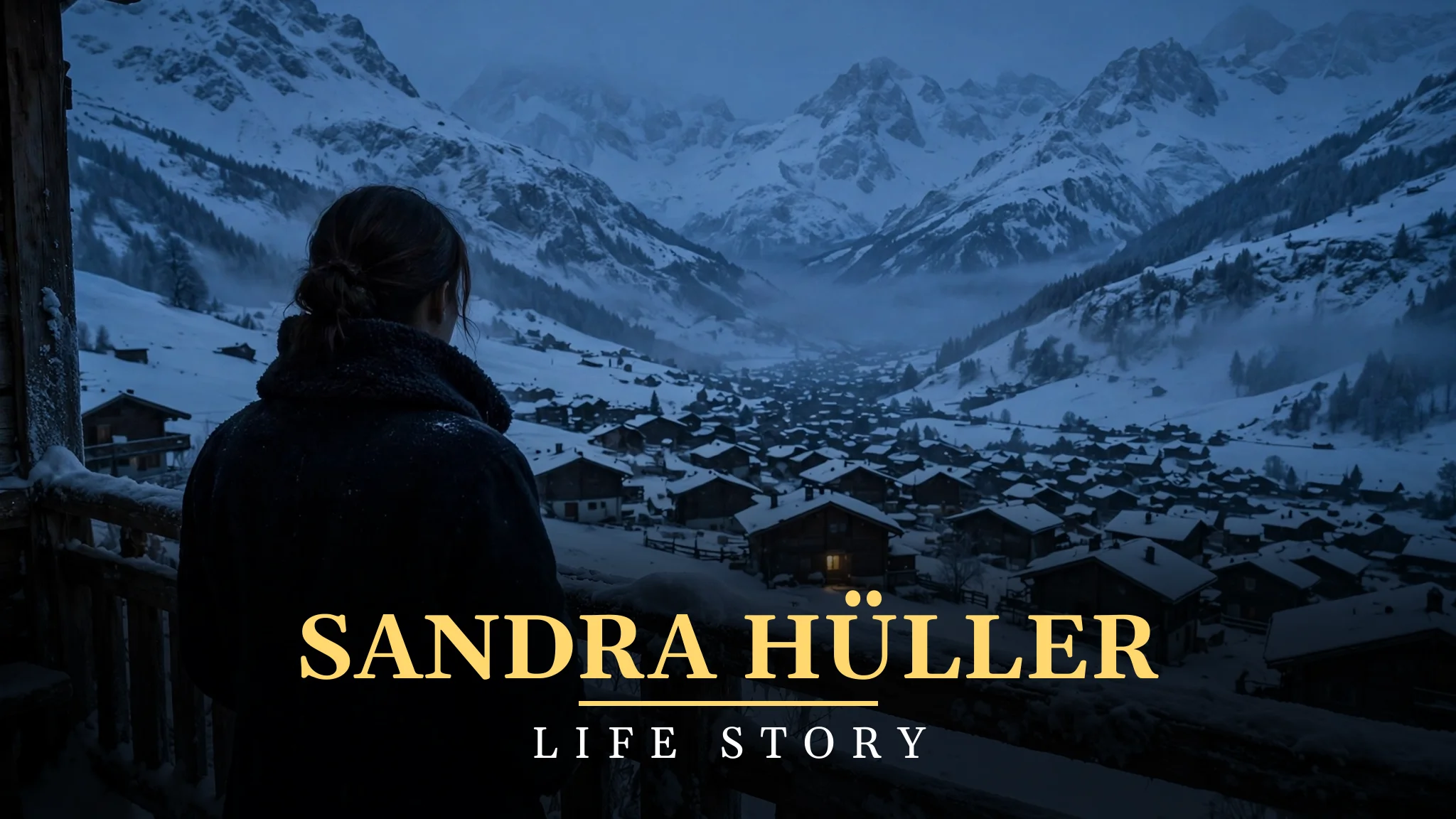
In the end, Sandra Hüller is remembered as one of the most respected actresses in the world, a woman who stands on a snowy balcony, looking out over a quiet village, and who can hold an audience with silence. That image is the heart of her career, a quiet power that does not need to shout, and that is why her performances will be remembered long after many louder ones are forgotten.
My Take:
When I think about Sandra Hüller, the first thing I feel is a deep respect for an actress who is not afraid to be difficult. I have seen many actresses who try to be liked, who smile, who charm, and who make the audience feel comfortable. Hüller does the opposite. She plays women who are angry, who are cold, who are funny in a strange way, and who do things that make the audience uncomfortable. That takes courage, because it means some people will not like you, and some people will not understand you. Hüller does not care. She plays the truth, and she trusts the audience to follow her there. I admire that trust, because it is rare, and it is the mark of a great actress.
I think about Anatomy of a Fall, and I think about how hard that role must have been to play. Sandra is a writer, her husband has died, she is on trial for murder, and the audience must decide if she is innocent or guilty. Hüller did not play her as innocent or as guilty. She played her as a real person, with flaws, with secrets, with a life that is hard to judge. I watched that film, and I did not know what to think, and that is the point. A great film does not tell you what to think. It makes you think, and Hüller made me think for days after I saw it. That is a powerful thing for an actress to do, and it is why she was nominated for an Oscar.
I admire her training, and I think it matters more than people say. She studied at the Ernst Busch Academy, she worked in theatre, she learned the craft properly, with discipline and with practice. That training is in every performance she gives, in the way she stands, in the way she speaks, in the way she uses her body. I think many young actors today skip that training, they want fame fast, and they end up with a career that is shallow. Hüller did not skip it, and her career is deep, because it was built on a strong base. That is a lesson I wish more young people would learn.
I think about The Zone of Interest, and I feel a chill, because the role is so disturbing. Hedwig Höss lives in a comfortable house next to Auschwitz, she cares about her garden, and she ignores the terrible crime happening next door. Hüller played her with a calm that was frightening, a woman who has chosen not to see, and who has made that choice seem normal. That is a brave role to play, because the audience might hate the character, and they might hate the actress for playing her. Hüller was not afraid. She played the role with honesty, and she showed how ordinary people can ignore evil when it is convenient. That is a lesson that matters, and it is one that the film tells with great power.
I love Toni Erdmann, and I want to say why it matters so much to me. It is a film about a father and a daughter, about humour and about sadness, about a man who wears disguises to make his daughter laugh. Hüller played Ines with a mix of control and pain, a woman who has built a hard shell around herself, and who has forgotten how to be happy. She played the role with an honesty that made me both laugh and feel sad, and she showed that a serious woman can also be funny, in a way that is awkward and real. That range is rare, and it is what makes her a complete actress. A woman who can play both a dark drama and a funny comedy is a woman who understands people, and Hüller understands people well.
I feel a hope when I think about her year in 2023, with two films at Cannes, both winning major prizes. That year showed the world what German audiences had known for many years, that Hüller is one of the great actresses of our time. I am glad the world finally saw it, because she deserved to be seen, and her work deserved to be known. I hope that year was not a peak, but a beginning, and that she will keep making great films for many years to come, because the world needs more actresses like her, actresses who are fearless and honest.
I think about her childhood in East Germany, and I think it matters more than people say. She grew up in a world that changed completely when she was eleven, when the Wall fell and Germany became one country. That experience, of living through a great change, gave her a view of people that is deep and serious, a view that she brings to every role. She knows that people can adapt, that they can cope, and that they can keep going when the world changes. That knowledge is in her acting, in the way she plays women who are trying to survive in a hard world. I think that is why her performances feel so real, because they come from a real understanding of change.
I also think about her stage work, and I think it is the base of everything she does. She began on the stage, she learned her craft there, and she has kept returning to it, even when film made her famous. That loyalty to the stage is a lesson for any actor, because the stage teaches discipline, teaches presence, and teaches honesty in a way that film cannot. Hüller knows that, and she has kept that learning alive, by working in theatre alongside film and television. I think that is why her film performances feel so strong, because they carry the discipline of the stage with them.
If I have a criticism, it is that she has not always chosen films that reach a wide audience, and that some of her best work is known only to a small number of people who love serious cinema. I understand why she chooses the roles she does, and I respect the choice, but as a viewer, I wish more people knew her work, because it is good work, and it deserves to be seen. That is not a criticism of her, really. It is a sadness that the world does not always notice great acting, and that a great actress can work for decades and still be unknown to many people. I hope this story changes that, even a little.
I think about young actresses in Germany, and I hope they look at Hüller and learn the right lesson. The lesson is not to copy her roles, because her roles belong to her. The lesson is to learn the craft, to study, to work in theatre, to be patient, and to build a career that is based on skill, not on luck. Hüller studied at a serious school, she worked in theatre, she took small roles, and she was ready when the big roles came. That patience is the real lesson, and it is a lesson that is still true today, when many young actresses want fame in a week and give up when it does not come.
I also think about the way she handles fame, and I think it is a model for any public person. She is famous now, she is respected around the world, and yet she keeps her private life private, she keeps her focus on the work, and she does not chase attention. That is a kind of strength, to be known for your work and not for your life, and I wish more famous people would do the same. When the work is the point, the work gets better, and Hüller proves it, because her work has only got better with time, even as she has kept herself out of the spotlight.
For a young reader, I think the lesson from Sandra Hüller is to be fearless, to be patient, and to be honest. Do not try to be liked, do not rush to be famous, and do not pretend to be someone you are not. Learn your craft, work hard, and trust that the audience will listen when you are ready. Hüller learned her craft, she worked hard, and she trusted the audience, and the audience has listened for many years. That trust was not luck. It was work, and it is work that anyone can do, if they are willing to keep going when no one is watching.
I also think her story teaches us about Germany, and about the power of a serious cinema to tell the story of a country. Toni Erdmann, Anatomy of a Fall, and The Zone of Interest are not only films about women. They are films about people, about families, about history, and about the choices we make when life is hard. Hüller helped to tell those stories, with honesty and with care, and she gave them a human face. That is a hopeful message for any young person in any country who thinks their country’s stories are too hard to tell. You can tell them, if you are willing to be honest, to be patient, and to trust the audience to listen. Hüller did, and world cinema is better for it.
In the end, I keep coming back to the image of a woman standing on a snowy balcony, looking out over a quiet village, with the mountains behind her. That image is the heart of Sandra Hüller, a quiet power that does not need to shout, and that is why her performances will be remembered long after many louder ones are forgotten. I hope she is remembered for that image, for her honesty, and for her long career of good work. She is not the most famous actress in the world, but she is one of the most honest, and honesty in acting is worth more than fame. I will keep watching her films, I will keep telling people about her, and I will keep believing that an actress who works this hard deserves to be heard.
I also want to say something about the way she uses her body on screen, because it is a skill that is easy to miss. Many actors act only with their face, but Hüller acts with her whole body, with the way she stands, the way she moves, the way she holds herself when she is afraid or angry. That physical acting is what makes her performances feel so real, because a real person does not only feel with their face. They feel with their whole self, and Hüller shows that. I think that is a rare gift, and it is one that I wish more actors had.
Finally, I want to say that Sandra Hüller taught me that acting is not about being famous. It is about being true, about finding the truth in a character, and about trusting the audience to follow you there. She has spent her career doing that, in many different roles, in many different films, and she has done it with a calm and a care that I admire deeply. I hope she keeps acting, keeps working in theatre, and keeps telling stories, because the world needs more actresses like her, actresses who care about the work more than about the fame.
I also think about the languages she works in, and I think it is a remarkable gift. She has acted in German, in French, and in English, and she has done it with the same honesty in each language. That is not easy, because each language has its own rhythm, its own feeling, and its own way of telling a story. Hüller moves between them as if they were all her own, and that movement is a sign of a great actress, a woman who understands that acting is not about words alone. It is about feeling, and feeling has no language, or rather, it speaks every language at once.
One last thought stays with me, and it is about the future. Hüller is still working, still making films, and still taking on difficult roles, and I hope she keeps doing it for many years. The world needs actresses who are fearless, who are honest, and who are willing to play women who are not easy to like. If she keeps doing that, her best work may still be ahead of her, and that is a hopeful thought for anyone who loves film. I will be watching, and I will be waiting for whatever she does next.
Frequently Asked Questions
Where was Sandra Hüller born and when?
Sandra Hüller was born on 30 April 1978 in Suhl, a town in Thuringia, in what was then East Germany. She was eleven when the Berlin Wall fell in 1989, and she grew up in a time of great change in Germany.
Where did Sandra Hüller study acting?
She studied acting at the Ernst Busch Academy of Dramatic Arts in Berlin, one of the most respected drama schools in Germany. She also worked on the stage in Berlin and in other cities, including the Basel Theatre in Switzerland.
What was Sandra Hüller’s first great film role?
Her first great film role was in Requiem in 2006, where she played a young woman who believes she is possessed. Her performance won her the Silver Bear for Best Actress at the Berlin Film Festival and made her known as a serious film actress.
What is Toni Erdmann about?
Toni Erdmann, released in 2016 and directed by Maren Ade, is about a father who follows his serious businesswoman daughter to Bucharest and pretends to be a man named Toni Erdmann to make her laugh. Hüller played the daughter Ines, and the film became one of the most loved films of the year.
What happened for Sandra Hüller in 2023?
In 2023, she starred in two films shown at the Cannes Film Festival, Anatomy of a Fall and The Zone of Interest. Anatomy of a Fall won the Palme d’Or, and Hüller was nominated for the Academy Award for Best Actress for her performance in it.
What is Anatomy of a Fall about?
Anatomy of a Fall, directed by Justine Triet, is about a writer named Sandra whose husband falls to his death from a window in their home in the French Alps, and who is then put on trial for his murder. Hüller played Sandra with a calm and complexity that made the film unforgettable.
What is The Zone of Interest about?
The Zone of Interest, directed by Jonathan Glazer, is about Rudolf Höss, the commandant of Auschwitz, and his family, who live in a comfortable house next to the camp. Hüller played his wife Hedwig, a woman who cares about her garden and ignores what is happening next door.


