SB19: The Life Story Behind the Philippines' P-Pop Kings
In this post
- Five Boys From Different Places
- Years of Training in the Korean Style
- Tilaluha, Go Up, and a Slow Start
- Alab, What?, and the Sound of P-pop
- Gento, World Tours, and a Global Stage
- A’TIN, the Fandom That Never Left
- Hard Years and the Will to Keep Going
- P-pop Kings With a Future Still to Write
- Pablo’s Pen: The Songs SB19 Wrote Themselves
- My Take:
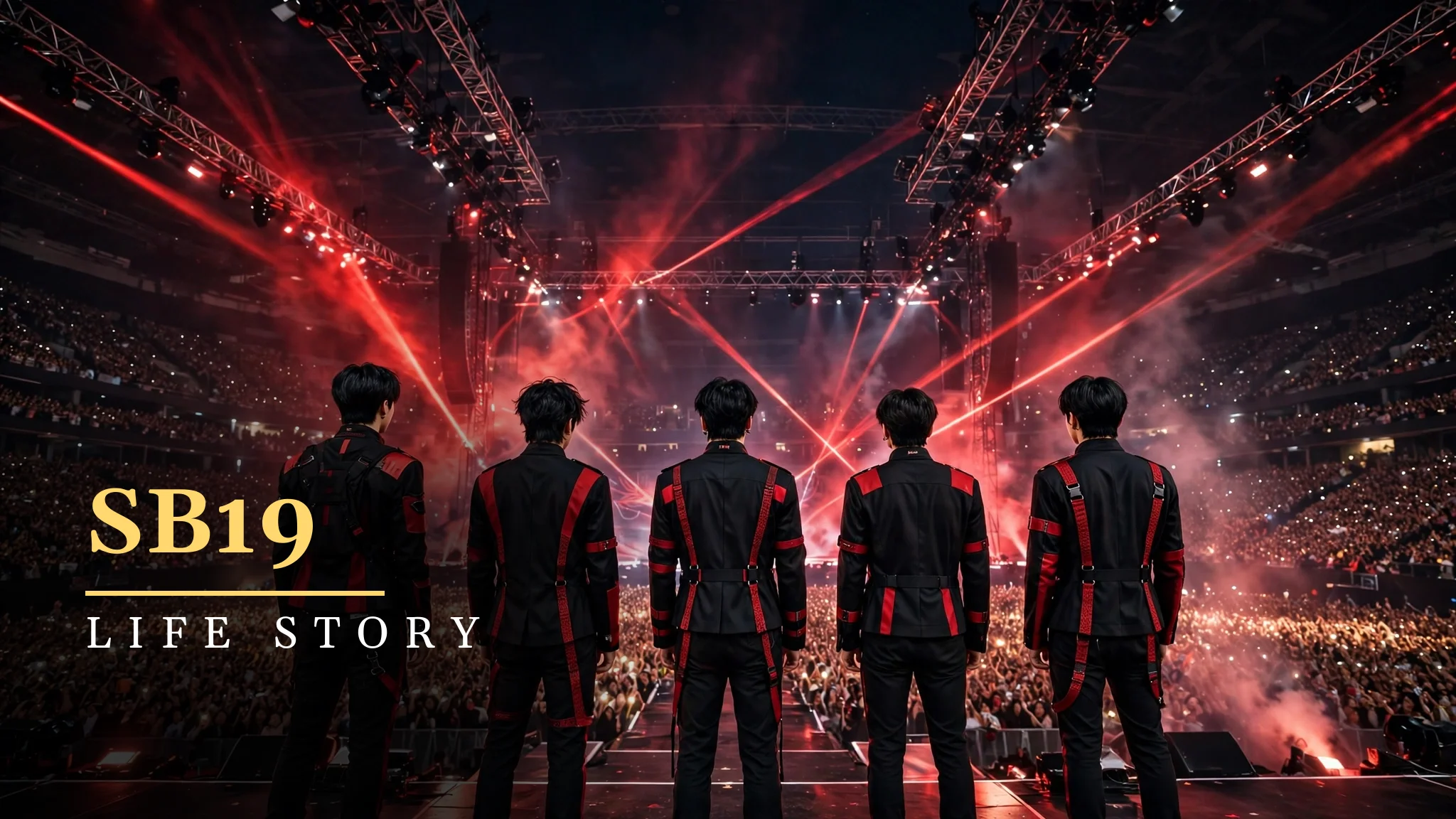
SB19 is a group of five young men who did something that no Filipino group had done before. They trained for years, they sang in Korean and in Filipino, they danced with a precision that rivalled the biggest K-pop groups, and they built a new kind of music in the Philippines, a kind called P-pop. They did not start with fame, with money, or with an easy road. They started with a small company, a hard training programme, and a dream that many people thought was impossible. They kept going, and they proved that a Filipino group could fill arenas, top charts, and win fans around the world.
The five members, Pablo, Josh, Stell, Ken, and Justin, came from different parts of the Philippines, and they came together in Manila to train. They lived together, they practised together, and they learned to sing and to dance as one. That training was long and hard, and it asked them to give up a normal life for years. They gave it up, because they believed in the dream, and because they believed in each other. That belief is at the heart of their story.
Today, people know SB19 for songs like “Go Up”, “Alab (Burning)”, “What?”, “Mapa”, and “Gento”, for world tours, and for a fandom called A’TIN that supports them with a loyalty that is rare in music. This is the story of how five young men built P-pop from nothing, and how they turned years of training into a career that has changed Filipino music.
Five Boys From Different Places
SB19 is made up of five members, Pablo, Josh, Stell, Ken, and Justin, and each of them came from a different part of the Philippines. Pablo, whose real name is John Paulo Nase, was born in Quezon City, and he became the leader of the group and its main songwriter. Josh, whose real name is Josh Cullen Santos, came from Las Piñas, and he brought a bold, energetic style to the group. Stell, whose real name is Stellvester Ajero, came from Las Piñas as well, and he became known for his powerful voice and his dancing. Ken, whose real name is Felip Jhon Suson, came from Pagadian City in Zamboanga del Sur, and he brought a deep voice and a quiet strength. Justin, whose real name is Justin de Dios, came from Malabon, and he became known for his visuals and his calm presence.
The five of them were chosen by ShowBT Philippines, a Korean company that wanted to train a Filipino boy group in the style of K-pop. They were not chosen because they were already famous. They were chosen because they had talent, because they were willing to work, and because they could learn. They moved to Manila, they lived together, and they began a training programme that would last for years. That training was the foundation of everything that followed.
They were young men with dreams, but they were also young men far from home, living in a dormitory, practising every day, and waiting for a chance that might never come. That life is hard, and it asks a great deal of a young person. They had to learn to sing, to dance, to speak Korean, and to work as a team, all at the same time. They had to learn to trust each other, because a group that does not trust each other cannot perform as one. They learned that trust slowly, day by day, in rehearsals that went on for hours.
Each member brought something different to the group, and that difference became their strength. Pablo wrote songs, Josh brought energy, Stell brought a soaring voice, Ken brought depth, and Justin brought a calm, visual presence. Together, they were more than five singers. They were a group, and a group that works as one is stronger than any single singer alone. That is the lesson they learned in training, and it is the lesson they have carried with them ever since.
Years of Training in the Korean Style
The training programme for SB19 was modelled on the Korean idol system, and it was long, hard, and demanding. The members trained for three years before they made their debut, and during those years they practised singing, dancing, and performing every day. They woke up early, they rehearsed for hours, they learned new dances, and they worked on their voices until they were strong enough to sing and dance at the same time. That is a skill that looks easy on stage, but it is one of the hardest things a performer can learn.
They also learned Korean, because their company was Korean, and because they needed to understand the instructions of their trainers. They learned to work with a team of choreographers, vocal coaches, and producers, and they learned to take criticism and to improve. A young person who is told, again and again, that they must do better, must learn to listen without losing hope, and SB19 learned that lesson well. They did not give up, even when the training was hard, and even when the debut seemed far away.
The training also taught them discipline, and discipline is the quiet foundation of their success. They learned to eat well, to rest when they could, to look after their bodies, and to prepare carefully for every performance. A dancer who is not fit cannot dance for a whole show, and a singer who does not take care of their voice cannot sing for a whole concert. SB19 learned to do both, and they did it for years before anyone knew their names.
Those years of training were also years of doubt. There were times when they wondered whether the group would ever debut, whether anyone would care, and whether the years of work would be wasted. They kept going, because they believed in each other, and because they believed in the dream of a Filipino group that could stand beside the best groups in Asia. That belief carried them through the hardest days, and it is a part of their story that their fans love to hear.
Tilaluha, Go Up, and a Slow Start
SB19 made their debut in 2018 with the song “Tilaluha”, a slow, emotional ballad that showed their voices but did not yet show the full power of the group. The debut was a quiet one, and it did not make them famous overnight. Many groups debut and then disappear, and SB19 could have been one of them. They were a new group, from a small company, singing in a style that was new to the Philippines, and the public did not yet know what to make of them.
They kept working, and in 2019 they released “Go Up”, a fast, energetic song with a powerful dance, and the song changed everything. A dance practice video of “Go Up” was shared online, and it went viral, because people could see the precision of their dancing, the strength of their singing, and the energy of their performance. The video was watched by millions of people, and suddenly SB19 was a name that everyone was talking about. A single video, shared by fans, had done what years of training could not do alone. It had made them famous.
“Go Up” became an anthem for their fans, because its message was simple and true, to keep going up, even when life is hard. The song’s lyrics, about rising and not giving up, suited the group’s own story, and their fans took it as their own. The group began to perform on television, in concerts, and in malls, and their audience grew with every performance. They were no longer a quiet debut group. They were a rising group, and the Philippines was watching.
The years after “Go Up” were a time of fast growth, and SB19 learned to handle fame, to handle a growing fandom, and to handle the pressure of being the first P-pop group to break through. They released more songs, they performed more shows, and they built a reputation as a group that gave its all on stage, every time. That reputation is the reason their fans stayed loyal, and it is the reason new fans kept joining.
Alab, What?, and the Sound of P-pop
After “Go Up”, SB19 released a series of songs that defined the sound of P-pop. “Alab (Burning)”, released in 2019, became one of their best-known songs, a fast, fiery track about a love that burns bright. The song’s dance was powerful, its chorus was catchy, and its video was watched by millions of people. It showed that SB19 was not a one-song group. They could follow a hit with another hit, and they could do it in their own style.
“What?”, released in 2021, was a bold, confident song that showed a new side of the group, a side that was louder, prouder, and more willing to take risks. The song’s message, about standing up and being heard, suited a group that had fought for its place in music, and their fans loved it. The video, with its strong visuals and its precise dancing, became another viral moment, and it proved that SB19 could keep growing without losing the energy that made them famous.
“Mapa”, released in 2021, was a different kind of song, a tender, emotional ballad about parents, about home, and about the love that guides a young person through life. The song was a gift to their families, and it moved many listeners to tears, because it spoke about the sacrifices that parents make for their children. A group that can sing a fast dance song and a slow, tender ballad with equal skill is a group with real range, and SB19 showed that range in “Mapa”.
Their first album, Get in the Zone, released in 2020, and their EP Pagsibol, released in 2021, gave their fans collections of songs that showed the full range of their talent. They sang in Filipino and in English, they mixed pop, hip-hop, and ballads, and they wrote songs that told their own story. Pablo, as the main songwriter, gave the group a voice that was personal and honest, and that honesty is what made their fans feel close to them.
Gento, World Tours, and a Global Stage
In 2023, SB19 released “Gento”, a song that became their biggest hit yet. The word gento means like this, like gold, and the song is about working hard, about shining, and about proving yourself. The dance for “Gento” went viral, with fans and celebrities around the world copying the moves, and the song reached audiences far beyond the Philippines. It was a moment when P-pop stepped onto the world stage, and SB19 led the way.
The success of “Gento” took SB19 on world tours, where they performed for Filipino communities and for new fans in the United States, Canada, and other countries. For Filipinos living abroad, an SB19 concert is a taste of home, a night of songs they grew up with, sung by a group they love. For new fans, it is a discovery, a group that sings and dances with a skill that rivals the best groups in the world. SB19 carried the music of the Philippines to the world in that way, one concert at a time.
Their album Pagtatag!, released in 2023, gave their fans a collection of songs that showed how far they had come, and their later album Simula at Wakas, released in 2025, continued that story. They also became self-managed under their own company, 1Z Entertainment, in 2023, which gave them control over their own careers. That step was a brave one, because it meant taking responsibility for their own future, and they took it with the same courage they had shown in training.
They have also won awards, topped charts, and set records on music platforms, including a number one on a Billboard chart for their song “Bazinga”. Those achievements are a part of their story, but they are not the whole of it. The real achievement is that they built P-pop from nothing, and that they opened a door for other Filipino groups to follow. They did not only succeed for themselves. They succeeded for a whole new kind of Filipino music.
A’TIN, the Fandom That Never Left
SB19’s fans are called A’TIN, a name that means ours, and the fandom is one of the most loyal in Filipino music. A’TIN supported SB19 when they were unknown, they shared the “Go Up” video when no one else was watching, and they have stayed with the group through every change. They stream the songs, they vote in awards, they fill concert halls, and they defend the group with a passion that is rare. That loyalty is not an accident. It was earned, by a group that gave its all, and by fans who felt that the group gave its all for them.
The relationship between SB19 and A’TIN is a close one, and the group has often spoken about their fans with gratitude. They know that without A’TIN, the viral video would not have gone viral, the concerts would not have sold out, and the tours would not have happened. They thank their fans in concerts, in interviews, and in songs, and that gratitude has made the bond even stronger. A group that loves its fans, and fans who love their group, is a powerful thing in music.
A’TIN has also helped to spread P-pop to the world, by sharing videos, by translating lyrics, and by telling new listeners about the group. That work, done by fans for free, out of love, is a part of SB19’s success that cannot be measured in sales or in streams. It is measured in the size of the community, in the warmth of the concerts, and in the feeling that SB19 and A’TIN are in this together.
The fandom has also been a source of strength for the members in hard times, when the training was hard, when the debut was slow, and when the music business was difficult. Knowing that thousands of people believe in you can carry you through a hard day, and SB19 has often said that A’TIN carried them. That is a beautiful thing, and it is a part of their story that their fans will always remember.
Hard Years and the Will to Keep Going
SB19’s career has not been smooth all the way through. There were years when the debut was slow, when the company was small, when the money was tight, and when the group wondered whether they would ever be heard. They faced those years with a patience that is rare for young men. They did not complain in public, and they did not give up. They kept training, kept singing, and kept dancing, and they trusted that their moment would come.
There were also times when they had to make hard choices, including the decision to become self-managed under 1Z Entertainment. That decision meant taking on new responsibilities, new risks, and new work, and it asked the members to grow from performers into business owners as well. They took that step with courage, and they learned to manage their own careers with the same discipline they had learned in training.
The rise of streaming and social media also changed the way music reaches people, and SB19 adapted to that change better than most. Their videos found new listeners online, and clips of their dances spread far beyond the Philippines. In a new world of short videos and quick fame, their long, steady career stood out as proof that real skill lasts longer than a trend, and that a group that works hard will be found, even if it takes years.
Through all of it, they kept the habit that had carried them from the start. They prepared carefully, they respected their audience, and they gave their best on stage. That steadiness is easy to overlook, because it is not dramatic, but it is the reason they are still here. Many groups have a bright few years and then fade. SB19 built a career that could bend without breaking, and that is a rarer and harder thing.
P-pop Kings With a Future Still to Write
SB19 is still performing, still recording, and still touring, and their concerts still draw crowds who know every word and every dance move. They have grown as singers, as dancers, and as songwriters, and their work has grown deeper, but the heart of it has not changed. They still give everything they have to the audience, and the audience still gives it back. That is the mark of a great group, and it is why their career has lasted.
Their place in Filipino music is secure. They are the P-pop kings, the group that built a new kind of music in the Philippines, and the group that opened a door for others to follow. Their songs are a part of the sound of the Philippines, played on the radio, in malls, and in homes. Their influence can be seen in the younger groups who train the way they trained, who dance the way they dance, and who dream of singing the way they do.
SB19 began as five young men in a training room in Manila, and they became a group that the Philippines, and a growing world audience, calls its own. Their story is not finished, because they are still young, still singing, still dancing, and still giving their audience the best of themselves. As long as there are people who love a great song, a great dance, and a great group, there will be a place for SB19, and their music will still fill the room.
Pablo’s Pen: The Songs SB19 Wrote Themselves
One of the things that makes SB19 different from many other groups is that they write their own songs, and the main writer is Pablo, the leader. Pablo writes in Filipino and in English, and he writes about the group’s own life, about training, about doubt, about family, and about the dream of rising. When he wrote “Go Up”, he was writing about the group’s own climb, about the years of training and the slow start. When he wrote “Mapa”, he was writing about his parents, and about the love that had carried him to Manila. When he wrote “Gento”, he was writing about working hard and shining like gold. Each song is a page from the group’s own diary, and that is why their fans feel so close to them.
Writing your own songs is harder than singing songs written by others, because it asks the writer to be honest about his own life, and to put that honesty into words that millions of people will hear. Pablo has done that, again and again, and he has done it with a skill that has grown with every album. His lyrics are simple, direct, and full of feeling, and they speak to young Filipinos in a language they understand, because it is their language too. A song written by the person who lived it is a song that feels true, and SB19’s songs feel true.
The other members also take part in the writing, in the music, and in the ideas behind each release. Josh brings energy and a bold style, Stell brings a soaring melody, Ken brings a deep, thoughtful sound, and Justin brings a visual sense that shapes the videos and the performances. Together, they build a song from the ground up, from a lyric to a dance to a stage show, and that teamwork is a part of their success. A group that writes its own songs is a group that owns its own story, and SB19 owns theirs.
That ownership became even clearer when they became self-managed under 1Z Entertainment in 2023. They took control of their own careers, of their music, of their tours, and of their future, and they did it with the same courage they had shown in training. A group that manages itself must make hard decisions, about money, about schedules, and about the direction of its music, and SB19 has made those decisions together, as a group. That is a brave step, and it is one that shows how far they have come, from five trainees in a dormitory to five owners of their own company.
My Take:
When I think about SB19, I think about five young men who were told, in so many ways, that their dream was impossible, and who kept going anyway. I think about three years of training, three years of waking up early, of rehearsing for hours, of learning to sing and to dance at the same time, and of waiting for a debut that might never come. I think about how easy it would have been to give up, to go home, to find a normal job, and to forget the dream. They did not give up. They kept going, and that is the part of their story that stays with me the most.
I admire them because they built something from nothing. P-pop did not exist as a big, famous thing before SB19. There were Filipino groups, and there were Filipino singers, but there was not a P-pop movement, with training, with dancing, with a fandom, and with world tours. SB19 built that movement, one rehearsal at a time, one song at a time, and one fan at a time. I think about what it takes to build something new, to be the first, and to do it without a map. It takes courage, it takes patience, and it takes a belief in each other that does not fade when the work gets hard. SB19 had all three.
I also admire the way their fans, A’TIN, stood by them when no one else was watching. The “Go Up” dance practice video went viral because fans shared it, again and again, until millions of people had seen it. I think about that video, and about the power of a fan who believes in a group, and I think about how different SB19’s story would be without those fans. A group can train for years, and can sing and dance beautifully, but without fans who share the work, the work stays hidden. A’TIN did not let the work stay hidden. They shared it, they shouted about it, and they made the world listen. That is a beautiful partnership, between a group and its fans, and it is a part of SB19’s story that I love.
I think about “Gento”, and about the dance that went viral around the world, and I think about what it means for a Filipino song to be danced by people in other countries. I think about the pride that must have felt, for the members, for their families, and for the Philippines, to see a P-pop song travel so far. I think about the young Filipinos who watched that dance and felt proud to be Filipino, and about the young people in other countries who discovered Filipino music for the first time. That is a powerful thing, and it is a thing that SB19 did with a single song, a single dance, and a single moment of joy.
I also think about “Mapa”, and about the tenderness in that song. It is a song about parents, about home, and about the love that guides a young person through life, and SB19 sang it with a feeling that made many listeners cry. I think about the members’ own parents, and about the sacrifices those parents made so that their sons could train in Manila, far from home. I think about the mothers and fathers who waited, who prayed, and who believed, and about the sons who sang “Mapa” as a thank you. That is a beautiful thing, and it is a thing that shows the heart behind the dancing and the fame. SB19 is not only a group that dances. It is a group that loves its families, and that love comes through in its songs.
There is a sadness in their story too, and I do not want to hide it. The sadness is that a life of training asks young men to give up a normal youth, to live in a dormitory, to practise for hours, and to miss the small, quiet moments that make a life. A birthday at home, a family dinner, a normal evening with friends, these are the things that SB19 gave up, and they are not small things. I think about the weight of that sacrifice, and I feel sad for the young men who only wanted to sing and dance and who found themselves carrying the hopes of a whole new music movement. It is a beautiful burden, but it is still a burden.
I also feel sad when I think about the way the music business treats young groups, and about how quickly it can move on to the next new thing. SB19 has had to prove itself again and again, to new audiences, to new companies, and to a world that is always looking for something new. That is not fair, and it is not their fault, but it is a part of the story that we should not ignore. They have faced it with grace, and they have kept singing and dancing, and that is why they are still here. But I think we should remember the cost of that life, and we should be grateful for the groups who pay it.
What I learn from SB19, more than anything else, is that a dream is built in the quiet hours, in the training room, when no one is watching. They trained for three years before anyone knew their names, and those three years were the foundation of everything that followed. I think about my own life, and about the things I want to do well, and I ask myself whether I am willing to do the quiet work, the practice, the waiting, and the showing up again after a bad day. SB19’s story says yes, that is the way, and it says it without preaching. It says it by living it, year after year.
I also learn from them that a group is stronger than a single person, when the group trusts each other. Pablo, Josh, Stell, Ken, and Justin are five different men, with five different strengths, and together they are more than the sum of those strengths. I think about the teams I have been a part of, and about the times when trust made the work easier, and when a lack of trust made it harder. SB19’s story shows what trust looks like, when five people believe in each other, and when they work as one. That is a lesson for any team, in any field, not only in music.
I think about the future, and I wonder what SB19’s story will mean in twenty years. I think it will mean that five young men from the Philippines could build P-pop from nothing, and that a Filipino group could fill arenas around the world. I think it will mean that training, patience, and trust can beat a quick fame that fades. I think young groups will study their dances, learn from their songs, and dream of singing the way they do. That is a legacy that does not fade, because it is built on real work and real feeling.
If I could speak to a young person who dreams of being in a group, using SB19’s life as the guide, I would say this. Train hard, even when no one is watching, because the quiet hours are the foundation. Trust your group, and let each member’s strength make the group stronger. Be patient when the debut is slow, and be ready when the moment comes. Love your fans, and thank them, because without them the work stays hidden. And when hard times come, as they will, keep going up, as your song says, and trust that the climb is worth it. That is what SB19 did, and that is why their music still fills the room.
I will finish with gratitude, because that is the feeling I have when I think about SB19. I am grateful that they trained for three years without giving up, and that they sang “Go Up” with a joy that made a whole country move. I am grateful that they sang “Mapa” with a tenderness that honoured their parents, and that they danced “Gento” with a pride that carried Filipino music to the world. SB19 reminds me that a great group is not only five voices. It is five hearts, beating as one, and a dream that refuses to fade.
I also think about the fandom, A’TIN, and about what it means to belong to a community like that. I picture a young fan, alone in her room, listening to “Go Up” on her phone, and feeling that she is a part of something bigger than herself. I picture her going to a concert, meeting other fans, and finding friends who love the same songs she loves. That is a beautiful thing, and it is a thing that SB19 has given to thousands of young people, a place to belong. In a world where many young people feel alone, a fandom can be a home, and A’TIN is a home for many.
I think about Pablo’s songwriting, and about the courage it takes to write about your own life. I have tried to write about my own life, and I know how hard it is to be honest on paper. It is easy to write about other people, and it is hard to write about yourself, because yourself is the one person you cannot hide from. Pablo writes about training, about doubt, about his parents, and about the dream of rising, and he does it in a way that millions of people understand. I think about the young songwriters who listen to his lyrics and who learn from them, and I think that is a gift that will outlast any single hit.
I also think about the decision to become self-managed, and about what it means for five young men to take control of their own careers. I picture them sitting around a table, talking about money, about tours, and about the future, and making decisions together, as equals. That is a grown-up thing to do, and it is a thing that many groups never learn to do. SB19 learned it, and they did it with the same teamwork they learned in training. I admire that, because it tells me that they are not only performers. They are owners, leaders, and partners, and they have built a company as well as a career.
I want to say one more thing about SB19, which is that they have given Filipino music a new word, P-pop, and a new dream. Before them, a Filipino group that trained like a K-pop group, that danced with such precision, and that toured the world, seemed like a dream that was too big. SB19 made that dream real, and they made it real by training for three years, by writing their own songs, and by trusting each other. I think about the young groups who are training now, in Manila and in other cities, and about the way they look at SB19 and think, we can do that too. That is a legacy, and it is a legacy that SB19 earned, one rehearsal at a time.
I also think about the word P-pop, and about how strange it must have felt the first time SB19 heard it. A new word, for a new kind of music, in a country that had never had it before. I picture the five of them, in a training room, hearing someone say P-pop, and wondering whether the word would ever mean anything to anyone. Now it means a movement, a sound, and a dream for thousands of young Filipinos. That is a remarkable thing, to give a country a new word, and SB19 did it, not by announcing it, but by living it, by training, by singing, and by dancing, until the word became real.
I think about the young groups who are training now, in Manila, in Cebu, and in Davao, and about the way they look at SB19. I picture a boy in a small town, watching a “Gento” dance video on his phone, and thinking, I could do that. I picture him practising in his bedroom, learning the moves, and dreaming of a stage. That boy’s dream is real because SB19 made it real, and that is a legacy that no award can measure. A group that gives other young people a dream has done something greater than making a hit song. It has changed what is possible, and SB19 changed what is possible for Filipino music.
I want to say one more thing about SB19, which is that they have shown me that five people, working as one, can do what one person alone cannot. Pablo’s songs, Josh’s energy, Stell’s voice, Ken’s depth, and Justin’s calm are five separate gifts, and together they make a group that is greater than the sum of its parts. I think about the teams I have been a part of, and about the times when trust made the work easier, and I ask myself whether I have trusted my team the way SB19 trust each other. Their story tells me that trust is not a soft thing. It is a strong thing, and it is the foundation of everything they have built.
Frequently Asked Questions
Who are the members of SB19?
SB19 has five members, Pablo, Josh, Stell, Ken, and Justin. Pablo is the leader and main songwriter, Josh brings bold energy, Stell is known for his powerful voice, Ken brings a deep voice and quiet strength, and Justin is known for his visuals and calm presence. They came from different parts of the Philippines and trained together in Manila.
How did SB19 become famous?
SB19 became famous when a dance practice video of their song “Go Up”, released in 2019, went viral online. Millions of people watched the video and saw the precision of their dancing and singing. The group had debuted in 2018 with “Tilaluha”, but “Go Up” was the song that made them a national name.
What is P-pop, and what is SB19’s role in it?
P-pop is short for Pinoy pop, a style of Filipino pop music inspired by K-pop training, dancing, and group performance. SB19 is widely seen as the group that built P-pop into a movement, through years of training, precise dancing, and hit songs. They opened the door for other Filipino groups to follow.
What are SB19’s most famous songs?
Their most famous songs include “Go Up”, “Alab (Burning)”, “What?”, “Mapa”, “Bazinga”, and “Gento”. “Gento”, released in 2023, became their biggest hit, with a dance that went viral around the world. “Mapa” is a tender ballad about parents and home that moved many listeners.
What is A’TIN?
A’TIN is the name of SB19’s fandom, and it means ours in Filipino. The fans supported SB19 when they were unknown, shared the “Go Up” video, and have stayed loyal through every change. They stream the songs, vote in awards, and fill concert halls, and the group often thanks them with gratitude.
Did SB19 train in the Korean idol style?
Yes, the five members trained for three years under ShowBT Philippines, a Korean company, in a programme modelled on the Korean idol system. They practised singing, dancing, and performing every day, and they also learned Korean. That long training gave them the discipline and skill that define their performances.


