Scarlett Johansson Childhood: School, Family, Early Life
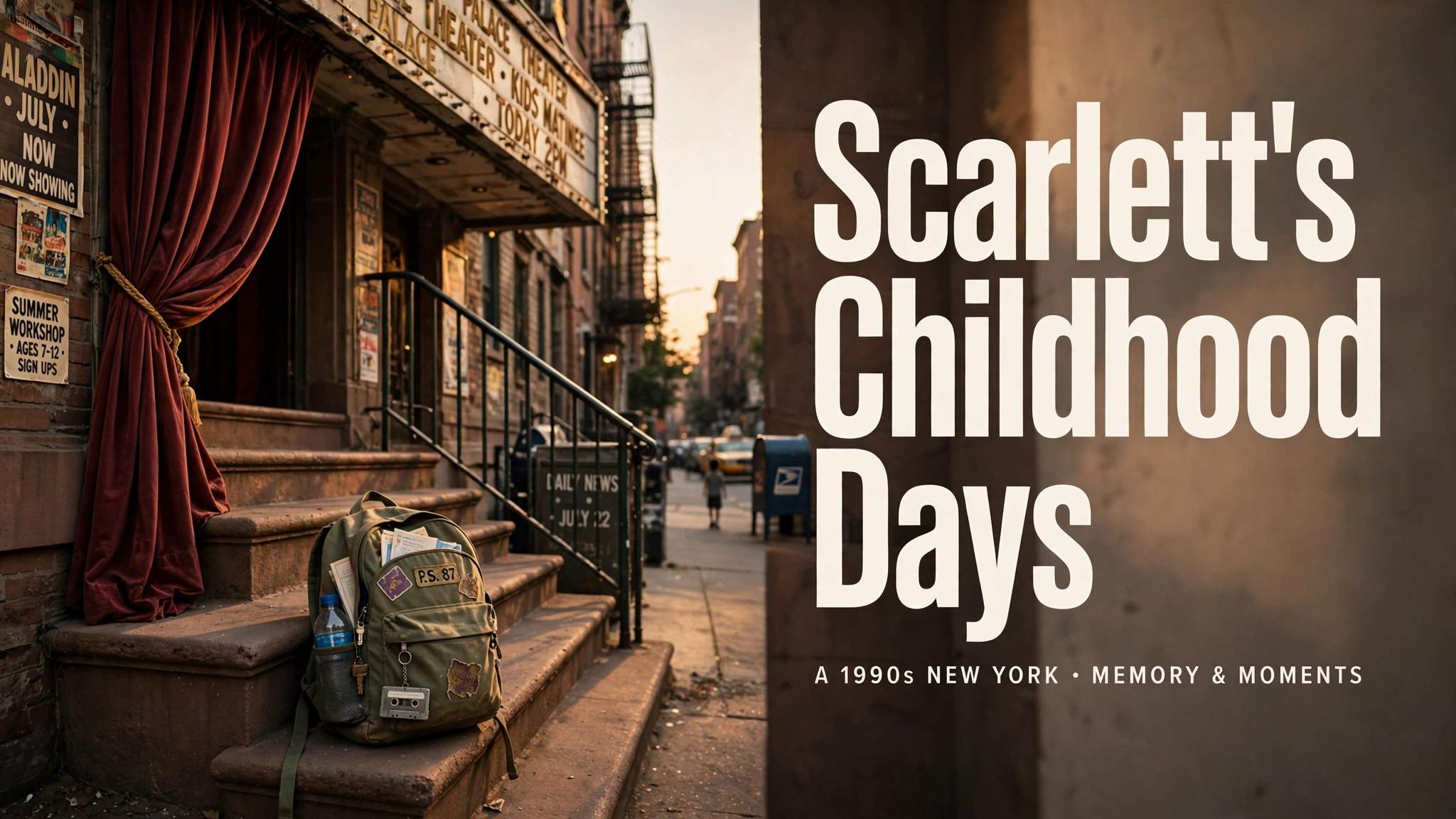
In this post
- Born In Manhattan, Raised In Greenwich Village
- A Family Of Two Worlds: Denmark And New York
- PS 41: An Ordinary Public School In An Extraordinary Neighbourhood
- Lee Strasberg And The Seriousness Of A Child Actor
- The Professional Children’s School: School And Work On The Same Day
- Growing Up With Little Money, But With Films Everywhere
- The NYU Rejection: A Door That Closed Before Adulthood
- What 1990s New York Gave Her That Other Places Could Not
- My Take: A Village Schoolgirl Learned To Be Watched, And To Watch Back
Scarlett Johansson did not grow up in Hollywood. She grew up in Manhattan, in Greenwich Village, in a New York childhood that was creative, crowded, close to theatres, and short on money. She was born in New York City, she went to a public elementary school a few streets from home, she trained at a famous acting institute as a child, and she finished at a school made for young performers. By the time most teenagers were choosing a college, she had already been acting for years, and she had already learned that school and work would have to share the same day.
This post is about that childhood, not about a list of her films. It follows her family, her neighbourhood, and her schools, in 1990s New York, before adult fame. If you searched for her childhood, her education, or her origin, you will find those answers here, with the family details kept clear and the school names kept exact. Where a detail is disputed or comes from a single memory, this post says so, rather than presenting every story as settled fact.
Born In Manhattan, Raised In Greenwich Village
Scarlett Ingrid Johansson was born on November 22, 1984, in New York City. Her birthplace is Manhattan, and her childhood neighbourhood was Greenwich Village, a part of Manhattan known for artists, writers, theatres, small streets, and a long history of creative life. Growing up in the Village in the late 1980s and 1990s meant growing up where art was not distant or special. It was on the street, in small theatres, in shops, in parks, and in the people around you.
That neighbourhood matters more than a simple birthplace line. A child in Greenwich Village does not need to travel far to see a play, hear music, or meet someone who works in film or theatre. The city itself becomes a classroom. Streets teach you to walk fast, to watch people, to listen to different accents, and to feel comfortable in crowds. Small theatres teach you that performance can happen in a tiny room, not only on a big screen. For a child who would become an actor, that everyday closeness to art was an education before any formal lesson began.
Her family home was described as a household with little money, but rich in culture. That combination is important. Little money does not mean little imagination. In Johansson’s home, films were watched, discussed, and loved. Her mother was a film buff, and the children were taken to film sets and to church on Sundays, rather than to the zoo, according to a memory Johansson later shared. That sentence, whether you take it literally or as a joke about her childhood, tells you what kind of home it was: a home where stories, films, and performance were normal conversation, not a rare treat.
Greenwich Village in the 1990s was also a real neighbourhood, not a film set. It had schools, families, shops, and ordinary problems. A child there still had homework, still had to get to school on time, and still had to deal with siblings, parents, and neighbours. Fame did not protect her from those ordinary things, and in fact, her early acting work added more pressure to them. She had to be a student and a performer at the same time, in the same city, often on the same day.
A Family Of Two Worlds: Denmark And New York
Scarlett Johansson’s family brought two worlds into one Manhattan home. Her father, Karsten Johansson, was a Danish-born architect, the son of Ejner Johansson, a well-known writer in Denmark. Her mother, Melanie Sloan, was an American producer and business manager, from an Ashkenazi Jewish family from the Bronx. Her parents met in Denmark, where her mother lived with Johansson’s maternal grandmother, Dorothy, a former bookkeeper and schoolteacher. That meeting, across countries and cultures, became the start of a family that was Danish, Jewish-American, and New York all at once.
She was not an only child, and she was not even the first child in the family. She arrived into a family that already included an older brother and sister, and a stepbrother, and she arrived with a twin. Her twin brother is Hunter Johansson, who also pursued acting. Her older sister is Vanessa Johansson, who is also an actress. Her older brother is Adrian Johansson. Her half-brother, from her father’s remarriage, is Christian Johansson. That is a large, blended family, with children of different ages, different mothers in the wider family story, and different interests, all sharing one home.
A large family teaches a child many lessons quickly. You learn to share space, to wait your turn, to argue and make up, and to find your own voice in a noisy house. You also learn that attention is not automatic. In a house with five children in the wider family, a child must speak up to be heard, or find a way to stand out without shouting. For Johansson, performance became one way to be heard. It was not the only way, but it was a way that her family understood, because her mother worked in production and her older sister also acted.
Her Danish heritage and her Jewish-American heritage also gave her a double identity from birth. She holds Danish citizenship, through her father, as well as her American birth. That dual background is often mentioned in profiles, but it is rarely explained as a childhood experience. For a child, it means hearing different stories, different languages or accents at home, different foods, different holidays, and different ideas about what a family should be. It means belonging to more than one story, and learning early that identity is not simple. You can be Danish and American, Jewish and Christian-influenced, Village-raised and world-travelling, all at once, without having to choose one label.
Her parents separated when Johansson was around thirteen, and her mother, Melanie, would become her manager. That separation is a turning point in her childhood story, because it changed both her home life and her work life. At thirteen, a child is already dealing with school, friendships, and growing up. Adding a parents’ separation, plus a mother becoming a manager, means home and work become even more mixed. Her mother was no longer only a parent. She was also the person who took her to auditions, negotiated for her, and protected her career. That closeness helped her career, but it also meant that family arguments and work arguments could become the same argument.
PS 41: An Ordinary Public School In An Extraordinary Neighbourhood
Johansson attended PS 41 in Greenwich Village for elementary school. PS 41, full name PS 41 Greenwich Village School, is a public elementary school in Manhattan, a few blocks from the kind of cultural density that only New York City can offer. That school is the most ordinary part of her education, and that ordinariness matters. Before she was a child actor with a special school, she was a child in a local public school, with local classmates, local teachers, and a normal school day.
At PS 41, her talent for performance was first recognised in a school setting. Teachers and classmates could see that she was not just a quiet child. She wanted to perform, she rehearsed in front of a mirror until she cried, according to one vivid account of her childhood, and she took performance seriously even when other children treated it as play. That mirror story, of a seven-year-old staring at herself and sobbing while rehearsing, is often told as a charming anecdote, but it also shows discipline. A child who rehearses alone, with no audience, is not performing for applause. She is practising, and practice is work.
PS 41 also gave her a neighbourhood peer group. Her classmates were Village children, from different backgrounds, with different families, and different futures. They were not all actors. They were ordinary New York children, and that normality is valuable. A child actor who only meets other child actors can lose touch with ordinary life. A child who goes to a public elementary school, walks home through Village streets, and does homework like everyone else, keeps a link to ordinary life, even when her afternoons become unusual.
It is also important to note what PS 41 did not do. It did not make her famous, and it did not train her as a professional actor. It gave her a start, a place to be seen, and a reason for her parents to take her talent seriously. After PS 41, her education became more specialised, but the public school years remain the foundation. They are the years when she was simply a Greenwich Village schoolgirl, before the labels of child star, performer, or celebrity were added.
Lee Strasberg And The Seriousness Of A Child Actor
After PS 41, Johansson’s training became serious. She enrolled at the Lee Strasberg Theatre and Film Institute in New York, one of the most respected acting schools in the world. The Strasberg approach is based on emotional truth and genuine personal experience for performance, a rigorous philosophy that asks actors to draw on real feelings, not just to pretend. Whether a child fully understands that philosophy is a fair question, but Johansson was in those rooms, learning it, while still a child.
Her path to Strasberg began with a family audition story that is often told. She tried out for a talent agency when she was seven years old, but one of her brothers was chosen instead. Most children would have ignored that disappointment or sulked for a week. Johansson, according to accounts of her childhood, treated it as a challenge. She enrolled at Strasberg, she worked on her craft, and she kept going. That response, turning a no into work, rather than into quitting, is a pattern that appears again and again in her early life.
At Strasberg, she also learned the difference between wanting attention and doing the work of acting. Acting training is not only about being seen. It is about listening, about remembering, about controlling your voice and body, and about understanding a character’s feelings. For a seven- or eight-year-old, those lessons are hard, but they are also exciting. A child who loves stories can learn to tell them with her whole body, not just with words. That is what Strasberg offered, and Johansson took it seriously.
She also tried the commercial circuit, like many young performers in New York, working with her mother while trying out for commercials. She resigned from that path almost right away, later saying she did not want to promote Wonder Bread, with a directness that suggests she already knew what kind of performer she did not want to be. That detail is small, but it is revealing. Even as a child, she was not willing to do any job for fame. She wanted work that felt real to her, even if it paid less or came slower. That instinct, to turn down the easy route when it felt cheap, would shape her later choices as well.
The Professional Children’s School: School And Work On The Same Day
Johansson later attended the Professional Children’s School in Manhattan, a private school created especially for young performers balancing academic requirements with career goals. She graduated from the Professional Children’s School in 2002. This school is the key to understanding her teenage education, because it was designed for children like her: children who had to leave school for auditions, rehearsals, and film sets, and who still had to pass their classes.
A normal school cannot easily handle a student who disappears for a film shoot. A professional children’s school can, because its schedule is flexible, its teachers understand the demands of performance, and its students share the same strange life. At Professional Children’s School, Johansson was not the only child who had to catch up after a shoot, or who had to study lines and homework on the same evening. She was among peers who understood that life, and that understanding matters for a teenager who might otherwise feel isolated.
The school also gave her a second education, alongside the formal one. The first education was subjects, exams, and graduation in 2002. The second education was on stages and sets, watching directors, learning from older actors, and understanding how a film is made. She made her stage debut at age eight, in an off-Broadway play called Sophistry, which featured a young Ethan Hawke, and she had only two lines. Two lines may sound tiny, but for an eight-year-old, standing on an off-Broadway stage, with a real audience, is a huge step. It teaches you to wait in the wings, to enter on cue, to speak clearly, and to leave the stage without breaking the play.
A year later, in 1994, she made her film debut in North, at age nine. That debut is mentioned in this post only as a time marker, not as a film review, because this post is about childhood and school, not a film list. The important point for her education is timing. By nine, she was already balancing school and film work. By her early teens, she was balancing school, family separation, and a growing career. By graduation in 2002, she had spent almost half her life in that balance. The Professional Children’s School did not create that balance, but it made it possible to survive it without dropping out.
Her mother as manager also fits here. A mother who takes her daughter to auditions, who understands the school’s flexible schedule, and who can talk to teachers about missed days, is a practical help, not just an emotional one. That help allowed Johansson to keep studying while working, rather than choosing one and losing the other. It also meant that her education was a family project, not only a school project.
Growing Up With Little Money, But With Films Everywhere
Johansson grew up in a household with little money, with a mother who was a film buff. That sentence, from published biographical sources, deserves unpacking, because it explains a lot about her childhood that money alone cannot explain. Little money in Manhattan is hard. Rent is high, space is small, and a large family must share rooms, clothes, and time. A child in that situation learns to be resourceful, to make do, and to find joy in things that do not cost much. For Johansson, one of those free or cheap joys was film.
Her mother took her to auditions from a young age, and the family visited film sets rather than going to the zoo, as Johansson later joked. That joke contains a truth: her childhood playgrounds were not only parks and streets. They were also sets, theatres, and rehearsal rooms. A child who grows up visiting sets learns how films are made, not just how they look. She sees cameras, lights, costumes, and waiting. She learns that acting is mostly waiting, rehearsing, and trying again, not only glamour. That early realism may have protected her from believing fame alone is the job.
Little money also meant that choices mattered. A family with little money cannot buy every opportunity. It must choose which lessons, which auditions, which trips are worth the cost. Johansson’s parents chose acting training, theatre, and a specialised school, even when money was tight. Those choices show what the family valued. They valued creativity and expression, even when they could not afford comfort. That value, that art matters even when money is short, is a powerful childhood lesson, and it likely stayed with her when she later had to choose between safe, well-paid roles and riskier, more interesting ones.
Her siblings also shared that life. Vanessa acted, Hunter acted, and the other siblings lived in the same creative, crowded home. A child with siblings who also perform does not feel alone in her ambition. She also does not feel uniquely special, because her brother or sister may be chosen for an agency when she is not, as happened when she was seven. That sibling reality keeps a child grounded. Fame may later single her out, but childhood did not. Childhood gave her brothers and sisters who shared the same home, the same money worries, and the same creative house.
The NYU Rejection: A Door That Closed Before Adulthood
After graduating from the Professional Children’s School in 2002, Johansson applied to the Tisch School of the Arts at New York University for the fall 2003 semester. Her application was rejected. She never attended the film school. That rejection is often mentioned as an irony, because she later became one of the most successful actors of her generation without that degree. But for a childhood and education post, the rejection is more than irony. It is the end of her formal school story, and it deserves a careful reading.
First, the rejection shows that school success and career success are not the same. A university can reject a talented applicant for many reasons: grades, portfolio, timing, or simply competition. Rejection does not mean lack of talent. It means that one institution, at one moment, said no. Johansson’s response was to devote all her attention to film, rather than to reapply endlessly or to treat the rejection as a verdict on her worth. That response is a mature one for an eighteen-year-old, and it likely came from years of hearing no in auditions and learning to keep working.
Second, the rejection closes a loop that began at PS 41. She started in a public elementary school, moved to a famous acting institute, finished at a school for young performers, and then was told no by a famous university. That is a full education arc, with a beginning, a middle, and a disappointing end that became a new beginning. Many young people face a similar rejection, from a college, a job, or an audition, and feel that their story has ended. Johansson’s story shows that a rejection can be a redirection, not an ending, if the person has other skills, other support, and other work to do.
Third, the NYU story should not be used to mock universities or to claim that education does not matter. Johansson did receive an education, just not a university film degree. She received it at PS 41, at Strasberg, at Professional Children’s School, on stages, and on sets, from directors and actors she worked with. That education was real, even if it did not come with a university diploma. The lesson is not to skip school. The lesson is that education can take many forms, and that a single rejection does not erase years of learning.
What 1990s New York Gave Her That Other Places Could Not
Johansson’s 1990s New York childhood gave her things that a childhood in a quieter place could not. It gave her density: many people, many stories, many languages, many theatres, all within walking distance. It gave her speed: a city that moves fast, where a child learns to keep up, to be on time, and to handle crowds. It gave her diversity: Danish, Jewish-American, Village, Bronx, Manhattan, and many other influences in one home and one neighbourhood. And it gave her a professional world that was close enough to touch, through her mother, her sister, and her schools.
It also gave her challenges that a quieter childhood might not have. It gave her a large, blended family with a separation at thirteen. It gave her little money in an expensive city. It gave her a school life split between normal classes and film work. It gave her rejection at seven, when her brother was chosen for an agency, and rejection at eighteen, when NYU said no. Those challenges did not make her childhood easy, but they made it real, and they gave her material for a lifetime of acting: loss, waiting, sibling rivalry, family love, and the feeling of being both inside and outside a group.
Other posts about Johansson often focus on her adult films, her awards, or her later life. Those posts miss the Village girl who rehearsed in front of a mirror, who went to PS 41, who learned at Strasberg, and who graduated from Professional Children’s School in 2002. That girl is the origin of the adult actor. She learned to perform before she learned to drive, she learned to balance school and work before she learned to vote, and she learned to handle rejection before she learned to accept an award. That early learning is the real story of her childhood.
If you visit Greenwich Village today, you will not see her childhood preserved as a museum. You will see streets, schools, theatres, and homes that have changed, as all cities change. But the pattern remains: a child can grow up in a busy, creative, crowded neighbourhood, with little money and a large family, and still find a path through school, training, and work. Johansson’s path was specific to her, but the pattern, of a neighbourhood shaping a child, is universal. That is why her New York childhood still matters, even for readers who have never been to New York.
My Take: A Village Schoolgirl Learned To Be Watched, And To Watch Back
When I think about Scarlett Johansson’s childhood, I do not start with fame. I start with a small girl in Greenwich Village, rehearsing in front of a mirror until she cries. That image stays with me because it is not glamorous. It is lonely, serious, and a little strange. A seven-year-old who rehearses alone is not showing off. She is working. She is trying to get something right, even when no one is watching. That, I believe, is the core of her childhood, and the core of her later work. She learned to work when no one was watching, so that when everyone was watching, she would be ready.
I think her public school years deserve more praise than they get. PS 41 is often mentioned in one line, as if it were just a name to tick off. It was not just a name. It was where she was a normal child, with normal classmates, in a normal classroom, before special schools and film sets took over. That normality is a gift. Many child actors lose normality early, and they spend adulthood trying to recover it. Johansson kept a link to normality through PS 41, through Village streets, and through siblings who were not all famous. That link may have helped her stay grounded, even when her work became extraordinary. It gave her a memory of being ordinary, and ordinary memories are useful for an actor who must play ordinary people.
Her family story also moves me, because it is not a simple happy family story, nor a simple tragic one. It is a blended, bicultural, creative family with little money, with a Danish architect father, a New York producer mother, a twin brother, older siblings, and a half-brother. That family is messy, in the best sense. Messy families teach children to negotiate, to share, to listen to different viewpoints, and to accept that love does not always look tidy. A child from a tidy, quiet home might learn to act by imagining other lives. A child from a messy, loud, creative home learns to act by living among other lives every day. Johansson lived among other lives from birth, and that daily practice is an education no school can fully replace.
I also believe her parents’ separation at thirteen should not be treated as a footnote. Thirteen is a fragile age. It is when a child is leaving childhood, entering teenage life, and trying to understand who she is. To have your parents separate at that age, and to have your mother become your manager at the same time, is a double change. Home changes, and work changes, and the person who comforts you at home is also the person who negotiates for you at work. That can be supportive, and it can also be confusing. I admire that Johansson navigated it without publicly turning it into a scandal. She kept working, she kept studying, and she graduated in 2002. That quiet persistence, without drama for its own sake, tells me more about her character than any award does.
The Strasberg training is another part I think people misunderstand. They hear a famous name and assume it means instant skill. It does not. Strasberg’s method asks for emotional truth, for drawing on real experience, for being present rather than pretending. For a child, that is a heavy ask. It means you cannot just smile and say lines. You must feel something, remember something, and let it show. A child who learns that early may become a powerful actor, but she may also become a sensitive person, who feels things deeply and does not hide them easily. That sensitivity is visible in her work, in the stillness, in the quiet moments, in the way she can dominate a scene without speaking loudly. That stillness, I believe, was learned in those small Strasberg rooms, not on a big set.
Her rejection by NYU is the part of her story I would tell to any young person who has just been rejected. It is tempting to say that NYU was wrong, and that Johansson proved them wrong by becoming famous. That is true, but it is also too simple. The deeper truth is that rejection did not stop her education. She had already been educated, at PS 41, at Strasberg, at Professional Children’s School, on stage at eight, on film at nine, and in a family that valued art even when money was short. NYU was one door. It closed. Other doors, which she had already opened through years of work, stayed open. That is the lesson: do not put your whole future behind one application, one audition, or one school. Build many doors, through work, through learning, through relationships, so that one closed door does not end your story.
I also think we should talk honestly about little money in Manhattan. It is easy to romanticise a creative home with little money, as if poverty were charming. It is not charming. It is stressful, it limits choices, and it forces a family to share space and sacrifice comfort. Johansson’s childhood with little money was not a bohemian postcard. It was a real constraint, in an expensive city, with a large family. The fact that her family still chose art, still chose training, still chose a specialised school, shows their values, but it does not erase the stress. I respect that family more for making those choices under pressure, than I would if they had made them with unlimited money. Choice under pressure reveals character, and her family’s choices reveal a belief that creativity matters, even when it is hard.
Her twin brother, Hunter, also deserves a moment in this judgement. Twins share a childhood in a way no one else does. They share a birthday, a home, a school era, and often a comparison. When one twin is chosen for an agency and the other is not, as happened at seven, the comparison becomes public. Johansson’s response, to work harder at Strasberg, rather than to resent her brother, shows a maturity that many adults lack. It also shows that sibling rivalry, handled well, can become motivation rather than bitterness. That is a lesson for any family with more than one talented child: one child’s success does not have to be another child’s failure, if the family treats work, not only winning, as the goal.
Finally, I believe her 1990s New York childhood explains why she can play both strength and vulnerability. A Village girl who grew up with little money, with a large family, with a separation at thirteen, with rejection at seven and eighteen, learns both. She learns to be strong, because she must keep going to school, to rehearsals, to auditions, even when life is hard. She learns to be vulnerable, because she has felt loss, waiting, and being overlooked, and she does not pretend those feelings do not exist. An actor who can hold both strength and vulnerability at once is rare, and Johansson learned that balance not in adulthood, but in childhood, on Village streets, in PS 41 classrooms, in Strasberg rooms, and in a Professional Children’s School where work and study shared the same day. That is her origin, and it is more interesting, and more human, than any film list.
Frequently Asked Questions
Where did Scarlett Johansson grow up? Scarlett Johansson was born in New York City and grew up in Greenwich Village, Manhattan. She attended PS 41 Greenwich Village School for elementary school, trained at the Lee Strasberg Theatre and Film Institute, and later attended the Professional Children’s School in Manhattan, graduating in 2002.
Where was Scarlett Johansson born? She was born Scarlett Ingrid Johansson on November 22, 1984, in New York City, in Manhattan. She holds Danish citizenship through her Danish-born father, as well as her American birth, but her birthplace and childhood home were in New York.
Who are Scarlett Johansson’s parents and siblings? Her father is Karsten Johansson, a Danish-born architect, and her mother is Melanie Sloan, an American producer and business manager from an Ashkenazi Jewish family from the Bronx. She has a twin brother, Hunter, an older sister, Vanessa, an older brother, Adrian, and a half-brother, Christian, from her father’s remarriage. Her parents separated when she was around thirteen, and her mother became her manager.
Where did Scarlett Johansson go to school? She attended PS 41 in Greenwich Village for elementary school, the Lee Strasberg Theatre and Film Institute for acting training, and the Professional Children’s School in Manhattan for her later school years, graduating in 2002. The Professional Children’s School is designed for young performers, with a flexible schedule for auditions and film work.
Did Scarlett Johansson go to NYU? No. After graduating from the Professional Children’s School in 2002, she applied to the Tisch School of the Arts at New York University for the fall 2003 semester, but her application was rejected. She never attended NYU, and instead devoted herself to film work after that rejection.
Was Scarlett Johansson poor as a child? Published biographical sources describe her household as having little money, even though her home was rich in culture and film. Her mother was a film buff, and the children visited film sets and attended church on Sundays. Money was tight in expensive Manhattan, but creativity and performance were valued in the home.
When did Scarlett Johansson start acting as a child? She began auditioning at age seven, when a talent agency chose one of her brothers instead of her, which led her to train at Lee Strasberg. She made her stage debut at age eight in the off-Broadway play Sophistry, with only two lines, and her film debut at age nine in 1994. This post focuses on that childhood start, not on a full list of her later films.
Sources
- Notable Biographies — Scarlett Johansson Biography (fetched 2026-10-31)
- Worldomep — Scarlett Johansson Education (fetched 2026-10-31)