Senta Berger: The Life Story Behind the Austrian Film Star
In this post
Senta Berger is one of the most enduring actresses in German-language film and television, and she has been working for more than sixty years. She was born in Vienna, she began acting as a teenager, she went to Hollywood in the 1960s, she worked with famous directors and actors, and then she returned to Europe, where she became a star of German television. She is known for her beauty, her intelligence, and her ability to play strong women who are both warm and determined. She has played in films, in theatre, and in many television series, and she is still respected today as one of the great actresses of Austria and Germany.
Her story is a story about a long career, about a woman who did not fade away after youth, but who kept working, kept learning, and kept finding new roles as she grew older. She was a young star in the 1960s, a mature actress in the 1970s and 1980s, and a beloved television star in the 1990s and 2000s. She was married to the director Michael Verhoeven for more than fifty years, she raised two sons, and she built a life that balanced work and family. She is a woman who has lived a full life, and who is still a presence in German culture today.
This is the story of a girl from Vienna who became a Hollywood actress, who came home to Europe, and who built a career that lasted longer than most. It is a story about talent, about persistence, about love, and about a woman who never stopped acting, even when the film world changed around her.
A Teenager on the Vienna Stage
Senta Berger was born on 13 May 1941 in Vienna, Austria, during the Second World War. Her father was a musician, and her mother was a teacher, and she grew up in a home where music and learning were valued. Vienna was a city in wartime, and her childhood was shaped by the war and by the years that followed it. She was a young girl who liked to perform, who liked to be on stage, and who had a natural ease in front of people. She was pretty, she was lively, and she was curious about the world, and she soon found her way to the theatre.
When she was still a teenager, she began to act on stage in Vienna. She studied acting, she worked in small theatres, and she learned the craft of acting from the inside. She was a young woman with a strong presence, and directors noticed her. She appeared in her first films in the late 1950s, while she was still a teenager, and she quickly became known as a promising young actress in Austria and Germany. She was not only beautiful. She was talented, she was hard-working, and she was serious about her work, even at a young age.
Her early films were in German, and they were popular in Austria and Germany. She played young women, she played girls in love, and she played characters who were lively and full of life. She learned how a film set worked, she learned to work with directors, and she learned to be patient. She was a star in the making, and she was building a career step by step. She was also learning about the film business, about fame, and about the pressure that comes with being a young actress in public. She was a teenager who was growing up in front of the camera, and she was doing it with courage.
The most important thing about those early years is that Senta did not try to be a star overnight. She worked in theatre, she worked in small films, and she learned her craft. She was a young woman from Vienna who wanted to act, and she was willing to work hard to do it. That hard work gave her a strong base, and it helped her to build a career that would last for more than sixty years. The girl from Vienna was on her way to becoming a star, and she was doing it the right way, with patience and with talent.
Hollywood Years and Major Dundee
In the early 1960s, Senta Berger went to Hollywood, and she became one of the few Austrian actresses to work in American films at that time. She was cast in The Victors in 1963, a film about the Second World War, directed by Carl Foreman, and she played a young woman in a story about soldiers and love. The film was a success, and it showed that she could act in English, in a big Hollywood film, and hold her own with famous actors. She was a young European actress in Hollywood, and she was noticed for her beauty, her talent, and her strong screen presence.
She followed that with Major Dundee in 1965, a Western directed by Sam Peckinpah, in which she starred with Charlton Heston. The film was about a Union officer who leads a group of men into Mexico, and Senta played Teresa Santiago, a woman who is caught in the middle of the story. The film was difficult to make, and it was a hard shoot, but it gave her a chance to work with one of the most famous directors in Hollywood, and to play a strong and complex woman. She was not only a pretty face in the film. She was a woman with depth, with feelings, and with a story of her own, and she played it with skill.
She also starred in The Quiller Memorandum in 1966, a spy film set in Berlin, in which she played with George Segal and Alec Guinness. The film was a success, and it showed that she could play in a thriller, in a story about spies and secrets, and be convincing. She worked in other Hollywood films, including Cast a Giant Shadow in 1966, and she became known in America as a European actress who was both beautiful and talented. She was a star in Hollywood, but she was also a woman who missed Europe, who missed her home, and who wanted to return to the theatre and film world she knew best.
Her Hollywood years were important, because they showed that she could work in America, in English, and in big films. But they were also a time when she learned that Hollywood is not the only place to make good films. She was a European actress, and she wanted to work in Europe, in German, and in stories that felt close to her. After a few years in Hollywood, she returned to Europe, and she began the next chapter of her career, a chapter that would last for many decades and that would make her a beloved star in Germany and Austria.
Return to Europe and a New Kind of Stardom
After Hollywood, Senta Berger returned to Europe and began to work in German, French, and Italian films. She starred in films in the late 1960s and 1970s, and she worked with directors in many countries. She was a mature actress now, no longer a teenager, and she played women who were strong, who were in love, who were facing hard times, and who were trying to live a good life. She was known for her elegance, her intelligence, and her ability to play complex women with honesty. She was a star in Europe, and she was respected by directors, actors, and audiences.
In 1966, she married the German director Michael Verhoeven, and the two of them built a life together that lasted for more than fifty years, until his death in 2024. They had two sons, Simon and Luca, and they worked together on many films. Michael Verhoeven directed films about history, about the Second World War, and about justice, and Senta often starred in his films. Their partnership was both personal and professional, and it was one of the most enduring partnerships in German cinema. They were a couple who loved each other, who worked together, and who supported each other through a long life.
During the 1970s and 1980s, Senta worked in films and in television, and she became a familiar face in German homes. She was no longer only a film star. She was a television star, and she appeared in series and in television films that were watched by millions of people. She played mothers, wives, doctors, and women in many different jobs, and she played them with warmth and with strength. She was a woman who could play a real person, not only a glamorous star, and audiences loved her for it. She was a star who had grown up, and who had grown into a mature and respected actress.
Her return to Europe was a wise choice, because it gave her a long career. In Hollywood, many actresses fade away after youth, but in Europe, Senta found roles that suited her as she grew older. She was a woman who kept working, kept learning, and kept finding new ways to act. She was not afraid to grow older on screen, and she was not afraid to play women who were real, with problems, with families, and with lives that felt true. That is a rare gift, and it is why her career lasted so long.
Unter Verdacht and German Television Fame
In the 1990s and 2000s, Senta Berger became one of the most loved television actresses in Germany. She starred in the series Unter Verdacht, which means Under Suspicion, in which she played Dr. Eva Maria Prohacek, a police detective who investigates crimes in Munich. The series ran for many years, from 2002 to 2019, and it was watched by millions of people in Germany and Austria. Senta played the detective with intelligence, with warmth, and with a strong sense of justice, and audiences loved her. She was no longer a young film star. She was a mature woman, a detective, a professional, and a person who solved crimes with her mind.
The success of Unter Verdacht showed that Senta could carry a television series, that she could play a complex character over many years, and that audiences trusted her. She was a star who had been famous in the 1960s, and now she was famous again, in a new way, as a television detective. It was a remarkable second career, and it showed her talent, her persistence, and her ability to adapt to a changing world. She was a woman who had worked in film, in theatre, and in television, and who had succeeded in all three.
She also appeared in other television series and films, including Die schnelle Gerdi, a series in which she played a taxi driver, and many other roles. She was a versatile actress, and she was willing to try new things, even in her sixties and seventies. She was not afraid to play ordinary women, women with jobs, women with families, and women with problems, and she played them with the same skill that she had brought to her Hollywood films. She was a star who had grown up with her audience, and her audience had grown up with her.
Her television fame also made her a public figure in Germany, a woman who was respected, loved, and listened to. She spoke about social issues, about the role of women, about ageing, and about the importance of culture, and people listened because she had earned their respect through a lifetime of work. She was not only an actress. She was a voice, a presence, and a part of German cultural life. Her long career in television is one of the most impressive parts of her story, because it shows that a good actress can keep working, keep growing, and keep being loved, even after many decades.
A Long Marriage, Family, and Later Life
Senta Berger’s marriage to Michael Verhoeven was one of the longest and most admired in German cinema. They were married in 1966, they had two sons, and they worked together for more than fifty years. Michael Verhoeven was a director who made films about history, about the Nazi past, and about justice, and Senta often starred in his films. They were a couple who shared a love of film, a love of history, and a love of family. They lived in Munich, they raised their sons, and they built a life that was both personal and professional. Their marriage lasted until Michael’s death in 2024, and it remains a model of a long and loving partnership in the film world.
She is a mother and a grandmother, and she has spoken about the importance of family, about the joy of having children, and about the challenge of balancing work and family. She was a working mother in a time when it was not easy for women to do both, and she did it with grace and with strength. She raised her sons, she worked, and she kept her family close, even when work took her away. She is a woman who has lived a full life, with love, with work, and with family, and that fullness is part of her story.
In her later years, Senta has continued to act, to appear in films and television, and to be a presence in German culture. She has written books, including her memoir, in which she tells the story of her life, her career, and her family. She has spoken about ageing, about being a woman in film, and about the changes she has seen in the industry. She is a woman who has seen the film world change a great deal, from the 1950s to today, and she has adapted to those changes with intelligence and with courage. She is still working, still thinking, and still acting, and she is still respected by young actors who look up to her.
Today, Senta Berger lives in Munich, she is in her eighties, and she is still a beloved figure in Austria and Germany. She is a star who has lasted, a woman who has worked for more than sixty years, and a person who has balanced fame, family, and work with dignity. Her life is a reminder that a career can be long, that a woman can keep working as she grows older, and that talent, hard work, and love can carry a person through a lifetime.
A Legacy of Persistence and Grace
Senta Berger’s legacy is a legacy of persistence, grace, and a long career that few actresses can match. She began as a teenager in Vienna, she went to Hollywood, she returned to Europe, and she became a television star in Germany, and she did it all with talent, with hard work, and with dignity. She has worked for more than sixty years, and she is still working. That is a remarkable achievement, and it is a legacy that young actresses can learn from. She showed that a career does not have to end at thirty, that a woman can keep acting as she grows older, and that a good actress will always find work if she is willing to adapt.
Her legacy is also in the roles she played. She played young women in love, she played women in Hollywood films, she played a detective in Unter Verdacht, she played mothers and wives, and she played them all with warmth and with honesty. She was a versatile actress, and her work is a record of a life in film and television. Her films from the 1960s are still watched, her television series is still remembered, and her memoir tells her story in her own words. She is a part of German and Austrian cultural history, and her work will be remembered for many years.
She is also remembered as a wife, a mother, and a woman who balanced work and family with grace. Her long marriage to Michael Verhoeven, her two sons, and her family life are part of her legacy, and they show that a star can also be a person who loves, who cares, and who builds a home. She is a woman who has lived a full life, and her legacy is a life well lived, a career well spent, and a talent that has lasted for more than sixty years.
A Voice for Women and for Ageing
Senta Berger has become, in her later years, a voice for women, for older people, and for the importance of culture. She has spoken openly about the difficulties that older actresses face, about the lack of good roles for women as they grow older, and about the need for better stories for women of all ages. She has used her fame to speak for others, and she has done it with dignity and with humour. She is not only an actress. She is a public figure who is respected for her honesty, her intelligence, and her willingness to speak about hard things. That voice is a part of her legacy, and it is a voice that matters.
She has also written a memoir, in which she tells the story of her life, her career, her marriage, and her family, with openness and with warmth. The book is a gift to readers, because it shows that a star is also a human being, with joys, with pains, and with a life that is real. She writes about her childhood in Vienna, about Hollywood, about her husband Michael Verhoeven, about her sons, and about ageing, and she does it with an honesty that is refreshing. She does not pretend to be perfect. She tells the truth, and that truth is moving. Her memoir is a part of her legacy, and it will be read for many years.
Her work as a spokesperson for culture, for film, and for the arts has also made her a respected figure in Germany. She has spoken at events, she has supported young actors, and she has argued for the importance of theatre, film, and television in society. She believes that culture matters, that stories matter, and that a society without culture is poorer. That belief is a part of who she is, and it is a belief that she has shared with audiences for many years. She is a star who cares about more than herself, and that care is a gift.
My Take:
When I think about Senta Berger, I think about a long career, and I think about a woman who did not give up. She began as a teenager in Vienna, she went to Hollywood, she came back to Europe, and she kept working for more than sixty years. That is a very long time to work in film and television, and it takes a special kind of strength to keep going, to keep learning, and to keep finding new roles as you grow older. Many actresses fade away after youth, because the film world does not give them roles when they are older. Senta did not fade away. She found new roles, she found television, she found a detective to play, and she became famous again in a new way. I admire that persistence, and I think it is a lesson for anyone who wants a long career: keep learning, keep adapting, and do not be afraid to change.
I think about her Hollywood years, and I am struck by how brave she was to go to America as a young European actress. She worked in The Victors, in Major Dundee, in The Quiller Memorandum, and she held her own with famous actors like Charlton Heston and Alec Guinness. That takes courage, because Hollywood is a hard place, and it is easy to be lost there. She did not get lost. She worked, she learned, and she came back to Europe with experience that made her a better actress. I respect that, because it shows that she was not afraid to try, to travel, and to take a risk. She was a young woman from Vienna who went to Hollywood and came back stronger, and that is a story worth admiring.
What moves me most is her television work, especially Unter Verdacht. To play a detective for many years, from 2002 to 2019, to play a woman who is intelligent, who is strong, and who solves crimes with her mind, is a wonderful role for a mature actress. It shows that a woman in her sixties and seventies can be a hero, can be a professional, and can be the centre of a story. That is important, because television often shows older women as mothers or grandmothers, not as detectives or professionals. Senta played a detective, and she played her with dignity and with skill, and audiences loved her for it. I think that is a great achievement, and it is a lesson about ageing: growing older does not mean becoming less important. It can mean becoming more interesting, more wise, and more powerful.
I also think about her marriage to Michael Verhoeven, and I feel a deep respect for their long partnership. They were married for more than fifty years, they had two sons, they worked together, and they supported each other through a long life. That is a rare thing in the film world, where marriages often do not last. Their marriage lasted because they shared a love of film, a love of history, and a love of family, and because they worked at it. I think that is a beautiful part of her story, and it shows that a star can also be a wife, a mother, and a person who builds a home. She did not let fame destroy her family. She built a family and a career together, and that is a lesson I want to remember: work and love can go together, if you are willing to work at both.
There is something else I keep thinking about, and it is the way Senta has spoken about ageing and about being a woman in film. She has been honest about the changes she has seen, about the difficulties for older actresses, and about the need for better roles for women of all ages. She has used her voice to speak for other women, and that is a brave and kind thing to do. She is not only an actress. She is a voice for women, for older people, and for the importance of culture. I respect her for that, and I think her honesty is a gift. She could have stayed quiet, but she spoke, and she spoke with wisdom.
If I compare Senta with other actresses of her time, I think what makes her special is her longevity. Many stars are bright for a short time, and then they fade. Senta has been bright for more than sixty years, in film, in theatre, and in television, and she is still working. That longevity is not an accident. It comes from talent, from hard work, from adaptability, and from a love of acting that has never faded. She loves to act, and that love shows in her work. I think that is a lesson for young people: if you love what you do, and you keep working at it, you can have a long and happy career, even if the world changes around you.
For a young reader, I think the lesson is to keep going, to keep learning, and to not be afraid of change. Senta changed from film to television, from young roles to mature roles, from Hollywood to Munich, and she did it with grace. She did not cling to one image or one kind of role. She grew, she changed, and she found new ways to work. That is a wise way to live, because the world changes, and we must change with it. If you are willing to learn, to adapt, and to keep working, you can have a long life, a good career, and a story worth telling. Senta’s story is proof of that.
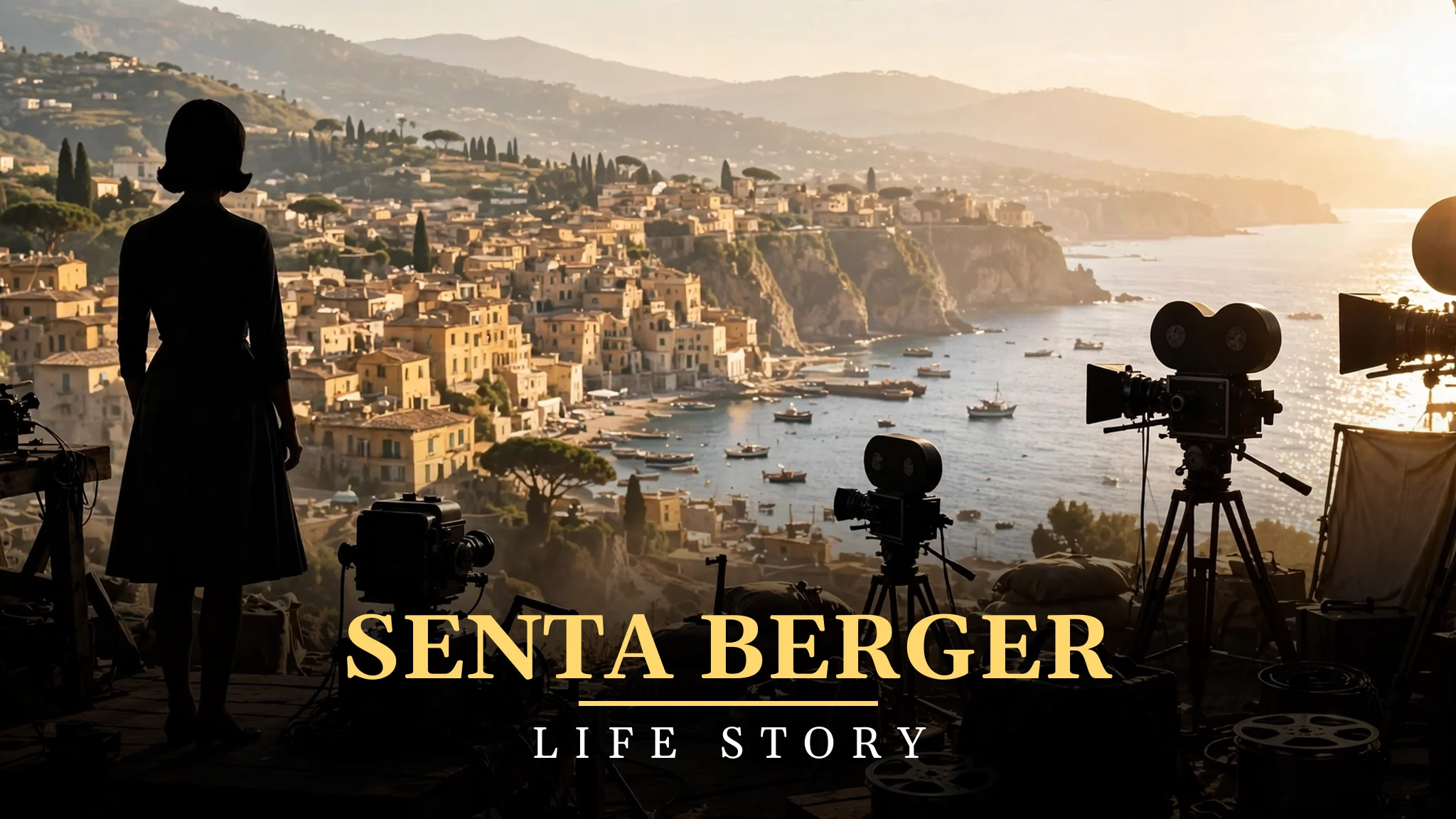
I keep thinking about the image of Senta on a film set above a coastal town, looking out at the sea, and I think it fits her. She is a woman who has looked out at the world, who has travelled, who has worked in many places, and who has always kept her eyes open. She is a woman who has seen a great deal, who has learned a great deal, and who is still looking forward. I wish her well, I wish her more work, and I wish her a life where she can continue to act, to write, and to share her wisdom. She is a star who has lasted, and she deserves to be celebrated for that.
In the end, I think Senta Berger teaches us that a career can be long, that a woman can keep working as she grows older, and that persistence, grace, and love can carry a person through a lifetime. She was a girl from Vienna who became a Hollywood actress, who came home to Europe, who became a television star, and who built a family and a life that lasted. She did not have a short or simple career. She had a long, rich, and varied career, and she is still living it. That is a legacy I respect, and a life I want to honour.
One more thought stays with me, and it is about her memoir and her honesty. She wrote about her life, her career, her family, and her feelings, and she did it with openness. That honesty is a gift to readers, because it shows that a star is also a human being, with joys, with pains, and with a life that is real. I think we should listen to such voices, because they teach us about life, about work, and about love. Senta’s voice is one worth listening to, and I am glad she is still here to share it.
I think about Senta’s long marriage, and I feel a deep respect for a partnership that lasted more than fifty years. She married Michael Verhoeven in 1966, they had two sons, they worked together, and they supported each other until his death in 2024. That is a rare thing in the film world, where marriages often do not last, and it is a testament to their love, their shared values, and their willingness to work at a relationship. I think that is a beautiful part of her story, and it shows that a star can also be a wife, a mother, and a person who builds a home. She did not let fame destroy her family. She built a family and a career together, and that is a lesson worth remembering.
I also think about her decision to return to Europe after Hollywood, and I admire it. She was a young actress in Hollywood, she was famous, she was working with great directors, and she could have stayed. But she came back to Europe, to German film and television, and she built a long career there. That choice gave her a career that lasted more than sixty years, while many Hollywood actresses fade away after youth. She found roles that suited her as she grew older, she found television, she found a detective to play, and she became famous again in a new way. That is a wise choice, and it shows that she knew herself, knew what she wanted, and was not afraid to leave Hollywood to find it.
There is a persistence in her story that I love, a persistence that kept her working for more than sixty years. She began as a teenager in Vienna, she went to Hollywood, she came back, she worked in film, in theatre, and in television, and she is still working in her eighties. That longevity is not an accident. It comes from talent, from hard work, from adaptability, and from a love of acting that has never faded. She loves to act, and that love shows in her work. I think that is a lesson for young people: if you love what you do, and you keep working at it, you can have a long and happy career, even if the world changes around you.
I think about Unter Verdacht, and about how wonderful it is to see a mature woman as a detective, as a professional, and as the centre of a story. Television often shows older women as mothers or grandmothers, not as detectives, but Senta played a detective, and she played her with intelligence and dignity. That is important, because it shows that growing older does not mean becoming less important. It can mean becoming more interesting, more wise, and more powerful. I am glad that Senta played that role, and that audiences loved her for it. It is a role that changed how people see older women on television.
Another thought stays with me, and it is about her memoir and her honesty. She wrote about her life, her career, her family, and her feelings, and she did it with openness. That honesty is a gift, because it shows that a star is also a human being, with joys and pains. I think we should listen to such voices, because they teach us about life, about work, and about love. Senta’s voice is one worth listening to, and I am glad she is still here to share it.
I keep thinking about the image of Senta on a film set above a coastal town, looking out at the sea, and I think it fits her. She is a woman who has looked out at the world, who has travelled, who has worked in many places, and who has always kept her eyes open. She is a woman who has seen a great deal, who has learned a great deal, and who is still looking forward. I wish her well, and I hope she continues to act, to write, and to share her wisdom for many more years.
I think about her work in Die schnelle Gerdi, about playing a taxi driver, and I smile at how ordinary that role is. She was a star who had played in Hollywood, and she was willing to play a woman driving a taxi through Munich, talking to passengers, and living a normal working life. That willingness to play ordinary people is a gift, because it shows that she does not think any role is beneath her. She respects working people, she respects their lives, and she brings that respect into her acting. That is a lesson for young actors: no role is too small if it is played with honesty, and a taxi driver can be as interesting as a queen.
I also think about the way she has aged on screen with grace. She did not try to stay young for ever, she did not hide her age, and she did not pretend to be someone she was not. She grew older, she played older women, and she made those women interesting, strong, and full of life. That is a brave way to age in public, especially for a woman in film, where youth is often prized above all else. She showed that a woman in her sixties and seventies can be a detective, a professional, and a hero, and that is a message that matters for all women. I am glad she did it, and I hope more actresses follow her example.
Frequently Asked Questions
When was Senta Berger born?
Senta Berger was born on 13 May 1941 in Vienna, Austria, during the Second World War, and she began acting on stage in Vienna while she was still a teenager.
What Hollywood films did Senta Berger star in?
She starred in The Victors in 1963, Major Dundee in 1965 with Charlton Heston, The Quiller Memorandum in 1966, and Cast a Giant Shadow in 1966, among other American films.
What is Unter Verdacht and who did Senta Berger play in it?
Unter Verdacht, meaning Under Suspicion, is a German television series that ran from 2002 to 2019, in which Senta Berger played Dr. Eva Maria Prohacek, a Munich police detective who investigates crimes.
Who was Senta Berger married to?
She was married to the German director Michael Verhoeven from 1966 until his death in 2024, a marriage of more than fifty years. They had two sons, Simon and Luca, and worked together on many films.
Did Senta Berger work in theatre as well as film?
Yes, she began her career on stage in Vienna as a teenager, and she has worked in theatre throughout her life, alongside her work in film and television in Austria, Germany, and Hollywood.
What other television work is Senta Berger known for?
She is also known for the series Die schnelle Gerdi, in which she played a taxi driver, and for many television films and series in Germany and Austria over several decades.
Is Senta Berger still acting today?
Yes, she continues to act in film and television, she has written a memoir about her life, and she lives in Munich, where she remains a respected figure in German and Austrian culture.


