Severina Vučković: The Life Story Behind Croatia's Pop Queen
In this post
- A Girl From Split With a Big Voice
- Children’s Festivals, First Songs, and a Young Star
- War, Dalmatinka, and Becoming a National Star
- Eurovision, New Sounds, and a Star Across the Balkans
- Musicals, Television, and Life in the Spotlight
- Still Singing, Still Loved, and a Lasting Legacy
- Arena Shows, New Generations, and the Queen Today
- My Take:
Severina Vučković is the biggest pop star Croatia has ever produced, a singer who has filled stadiums, sold millions of records, and stayed at the top for more than thirty years, in a business where most stars fade after a few summers. She is known simply as Severina, one name, like a queen, and in Croatia and across the Balkans, that one name is enough. Everyone knows who she is, everyone knows her songs, and everyone has an opinion about her.
She was born in Split, a sunny city on the Adriatic coast, and she grew up singing, dancing, and performing, a girl with a big voice and a bigger personality who wanted to be on stage from the time she was small. She won a children’s singing contest, she sang at festivals, and she worked her way up, one song at a time, until she became the most famous singer in her country. It was not luck. It was hard work, and it was a voice that people loved to hear.
What makes her story worth telling is how long she has lasted, and how she has changed with the times without losing herself. She started as a young pop singer in the 1980s, she became a star in the 1990s, she represented Croatia at Eurovision, she acted in musicals, she survived scandals and hard times, and she is still filling arenas today, in her fifties, singing songs that new generations learn by heart.
This is the story of a girl from Split who became a queen of Balkan pop, a woman who sang her way through war, through fame, through motherhood, and through every change in music, and who is still standing on stage, still singing, still loved.
A Girl From Split With a Big Voice
Severina Vučković was born on 21 April 1972 in Split, a beautiful city on the Dalmatian coast of Croatia, which was then part of Yugoslavia. Split is a city of sun, of sea, of old stone, and of music, and a child growing up there learns early that life is lived outdoors, in cafes, on the waterfront, and in festivals. Her family was ordinary, and her childhood was happy, with school, with friends, and with a love of singing that showed itself early.
As a girl, she loved to sing, and she sang whenever she could, at home, at school, and in children’s groups. She had a strong voice, and she had a natural sense of rhythm, and people noticed. She took part in children’s singing festivals, and she won prizes, and she began to dream of a life on stage. She was not a shy child. She liked to perform, she liked to be watched, and she liked the feeling of a crowd listening to her.
She went to school in Split, and she studied and sang, and she learned to play and to perform in the way that young singers do, by doing it again and again. She joined a children’s choir, she sang in school shows, and she took part in local events, building her confidence one performance at a time. Her family supported her, and they encouraged her to follow her talent, even though a career in music was not a safe or easy choice.
The Split of her childhood gave her a sense of who she was, a Dalmatian girl, sunny, direct, and proud of her city, and that identity stayed with her for the rest of her career. She sings in Croatian, she sings about Dalmatia, and she carries the feeling of the coast with her, even when she performs in a big arena in Zagreb or in another country. She is a Split girl, and she has never tried to hide it.
Her early years also taught her that talent is not enough, and that a singer must work hard, must practise, and must learn to handle a stage. She learned that young, and it became the foundation of a career that has lasted for more than thirty years, through every change in music and in fashion.
Children’s Festivals, First Songs, and a Young Star
Severina’s first big moment came when she was still a child, at a children’s music festival in Split, where she sang and won attention for her voice and her stage presence. It was a small stage, but it was a real one, and it taught her what it felt like to perform for a crowd that did not know her, and to win them over with a song. She liked that feeling, and she wanted more of it.
In the late 1980s, when she was still a teenager, she began to record music, and her first album, Severina, was released in 1989, when she was seventeen. It was a pop album, with songs that were catchy, sunny, and young, and it made her a known name in Croatia. She was a teenage pop star, with a fresh face, a strong voice, and a style that young people liked, and she began to appear on television and in concerts.
She also sang at the Split Festival, one of the most important music festivals in Croatia, where singers perform new songs and compete for prizes. The festival was a big stage, and it was watched by many people, and Severina did well there, earning respect from older singers and from the music industry. She was no longer just a child singer. She was a professional, and she was building a career.
In those early years, she learned the music business from the inside, how to record, how to perform, how to handle interviews, and how to deal with the press. It was not always easy, because she was young, and the business can be hard on young singers, but she had a strong personality, and she learned quickly. She also learned to write and to choose songs that fitted her voice, and that skill became important later.
By the early 1990s, she was a rising star in Croatia, with albums, with hit songs, and with a growing audience. She was still young, but she was already a professional singer, and she was ready for bigger things. Then war came to Croatia, and her career, like everything else in the country, had to face a hard time.
War, Dalmatinka, and Becoming a National Star
In the early 1990s, war came to Croatia, and life changed for everyone, including singers. Concerts were cancelled, people were afraid, and the country was focused on survival. Severina continued to sing, and she became a voice that people turned to for comfort, for hope, and for a reminder of normal life. Music mattered more than ever in wartime, because it gave people a reason to gather, to sing, and to feel human again.
In 1993, she released the album Dalmatinka, which became a huge success, and which made her a star across Croatia. The title means a girl from Dalmatia, and the album celebrated her home, her coast, and her people, with songs that were sunny, warm, and full of pride. It was the right album at the right time, because people needed to hear something that reminded them of home, and Severina gave it to them.
She followed it with more albums, including Djevojka sa sela, which means a village girl, and Virujen u te, which means I believe in you, and each one made her more famous. Her songs were played on the radio, they were sung at weddings and at parties, and they became part of everyday life in Croatia. She was no longer just a pop singer. She was a national star, a voice that belonged to the whole country.
Her style in those years was a mix of pop, folk, and Dalmatian music, with catchy melodies, strong rhythms, and lyrics about love, about home, and about life. She could sing a slow, sad song and make people cry, and she could sing a fast, happy song and make people dance, and that range made her popular with many different kinds of listeners, young and old.
By the mid-1990s, she was the most famous female singer in Croatia, and she was known across the Balkans as well. She had survived the war years, she had built a career, and she had earned the love of an audience that had been through hard times with her. She was a star, and she was still young, with many years ahead of her.
Eurovision, New Sounds, and a Star Across the Balkans
In 2006, Severina represented Croatia at the Eurovision Song Contest in Athens, with the song Moja štikla, which means my high heel, a fun, catchy, and cheeky song about a woman, her shoes, and her life. The song was a hit, and it became one of the most talked-about entries that year, with its humour, its energy, and its Balkan folk-pop sound. She finished in thirteenth place, but the song became a huge success at home and across the region, and it is still played today.
Eurovision gave her a new audience in Europe, and it showed that she could compete on a big international stage. She performed with confidence, she wore a striking outfit, and she sang with the energy that had made her famous. It was a proud moment for Croatia, and it was a proud moment for her, because she had taken a song in Croatian to a European stage and made people dance to it.
In the years that followed, she continued to release albums, including Zdravo Marijo in 2008 and Dobrodošao u klub in 2012, which means welcome to the club, and she experimented with new sounds, with dance music, with pop, and with collaborations with other singers. She was not afraid to change, and she was not afraid to try new things, even when her older fans were used to her earlier style. That willingness to change kept her relevant, and it kept her audience growing.
She also became a star across the whole of the former Yugoslavia, performing in Serbia, Bosnia, Slovenia, and other countries, where audiences sang her songs in Croatian and loved her as their own. Music crossed borders that politics could not, and Severina was one of the singers who proved it. Her concerts drew crowds of many nationalities, and her songs became shared memories for people who had once lived in the same country.
By the 2010s, she was not just a singer. She was an institution, a name that everyone in the Balkans knew, a performer who could fill an arena, and a woman who had been at the top for more than twenty years. That is a rare achievement in pop music, where most stars fade after a few years, and it showed how much her audience loved her.
Musicals, Television, and Life in the Spotlight
Alongside her music, Severina also worked in theatre and television, and she showed that she was more than a singer. She appeared in musicals, including a Croatian production of a famous musical, and she proved that she could act and dance as well as sing. She also appeared as a judge and as a guest on television shows, where her personality, her humour, and her honesty made her popular with viewers.
She became a mother in 2012, when her son Aleksandar was born, and motherhood changed her life in a deep way. She has spoken about how much she loves her son, and how being a mother gave her a new sense of purpose, and a new reason to work hard. She also faced difficult times in her private life, including a long and public dispute over custody, which was covered in the press and which caused her a great deal of pain. She has spoken about that time with honesty, and she has said that it was one of the hardest periods of her life.
Life in the spotlight is not easy, and Severina has faced scandals, gossip, and criticism in the press, as many famous singers do. She has been judged for her clothes, for her songs, and for her private life, and she has had to learn to live with that. She has done it with strength, and with a willingness to speak her mind, and she has not let the press decide who she is. She is a strong woman, and she has shown it again and again.
She has also used her fame for good, supporting charities, performing at benefit concerts, and speaking out on issues she cares about. She is not only a singer. She is a public figure, and she understands that her voice can be used for more than a song. She has used it to help others, and that is a part of her story that deserves to be remembered.
In her fifties, she is still performing, still recording, and still filling arenas, which is a remarkable achievement. She has outlasted many of her contemporaries, and she has done it by working hard, by changing with the times, and by staying true to herself. She is a queen of Balkan pop, and she has earned that title.
Still Singing, Still Loved, and a Lasting Legacy
Today, Severina is still one of the biggest stars in the Balkans, with concerts that sell out, with new songs that become hits, and with an audience that includes people who grew up with her music and young people who are discovering it for the first time. She has released many albums, she has won many awards, and she has become a part of the culture of Croatia and of the whole region, a voice that people associate with summer, with the sea, and with home.
Her legacy is clear. She showed that a singer from a small country could become a star, that a woman could stay at the top for decades, and that a pop singer could also be a serious artist, with a voice, a style, and a personality that no one else could copy. She inspired many young singers, especially young women, who saw her and believed that they too could make it in music.
She is also a reminder that a career in music is not only about talent. It is about hard work, about discipline, about the willingness to change, and about the love of an audience that grows over years. Severina has all of those things, and that is why she is still here, still singing, still loved, and still relevant, after more than thirty years.
Her story is not finished, and that is part of its power. She is still making music, still performing, and still planning new projects, and her audience is still waiting to hear what she will do next. She is a living legend, a queen of pop, and a woman from Split who became a star, and who never forgot where she came from.
For people in Croatia, she is more than a singer. She is a part of their lives, a voice that has been with them through good times and bad, through war and peace, through youth and age. That is a rare and precious thing, and it is why her story is worth telling, and why it will be told for a long time to come.
Arena Shows, New Generations, and the Queen Today
Severina’s arena shows in recent years are among the biggest music events in the Balkans, with tens of thousands of fans, with lights, with dancers, and with a stage production that matches the biggest pop stars in the world, and she performs for hours, singing her old hits, and her new songs, with an energy that surprises audiences, because she is in her fifties, and she sings and dances like a woman half her age, and that stamina, that joy, is a part of why people love her, and why they return, again and again.
Her concerts are not just shows, but celebrations, with fans of all ages, from teenagers who discovered her through their parents, to older fans who have followed her since the 1980s, singing every word, together, in a crowd that feels like a family, and that feeling, of a shared song, is a powerful thing, and it is a sign of a singer whose music has become part of people’s lives, not just a product, but a memory, and a home.
She has also embraced new technology, with music videos, with streaming, and with social media, where she shares her life, her work, and her thoughts, with millions of followers, and she has used those platforms to stay close to her audience, to announce new music, and to show a side of herself that is warm, funny, and honest, and that closeness, in a digital age, has helped her stay relevant, and has brought her new fans, who discover her through a video, or a song, online.
Her new songs, released in recent years, show that she is still a relevant artist, still writing, still recording, and still singing with the same voice, and the same passion, that made her famous, and her audience, young and old, still listens, still sings along, and still buys tickets to her shows, which is a remarkable achievement, for a singer who has been at the top for more than thirty years, in a business where most stars fade after a few summers.
She has also performed in many countries, for Croatian communities abroad, in Europe, in America, and in Australia, where people who left Croatia during the war, or for work, come to hear her sing, and to feel close to home again, and for those audiences, a Severina concert is not just entertainment, but a link to the country they left, a night when they can sing in Croatian, and feel that they are home, even for a few hours, and that is a gift she gives, with her music, and with her presence.
She has won many awards in her career, including music awards, and honours for her contribution to Croatian culture, and she is regarded as one of the greatest singers in the history of Croatian pop, a woman who defined a generation, and who continues to define it, for new generations, who learn her songs, and who sing them, as if they were their own, which, in a sense, they are, because a great song belongs to everyone who sings it.
Today, she remains the Queen of Croatian Pop, a title she earned, song by song, year by year, and a star who is still singing, still performing, and still loved, and whose story is not finished, because she is still making music, still planning new shows, and still surprising her audience, with new songs, new looks, and new energy, and that is a fitting end to a long career, and a beginning, for the years to come.
My Take:
I think the first thing I feel about Severina is admiration for how long she has lasted, because pop music is a cruel business, and most stars fade after a few years, yet she has been at the top for more than thirty years, filling arenas in her fifties, singing songs that new generations learn by heart. That does not happen by luck. It happens because a singer works hard, changes with the times, and keeps a connection with her audience that is real, not faked. I respect that more the longer I think about it.
I admire her voice, because it is strong, warm, and unmistakably hers, and because she can sing a slow, sad song and a fast, happy song with equal skill. When I hear her sing about Dalmatia, about the sea, about love, I feel the sun and the coast in her voice, and I understand why people in Croatia love her so much. She does not sing like a star from somewhere else. She sings like a girl from Split, and that honesty is her greatest strength.
What moves me about her story is the way she sang through the war years, when people needed music more than ever, and when a song could give them hope. She was not a soldier, and she was not a politician, but she gave people something they needed, a reason to gather, to sing, and to feel human again. That is a powerful thing for a singer to do, and it is a part of her story that should not be forgotten.
I also think about Eurovision, and about Moja štikla, because it was a brave and funny choice, a song about a high heel, about a woman who knows what she wants, and about life in a way that was cheeky and joyful. She did not try to sing a serious ballad to impress Europe. She sang a fun song in Croatian, she danced, she smiled, and she made people remember her. I like that confidence, and I think it shows a woman who knows who she is and is not afraid to show it.
Her life as a mother also stays with me, because she has spoken honestly about how much she loves her son, and about how hard the custody dispute was for her. It is easy to see a pop star and to think her life is easy, but it is not. She faced a painful and public fight, and she kept going, and she kept singing, and she kept being a mother. I respect that strength, and I think it tells us more about her than any hit song ever could.
There is a lesson here for young singers, and it is about change. Severina started as a teenage pop singer, she became a folk-pop star, she tried dance music, she acted in musicals, and she kept changing, without losing herself. Many singers are afraid to change, because they worry their fans will leave them. She changed, and her fans stayed, because they trusted her. That trust is earned over years, and it is a precious thing.
I also learn from her that a star should stay close to home, in the best sense. She sings in Croatian, she sings about Dalmatia, she performs in Split, and she carries her home with her wherever she goes. She did not try to become an international star by singing in English and forgetting where she came from. She became a star by being herself, and the world came to her. That is a brave way to work, and it is a reminder that a small place, sung about with love, can speak to everyone.
If I have a sadness about her story, it is that the press has often judged her harshly, for her clothes, for her private life, and for things that have nothing to do with her music. She has had to live with gossip and with criticism that a male singer would not face in the same way, and that is unfair. I admire the way she has handled it, with strength and with honesty, and without letting it stop her from singing.
In the end, I think Severina teaches us that a long career is built on hard work, on a real connection with an audience, and on the courage to keep changing. She did not become a queen of pop overnight. She became one by singing, year after year, through good times and bad, and by giving her audience songs that became part of their lives. That is a legacy I would be proud of, and I think she should be proud of it too.
I keep thinking about her arena shows, and about what it takes to fill a stadium in your fifties, to sing for hours, to dance, and to make tens of thousands of people sing along, and I realise that this is not luck, but the result of thirty years of hard work, of a voice that has been cared for, of a body that has been trained, and of a connection with an audience that has been built, concert by concert, song by song, and that is a remarkable achievement, one that few pop stars ever manage.
I also think about the new generations who discover her, teenagers who hear her songs through their parents, or through streaming, and who learn the words, and who come to her concerts, and I find that moving, because it means her music is not only for one generation, but for many, and that a song written in the 1990s can still speak to a young person today, if it is honest, and if it is sung with love, and that is a sign of a great song, and a great singer.
Her use of social media also matters to me, because many older stars are afraid of new technology, and they do not know how to use it, but Severina embraced it, sharing her life, her work, and her humour, with millions of followers, and staying close to her audience, in a digital age, and that willingness to learn, to change, and to try new things, is a part of why she has lasted so long, and why she is still relevant, when many of her contemporaries have faded.
I think about her concerts for Croatians abroad, and about what it must mean to sing for people who left their home, during the war, or for work, and who come to hear her, to feel close to Croatia again, and I realise that a singer can be a link to home, a voice that carries a country, across borders, and across oceans, and that is a powerful and generous thing to do, and it is a part of her story that deserves to be remembered, and honoured.
Another thought that stays with me is about her strength as a woman in a business that is often hard on women, where a singer is judged for her looks, for her age, and for her private life, in ways that a male singer is not, and Severina has faced that judgement, and she has kept going, with dignity, and with a refusal to be defined by other people’s opinions, and that strength is a lesson for young women, who see in her a proof that a woman can be a star, a mother, and a person, on her own terms.
I also reflect on her songs, and on how they have become part of everyday life in Croatia, sung at weddings, at birthdays, at parties, and in cars, on long drives, and how a song can become a memory, of a summer, of a love, of a time, and how Severina’s songs are memories for millions of people, and that is a legacy that no award can measure, because it lives in people’s hearts, not on a shelf.
There is a lesson here about longevity, and it is a lesson I want to remember, because Severina has lasted for more than thirty years, not by chasing trends, but by being herself, by singing in Croatian, by singing about Dalmatia, and by staying true to her audience, and that loyalty, to her home, to her language, and to her fans, is why they have stayed loyal to her, in return, and that mutual loyalty is a beautiful thing, and a rare one, in pop music.
I think about her motherhood, and about the way she has balanced a career as a pop star, with a life as a mother, and how hard that balance must be, with long tours, with late nights, and with a child at home, and I admire her for keeping that balance, for protecting her son, and for being there for him, even when her work took her away, because that is a hard thing to do, and it is a sign of a woman who understands what matters, and who puts her family first, even when she is a queen.
Her humour also deserves more thought, because Moja štikla, her Eurovision song, was funny, cheeky, and joyful, and it showed a woman who does not take herself too seriously, who can laugh, and who can make others laugh, and that humour is a part of her charm, and a part of why audiences love her, because she is not only a beautiful singer, but a funny, warm, and human person, who enjoys life, and who invites others to enjoy it with her.
I also think about the future, and about what Severina will do next, because she is still making music, still performing, and still surprising her audience, and I hope she keeps doing it, for many years to come, because the Balkans need singers like her, singers who sing from the heart, who stay true to home, and who bring people together, with a song, and with a smile, and that is a gift that lasts longer than any chart position.
In the end, I think the extra chapter of her life, the arenas, the new generations, and the concerts abroad, makes her story richer, because it shows a star who is not only famous in Croatia, but loved around the world, by Croatians, and by others, who hear her songs, and who dance, and who sing, even if they do not understand every word, because music does not need translation, when it is sung with love.
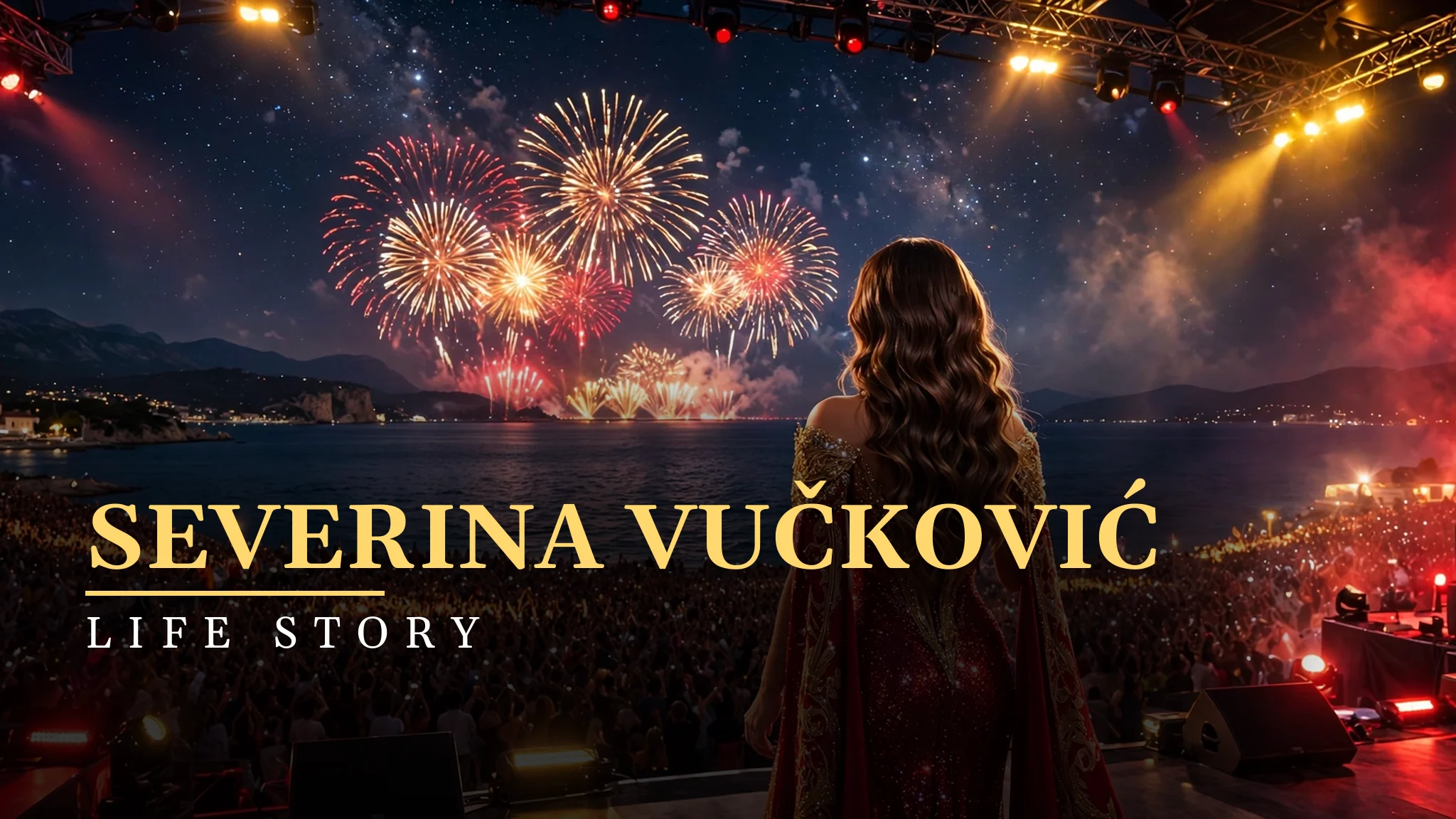
Finally, I return to the image of the seaside stage at night, with fireworks over the sea, and a huge crowd, because that image captures her story, a woman in a red gown, on a stage, by the sea, with fireworks, and with thousands of people singing along, and I hope that image stays with readers, as a picture of a queen of pop, who has earned her crown, song by song, and who wears it with joy.
One more thought stays with me, and it is about the word queen, and about what it means to be called the Queen of Croatian Pop, because a queen is not only a star, but a person who represents a country, a culture, and a people, and Severina does that, with her songs, with her concerts, and with her life, and she does it with a grace, and with a warmth, that makes people proud to call her theirs, and that is a title she has earned, and a title she deserves.
And I think about young girls in Split, who hear her songs, and who dream of singing, and who see in Severina a proof that a girl from their city can become a star, can fill arenas, and can be loved around the world, and that dream, passed on to a new generation, is a legacy that lasts longer than any single song, because it inspires others to try, to sing, and to believe in themselves, and that is the best gift a star can give.
I also think about the simple joy of a Severina concert, with a crowd singing every word, with lights, with dancing, and with a feeling that the whole country has come together, for one night, to celebrate, and I realise that this joy is a gift, in a world that is often sad, and serious, and a singer who can give people joy, for thirty years, has done something important, and something that deserves to be honoured, not only with awards, but with love, from an audience that has grown up with her songs, and that will go on singing them.
And I think about the girls in Split, who hear her songs, and who dream of singing, and who see in Severina a proof that a girl from their city can become a queen, can fill arenas, and can be loved around the world, and that dream, passed on to a new generation, is a legacy that lasts longer than any single song, because it inspires others to try, to sing, and to believe in themselves, and that is the best gift a star can give, to the young people who look up to her, and who want to follow in her footsteps.
Frequently Asked Questions
When and where was Severina Vučković born?
Severina Vučković was born on 21 April 1972 in Split, Croatia, which was then part of Yugoslavia. She grew up in the sunny coastal city, singing in children’s festivals and dreaming of a life on stage.
What was Severina’s breakthrough album?
Her breakthrough came with Dalmatinka in 1993, an album celebrating her Dalmatian home that became a huge success in Croatia. She followed it with Djevojka sa sela and Virujen u te, which made her a national star.
What song did Severina sing at Eurovision?
She represented Croatia at Eurovision in 2006 in Athens with Moja štikla, which means my high heel, a fun folk-pop song that became a huge hit across the Balkans even though she finished thirteenth in the contest.
Does Severina have children?
Yes, she has a son, Aleksandar, who was born in 2012. She has spoken about how much motherhood changed her life, and she has also spoken honestly about the painful custody dispute that followed.
What kind of music does Severina sing?
She sings a mix of pop, folk, and Dalmatian music, with catchy melodies and lyrics about love, home, and life. Over the years she has also tried dance music and new sounds, while keeping her Croatian language and her Dalmatian identity at the centre.
Is Severina still performing today?
Yes, she is still one of the biggest stars in the Balkans, filling arenas and releasing new music in her fifties. Her concerts draw audiences of all ages, from people who grew up with her songs to young fans discovering her for the first time.


