Shelly-Ann Fraser-Pryce: The Life Story Behind Jamaica's Pocket Rocket
In this post
- Waterhouse: Running Barefoot in Kingston
- Beijing 2008: The First Jamaican Woman to Win the 100m
- London 2012: Gold Again, and a Silver in the 200m
- Motherhood, Zyon, and the Doubt That Followed
- Tokyo Silver, Eugene Gold, and Running at Thirty-Five
- The Hair, the Foundation, and the Woman Behind the Speed
- Paris 2024 and the Long Goodbye
- My Take:
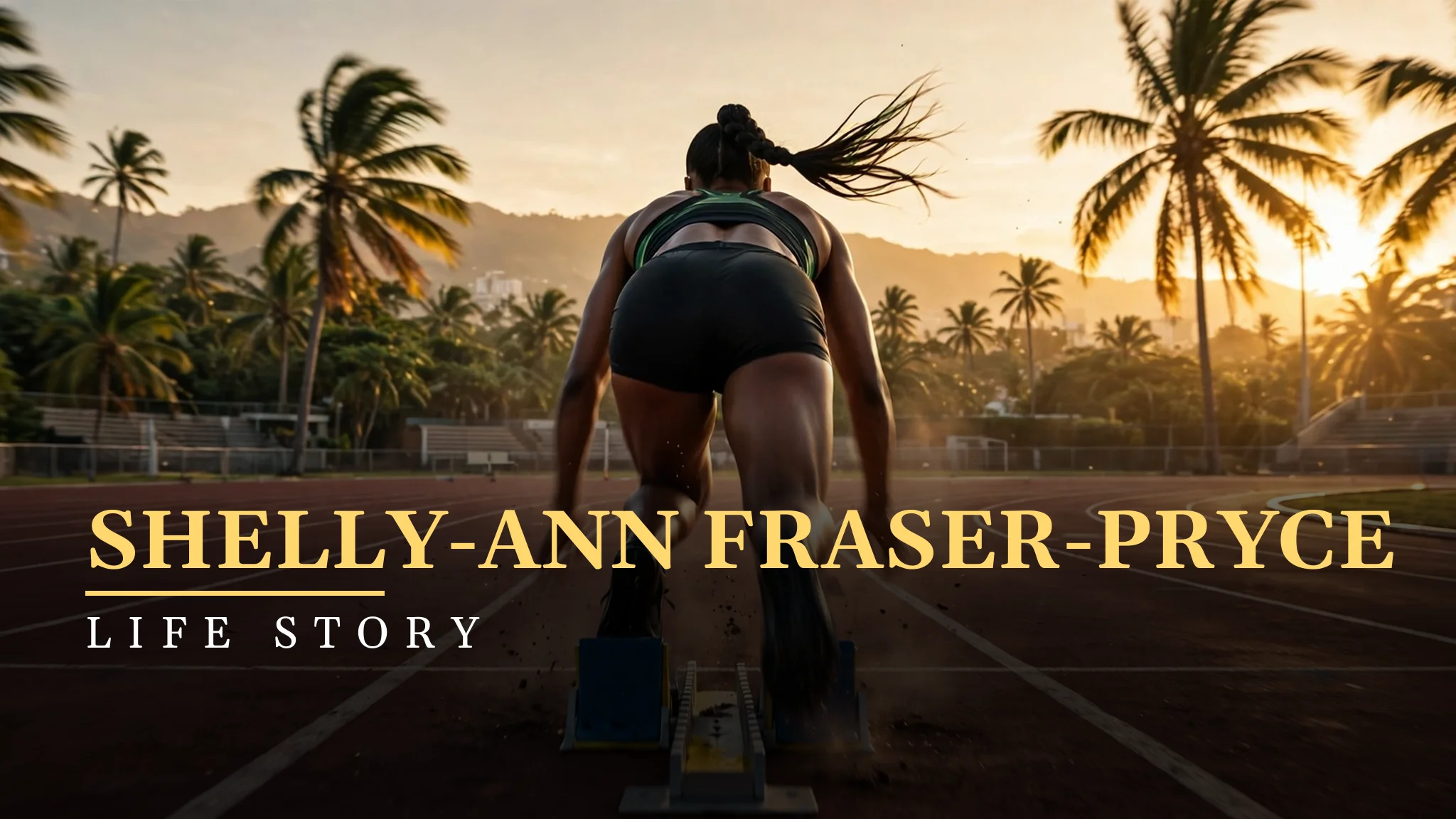
Shelly-Ann Fraser-Pryce is the fastest woman Jamaica has ever produced, and she is also one of the smallest. She stands about five feet tall, which is short for a sprinter, and her nickname is the Pocket Rocket: small in size, huge in speed. She has won the Olympic gold medal in the 100 metres twice, in Beijing in 2008 and in London in 2012, and she won the world title in the same event five times. She has run the 100 metres in 10.60 seconds, which is one of the fastest times in history, and she did it at the age of thirty-four, when most sprinters have already retired. She is a mother, a businesswoman, and a role model, and she has done it all with a smile and a head full of brightly coloured hair that has become her trademark.
Her story begins in Waterhouse, a poor and tough neighbourhood in Kingston, the capital of Jamaica. She grew up with very little money, and she ran barefoot as a child because her family could not always afford shoes. She was raised by her mother, Maxine, who worked hard to give her children a better life, and who taught Shelly-Ann to be strong, to be honest, and to never give up. The girl from Waterhouse became the queen of the 100 metres, and she never forgot where she came from. She still goes back to her community, she still helps the young people there, and she still tells them that where you start does not decide where you finish.
What makes her story special is not only the medals. It is the length of her career, and the way she kept coming back. She won her first Olympic gold in 2008, and she won her last world title in 2022, fourteen years later. In between, she had a son, she suffered injuries, and she watched younger sprinters come and go. She kept running, and she kept winning, because she loved the sport and because she believed in herself. She is a sprinter who refused to be told that she was too small, too old, or too much of a mother to win. She proved them all wrong, again and again, with her feet and with her heart.
Waterhouse: Running Barefoot in Kingston
Shelly-Ann Fraser was born on 27 December 1986 in Waterhouse, Kingston, Jamaica. Waterhouse is a poor neighbourhood, and life there is hard. The streets are crowded, the houses are small, and many families struggle to make ends meet. Shelly-Ann grew up in that world, and she learned early what it means to have very little. She ran barefoot as a child, because shoes were a luxury, and she played in the streets with the other children. She was small, quick, and full of energy, and she loved to race. She did not know that running would change her life. She only knew that she was fast, and that being fast felt good.
Her mother, Maxine, raised her with love and with discipline. Maxine worked as a street vendor, selling goods to support her family, and she taught her daughter to work hard and to respect herself. She did not have much money, but she had strong values, and she passed them on to Shelly-Ann. She told her daughter to be honest, to be kind, and to never let anyone look down on her because she was poor. Those words stayed with Shelly-Ann for her whole life, and they became the foundation of her character. She has spoken about her mother many times, and she has said that everything she achieved started with her mother’s love and her mother’s strength.
At school, her talent was noticed by her teachers, and she began to run in competitions. She was not the tallest or the strongest girl on the track, but she was the quickest, and her start was explosive. She ran with a low, powerful style, and she covered the ground in short, fast steps. Coaches began to talk about her, and she joined the MVP Track Club, one of the best training groups in Jamaica. Her coach, Stephen Francis, saw her potential, and he began to shape her into a professional sprinter. He taught her to be patient, to trust her training, and to believe that a small girl from Waterhouse could beat the best in the world. She believed him, and she worked harder than anyone else in the group.
The road from Waterhouse to the Olympic Games was not easy. She had to train, she had to study, and she had to deal with the pressure of being a young woman from a poor neighbourhood in a sport that rewards the rich. But she had her mother’s strength, her coach’s guidance, and her own fierce determination. She did not let poverty define her, and she did not let anyone tell her that she was too small to win. She kept running, and she kept getting faster, and by the time she was twenty-one years old, she was ready for the biggest stage in the world.
Beijing 2008: The First Jamaican Woman to Win the 100m
The Olympic Games in Beijing in 2008 changed Shelly-Ann Fraser’s life forever. She was twenty-one years old, and she was running in the 100 metres final against the best sprinters in the world. She ran a perfect race, with a fast start and a strong finish, and she won the gold medal in 10.78 seconds. She became the first Jamaican woman ever to win the Olympic gold medal in the 100 metres, and she did it in a year when Jamaica dominated the sprints. Her compatriots Usain Bolt and the men’s team also won gold, and the whole country celebrated. Jamaica, a small island with fewer than three million people, had become the fastest country on earth, and Shelly-Ann was its queen.
The win in Beijing was special for another reason. It came from a girl who had run barefoot in Waterhouse, and it showed the world that greatness can come from anywhere. She celebrated with joy, and she thanked her mother, her coach, and her country. She had not only won a gold medal. She had made history, and she had given hope to every poor child in Jamaica who dreamed of a better life. She returned home to a hero’s welcome, and she became a national star overnight. But she did not let the fame change her. She stayed close to her family, she stayed humble, and she kept training for the next challenge.
In 2009, she won the gold medal in the 100 metres at the World Championships in Berlin, and she added a gold in the 4 by 100 metres relay. She was now the Olympic champion and the world champion, and she was the best female sprinter in the world. She was still only twenty-two, and her future looked bright. But the years ahead would bring challenges that tested her in ways she had never imagined. She would face injuries, she would face younger rivals, and she would face a decision that would change her life: the decision to become a mother.
London 2012: Gold Again, and a Silver in the 200m
The Olympic Games in London in 2012 brought Fraser-Pryce her second Olympic gold medal in the 100 metres. She won in 10.75 seconds, beating the American Carmelita Jeter by a small margin. It was a different kind of win from Beijing. In Beijing, she had been a surprise. In London, she had been the favourite, and she had carried the pressure of a whole country on her shoulders. She handled it with calm and with class, and she won again. She became one of the few women in history to win the Olympic 100 metres twice, and she did it with a performance that showed her maturity as an athlete.
In London, she also won a silver medal in the 200 metres, and another silver in the 4 by 100 metres relay. She left the Games with three medals, and she was now one of the great names in world athletics. She had won in Beijing, she had won in London, and she had done it with a style that was all her own. She was small, she was fast, and she was fearless. She celebrated her wins with her trademark hair, which she changed colour for every major competition, and she became known around the world for her bright and bold style. Her hair was not a gimmick. It was a statement: she was herself, and she was proud of it.
The years after London brought new challenges. She suffered injuries, including a toe injury that affected her running, and she watched as younger sprinters began to emerge. In Rio in 2016, she won a bronze medal in the 100 metres, behind her compatriot Elaine Thompson, and a silver medal in the 4 by 100 metres relay. The bronze was a disappointment, because she had wanted gold, but it was also a sign of her toughness. She had run with an injury, and she had still won a medal. She was thirty years old, and many people believed her best years were behind her. They were wrong, but she did not know that yet. She had a decision to make, and it would change everything.
Motherhood, Zyon, and the Doubt That Followed
In 2017, Shelly-Ann Fraser-Pryce became a mother. Her son, Zyon, was born in August of that year, and she stepped away from the sport to care for him. She did not know if she would come back, and she did not know if her body would ever be the same. She had spent her whole life as an athlete, and now she was a mother first. It was a hard time, because she loved running, and she missed it. But she also loved her son, and she wanted to be there for him. She took her time, she recovered slowly, and she began to think about a comeback.
Many people doubted that she could return to the top. She was thirty years old, she had a baby, and she had been away from the sport for more than a year. Sprinting is a young person’s sport, and most sprinters retire in their early thirties. But Fraser-Pryce believed in herself, and she believed that motherhood had made her stronger, not weaker. She trained with patience, she listened to her body, and she accepted that the road back would be slow. She has spoken about how hard those months were, and about how she sometimes doubted herself. But she kept going, and she kept believing, and in 2019 she returned to the biggest stage in the world.
Her comeback was one of the great stories in sport. At the World Championships in Doha in 2019, she won the gold medal in the 100 metres in 10.71 seconds, which was one of the fastest times of her life. She was thirty-two years old, a mother, and the world champion again. She celebrated with her son in her arms, and the image of the two of them together became famous around the world. She had proved that a mother can come back, and that a woman’s career does not end when she has a child. She had also proved that age is not a barrier, and that belief is stronger than doubt. The comeback was complete, and it was beautiful.
Tokyo Silver, Eugene Gold, and Running at Thirty-Five
The Olympic Games in Tokyo in 2020, held in 2021, brought Fraser-Pryce a silver medal in the 100 metres. She finished second behind her Jamaican team-mate Elaine Thompson-Herah, who ran a brilliant race. Fraser-Pryce ran well, but Thompson-Herah was faster on the day. She also won a gold medal in the 4 by 100 metres relay, and she left Tokyo with two more medals. She was thirty-four years old, a mother, and still one of the fastest women in the world. The silver did not feel like a failure. It felt like proof that she was still at the top, even as younger runners came and went.
The year after Tokyo brought her greatest achievement as a veteran. At the World Championships in Eugene, Oregon, in 2022, she won the gold medal in the 100 metres in 10.67 seconds. She was thirty-five years old, and she had run one of the fastest times of her life. It was her fifth world title in the 100 metres, and it was won against a field of younger women who had grown up watching her. She celebrated with joy, and the crowd in Eugene gave her a welcome that she would never forget. She had become the oldest woman ever to win the world title in the 100 metres, and she had done it with a performance that was as good as anything she had done as a young woman.
In 2023, at the World Championships in Budapest, she won a bronze medal in the 100 metres, behind the American Sha’Carri Richardson and her Jamaican team-mate Shericka Jackson. She was thirty-six years old, and she was still winning medals at the highest level. The bronze was not a gold, but it was a sign of her longevity. She had been winning medals since 2008, and she was still on the podium fifteen years later. Few sprinters in history have lasted that long, and few have done it with such grace. She accepted the bronze with a smile, and she congratulated the younger women who had beaten her. She knew that her time at the very top was coming to an end, but she was not bitter about it. She was proud of what she had achieved, and she was happy to see the next generation take over.
In 2022, she also ran 10.60 seconds, which was the third fastest time in history at that point, and she did it at the age of thirty-five. It was a time that showed she was not only winning, but winning with speed that few women in history had ever matched. She had become a legend, and she had done it by refusing to retire, by refusing to accept that age was a limit, and by refusing to let motherhood end her career. She was the Pocket Rocket, and she was still flying.
The Hair, the Foundation, and the Woman Behind the Speed
Shelly-Ann Fraser-Pryce is known for more than her speed. She is known for her hair, which she changes colour for every major competition. She has worn blonde, pink, purple, green, and many other colours, and her hair has become a symbol of her personality. She is bold, she is bright, and she is not afraid to stand out. Her hair is not a distraction. It is a statement that she is herself, and that she is proud of who she is. Young girls around the world copy her style, and they see in her a woman who is confident, joyful, and free.
She has also used her fame to help others. She founded the Pocket Rocket Foundation, which supports young students in Jamaica, helping them with their education and their dreams. She knows what it is like to grow up with very little, and she wants to give back to the community that raised her. She has spoken about how important education is, and about how sport and school must go together. Her foundation has helped many young people, and it is one of the proudest achievements of her life. She is not only a sprinter. She is a woman who cares about her country, and who uses her success to lift others up.
She is also a businesswoman, and she has built a life beyond the track. She has interests in business and in her community, and she has prepared for a life after running. She is married, and she balances her life as an athlete with her life as a wife and a mother. She has spoken about how hard that balance is, and about how she manages it with the support of her family. She is a woman who does many things, and who does them all with energy and with care. Her life is bigger than the track, and that is one of the reasons she has lasted so long. She has never let running be the only thing in her life.
Paris 2024 and the Long Goodbye
The Olympic Games in Paris in 2024 were meant to be Fraser-Pryce’s final Olympic Games, and she arrived with the hope of one more medal. But the Games did not go the way she wanted. She withdrew before the semi-final of the 100 metres, after an injury disrupted her warm-up, and her Olympic career ended in disappointment. It was a sad end to a great career, and it showed the cruel side of sport. She had prepared for years, she had travelled to Paris, and her body let her down at the last moment. She handled the disappointment with dignity, and she thanked her fans for their support. She did not make excuses, and she did not complain. She accepted the result, and she looked to the future.
The end in Paris did not change her legacy. She had already won two Olympic gold medals, five world titles in the 100 metres, and more medals than almost any other female sprinter in history. She had run for sixteen years at the top, she had become a mother and come back to win, and she had run her fastest times in her mid-thirties. One bad day in Paris could not take any of that away. She left the sport as one of the greatest sprinters of all time, and as a woman who had changed the way people think about age, motherhood, and size in sport. She was small, she was a mother, and she was thirty-five when she won her last world title. Those are not weaknesses. They are the proof of her greatness.
She has also become an ambassador for Jamaica, and for the sport of sprinting, in a way that goes beyond medals. She speaks to young people, she visits schools, and she tells them that they can achieve great things, no matter where they come from. She is a woman who has used her fame to lift others, and she has done it with a humility that is rare among stars. She does not talk about herself in big words. She talks about her community, her family, and her country, and she gives credit to the people who helped her. That is a generous way to live, and it is one of the reasons she is so loved in Jamaica and around the world.
Her future after running is bright. She has her foundation, her business, and her family, and she will continue to work for young people in Jamaica. She has said that she wants to help the next generation, and that she wants to be remembered not only for her medals, but for what she gave back. That is a good legacy, and it is one that she has earned. The girl from Waterhouse who ran barefoot became the queen of the 100 metres, and she did it with speed, with style, and with a heart that never gave up.
My Take:
When I think about Shelly-Ann Fraser-Pryce, the first thing that comes to my mind is her size. She is about five feet tall, and she stands next to other sprinters who are much taller than her. She looks small, and then the gun goes off, and she is gone. That is the magic of the Pocket Rocket: she is small, and she is faster than everyone else. I think about how many people in life are told they are too small, too short, or too little to succeed. She heard those words, and she answered them with her feet. She did not grow taller. She grew faster. That is a lesson for anyone who has ever been told they are too small for their dream. Size is not the measure of a person. Speed, heart, and belief are the measures, and she has all three.
I also think about Waterhouse, and about what it means to come from a poor neighbourhood and become a world champion. She ran barefoot as a child, because her family could not afford shoes. She grew up in a place where life is hard, and where many children never get a chance. She got her chance, and she took it with both hands. I think about the children in Waterhouse who watch her now, and who see a woman from their own streets winning Olympic gold medals. That is a powerful thing. It tells them that their dreams are not stupid, and that where they come from does not decide where they go. She is proof, and she is living proof, and that is worth more than any speech about hope.
Her mother, Maxine, is another part of her story that I think about often. Maxine worked as a street vendor, she raised her daughter with love and discipline, and she taught her to be honest and strong. She did not have money, but she had values, and she gave those values to her daughter. I think that is a reminder that greatness does not start with money. It starts with a parent who believes in a child, and who teaches that child to work hard and to respect herself. Shelly-Ann has never forgotten her mother, and she has spoken about her with love many times. I think that is the foundation of her whole career: a mother’s love, and a daughter’s determination to honour it.
The comeback after having her son, Zyon, is the part of her story that moves me most. She had a baby in 2017, she stepped away from the sport, and many people believed her career was over. She came back, and she won the world title in 2019, at the age of thirty-two. She celebrated with her son in her arms, and the image of the two of them together became famous around the world. I think about how many mothers are told that their careers are over when they have a child, and I think about how wrong that is. Fraser-Pryce proved it wrong, and she proved it in the clearest way possible: by running faster as a mother than she had ever run before. That is a lesson for every mother, and for every person who thinks that motherhood is the end of ambition. It is not the end. It can be the beginning of something even better.
I also think about her hair, and I know that sounds like a small thing, but it is not. She changes her hair colour for every major competition, and she wears it with pride. She is bold, she is bright, and she is not afraid to stand out. In a sport where many athletes try to look serious and professional, she looks like herself. I think that is a brave thing, because the world often tells women to be quiet, to be modest, and to not draw attention to themselves. Fraser-Pryce draws attention to herself, and she does it with joy. She is not showing off. She is being herself, and she is telling young girls that it is okay to be bright, bold, and beautiful. That is a message worth hearing, and it is one that goes far beyond the track.
Her win in Eugene in 2022, at the age of thirty-five, is another moment I think about often. She ran 10.67 seconds to win her fifth world title, and she did it against women who were much younger than her. Most sprinters retire in their early thirties, because the body wears down and the young runners keep coming. She did not retire. She kept training, she kept believing, and she kept winning. I think that is a lesson about age. Age is not a limit. It is a number, and it only matters if you let it matter. She did not let it matter, and she ran her fastest times in her mid-thirties. That is extraordinary, and it is a reminder that we should not give up on our dreams just because we are getting older. Dreams do not have an age limit, and neither do we.
I think about her rivalry with Elaine Thompson-Herah, and how the two Jamaican women pushed each other to be better. Thompson-Herah won the gold in Tokyo, and Fraser-Pryce won the silver. It was a race between two great athletes from the same small island, and it showed the world how strong Jamaican sprinting is. I like that they competed hard and respected each other, because that is what sport should be: a competition that makes everyone better. Fraser-Pryce did not complain when she lost in Tokyo. She congratulated her rival, and she kept working. That is a mature response, and it is one that I admire. Losing with grace is just as important as winning with grace, and she does both.
The end of her career in Paris in 2024 makes me sad, because she deserved a better ending. She withdrew before the semi-final, after an injury disrupted her warm-up, and her Olympic career ended in disappointment. It is a cruel way for a great career to end, and I think about how hard that must have been for her. She had prepared for years, she had travelled to Paris, and her body let her down. But I also think that one bad day does not define a career. She won two Olympic gold medals, five world titles, and more medals than almost any other female sprinter in history. Paris was a sad ending, but it was only an ending. The story that came before it was magnificent, and that is what people will remember.
I also admire her foundation, the Pocket Rocket Foundation, and the work she does for young students in Jamaica. She knows what it is like to grow up with very little, and she wants to give back to the community that raised her. She helps young people with their education, and she tells them that sport and school must go together. I think that is a generous use of fame, and it is one that many athletes could learn from. Fame is not a prize to keep. It is a tool to use, and she uses it to help others. That is a rare and beautiful thing, and it is one of the reasons I admire her so much.
I think about what her story means for small people everywhere. She is short, and she is fast, and she has never let her height hold her back. I think about children who are small for their age, and who are told they will never be good at sport. She proves them wrong, and she proves it every time she runs. She is not fast despite being small. She is fast because of who she is, and her size is part of that. Her short, powerful strides, her explosive start, and her low centre of gravity are all part of her speed. She turned what some people saw as a weakness into a strength, and that is a lesson for anyone who has ever been told they are too small, too short, or too different to succeed. You do not need to be like everyone else. You need to be yourself, and to make the most of what you have.
I also think about the way she balances her life. She is an athlete, a wife, a mother, and a businesswoman, and she does all of it with energy and with care. That is a hard balance, and many people struggle with it. She manages it with the support of her family, and with a discipline that she learned as a child. I think that is a lesson for anyone who feels pulled in many directions. You cannot do everything at once, but you can do many things well if you have support, if you are organised, and if you know what matters most. For Fraser-Pryce, what matters most is her family, her community, and her running. She has kept those three things in balance for many years, and that is an achievement in itself.
When I look at her whole career, I see a woman who was given very little and made a great deal out of it. She was born in a poor neighbourhood, she ran barefoot, and she was raised by a mother who worked as a street vendor. She became the fastest woman Jamaica has ever produced, a two-time Olympic champion, and a five-time world champion. She became a mother, she came back, and she won again at thirty-five. She did it with speed, with style, and with a heart that never gave up. That is a life worth studying, and it is a life that will inspire people for a long time. She did not only run fast. She ran with meaning, and she showed the world what a small girl from Waterhouse can do.
I also think about the way she runs, and about what it looks like. She is small, and she runs with short, powerful strides, and with an explosive start that leaves taller sprinters behind. Her start is one of the best in history, because she gets out of the blocks faster than anyone else, and she builds her speed in the first few metres. That is a gift, and it is one that she has worked hard to develop. She practises her start again and again, and she knows that a good start can win a race. I think that is a lesson for anyone who wants to succeed: the beginning matters. If you start well, you have a chance. If you start badly, you spend the whole race catching up. Fraser-Pryce starts well, and she wins because of it.
I think about Jamaica, and about what it means to be a sprinter from a small island that produces the fastest people on earth. Jamaica has fewer than three million people, and it has produced Usain Bolt, Elaine Thompson-Herah, Shelly-Ann Fraser-Pryce, and many more. That is an extraordinary thing, and it shows that greatness does not only come from big countries. It comes from anywhere, if the talent is there and the work is done. Fraser-Pryce is proof of that, and she is a hero in Jamaica because of it. Young Jamaican children watch her run, and they dream of being like her. That is a powerful thing, and it is one of the reasons sport matters. It gives children a dream, and it gives them a reason to work hard.
There is one more thing I want to say about her, and it is about joy. She runs with joy, she celebrates with joy, and she lives with joy. Her hair is bright, her smile is bright, and her spirit is bright. In a world that is often serious and sad, her joy is a gift. She reminds us that sport is supposed to be fun, and that winning is supposed to feel good. I watch her run, and I smile, because she is smiling, and that is enough. She is a woman who has known poverty, injury, and disappointment, and she still smiles. That is a strength, and it is one that I admire more than any medal.
I also think about what she will do next, and I think she will keep helping young people. She has her foundation, she has her community, and she has a lifetime of experience to share. She will not disappear. She will stay in Jamaica, she will work with children, and she will keep giving back. That is a good future, and it is one that she has earned. She ran fast, she won medals, and she helped others. That is a complete life, and it is one that I will remember.
In the end, I think Shelly-Ann Fraser-Pryce will be remembered as the Pocket Rocket, the small woman with the huge speed, and as the queen of the 100 metres. She will also be remembered as the mother who came back, the woman who helped young students in Jamaica, and the athlete who ran her fastest times at thirty-five. Those are the parts of her story that will last, because medals fade and records fall, but a life lived with courage, joy, and generosity does not fade. She lived it, she ran it, and she smiled through it all. That is a legacy worth remembering, and it is one that I will carry with me.
Frequently Asked Questions
Why is Shelly-Ann Fraser-Pryce called the Pocket Rocket?
She is called the Pocket Rocket because she is short, at about five feet tall, and very fast. The nickname captures the contrast between her small size and her explosive speed in the 100 metres, where she has won two Olympic gold medals and five world titles.
How many Olympic gold medals has Shelly-Ann Fraser-Pryce won?
Fraser-Pryce has won two Olympic gold medals in the 100 metres, at the Beijing Games in 2008 and the London Games in 2012. She also won a gold medal in the 4 by 100 metres relay at the Tokyo Games in 2020, along with silver and bronze medals in other Olympic events.
Did Shelly-Ann Fraser-Pryce come back to running after having a baby?
Yes, her son Zyon was born in August 2017, and she spent more than a year away from competition. She returned in 2019 and won the gold medal in the 100 metres at the World Championships in Doha, and she went on to win the world title again in Eugene in 2022 at the age of thirty-five.
What is Shelly-Ann Fraser-Pryce’s fastest 100 metres time?
Her fastest time in the 100 metres is 10.60 seconds, which she ran in 2022 at the age of thirty-five. It was one of the fastest times in the history of women’s sprinting, and it showed that she was running at her best even in the later years of her career.
Why is Shelly-Ann Fraser-Pryce famous for her hair?
Fraser-Pryce is famous for changing her hair colour for every major competition, wearing bright colours such as blonde, pink, purple, and green. Her hair has become a symbol of her bold and joyful personality, and young fans around the world copy her style.
What is the Pocket Rocket Foundation?
The Pocket Rocket Foundation is a charity that Fraser-Pryce founded to support young students in Jamaica with their education. It grew out of her own experience growing up with very little in Waterhouse, Kingston, and it helps young people to study, to dream, and to build a better life.


