SHINee: The Life Story Behind K-Pop's Shining Group
In this post
- Five Teenagers and a Word That Meant Light
- Replay, Ring Ding Dong, and the Sound of Youth
- Sherlock, Dream Girl, and a Group That Refused to Stand Still
- The Winter of 2017 and the Light That Stayed
- Army Years, Solo Stages, and the Return as Four
- Tokyo Dome, Tours, and the Fans in Blue
- What SHINee Leaves Behind
- My Take:
There is a word in Korean that means a person who has received light, and in May 2008 a Seoul company gave that word to five teenagers and asked them to live up to it. The name was SHINee, and the promise inside it was simple: these five would shine. Most new groups are given a name that sounds tough or cool. SHINee was given a name that sounded bright, and the group spent the next fifteen years proving that brightness was not a weakness. The singing was smooth, the dancing was sharp enough to cut, and the clothes were more stylish than anything else on a Korean stage at the time. Other groups chased power. SHINee chased polish, and polish turned out to be a kind of power all its own.
The first song, Replay, told a story that any teenager could understand. An older woman walks past, a young man falls in love at first sight, and he cannot stop thinking about her. It was a gentle song, with harmonies that floated rather than shouted, and it made SHINee sound older than their years. The members were between fourteen and eighteen when they sang it, yet the record sold, the music shows invited them back, and the fans began to call them the princes of Korean pop. The nickname stuck, not because the group demanded it, but because the elegance was real. Even in rehearsal clothes, they moved like people who had been taught to carry themselves well.
SHINee’s story is not only a story about style. It is also a story about a group that kept changing its sound while other groups stayed safe, that lost a beloved member in the saddest way a group can lose one, and that still came back to the stage, four men standing where five had once stood, singing for the fans and for the friend who was gone. This is how five teenagers became the most respected vocal group of their generation, and how they kept their light on through years that would have put out a weaker flame.
Five Teenagers and a Word That Meant Light
The Seoul company SM Entertainment had been looking for a new kind of boy group. Its older groups were large, loud, and built around spectacle. For the next one, the company wanted something smaller and more modern, a group that sang contemporary rhythm and blues, danced in perfect lines, and dressed like models from a fashion magazine. The search took years. Onew, the oldest, was discovered at an audition in 2006 and became the leader. Jonghyun, a singer with a voice that could climb higher than anyone expected, joined after being spotted at a singing contest. Key, who loved fashion and rap, came through an audition in Seoul. Minho, tall and athletic, was found on the street. Taemin, the youngest, was only twelve when he joined the company’s training school, a dancer so gifted that his teachers knew at once he was special.
Each of the five had a job inside the group, and the jobs fitted together like the parts of a small machine. Onew led the group and sang the high, clear lines that held the choruses together. Jonghyun sang the most difficult parts, the notes that made audiences gasp, and he also wrote songs for the group and for other singers. Key rapped, sang, and became the group’s fashion leader, the member whose clothes other idols copied. Minho rapped too, and his height and his looks made him the member who appeared most often in dramas and on television. Taemin danced at the centre, with a control over his body that dancers twice his age envied, and his voice grew stronger with every year.
Training in Seoul was strict, and the five lived close together, practising from morning until late at night. They learned to sing while dancing, which is far harder than it sounds, because a singer who is out of breath cannot hold a note. They learned to move as one, so that five bodies looked like a single shape on stage. They learned Japanese, because the company planned to take them to Japan, and they learned how to speak to cameras, to fans, and to journalists. Taemin was still a schoolboy, and he did his homework between rehearsals. The others were only a little older, and none of them had lived a normal teenage life. What they had instead was each other, and a shared belief that the work would be worth it.
The company showed them to the public in a short film that played on television in May 2008, and the response was quick. Fans noticed the clothes first, then the dancing, then the singing. The name SHINee, a made-up word from shine, was explained as meaning a person who has received the light, and the fans took the name for themselves, calling themselves Shawol, a short form of SHINee World. Within weeks, the group had a fan club, a fan colour of pearlescent sky blue, and a place on every music show in Korea.
Replay, Ring Ding Dong, and the Sound of Youth
SHINee’s first record, the mini-album Replay, came out on 22 May 2008, and the title song went to the top ten in Korea. The song’s Korean title, Noona Neomu Yeppeo, means older sister, you are so pretty, and the lyrics told of a young man in love with an older woman. It was an unusual subject for a group of teenagers, and it worked, because the singing was sincere and the harmonies were beautiful. The group won its first music show award within weeks, and the members, who had been trainees only months before, were suddenly famous.
The first full album, The SHINee World, arrived in August 2008, with the song Love Like Oxygen, and the group performed it with a dance that used their arms like waves. A second album, Romeo, followed in May 2009, with the song Juliette, a bright and romantic track that became another hit. Then, in October 2009, came Ring Ding Dong, a song with a strange, ringing chorus that some people found annoying and others found impossible to forget. The song was a huge hit, and its dance, with its ringing bell movement, became famous across Korea. It also showed a new side of SHINee: the group could be playful and odd, not only smooth and elegant.
In July 2010, the group released Lucifer, the title song of its second full album, and it remains one of the most admired songs in Korean pop. The dance was so fast and so difficult that other groups studied it, and the song’s electronic sound was far ahead of its time. Lucifer won awards, topped charts, and gave SHINee a reputation as the group that other idols watched to learn what was possible. The members were still young, Jonghyun was twenty, Taemin was seventeen, but they performed like veterans, and the critics began to write about SHINee as the best live act of their generation.
Japan came next. SHINee sang Replay in Japanese in June 2011, and the single sold more than one hundred thousand copies in its first week, a record for a Korean group at the time. The group toured Japan, played the Tokyo Dome, and built a following that stayed loyal for more than a decade. The Japanese fans loved the group’s politeness, its precise dancing, and its willingness to learn Japanese and speak it on stage. SHINee was no longer only a Korean group. It was becoming an Asian one, and the light in its name was reaching further than anyone had planned.
Sherlock, Dream Girl, and a Group That Refused to Stand Still
Most groups find a sound that works and repeat it. SHINee did the opposite. In March 2012, the group released Sherlock, a song that mixed two different tracks into one, with a dance that told a detective story on stage. The video was full of clues, mirrors, and shadows, and the performance won praise for its originality. Sherlock took the top prize at the Mnet Asian Music Awards, and it showed that SHINee was willing to take risks that other groups would not. The members were growing older, and the music was growing with them.
The year 2013 brought two albums, Dream Girl and Why So Serious?, released only months apart. Dream Girl was bright and playful, with a dance that made the members look like they were floating. Why So Serious? was darker, with a rock sound that surprised people who thought SHINee only sang smooth pop. The group performed both, and the fans loved both, because the change felt honest. SHINee was not chasing a trend. It was trying out new ideas, and it trusted its audience to follow. That trust was repaid, because the albums sold well, and the concerts sold out.
In May 2015, the group released Odd, an album that carried the song View, a deep house track that sounded like nothing else in Korean pop that year. View was smooth, adult, and confident, and it became one of SHINee’s most loved songs. The album showed a group that had grown up. Taemin was twenty-one, no longer the child dancer of Replay, and his solo work, which had begun with the mini-album Ace in 2014, had made him a star in his own right. Key was writing songs. Jonghyun was writing songs for other singers, including the hit Breath for Lee Hi. Onew was acting in dramas. Minho was acting too. The group was becoming five solo artists who still chose to come together, and that choice made the music richer.
The album 1 of 1, released in October 2016, looked back to the music of the 1990s, with a sound full of old-style rhythm and blues, and the fans loved it for its warmth. The group celebrated its tenth year in 2018 with The Story of Light, a three-part album that showed how far the five had come. By then, SHINee had released music in Korean and Japanese, played the Tokyo Dome, and won awards in both countries. The group had also survived the hardest test any group can face, and that test is the subject of the next part of this story.
The Winter of 2017 and the Light That Stayed
On 18 December 2017, Jonghyun died in Seoul, at the age of twenty-seven. The news reached the fans in the middle of the night, and it was met with grief that spread across Korea and around the world. Jonghyun had been one of the group’s two main singers, its most gifted songwriter, and a friend to the other four since they were teenagers. His death was a loss that no award, no song, and no concert could repair, and the group and its fans have carried it ever since. Out of respect for him and for his family, this story will say no more about the details of that day than that.
What happened after that winter tells me more about SHINee than any hit song does. The four remaining members, Onew, Key, Minho, and Taemin, could have stopped. Nobody would have blamed them. Instead, they chose to continue, and they did it in a way that honoured their friend. They released The Story of Light in 2018, an album that included songs about missing someone and about carrying on, and they performed it with a quiet dignity that moved the fans to tears. At concerts, the fans sang Jonghyun’s parts, and the four men on stage sang with them, and the hall became a place of shared memory.
The group also kept Jonghyun’s work alive in other ways. His solo music, including the album She Is from 2016 and the record Poet Artist, released after his death in January 2018, was loved by the fans, and his songs for other singers continued to be played. The members spoke about him in interviews with love and with care, and they never treated his memory as something to be used for attention. They treated it as something private and precious, and the fans respected them for it. The light in the group’s name took on a new meaning after 2017. It was no longer only about shining on stage. It was about keeping a light on for someone who was gone.
The fans, Shawol, held the group through those years with a loyalty that was quiet and steady. They did not demand new music. They did not demand smiles. They waited, they listened, and they filled the concert halls with the pearlescent blue light that had always been the group’s colour. When the four members returned to the stage, the fans were there, and the music was there, and the memory of Jonghyun was there too, in every song he had sung.
Army Years, Solo Stages, and the Return as Four
In Korea, every young man must serve in the army, and for SHINee, that duty came for three members in quick succession. Onew enlisted in December 2018, Key in March 2019, and Minho in April 2019. Taemin, the youngest, stayed behind, and he released solo music, including the album Never Gonna Dance Again in 2020, which showed how far he had grown as a dancer and a singer. The three older members finished their service in 2020, and the group came back together for the first time in years.
The return was marked by the album Don’t Call Me, released in February 2021, a record that was harder and more confident than anything SHINee had made before. The title song was dark and powerful, and the video showed the four men in sharp suits, dancing with the precision that had always been their trademark. The album sold well, and the fans, who had waited through grief and through army service, welcomed it with joy. SHINee was back, and the group sounded like it had something to prove, and it proved it.
Taemin enlisted in May 2021, and the other three carried on with solo work while they waited for him. Key released the solo album Bad Love in September 2021, a record full of retro style and humour that showed his taste as an artist. Onew released his first solo album, Voice, in 2018, and later Circle in 2023. Minho acted in dramas and films, and became a regular face on Korean television. The solo work kept the members visible, but the fans always asked the same question: when would the four be together again?
The answer came in June 2023, when SHINee released Hard, an album that celebrated fifteen years since Replay. The title song was bright and energetic, and the group performed it on music shows with the same joy that had marked their earliest performances. The album was a celebration, not only of fifteen years, but of survival, of friendship, and of a group that had kept going through loss and through time. The fans filled the concerts, the light sticks glowed blue, and the four men on stage sang for the five who had started it all.
Tokyo Dome, Tours, and the Fans in Blue
The Tokyo Dome is a place that Korean singers dream about, because it holds more than fifty thousand people, and because filling it means that a foreign act has truly been accepted in Japan. SHINee first played there in 2012, only four years after Replay, and the concert sold out so fast that the group added more dates. The members spoke to the crowd in Japanese, sang their songs in Japanese, and bowed deeply at the end, and the Japanese fans, who are known for their polite and steady support, answered with a roar that filled the dome. The group returned to the Dome again and again, and each time the hall was full, and each time the members said that the Dome felt like a second home.
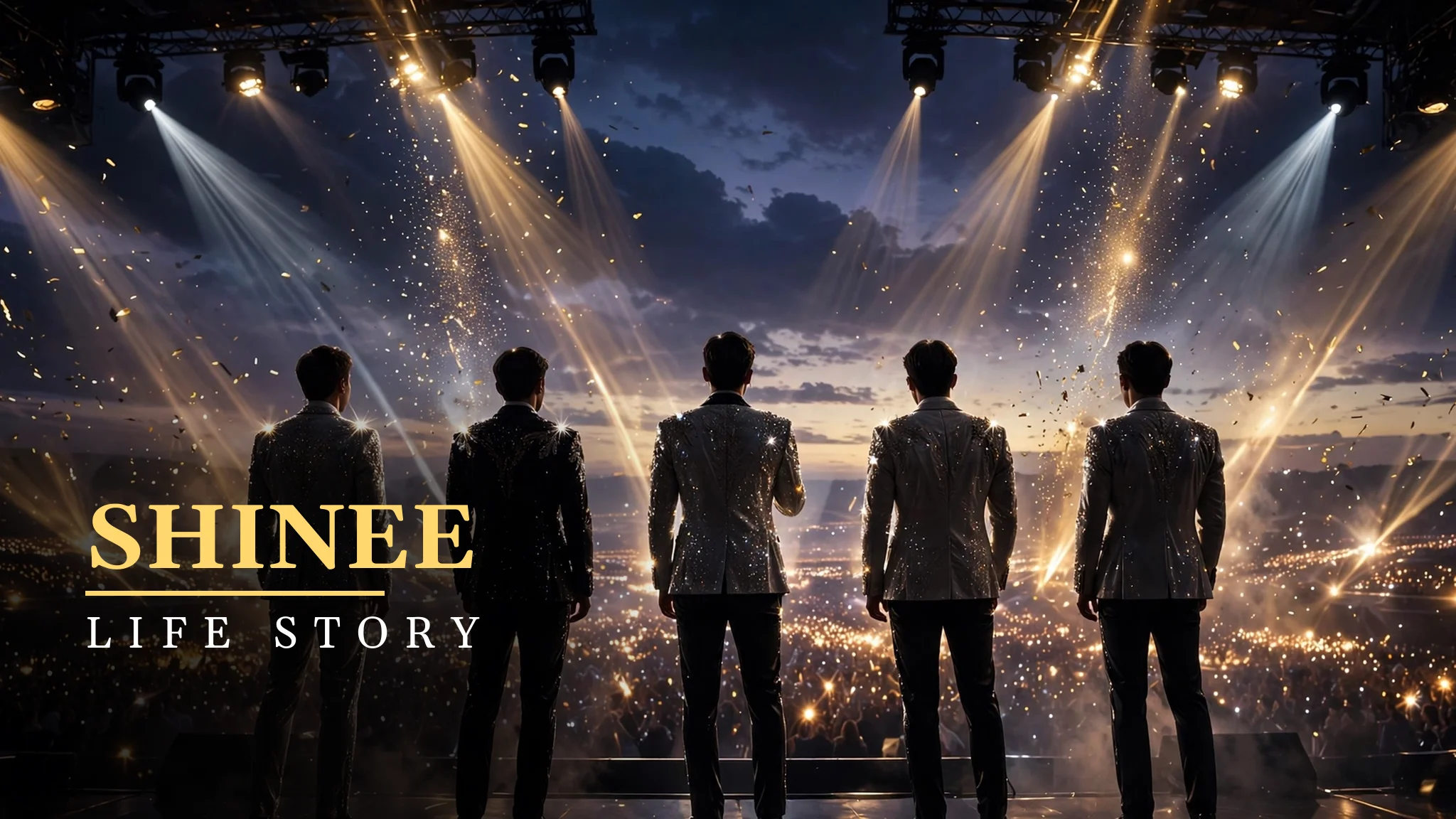
The tours that followed took SHINee across Asia and beyond. The group played in Seoul, in Tokyo, in Osaka, in Taipei, in Singapore, and in many other cities, and the concerts were known for their precision. The dancing was so exact that fans in the back rows could follow every move, and the singing was live, with harmonies that held even when the members were dancing hard. The set lists mixed the old songs with the new ones, so that a fan who had loved Replay in 2008 could hear it next to View from 2015, and the concert became a journey through the group’s whole life. The light sticks in the crowd glowed in pearlescent sky blue, the group’s colour, and from the stage the hall looked like a sea of pale blue stars.
What made those concerts special was not only the scale but the feeling in the room. SHINee’s fans, Shawol, are known for singing along to every word, in Korean and in Japanese, and for staying loyal through the long gaps between albums. When the group performed after Jonghyun’s death, the fans sang his parts, and the four men on stage listened, and the hall became a place where grief and love sat side by side. When the group returned after the army years, the fans sang even louder, as if they were welcoming old friends home. A concert is only as good as the people in the crowd, and SHINee’s crowds were among the best in Korean pop, because they knew the songs, they knew the dances, and they knew the story behind every record.
What SHINee Leaves Behind
SHINee’s place in Korean pop is built on singing, dancing, and style, and on a willingness to change that few groups have matched. The group showed that a boy group could be elegant without being soft, and that it could sing contemporary rhythm and blues, deep house, and old-style pop, all with the same confidence. The dancing set a standard that other groups studied, above all the fast, precise work in Lucifer and Sherlock, and the fashion sense, led by Key, changed how Korean idols dressed. The group’s Japanese success showed that a Korean act could build a lasting career in Japan, and its concerts in the Tokyo Dome became a mark of honour.
The story is not finished. Onew, Key, Minho, and Taemin are in their thirties now, and they have solo careers, acting work, and lives of their own. Taemin finished his army service in April 2023, and the group has performed together since then, including a concert in Seoul in May 2023 that marked fifteen years. The fans still ask when the next album will come, and the members still answer that they will come back when the music is ready. What is certain is that the songs are still played, the dances are still studied, and the name SHINee still means what it meant in 2008: a person who has received the light, and who shares it with everyone who listens.
My Take:
When I think about SHINee, the first thing that comes to my mind is not a single song but a feeling of care. Everything this group did was done with care, from the way the members stood in a line to the way they sang a harmony. Other groups were louder, other groups were bigger, and other groups sold more records in a single year, but nobody did the small things better than SHINee. The dancing was exact, the singing was clean, and the clothes were chosen with the eye of a designer. I think that care is why the group lasted. Fans can tell when artists respect their work, and they stay with artists who do.
I admire the way SHINee changed its sound. A group that finds a hit often spends the rest of its career trying to repeat it, and the result is music that sounds tired. SHINee never did that. Replay was gentle pop, Lucifer was hard electronic dance, Sherlock was a puzzle in song form, View was deep house, and 1 of 1 was old-style rhythm and blues. Each record sounded different, and each one sounded like SHINee. That takes courage, because a new sound can fail, and a failed record can hurt a group’s career. SHINee took the risk again and again, and the fans followed, because they trusted the group to bring them something worth hearing.
The loss of Jonghyun is the part of this story that I find hardest to write about, and I think it should be hard. He was twenty-seven years old, a singer of rare talent, and a songwriter whose work other artists asked for. His death was a loss to his family, to his friends, and to the fans who loved him, and no amount of success can make that loss smaller. I do not want to use his death to make this story more dramatic, and I do not want to pretend that I understand what his family and his friends went through. What I will say is this: the way the four remaining members carried on, with dignity and with love, is one of the bravest things I have seen in popular music. They did not hide, and they did not turn his memory into a show. They sang, they remembered, and they kept going, and that is a kind of strength that deserves respect.
I think about the fans when I think about those years, because Shawol did something that fan groups do not always do. They waited. They did not demand new music while the group was grieving. They did not demand that the four men smile when they were sad. They filled the concert halls with blue light, they sang Jonghyun’s parts, and they let the group know that it was loved. That patience is a form of love, and it is one of the reasons SHINee survived. A group can have talent, but without fans who stand by it in the dark years, talent is not enough. SHINee had fans who stood by it, and the group knew it.
What I love most about the group’s singing is the way the voices fitted together. Onew sang with a clear, honest tone that made a chorus feel warm. Jonghyun sang with a power that could lift a song into another place. Taemin’s voice grew from a boy’s voice into a man’s voice, and it became smooth and confident. Key and Minho added rap and harmony that held the songs together. When the five sang together, the sound was rich and full, and it was different from the sound of any other group. I think that is why Lucifer still sounds fresh today. The song was built on voices that knew how to work together, and that kind of singing does not go out of fashion.
I also want to praise Taemin, because his story inside this story is remarkable. He was twelve when he joined the company’s training school, and fourteen when SHINee sang Replay. He grew up on stage, in front of millions of people, and he could have become a person who only knew how to dance. Instead, he became a solo artist in his own right, with records like Ace and Never Gonna Dance Again that showed a dancer who could also sing, act, and command a stage alone. I think his growth is a lesson for anyone who starts young. Talent at twelve is a gift, but talent at thirty is a choice, and Taemin chose to keep working, to keep learning, and to keep growing.
Key is another member I admire, for a different reason. He was the group’s fashion leader, the member whose clothes other idols copied, and he turned that taste into a solo career full of style and humour. His album Bad Love was full of retro colour and playful ideas, and it showed an artist who knew exactly who he was. I like artists who have a clear sense of taste, because taste is a form of honesty. Key did not follow trends. He set them, and he did it with a smile. In a world where many idols dress the way their company tells them to dress, Key dressed the way he wanted to, and the fans loved him for it.
Onew and Minho deserve praise too, for the quieter parts of the story. Onew was the leader, the oldest, and the one who had to hold the group together through the hardest years. Leadership in a group is not about shouting orders. It is about staying calm when others are frightened, and about making sure everyone is heard. Onew did that, and he did it while singing some of the most difficult parts in the group’s songs. Minho was the member who appeared most often on television and in dramas, and he brought new fans to the group with his acting. He also carried the group’s rap parts with a steady, confident voice. Both men did work that was easy to overlook, and both were essential to the group’s success.
If I had to choose one SHINee song to play for someone who had never heard the group, I would choose View, because it is the song that shows how grown up the group became. It is smooth, adult, and confident, and it sounds like a group that knows exactly who it is. I would also play Lucifer, because it is the song that shows what the group could do at its best, with dancing so fast and so precise that it still amazes me. Between those two songs, you can hear the whole journey, from the teenagers who sang Replay to the men who sang Hard fifteen years later.
I think SHINee’s influence on Korean pop is easy to miss, because it is quiet. The group did not start a loud trend, and it did not change the industry with a single record. Instead, it set a standard, and other groups had to meet it. The dancing had to be precise. The singing had to be live and strong. The styling had to be thoughtful. The music had to change and grow. Every group that came after SHINee was judged, in part, by the standard that SHINee set, and that is a lasting influence, even if it is not the kind that makes headlines.
There is a sadness in this story that I cannot ignore, and it is the sadness of a group that will never be five again. The four men who perform now do it with grace, and they do it well, but the empty place on stage is real, and the fans feel it, and the members feel it too. I do not think that sadness should be hidden. It is part of the story, and it makes the music that came after 2017 more meaningful, not less. When the four sing, they are singing for five, and the audience knows it, and that shared knowledge makes the concerts into something more than entertainment. It makes them into a kind of remembrance, and remembrance is a beautiful thing.
I also think there is a lesson in the way SHINee handled the army years. Three members went away at almost the same time, and the group could have disappeared for years. Instead, the members kept working, Taemin kept performing, and the group came back with Don’t Call Me, a record that sounded like a group with something to prove. I admire that kind of patience. In popular music, where everything moves fast and new groups appear every month, waiting is a risk. SHINee waited, and the fans waited with them, and the return was worth the wait. That is a lesson for anyone who thinks that success must come quickly or not at all.
If I am honest, I do not love every SHINee record equally. Some of the early songs feel young now, and some of the later ones are too dark for my taste. I also think the group was sometimes pushed too hard by its company, and that the members worked long hours when they were still very young. I say this not to be unkind, but because I think it is important to be honest about the cost of a career that starts at fourteen. The music was wonderful, but it was made by teenagers who gave up a normal youth, and that cost should be part of the story too.
In the end, what I take from SHINee is a simple lesson about light. The group’s name promised light, and the group delivered it, not only in bright songs and sparkling clothes, but in the way it carried itself through the darkest years. The light did not go out when Jonghyun died. It did not go out when the members went to the army. It did not go out when the music world moved on to newer groups. It stayed on, because the members and the fans kept it alive, and because the music was good enough to be worth keeping. That is a legacy worth having, and it is one that SHINee earned, one song at a time, one concert at a time, one year at a time.
I also think the Tokyo Dome concerts deserve a special place in this story, because they show how far a group can travel when it respects its audience. SHINee did not treat Japan as a second market to be visited once and forgotten. The members learned the language, sang in it, and returned again and again, and the Japanese fans repaid that respect with loyalty that lasted more than a decade. That is a lesson for any artist who wants to work in another country: learn the language, learn the customs, and show the audience that you care. SHINee did all of that, and the Dome was full every time.
I hope the four members keep singing together for many more years, because the world needs groups that care about their work, and because the fans still need the light that SHINee promised in 2008. Even if the group one day stops, the songs will still be there, and the dances will still be studied, and the name will still mean what it always meant: a person who has received the light, and who shares it with everyone who listens. That is a beautiful idea, and SHINee made it real.
One last thought stays with me. SHINee began as five teenagers who were asked to shine, and they did shine, but the light they gave was not the bright, loud light of a firework. It was the steady light of a lamp that stays on through the night, through grief, through waiting, through change. That kind of light is harder to keep alive, and it is more precious, because it does not fade when the music stops. It stays in the people who heard it, and it stays in the songs that carry it forward, and that is why SHINee will be remembered long after the last concert ends.
Frequently Asked Questions
When did SHINee debut and with what song?
SHINee debuted in May 2008 with the mini-album Replay and its title song of the same name. The group had five members at debut and became known for its smooth singing and sharp dancing.
What is SHINee’s most famous song?
SHINee’s most famous songs include Ring Ding Dong, Lucifer, and View. Lucifer, released in 2010, is one of the group’s best-known hits, while View from 2015 is also widely loved.
Who are SHINee’s fans called?
SHINee’s fans are called Shawol, a name that comes from the group’s official fan club. Shawol are known for their loyalty, especially through the group’s hard years and military service.
What happened to Jonghyun of SHINee?
Jonghyun, one of SHINee’s main vocalists, died in December 2017. His death was a great loss to the group and its fans, and the remaining four members have kept his memory alive with love and respect.
Is SHINee still active today?
Yes, SHINee is still active with four members, who have released albums including Don’t Call Me in 2021 and Hard in 2023. The group celebrated fifteen years since its debut in 2023.
Why is SHINee called the princes of K-pop?
SHINee is called the princes of K-pop because of its elegant style, smooth singing, and fashionable image. The name reflects the group’s grace and its long-standing respect in the K-pop world.


