Sigur Rós: The Life Story Behind Iceland's Dream Band
In this post
Some music is hard to describe, and Sigur Rós is one of those bands. Their songs are slow, soft, and full of light, like the sun rising over a glacier in Iceland. The singer, Jónsi, sings in a high voice that sounds like it comes from another world, and he plays his guitar with a bow, the way a cello player plays a cello. The words are sometimes in Icelandic, and sometimes in a language the band invented, a language with no fixed meaning, so that the listener can feel the sound without worrying about the words.
The band came from Reykjavík, the capital of Iceland, and they began in 1994, when three young friends decided to make music that sounded like the land around them. Iceland is a place of volcanoes, of glaciers, of long nights and long days, and the band’s music carries all of that inside it. Their songs are long, they grow slowly, and they fill the listener with a feeling of wonder, as if they are standing in a wide and empty place and listening to the wind.
This is the story of Sigur Rós, a band that became famous by being quiet in a loud world. It is a story about three friends who loved music, about a singer with a voice like no other, about albums that took years to make, and about a band that travelled the world without changing its soul. It is also a story about Iceland, and about how a small island can produce music that touches people in every country.
What makes Sigur Rós special is not only their sound. It is their patience. Their songs take time, their albums take years, and their shows ask the audience to slow down and to listen. In a world where music is often fast and loud, Sigur Rós asks for something different. They ask for quiet, for attention, and for trust, and the people who give them those things are rewarded with music that feels like a dream.
There is also something hopeful in the story of this band, because they show that a band does not need to sing in English to reach the world. They sing in Icelandic, and they sing in a language they invented, and people in America, in Britain, and in Japan still love them. That tells us that music is larger than language, and that a feeling can cross any border if it is honest and true. Sigur Rós proves that every time they play.
Three Friends in Reykjavík
Sigur Rós began in Reykjavík in 1994, when Jón Birgisson, known as Jónsi, Georg Hólm, and Ágúst Ævar Gunnarsson started playing music together. Jónsi sang and played guitar, Georg played bass, and Ágúst played drums. They were young men who loved music that was soft and strange, and they wanted to make songs that sounded like the Iceland they knew. The band was named after Jónsi’s younger sister, Sigurrós, which means victory rose in Icelandic, and the name fitted the band well, because it was gentle and strong at the same time.
The band’s early music was slow and quiet, and it did not sound like the rock music that was popular at the time. The songs were long, they had few words, and they grew slowly from a whisper to a wave of sound. Jónsi began to play his guitar with a cello bow, which gave the guitar a singing and crying sound that no other band had. The bow made the guitar sound like a voice, and the voice and the guitar blended into one long and beautiful line. That sound became the heart of the band.
In those early years, the band played small shows in Iceland, in bars and in small halls, and they built a small audience at home. They were not in a hurry, and they were not thinking about fame. They were thinking about the next song, and about how to make it sound like the land around them. They practised together, they wrote together, and they learned to trust each other, because a band that plays such slow and open music has to listen to each other very closely.
The band also loved the Icelandic landscape, and it shaped their music in a deep way. Iceland has wide open spaces, with mountains, with glaciers, and with a sky that seems larger than in other places, and the band’s songs have that same feeling of space. A Sigur Rós song does not rush. It takes its time, the way a glacier moves, and it fills the space around the listener. That feeling is hard to describe, but anyone who has heard the band knows it at once.
The friendship between the three members was the foundation of the band, and it showed in the way they played. A band that makes quiet music has to trust each other, because there is nowhere to hide. Every note is heard, every pause matters, and every mistake is clear. The three friends trusted each other, and they built their music on that trust. That trust would carry them through many years, through changes in the band, and through the pressures of fame.
Von and the First Steps
The band’s first album, Von, was released in 1997, and it was a quiet and strange record that few people heard at first. The album was long and slow, with songs that drifted like clouds, and it did not sound like anything else in Iceland at the time. The album did not make the band famous, but it showed what they could do, and it gave them the confidence to keep going. A first album is often a promise, and Von was a promise of something beautiful.
After Von, the band began to work on new songs, and they were joined by Kjartan Sveinsson, who played keyboards and brought a new richness to the sound. Kjartan’s playing added colour to the band’s music, with piano, with strings, and with sounds that filled the space around Jónsi’s voice. The band was growing, and the new member helped them to grow in the right direction. The sound became fuller, but it stayed gentle, and the band kept its heart.
The band also began to play more shows in Iceland, and their audience grew slowly. People who heard them once often came back, because the music stayed with them after the show had ended. A Sigur Rós concert was not like a normal rock show. It was quiet, it was beautiful, and it asked the audience to listen in a different way. The band did not shout, and they did not jump around. They played, and the music did the work, and the audience felt it deeply.
During these years, the band learned how to record their music in a way that kept its feeling. Recording a quiet band is hard, because the studio can make the music sound cold and empty, and the band had to learn how to keep the warmth. They worked with producers who understood their sound, and they took their time, recording slowly and carefully. That patience became a habit, and it stayed with the band for the rest of their career.
By the end of the 1990s, Sigur Rós had made one album, they had a small but loyal audience in Iceland, and they had found their sound. They were still not famous outside Iceland, but they were ready. They had the songs, they had the sound, and they had the trust of each other. The next album would change everything, and the band was ready for it.
Ágætis byrjun and the World Listens
The band’s second album, Ágætis byrjun, was released in 1999, and it changed the band’s life. The title means a good beginning in Icelandic, and it was a good beginning indeed. The album included the songs Svefn-g-englar and Starálfur, and both became beloved by listeners around the world. The album was soft, beautiful, and full of light, and it sounded like nothing else in the music of that time. People who heard it could not forget it.
The album spread by word of mouth, because people who loved it told their friends, and their friends told others. The band did not have a big record company campaign, but they did not need one. The music spoke for itself, and it travelled from Iceland to Britain, to America, and to many other countries. Critics praised the album, and listeners who had never heard Icelandic music before fell in love with it. The band had found its audience, and the audience was large.
The songs on Ágætis byrjun were long, but they did not feel long, because they grew and changed as they played. Svefn-g-englar began with a soft and slow melody, and it built into a wave of sound that filled the room. Starálfur was gentle and full of hope, and it made listeners feel as if they were floating. The album was not a collection of separate songs. It was a single journey, and the listener travelled through it from the first note to the last.
The band began to tour outside Iceland, playing in Britain, in Europe, and in America, and their live shows became famous. The band played in the dark, with soft lights, and the music filled the hall like water filling a room. The audience sat quietly, and many people cried, because the music touched them deeply. A Sigur Rós concert was an experience, not only a show, and people who went to one never forgot it.
By the end of 1999, Sigur Rós was no longer a small Icelandic band. They were a band that the whole world was talking about, and they had done it with quiet music in a language that most of the world did not understand. That is a remarkable thing, and it shows the power of honest music. The band had kept their sound, they had kept their language, and the world had come to them.
The Untitled Album and Hopelandic
The band’s next album, released in 2002, was called ( ), which means it had no title at all. The songs on the album had no titles either, and the words were sung in Hopelandic, a language the band invented, with no fixed meaning. The idea was simple. The band wanted the listener to feel the sound of the voice without worrying about the meaning of the words, so that the voice became another instrument, like the guitar or the piano. It was a brave idea, and it worked.
The album was darker and sadder than Ágætis byrjun, and it showed a band that was willing to take risks. The songs were long, the sound was heavy in places, and the mood was serious. Some listeners found the album hard to understand, but many loved it, because it was honest and because it asked them to listen in a new way. The band did not care if the album was hard. They cared that it was true, and they trusted their listeners to follow them.
Hopelandic, which the band calls Vonlenska in Icelandic, became one of the most interesting parts of the band’s story. The language has no dictionary, and the words mean what the listener feels they mean. Jónsi sings sounds that feel like words, and the listener hears their own feelings in those sounds. That is a beautiful idea, because it means that the same song can mean something different to every person who hears it. The band gave the listener a gift, the gift of their own meaning.
The album ( ) also showed the band’s growth as musicians. The playing was more confident, the sound was richer, and the band knew how to build a song from a whisper to a storm. The drummer, Orri Páll Dýrason, who had joined the band in 1999, brought a strong and steady rhythm, and the band sounded more powerful than before. The album was a step forward, and it showed that the band was not afraid to change.
The band toured behind the album, and their shows became even more beautiful, with films and lights that matched the music. The band wanted the audience to feel as if they were inside the music, and the lights and films helped them to do that. A Sigur Rós show was not only about hearing. It was about seeing and feeling as well, and the band worked hard to make every show a complete experience.
Takk, Hoppípolla, and the Bright Years
The band’s next album, Takk…, was released in 2005, and it was brighter and more joyful than the albums before it. The title means thanks in Icelandic, and the album felt like a thank you to the band’s fans. The album included the song Hoppípolla, which became the band’s most famous song, and which was used in films, in television shows, and in advertisements around the world. The song was happy, it was full of hope, and it made people smile.
Hoppípolla was different from the band’s earlier songs, because it was shorter, it was brighter, and it had a feeling of childhood joy. The song sounded like running through a field on a summer day, and listeners loved it. The song was used in the BBC’s nature programmes, and it became known to millions of people who had never heard of the band. That exposure brought new listeners to Sigur Rós, and the band welcomed them.
The album Takk… also included the songs Glósóli and Sæglópur, and it showed a band that was full of energy and joy. The band had been through dark times, and now they were making music that was light and open. The change was not a trick. It was a natural part of the band’s growth, because a band that has been sad for a long time can also be happy, and the happiness is just as honest as the sadness.
The band toured widely behind Takk…, playing in large venues and at festivals, and their shows were joyful and beautiful. The band played with more energy than before, and the audience responded with cheers and with tears. The band had learned how to be both quiet and loud, both sad and happy, and that range made their shows richer than ever. The band was at the height of its fame, and they were enjoying it.
During these bright years, the band also made a film called Heima, released in 2007, which showed them touring Iceland and playing free shows in small towns. The film was a love letter to Iceland, and it showed the band playing in fields, in churches, and in small halls, with the Icelandic landscape behind them. The film reminded the world that the band had not forgotten where they came from, and that Iceland was still the heart of their music.
Quiet Years, Changes, and Átta
After Takk…, the band released Með suð í eyrum við spilum endalaust in 2008, an album with a happier and more open sound, and then Valtari in 2012 and Kveikur in 2013. Kveikur was heavier and darker, and it showed that the band could still surprise their listeners. The band was changing, and the changes were honest, because the members were growing older and their lives were changing too. The band did not try to stay young forever. They let their music grow with them.
In 2013, Kjartan Sveinsson left the band, and the band continued as a trio. Losing a member is always hard, especially after so many years together, but the band kept going, because the friendship at the centre was still strong. The band took a long break after Kveikur, and they did not rush to make a new album. They rested, they worked on solo projects, and they waited for the right time to come back together.
Jónsi made a solo album called Go in 2010, and he worked on other music, including film scores, with his partner Alex Somers. Georg Hólm worked on his own projects, and the band members lived their own lives for a time. The break was not a break-up. It was a rest, and the band knew that they would come back when the music was ready. That patience is a sign of a band that cares about the music more than about the schedule.
In 2023, the band returned with the album Átta, which means eight in Icelandic, and it was their eighth album. Kjartan Sveinsson returned to the band for the album, and the music was soft, beautiful, and full of strings. The album felt like a homecoming, because the band was together again, and the music sounded like the Sigur Rós that fans had loved for so many years. The band toured behind the album, and the fans welcomed them back with joy.
Today, Sigur Rós is still playing, still making music, and still asking their audience to slow down and to listen. The band has lasted for thirty years, and they have done it by staying true to their sound, by taking their time, and by trusting each other. That is a fine legacy for three friends from Reykjavík, and it is a story that is still being written.
What Sigur Rós Gave the World
Sigur Rós gave the world a new way to listen to music. Before the band, most popular music was fast, loud, and full of words, and listeners were used to hearing a song in three minutes. Sigur Rós asked listeners to slow down, to listen to a song for ten minutes, and to feel the music rather than to understand it. That request changed the way many people listen, and it opened a door for other quiet and slow bands to follow.
The band also gave the world Hopelandic, a language with no fixed meaning, and that gift is larger than it seems. Hopelandic tells the listener that a voice does not need words to be beautiful, and that a feeling does not need a name to be real. That idea has touched many listeners, and it has changed the way some people think about language itself. A song can be a feeling, and a feeling can be enough, and that is a beautiful thought.
For Iceland, the band was one of the most important musical exports the country has ever had. They showed the world that Iceland was not only a place of volcanoes and glaciers, but also a place of deep and beautiful music. They carried the name of Iceland to every country they toured, and they did it with pride. Young Icelandic musicians saw that a band from their own country could be loved around the world, and they believed in their own chances because of it.
The band’s long career also shows the value of patience. They did not rush their albums, they did not chase every trend, and they did not change their sound to please the charts. They took their time, they made the music they believed in, and they trusted that the audience would find them. That patience is rare in the music world, and it is one reason the band has lasted for thirty years. A band that is patient with its music will be patient with its fans, and the fans will wait.
Today, the music of Sigur Rós is still played in films, in homes, and in concert halls, and new listeners still discover it for the first time. A person who hears Hoppípolla today feels the same joy that listeners felt in 2005, and a person who hears Svefn-g-englar feels the same wonder that listeners felt in 1999. That is the mark of music that lasts, and it is the mark of a band that made something true.
My Take:
When I think about Sigur Rós, the first thing I feel is quiet, because their music makes the world go quiet in a good way. I listen to their songs, and the noise of the day fades, and I feel as if I am standing in a wide and open place, with the sky above me and the land around me. I admire that feeling, because most music tries to fill every second with sound, and Sigur Rós leaves room for silence. That silence is not empty. It is full of meaning, and it gives the listener time to breathe.
I think Jónsi is one of the most special singers I have ever heard, because his voice does not sound like other voices. It is high, it is soft, and it is full of feeling, and when he sings, it feels as if he is singing from a place that is far away and close at the same time. I also admire the way he plays his guitar with a bow, because that is a brave and strange idea, and it works beautifully. A person who can make a guitar sing like a cello has a gift, and Jónsi has that gift.
What I love most about this band is Hopelandic, because it is a kind and generous idea. The band could have sung in English so that everyone would understand the words, but they chose to sing in a language with no fixed meaning, so that every listener could hear their own feelings in the song. That is a gift, because it means that the song belongs to the listener as much as to the singer. I have never heard another band do this so well, and I think it is one of the most beautiful ideas in modern music.
I also think about Iceland, and I feel grateful for the land that made this music. Iceland is a place of extremes, with fire and ice, with long nights and long days, and the band’s music carries those extremes inside it. The songs are soft and then they are loud, they are sad and then they are joyful, and that mix feels like the land itself. I have never been to Iceland, but when I listen to Sigur Rós, I feel as if I have seen it, and that is a powerful thing for music to do.
I feel sad when I think about how hard it must be to make music this slow and this open, because a band that plays quietly has nowhere to hide. Every note is heard, every pause matters, and the audience can hear a mistake at once. The band has played this way for thirty years, and they have done it with great skill and with great courage. I respect that courage, because it would be easier to play loud and fast, where mistakes can hide. Sigur Rós chose the hard road, and they walked it beautifully.
I think about Hoppípolla, and I smile, because it is a song about joy, and it is one of the happiest songs I know. The song makes me think of running, of playing, and of being a child again, and it does so without a single word that I can understand. That is a remarkable thing, because it shows that joy does not need words. It needs a melody, a voice, and a feeling, and this song has all three. I have heard it many times, and it still makes me happy.
I admire the patience of this band, because they take years to make an album, and they do not rush. In a world where artists are told to release new music every few months, Sigur Rós takes its time, and the music is better for it. A song that has been given time to grow will be stronger than a song that has been rushed, and the band knows this. I wish more artists had this patience, because the world would have better music if they did.
I also think about the film Heima, and I love it, because it shows the band playing in small towns in Iceland, for free, for the people who live there. A famous band could have stayed in the big cities, but Sigur Rós went home, and they played in fields and in churches, and they shared their music with their own people. That is a humble and generous thing to do, and it tells me that the band has not forgotten where they came from. Fame did not change them. It made them want to give back.
There is a lesson here for anyone who makes music, and it is a simple one. You do not have to be loud to be heard. You do not have to sing in English to reach the world. You do not have to make a song in three minutes to be loved. You have to be honest, you have to take your time, and you have to trust your listener. Sigur Rós did all three, and the world listened. That is a hopeful lesson, and it is one I will remember.
I think about the changes in the band, and I respect the way they handled them. When Kjartan left, they did not fall apart. When they took a long break, they did not break up. When Kjartan came back for Átta, they welcomed him. That is a mature way to handle change, and it shows that the band puts the music and the friendship first. A band that can survive change without bitterness is a band with a deep foundation, and Sigur Rós has that foundation.
I feel a little sad that the band is not more famous in some parts of the world, because their music is so beautiful that everyone should hear it. But maybe that is also part of their charm. They are not a band for everyone, and they never tried to be. They are a band for the people who need quiet, who need beauty, and who need time to listen. Those people find the band, and they stay with it, and that is enough. A band does not need to be famous everywhere. It needs to be loved where it is loved.
For a reader who has never heard the band, I would say this. Find a quiet moment, put on your headphones, and listen to Hoppípolla first, and then to Svefn-g-englar. Do not try to understand the words. Just listen to the sound, and let the music take you where it wants to go. If you feel something, if you feel calm or hopeful or moved, then you have found a band that will stay with you for a long time. That is how I found them, and I am glad I did.
In the end, I think Sigur Rós teaches us that slowness is not a weakness. It is a strength, and it is a choice. In a fast world, a band that asks us to slow down is giving us a gift, because slowing down lets us feel more deeply. The band’s music is slow, it is quiet, and it is beautiful, and it reminds us that the best things in life take time. That is a lesson I need to hear, and I think many other people need to hear it too.
I keep thinking about the bow on the guitar, and about how strange that idea must have seemed at first. A guitar is played with a pick, not with a bow, and anyone who saw Jónsi play that way for the first time must have thought it was a mistake. But it was not a mistake. It was a new way to play, and it gave the band a sound that no one else had. That is a reminder that a strange idea is not a bad idea. It is only an idea that has not been tried yet, and it needs someone brave enough to try it.
One more thought stays with me, and it is about the name of the band. Sigur Rós means victory rose, and it is a gentle name for a band that makes gentle music. The name does not shout, and it does not try to be tough. It is soft and strong at the same time, just like the music. I think a band’s name should fit its music, and this name fits perfectly. It is a small thing, but it tells me that the band thought carefully about who they were from the very beginning.
I also want to say that I respect the band for returning with Átta after such a long break. Many bands would have stayed away, because coming back is hard, and the world may have moved on. Sigur Rós came back, they made a beautiful album, and they toured again, and the fans welcomed them. That takes courage, and it shows that the band still believes in its music. I hope they keep making albums, and I hope they keep playing, because the world is a better place with their music in it.
I think about the listeners who have cried at a Sigur Rós concert, and I understand why. The music touches feelings that are hard to name, feelings of sadness, of hope, and of wonder, and it lets the listener feel them safely. A song that can do that is a kind of medicine, and it is a kind of friend. I am grateful for music like this, because it reminds me that feelings are not a weakness. They are a part of being human, and they deserve to be heard.
Finally, I want to say that this band gives me hope about art itself. In a world where art is often made quickly and sold quickly, Sigur Rós shows that art can still be slow, careful, and true. They take years to make an album, they sing in a language they invented, and they ask their audience to listen with patience. That is a brave way to make art, and it is a beautiful way. I hope other artists learn from them, and I hope their music keeps reaching new listeners for many years to come.
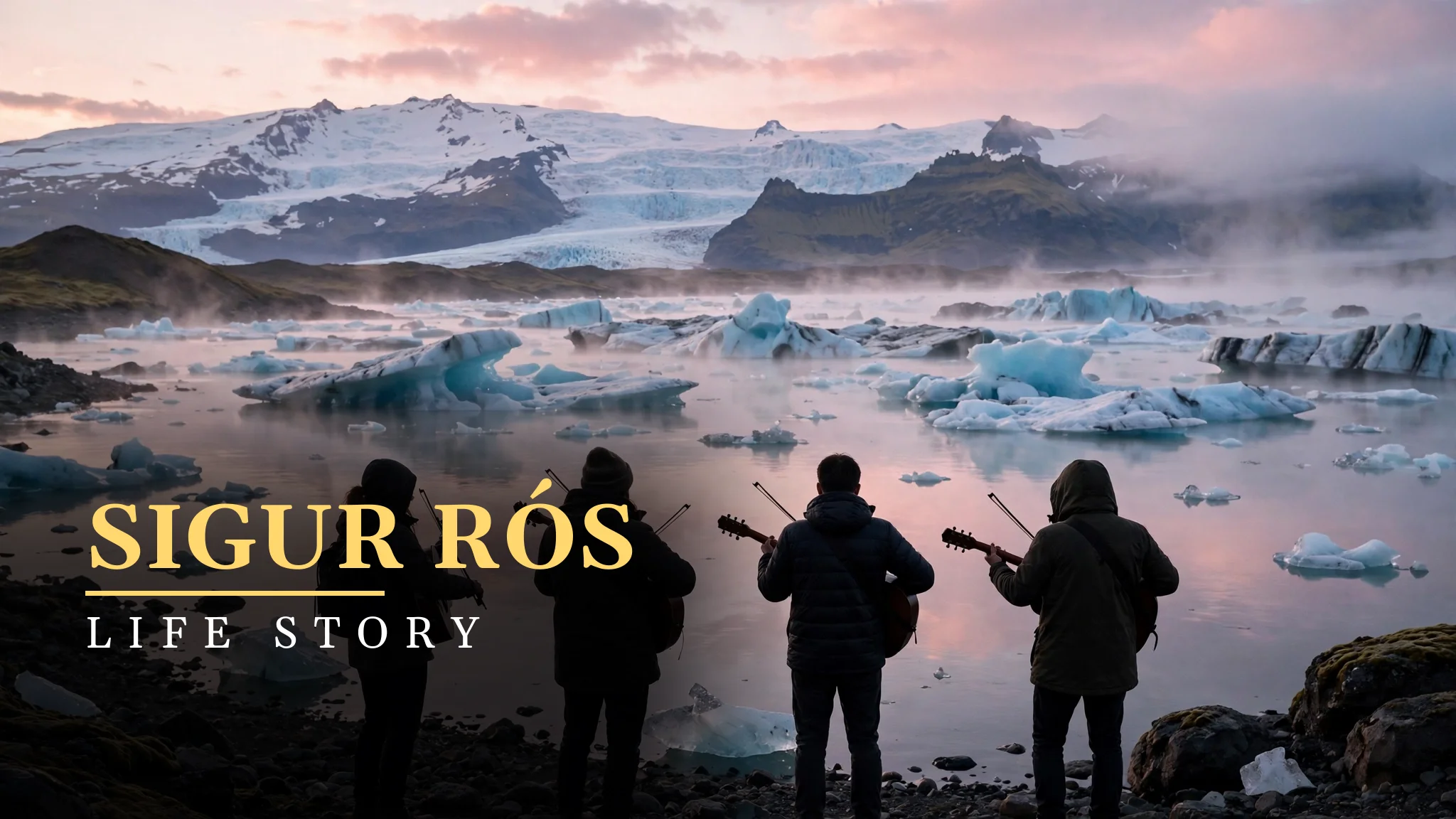
I will end with a simple image that stays in my mind. Four musicians in winter coats, standing by a glacial lagoon in Iceland, holding their instruments, looking out at the ice and the mountains. That image is the band in one picture. It is cold, it is beautiful, and it is full of quiet strength. The band stands in the cold and makes warm music, and that is a miracle of sorts. I am glad they exist, and I am glad their music is still being made.
When I finish thinking about Sigur Rós, I feel calm, and I feel hopeful, and I feel grateful. Calm, because the music slows me down. Hopeful, because the band shows that honest art can reach the world. Grateful, because I have heard music that makes me feel more human. That is a lot for one band to give, and it is a gift I do not take lightly. I will keep listening, and I will keep telling others to listen too.
I also think the band’s story has a message for people who feel different. If you are a quiet person in a loud world, if you like slow things when others like fast things, it is easy to think something is wrong with you. Sigur Rós tells you that nothing is wrong with you. Your quiet is a strength, your slowness is a gift, and there are other people who feel the same way. That message matters, and it is one more reason I love this band. I hope every quiet person who reads this story hears that message, and I hope they believe it, because it is true, and because this band is the proof that quiet people can move the world.
Frequently Asked Questions
When did Sigur Rós form and who started the band?
Sigur Rós formed in Reykjavík, Iceland, in 1994, when Jón Birgisson, known as Jónsi, Georg Hólm, and Ágúst Ævar Gunnarsson began playing music together. The band was named after Jónsi’s younger sister Sigurrós, and Kjartan Sveinsson later joined on keyboards, with Orri Páll Dýrason joining on drums in 1999.
What is Sigur Rós’s most famous song?
Hoppípolla, from the album Takk… in 2005, is the band’s most famous song, and it has been used in films, television shows, and advertisements around the world. Other well known songs include Svefn-g-englar, Starálfur, Glósóli, and Sæglópur.
What is Hopelandic?
Hopelandic, called Vonlenska in Icelandic, is a language invented by the band, with no fixed meaning, used on the untitled album ( ) in 2002 and in other songs. The idea is that the voice becomes another instrument, and each listener can hear their own feelings and meaning in the sounds.
Why does Jónsi play guitar with a bow?
Jónsi plays his electric guitar with a cello bow, which gives the guitar a singing and crying sound that is very different from normal guitar playing. The bowed guitar became one of the band’s most recognisable sounds, and it helps to give their music its dreamlike and floating feeling.
What are Sigur Rós’s most important albums?
Their most important albums are Ágætis byrjun from 1999, the untitled album ( ) from 2002, Takk… from 2005, and Átta from 2023. Their first album, Von, was released in 1997, and other albums include Með suð í eyrum við spilum endalaust, Valtari, and Kveikur.
Is Sigur Rós still active today?
Yes, the band returned with the album Átta in 2023, with Kjartan Sveinsson back in the group, and they have toured behind it. After a long break following Kveikur in 2013, the band is active again, playing their classic songs and their new music for fans around the world.


