Simona Halep: The Life Story Behind Romania's Tennis Star
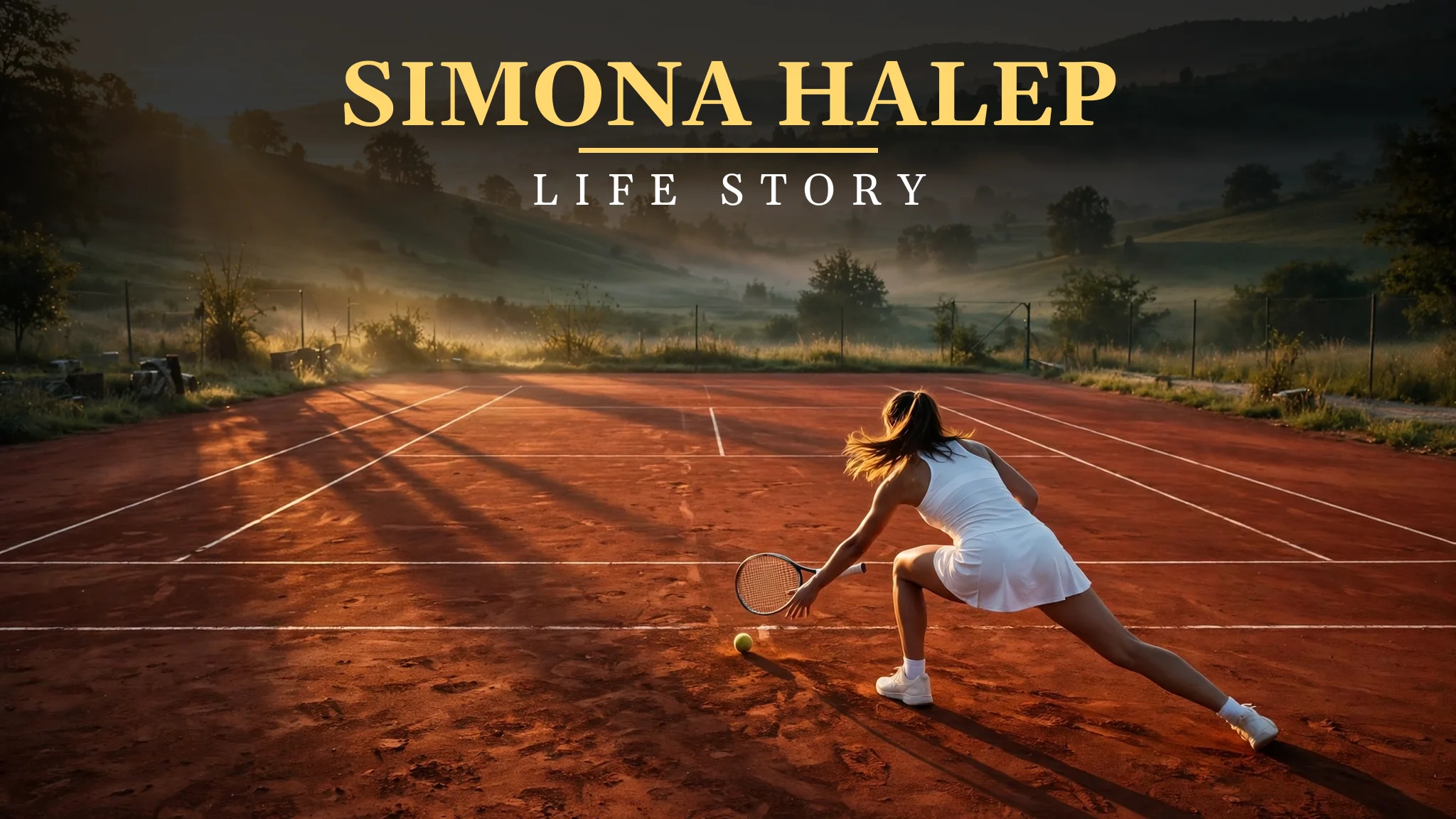
In this post
- A Girl From Constanta on the Black Sea
- The Breakthrough Year and the Finals She Lost
- Paris 2018: The First Grand Slam at Last
- Wimbledon 2019: Beating Serena on Centre Court
- The Ban That Took Almost Two Years
- Retirement in 2025 and a Country’s Love
- Darren Cahill and the Coach Who Changed Her Mind
- Romania’s Hero and the Love of a Country
- The 2017 French Open Final and a Painful Loss
- The Back Injury and Playing Through Pain
- The 2013 Breakthrough and Six Titles in One Year
- My Take:
Simona Halep is a fighter. She is not the tallest player, she is not the strongest player, and she does not hit the ball the hardest. But she runs for every ball, she never gives up on a point, and she has a will that is hard to break. She comes from Constanta, a port city on the Black Sea in Romania, and she carries the spirit of that place with her: a spirit of hard work, of patience, and of never giving up, even when the odds are against you.
Her story is about a girl who was told she was too small, who had surgery to change her body, who lost Grand Slam finals and then won them, who became world number one, who won Wimbledon by beating Serena Williams, and who then faced a doping ban that kept her away from tennis for almost two years. It is a story about fighting, about losing, about winning, and about a woman who refused to quit, even when the world seemed to be against her.
This is the story of Romania’s greatest tennis player, a woman who became a national hero, who was loved by her country, and who showed that a small player with a big heart can reach the top of the world.
A Girl From Constanta on the Black Sea
Simona Halep was born on 27 September 1991 in Constanta, Romania, a city on the Black Sea coast. Her father, Stere, owned a dairy factory, and her mother, Tania, was a housewife. Tennis was not the family business, but Simona began to play when she was four years old, hitting a ball with her older brother, Nicolae. She liked it at once, and she played every day. She was small, but she was fast, and she loved to run.
As a child, she played on clay courts in Constanta, and she learned to slide, to move, and to hit the ball with spin. Clay suited her, because it gave her time, and because it rewarded patience. She played junior tournaments in Romania, and she won many of them. She was a star in her country, and people began to say that she could become a great player. She was still a teenager, but she was already dreaming of the top.
She turned professional in 2006, when she was fifteen, and she began to play on the women’s tour. She was small, she was light, and she did not have a big serve. What she had was speed, and a fighting spirit, and a forehand that was strong. She climbed the rankings slowly, and she won titles in smaller tournaments. She was not a prodigy like some players. She was a worker, and she built her career one match at a time.
In 2009, she had surgery to reduce the size of her chest, because she felt it was holding her back on the court. It was a personal decision, and it was a brave one, and she spoke about it openly. She said she wanted to be faster, and to move better, and the surgery helped her. It was a sign of how serious she was about tennis, and how willing she was to do what it took to become the best.
The Breakthrough Year and the Finals She Lost
In 2013, Halep had her breakthrough year. She won six titles, she climbed into the top twenty, and she became one of the most improved players on the tour. She was playing with confidence, she was winning matches, and she was beating top players. She was twenty-two, and she was finally showing the talent that people had seen in her as a junior. It was a late breakthrough, but it was a real one.
In 2014, she reached the final of the French Open, losing to Maria Sharapova in three sets. It was a hard loss, because she had played well, and she had come close to winning. She also reached the semi-finals of Wimbledon, and she became world number two. She was now a top player, and she was a contender for Grand Slam titles. But the final step, winning a Grand Slam, was still ahead of her, and it would take time.
She continued to play well, and she won titles, but she also lost finals. She lost the French Open final again in 2017, to Jelena Ostapenko, a young player from Latvia, after leading by a set and a break. It was a painful loss, and it made people wonder whether she would ever win a Grand Slam. She was a great player, but she could not win the biggest matches. She was too nervous, some people said, and she did not have the belief that a champion needs.
She did not give up. She kept working, she kept training, and she kept believing that her time would come. She worked with a new coach, Darren Cahill, an Australian who had coached other great players, and he helped her to believe in herself. He taught her to be more aggressive, to take the ball early, and to trust her game. That partnership would change her career, and it would lead to her greatest wins.
Paris 2018: The First Grand Slam at Last
In 2018, Halep finally won a Grand Slam title. She went to the French Open in Paris, and she played with a calm that she had not shown before. She reached the final, and her opponent was Sloane Stephens of the United States. Halep lost the first set, and she was behind in the second, but she did not give up. She fought back, she won the second set, and she won the third, and she became the French Open champion. It was her third French Open final, and it was the first time she had won.
The win meant a great deal to her, and to Romania. She had lost two French Open finals, and she had been criticised for not winning, but she had kept going, and she had finally done it. She cried, she smiled, and she celebrated with her team. She was twenty-six, and she was a Grand Slam champion, and she was world number one. The girl from Constanta had reached the top, and she had done it the hard way, by losing and by coming back.
After Paris, she became more confident, and she played with a freedom that she had not had before. She was no longer a player who was afraid to lose a final. She was a player who knew she could win one, and that knowledge changed her. She won titles, she stayed at number one, and she became a national hero in Romania. Her matches were watched by millions of people in her country, and she was loved for her fighting spirit and for her humility.
She also became a role model for young Romanian players. She showed that a girl from a small city on the Black Sea could become the best player in the world, and that hard work and patience could pay off. She did not have the advantages of players from bigger countries, but she had a big heart, and that was enough.
Wimbledon 2019: Beating Serena on Centre Court
In 2019, Halep won Wimbledon, and she did it in the most impressive way possible. She reached the final, and her opponent was Serena Williams, the greatest player of her generation, a player who had won Wimbledon seven times. Serena was the favourite, and most people expected her to win. Halep did not care. She played the match of her life, and she beat Serena in straight sets, 6-2, 6-2, in less than an hour. It was a stunning win, and it was one of the best performances in a Wimbledon final in many years.
She played with a calm and a precision that Serena could not match. She hit the ball deep, she moved well, and she made almost no mistakes. She did not let Serena’s power overwhelm her, and she did not let the occasion overwhelm her. She played her game, and her game was enough. When she won, she fell to the grass, and she cried, and she became a Wimbledon champion. It was a moment that Romania would never forget.
The win made her a two-time Grand Slam champion, and it made her one of the great players of her generation. She had won the French Open on clay, and she had won Wimbledon on grass, and she had beaten Serena in a final. She was at the peak of her career, and she seemed ready to win more. She was twenty-seven, she was world number one, and the future looked bright.
But behind the success, there were problems. She had injuries, especially to her back, and she missed tournaments. She also had the pressure of being number one, and of carrying the hopes of a whole country. She kept playing, and she kept fighting, but her body was beginning to break down, and the tour was getting harder. She did not know that the hardest years of her career were still ahead of her.
The Ban That Took Almost Two Years
In 2022, Halep failed a drug test at the US Open, for a substance called roxadustat, and she was suspended from tennis. She said she had not taken the substance knowingly, and that it had come from a contaminated supplement. She fought the ban, and she went to a hearing, and she was initially banned for four years. She appealed, and in 2024, the ban was reduced to nine months, and she was allowed to return to tennis. She had been away for almost two years, and she had missed many tournaments.
The ban was a shock to her, and to Romania, and to the tennis world. She had always been known as a clean and honest player, and many people believed her. Others were not sure. She spoke about the ban openly, and she said it had been the hardest time of her life. She had lost her ranking, she had lost her income, and she had lost the game she loved. She had also lost her confidence, and she had to rebuild it from nothing.
She returned to tennis in March 2024, playing in Miami, and she won a match, but she lost in the next round. She was rusty, and her body was not ready, and she knew it would take time to get back to her best. She played in smaller tournaments, and she tried to climb the rankings, but it was hard. She was thirty-two, she had been away for a long time, and the game had moved on. She kept trying, because she loved tennis, and because she wanted to prove that she could come back.
Her return was not about winning Grand Slams. It was about playing again, and about showing that she had not given up. She played through pain, and through doubt, and she kept going. That is a kind of courage, and it is a part of her story that many people admire, even if they do not agree about the ban.
Retirement in 2025 and a Country’s Love
In February 2025, Halep announced her retirement from professional tennis, after losing in the first round of a tournament in Cluj, in Romania. She was thirty-three, and she had decided that it was time to stop. She played her last match in front of a home crowd, and she cried, and the crowd cheered her. It was a fitting end to a career that had begun in Romania, and that had made Romania proud.
She retired with two Grand Slam titles, a world number one ranking, and a reputation as one of the great fighters in tennis. She had won twenty-four titles in total, and she had been at the top for many years. She had also become a national hero, and she was loved by her country in a way that few athletes are loved. Her matches were watched by millions, and her name was known to everyone in Romania.
After retirement, she has spoken about her life, and about her future. She wants to help young Romanian players, and she wants to stay involved in tennis. She is also a wife, and she has a life outside the game. She has said that she is at peace with her decision, and that she is proud of what she achieved. She did not win as many Grand Slams as some players, but she won two, and she won them the hard way, by fighting for every point.
Her legacy in Romania is clear. She is the greatest Romanian tennis player of all time, and she is a symbol of hard work and of never giving up. Young girls in Romania look up to her, and they dream of becoming like her. She showed them that it is possible, even if you are small, even if you come from a small city, and even if the odds are against you. That is a legacy that will last long after her last match.
Darren Cahill and the Coach Who Changed Her Mind
Halep’s career changed when she began to work with Darren Cahill, an Australian coach who had worked with other great players. Cahill understood Halep, and he understood what she needed. She was a fighter, but she was also nervous in big matches, and she did not always believe in herself. Cahill helped her to believe, and he helped her to play more aggressively, to take the ball early, and to trust her game. He did not try to change her into a different player. He helped her to become a better version of herself.
He also helped her to stay calm in finals. In the French Open final in 2018, she lost the first set, and she was behind in the second, but she did not panic. She fought back, and she won, and that calm was a large part of Cahill’s work. He taught her to breathe, to focus on the next point, and to not think about the past. That mental strength was the key to her Grand Slam wins, and it was a skill that she had to learn, just as she had to learn to hit a forehand.
Cahill and Halep had a close relationship, and they worked together for many years, with breaks in between. He was a coach who believed in her, and who was honest with her, and who pushed her to be better. That honesty mattered, because Halep needed someone who would tell her the truth, not only what she wanted to hear. He did that, and she listened, and she became a champion. It is a partnership that shows how important a good coach can be, and how much a player can grow with the right person by their side.
Romania’s Hero and the Love of a Country
Halep is a national hero in Romania, and her matches were watched by millions of people in her country. When she played in a Grand Slam final, the whole of Romania stopped to watch, and when she won, the country celebrated. She was not only a tennis player. She was a symbol of Romania, and of what a Romanian girl from a small city could achieve. She carried that responsibility with humility, and she never forgot where she came from.
She was given honours by the Romanian government, and she was celebrated in Bucharest, her country’s capital, when she returned home after winning the French Open and Wimbledon. Thousands of people came to see her, and they cheered her, and they thanked her. It was a moment of national pride, and it showed how much she meant to her country. She was a hero, and she was loved, and she knew it.
She also gave back to Romania, by helping young players, by supporting tennis in her country, and by being a role model for girls who dream of playing tennis. She showed them that it is possible, even if you come from a small city, even if you are small, and even if the odds are against you. That message has inspired a generation, and it will continue to inspire young Romanian players for years to come. She is not only a champion. She is a national treasure, and her legacy in Romania will last long after her last match.
The 2017 French Open Final and a Painful Loss
In 2017, Halep reached the French Open final for a second time, and she played Jelena Ostapenko, a young player from Latvia who was playing in her first Grand Slam final. Halep won the first set, and she led by a set and a break in the second, and she seemed certain to win her first Grand Slam title. Then Ostapenko began to hit winners, again and again, and Halep could not stop her. Ostapenko won the second set, and she won the third, and Halep lost the final. It was a painful loss, and it made people wonder whether Halep would ever win a Grand Slam.
She did not give up. She kept working, and she came back to Paris in 2018, and she won. That is a story about resilience, and it is a story that many players can learn from. Losing a final when you are ahead is one of the hardest things in sport, and it can break a player. Halep did not break. She learned from it, she worked on her mind, and she came back stronger. The 2017 loss made the 2018 win sweeter, because she knew how much it had cost her to get there.
The Back Injury and Playing Through Pain
Halep had problems with her back for many years, and she played through pain that other players would not have tolerated. She missed tournaments, she had treatment, and she had to manage her body carefully. She did not complain, and she did not make excuses. She kept playing, and she kept fighting, because she loved tennis, and because she wanted to win. That toughness is a large part of who she was, and it is a part that many people miss, because they only see the wins and the losses, not the pain that came in between.
Her back also affected her movement, and she had to work harder to stay fit. She did exercises, she stretched, and she listened to her body, and she learned to play in a way that protected her back. That is a skill in itself, and it shows how smart she was as a player. She did not just hit the ball. She thought about her body, about her health, and about how to play for a long time without breaking down. She played for many years at the top, and that longevity is a testament to her intelligence and her discipline.
The 2013 Breakthrough and Six Titles in One Year
In 2013, Halep had her breakthrough year, winning six titles and climbing into the top twenty for the first time. She was twenty-two, and she was finally showing the talent that people had seen in her as a junior. She won in Nuremberg, in s-Hertogenbosch, in Budapest, in New Haven, in Moscow, and in Sofia, and she became one of the most improved players on the tour. It was a remarkable year, and it was the year when the tennis world began to take her seriously. She was no longer a promising junior. She was a top player, and she was a contender.
That year also showed her work ethic, because she played many tournaments, she travelled constantly, and she won matches week after week. She did not rest, and she did not complain. She kept playing, and she kept winning, and she built her ranking one match at a time. It was a late breakthrough, but it was a real one, and it set the stage for everything that followed. Without 2013, there would have been no French Open final in 2014, no world number one ranking, and no Grand Slam titles. That year was the foundation of her career, and it is a year worth remembering.
My Take:
I think Simona Halep’s story is about fighting, and I say that in the simplest way. She fought for every point, she fought for every title, and she fought for her career when it seemed to be over. She was not the biggest player, she was not the strongest player, and she did not have the easiest path to the top. She had to work for everything, and she did, and that work made her a champion. I admire that, because it is easy to admire talent, and it is harder to admire hard work, but hard work is what lasts.
What moves me most is the French Open win in 2018. She had lost two French Open finals, in 2014 and in 2017, and she had been criticised for not winning. She could have given up, and she could have believed the critics, but she did not. She went back to Paris in 2018, she lost the first set in the final, she was behind in the second, and she fought back and won. That is a story about never giving up, and it is a story that I think about often. It tells me that losing a final does not mean you will never win one, and that the third time can be the time that matters.
The Wimbledon win in 2019 is the part I love most. She beat Serena Williams in straight sets, 6-2, 6-2, in less than an hour, on Centre Court. Serena is one of the greatest players who ever lived, and she had won Wimbledon seven times, but Halep played the perfect match. She hit the ball deep, she moved well, and she made almost no mistakes. I try to imagine what it felt like to play that well, in front of that crowd, against that opponent, and to win so clearly. It must have been the best day of her life, and it was a day that Romania will never forget.
I also think about her size, and about the surgery she had in 2009. She was a small player, and she felt that her body was holding her back, so she had surgery to change it. That was a brave and personal decision, and she spoke about it openly. I respect that honesty, because it is not easy to speak about your body in public, and it is not easy to make a decision like that. She did it because she wanted to be faster, and to move better, and it helped her. It shows how serious she was about tennis, and how willing she was to do what it took to become the best.
The ban is the hardest part of her story to think about, and I want to be fair about it. She failed a drug test in 2022, she said it came from a contaminated supplement, and she was initially banned for four years, then the ban was reduced to nine months. I do not know what happened, and I do not want to judge her. I only know that the ban kept her away for almost two years, and that it hurt her career, and that it hurt her reputation. She fought it, she came back, and she played again, even though it was hard. That fighting spirit is a part of who she is, and I admire her for not giving up.
Her retirement in 2025, in Cluj, in front of a home crowd, is a fitting end to her story. She played her last match in Romania, and she cried, and the crowd cheered her. That is how a career should end, at home, with the people who love you. She did not win her last match, but she won something more important: the love of her country, and the respect of the tennis world. She left the game as a two-time Grand Slam champion, a former world number one, and a national hero.
What I learn from her is that being small is not a weakness. She was small, she was told she was too small, and she became the best player in the world. She proved that speed, fight, and a big heart can beat power and size. I think that is a lesson for young players who are told they are too small, or too slow, or not good enough. Halep tells them that they can do it, if they work hard, if they fight, and if they never give up.
I also learn from her that losing is a part of winning. She lost Grand Slam finals, she lost matches she should have won, and she lost almost two years to a ban, but she kept coming back. She did not let a loss define her. She let the loss teach her, and she used that lesson to grow stronger. That is a lesson for all of us, not only for tennis players. We all lose, and we all face setbacks, and the question is not whether we will lose, but whether we will come back. Halep came back, again and again, and that is why her story stays with me.
In the end, I think Simona Halep will be remembered as Romania’s greatest tennis player, as a fighter, and as a woman who never gave up. She won the French Open, she won Wimbledon, she became world number one, and she did it with a small body and a big heart. I hope young players in Romania and around the world read her story, and I hope they learn from her fighting spirit, because it is a spirit that can take you to the top, even when the odds are against you.
I also think about her back injury, and about how she played through pain for many years. She had problems with her back, and she missed tournaments, and she had to manage it carefully. She did not complain, and she did not make excuses. She kept playing, and she kept fighting, because she loved tennis, and because she wanted to win. That is a kind of toughness that is easy to miss, because it is quiet. She did not shout about her pain. She just played, and she won, and she did it with a bad back. I respect that, because it shows how much she wanted it.
What I learn from her is that a fighter is not born. A fighter is made, one point at a time, one match at a time, one loss at a time. Halep lost finals, she lost matches she should have won, and she lost almost two years to a ban, but she kept coming back. She did not let a loss define her. She learned from the defeat, and she turned that lesson into strength. That is a lesson for all of us, not only for tennis players. We all lose, and we all face setbacks, and the question is not whether we will lose, but whether we will come back. Halep came back, again and again.
In the end, I think Simona Halep will be remembered as Romania’s greatest tennis player, as a fighter, and as a woman who never gave up. She won the French Open, she won Wimbledon, she became world number one, and she did it with a small body and a big heart. I hope young players in Romania and around the world read her story, and I hope they learn from her fighting spirit, because it is a spirit that can take you to the top, even when the odds are against you.
I also think about the 2017 French Open final, when she led Ostapenko by a set and a break and still lost. That loss could have broken her, but it did not. She came back in 2018 and won, and that win was sweeter because of the pain that came before it. I think about my own losses, and about how hard it is to come back after a painful defeat. Halep shows me that it is possible, if you keep working, and if you believe in yourself. She did not let one loss define her. She let it teach her, and she used it to become a champion.
What I take from her, finally, is that a fighter is made, not born, one point at a time. She lost finals, she lost matches, and she lost almost two years to a ban, but she kept coming back. She did not let a loss define her. She let it teach her, and she used it to become stronger. That is a lesson for all of us. We all lose, and we all face setbacks, and the question is whether we will come back. Halep came back, again and again, and that is why her story stays with me.
I also think about her back injury, and about how she played through pain for years without complaining. She did not shout about it, and she did not make excuses. She just played, and she won, and she did it with a bad back. That quiet toughness is a part of her story I admire, because it shows how much she wanted it. She was not the biggest player, and she was not the strongest, but she was one of the toughest, and that toughness took her to the top of the world.
Another thought that stays with me is her love for Constanta, and for Romania. She never forgot where she came from, and she carried her hometown with her wherever she played. She was a girl from a port city on the Black Sea, and she became the best player in the world, and she did it without forgetting her roots. That humility is a gift, and it is a part of why Romania loves her so much. She is a hero, but she is also a normal person, and that combination is rare and wonderful.
I also keep thinking about her Wimbledon win in 2019, and about how perfect it was. She beat Serena Williams 6-2, 6-2, in less than an hour, on Centre Court, and she made almost no mistakes. It was one of the best performances in a Wimbledon final in many years, and it showed that she could play at a level that few players have ever reached. I try to imagine what it felt like to play that well, in front of that crowd, against that opponent, and to win so clearly. It must have been the best day of her life, and it was a day that Romania will never forget. That match is a perfect example of what she could do when she was calm, confident, and at her best.
Another thought that stays with me is her coach Darren Cahill, and how he helped her to believe in herself. She was a fighter, but she was also nervous in big matches, and she did not always trust her game. Cahill helped her to be more aggressive, to take the ball early, and to trust herself, and that belief was the key to her Grand Slam wins. He did not try to change her into a different player. He helped her to become a better version of herself, and that is what a good coach does. I think young players should look for a coach who understands them, and who believes in them, because that belief can change a career, just as it changed Halep’s.
A third thought is about her retirement in Cluj in 2025, in front of a home crowd, and about how fitting that ending was. She played her last match in Romania, she cried, and the crowd cheered her, and she knew that she was loved. She did not win her last match, but she won something more important: the love of her country, and the respect of the tennis world. She left the game as a two-time Grand Slam champion, a former world number one, and a national hero, and that is a legacy to be proud of. I hope she is at peace with her decision, and I hope she knows how much she is admired.
One last thought stays with me: her fighting spirit. She ran for every ball, she never gave up on a point, and she fought for every title, even when the odds were against her. That spirit took her from Constanta to the top of the world, and it is a spirit that young players should learn from. She was small, she was told she was too small, and she became the best player in the world anyway, because she fought harder than anyone else.
Frequently Asked Questions
How many Grand Slam titles did Simona Halep win?
She won two Grand Slam singles titles: the French Open in 2018 and Wimbledon in 2019. She also reached the French Open final in 2014 and 2017, and she was world number one.
How did Simona Halep win Wimbledon in 2019?
She beat Serena Williams in the final in straight sets, 6-2, 6-2, in less than an hour. It was one of the most impressive performances in a Wimbledon final, and she made very few mistakes.
Why was Simona Halep banned from tennis?
She failed a drug test at the US Open in 2022 for roxadustat. She said it came from a contaminated supplement. She was initially banned for four years, but the ban was reduced to nine months on appeal, and she returned in 2024.
When did Simona Halep retire?
She retired in February 2025, after losing in the first round of a tournament in Cluj, Romania. She was thirty-three and had decided it was time to stop.
What is Simona Halep’s highest ranking?
She reached world number one, and she held the top ranking for many weeks. She was the first Romanian woman to reach number one in singles.
Where is Simona Halep from?
She was born on 27 September 1991 in Constanta, Romania, a port city on the Black Sea. Her father owned a dairy factory, and she began playing tennis at four.


