Sol Kyung-gu: The Life Story Behind Korea's Veteran Star
In this post
- Growing Up in Seocheon and the Theatre
- Small Film Roles and the Long Road to Peppermint Candy
- Peppermint Candy and the Breakthrough
- Public Enemy, Silmido, and the Height of Fame
- The Merciless, The Book of Fish, and the Later Masterworks
- The Veteran and His Place in Korean Cinema
- The Face of Modern Korea and the Weight of History
- My Take:
Sol Kyung-gu is the kind of actor who carries a whole country in his face. He is not handsome in the smooth, polished way of a young star. He is weathered, strong, and real, with a voice that sounds like it has lived through hard times and a presence that fills a cinema without trying. For more than twenty-five years he has been one of Korea’s greatest film actors, playing soldiers, detectives, gangsters, fathers, and ordinary men caught in extraordinary times. He has played the pain of modern Korea itself, and audiences trust him because he never lies about that pain.
He began in theatre, like the best Korean actors of his generation, and his breakthrough came in Peppermint Candy, a film that runs backwards through twenty years of a man’s life, from a desperate man on a railway bridge back to the innocent young man he once was. It was a brave, strange film, and Sol’s performance in it is still regarded as one of the finest in Korean cinema. From there he went on to Silmido, one of the biggest Korean films ever made, to Public Enemy, to The Merciless, and to a long list of films that show his range, his power, and his honesty.
This is the story of a man from a small town who became a giant of Korean film, not by being glamorous, but by being true. It is a story about theatre, about a film that changed everything, about fame, about failure, and about a veteran who is still working, still learning, and still surprising audiences in his late fifties.
Growing Up in Seocheon and the Theatre
Sol Kyung-gu was born on 1 May 1968 in Seocheon, a county in South Chungcheong Province, South Korea. Seocheon is a quiet place of fields, rivers, and small towns, far from the bright lights of Seoul, and Sol grew up in that slower world. He was a boy who watched people, who listened to stories, and who felt the weight of ordinary life. That feeling, that life is hard and beautiful at the same time, would become the centre of his acting.
As a young man, he went to Seoul to study theatre and film at Hanyang University, one of Korea’s best universities. There he learned the craft of acting: voice, movement, text, and the history of theatre. He was a serious student, and he took the work seriously, because he understood that acting was not about showing off. It was about telling the truth, and truth takes training. He spent years on stage, playing many kinds of characters, and learning how to hold an audience without tricks.
Theatre in Korea in the 1990s was a hard life. It did not pay well, and it did not make a person famous, but it made a person strong. Sol became strong in those years. He learned to project his voice, to use his body, and to keep a character alive for hours. He also learned to work with other actors, to listen, and to put the play first. Those lessons stayed with him, and they are the reason his film acting feels so solid. He is not acting for a camera. He is acting for people, and the camera happens to be watching.
He also learned patience. A theatre actor can work for a decade without being noticed by film, and many give up. Sol did not give up. He believed that good work would lead to more good work, and he kept working, even when the future was unclear. That patience would be rewarded, but not quickly, and not easily.
Small Film Roles and the Long Road to Peppermint Candy
Sol Kyung-gu began appearing in films in the mid-1990s, taking small roles and learning how the camera sees a face. Film acting is different from theatre. On stage, you must be big enough for the back row. On film, you must be small enough for a close-up, and a tiny movement can say more than a loud speech. Sol learned to be smaller, to trust the camera, and to let his eyes do the work. It was a hard adjustment, and it took time, but he made it.
He appeared in a number of films in the late 1990s, playing supporting parts and building a reputation as a reliable, serious actor. Directors noticed him, but the public did not know his name. He was a working actor, not a star, and he was proud of that. He took the work seriously, he arrived prepared, and he gave every role his full attention, even when the role was small. That professionalism is worth more than it sounds, because in a fast industry, reliability is rare.
He also continued to work in theatre, because theatre was his home and because it kept his skills sharp. A screen actor who stops doing theatre can lose the habit of listening, and Sol never lost it. He listened, he watched, and he waited for the right role, a role that would let him show what he could really do. That role was coming, and it would change his life.
By the end of the 1990s, he was in his early thirties, an age when many actors worry that their chance has passed. For Sol, the chance had not passed. It was simply waiting, and when it came, it came in the form of a film that was as brave and as strange as he was.
Peppermint Candy and the Breakthrough
In 1999, Sol Kyung-gu starred in Peppermint Candy, directed by Lee Chang-dong, one of Korea’s greatest directors. The film tells the story of a man named Kim Yong-ho, and it runs backwards in time, starting with Yong-ho as a desperate, broken man standing on a railway bridge, and going back through twenty years of his life, to the young, innocent man he once was. It is a film about modern Korea, about the pain of a generation, and about how a good person can be broken by history.
Sol’s performance was extraordinary. He played Yong-ho at many ages, from a hopeful young soldier to a cruel businessman to a broken man, and he made each version feel like the same person, changed by life. He showed anger, sadness, cruelty, and tenderness, sometimes in the same scene, and he did it without asking for pity. The film was praised around the world, and Sol won major awards for his performance. He was no longer a working actor. He was a star, and he was a serious artist.
Peppermint Candy remains one of the most important Korean films ever made, and Sol’s performance in it is still studied by young actors. It showed what Korean cinema could do: tell a hard, honest story about a whole country, through one man’s life. And it showed what Sol could do: carry a film on his shoulders, for two hours, without ever letting the audience look away.
The film also set the pattern for his career. He would take on difficult, adult stories, about men who are flawed, about history that is painful, and about truths that are hard to face. He would not play safe heroes. He would play real men, and he would play them with honesty. That choice made him one of the most respected actors in Korea.
Public Enemy, Silmido, and the Height of Fame
After Peppermint Candy, Sol Kyung-gu became one of Korea’s biggest film stars, and the films that followed showed his range. In 2002 he starred in Public Enemy, playing a tough, funny detective chasing a rich and violent killer, and the film was a huge hit. He played the detective as a man who is rough, honest, and tired, a man who does his job because someone must, and audiences loved him for it. The film made him a commercial star as well as a critical one.
In 2003 he starred in Silmido, a film based on the true story of a secret military unit trained to kill the North Korean leader, and then abandoned by its own government. Sol played a member of the unit, a man who is trained, betrayed, and left with nothing, and his performance was powerful and sad. Silmido became one of the biggest Korean films of all time, drawing millions of viewers, and it confirmed Sol as a leading man who could carry a large, historical story.
In the years that followed, he starred in many successful films, including a disaster film, a comedy, and a thriller, and he showed that he could do almost anything. He played a man in a flood, a man in a love story, and a man in a crime film, and each time he brought the same honesty and the same power. He was at the height of his fame, and he was using that fame to take on interesting work, not only easy hits.
He also became known as a generous colleague, a man who helped younger actors and who treated staff with respect. Directors wanted to work with him because he was reliable, because he made other actors better, and because audiences trusted him. He was not only a star. He was a professional, and that professionalism kept his career strong.
The Merciless, The Book of Fish, and the Later Masterworks
In 2017, Sol Kyung-gu starred in The Merciless, a crime film about two men in a prison who become involved in a dangerous plan, and his performance was praised for its intensity. He played a man who is cold, clever, and dangerous, and he did it with a stillness that made the character frightening. The film was shown at the Cannes Film Festival, and it reminded the world that Sol was still one of Korea’s finest actors, even in his late forties.
In 2021 he starred in The Book of Fish, a black-and-white historical film about a scholar who is exiled to an island and who writes a book about fish with the help of a young fisherman. Sol played the scholar, a man who is proud, curious, and lonely, and his performance was gentle and wise. The film was praised for its beauty and its humanity, and it showed a different side of Sol: not the angry detective or the tough soldier, but a thoughtful, kind man who loves learning. It was a reminder that his range was wider than people thought.
He continued to work in films that interested him, including Kill Boksoon in 2023, a Netflix action film about a female assassin, where he played a supporting role, and A Normal Family in 2023, a drama about two brothers who face a moral crisis when their children commit a crime. In A Normal Family, he played a man who must choose between his family and his principles, and his performance was praised for its moral complexity. He was still taking on difficult roles, and he was still doing them well.
By his mid-fifties, he had become a veteran, a man whose name promised quality, and whose presence in a film made it better. Young actors looked up to him, directors wanted to work with him, and audiences still bought tickets when his name was on a poster. He had come a long way from Seocheon, but he had not forgotten where he came from.
The Veteran and His Place in Korean Cinema
Sol Kyung-gu is married to the actress Song Yoon-ah, and he has kept his family life private, as he has always done. He does not share his personal life with the press, and he does not use his fame to sell himself. He lets his work speak, and his work speaks loudly. That privacy has given his acting a kind of dignity, because when you watch him, you see the character, not the celebrity.
His career tells a larger story about Korean cinema. When he started, Korean films were growing, but they were still finding their voice. Today they are watched around the world, and Sol has been part of that rise, from Peppermint Candy to Silmido to The Merciless to The Book of Fish. He has worked with the directors who made Korean cinema what it is, and he has helped them tell stories that the world wanted to hear. He did it not by being glamorous, but by being true.
He is also a reminder that a career can be long, and that a long career is built on craft, not on fame. He did not become a star in one night. He became an actor over thirty years, role by role, film by film, and the result is a body of work that few actors in any country can match. Young actors who want a quick career should look at Sol Kyung-gu and learn patience. Patience is not a weakness. It is a strategy, and it works.
Today, Sol Kyung-gu remains one of Korea’s most respected actors. He continues to choose films carefully, and he continues to surprise audiences. He is still growing, and his best work may still be ahead of him. What is certain is that his story so far is a story of hard work, of honesty, and of a man who learned that the most powerful thing an actor can do is to tell the truth about a life, even when the truth is painful.
The Face of Modern Korea and the Weight of History
One of the most important things about Sol Kyung-gu is that his face has become, for many audiences, the face of modern Korea itself, and that story deserves to be told in full, because it explains why his performances feel so much larger than a single character. When he plays a soldier in Silmido, a detective in Public Enemy, a businessman in Peppermint Candy, or a scholar in The Book of Fish, he is not only playing one man. He is playing a generation, a time, and a history, and the audience feels that history in his face, in his voice, and in the way he carries himself. That is a rare gift, and it comes from a deep understanding of Korean history, of the pain of the country’s modernisation, and of the way ordinary people have lived through extraordinary times.
Peppermint Candy is the clearest example of that gift, and it is worth describing in detail, because the film is built on the idea that one man’s life can tell the story of a whole country. The film runs backwards, from 1999 to 1979, and Sol plays the same man at many ages, from a hopeful young soldier to a cruel businessman to a broken man on a bridge. In each period, he shows how history has changed the man, how the army, the factory, and the city have made him harder, colder, and sadder. He does not play history as an idea. He plays it as a lived experience, in the way a man walks, in the way he speaks to his wife, and in the way he looks at the world. That is why the film is still studied, and why Sol’s performance in it is still regarded as one of the finest in Korean cinema.
Silmido tells a different kind of history, the history of a secret military unit, and Sol plays it with the same truth. The men in Silmido are trained to kill, they are promised a mission, and then they are abandoned by the government that created them. Sol plays one of those men as a person who is loyal, who is brave, and who is betrayed, and he does it without making the character into a hero or a victim. He plays him as a man who did his duty and who paid for it, and that honesty makes the film feel like a real tragedy, not like a political argument. The audience does not need to know the details of Korean military history to feel the betrayal. They only need to watch Sol’s face, and they understand it.
His later films continue that work of telling history through a single life. In The Book of Fish, he plays a scholar in the Joseon era who is exiled to an island, and who writes a book about fish with the help of a young fisherman. The film is quiet, beautiful, and deeply human, and Sol plays the scholar as a man who is proud, curious, and lonely, a man who loves learning even when the world has punished him for it. That performance shows a different side of history, not the history of wars and politics, but the history of knowledge, of curiosity, and of the slow work of understanding the world. It is a reminder that history is not only about power. It is also about people who think, who learn, and who keep going.
Finally, it is worth saying that Sol’s gift for playing history comes from his own life, from growing up in a small town, from studying theatre, and from living through the rapid changes of modern Korea himself. He was born in 1968, he grew up as Korea was becoming a modern country, and he has watched that change with his own eyes. He brings that lived experience to his roles, and that is why they feel true. He is not acting history from a book. He is acting it from memory, from observation, and from a deep love of his country, with all its pain and all its beauty.
His work in Haeundae, the disaster film about a tsunami hitting Busan, is also worth remembering, because it showed a different side of him, the side that can carry a large, popular film without losing his honesty. He played a man caught in a disaster, a man who must protect his family and his community, and he did it with a warmth that made the huge spectacle feel human. The film was a massive commercial hit, and it proved that Sol could be a popular star as well as a serious artist, and that he could do both without compromising either. That balance, between art and popularity, is hard to hold, and Sol has held it for more than twenty-five years, which is a remarkable achievement.
He has also played fathers with a particular tenderness, and that tenderness deserves attention, because it is easy to think of him only as a tough man, a soldier or a detective, and to forget that he can be gentle. In his later films, he plays fathers who are tired, who worry about their children, and who love them without making a show of it, and that quiet love feels real. He does not play fathers who shout or who give long speeches. He plays fathers who listen, who cook, who drive, and who sit with their children in silence, and that silence, on screen, is more powerful than any speech. Audiences who are fathers themselves recognised that silence, and they felt seen by it.
My Take:
I think Sol Kyung-gu is one of the greatest actors Korea has ever produced, and I say that without hesitation. When I watch Peppermint Candy, I see a performance that is not only acting but a kind of history, a man who carries twenty years of a country’s pain in his face and his body. He plays a young soldier who is innocent, and then a businessman who is cruel, and then a broken man on a bridge, and he makes all of those men feel like the same person, changed by life. That is a rare gift, and I do not think it can be taught. It comes from understanding people, from watching them, and from having the courage to show them as they are, not as we wish they were.
What moves me most is his honesty. He does not try to make his characters likeable. He tries to make them true, and truth is often unlikeable. In Public Enemy, he plays a detective who is rough and funny and tired, a man who does his job because someone must, and who is not a hero in the simple sense. I think that is a more honest kind of heroism, the heroism of a person who keeps going when the work is hard and the reward is small. I have met people like that in real life, people who do difficult jobs without praise, and I think Sol understands them, because he is one of them in his own way. He does his job, he does it well, and he does not ask for applause.
I also admire his range, because it is easy to think of him as only a tough man, only a soldier or a detective, and then you watch The Book of Fish and you see a gentle scholar who loves learning and who is kind to a young fisherman. That performance surprised me, and it reminded me that people are bigger than the boxes we put them in. Sol is not only tough. He is also tender, and he is also wise, and he can show all of those things when the role asks for it. I think that is the mark of a great actor: not that he can play one thing well, but that he can play many things well, and that he can surprise you even after twenty-five years.
Silmido stayed with me for a long time after I learned about it, because it is a story about betrayal, about men who are trained to kill and then abandoned by their own country. Sol plays one of those men with a sadness that feels real, not performed. He does not shout about the injustice. He carries it in his body, in the way he walks, in the way he looks at the sea. I think that is a powerful way to tell a story about history, because history is not only about big events. It is about the small, broken lives of the people who live through those events, and Sol understands that. He plays the small life, and the big history comes through it.
I think about his theatre roots a great deal, because I believe they are the reason his acting feels so solid. In theatre, you must be present, you must listen, and you must earn the audience’s attention. Sol learned that, and he carried it into film, where many actors forget to listen. When I watch him, I see a man who is always listening, even when he is not speaking, and that listening makes the scene work. I wish more actors learned to listen like that. I wish more people in life learned to listen like that, too. Listening is a small thing, but it changes everything.
There is a lesson here about age, too. Sol is in his late fifties, and he is still doing some of the best work of his life. In a world that worships youth, that is a hopeful thing. It says that an actor does not run out of roles when he gets older. He grows into new ones, roles that need a face with lines, a voice with weight, and a life with experience. I think that is true for all of us, not only for actors. We do not become less as we get older. We become more, if we keep learning and keep working. Sol proves that, and I find it deeply encouraging.
If I could ask him one question, I would ask him what he learned from Peppermint Candy that he still uses today. I suspect he would talk about the film running backwards, about seeing a man’s life in reverse, and about understanding that the person you are now was once a different person, and that the person you will become is still being made. I think that is a profound idea, and it applies to all of us. We are not fixed. We are made, day by day, by the choices we make and the history we live through. Sol’s performance in that film shows that, and it is why the film still matters.
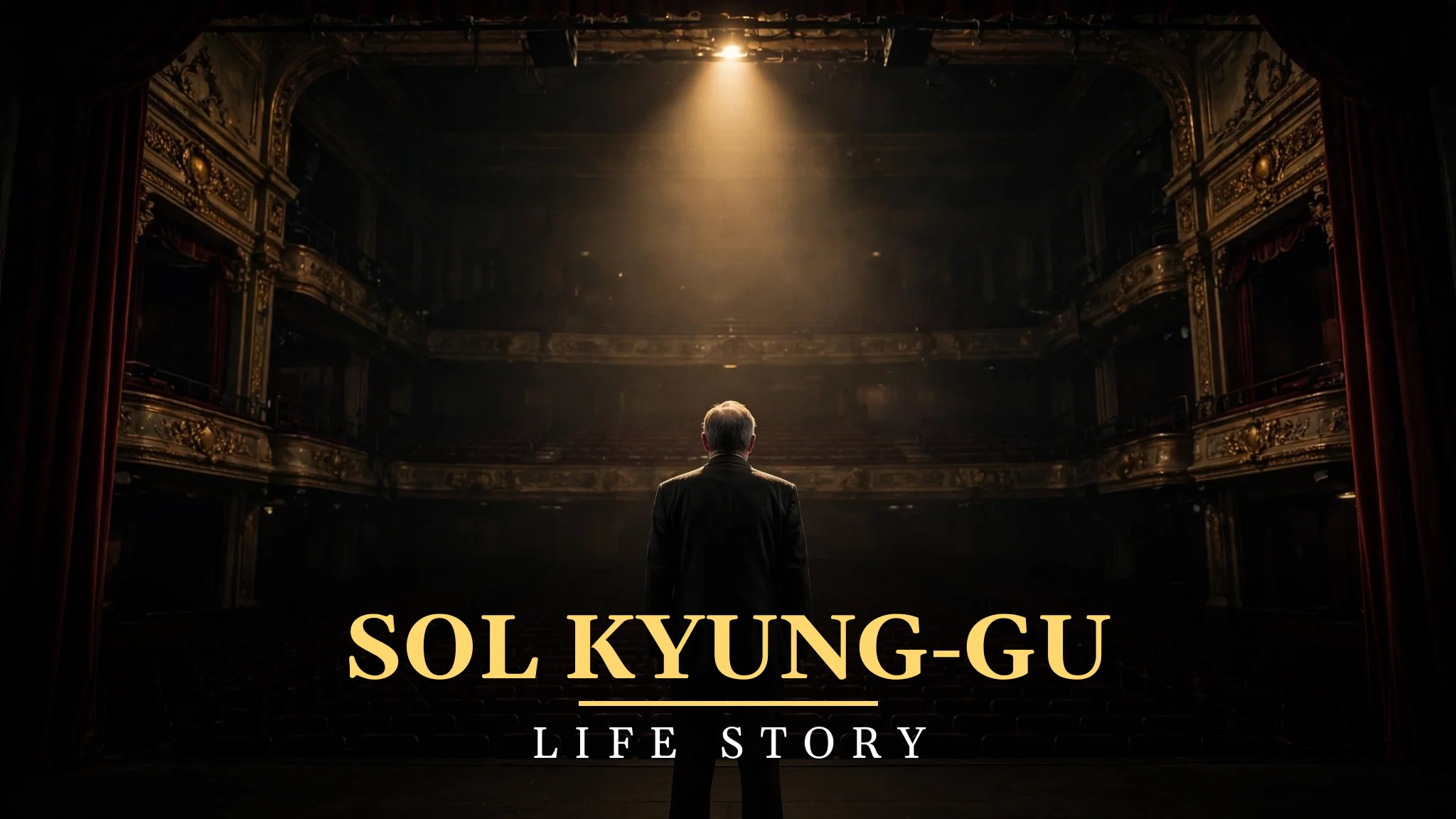
In the end, I come back to the image of him alone on a stage, facing empty seats, under a single light. That image fits him, because he has always seemed like a man of the theatre, a man who acts for the audience, even when the audience is not there yet. He stands alone, and he is ready, and that readiness is his power. I hope he keeps standing on that stage, and on film sets, for many years, and I hope his next roles are as brave as the ones that came before. I think Korean cinema is better because he is in it, and I think anyone who values honest, hard work will find a friend in his films.
One last thought stays with me. Sol Kyung-gu’s career shows that you do not need to be glamorous to be great. You need to be true, and you need to be patient, and you need to keep working when no one is watching. If you do those things, the work will speak for you, and it will speak louder than any headline. That is a lesson for actors, and it is a lesson for all of us. Be true, be patient, and let the work speak.
I also keep thinking about his face, because it is such a distinctive face, weathered and strong, and because it tells a story even when he is not speaking. When Sol Kyung-gu looks at the camera, you can see twenty years of Korean history in his eyes, and that is a rare gift. Most actors need dialogue to tell you who they are. Sol needs only a look, and the audience understands. I think that is because he has lived the history he plays, and because he brings that lived experience to every role. That is a lesson for all of us. Live fully, pay attention, and your face will tell the truth, even when you say nothing.
There is another thought that stays with me, about the difference between a star and a veteran. A star is someone who is famous now. A veteran is someone who has been good for a long time, and who is still good. Sol is a veteran, in the best sense, and his career shows what a veteran can do that a star cannot. He can play a man with a past, a man with a history, and a man who has lived, and he can do it with a depth that a younger actor cannot fake. I think that should give hope to every actor, and every person, who feels that they are getting older. You are not getting less. You are getting more, if you keep learning and keep working, and Sol proves it.
I also think about the young actors who look up to him, and about what they learn from watching him. They learn that acting is not about being pretty, and it is not about being loud. It is about being true, about understanding history, and about carrying a story with honesty. That is a valuable lesson, and it is one that will shape Korean cinema for years to come, because the young actors who learn from Sol will carry his honesty into their own work. That is how a tradition is built, not in a single film, but in a lifetime of good work passed from one generation to the next.
If I could watch only one of his performances again, it would be Peppermint Candy, because it is the film in which all his gifts come together: history, honesty, anger, and sadness, held in a single life told backwards. I would watch it and be reminded that a single film, played with total honesty, can tell the story of a whole country, and that an actor who is willing to carry that story is a rare and precious thing. I hope Sol Kyung-gu keeps carrying it for many years to come.
I also keep thinking about his work in Haeundae, because it showed a different side of him, the side that can carry a large, popular film without losing his honesty. He played a man caught in a disaster, a man who must protect his family, and he did it with a warmth that made the huge spectacle feel human. I think that balance, between art and popularity, is hard to hold, and Sol has held it for more than twenty-five years. He can make a film that millions watch, and he can make a film that only a few thousand watch, and he gives both the same honesty. That is a rare gift, and it is one reason his career has lasted so long.
There is another thought that stays with me, about the way he plays fathers. In his later films, he plays fathers who are tired, who worry, and who love their children without making a show of it, and that quiet love feels real. He does not play fathers who shout or give long speeches. He plays fathers who listen, who sit in silence, and who keep going, and that silence is more powerful than any speech. I think that helped many viewers see their own fathers differently, and it helped many fathers see themselves with more kindness. That is a real thing that art can do, and I am grateful that Sol’s work did it.
I also think about the young actors who look up to him, and about what they learn from watching him. They learn that acting is not about being pretty, and it is not about being loud. It is about being true, about understanding history, and about carrying a story with honesty. That is a valuable lesson, and it is one that will shape Korean cinema for years to come, because the young actors who learn from Sol will carry his honesty into their own work, and that is how a tradition is built, not in a single film, but in a lifetime of good work.
If I could watch only one of his performances again, it would be Peppermint Candy, because it is the film in which all his gifts come together, and because it is the film that tells the story of a whole country through a single life. I would watch it and be reminded that a single film, played with total honesty, can change the way you see history, and that an actor who is willing to carry that history is a rare and precious thing. I hope Sol Kyung-gu keeps carrying it for many years to come.
One more thought stays with me, and it is about history. Sol Kyung-gu has spent his career telling the story of modern Korea through single lives, and that story matters, because it helps a country remember who it is and where it came from. I hope he keeps telling it, and I hope audiences keep listening, because a country that remembers its history is a country that can build a better future.
Frequently Asked Questions
What is Sol Kyung-gu best known for?
He is best known for Peppermint Candy from 1999, where he played a man whose life is told backwards over twenty years, and for Silmido from 2003, one of the biggest Korean films of all time. He is also known for Public Enemy, The Merciless, and The Book of Fish. His powerful, honest acting has made him one of Korea’s most respected film stars.
Did Sol Kyung-gu start in theatre?
Yes, he studied theatre and film at Hanyang University and spent many years working on stage before moving into film. His theatre training gave him a strong voice, good timing, and the discipline of live performance. He still values theatre as the foundation of his acting.
What was Sol Kyung-gu’s role in Silmido?
In Silmido he played a member of a secret military unit trained to kill the North Korean leader, a unit that was later abandoned by its own government. His performance was powerful and sad, and the film became one of the biggest Korean hits ever made. It confirmed him as a leading man who could carry a large historical story.
Has Sol Kyung-gu won major awards?
Yes, he has won many honours for his film work, including major awards for Peppermint Candy and for his later films. Critics have praised his performances for more than twenty-five years, and he is regarded as one of the finest actors in Korean cinema history.
What kind of roles does Sol Kyung-gu usually play?
He often plays strong, complex men, including soldiers, detectives, gangsters, and fathers, and he is known for playing characters who carry pain and history in their faces. In recent years he has also shown a gentle, wise side, especially in The Book of Fish. His range covers crime, history, drama, and action, always with honesty.
What is the best entry point into Sol Kyung-gu’s long film career?
A new fan should start with Peppermint Candy for his greatest performance, then watch Silmido for a large, powerful historical film. Public Enemy shows his popular, funny side, and The Book of Fish shows his gentle, mature side. Together, they give a full picture of his range and his power.


