Souad Massi: The Life Story Behind Algeria's Gentle Voice
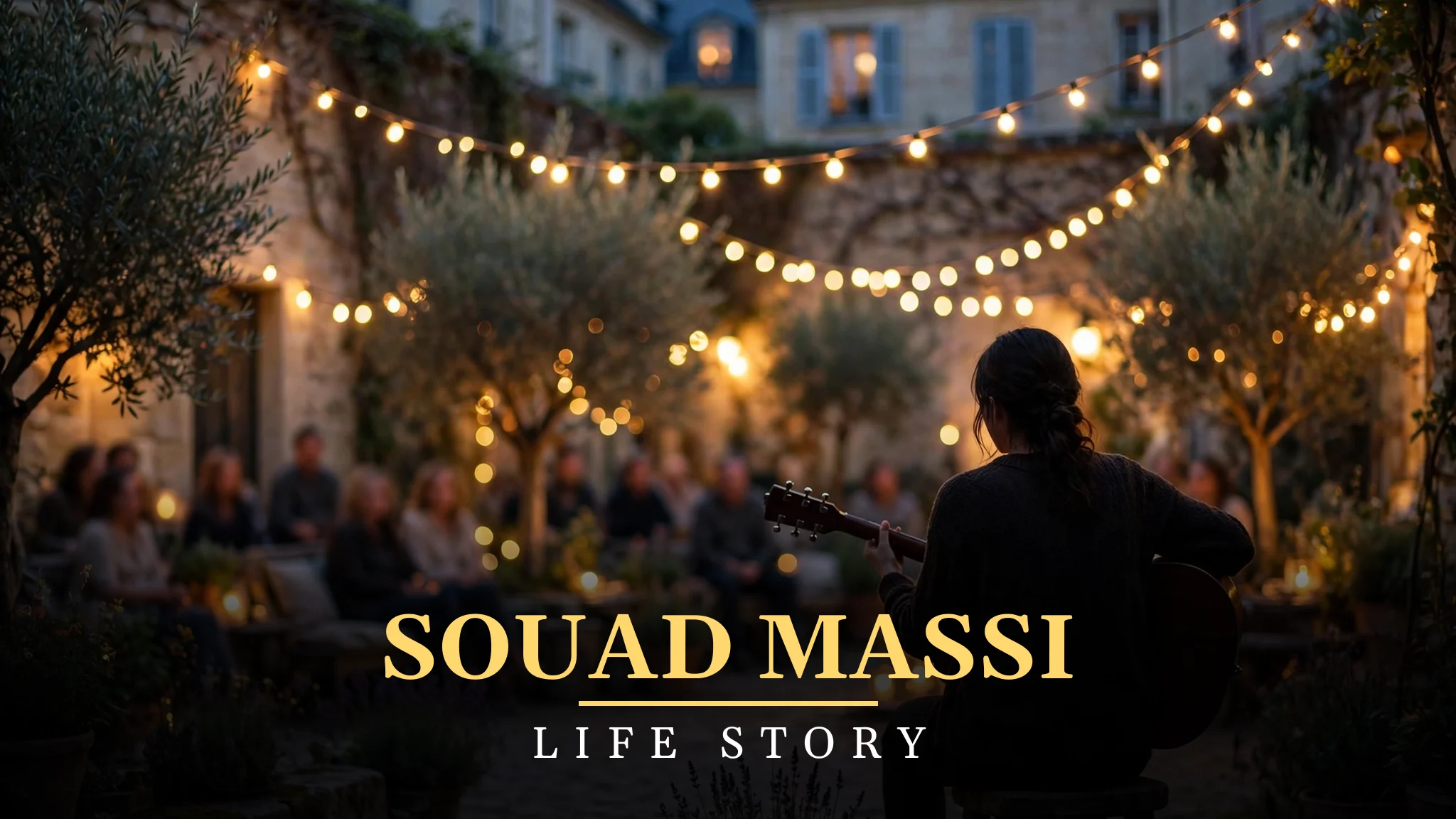
In this post
- Growing Up in Algiers With a Guitar in Her Hands
- Atakor, Rock Music, and Singing in a Dangerous Time
- Paris, Raoui, and Starting Again in a New Country
- Deb, Ghir Enta, and a Voice the World Learned to Love
- Mesk Elil, Ô Houria, and the Search for Freedom
- El Mutakallimûn, Oumniya, and a Mature Artist
- A Gentle Voice That Refused to Be Silenced
- The Guitar, the Songs, and the Life They Carry
- My Take:
Souad Massi is a singer and guitarist whose music is as gentle as it is brave, a soft voice that carries songs about love, freedom, and the pain of leaving home, sung in Arabic, in French, and in Kabyle. She was born in Algiers, she began her career in a rock band in a country torn by violence, and she moved to Paris in 1999, where she built a new life as one of the most respected folk singers in the world. Her albums, from “Raoui” to “Oumniya”, are quiet, beautiful records, full of acoustic guitar, of longing, and of a hope that is never loud but never dies.
What makes Souad’s story special is the courage it took to sing at all. In Algeria in the 1990s, a woman who played guitar in a rock band and sang about freedom was taking a risk, and the country around her was dangerous, with a civil conflict that made daily life uncertain and art a target. She sang anyway, and when the danger grew too great, she left, carrying her guitar and her songs to Paris, where she started again, in a new language, in a new city, with nothing but her voice and her determination.
Her music is not the music of a star who chases fame. It is the music of a woman who has lived, who has lost, and who has kept singing, and that honesty is why her fans love her so deeply. This is the story of how a girl from Algiers became Souad Massi, the gentle voice of Algeria.
Growing Up in Algiers With a Guitar in Her Hands
Souad Massi was born on 23 August 1972 in Algiers, the capital of Algeria, a city on the Mediterranean coast where the white buildings climb the hills above the sea, and where music has always been part of daily life. She grew up in the district of Bab El Oued, a working-class neighbourhood known for its strong community, its markets, and its music, and she learned to love song from the sounds around her, from the chaabi played in cafes, from the rai on the radio, and from the folk songs sung at home. Algiers in the 1970s and 1980s was a city full of life, and a child growing up there could hear many kinds of music in a single day.
As a girl she was drawn to the guitar, an instrument that was not common for young Algerian women at the time, and she learned to play it with a quiet determination, practising until her fingers knew the strings by heart. The guitar became her companion, a way to express feelings that were hard to put into words, and a tool that would carry her through the hardest years of her life. She also learned to sing, and her voice, soft and clear, fitted the guitar perfectly, creating a sound that was intimate and honest, like a conversation with a close friend.
School and study were part of her early life, and she balanced her education with her love of music, playing at home and with friends, and dreaming of a career that seemed far away. She did not grow up in a music school, and she did not have a teacher who laid out a path for her. She learned by listening, by playing, and by trying, and that self-taught beginning gave her music a freshness that formal training sometimes takes away. She was not trying to be perfect. She was trying to be true, and that truth is audible in every song she has made.
The Algeria of her youth was a country in change, with a young population, a rich culture, and a growing sense of unease, as the economy struggled and political tensions rose. Souad grew up inside that change, and she saw the hope and the fear of her generation, the desire for freedom and the pressure to conform. Those feelings would become the subject of her songs, and they would give her music a depth that listeners in many countries recognised, even if they did not know Algeria.
By the time she was a young woman, Souad knew that music was more than a hobby. It was the thing she wanted to do with her life, and she began to look for a way to make it real, in a country where a woman with a guitar was still an unusual sight. That search would lead her to a rock band, to a stage, and to a decision that would change her life forever.
Atakor, Rock Music, and Singing in a Dangerous Time
In the 1990s Souad Massi joined a rock band called Atakor, a group that played in Algiers at a time when the country was in the grip of a violent civil conflict, and when music, especially rock music sung by a woman, was a brave and dangerous act. Atakor was not a commercial band. It was a group of young musicians who loved rock, who played with energy and passion, and who used their music to speak about the life they were living, a life of fear, of hope, and of a desire for freedom. Souad was the singer and guitarist, and her presence on stage, a woman with a guitar singing rock songs in Algiers, was itself a statement.
The band played in small venues, at gatherings, and at concerts that were often tense, because the Algeria of the 1990s was a place where artists were targeted, where concerts could be dangerous, and where a singer who spoke about freedom could become a target. Souad and her bandmates knew the risks, and they played anyway, because music was their way of saying that life went on, that young people still had dreams, and that art could not be silenced by fear. That courage is a key part of her story, and it is one of the reasons her fans respect her so deeply.
Atakor’s music was a mix of rock, folk, and Algerian sounds, and Souad’s voice, soft and clear, stood out against the loud guitars, creating a contrast that made the band’s sound unique. She sang in Arabic and in French, and her lyrics spoke about love, about freedom, and about the pain of living in a country at war with itself. The band did not become famous in the usual sense, but it gave Souad her first real experience of performing, of working with other musicians, and of using music to say something that mattered.
The danger grew as the conflict continued, and Souad began to receive threats, as many artists in Algeria did in those years, for the simple act of singing in public. The threats were serious, and they forced her to think about her safety and her future, about whether she could continue to live and work in Algiers, or whether she needed to leave. That decision, to stay or to go, is one that many Algerian artists faced in the 1990s, and it is a decision that no artist should have to make, but Souad faced it with the same quiet courage she had shown on stage.
In 1999 she left Algeria and moved to Paris, a move that was both a loss and a beginning. She left her home, her family, and her band, but she carried her guitar and her songs with her, and she arrived in France determined to start again, to build a new career in a new country, and to keep singing the songs that had made her who she was. The Atakor years were over, but the lessons they taught her, about courage, about music, and about freedom, would stay with her for the rest of her life.
Paris, Raoui, and Starting Again in a New Country
Souad Massi arrived in Paris in 1999, a city that was both welcoming and strange, a place where she could sing freely but where she was far from home, from her family, and from the life she had known in Algiers. She began to play in small venues, at cafes and at gatherings of the Algerian community, and she slowly built a new audience, people who were moved by her gentle voice and her acoustic guitar, and who recognised in her songs the feeling of exile that many migrants know. Paris gave her safety, but it also gave her loneliness, and that loneliness became part of her music, a soft ache that runs through her best songs.
Her first solo album, “Raoui”, was released in 2001, and it was a breakthrough, a record that introduced her to a wider audience in France and beyond. The title means “storyteller” in Arabic, and the album was exactly that, a set of stories told in song, about love, about leaving home, about the pain of separation, and about the hope of return. The songs were quiet and acoustic, with Souad’s guitar and voice at the centre, and they stood out in a music world full of loud pop, because they were honest, intimate, and deeply felt. “Raoui” was praised by critics, and it won her new fans, people who had never heard of Atakor but who loved the gentle, folk sound of her solo work.
The album’s success was not a sudden explosion of fame. It was a slow, steady growth, as listeners discovered her music, shared it with friends, and came to her concerts, where they found a performer who was warm, humble, and completely focused on the songs. She did not put on a show in the usual sense. She sat with her guitar, she sang, and she let the music do the work, and that simplicity was part of her appeal. In a world of big productions, Souad’s small, honest performances felt like a breath of fresh air.
“Raoui” also marked a change in her sound, from the rock of Atakor to a softer, folk-influenced style, with influences from flamenco, from Portuguese fado, and from the folk music of many countries. She had learned from her time in Paris that music could travel, that a song from Algiers could be shaped by the sounds of Spain and Portugal, and that those influences could make the song richer rather than weaker. That openness to other cultures became a key part of her art, and it is the reason her albums appeal to listeners in many countries.
By the end of the “Raoui” period, Souad had done something remarkable. She had left her country, started again in a new one, and built a career that was respected by critics and loved by fans, all with a guitar and a gentle voice. She had also shown that exile, painful as it is, can be a source of art, and that a singer who has lost her home can find a new home in music.
Deb, Ghir Enta, and a Voice the World Learned to Love
Souad Massi’s second album, “Deb”, was released in 2003, and it built on the success of “Raoui”, with a richer sound and a set of songs that showed her growth as a writer and a performer. The title means “gold” in Tamazight, and the album was a golden record in every sense, with songs that were warm, melodic, and full of the feeling that had made her first album so loved. It was praised by critics in France and in the wider world, and it brought her to new audiences, including listeners in Britain and in America who discovered her music through the album’s international release.
One of the best-known songs from this period is “Ghir Enta”, a track whose title means “only you” in Arabic, and which became one of her signature works, a love song sung with a tenderness that makes it unforgettable. The song is simple, with a gentle guitar and a voice that carries the melody like a conversation, and it shows Souad at her best, singing about love in a way that is direct, honest, and deeply felt. It became a favourite at her concerts, where audiences sang along, and it remains one of the songs most associated with her name.
Other songs from “Deb” and from the albums that followed added to the picture of who Souad was as an artist, a singer who could move between languages and styles, who could sing a song in Arabic, in French, or in Kabyle, and who could make each language sound like her own. She worked with musicians from many countries, and those collaborations pushed her sound in new directions, adding flamenco guitar, string arrangements, and folk rhythms to her Algerian roots. The result was music that was both local and global, both Algerian and universal, and that appealed to listeners who had never been to Algiers.
Her live performances during this period also grew, and she began to tour in Europe, in North America, and in other parts of the world, playing at festivals and in concert halls where audiences came to hear her gentle voice and her acoustic guitar. A Souad Massi concert is a quiet, intimate event, with the singer sitting on stage, talking softly to the audience, and singing songs that make the room feel like a living room. Those concerts built her a loyal following, people who returned again and again, bringing friends, and who felt that her music was a part of their lives.
By the middle of the 2000s, Souad was recognised as one of the leading folk singers in the world, a woman whose music had travelled from a rock band in Algiers to concert halls in Paris, London, and New York, and whose voice had become a symbol of Algerian culture at its most gentle and most brave. She had also shown that a singer could be successful without being loud, without being shocking, and without giving up her identity, and that lesson is one that many young artists have learned from her.
Mesk Elil, Ô Houria, and the Search for Freedom
In 2005 Souad Massi released the album “Mesk Elil”, a title that means “night perfume” in Arabic, and a record that continued her journey as a folk singer, with songs that were more varied and more ambitious than her earlier work. The album mixed acoustic folk with flamenco, with rock, and with the sounds of North Africa, and it showed a singer who was confident in her style and willing to try new things. It was well received, and it kept her name alive in a music world that was changing fast, with new stars appearing every year and with the pressure to stay relevant growing stronger.
Her next major album, “Ô Houria”, released in 2010, was a more political record, with a title that means “Oh freedom”, and with songs that spoke about the desire for liberty, about the lives of women, and about the hope for a better world. The album was released in a year when the Arab world was on the verge of great change, with protests and revolutions beginning in Tunisia and Egypt, and Souad’s songs about freedom fitted the mood of the time. She did not write slogans. She wrote songs about the feeling of wanting to be free, and that feeling resonated with listeners who were living through those changes.
The songs on “Ô Houria” showed a singer who was growing bolder, who was willing to speak about politics and about women’s lives in a direct way, and who was not afraid to use her music to say something that mattered. She sang about the pain of exile, about the strength of women, and about the hope that a better future was possible, and she sang those songs with the same gentle voice that had made her famous. That combination, a soft voice and a strong message, is the heart of her art, and it is the reason her music is respected as well as loved.
During these years she also continued to tour, to perform at festivals, and to collaborate with other artists, and her reputation as a live performer grew. She was known as a singer who gave everything to her audience, who sang with honesty, and who created a warm, intimate atmosphere in even the largest hall. Those performances kept her connection with her fans alive, and they reminded everyone why her music mattered, even when the headlines were about other singers.
By the end of this period, Souad had established herself as more than a folk singer. She was a voice for freedom, for women, and for the Algerian diaspora, a singer whose gentle songs carried a powerful message, and whose career had grown from a rock band in Algiers to a world stage, without losing the honesty that had made her special.
El Mutakallimûn, Oumniya, and a Mature Artist
In 2015 Souad Massi released the album “El Mutakallimûn”, a title that refers to the great Arab poets and thinkers of the medieval period, and a record that set the words of those poets to music, with songs in Arabic that drew on the rich literary heritage of the Arab world. The album was a bold, ambitious project, and it showed a singer who was interested in more than pop songs, who wanted to connect her music to the deeper traditions of her culture. It was praised by critics, and it proved that Souad was still growing as an artist, still willing to take risks, and still capable of surprising her audience.
Her next album, “Oumniya”, released in 2019, was a more personal record, with a title that means “wish” or “desire”, and with songs that spoke about love, about hope, and about the life of a woman who has lived through much and who still believes in the future. The album was warm and reflective, with a sound that was both familiar and new, and it showed a mature artist who was comfortable with her voice and her style. It was a fitting record for a singer in her late forties, a woman who had seen a great deal and who had turned what she saw into music.
These later albums also showed her range as a singer, her ability to move between Arabic, French, and Kabyle, and her willingness to work with musicians from many countries. She had become a world artist, in the best sense, a singer whose music belonged to Algeria but also to the world, and whose songs could be heard in Paris, in London, and in Algiers with equal love. That breadth is a rare achievement, and it is one that Souad earned through years of work, of touring, and of staying true to her art.
Her live performances in these years remained the heart of her career, and she continued to sing at concerts and festivals, where audiences came to hear her gentle voice and her acoustic guitar. She was known for the warmth of her shows, for the way she spoke to the audience, and for the feeling that her concerts were not performances but gatherings, where a singer and her listeners shared a moment of music together. That feeling is hard to create, and Souad created it again and again, night after night, year after year.
By the end of the 2010s, Souad was recognised as one of the most important Algerian singers of her generation, a woman whose music had travelled from a rock band in a dangerous time to the world stage, and whose voice had become a symbol of gentleness, of courage, and of freedom. She had also shown that a singer could grow older without losing her relevance, and that a mature artist could make music that was as fresh and as honest as the work of her youth.
A Gentle Voice That Refused to Be Silenced
Souad Massi’s story is, above all, a story about a gentle voice that refused to be silenced, in a country where singing could be dangerous, in a city where she was far from home, and in a music world that often rewards the loudest voices. She sang softly, and she was heard, because her songs were true, because her guitar was honest, and because her listeners recognised in her voice their own feelings of love, of loss, and of hope. That is a remarkable achievement, and it is one that will keep her music alive for a long time.
Her legacy is still being written, because she is still active, still singing, and still making music, but its shape is already clear. She opened a door for other Algerian women who want to sing, who want to play guitar, and who want to speak about freedom, and she showed them that it is possible to do so with gentleness and with courage at the same time. She also helped to change the way Algerian music is heard in the world, bringing a soft, folk sound to audiences who had only known rai, and showing them a different side of her country.
For a young woman in Algiers today, Souad’s story is a reminder that a career in music can start with a guitar and a song, and that it can grow if the singer is willing to work, to learn, and to stay true to who she is, even when the world is dangerous and the road is hard. That message is hopeful, and it is one that Souad’s life makes real, in a way that no speech or slogan could.
The Guitar, the Songs, and the Life They Carry
The guitar that Souad Massi has carried since her youth is more than an instrument. It is a companion, a friend, and a part of her identity, and her songs are the life that guitar has carried, from Algiers to Paris, from a rock band to a folk stage, and from a young woman’s dreams to a mature artist’s reflections. Each album she has made is a chapter in that life, and each song is a moment, a feeling, a memory that she has shared with her listeners. That sharing is the heart of her art, and it is the reason her fans love her so deeply.
Today her music is still played, her concerts are still attended, and her name is still known as one of the gentle voices of Algeria, a singer who proved that softness can be strong, that a woman with a guitar can change the world, and that a song sung truly can travel further than a shout. Her story is not finished, and the next chapters will bring new songs, new concerts, and new moments when her voice fills a room and makes people feel less alone.
My Take:
I think Souad Massi is one of the bravest singers I have written about, and I say that because her bravery was quiet. She did not shout, she did not make a scene, and she did not seek controversy. She picked up a guitar in Algiers in the 1990s, she sang in a rock band, and she kept singing when the country around her was dangerous and when artists were threatened for the simple act of performing. That kind of quiet courage is harder than loud courage, because it does not get applause in the moment. It is a daily choice, to keep playing, to keep singing, and to keep believing that music matters even when the world is falling apart. Souad made that choice, again and again, and I admire her for it more than I can say.
What I love most about her music is its gentleness. Her voice is soft, her guitar is acoustic, and her songs are intimate, like a conversation with a close friend, and that gentleness is not a weakness. It is a strength, because it allows the listener to hear the feeling in the song, without distraction, without noise, and without the need to shout to be heard. In a world full of loud pop music, Souad’s quiet songs feel like a breath of fresh air, a reminder that music can be a whisper as well as a shout, and that a whisper, when it is true, can be heard further than a shout. I think about her concerts, where a whole hall falls silent to listen to a woman and a guitar, and I find that image deeply moving, because it shows how much people need quiet, honest music.
Her move from Algeria to Paris in 1999 is the part of her story that stays with me most, because it is a story of loss and beginning at the same time. She left her home, her family, and her band, and she arrived in a new country with nothing but her guitar and her songs, and she started again, in a new language, in a new city, with no guarantee that anyone would listen. That is a frightening thing to do, and it takes a kind of courage that many people never find. She found it, and she built a new career, album by album, concert by concert, until her name was known around the world. I think about how lonely those first years in Paris must have been, and how much strength it took to keep singing when the audience was small and the future was uncertain, and I respect her for it.
The album “Raoui” interests me because it shows what can happen when a singer starts again with honesty. The title means storyteller, and the album is exactly that, a set of stories told in song, about love, about leaving home, and about the hope of return, and those stories are told with a simplicity that makes them universal. A listener in France, in Britain, or in America can hear a song from “Raoui” and feel that it was written for them, even though it was written by a woman from Algiers who had just left her home. That universality is the mark of great art, and it is the reason “Raoui” is still loved today, more than twenty years after it was released.
I also think about the song “Ghir Enta”, and about how a simple love song can become a signature, a piece of music that defines a singer for the rest of her career. The song is not complicated. It is a gentle guitar, a soft voice, and a lyric about loving only one person, and yet it moves people deeply, because it is sung with a sincerity that cannot be faked. I think that is a lesson for any songwriter, that a song does not need to be clever or complex to be great. It needs to be true, and Souad’s songs are true, in a way that many more famous songs are not.
Her later work, especially “Ô Houria” and “El Mutakallimûn”, shows a singer who was willing to grow, to take risks, and to speak about freedom and about the literary heritage of her culture. “Ô Houria” is about freedom, a subject that mattered deeply to Souad, who had lived through a time when freedom was dangerous, and who had left her country because singing freely was not safe. To sing about freedom, in a gentle voice, is a powerful act, because it shows that freedom is not only a political idea. It is a feeling, a desire to live, to love, and to sing without fear, and Souad’s songs give that feeling a voice. I think that is a beautiful thing, and it is one of the reasons her music is respected as well as loved.
I want to say something about women in music, because Souad’s story is also a story about what it means to be a woman with a guitar in a world that often expects women to be quiet. She was not quiet. She played, she sang, and she led a rock band, and she did it in a country and a time when that was a brave act. She did not make a fuss about being a woman. She simply did the work, and she let the music speak, and that quiet defiance is more powerful than any speech. Young women in Algeria today who pick up a guitar owe her a debt, because she showed them that it was possible, and that a woman’s voice, even a gentle one, can be heard.
If I am honest, I do not think every album she made is perfect, and I do not think her music is for everyone. Some listeners will find it too quiet, too slow, or too far from the pop music they know, and I understand that. Her music requires patience, and it requires a listener who is willing to sit still and listen, and not everyone wants to do that. I think that is fine. Not every singer needs to please everyone. Souad pleases the listeners who need her, the people who are looking for a quiet, honest voice, and those listeners are loyal, because they know that her music is made for them, not for a chart.
I think about the Algerian diaspora, and about how Souad’s music travels with them, from Algiers to Paris, from Paris to London, and from London to the world. For a migrant, a song from home is not just entertainment. It is a reminder of family, of streets, and of a life left behind, and Souad’s songs carry that reminder with a gentleness that makes the longing bearable. She is a singer for people who live between worlds, and her music helps them to hold those worlds together, in a way that no other art can. That role, as a voice for exiles, is a heavy one, and she carries it with grace.
Her story also teaches a lesson about starting again, a lesson that many people need in a world where lives are disrupted by war, by migration, and by change. Souad lost her home, she left her band, and she started again in Paris, with nothing but a guitar, and she built a career that is respected around the world. That is a hopeful message, because it shows that a life can be rebuilt, that a career can be started again, and that a singer who is willing to work can find a new audience in a new country. I think that message matters, especially now, when so many people are forced to start again in a new place.
In the end, I think Souad Massi’s story is about a gentle voice that refused to be silenced, a woman who sang softly in a dangerous time, who left her home and started again, and who kept singing until the world learned to listen. Her music is not loud, but it is strong, and it will keep being heard for as long as there are people who need a quiet, honest song. I will keep listening to her albums, and I will keep thinking about the girl from Bab El Oued who picked up a guitar and changed her life, because her story reminds me that courage does not always shout. Sometimes it sings, softly, and that soft song can travel further than a shout ever could.
I hope her music keeps reaching new listeners, and I hope young singers in Algeria and in France know her name and understand what she achieved. She was not only a great folk singer. She was a bridge between a rock band in Algiers and a concert hall in Paris, between a dangerous time and a hopeful one, and between a woman’s voice and the world’s ear. Her life is a reminder that art can be gentle and still be brave, and that a single guitar, played truly, can carry a whole life across a sea. That is a gift, and I am grateful for it, and I think many listeners are too.
I want to end by thinking about the listener who hears a Souad Massi song for the first time, in a quiet room, on a phone, or in a car, and who feels a sudden sense of calm, as if someone were speaking directly to them. That feeling is the heart of her art, and it is the reason her music matters. She does not sing to impress. She sings to connect, and that connection, between a singer and a listener, is the most important thing in music. I hope that connection keeps growing, and I hope Souad keeps singing, because the world needs more voices like hers, gentle, honest, and true.
I also think about the guitar itself, and about how an instrument can become a part of a person. Souad’s guitar has been with her since she was young, through a rock band, through exile, and through a solo career in Paris, and it has carried her songs across a sea and across a life. That kind of companionship is rare, and it is a reminder that an artist’s tools are not only tools. They are friends, and they carry the artist’s history in their wood and their strings. I think about the guitar in her hands on stage, and I see a woman who is not alone, because she has her music with her, and that music has never left her.
Finally, I want to say that her story gives me hope for the future of Algerian music, and for the future of folk music in general. In a world that rewards loud, fast, and fashionable sounds, Souad shows that a quiet, acoustic song, sung truly, can still find an audience, and that a singer who stays true to her art can build a career that lasts for decades. That hope is important, because it tells young musicians that they do not have to shout to be heard, and that they do not have to give up their identity to succeed. Souad’s life is proof of that, and I hope it encourages others to pick up a guitar and sing, softly and truly, as she did.
I also think about the way her songs will age, and about whether a young listener ten years from now will still find comfort in a Souad Massi folk song. I believe they will, because her best songs are not built on a fashion that fades. They are built on a gentle voice, an acoustic guitar, and a feeling of longing that does not go out of date, and those things travel well across time. A quiet song, sung truly, will mean as much to a young Algerian in ten years as it does today, because the feeling behind it does not change. That is the test of a folk song, and Souad’s best work passes it with ease.
One last thought stays with me, about the district of Bab El Oued itself, with its streets, its markets, and its music, and about how a singer can carry a whole neighbourhood in her voice. Souad carries Bab El Oued with her, in her sound and in her memory, and when listeners in other countries hear her songs, they hear a little of that neighbourhood too. That is a beautiful thing for a singer to do, to make a place audible, and I hope she keeps doing it, song after song, for many years to come.
Frequently Asked Questions
When was Souad Massi born?
Souad Massi was born on 23 August 1972 in Algiers, Algeria. She grew up in the Bab El Oued district of the capital and began playing guitar as a young woman.
What was Atakor?
Atakor was the rock band Souad Massi sang and played guitar in during the 1990s in Algiers. The band performed at a time when Algeria was in civil conflict, and singing in public was a brave and dangerous act.
Why did Souad Massi move to Paris?
She moved to Paris in 1999 after facing threats in Algeria for her music during the civil conflict. In Paris she was able to sing freely and began her solo career with the album “Raoui”.
What is Souad Massi’s best-known album?
“Raoui”, released in 2001, is her best-known early album, a gentle folk record whose title means storyteller. “Deb” from 2003 and “Oumniya” from 2019 are also among her most loved records.
What is Souad Massi’s song Ghir Enta about?
“Ghir Enta” is a love song whose title means “only you” in Arabic. It is one of her signature songs, known for its gentle guitar and tender vocal performance.
What languages does Souad Massi sing in?
She sings in Arabic, in French and in Kabyle, the Berber language, often mixing languages and musical styles in her work. That mix reflects her Algerian roots and her life in France.


