SpaceX Dragon Blasts Off: 6,300 Pounds of Supplies Racing to the Space Station
SpaceX launched its CRS-35 Dragon cargo mission carrying 6,300 pounds of supplies, new solar arrays and medical experiments to the ISS. The full story.
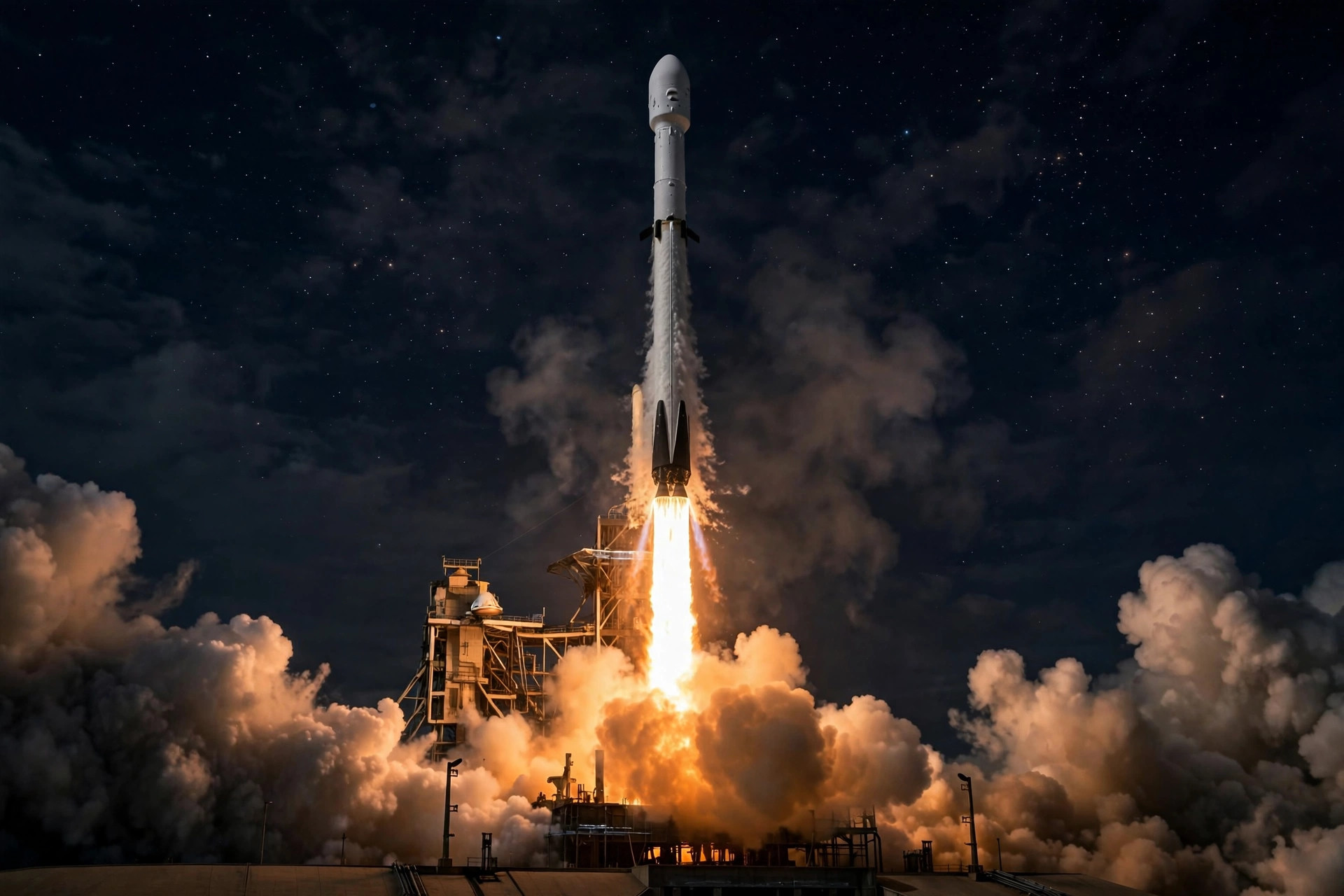
The sky over Florida was just beginning to glow when the rocket lit it up completely. At 6:33 in the morning on Tuesday, October 13, 2026, a SpaceX Falcon 9 roared away from Cape Canaveral, carrying a Dragon spacecraft packed with more than 6,300 pounds of food, science and hardware. Its destination: the International Space Station, a football-field-sized laboratory orbiting about 400 kilometres above Earth, where astronauts are waiting for their delivery.
There were no astronauts on board this flight. This Dragon is a cargo ship — a flying delivery truck for the most remote address humans have ever lived at. And this particular delivery, known as CRS-35, carries something special: the final pair of new solar wings that will complete a years-long upgrade of the station’s power system.
A Sunrise Liftoff from Cape Canaveral
The launch took place from Space Launch Complex 40 at Cape Canaveral Space Force Station in Florida, right on schedule at 6:33 a.m. local time (10:33 UTC). The weather barely caused a worry — forecasters had put the chance of a weather violation at under five percent. Under the soft glow of sunrise, the Falcon 9 climbed into the sky on a northeast path, matching the tilt of the station’s orbit.
Minutes later came the moment Florida residents have learned to listen for. The rocket’s first-stage booster, a veteran machine known as B1096 flying for the eighth time, turned around and flew itself back to Landing Zone 40, right next to the launch pad. Its return broke the sound barrier over the spaceport, sending a thunderous sonic boom rolling across the area — the sound of a rocket coming home instead of falling into the ocean. Less than ten minutes after liftoff, the Cargo Dragon, spacecraft C211, separated from the rocket’s upper stage and began its solo journey. For C211, this is familiar work: the same spacecraft has already flown three cargo missions before — CRS-26, CRS-29 and CRS-33.
What Does CRS-35 Actually Mean?
The name sounds like alphabet soup, but it is simple once you break it down. CRS stands for Commercial Resupply Services — a NASA program in which the space agency hires private companies, like SpaceX, to carry supplies to the space station instead of building and flying every delivery vehicle itself. Think of it as NASA booking a courier service, except the courier is a rocket.
CRS-35 is simply the 35th such delivery SpaceX has flown for NASA under this program. It is a system that has quietly become the backbone of life on the station: regular flights bring up food, clothing, spare parts and experiments, and carry results and rubbish back down. The crew currently waiting to receive this shipment is Crew-13, who arrived at the station on October 1. The port Dragon will use was freed up only days ago, when Crew-12’s spacecraft splashed down off California on October 8 after nearly eight months in orbit.
The Final Solar Wings
The star of this cargo load is riding in Dragon’s trunk — the unpressurised back section of the spacecraft. Inside are the final two Roll-Out Solar Arrays, known as iROSAs, built by Redwire Space. These are not ordinary solar panels. Instead of folding like a book, each one rolls out like a giant fruit roll-up, unrolling into a wing more than 18 metres long once astronauts install it during spacewalks.
Each array can produce more than 20 kilowatts of power for more than ten years. They are the fourth and final pair in a multi-year program to modernise the ageing station’s electricity supply, and NASA has been preparing for their installation with a series of spacewalks. When these last wings are in place, the station’s power upgrade will be complete — giving the orbiting laboratory the electricity it needs to keep running experiments well into its final years.
The upgrade was badly needed. The station’s original solar wings have been in space for more than two decades, and the harsh environment of orbit — blazing sunlight, bitter cold and tiny micrometeorites — slowly wears them down, so each year they produce a little less power than the year before. Rather than replacing the giant old wings, engineers chose a smarter path: smaller, newer roll-out arrays placed partly over the old ones, squeezing far more electricity out of modern solar technology. It is the space equivalent of fitting a brand-new engine into a beloved old car — and CRS-35 is delivering the last parts.
Science, Medicine — and Even Tiny Shrimp
The rest of the 6,300 pounds is a floating shopping list of science. Dragon is carrying medical experiments, science hardware and investigations designed by researchers back on Earth, including an experiment created by students at Florida Tech, who will now be able to say their work flew to space. Among the reported payloads is a biology project called SCAMPI, carrying three live Hawaiian red shrimp — tiny crustaceans scientists use to study how living creatures adapt to weightlessness. What happens to a small animal’s body when gravity disappears is exactly the kind of question the station exists to answer, and the answers help prepare humans for longer journeys to the Moon and Mars.
Two Days of Chasing, Then a Gentle Arrival
Getting to the station is a slow, careful dance. The space station travels at about 28,000 kilometres per hour, so Dragon must gradually raise its orbit and match that speed precisely. The chase takes just over 52 hours. If all goes to plan, Dragon will dock by itself — fully autonomously, with no pilot — at the space-facing zenith port of the station’s Harmony module on Thursday, October 15, at around 11 a.m. Eastern Time (15:00 UTC), while astronauts monitor its arrival.
After docking, the crew will unload the supplies and begin the new science. Dragon will stay attached to the station for about a month before undocking in November, splashing down with experiment results and other cargo that needs to return to Earth — completing another round trip for one of the hardest-working delivery trucks in history.
Why the Station Cannot Simply Stock Up
People often ask why astronauts need deliveries so often. The answer is that a space station is less like a house and more like a ship on an endless voyage. The crew cannot grow enough food in orbit, cannot manufacture spare parts for every machine, and cannot store years of supplies in a home the size of a large house. Oxygen and water are recycled with great care, but nothing recycles perfectly. Experiments also have deadlines: medical samples, living cells and tiny creatures like the SCAMPI shrimp must arrive fresh, because their whole purpose is to be studied alive in weightlessness.
That is why missions like CRS-35 matter so much. Each Dragon is a care package and a laboratory delivery in one — and also a return ticket, since the same spacecraft later brings experiment results, worn equipment and scientific samples safely back to Earth through an ocean splashdown, something no other cargo vehicle currently flying to the station can do in the same way. Behind every quiet launch is a simple promise: as long as humans live above the Earth, someone on the ground must keep sending what they need to survive.
Frequently Asked Questions
What is the SpaceX CRS-35 mission?
CRS-35 is SpaceX’s 35th cargo delivery flight to the International Space Station under NASA’s Commercial Resupply Services program. It launched on October 13, 2026, from Cape Canaveral, Florida.
How much cargo is Dragon carrying?
More than 6,300 pounds of supplies, science hardware and experiments, including the final pair of iROSA Roll-Out Solar Arrays for the station’s power system.
When will Dragon reach the space station?
Docking is planned for Thursday, October 15, 2026, at around 11 a.m. Eastern Time, after a journey of just over 52 hours. Dragon will dock autonomously at the Harmony module.
Are there astronauts on this flight?
No. This is a cargo-only mission using the Cargo Dragon spacecraft C211, which is flying its fourth mission. The station’s Crew-13 astronauts will receive and unload the delivery.
The Delivery Truck of the Space Age
A generation ago, a supply run to a space station was front-page drama. Today, it is a Tuesday morning launch that most of the world slept through — and that is precisely the achievement. SpaceX and NASA have turned space delivery into a routine service, and CRS-35, with its final solar wings and its tiny shrimp passengers, shows how far that routine now reaches. The Dragon is on its way. The station is waiting.