Split Enz: The Life Story Behind the New Wave Stars
In this post
- Tim Finn, Phil Judd, and the Birth of the Band
- Neil Finn Joins and the Sound Changes
- True Colours, I Got You, and the Breakthrough
- Waiata, Time and Tide, and the Peak Years
- Conflicting Emotions, Message to My Girl, and the End
- Reunions and the Band’s Later Life
- The Legacy of New Zealand’s Strangest and Best Band
- The Costumes, the Theatre, and the Show
- My Take:
Split Enz was a band like no other. They wore wild costumes, they painted their faces, they played songs that were strange and beautiful at the same time, and they made audiences in New Zealand and Australia fall in love with them. They started as an art-rock band in Auckland, playing music that was theatrical and odd, and they ended as one of the most successful pop bands in the Southern Hemisphere, with hit songs like “I Got You”, “Six Months in a Leaky Boat”, and “Message to My Girl”. Their story is a story about being different, about taking risks, and about two brothers, Tim and Neil Finn, who wrote some of the best songs ever to come from New Zealand.
The band was formed in 1972 by Tim Finn and Phil Judd, two young men from Auckland who loved music and art. They wanted to make something new, something that had never been heard before, and they did it. Their early shows were full of colour and drama, with costumes that looked like they had come from a circus, and songs that mixed rock, folk, and theatre. People did not know what to make of them at first, but they could not look away. Split Enz was a band that demanded attention, and they got it.
What makes their story worth telling is the way they changed and grew without losing their spirit. They started as outsiders, they became pop stars, and they did it by writing better and better songs. Their music moved from strange art-rock to bright and clever pop, and each album was better than the one before it. They also gave the world Neil Finn, one of the greatest songwriters of his time, and they gave New Zealand a band that it could be proud of. This is the story of a band that was too strange to be ignored, and too good to be forgotten.
Tim Finn, Phil Judd, and the Birth of the Band
Split Enz was formed in Auckland in 1972 by Tim Finn and Phil Judd, two friends who had met at university. Tim was a singer and songwriter, and Phil was a guitarist and songwriter, and together they had a vision of a band that would be different from anything else in New Zealand. They wanted to mix music with art, with theatre, and with humour, and they wanted to make shows that were as much a visual experience as a musical one. They called the band Split Enz, a play on the words “split ends” and the name of their country, and the name was as odd as the band itself.
The early band was a large group, with many members, and their music was a mix of folk, rock, and art. They wore strange costumes, they painted their faces, and they played songs that were long and complex. Their first album, Mental Notes, was released in 1975, and it showed a band that was full of ideas. The songs were clever and unusual, and the band’s live shows were famous for their energy and their visual style. People who saw them live never forgot them, because they had never seen anything like it.
The band’s early years were hard. They toured New Zealand and Australia, they played in small venues, and they struggled to make a living. The music business did not know what to do with a band that was so strange, and record companies were not sure how to sell them. But Split Enz kept going, because they believed in their music, and because they had a small but loyal audience who loved them. They were outsiders, and they were proud of it.
By the late 1970s, the band had begun to change. Phil Judd left the group, and Tim’s younger brother Neil Finn joined. Neil was a gifted songwriter and singer, and his arrival changed the band’s sound. The songs became shorter, sharper, and more melodic, and the band began to move towards pop music. The strange art-rock band was becoming a pop band, and the best years of their career were about to begin.
Neil Finn Joins and the Sound Changes
Neil Finn joined Split Enz in 1977, and his arrival was a turning point for the band. Neil was younger than Tim, but he was already a talented songwriter, and he brought a new energy to the group. He wrote songs that were catchy and clever, with strong melodies and honest words, and he sang them in a clear and warm voice. Tim and Neil became a songwriting partnership, two brothers who wrote songs together and who pushed each other to be better. Their partnership would become one of the most important in New Zealand music.
The band’s sound changed with Neil’s arrival. The long and complex songs of the early years gave way to shorter and sharper pop songs, and the costumes became less wild, though the band still kept its visual style. The music was still clever and unusual, but it was now easier to listen to, and more people began to like it. The band’s live shows were still full of energy, and the brothers’ harmonies became a signature of their sound. Audiences in New Zealand and Australia began to take notice, and the band’s fan base grew.
The band also began to work with new producers, who helped them to make records that sounded bright and clear. They recorded in London and in Australia, and they learned how to make a pop record that could compete with the best bands in the world. They were no longer just an art-rock band from Auckland. They were a pop band with a unique sound, and they were ready to make their mark on the world.
By the end of the 1970s, Split Enz was ready for its breakthrough. The band had the songs, the singers, and the sound, and they had a new confidence that came from years of hard work. The strange band from Auckland was about to become a pop sensation, and the world was about to hear their music.
True Colours, I Got You, and the Breakthrough
In 1980, Split Enz released the album True Colours, and it changed everything. The album was a bright and clever pop record, full of strong songs and sharp melodies, and it became a huge success in New Zealand and Australia. The album included the song “I Got You”, written by Neil Finn, which became a number one hit in both countries. The song was a joyful and catchy pop song, with a melody that stayed in the mind, and it made Split Enz famous. It was the song that the band had been working towards for eight years, and it was worth the wait.
True Colours also included other strong songs, including “Shark Attack” and “What’s the Matter with You”, and it showed a band that had learned how to write pop songs without losing its cleverness. The album was produced in a way that made the songs sound bright and clear, and it was a record that people wanted to play again and again. The band toured to support the album, playing in New Zealand, Australia, and Britain, and audiences who had never heard of them before fell in love with their music.
The success of True Colours and “I Got You” made Split Enz one of the biggest bands in the Southern Hemisphere. They were no longer outsiders. They were pop stars, and they were enjoying it. But they did not let the success change them. They kept writing songs, they kept playing live, and they kept pushing themselves to be better. They understood that a hit album is a gift, but it is also a test, and they passed that test again and again.
The years after True Colours were the happiest of the band’s career. They were making the music they loved, they were playing to big crowds, and they were being recognised as one of the best bands in the world. They had come from a small town in New Zealand, and they had become pop stars. That was a remarkable journey, and it was only the beginning.
Waiata, Time and Tide, and the Peak Years
The band’s next album, Waiata, was released in 1981, and it was another success. The album was also known as Corroboree in Australia, and it included the songs “History Never Repeats” and “One Step Ahead”. The album showed a band that was confident and creative, and it proved that True Colours was not a one-off. Split Enz could write hit songs again and again, and they could do it without repeating themselves. The band’s sound was bright and clever, and their songs were full of ideas.
Their next album, Time and Tide, was released in 1982, and it included one of their most famous songs, “Six Months in a Leaky Boat”. The song was about a journey across the sea, and it was inspired by the story of the first European settlers who sailed to New Zealand. The song was a hit in New Zealand and Australia, and it became one of the band’s signature songs. It was a song that was both clever and emotional, and it showed that Split Enz could write about history and about the sea in a way that felt personal and real.
Time and Tide also included other strong songs, and it was another success. The band was at the peak of its career, playing to big crowds, making hit records, and being recognised as one of the best bands in the world. They had come a long way from the art-rock band that had started in Auckland in 1972, and they had done it by writing better and better songs. Their music was pop, but it was pop with a brain, and that was what made it special.
During these years, the band also toured the world, playing in Britain, in America, and in other countries. They were respected by other musicians as a band with a unique sound, and they were loved by their fans for their energy and their creativity. They were at the top of their game, and they were enjoying every moment of it.
Conflicting Emotions, Message to My Girl, and the End
In 1983, the band released the album Conflicting Emotions, and it showed a band that was changing again. The album was more serious and more thoughtful than their earlier work, and it included the song “Message to My Girl”, written by Neil Finn. The song was a beautiful and gentle love song, and it became one of the band’s most loved songs. It was a song that showed Neil’s gift for writing about love in a simple and honest way, and it became a favourite at concerts and on the radio.
The album also showed that the band was under strain. The members had been working together for many years, and they were tired. Tim Finn was thinking about a solo career, and the band was finding it hard to keep going. The music was still good, but the energy that had driven the band for so long was beginning to fade. It was a sad time, but it was also a time of great music, because the band was still writing songs that mattered.
In 1984, Split Enz came to an end. The band played their final shows, and the members went their separate ways. Tim Finn began a solo career, and Neil Finn went on to form a new band, Crowded House, which would become even more successful than Split Enz. The end of the band was not a failure. It was the end of a journey that had lasted for twelve years, and it had produced some of the best music ever to come from New Zealand. The band had done what it set out to do, and it was time to move on.
The final years of Split Enz were a reminder that even the best bands do not last forever. But the music they made lasted, and it is still loved today. “I Got You”, “Six Months in a Leaky Boat”, and “Message to My Girl” are still played on the radio, and they are still sung by crowds at concerts. The band may have ended, but the songs did not, and that is the mark of a great band.
Reunions and the Band’s Later Life
After the band ended, the members of Split Enz went on to do many things. Tim Finn had a successful solo career, Neil Finn formed Crowded House, and the other members worked as musicians and producers. But the band’s music did not disappear. It was played on the radio, it was loved by new generations, and it became part of the story of New Zealand music. The band’s albums were reissued, their songs were covered by other artists, and their legacy grew with every year.
In 2006, the band reunited for a series of concerts in New Zealand and Australia, and the reunion was a huge success. Fans who had loved the band in the 1980s came to see them, and they brought their children with them. The band played their old songs, and the crowds sang every word. It was a reminder that great music does not go out of date, and that a band that was once strange and different could become a beloved part of a country’s history.
The band reunited again in 2009 for more concerts, and each time the shows were full of joy and nostalgia. The members were older, but the music was still fresh, and the crowds still loved it. The reunions showed that Split Enz was not just a band from the past. It was a band that still mattered, and whose music still spoke to people. The brothers, Tim and Neil, sang together again, and the harmonies were as beautiful as they had ever been.
The later life of the band also included honours and recognition. Split Enz was inducted into the New Zealand Music Hall of Fame, and their songs were named among the most important in the country’s music history. They were recognised as pioneers, as a band that had shown New Zealand musicians that they could be different, that they could be creative, and that they could succeed on their own terms. That is a legacy that goes beyond their records, and it is one of the most important parts of their story.
The Legacy of New Zealand’s Strangest and Best Band
Today, Split Enz stands as one of the most important bands in New Zealand history. Their songs are still played on the radio, their albums are still loved, and their story is still told. They were a band that started as outsiders, with wild costumes and strange songs, and they became pop stars by writing better and better music. They gave the world Neil Finn, one of the greatest songwriters of his time, and they gave New Zealand a band that it could be proud of.
Their legacy is not just in the hit songs. It is in the idea that a band can be different and still succeed, that a band can be clever and still be popular, and that a band from a small country can make music that the whole world loves. Young musicians in New Zealand look up to Split Enz as an example of how to be brave, how to try new things, and how to build a career that lasts. They showed them that you do not have to copy the latest fashion. You have to be true to your own ideas, and your own sound, and your own people.
Split Enz’s music will last because it is about things that do not change. Love, hope, home, and the feeling of being alive are the same for every generation, and their songs speak to those things in a clear and honest way. A young person hearing “I Got You” for the first time today can feel what a young person felt when they heard it in 1980, and that is the mark of a great song. Split Enz wrote songs that will outlive them, and that is the best thing any band can hope for.
The Costumes, the Theatre, and the Show
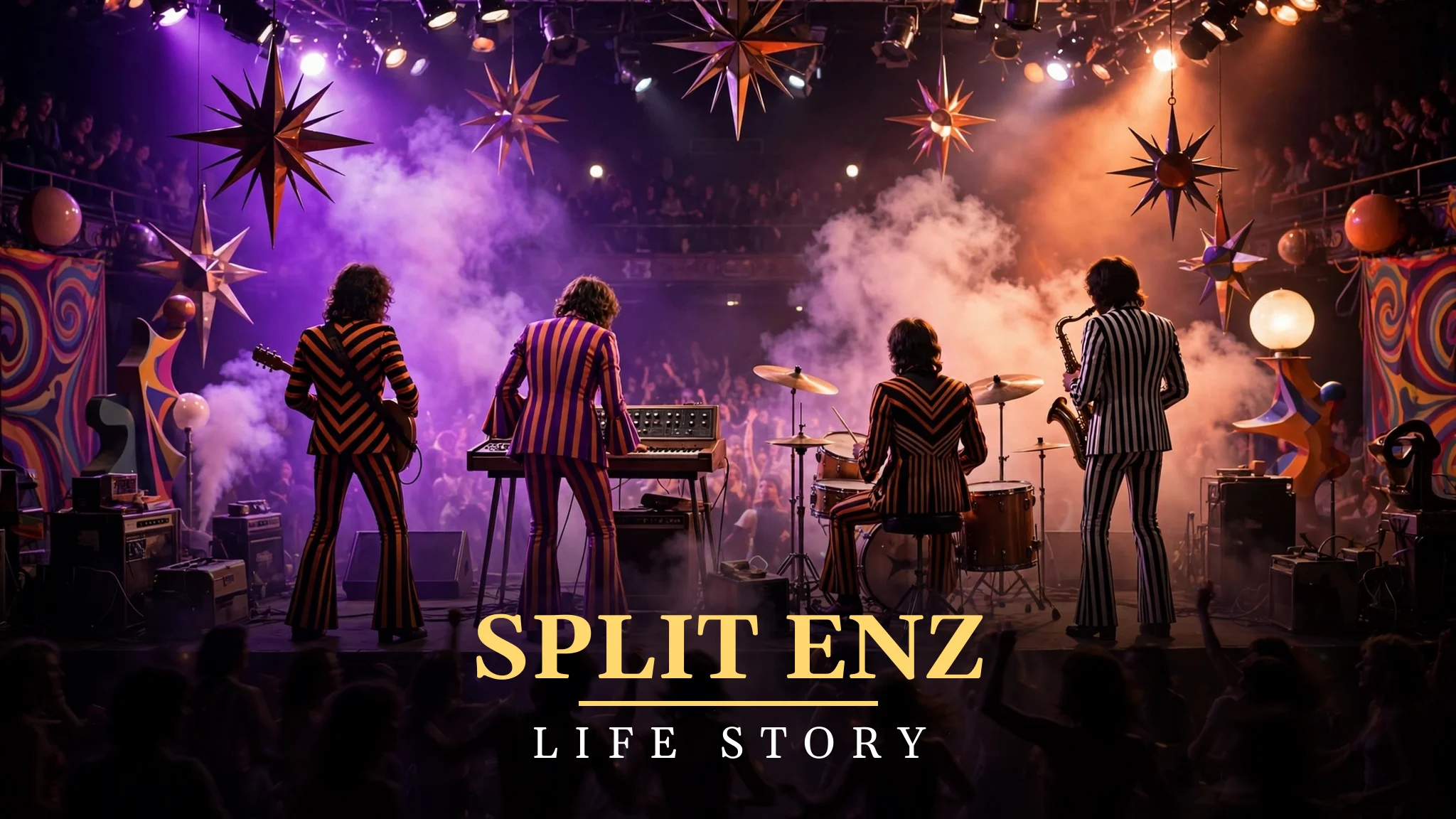
One of the most remarkable things about Split Enz was their visual style, which was unlike any other band. In their early years, they wore wild costumes, painted their faces, and made their live shows into pieces of theatre. Their clothes were bright and strange, with bold colours and odd shapes, and their stage sets were full of colour and surprise. Audiences who saw them live never forgot them, because they had never seen a band that looked like that. The costumes were not just for show. They were part of the band’s art, a way of saying that music could be visual as well as musical.
The band’s theatrical style came from Tim Finn and Phil Judd, who loved art and theatre as much as they loved music. They wanted their shows to be an experience, not just a concert, and they worked hard to make each show different. They changed their costumes, they changed their stage sets, and they made the audience feel like they were part of a strange and wonderful world. That was a brave thing to do, because most bands just stand on stage and play, but Split Enz wanted to do more, and they did.
As the band moved towards pop music, their costumes became less wild, but they never lost their sense of style. They still dressed in a way that was distinctive, and their shows were still full of energy and colour. The band’s visual style was part of their identity, and it helped them to stand out in a crowded music world. Young bands who saw them learned that a band could be visual as well as musical, and that a show could be a piece of art. That is a legacy that goes beyond their records, and it is one of the most important parts of their story.
Their influence on other bands is also part of their story, because many New Zealand musicians learned from Split Enz that it was okay to be strange. Young bands who saw their costumes and heard their clever songs realised that they did not need to copy the latest fashion from Britain or America. They could make music that was their own, and they could be proud of it. That lesson has shaped New Zealand music for decades, and it is one of the most important things the band ever did.
My Take:
When I think about Split Enz, the first thing I feel is joy, because their story is a story about being different and proud of it. They started as a band that wore wild costumes, painted their faces, and played songs that were strange and beautiful at the same time, and the music world did not know what to do with them. But they did not change to please the music world. They kept being themselves, they kept writing better songs, and in the end the world came to them. I think that is a wonderful lesson, because it shows that you do not have to fit in to succeed. You have to be yourself, and you have to do your work well, and the world will find you.
I admire the Finn brothers, Tim and Neil, because they are two of the greatest songwriters New Zealand has ever produced, and they did it together. Tim was the older brother, the one who started the band, and Neil was the younger brother, the one who joined later and changed the sound. Together, they wrote songs that were clever, catchy, and full of feeling. When I hear “I Got You”, I hear a song that is joyful and bright, and it makes me want to dance. When I hear “Six Months in a Leaky Boat”, I hear a song that is clever and emotional, and it makes me think about history and about the sea. When I hear “Message to My Girl”, I hear a song that is gentle and honest, and it makes me feel the love inside the words. Those are three very different songs, and they were all written by the same band, and that is a remarkable thing.
What I love most about their story is the way they changed and grew without losing their spirit. They started as an art-rock band, they became a pop band, and they did it by writing better and better songs. They did not lose their cleverness when they became pop stars. They kept it, and they used it to make pop music that was smarter than most pop music. I think that is brave, because it is easier to make simple pop music than to make clever pop music, and most bands choose simple. Split Enz chose clever, and their music is better because of it.
I think about the early years often, when the band was strange and the crowds were small, and I admire the courage it took to keep going. Imagine wearing a wild costume, painting your face, and playing a strange song to a small crowd that does not know what to make of you. That would be hard for anyone, and it would be harder for a young band. But Split Enz kept going, because they believed in their music, and because they had a vision of what they wanted to be. That is a lesson for anyone who makes something different. You have to believe in your work, even when the world does not understand it yet, because the world may come to understand it later.
There is something I find sad in their story, and it is that the band ended when it was still making great music. They could have kept going, they could have made more albums, and they could have had more hits. But the members were tired, and Tim wanted to go solo, and the band came to an end in 1984. That is sad, but it is also honest, because a band is a group of people, and people change, and sometimes it is better to end a band than to keep it going when the heart is gone. I respect them for ending it when they did, and for leaving behind a body of work that is still loved today.
I also think about the way Neil Finn went on to form Crowded House, and I admire that very much. He did not stop when Split Enz ended. He started again, with a new band, and he made even better music. That is a brave thing to do, and it shows that a good songwriter does not run out of songs. He keeps writing, and he keeps growing, and he finds new ways to say what he wants to say. Split Enz was not the end of Neil Finn’s story. It was the beginning, and that is a beautiful thing.
If I were to tell a young band what to learn from Split Enz, I would say this. First, be different, because the world has enough bands that sound the same, and it needs bands that sound like themselves. Second, write good songs, because a good song is the heart of everything, and no costume or show can save a bad song. Third, work hard, because a career is built over years, not over one night. Fourth, be brave enough to change, because a band that does not change will become boring, and a band that changes will keep growing. Split Enz did all of these things, and their career shows what happens when a band trusts its own ideas.
I think their reunions are a beautiful part of their story, because they show that great music does not go out of date. When the band reunited in 2006, fans who had loved them in the 1980s came to see them, and they brought their children, and the children loved the music too. That is a wonderful thing. Music is often something that divides the young from the old, but Split Enz’s music brings them together, because it is about things that do not change. That is the highest thing a band can do.
When I finish thinking about their story, I feel happy. I feel happy because there are bands like Split Enz in the world, bands that are strange and clever and brave, and that make music that is both fun and smart. Their story is a reminder that a band does not have to be normal to be loved, and that being different is not a weakness. It is a strength. Split Enz was a band from Auckland that wore wild costumes, played strange songs, and became one of the best pop bands in the world. That is a story worth telling, and it is a story worth remembering.
I also think about the way their songs are still played on the radio in New Zealand, and it makes me happy. “I Got You” is played at parties, “Six Months in a Leaky Boat” is played on long drives, and “Message to My Girl” is played at weddings, and each time they play, people sing along. That is because their songs have a quality that fits the most important moments of life, a cleverness and a warmth that makes a moment feel real. I think that is a wonderful thing for a song to do, to be part of a person’s life for decades, and Split Enz’s songs do that, and they do it without trying. They are simply good, and goodness lasts.
There is another part of their story that I admire, and it is the way the Finn brothers worked together. Tim and Neil are brothers, and brothers do not always work well together, but they did. They wrote songs together, they sang together, and they pushed each other to be better. I think that is a beautiful thing, because it shows that family can be a source of strength, not just a source of arguments. The brothers’ partnership was one of the most important in New Zealand music, and it produced some of the best songs ever written in the country.
I think about their sound often, because it is a sound that changed with them. When they started, their sound was strange and theatrical, with long songs and wild costumes. As they grew, their sound became brighter and more melodic, with short pop songs that people could sing along to. I love that their sound changed with them, because it shows that they did not try to stay the same forever. They let their music grow up, and they let their songs grow up with it, and that is why their later music feels so honest.
I also admire the way they handled the music business. They saw record companies come and go, they saw radio change, and they saw the whole industry change, and they kept working through all of it. That takes a kind of steadiness that I respect, because it is easy to give up when the world changes around you. Split Enz did not give up. They kept writing, they kept recording, and they kept finding people who wanted to hear their songs. That is a lesson for anyone who works in a changing world. You cannot control the changes, but you can control your work, and if your work is good, it will find its people.
There is a small sadness I feel when I think about how the band ended. They could have kept going, they could have made more albums, and they could have had more hits. But the members were tired, and Tim wanted to go solo, and the band came to an end in 1984. That is sad, but it is also honest, because a band is a group of people, and people change, and sometimes it is better to end a band than to keep it going when the heart is gone. I respect them for ending it when they did, and for leaving behind a body of work that is still loved today.
I think about the word different, because it is a word that describes their whole career. They were different in their costumes, different in their songs, and different in their sound, and they were proud of it. Different is not a loud word, and it is not a word that the music business uses very often. But it is a word that matters, because a band that is different will be remembered, while a band that copies everyone else will be forgotten. Split Enz was different, and they are remembered, and that is a wonderful thing.
If I were to sum up what their story teaches me, it would be this. A career is not a single moment. It is a lifetime of moments, some big and some small, and the small ones matter as much as the big ones. The big moment was “I Got You”, but the small moments were the songs written in Auckland, the shows played in small halls, and the costumes made by hand. Those small moments built the career, and they are the reason the big moment was possible. I think that is a beautiful truth, and it is one that I will remember.
I also feel grateful for the simple pleasure of their music. There are songs that make you think, and there are songs that make you feel, and Split Enz’s songs do both, but they also do something simpler, which is to make you happy. When I hear “I Got You”, I smile, and I feel like dancing, even if I am sitting still. That is a gift, and it is a gift that Split Enz has given to millions of people. A band that can make people smile is a band that has done something wonderful, and Split Enz has done it for a very long time.
In the end, I think Split Enz’s story is a story about being yourself. It is about a band from Auckland that wore wild costumes, played strange songs, and became one of the best pop bands in the world, not by copying anyone, but by being different. They did not need to fit in to succeed. They needed only to be honest, to work hard, and to trust their own ideas. That is a story that will inspire bands for many years to come, and it is a story that I am glad to have told.
Frequently Asked Questions
Who were Split Enz and why are they famous?
Split Enz was a New Zealand band formed in Auckland in 1972 by Tim Finn and Phil Judd. They became famous for their theatrical style, their wild costumes, and their hit songs, including “I Got You”, “Six Months in a Leaky Boat”, “History Never Repeats”, and “Message to My Girl”. They were one of the most successful bands in New Zealand and Australia in the early 1980s.
What are Split Enz’s most famous songs?
Their most famous songs are “I Got You” from 1980, which was a number one hit in New Zealand and Australia, “Six Months in a Leaky Boat” from 1982, “History Never Repeats” from 1981, and “Message to My Girl” from 1983. Each song shows a different side of the band, from joyful pop to clever storytelling to gentle love songs.
Who were the main members of Split Enz?
The main members of Split Enz were Tim Finn, who founded the band, his younger brother Neil Finn, who joined in 1977, Phil Judd, who was a founding member, Eddie Rayner on keyboards, Noel Crombie on percussion, Nigel Griggs on bass, and Paul Hester on drums. Tim and Neil Finn were the main songwriters, and their partnership became one of the most important in New Zealand music.
When did Split Enz form and when did they break up?
Split Enz was formed in Auckland in 1972, and the band broke up in 1984, after twelve years together. During that time they released albums including Mental Notes, True Colours, Waiata, Time and Tide, and Conflicting Emotions. After the break-up, Tim Finn began a solo career, and Neil Finn formed the band Crowded House.
What is the song “Six Months in a Leaky Boat” about?
“Six Months in a Leaky Boat” is a song about a long journey across the sea, inspired by the story of the first European settlers who sailed to New Zealand. The song was released in 1982 on the album Time and Tide, and it became one of the band’s most loved songs. It is both a clever story and an emotional song about home and the sea.
Did Split Enz ever reunite after breaking up?
Yes, Split Enz reunited for concerts in 2006 and again in 2009, playing shows in New Zealand and Australia. The reunions were very successful, with fans who had loved the band in the 1980s bringing their children to the shows. The band was also inducted into the New Zealand Music Hall of Fame, recognising their importance in the country’s music history.
What happened to the members of Split Enz after the band ended?
After Split Enz ended, Tim Finn had a successful solo career, and Neil Finn formed Crowded House, which became even more successful than Split Enz. The other members worked as musicians and producers, and many of them played in other bands. Neil Finn later reunited with Tim Finn for concerts, and the brothers’ songs are still loved around the world.


