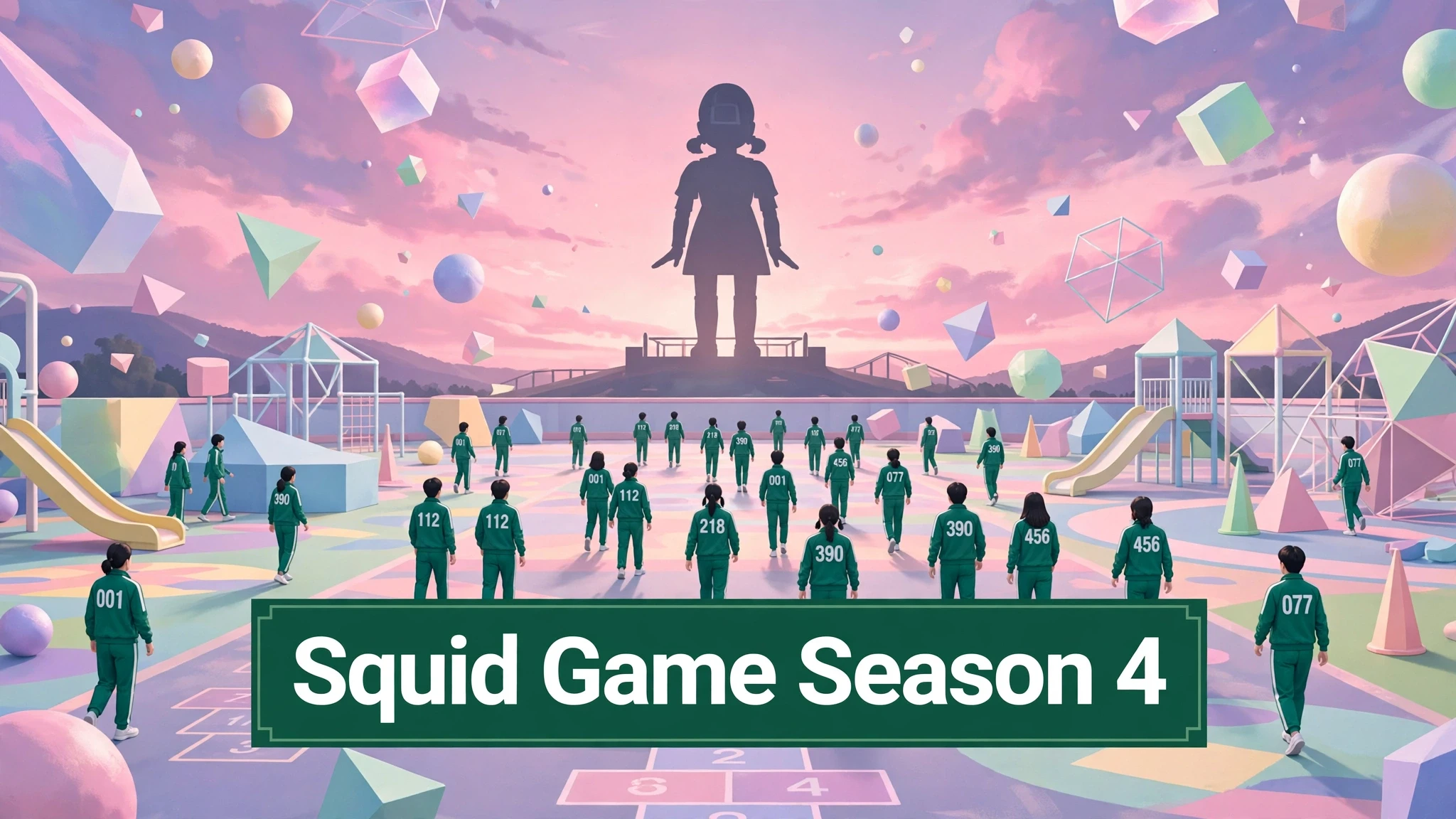
Squid Game Season 4: What to Expect Next
In this post
Squid Game is the rare show that became a global event. When the first season arrived on Netflix in 2021, it was a Korean drama about desperate people playing children’s games for money, and within weeks it was the most-watched show in the platform’s history, discussed in schools, workplaces, and parliaments around the world. Its images, the green tracksuits, the pink guards, the giant doll, became instantly recognisable, and its story, about debt, inequality, and the choices of desperate people, struck a chord everywhere.
Since then, the show has continued, and fans have kept asking the same question: will there be a season four? This guide explains where the story stands, what the creator has said, which characters could return, what new games might look like, and how to tell real news from rumours. It is honest about what is known and what is not, because with a show this popular, rumours spread fast, and most of them are wrong.
Where the Story Stands So Far
The story of Squid Game follows Seong Gi-hun, a man drowning in debt, who is invited to play a series of children’s games for a huge cash prize, only to discover that losing means death. The first season was a complete story in itself: Gi-hun survives, learns the truth about who runs the games, and is left with a choice about what to do next. It worked because it was focused, and because its ending was both satisfying and unsettling, leaving the audience with questions that felt earned rather than forced.
The later seasons expanded the story, bringing back familiar faces, introducing new players, and revealing more about the organisation behind the games. They were watched by millions, and they deepened the world, but they also raised a question that every successful show faces: how long can a story continue before it repeats itself? The games are the spectacle, but the heart of the show has always been the people, their debts, their choices, and their dignity. Any future season would need to find something new to say about those people, not just new games to show them playing.
Why Season 4 Is Still Uncertain
There are good reasons why a fourth season has not been confirmed. The creator, Hwang Dong-hyuk, has said in interviews that the story was difficult to write, that it took years, and that he did not expect its success. He has also said that he sees the story as having a natural shape, and that extending it indefinitely would weaken it. That caution is understandable: a show that ends well is remembered fondly, while a show that continues too long is remembered for its decline.
There is also the practical side. A season of Squid Game is enormously expensive to produce, with large sets, hundreds of extras, and complex action sequences. Netflix must weigh that cost against the audience it will bring, and against other shows competing for the same budget. And the creator’s time matters too: he has other projects, and other stories he wants to tell. All of this means that a fourth season is possible, but not inevitable, and fans should be prepared for the possibility that the story has already ended, and that what comes next will be something different, such as a spin-off, rather than a continuation.
What the Ending Set Up for the Future
Without giving away detailed spoilers, the ending of the later seasons leaves the organisation behind the games still standing, even as the main character’s arc reaches a conclusion. That is a deliberate choice: the games are bigger than any one player, and the system that creates them, a world of debt, inequality, and people willing to profit from desperation, has not gone away. That open ending is what keeps the question of a fourth season alive, because it suggests there is more story to tell, if the creators want to tell it.
But an open ending is not a promise. Many shows end with threads unresolved, because life itself is unresolved, and because a neat ending would feel false. The organisation’s survival could be a statement about the world, rather than a setup for another season: the point may be that the games continue because the conditions that create them continue, and that is a darker, more honest ending than a final victory would be. Fans who want a fourth season should ask themselves what they want from it: more games, or more meaning? The show’s strength has always been the second, and any future season would need to deliver it.
Characters Fans Most Want to See Again
Gi-hun is the character fans ask about most, because his journey, from a desperate gambler to a man who understands the system, is the heart of the show. But his story has reached a natural end, and bringing him back would require a strong reason, not just popularity. A character who returns without a purpose becomes a cameo, and that would diminish what made him matter. If he were to return, it would need to be because he has something new to do, not because the audience misses him.
Other characters, such as the Front Man, whose own history is tied to the games, offer more room for a new story, because his past is only partly revealed, and his choices are still ambiguous. New characters are the most likely path for a future season, because the show has always been about ordinary people in extraordinary circumstances, and there is no shortage of such people. The games need players, and the world has no shortage of debt. A new cast, with new stories, would let the show explore its themes again, without repeating what has already been said.
New Games: What Could Work Next
The games are the most discussed part of any future season, because they are the show’s signature. The first season used Korean children’s games, such as Red Light, Green Light, tug of war, and marbles, and their familiarity made them terrifying: innocent games, played for life and death. Later seasons added new games, and fans have spent years suggesting others, from hopscotch to hide and seek, and from traditional games in other countries to playground games from around the world.
But the games work because they are simple, fair, and familiar, and because they reveal character. A game that is too complicated, or too spectacular, would lose that quality. The best new games would be ones that most viewers recognise from childhood, that can be explained in a sentence, and that force a moral choice as well as a physical one. That is the formula, and it is harder to get right than it looks. A future season that invents games for spectacle alone would be a disappointment. One that finds games that reveal who people really are would be worth watching.
The Themes the Show Keeps Returning To
Squid Game is, at its heart, about debt, and about what debt does to people. Every player is there because they owe money, and because the ordinary world has offered them no way out. That is why the show resonated so widely: debt is a global experience, and the feeling of being trapped by it is universal. The show does not offer easy answers about debt. It shows people making impossible choices, and it asks the audience to judge them, and to understand them, at the same time.
It is also about inequality, and about the people who profit from it. The VIPs who watch the games, betting on the players, are a portrait of a class that treats human lives as entertainment, and that portrait is deliberately uncomfortable. And it is about solidarity, and its failure: the players sometimes help each other, and sometimes betray each other, and the show is honest about both. Those themes are as relevant now as they were in 2021, and they are the reason the show matters beyond its spectacle. Any future season that forgets them, and focuses only on the games, would miss the point.
How to Tell Real News From Rumours
With a show as popular as Squid Game, rumours are constant. A fake poster, a misleading headline, or a social media post claiming a release date can spread to millions of people in hours, and most of it is wrong. The only reliable sources are Netflix itself, and the creator, Hwang Dong-hyuk, speaking in a reputable interview. If a claim does not come from one of those, treat it as a rumour, however convincing it looks.
There are simple checks. Does the article name its source, or does it say “reports suggest”? Does it link to an official announcement, or only to another rumour? Is the date specific, or vague? And does the claim make sense: would Netflix announce a season through a random social media account, or through its own channels? Learning to ask these questions will save you disappointment, and it will make you a better consumer of entertainment news in general. The show will return, if it returns, through an official announcement, and until then, the honest answer is that we do not know, and that not knowing is fine.
The Global Impact: How Squid Game Changed Television
It is difficult to overstate how much Squid Game changed television, because before it, the idea that a Korean-language drama could become the most-watched show in the world seemed unlikely. Streaming services had invested in international content, but they had not expected a non-English show to dominate the global conversation in the way that Squid Game did. Its success proved that audiences would watch a show in another language, with subtitles, if the story was strong enough, and it opened the door for other international shows to find a global audience. That is a lasting change, and it is one of the most important legacies of the series, whether or not a fourth season is ever made.
The show also changed how television is marketed and discussed. The pink guards, the green tracksuits, and the dalgona candy became instantly recognisable, and they were shared, copied, and parodied around the world. The show became a cultural moment, not just a television programme, and it was discussed in schools, in workplaces, and in the news. That kind of impact is rare, and it is difficult to repeat, because it depends on a combination of timing, quality, and luck. The creators of the show have said that they did not expect its success, and that they were surprised by it, which makes the story even more remarkable. A show that was rejected for years, that was almost never made, became one of the most successful shows in history.
Squid Game also changed the conversation about inequality, debt, and capitalism, because its story is, at its heart, a story about people who are desperate, and who are willing to risk their lives for money. That theme resonated around the world, because debt and inequality are global problems, and the show gave people a way to talk about them. Critics, academics, and ordinary viewers all discussed what the show meant, and whether it was a critique of capitalism, a warning, or simply entertainment. That discussion is a sign of a show that matters, because it is not only watched, but thought about, and debated. A fourth season, if it is made, will need to have something new to say, because the world has already heard the first message, and it will be listening for the next one.
The commercial impact was also enormous. The show led to merchandise, to a reality competition series, to games, and to a planned American version, and it showed streaming services that a single show could generate a vast amount of value, beyond the viewing figures. That has changed how shows are commissioned, how they are marketed, and how their success is measured. It has also raised expectations, and that is a challenge for any future season, because it will be compared to the original, and it will be judged not only on its quality, but on its ability to recreate a cultural moment. That is a difficult task, and it is one reason why the creators have been cautious about promising more.
Finally, the show’s impact on Korean television, and on Korean culture more broadly, should not be underestimated. It brought Korean drama to a global audience that had never watched it before, and it led many viewers to explore other Korean shows, films, and music. It also showed that stories from outside the English-speaking world could be universal, and that they could speak to audiences everywhere. That is a hopeful legacy, and it is one that will last, whatever happens next. Whether Squid Game returns for a fourth season, or whether it ends here, its impact on television is already secure, and it will be remembered as a show that changed what television could be.
My Take:
I am cautious about a fourth season, and I think that caution is justified, because the first season was a complete story, and it worked precisely because it was focused and had something to say. The later seasons expanded it, and they were watched by millions, but they also raised a question that will not go away: how long can a story about a deadly game continue before it becomes repetitive? A fourth season would need a new idea, a new reason to exist, and not just a continuation of what came before. If the creators have that idea, it could be excellent. If they do not, it would be better to stop, and to let the story end with dignity. Not every successful show needs to continue forever, and knowing when to stop is a sign of respect for the audience.
I am also curious about the American version, but sceptical, because the original worked in part because it was Korean, because its themes were rooted in Korean society, and because its style was distinct. An American version could be good, but it could also be a pale imitation, and the audience will judge it harshly if it is. The best spin-offs find their own voice rather than copying the original, and I hope that is what happens here. If it does, it could be a worthy addition. If it does not, it will be forgotten quickly, and the original will remain the version that matters.
And the most important point, for me, is that the show’s message should not be lost in the excitement about a new season. Squid Game is a story about inequality, about debt, and about the choices desperate people make, and that message is as relevant now as when the show first appeared. If a fourth season is made, it should have something new to say about that world, and it should not be afraid to be uncomfortable, or to challenge its audience. The show’s greatest strength was its willingness to be serious, and to ask difficult questions, and that is what I hope to see again. If it does, I will watch. If it does not, I will remember the original, and I will be grateful for what it gave us.
The cultural impact is what I keep coming back to, because it is the thing that makes Squid Game more than just a popular show. It is easy to focus on the games, the twists, and the question of whether there will be another season, but the real story is what the show did to television itself. It proved that a story in another language could be the biggest show in the world, and that audiences were ready for it. That changed the industry, and it opened doors for other creators, from other countries, with other stories to tell. That is a legacy that matters, and it is one that should not be forgotten, even as we wait to hear about the future.
I am also cautious about a fourth season, and I think that caution is justified. The first season was a complete story, with a beginning, a middle, and an end, and it worked because it was focused, and because it had something to say. The later seasons expanded the story, and they were watched by millions, but they also raised a question: how long can a story about a deadly game continue, before it becomes repetitive? A fourth season would need a new idea, a new reason to exist, and not just a continuation of what came before. If the creators have that idea, then a fourth season could be excellent. If they do not, then it would be better to stop, and to let the story end with dignity. Not every successful show needs to continue forever, and knowing when to stop is a sign of respect for the audience.
The American version is a test of that idea, because it will show whether the story can work in a different setting, with different characters, and a different culture. I am curious about it, but I am also sceptical, because the original worked in part because it was Korean, because its themes were rooted in Korean society, and because its style was distinct. An American version could be good, but it could also be a pale imitation, and the audience will judge it harshly if it is. The best spin-offs are the ones that find their own voice, rather than copying the original, and I hope that is what happens here. If it does, it could be a worthy addition. If it does not, it will be forgotten quickly.
And the most important point, for me, is that the show’s message should not be lost in the excitement about a new season. Squid Game is, at its heart, a story about inequality, about debt, and about the choices that desperate people make, and that message is as relevant now as it was when the show first appeared. If a fourth season is made, it should have something new to say about that world, and it should not be afraid to be uncomfortable, or to challenge its audience. The show’s greatest strength was its willingness to be serious, and to ask difficult questions, and that is what I hope to see again. If it does, I will watch. If it does not, I will remember the original, and I will be grateful for what it gave us.
A hit on the scale of Squid Game changes more than a single show. It changes what studios are willing to fund, what stories get translated, and what audiences expect from television made outside Hollywood. After the first season, Korean dramas found a far larger global audience, and other non-English series were given bigger budgets and better promotion, because the industry finally believed that viewers would read subtitles if the story was good enough. That is a lasting effect, and it is bigger than any single season, because it means more kinds of stories will reach more people in the years to come.
It also puts pressure on the people who make the show. A creator who wrote the first season as a single, self-contained story suddenly has to continue it, and to satisfy an audience that has spent years guessing what happens next. Some of that pressure is creative, and some of it is commercial, and the two do not always point in the same direction. Spin-offs, games, and merchandise can keep a franchise alive, but they can also dilute what made it special. The honest hope for a fourth season is not that it is bigger, or louder, but that it has something to say, and that it earns its existence the way the first season did: with a clear idea, and the courage to follow it to its end.
Frequently Asked Questions
Is Squid Game season 4 confirmed?
As of the time of writing, no fourth season has been officially confirmed by Netflix or the creator. The story was presented as concluding with the later seasons, though the franchise continues with spin-offs, so any future season would be a new announcement, not something already promised.
When could Squid Game season 4 be released?
There is no release date, because no season has been announced. If one were greenlit, a realistic wait would be at least a year or two from announcement, given the scale of production. Treat any date you see online without an official source as a rumour.
What happened at the end of the last season?
This guide avoids detailed spoilers, but broadly the story reached a conclusion for its main character’s arc, with the organisation behind the games left unresolved. That open ending is part of why fans keep asking whether the story will continue.
Will Gi-hun return in season 4?
His story reached a natural end point in the later seasons, so a return would need a strong new reason. A future season would more likely focus on new characters, or on the organisation itself, than on repeating his arc. Nothing has been confirmed either way.
Could there be a Squid Game spin-off instead?
Yes, that is more likely than a direct fourth season. An American version has been discussed, and a reality competition series already exists. Spin-offs let the franchise continue with new settings and characters while the main story stays finished.