Stefano Accorsi: The Life Story Behind Italy's Beloved Actor
In this post
- Growing Up in Bologna and Finding the Theatre
- Jack Frusciante and the First Taste of Fame
- The Last Kiss and a Generation’s Love Story
- Love, Family, and Life in the Public Eye
- Saturno contro, Baciami ancora, and the Middle Years
- 1992 and a Completely New Kind of Role
- Still Working, Still Learning, Still Bologna
- The Stage, the Comedy, and the Actor’s Second Home
- My Take:
Stefano Accorsi has the kind of smile that makes an audience feel at home. For more than thirty years, Italian viewers have watched him grow up on screen, from a shy young man in Bologna to one of the most loved leading men in Italian cinema. He has played romantic heroes, confused husbands, ambitious politicians, and ordinary men trying to do the right thing, and in every role he brings a warmth that is hard to fake. People like him because he feels like someone they might know, a neighbour, a friend, a brother.
He was born in Bologna, a city famous for its food, its university, and its long covered walkways, and he has never lost the easy, open manner of his home town. He trained in the theatre, worked his way up through small films, and then found fame with a film about a young man who could not choose between love and freedom. That film, The Last Kiss, became a landmark in Italian cinema, and it made Accorsi a star across the whole country.
Since then he has worked with Italy’s best directors, moved between cinema and television with ease, and kept reinventing himself, most recently as a cold and ambitious political fixer in the hit series 1992. He has also lived much of his life in the public eye, with a famous relationship and a family that the Italian press followed closely. This is the story of a boy from Bologna who became the face of a generation, and who is still working, still learning, and still surprising his audience.
Growing Up in Bologna and Finding the Theatre
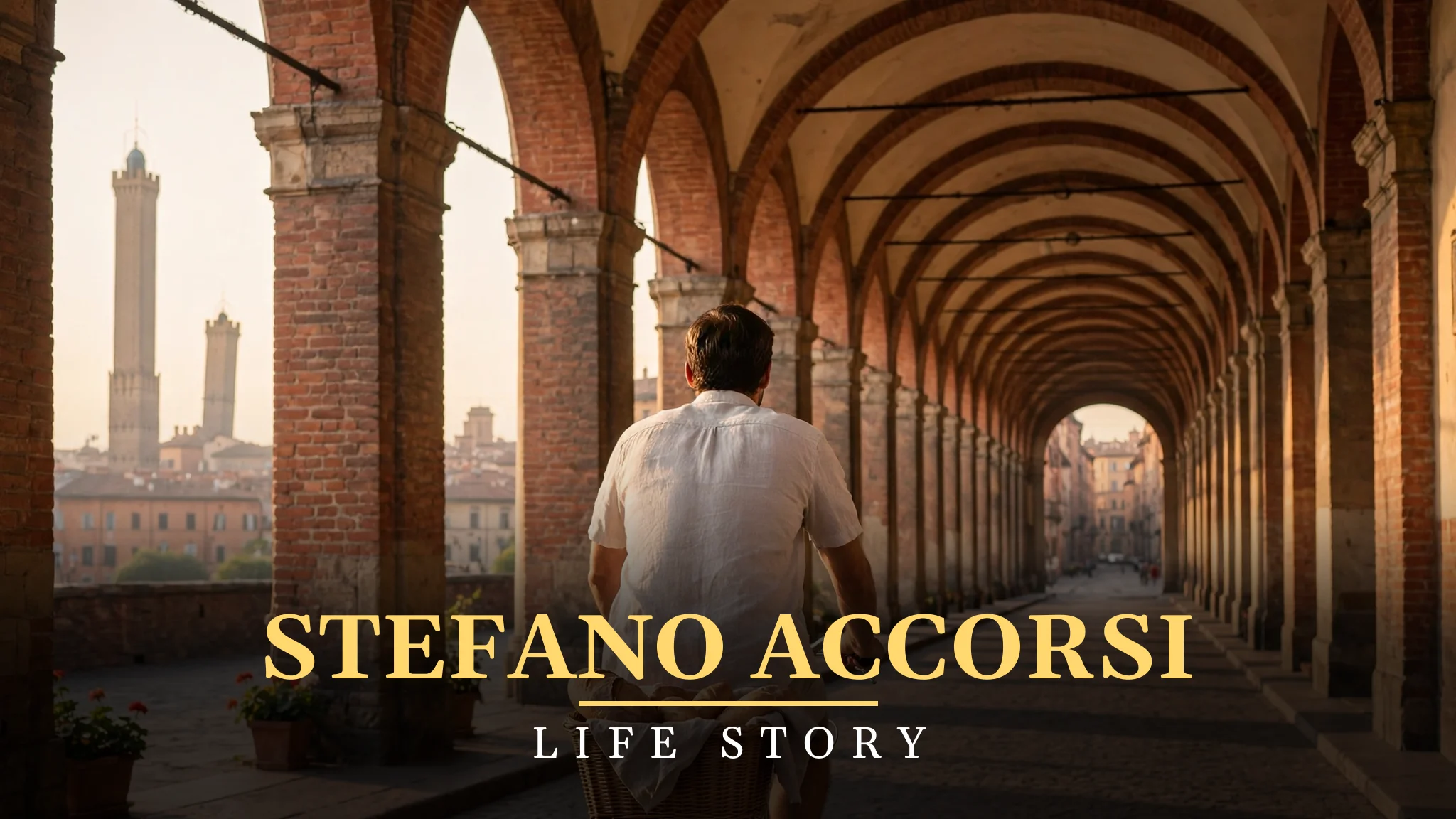
Stefano Accorsi was born on 2 March 1971 in Bologna, in the Emilia-Romagna region of northern Italy. Bologna is a warm and generous city, known for its red rooftops, its medieval towers, and its long porticoes, the covered arcades that run for miles through the streets. It is also a city with one of the oldest universities in the world, and a place where people love to talk, to eat, and to argue about football and politics. Growing up there gave Accorsi a sense of ease with people, a way of speaking that is direct and friendly, and a love of everyday life that would later show in his acting.
As a teenager, he became interested in acting, and he found his way to the theatre. Bologna had a lively theatre scene, and a young person who wanted to perform could find a stage, a teacher, and a group of people who shared the same dream. Accorsi studied at the theatre school of Alessandra Galante Garrone in Bologna, where he learned the basics of the craft: how to use his voice, how to move on stage, and how to listen to the other actors. The school was small and serious, and it taught him that acting was work, not just talent.
Theatre training is slow and demanding. A student must repeat the same scene many times, must learn to control his breathing, and must learn to be honest in front of a live audience that can see everything. Accorsi took to it with energy. He was not the loudest student, but he was one of the most natural, and teachers noticed that he had a gift for making a character feel real. He could play a young man in love, a son arguing with his father, or a friend making a joke, and the audience believed him.
After his training, he began to work in the theatre and to look for small roles in film. Italy in the early 1990s was a hard place for a young actor. There were many talented people and not many films being made, and a newcomer had to be patient. Accorsi was patient. He took the work that came, he learned from every job, and he waited for the role that would show what he could do. That patience would pay off sooner than he expected.
Jack Frusciante and the First Taste of Fame
Accorsi’s first big break came in 1996, when he played Alex in Jack Frusciante è uscito dal gruppo, a film based on the popular novel by Enrico Brizzi. The story is about a seventeen-year-old boy in Bologna who falls in love with a girl named Aidi, and who tries to find his place in a world of school, family, and friends. Alex is a gentle and thoughtful teenager, and the film captures the feeling of being young in Italy in the 1990s, with its music, its slang, and its confusion about growing up.
The film was a success with young audiences, and Accorsi became a familiar face to a whole generation of Italian teenagers. He played Alex without any showing off. He did not try to be cool or clever. He played a boy who was unsure of himself, who made mistakes, and who loved a girl with all his heart, and young viewers recognised themselves in him. That honesty made him different from many young actors of the time, who seemed more interested in looking good than in telling the truth.
The success of Jack Frusciante opened the door to more film work, and Accorsi began to appear in a series of Italian films, learning his trade on set. He worked with different directors, played different kinds of young men, and slowly built a reputation as a reliable and talented actor. He was not yet a star, but people in the Italian film world knew his name, and they knew that he could be trusted with a leading role.
In 1998 he appeared in Radiofreccia, the first film directed by the singer Luciano Ligabue, playing a young man in a story about a free radio station in the 1970s. The film was a love letter to a time when young people in Italy started their own radio stations and played the music they loved, and Accorsi was part of an ensemble cast that brought that world to life. His work in the film brought him one of Italy’s top acting prizes, and it showed that he could hold his own in a strong cast.
The Last Kiss and a Generation’s Love Story
The film that made Stefano Accorsi a star was L’ultimo bacio, The Last Kiss, released in 2001 and directed by Gabriele Muccino. Accorsi played Carlo, a man in his late twenties who is about to become a father and who suddenly feels trapped by the life he has chosen. He loves his girlfriend Giulia, played by Giovanna Mezzogiorno, but he is afraid of growing up, afraid of losing his freedom, and afraid that the best years of his life are already over. When he meets a beautiful young girl, he is tempted to throw everything away.
The Last Kiss spoke to a whole generation of Italians. Many young people in their twenties and thirties felt the same fear as Carlo: the fear that adult life would be boring, that love would become routine, and that the dreams of youth would slowly disappear. Accorsi played Carlo with a painful honesty. He did not make him a hero, and he did not make him a villain. He made him a real man who was scared and selfish and loving, all at the same time, and audiences saw themselves in him.
The film was a huge box office success in Italy, and it won awards at home and abroad. It also made Accorsi one of the most famous actors in the country. His face was on posters everywhere, and young Italians quoted his lines and argued about whether Carlo was right or wrong. The film’s success also took Muccino to Hollywood, where he later directed films with Will Smith, and it opened doors for Accorsi to work with bigger budgets and better directors.
For Accorsi, The Last Kiss was both a gift and a challenge. It gave him fame, but it also gave him a character that people would always associate with him. He knew that he had to move beyond Carlo, or he would be playing the same confused young man for the rest of his life. He began to choose roles that were different, roles that showed other sides of him, and he worked hard to prove that he was more than one famous part.
Love, Family, and Life in the Public Eye
While his career was growing, Accorsi’s private life also became famous. In 2003 he began a relationship with Laetitia Casta, the French model and actress, and the two of them became one of the most photographed couples in Europe. They had three children together, a son named Orlando and two daughters, Athena and Alexandra. The family lived between France and Italy, and the Italian press followed them closely, writing about their holidays, their homes, and their children.
Accorsi and Casta were together for many years, and they married in 2019, but the marriage did not last, and they separated in the same year. The end of the relationship was painful, and it was played out in the newspapers, which is hard for anyone, and harder still when there are children involved. Accorsi has always been careful about what he says about his private life, and he has tried to protect his children from the attention of the press. He has said little about the split, and he has kept his focus on his work and on being a father.
Being famous in Italy means living with a kind of attention that is hard to imagine. Photographers follow actors to the beach, to the shops, and to their children’s schools. Accorsi learned to live with it, but he never seemed to enjoy it. He is a private man by nature, and he prefers to talk about his work rather than about his life. He has kept his home in Bologna, and he often returns to the city where he grew up, where people know him as a neighbour as well as a star.
Fatherhood changed him, as it changes most people. He has spoken about how having children made him think differently about time, about responsibility, and about what matters in life. He has also said that his children keep him honest, because they do not care about his fame. They care about whether he is there, whether he listens, and whether he keeps his promises. That is a good test for any parent, and a good test for any actor too.
Saturno contro, Baciami ancora, and the Middle Years
After The Last Kiss, Accorsi worked steadily through the 2000s, taking on a wide range of roles. In 2007 he appeared in Saturno contro, Saturn in Opposition, directed by Ferzan Özpetek, playing a man in a group of friends in Rome whose lives are shaken by a sudden loss. The film was a success, and it showed Accorsi as part of a strong ensemble, able to share the screen with other fine actors and to play a character who was warm, funny, and sad by turns.
In 2010 he returned to the world of The Last Kiss in Baciami ancora, Kiss Me Again, the sequel directed by Muccino. The film caught up with Carlo and his friends ten years later, and it asked what had happened to their dreams. Carlo was now older, still searching, still making mistakes, and Accorsi played him with a new depth. The audience could see that the character had grown, even if he had not solved all his problems. The sequel was not as big a success as the first film, but it gave Accorsi a chance to revisit the role that had made him famous, and to show how both he and the character had changed.
During these years he also worked in France, appearing in French films and television, and he became comfortable working in two languages and two film cultures. French cinema gave him different kinds of roles, and it taught him to adapt to new directors and new ways of working. He also appeared in films by other Italian directors, and he kept choosing parts that interested him, even when they were not the biggest or the most glamorous.
He also returned to the theatre from time to time, because the stage had always been his first home. Theatre work kept him sharp, and it reminded him that acting is a live art, where the actor and the audience share the same moment. He has said that the theatre is where he feels most like an actor, because there is nowhere to hide and no second take. That honesty has stayed with him through his whole career.
1992 and a Completely New Kind of Role
In 2015, Accorsi surprised his audience again, this time on television, when he played Leonardo Notte in the Sky series 1992. The series is set in Milan during the early 1990s, at the time of the great corruption scandal known as Tangentopoli, when the old political system of Italy collapsed. Accorsi’s character is a clever and ambitious advertising man who becomes a fixer for politicians, a man who knows how to make deals, how to hide the truth, and how to survive in a world where everyone is corrupt.
Leonardo Notte was nothing like Carlo from The Last Kiss. He was cold, calculating, and often cruel, and he wore expensive suits and smiled while he lied. Accorsi played him with a quiet menace that shocked viewers who had only ever seen him as a warm romantic hero. It was a brave choice, and it worked. The series was a hit, and Accorsi won praise for showing a side of himself that no one had seen before.
He continued the role in the follow-up series 1993 and 1994, which followed the same characters through the years when Italy’s politics changed completely. The three series together tell the story of a country in crisis, and Accorsi’s character is at the centre of it, a man who tries to stay on top as the world around him falls apart. It was the most complex role of his career, and it showed that he could play a character over many years, letting him change and grow as the story went on.
The success of 1992 changed how people saw Accorsi. He was no longer just the boy from The Last Kiss. He was an actor who could play a villain, a politician, and a man with a dark side, and he could do it on television, in a long story that asked the audience to pay attention for hours. It opened a new chapter in his career, and it brought him a new audience, including younger viewers who had not seen his early films.
Still Working, Still Learning, Still Bologna
In recent years, Accorsi has continued to work in film and television, taking on roles that interest him and working with directors he admires. He has appeared in comedies and dramas, in Italian films and in international projects, and he has kept the same approach he has always had: prepare carefully, listen to the other actors, and tell the truth. He has also worked as a producer, helping to bring new stories to the screen, and he has supported young Italian actors who are starting out, as others once supported him.
He remains close to Bologna, the city where he was born and where he learned to act. He has said that Bologna keeps him grounded, because there he is not a star, he is a neighbour, a father, and a man who goes to the market and rides his bicycle through the porticoes. That sense of home matters to him, and it shows in his work. His characters always feel like real people from real places, not like figures from a magazine.
He has also spoken about getting older as an actor, and about how the roles change. When he was young, he played boys who were afraid of growing up. Now he plays men who have grown up, who have made mistakes, and who are trying to live with what they have done. He seems to enjoy that change, because it gives him new things to play, and new ways to understand life. He has said that acting is a job where you never stop learning, and that each new role teaches you something about yourself.
Stefano Accorsi’s story is not a story of sudden fame or of a single triumph. It is a story of steady work, of patience, and of a man who has stayed true to himself through more than thirty years in the public eye. He became famous as a young man, he lived through love and loss in front of the cameras, and he reinvented himself when he could have stayed comfortable. That is a long and honest career, and it is still going.
The Stage, the Comedy, and the Actor’s Second Home
While the world knows Stefano Accorsi from the cinema and from television, the theatre has always been his second home, and the place where he returns to learn. He trained on the stage in Bologna, and he has gone back to it throughout his career, because the stage asks something of an actor that no camera can ask. On stage, there is no director to shout cut, no editor to save a weak moment, and no second chance. The actor must be ready, every night, and must earn the audience’s attention with nothing but his voice, his body, and the truth of the scene.
Accorsi has said that the theatre keeps him honest. In a film, a performance can be built from many small takes, and a good editor can make a weak actor look strong. On stage, the actor is alone with the audience, and the audience can see everything: the hesitation, the false note, the moment when the actor stops listening. That is a frightening place to be, and it is also the best place to learn, because it teaches an actor to be present, to listen, and to trust his instincts.
He is also a gifted comic actor, a side of him that many people forget. His early films had a lightness to them, a humour that came from his timing, from the way he could make a small gesture funny, and from the way he could laugh at himself. In the theatre, he has played comedies as well as dramas, and he has shown that he understands the rhythm of a joke, the pause before the laugh, and the look that says more than a line of dialogue. Comedy is one of the hardest things an actor can do, because if the audience does not laugh, there is nowhere to hide, and Accorsi has the courage to try it.
His work in France also deserves to be remembered. He has acted in French films and in French television, and he has done it in a second language, which is a difficult and brave thing for any actor. Working in France taught him to listen differently, to adapt to new directors and new ways of working, and to find his character in a language that was not his own. It also showed that he was not afraid to leave the comfort of Italian cinema, and to test himself in a new world, with new rules.
Another part of his craft is his generosity as a scene partner. Actors who have worked with him say that he listens, that he gives the other actor room to work, and that he does not try to steal a scene. That generosity is rare, and it is one of the reasons directors like to work with him again. A film is not made by one actor. It is made by a group of people who trust each other, and Accorsi is a man who builds that trust, scene by scene, film by film.
He has also worked as a producer, helping to bring new stories to the screen, and supporting young directors and actors who are starting out. He knows how hard it is to begin a career in film, because he began his own career in the same way, with small roles and with patience, and he wants to give something back to the world that gave him his chance. That generosity, on screen and off it, is part of who he is, and it is part of why people like working with him.
In recent years, he has taken on roles that are quieter and more mature, roles of men who have lived, who have made mistakes, and who are trying to understand their lives. He seems to enjoy that change, because it gives him new things to play, and new ways to understand himself. He has said that acting is a job where you never stop learning, and that each new role teaches you something about the world, and about yourself. That is the attitude of a man who loves his work, and who will keep doing it for as long as he can.
My Take:
When I think about Stefano Accorsi, I think about a man who grew up in front of his audience. Most actors try to hide their age, or they try to stay the same forever. Accorsi did something different. He let the audience watch him change, from a shy teenager in Jack Frusciante to a frightened young father in The Last Kiss to a cold political fixer in 1992. Each of those roles belongs to a different age, and each one feels true to the time of life it shows. I admire that, because it takes honesty to let people see you grow older, and to play characters who are as confused as you once were.
I think The Last Kiss is the film that matters most in his story, not only because it made him famous, but because it asked a question that many people are afraid to ask. The question is simple: what happens when the life you chose starts to feel like a trap? Carlo loves his girlfriend, and he is about to have a child, and still he wants to run away. That is a hard thing to admit, and many people feel it but never say it. Accorsi played that fear without making excuses for it, and without asking the audience to forgive him. He just showed it, and let the audience decide. I think that is brave, and I think it is why the film still matters today.
What I like most about him as an actor is his warmth. He has a way of smiling that makes you trust him, even when his character is doing something wrong. That warmth is not a trick. It comes from the way he listens, the way he looks at the other actor, and the way he lets a scene breathe. In Saturno contro, for example, he plays a man who is part of a group of friends, and you believe that he loves those friends, because you can see it in the small things, the way he laughs, the way he touches a shoulder, the way he stays quiet when someone is hurting. That kind of acting cannot be faked. It comes from paying attention to people in real life.
I also think about his life in the public eye, and I feel sympathy for him. He fell in love with a famous woman, they had three children, and the whole country watched. That is a hard way to live. When a relationship ends, most people can grieve in private. Accorsi had to grieve in the newspapers. I respect the way he handled it, by saying very little and by putting his children first. He did not use the press to attack anyone, and he did not turn his private life into a show. That tells me something about his character. He knows the difference between his work, which belongs to the public, and his life, which belongs to him and his family.
His role in 1992 is the one that surprised me most, because it showed a side of him I had never seen. Leonardo Notte is a man who lies for a living, who helps corrupt politicians, and who seems to feel very little. Watching Accorsi play him was strange at first, because I kept expecting the warm smile, and it never came. Then I realised that was the point. He was showing that a man can be charming and empty at the same time, and that charm can be a weapon. I think it was one of the best decisions of his career, because it proved that he was not trapped in the image of the romantic hero. He could be dark, and he could be dangerous, and the audience would still watch.
There is a lesson in that for anyone who does creative work. It is easy to keep doing what people already like. It is much harder to do something new, because the audience might not follow you. Accorsi took that risk, and it paid off, but it might not have done. I admire people who take that risk, because that is how art grows. If he had played Carlo again and again, he would have been safe, and he would have been bored, and the audience would have been bored too. Instead he chose to surprise us, and I think we are lucky that he did.
I also think about Bologna, and about how much a place can shape a person. Bologna is not Rome or Milan. It is a smaller city, a warmer city, a city where people know each other and where life moves at a human pace. Accorsi carries that with him. He does not act like a star from the capital. He acts like a man from Bologna, someone who is easy to talk to, someone who enjoys a meal and a conversation. I think that is why Italian audiences love him. He feels like one of them, not like someone from another world.
Another thing I notice is how steady his career has been. He did not have one huge year and then disappear. He worked in the 1990s, he worked in the 2000s, he worked in the 2010s, and he is still working now. That kind of staying power is rare, and it comes from being reliable, from being easy to work with, and from choosing good roles. Directors want to work with him again because he shows up prepared, because he listens, and because he makes the other actors better. That is a quiet kind of success, but it is a real one.
I think his story also teaches something about growing up. When he was young, he played boys who were afraid of becoming adults. Now he plays men who have become adults, with all the mistakes and regrets that brings. That is a natural journey, and I think it is a good one. Too many actors try to stay young forever, and they end up playing parts that do not fit them anymore. Accorsi let himself grow older on screen, and the roles got richer because of it. I hope he keeps doing that, because I want to see what he plays in his sixties and seventies, when he will have even more life to draw on.
There is a sadness in his story too, and it is the sadness of a public love that did not last. He and Laetitia Casta were together for many years, they had three children, and then it ended. I do not know what happened between them, and I do not want to guess. What I know is that it must have been hard, and that he handled it with dignity. He did not blame anyone in public, and he kept working, and he kept being a father. That is what a grown man does. He does not make a show of his pain. He lives through it, and he keeps going.
If I have one criticism, it is only that I wish he had worked more outside Italy. He has the talent to be known around the world, and his work in French films shows that he can adapt to other languages and other cultures. But he has mostly stayed in Italy, telling Italian stories for Italian audiences, and there is nothing wrong with that. In fact, it may be the reason his work feels so true. He knows his own world deeply, and he tells stories from inside it, not from outside. Still, I think the world would be richer if more people knew his work, and I hope that the success of series like 1992 brings him to a wider audience.
In the end, I think Stefano Accorsi’s story is about staying true to yourself. He became famous young, he lived his private life in public, he played the same character that made him famous, and then he broke free of it and played something completely different. He did all of that without losing the warmth and the honesty that made people love him in the first place. That is a hard thing to do, and he did it. I think that is why he is still here, still working, still loved, and still worth watching. I will keep watching his films, because I know that whatever he plays next, he will play it like a real person, and that is all I ever ask of an actor.
There is one more thing I want to say about Accorsi, and it is about the way he handles fame. He became famous when he was young, and he has lived with that fame for more than thirty years, and he has never seemed to enjoy the attention. He does not pose for the cameras, he does not share his private life, and he does not use his fame to sell things. He uses it to work, and then he goes home, to Bologna, to his children, and to his life. I think that is a wise way to live, because fame is a noisy thing, and if you listen to it too much, you will lose yourself. Accorsi listened to his work instead, and he kept himself.
I also think about the young actors in Italy who look at his career and who want to be like him, and I hope they learn the right lesson. The lesson is not to find a famous film and to repeat it. The lesson is to work steadily, to take small parts, to learn from every director, and to be patient. Accorsi did not become a star overnight. He studied, he worked in the theatre, he played small roles, and he built his career one film at a time. That is slow, and it is hard, but it is the honest way, and it is why his work lasts.
If I could ask him one question, I would ask him about Carlo, about the character from The Last Kiss, and about whether he ever gets tired of being asked about him. I think he would smile, and say that Carlo is a part of him, and that he is grateful for the film, but that he is also more than Carlo. Every actor has a role that defines them, and the brave ones are the ones who move beyond it, who play something different, and who trust the audience to follow. Accorsi did that, with Leonardo Notte, with his theatre work, and with his later films, and I respect him for it.
I also think about Bologna, and about how much a home town can protect a person. Bologna is not Rome or Milan. It is a smaller city, a warmer city, and a city where people know each other. When Accorsi goes home, he is not a star. He is a neighbour, a father, and a man who rides his bicycle through the porticoes. That sense of home matters, because it reminds him of who he is, and of where he came from, and it keeps him from believing the stories that fame tells. I think every famous person needs a place like that, a place where they are just a person, and Bologna is that place for him.
Another thought that stays with me is about his children. He has three children with Laetitia Casta, and he has tried hard to protect them from the press, to give them a normal life, and to be a good father. That is not easy when you are famous, and when photographers follow you everywhere. But he has done it, quietly and without making a show of it, and I admire that. A father who protects his children, who shows up, and who keeps his promises, is doing the most important work there is, and no film prize matters more than that.
I also want to say something about his work in France, because I think it shows a side of him that many Italian audiences do not see. Working in another language, in another film culture, is a brave thing to do, because it means starting again, as a stranger, and proving yourself to people who do not know you. Accorsi did that, and he did it well, and it made him a better actor, because it taught him to listen, to adapt, and to find his character in a new way. I wish more actors would do that, because it keeps them honest, and it keeps them learning.
Finally, I want to say why I will keep watching his films. It is not because he is famous, or because he was in The Last Kiss, or because he played a villain in 1992. It is because I trust him. When I see his name, I know that he has prepared, that he has listened to the other actors, and that he will play a real person, not a stereotype. That trust is earned slowly, over many years, and Accorsi has earned it. I look forward to seeing what he does next, because I know that whatever it is, he will play it with honesty, with warmth, and with the quiet skill that has made him one of Italy’s most loved actors.
Frequently Asked Questions
When and where was Stefano Accorsi born?
Stefano Accorsi was born on 2 March 1971 in Bologna, Italy. He grew up in Bologna and studied acting at the theatre school of Alessandra Galante Garrone in the city.
What film made Stefano Accorsi famous?
The Last Kiss, released in 2001 and directed by Gabriele Muccino, made him a star in Italy. He played Carlo, a man in his late twenties who is afraid of growing up and becoming a father.
Who did Stefano Accorsi play in the series 1992?
He played Leonardo Notte, a clever advertising man who becomes a fixer for corrupt politicians during the Tangentopoli scandal in Milan. He continued the role in the follow-up series 1993 and 1994.
What was Stefano Accorsi’s first successful film?
His first big success was Jack Frusciante è uscito dal gruppo in 1996, in which he played Alex, a teenager in Bologna who falls in love. The film was popular with young Italian audiences.
Was Stefano Accorsi married to Laetitia Casta?
He was in a long relationship with the French model and actress Laetitia Casta, and they had three children together. They married in 2019 and separated in the same year.
What role did Stefano Accorsi play in Radiofreccia?
He appeared in Radiofreccia, the 1998 film directed by Luciano Ligabue about a free radio station in the 1970s. His work in the film brought him one of Italy’s top acting prizes.


