Stormzy: The Life Story Behind the Grime Star
In this post
- Growing Up in Croydon
- Wicked Skengman and the Online Rise
- Shut Up and the Christmas Number One
- Gang Signs and Prayer and the Mercury Prize
- Heavy Is the Head and Glastonbury
- This Is What I Mean and the #Merky Foundation
- Faith, Family, and the Gospel in Grime
- Speaking Out and the Power of a Platform
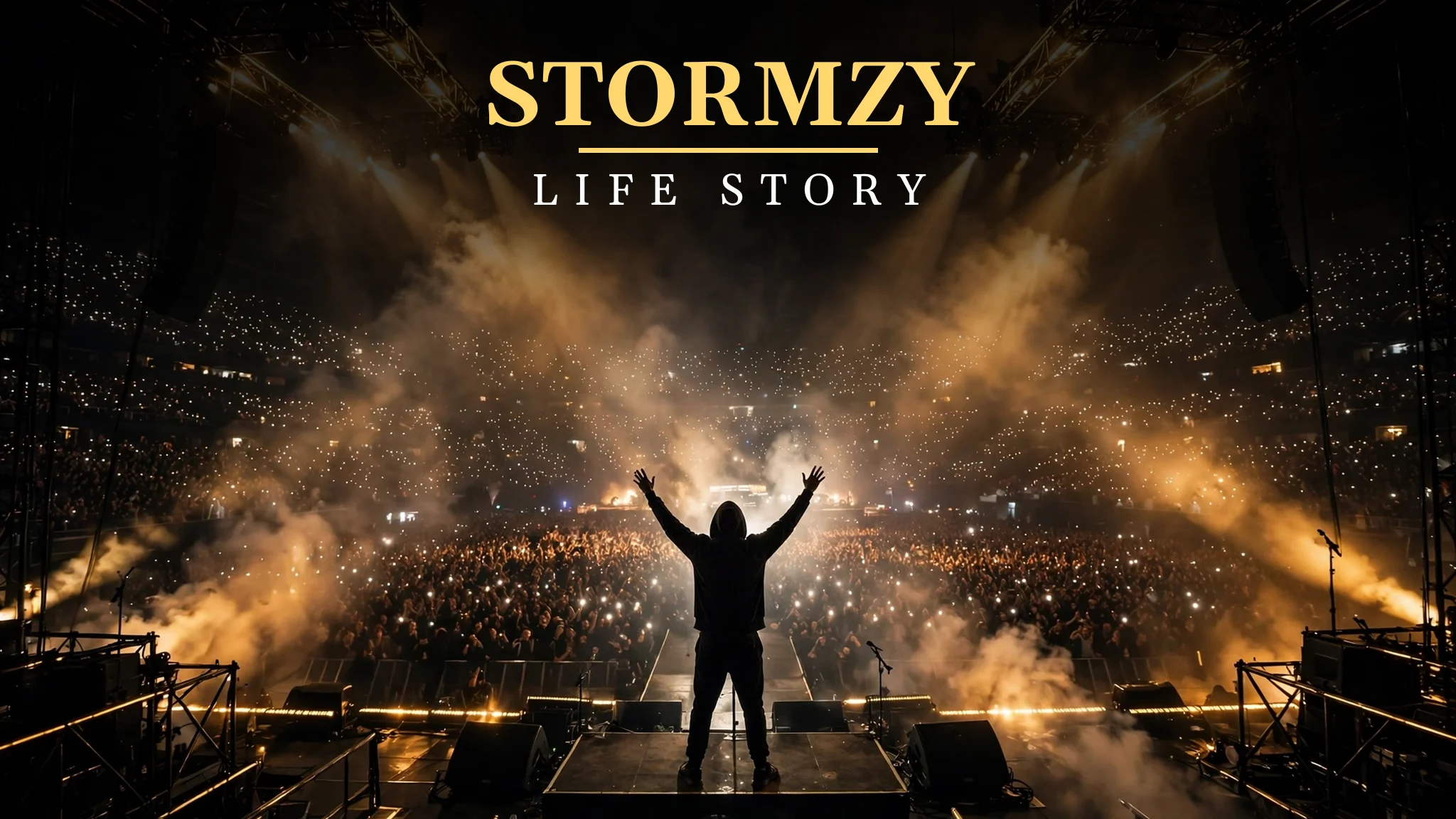
- Live Shows and the Power of a Crowd
- My Take:
Stormzy is the grime star who took a sound from the streets of south London to the biggest stage in Britain. He did it with a voice that is deep, clear, and full of confidence, and with songs that mix grime, gospel, R and B, and pop into something that feels both personal and huge. When he headlined Glastonbury in 2019, he was only twenty-five years old, and he was the second youngest solo headliner in the festival’s history. That night was not just a concert. It was a statement that a young Black man from Croydon could stand at the centre of British music and speak for a whole generation.
He was born Michael Omari, and he grew up in Croydon, in south London, in a family with Ghanaian roots. He learned to rap as a teenager, he posted freestyles online, and he built a following one video at a time. He did not come through a television talent show, and he did not have a major record company behind him at the start. He built his career himself, with hard work, with a clear sense of who he was, and with a belief that grime could be both honest and successful.
His story is about more than music. It is about a young man who has used his fame to help other young people, to speak about race and inequality in Britain, and to build a foundation that pays for Black British students to go to Cambridge University. He is a star, but he is also a public figure who takes his responsibilities seriously, and that combination is why his story matters.
Growing Up in Croydon
Michael Ebenazer Kwadjo Omari, known as Stormzy, was born on 26 July 1993 in Croydon, south London. His mother was from Ghana, and he grew up in a household that was loving but not wealthy. Croydon in the 1990s and 2000s was a busy, diverse part of London, with tower blocks, markets, and a strong sense of community, and Stormzy learned his values there. He learned to work hard, to respect his family, and to be proud of where he came from.
At school, he was a bright pupil, and he did well in his exams. He was not a child who was always in trouble, and he was not a child who had given up on education. He was a young man who liked music, who liked sport, and who had a clear sense of ambition. He began to rap as a teenager, writing lyrics in his bedroom and performing for his friends. He was drawn to grime, the sound of London, and he learned to rap over its fast, spare beats.
He also learned about the difficulties of life in south London. He saw friends who struggled, he saw the effects of poverty, and he saw how the police and the wider society treated young Black men. Those experiences went into his music, and they gave his lyrics a seriousness that many pop songs lack. He was not just rapping about parties. He was rapping about life, about faith, and about the world around him.
By the time he left school, he knew that he wanted to make music for a living. He did not have a clear plan, but he had a voice, a talent for writing, and a determination to succeed. He began to post his music online, and he began to build a following, one listener at a time.
Wicked Skengman and the Online Rise
Stormzy began his rise with a series of freestyles called Wicked Skengman, which he posted online from 2013 onwards. The videos were simple: Stormzy rapping to camera, over a grime beat, with no big production. But his flow was sharp, his lyrics were clever, and his confidence was clear. People shared the videos, and his following grew. He was not a major label artist. He was a young man from Croydon with a phone, a beat, and a voice, and that was enough.
The Wicked Skengman series showed that he could rap about anything, from street life to faith to his own ambition, and make it sound fresh. He had a deep voice, a clear delivery, and a way of building a verse that kept the listener engaged. He also had a sense of humour, and he was not afraid to be playful. That combination made his videos popular, and it built a fan base that would stay with him when he released his first singles.
During this time, he also began to perform live, at small venues and at grime events. He learned how to work a crowd, how to hold their attention, and how to make a room move. He was still a young artist, but he was learning fast, and he was building a reputation as one of the most exciting new voices in grime. He was not just a rapper. He was a performer, and that would matter when he moved to bigger stages.
By 2014, he had a growing online following, and he was ready to release music that would reach a wider audience. He had learned how to make a freestyle, how to build a fan base, and how to be himself in public. The next step would be a single that would take him from the internet to the charts.
Shut Up and the Christmas Number One
Shut Up was released in 2015, and it became a phenomenon. The song was a grime track with a simple, catchy chorus, and it was released as a Christmas single after a campaign by his fans. It went to number one in Britain at Christmas, becoming the first grime song to top the charts at Christmas, and it made Stormzy a household name. He was twenty-two years old, and he had a number one single that had been built by his fans, not by a major label campaign.
The song’s success was a sign of how much the music business had changed. A young artist could build a following online, release a song independently, and reach number one without the old gatekeepers. Stormzy had done that, and he had done it with a grime song, a sound that had once been seen as too underground for the charts. That was a powerful message, and it inspired other young artists to believe that they could do the same.
Shut Up also showed Stormzy’s sense of humour and his confidence. He was not afraid to be playful, and he was not afraid to celebrate his own success. The song was a party track, but it was also a statement: grime was now at the centre of British pop, and Stormzy was at the centre of grime. He had arrived, and he was not going to be ignored.
After Shut Up, he became a major figure in British music. He was invited to perform at festivals, to appear on television, and to collaborate with other artists. He was still a young man, but he was already a star, and he was learning how to use that fame.
Gang Signs and Prayer and the Mercury Prize
Gang Signs and Prayer was released in 2017, and it was a landmark album. It was a mix of grime, gospel, R and B, and pop, with songs that dealt with faith, street life, love, and ambition. The album included Shut Up, Big for Your Boots, and Blinded by Your Grace, Pt. 2, with MNEK, and it showed that Stormzy could make a full album that was both personal and popular. It went to number one in Britain, and it won the Mercury Prize in 2017, making Stormzy the first grime artist to win the prize since Dizzee Rascal.
The album was important because it showed a different side of grime. It was not just about street life. It was about faith, about prayer, and about the search for meaning. Stormzy sang and rapped about his Christian faith, about his mother’s influence, and about the need for hope in a difficult world. That openness about faith was unusual in grime, and it made the album feel honest and human. It was a record that spoke to many people, not just to grime fans.
Winning the Mercury Prize was a major moment. It confirmed that Stormzy was not just a hitmaker, but an artist with a serious body of work. He had made an album that was judged to be the best in Britain, and he had done it on his own terms, with his own label, #Merky Records. That independence was part of his story, and it showed that an artist could succeed without giving up control.
Gang Signs and Prayer remains his most important album, and it is still regarded as a classic of British music. It captured a moment when grime became a mainstream art form, and it captured the voice of a young man who had something to say about faith, life, and Britain.
Heavy Is the Head and Glastonbury
Heavy Is the Head was released in 2019, and it was another number one album. It included Vossi Bop, which went to number one, and Own It, with Ed Sheeran and Burna Boy, and it showed that Stormzy could make pop hits as well as grime tracks. The album was a mix of styles, from grime to R and B to Afrobeats, and it reflected his wide musical taste. It was a confident record, made by an artist who knew he was at the top of his game.
In June 2019, Stormzy headlined the Pyramid Stage at Glastonbury, the biggest festival in Britain. It was a historic performance, and it was watched by millions on television. He wore a stab-proof vest designed by Banksy, he brought out guests including Chris Martin and Dave, and he used the stage to speak about Black British culture, about inequality, and about the need for change. The performance was praised as one of the best Glastonbury headline sets ever, and it made him a national figure, not just a music star.
The Glastonbury set was important because it showed that Stormzy was more than a rapper. He was a performer who could hold a huge stage, a speaker who could address a crowd of tens of thousands, and a cultural figure who could make a political point without losing the audience. He did it with confidence, with humour, and with a clear sense of purpose. It was a night that many people in Britain will remember for a long time.
Heavy Is the Head and Glastonbury together marked the peak of Stormzy’s early career. He was at the top of the charts, at the top of the festival world, and at the centre of a national conversation about race, class, and music. He had come a long way from Croydon, and he had done it on his own terms.
This Is What I Mean and the #Merky Foundation
This Is What I Mean was released in 2022, and it was a more reflective album. It dealt with love, with faith, and with the pressure of fame, and it included songs like Hide and Seek and Firebabe. The album went to number one in Britain, and it showed that Stormzy was still a major artist, even as he took a more mature approach to his music. He was no longer the young man of Wicked Skengman. He was a man in his late twenties, thinking about his life and his place in the world.
Alongside his music, Stormzy has built a reputation for charity and activism. In 2018, he launched the #Merky Foundation, which supports young Black people in Britain. The foundation has funded scholarships for Black British students to study at Cambridge University, and it has supported a range of projects for young people. He has also spoken out about racism, about police brutality, and about the need for better opportunities for young people from working-class backgrounds. That work has made him a respected public figure, not just a pop star.
He has also used his platform to support other artists, to promote grime, and to speak about the importance of education. He has funded a publishing imprint, #Merky Books, which publishes books by young and diverse writers. He has shown that fame can be used to help others, and that a star can make a real difference in people’s lives.
In recent years, Stormzy has continued to make music, to perform, and to work on his foundation. He remains one of the most important figures in British music, known for his voice, his live shows, and his commitment to his community. His story is still being written, and he continues to use his fame for good.
Faith, Family, and the Gospel in Grime
Stormzy’s faith is a central part of his music, and it is what makes Gang Signs and Prayer different from most grime albums. He grew up in a Christian household, and his mother played a big role in his faith. He sings and raps about prayer, about grace, and about the need for hope, and he does it in a way that feels honest, not preachy. Blinded by Your Grace, Pt. 2, with MNEK, is a gospel song, but it is also a grime song, and that mix should not work, but it does, because Stormzy believes every word he sings. That belief is what makes the album special.
His family is also a big part of his story. He has spoken about his mother, about her hard work, and about how she raised him in Croydon. He has also spoken about his father, who was not always present, and about the complexity of family life. Those personal details are in his music, and they give his lyrics a depth that many rap songs lack. He is not just rapping about street life. He is rapping about love, about loss, and about the people who shaped him. That honesty makes his music feel human.
The gospel influence also shows in his live performances, where he often brings a choir on stage, and where the audience sings along to songs about faith. That is a different kind of concert from a typical grime show, and it shows how wide Stormzy’s musical vision is. He is not limited to one sound. He is open to gospel, to R and B, to Afrobeats, and to pop, and he lets all of those sounds into his work. That openness is a strength, and it is why his albums feel rich and varied.
Faith has also given him a sense of purpose beyond music. He has used his fame to help others, to fund scholarships, and to speak about inequality, and that work is driven by his belief that he has a responsibility to use his platform for good. That is a serious view of fame, and it is one that many pop stars do not share. Stormzy does, and it is why his story matters beyond music.
Speaking Out and the Power of a Platform
Stormzy has used his platform to speak about race, inequality, and politics in Britain, and that speaking out is a big part of his public life. He has spoken about being stopped by the police, about the way young Black men are treated, and about the need for better opportunities for working-class young people. He has also spoken at political events, and he has criticised the government in public. That takes courage, because a pop star who speaks about politics risks losing fans, losing work, and being attacked in the media. Stormzy has done it anyway, because he believes it is right.
His Glastonbury headline set in 2019 was a powerful example of that speaking out. He wore a stab-proof vest designed by Banksy, he brought out guests, and he used the stage to celebrate Black British culture and to call for change. It was not just a concert. It was a statement, made in front of tens of thousands of people and millions on television. He did it with confidence, with humour, and with a clear sense of purpose, and it was praised as one of the best Glastonbury sets ever.
He has also used his platform to support other artists, to promote grime, and to fund education. The #Merky Foundation has paid for Black British students to go to Cambridge, and #Merky Books has published books by young and diverse writers. Those are practical, tangible actions, not just words. A scholarship is not a headline. It is a future, and Stormzy has given that future to many young people. That is a legacy that will last longer than any hit single.
Speaking out has also brought criticism, and Stormzy has faced it with the same calm he shows on stage. He does not shout, and he does not try to be provocative for its own sake. He speaks clearly, he gives reasons, and he lets his actions speak for themselves. That calm, reasoned approach is a big part of why he is respected, even by people who disagree with him.
Live Shows and the Power of a Crowd
Stormzy’s live shows are a big part of why he matters, because they are not just concerts. They are celebrations, with a huge stage, a choir, and a crowd that sings every word. He has played festivals, arenas, and stadiums, and his performances are known for their energy, their warmth, and their sense of occasion. He does not just rap. He talks to the audience, he brings out guests, and he makes the night feel like a shared experience. That is a rare skill, and it is why his Glastonbury set is still talked about as one of the best ever.
He learned to perform in small venues and at grime events, where the crowd is close and the energy is intense. Those early shows taught him how to work a room, how to hold attention, and how to make a crowd move. He took that skill to bigger stages, and he did not lose it. He still performs as if the room is small, as if he is talking to each person in it, and that intimacy is what makes a huge arena feel personal. It is a gift, and it is why his fans return to see him again and again.
His live band and his choir are also a big part of the show. He brings gospel singers on stage, he uses live instruments, and he creates a sound that is richer than a backing track. That live sound gives his songs a depth that a studio record cannot capture, and it shows how wide his musical vision is. He is not just a rapper with a DJ. He is a performer with a band, a choir, and a stage full of people who believe in the music.
The crowd is the final part of the show. Stormzy’s fans are loyal, passionate, and loud, and they sing along to every song, from Shut Up to Blinded by Your Grace. That singing is not just an audience response. It is a part of the music, a chorus of thousands of voices that makes the night feel like a community. Stormzy understands that, and he lets the crowd be a part of the show. That generosity is why his live performances feel so special.
My Take:
I think Stormzy is one of the most important British artists of his generation, and I say that because he has used his fame for something bigger than himself. Many pop stars talk about helping others, but Stormzy has actually done it. He has paid for Black British students to go to Cambridge, he has funded books by young writers, and he has spoken out about racism and inequality when it would have been easier to stay quiet. That takes courage, and it is why I respect him as more than just a rapper.
When I listen to Gang Signs and Prayer, I hear an album that is both personal and universal. He raps about his faith, about his mother, about street life, and about the wish to be better, and he does it with an honesty that is rare in pop music. Blinded by Your Grace is a gospel song, and it is also a grime song, and that mix should not work, but it does, because Stormzy believes every word he sings. That belief is what makes the album special. He is not pretending to be a gospel singer. He is a grime artist who also believes in God, and he lets both parts of himself into the music.
His Glastonbury headline set in 2019 is a night I think about often, because it was a moment when British music changed. A young Black man from Croydon, wearing a stab-proof vest designed by Banksy, stood on the Pyramid Stage and spoke about Black British culture, about the need for change, and about the joy of being alive. He did it in front of tens of thousands of people, and millions more on television, and he did it with confidence and with joy. That is a brave thing to do, and it is a historic thing to do. Glastonbury is the biggest festival in Britain, and Stormzy made it his own.
I also admire the way he built his career. He did not come through a talent show, and he did not have a major label behind him at the start. He posted freestyles online, he built a following, and he released Shut Up as a Christmas single because his fans wanted it. That is a modern way to build a career, and it shows that an artist can succeed without the old gatekeepers. He proved that grime could reach number one, and he proved that an independent artist could win a Mercury Prize. That is a powerful lesson for young artists.
If I have a criticism, it is not really a criticism of Stormzy himself. It is a sadness that he has had to speak out about racism so often, because it shows that Britain still has a long way to go. He has spoken about being stopped by the police, about the way young Black men are treated, and about the need for better opportunities. He should not have to do that, but he does, and he does it with clarity and with dignity. I respect him for it, but I wish the world he describes was already better.
I think his voice is a gift. It is deep, it is clear, and it is full of confidence. He can rap fast, he can sing a chorus, and he can speak to a crowd, and he does all of those things with the same ease. That versatility is rare, and it is why his live shows are so good. He does not just perform. He connects, and that connection is what makes a great live artist.
His work with the #Merky Foundation is the part of his story I admire most, because it is practical. He is not just talking about helping young people. He is paying for their education, and he is giving them a chance to go to one of the best universities in the world. That is a real, tangible thing, and it will change lives. A scholarship is not a headline. It is a future, and Stormzy has given that future to many young people. That is a legacy that will last longer than any hit single.
For a young person from Croydon, or from any working-class area, I think Stormzy’s story is a useful one. He grew up in a tower block, he went to a local school, and he built a career from nothing but his voice and his determination. He did not have money, he did not have connections, and he did not have a clear path. He made his own path, and he has used his success to help others make theirs. That is a powerful example, and it is why his story matters beyond music.
When I look at his whole career, I see a man who has had number one singles, a Mercury Prize, a Glastonbury headline set, and a foundation that helps young people. That is a full life, and he is still only in his early thirties. He has achieved more than most artists achieve in a lifetime, and he has done it while staying true to where he came from. I hope he keeps making music, and I hope he keeps using his platform for good, because British music needs voices like his.
In the end, I think Stormzy teaches us that fame is not just about being famous. It is about what you do with it. He has used his fame to help others, to speak the truth, and to make music that is honest and joyful. That is a good use of fame, and it is why I think his story will still matter in twenty years, when many other pop stars have been forgotten.
I also think about his mother, and how much she shaped him. He has spoken about her hard work, her faith, and her love, and those qualities are in his music. He is a man who is proud of his family, and who does not hide that pride. That is a good thing in a genre where many rappers try to be tough and independent. Stormzy is tough, but he is also loving, and he lets both parts of himself into his songs. That balance is rare, and it is why his music feels human.
Another thing I notice is how his voice has grown. At the start, with Wicked Skengman, his voice was sharp, fast, and full of energy. By Gang Signs and Prayer, it had become deeper, warmer, and more confident. By This Is What I Mean, it was reflective, mature, and full of feeling. That growth is the sound of a man growing up in public, and it is why his albums feel like chapters in a life, not just collections of songs.
I think about the #Merky Foundation again, and how practical it is. He is not just talking about helping young people. He is paying for their education, and he is giving them a chance to go to one of the best universities in the world. That is a real, tangible thing, and it will change lives. A scholarship is a future, and Stormzy has given that future to many young people. That is a legacy that will last longer than any hit single, and it is why I admire him so much.
If I have a sadness, it is that he has had to speak out about racism so often, because it shows that Britain still has a long way to go. He has spoken about being stopped by the police, about the way young Black men are treated, and about the need for better opportunities. He should not have to do that, but he does, and he does it with clarity and dignity. I respect him for it, but I wish the world he describes was already better.
For a young person from Croydon, I think Stormzy’s story is a powerful example. He grew up in a tower block, he went to a local school, and he built a career from nothing but his voice and his determination. He did not have money, he did not have connections, and he did not have a clear path. He made his own path, and he has used his success to help others make theirs. That is a good use of fame, and it is why his story will still matter in twenty years.
In the end, I come back to Glastonbury, and to the image of a young Black man from Croydon standing on the Pyramid Stage, wearing a Banksy vest, and speaking to a whole country. That is a historic moment, and it is a reminder that music can change the way a country sees itself. Stormzy did that, and he did it with joy, with confidence, and with a clear sense of purpose. I hope he keeps doing it.
I also think about his album Heavy Is the Head, and how it showed him at the peak of his powers. It had Vossi Bop, a number one single, and Own It, with Ed Sheeran and Burna Boy, and it showed that he could make pop hits as well as grime tracks. That versatility is a strength, and it is why he has been able to reach so many different audiences. He is not limited to one sound. He is open to many sounds, and he lets them all into his music. That openness is a sign of a mature artist.
Another thing I notice is how his work with #Merky Books shows his commitment to young writers. He is not just funding scholarships. He is publishing books by young and diverse authors, and giving them a platform to tell their own stories. That is a practical, tangible action, and it will change lives. A book is not just a product. It is a voice, and Stormzy has given a voice to many young writers who might not otherwise have been heard. That is a legacy that will last.
I think about his faith again, and how it gives him a sense of purpose that goes beyond music. He believes that he has a responsibility to use his fame for good, and he acts on that belief, by funding education, by speaking out, and by supporting other artists. That is a serious view of fame, and it is one that many pop stars do not share. Stormzy does, and it is why his story matters beyond music. He is a star who takes his responsibilities seriously, and that is rare.
In the end, I come back to the idea that fame is not just about being famous. It is about what you do with it. Stormzy has used his fame to help others, to speak the truth, and to make music that is honest and joyful. That is a good use of fame, and it is why I think his story will still matter in twenty years, when many other pop stars have been forgotten.
I also think about his album This Is What I Mean, and how it showed a more reflective Stormzy. He was no longer the young man of Wicked Skengman, shouting for attention. He was a man in his late twenties, thinking about love, about faith, and about the pressure of fame, and he sang about those things with a maturity that felt real. That growth is a sign of an artist who is not afraid to change, and who is willing to let his audience grow with him. It is a brave thing to do, and it is why his later work feels so honest.
Another thing I notice is how his live shows bring people together. A Stormzy concert is not just a performance. It is a community, with fans singing every word, with a choir, and with a sense of shared joy. That is a powerful thing in a country that often feels divided. For a few hours, thousands of people are together, singing the same songs, and feeling the same hope. That is what music can do at its best, and Stormzy understands that better than most artists.
I think about his future, and how much he still has to give. He is only in his early thirties, he has a Mercury Prize, a Glastonbury headline set, and a foundation that helps young people, and he is still making music. That is a remarkable record, and it is still growing. I hope he keeps making albums, keeps performing, and keeps using his platform for good, because British music needs voices like his, now more than ever.
Frequently Asked Questions
How did Stormzy first become famous?
He first became famous through his Wicked Skengman freestyle videos online from 2013, and then with the Christmas number one single Shut Up in 2015, which was driven by his fans.
What is Stormzy’s most important album?
His most important album is Gang Signs and Prayer, released in 2017, which reached number one in Britain and won the Mercury Prize, blending grime, gospel, R and B, and pop.
Did Stormzy headline Glastonbury?
Yes, he headlined the Pyramid Stage at Glastonbury in June 2019, becoming one of the youngest solo headliners in the festival’s history, in a performance praised for its power and its message.
Where was Stormzy born?
He was born Michael Ebenazer Kwadjo Omari on 26 July 1993 in Croydon, south London, where he grew up in a family with Ghanaian roots.
What is the #Merky Foundation?
The #Merky Foundation is a charity launched by Stormzy in 2018 that supports young Black people in Britain, including funding scholarships for Black British students to study at Cambridge University.
What are Stormzy’s biggest hit singles?
His biggest hits include Shut Up, Big for Your Boots, Vossi Bop, which reached number one, and Own It with Ed Sheeran and Burna Boy.
Is Stormzy still making music?
Yes, he released This Is What I Mean in 2022, which reached number one in Britain, and he continues to perform, to record, and to work through his foundation.


