Super Junior: The Life Story Behind K-Pop's Long-Running Group
In this post
Ask a Korean pop fan to name the funniest group in the history of the music, and the answer will very often be the same: Super Junior. Ask the same fan to name the longest-running group, the one that has been on stage for twenty years and is still filling halls, and the answer will very often be the same again. Super Junior, known to its fans as SuJu, is a group that was built to be big, loud, funny, and impossible to ignore, and it has stayed big, loud, and funny for longer than almost any other act in Korean music. Where other groups chased a cool image, Super Junior chased laughter. Where other groups kept their members in neat lines, Super Junior let thirteen young men talk over each other, joke with each other, and turn every television appearance into a small comedy show.
The size was the first thing people noticed. Twelve members stood on stage at the debut in November 2005, and a thirteenth, Kyuhyun, joined a few months later, making Super Junior the largest boy group Korea had ever seen. The company that built them, SM Entertainment, had a strange plan for the group: it would be a rotating cast, with members joining and leaving over the years, like a school class that changed every year. The plan did not last, because the fans fell in love with the thirteen as they were, and the idea of swapping them out became unthinkable. What stayed was the size, the noise, and the feeling that watching Super Junior was like watching a large family that happened to sing and dance for a living.
What makes this story worth telling is not only the length of it, though twenty years on stage is a rare thing in any country’s pop music. It is the way the group kept finding new work to do. When the members grew too old to be teenage idols, they became television hosts, actors, radio presenters, and solo singers. When the music changed, they changed with it, from the sharp dance of Sorry Sorry to the smooth ballads of their vocal unit, from the bright pop of Mr. Simple to the Latin sound of Lo Siento. And when the members went away for army service, one by one, the group waited, and the fans waited with them, and the reunion concerts were louder than ever. This is the story of a group that refused to end, and of the fans, called ELF, who refused to let it.
A Rotating Cast That Refused to Rotate
The plan for Super Junior began in the early 2000s, when SM Entertainment was looking for a way to make a group that could do everything. The company wanted singers who could also act, dance, host television, and make people laugh, and it wanted so many of them that the group could split into smaller teams for different jobs. The name at first was Super Junior 05, because the group was meant to belong to the year 2005, and a new group of young men would take its place in the years that followed. It was a clever idea on paper, and it was a terrible idea in practice, because fans do not fall in love with a rotating cast. They fall in love with people, and the thirteen people who stood on that first stage were people the fans did not want to lose.
The thirteen came from many places. Leeteuk, the leader, had trained for years and was known for his calm, careful way of holding a group together. Heechul was the member who said what others would not say, a witty and unpredictable talker who became a star on variety shows. Yesung sang with a voice that was soft and strange and immediately recognisable. Kangin was the strong, cheerful member who hosted television. Shindong was the dancer and the comedian, a man whose humour made him beloved. Sungmin sang and acted. Eunhyuk danced and rapped and became one of the best television hosts in Korea. Siwon, tall and handsome, acted in dramas and films. Donghae sang and danced and wrote songs. Ryeowook sang the high, clear notes. Kibum acted. Kyuhyun, the youngest, joined last, and his voice was so strong that he became the group’s main singer almost at once. From China came Hangeng, a dancer whose skill had brought him to Seoul from his home country, and who became the first Chinese member of a major Korean group.
The group lived together in dormitories in Seoul, and the life they lived was close and chaotic. Thirteen young men in one home meant thirteen schedules, thirteen tempers, and thirteen jokes, and the members have said in interviews that the dormitory was loud from morning until night. They practised singing and dancing for hours each day, learned to perform as one body on stage, and learned to host television shows, where a quick joke matters as much as a good song. The company gave them a variety show of their own, and the members used it to show the public who they were: funny, warm, and a little bit messy, in the best way.
The debut came on 6 November 2005, on the music programme Popular Songs, with the song Twins, also known as Knock Out. The song was loud and dramatic, and the dance was powerful, and the group made an impression, though it did not yet make them stars. The first album, Super Junior 05, sold well for a new group, and the members worked hard, appearing on television constantly, because in Korea, a new group that is not on television is a group that people forget. By the time Kyuhyun joined in May 2006, the group had thirteen members, and the name had been shortened to simply Super Junior, and the rotating plan had been quietly dropped. The thirteen were staying, and the fans were glad.
U, Don’t Don, and the Long Climb
The first years were a climb, and the climb was slower than the members had hoped. The single U, released in June 2006, became a hit, with a bright and happy sound that suited the group’s energy, and the dance, with its cheerful arm movements, was easy for fans to copy. The group performed it everywhere, and the fans began to grow. The second album, Don’t Don, arrived in September 2007, with a harder sound, full of rock guitars and strong dancing, and the title song showed that Super Junior could be serious as well as funny. The album sold well, and the group won awards, but the members were still working harder than they were resting, and the schedule was taking its toll.
In April 2007, the group suffered a terrible car accident on the way home from a radio show. Leeteuk, Shindong, Eunhyuk, and Kyuhyun were in the car when it overturned, and all four were hurt. Kyuhyun was hurt most seriously, with injuries to his ribs and lungs, and for a time, it was not clear whether he would sing again. He recovered, slowly, with months of rest and treatment, and he returned to the group, and his voice was as strong as before. The accident changed the group. The members have said that it made them closer, and that it taught them how quickly everything can be taken away. It also made the fans love them more, because the fans had waited and worried, and the return felt like a gift.
The group also lost its first member in those years, though not in the way anyone expected. Kibum, who had always been more interested in acting than in singing, stopped taking part in group activities after 2009, and though he was never formally removed, he never returned to the stage with Super Junior. The fans accepted it, because Kibum had always been clear about his love of acting, and because the group still had twelve members who were working hard. The loss was a small one, and the group carried on, but it was a reminder that a group of thirteen cannot stay thirteen forever.
By 2008, Super Junior was a well-known group in Korea, but it was not yet a global one. The members were famous, they hosted television shows, they acted in dramas, and they sang in the group’s vocal unit, Super Junior-K.R.Y., which was formed in 2006 with Yesung, Ryeowook, and Kyuhyun, and which sang ballads so beautiful that they became a favourite at concerts. The group had also formed Super Junior-T, a trot unit, and Super Junior-Happy, a cheerful unit that sang bright, funny songs. The sub-units were a clever idea, because they let different members shine in different styles, and they kept the fans interested between full-group albums. The stage was set for the song that would change everything.
Sorry Sorry and the Dance the World Copied
In March 2009, Super Junior released its third album, Sorry Sorry, and the title song became the biggest hit of the group’s career. The song was simple, catchy, and impossible to forget, with a chorus that repeated the words sorry sorry over a smooth, funky beat. The dance was even simpler, with a hand-rubbing movement that anyone could learn, and that simplicity was the secret. Fans in Korea, in China, in Taiwan, in Thailand, and in many other countries copied the dance, posted their own versions online, and taught it to their friends. The song topped charts across Asia, and it became one of the most famous Korean songs of all time.
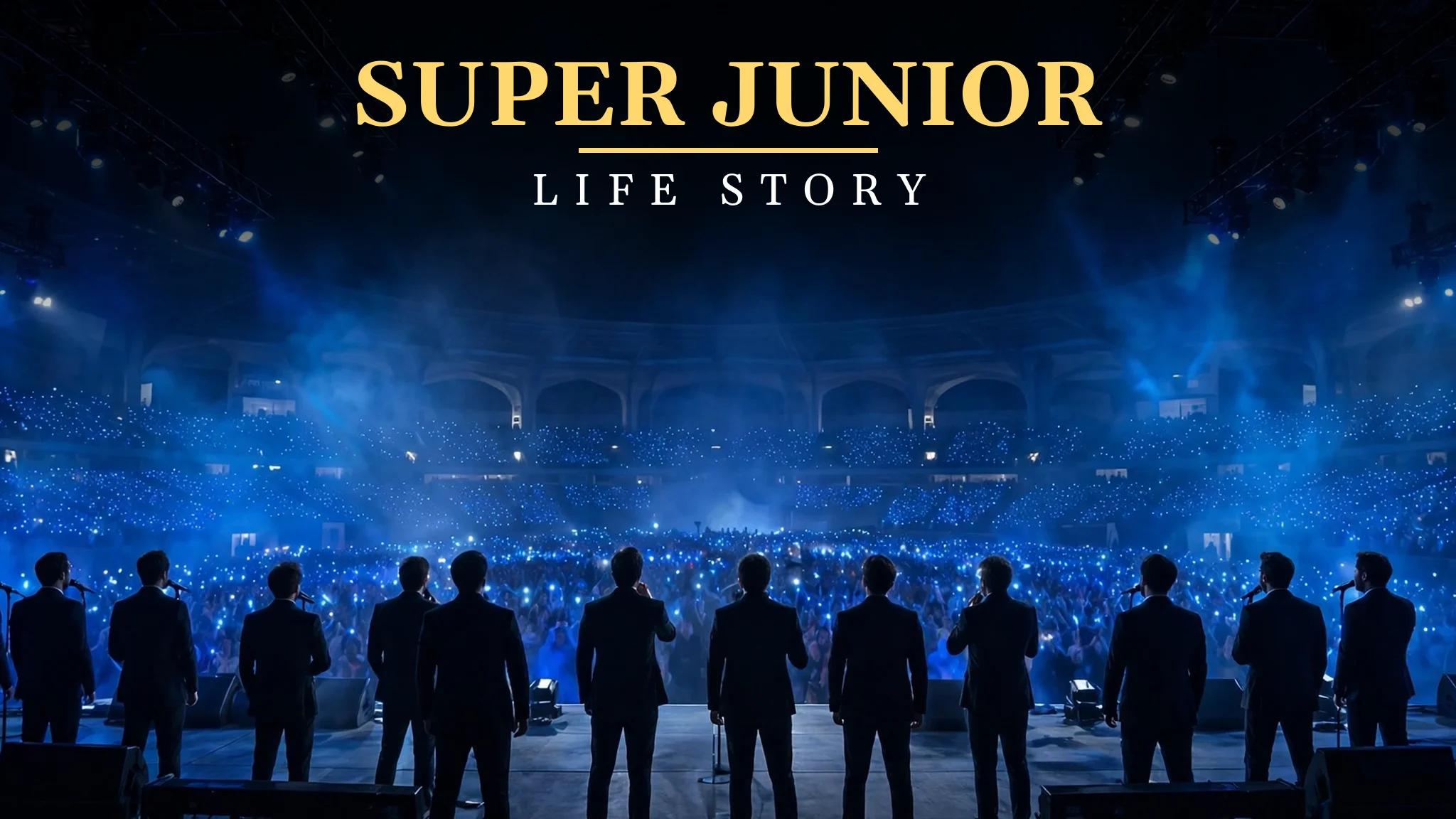
The album sold hundreds of thousands of copies, and the group toured Asia with a concert series called Super Show, which became one of the most successful tours in Korean pop. The Super Show concerts were not only about singing. They were shows in the full sense, with comedy, with magic, with the members talking to the crowd and making jokes, and with the fans singing along to every word. The first Super Show, in 2008, had been a success, but after Sorry Sorry, the halls were bigger, the crowds were louder, and the tickets sold out faster. The group played in Seoul, in Beijing, in Shanghai, in Taipei, in Bangkok, and in many other cities, and the fans, called ELF, which stands for Ever Lasting Friends, filled the halls with blue light sticks, the group’s colour, sapphire blue.
The success brought new work. Super Junior-M, a unit for China, was formed in 2008 with Hangeng, Siwon, Donghae, Ryeowook, Kyuhyun, and two Chinese members, Henry and Zhou Mi, and it sang in Mandarin and performed in China. The unit’s first album, Me, was a hit, and it showed that Super Junior could work in two languages, just as its company had hoped. The group also released the album Bonamana in May 2010, with a title song that was smooth and confident, and the album Mr. Simple in August 2011, with a title song that won awards and sold in huge numbers. Mr. Simple was bright, funny, and full of energy, and it suited the group’s personality perfectly.
Not everything was easy in those years. In December 2009, Hangeng, the Chinese member, filed a lawsuit against SM Entertainment, saying that his contract was unfair and that he had been treated badly, and he left the group to return to China. The fans were sad, because Hangeng had been a beloved member, and because his departure meant that Super Junior-M had lost its leader. The group carried on with eleven members, and Hangeng built a successful solo career in China, but the loss was felt, and it was the first time the fans had to say goodbye to a member they loved. The group did not let the loss stop it. It made new music, it toured, and it kept the fans close, and the fans stayed.
Sub-Units, Television, and a Group That Did Everything
What set Super Junior apart from other groups was not only the music. It was the way the members worked outside the group, on television, in films, and on the radio, and how that work made the group famous in a way that songs alone could not. Leeteuk and Eunhyuk became two of the most popular television hosts in Korea, presenting music shows and variety programmes with a warmth and a humour that audiences loved. Heechul became a star of variety television, a man whose quick wit and honest opinions made him a favourite guest on every show. Shindong directed music videos and hosted radio. Siwon acted in dramas and films, in Korea and in China, and became known around Asia. Donghae acted too, and wrote songs for the group. The members were everywhere, and everywhere they went, they talked about Super Junior, and new fans found the group through them.
The sub-units kept the music fresh. Super Junior-K.R.Y. sang ballads, and its concerts were quiet and beautiful, a contrast to the loud fun of the full group. Super Junior-D and E, the duo of Donghae and Eunhyuk, formed in 2011, sang bright pop songs and danced with a joy that made their concerts feel like parties. Super Junior-M continued to work in China, with Henry and Zhou Mi as its Chinese members, and its albums sold well. Each unit gave different members a chance to lead, and each one showed a different side of the group. A fan who loved ballads could love K.R.Y. A fan who loved dancing could love D and E. A fan who loved the full group could love them all.
The albums kept coming. Sexy, Free and Single, released in July 2012, carried a title song that was smooth and confident, and the album sold in huge numbers. The group also released the album Mamacita in September 2014, with a title song that had a western, cowboy feel, and the album Devil in July 2015, which marked ten years since the debut. The tenth anniversary was a proud moment, because very few Korean groups reach ten years, and the members celebrated it with concerts, with a special album, and with the fans, who had been with them since the start. The group was no longer young, but it was still working, still singing, and still making people laugh.
The army years began in those years too, and they took the members one by one. Heechul, Leeteuk, Yesung, Shindong, Sungmin, Eunhyuk, Donghae, Siwon, Ryeowook, and Kyuhyun all served, in different years, and the group was never whole for a long time. The fans waited, and the members who were still free kept working, releasing solo music, hosting television, and acting. The waiting was long, but it was not lonely, because the fans kept the group’s name alive, and the members kept in touch with each other, and the promise of a reunion was always there.
Lo Siento, House Party, and the Sound of Growing Older
In April 2018, Super Junior did something that surprised even its oldest fans. The group released a song called Lo Siento, sung in Korean and in Spanish, with the American singer Leslie Grace, and the sound was Latin pop, full of smooth guitars and a slow, romantic beat. It was a long way from Sorry Sorry, and it was a long way from the bright pop of Mr. Simple, but it worked, because the members sang it with confidence, and because the Latin sound suited their voices. The song became a hit in Latin America, and the group performed it in Mexico and in other countries where Spanish is spoken, and the fans there, who had waited years to see Super Junior, filled the halls and sang along in Korean and in Spanish.
The Latin song was a sign of how the group had changed. Super Junior was no longer a group of teenagers, and it was no longer trying to sound like one. The members were in their thirties, and they were making music that suited men in their thirties: smooth, confident, and a little bit romantic. The album Replay, released in the same year, carried the song, and the fans loved it, because it showed that the group was still willing to try new ideas, even after thirteen years on stage. A group that stops trying new things becomes boring, and Super Junior refused to become boring.
The pandemic years, from 2020 to 2022, were hard for every singer in the world, because concerts were cancelled, and the fans could not gather in halls. Super Junior answered with the album The Renaissance, released in March 2021, and its title song House Party, a bright and joyful track about staying home, staying safe, and waiting for better days. The song was made for a time when people could not meet, and it sounded like a message from the group to its fans: we are still here, we are still singing, and we will meet again. The video showed the members at home, dancing in their living rooms, and the fans loved it, because it was honest, and because it was exactly how everyone felt.
The group also used those years to make music that looked back as well as forward. The album The Road, released in 2022, carried the song Mango, a smooth and sweet track that became a favourite at concerts when the halls reopened. The members performed it with the same energy they had brought to Sorry Sorry thirteen years earlier, and the fans sang along, because the song was new, but the feeling was old: joy, warmth, and a group that loved being on stage. Growing older had not made Super Junior quieter. It had made the group wiser, and the music showed it.
Twenty Years On, Still on Stage
In November 2017, Super Junior released the album Play, with the song Black Suit, a smooth and confident track that showed the group had lost none of its style. The album was a success, and the group toured Asia again, playing to crowds that had waited years to see them. In October 2019, the album Time Slip arrived, with the song Super Clap, and the group celebrated its fourteenth year. The album The Renaissance, released in March 2021, carried the song House Party, a bright and joyful track that was made during the pandemic, when concerts were impossible, and the members sang about staying home and staying safe. The group also released The Road in 2022, with the song Mango, and the album Super Junior25 in July 2025, which marked twenty years since the debut, with the song Express Mode.
The twentieth anniversary was a moment that few groups ever reach. The members who were still active, Leeteuk, Heechul, Yesung, Shindong, Eunhyuk, Donghae, Siwon, Ryeowook, and Kyuhyun, performed together, and the fans filled the halls in Seoul and around Asia. Sungmin, who had stepped back from group activities after his marriage in 2014, and Kangin, who had left the group in 2019 after a series of troubles, were not on stage, and their absence was felt, but the nine who performed sang with the same energy that had marked the group since 2005. The concerts were a celebration, not only of twenty years, but of survival, of friendship, and of a group that had kept going when most groups would have stopped.
Super Junior’s place in Korean pop is now secure, and it rests on more than one song. The group showed that a large group could last, that a group could be funny and successful at the same time, and that members could build solo careers without leaving the group behind. The Super Show tours set a standard for concerts in Korean pop, and the sub-units showed other companies how to keep a large group busy. The fans, ELF, showed how a fan group could stay loyal for twenty years, through departures, through army service, and through the long gaps between albums. The blue light sticks are still there, in halls across Asia, and they are still shining.
The story is not finished. The members are in their late thirties and early forties now, and they have careers, families, and lives outside the group. Yet they still come back together, still sing Sorry Sorry, still make the crowd laugh, and still fill the halls. The group that was meant to rotate, that was meant to change every year, became the group that never changed at its heart: thirteen young men who became nine, who became a family, and who are still on stage, twenty years on, singing for the fans who have never left them.
My Take:
I have always liked Super Junior for a reason that has nothing to do with music charts. I like them because they are funny, and because they never pretended to be cool in the way that other groups pretended to be cool. Most boy groups in Korean pop are taught to look serious, to pose like models, and to speak in careful, polite sentences. Super Junior talked over each other, made jokes at their own expense, and turned every television appearance into a small comedy show. That honesty is rare in pop music, and it is the reason the group lasted for twenty years. Fans do not stay loyal to a perfect image for twenty years. They stay loyal to people they like, and Super Junior were people the fans liked.
What I admire most about this group is its size, and I mean that in a good way. Thirteen members is a lot of people to keep together, and it is a lot of voices, a lot of tempers, and a lot of schedules to manage. Most companies would never try it, because it is too hard. SM Entertainment tried it, and the group made it work, not by making the members the same, but by letting them be different. Leeteuk was calm. Heechul was wild. Shindong was funny. Kyuhyun was serious about his singing. Siwon was handsome and polite. Eunhyuk was quick and clever. Each member had a place, and each place mattered. I think that is a lesson for any team, in music or in life: you do not need thirteen people who are the same. You need thirteen people who are different, and who respect each other’s differences.
The car accident in 2007 is the part of this story that I find most moving, because it shows what the group is made of. Four members were hurt, Kyuhyun most of all, and for a time, it was not clear whether he would sing again. The fans waited, the members waited, and Kyuhyun came back, and his voice was as strong as before. I do not want to make the accident sound like a happy story, because it was not. It was frightening, and it could have ended a career. But the way the group carried on after it, closer than before, tells me something about friendship. A group that goes through a frightening time together, and comes out of it together, is a group that will not break easily. Super Junior did not break, and the accident is part of the reason why.
I think Sorry Sorry deserves more praise than it usually gets. People call it a simple song, and it is simple, but simple is hard. A song that anyone can sing, and a dance that anyone can copy, is a song that can travel further than a clever song that only experts can enjoy. The hand-rubbing dance was copied in schools, in offices, and in living rooms across Asia, and each copy made the song more famous. I admire the group for trusting a simple idea. Many artists are afraid of simple, because they think it makes them look untalented. Super Junior were not afraid, and the result was the biggest hit of their career, and one of the most famous Korean songs of all time.
The sub-units are another idea I admire, because they showed that a large group does not have to do everything together. Super Junior-K.R.Y. sang ballads so beautiful that they became a favourite at concerts, and the three singers, Yesung, Ryeowook, and Kyuhyun, showed a side of the group that the loud pop songs never showed. Super Junior-D and E, the duo of Donghae and Eunhyuk, sang bright pop and danced with joy, and their concerts felt like parties. Super Junior-M worked in China and sang in Mandarin. Each unit gave different members a chance to lead, and each one kept the fans interested between full-group albums. It was a clever way to run a group, and other companies copied it, because it worked.
I also want to praise the members for their work on television, because that work is often treated as less important than music, and it should not be. Leeteuk and Eunhyuk became two of the best television hosts in Korea, and Heechul became a star of variety shows, a man whose quick wit made him a favourite guest everywhere. That work brought new fans to the group, because people who had never heard Sorry Sorry saw Heechul on a talk show, liked him, and went to listen to the music. In Korean pop, television is not a distraction from music. It is a way of reaching people, and Super Junior understood that better than any other group. They were not only singers. They were entertainers, in the full sense of the word, and they were proud of it.
The departures are the sad part of this story, and I want to be honest about them. Hangeng left in 2009 after a lawsuit about his contract, and his departure hurt the fans, because he had been a beloved member, and because he was the first Chinese member of a major Korean group. Kibum stopped taking part in group activities to act, and though he was never formally removed, he never came back. Sungmin stepped back after his marriage, and Kangin left in 2019 after a series of troubles. Each departure was different, and each one was felt, and the group became smaller, from thirteen to nine. I do not think the group should be blamed for the departures, and I do not think the members who left should be blamed either. People grow, people change, and people make choices that are right for them, even when those choices hurt the fans. What matters is that the nine who stayed kept going, and that they did it with grace.
I think the army years deserve praise too, because they tested the group in a way that no chart or award could. Ten members went away, one by one, and the group was never whole for a long time. The fans waited, and the members who were still free kept working, releasing solo music, hosting television, and acting. The waiting was long, but it was not lonely, because the fans kept the group’s name alive, and the members kept in touch with each other. When the group came back together, the reunion concerts were louder than ever, because the fans had waited, and the waiting had made the return sweeter. That is a lesson for anyone who thinks that success must come quickly. Sometimes, waiting is part of the work.
If I had to choose one Super Junior song to play for someone who had never heard the group, I would choose Sorry Sorry, because it is the song that explains everything. It is simple, it is catchy, and it shows the group’s joy. I would also play a ballad by Super Junior-K.R.Y., because it shows the group’s other side, the quiet, beautiful singing that the loud pop songs never show. Between those two, you can hear the whole story: a group that could make you laugh, and a group that could make you cry, and a group that could do both in the same concert.
I think Super Junior’s influence on Korean pop is larger than people admit. The group showed that a large group could last, that a group could be funny and successful at the same time, and that members could build solo careers without leaving the group behind. The Super Show tours set a standard for concerts, and the sub-units showed other companies how to keep a large group busy. The fans, ELF, showed how a fan group could stay loyal for twenty years, through departures, through army service, and through the long gaps between albums. That influence is quiet, but it is real, and it is still there, in every large group that comes after Super Junior.
There is something I want to say about humour, because I think it is the group’s greatest strength, and also the thing that people underestimate most. Humour is hard to do well, and it is hard to keep doing for twenty years. Super Junior did it, and they did it without being cruel, without mocking others, and without losing their warmth. They made jokes about themselves, they laughed at their own mistakes, and they made the audience laugh with them, not at them. That kind of humour is a gift, and it is one of the reasons the group lasted. People do not stay loyal to a group that only sings well. They stay loyal to a group that makes them happy, and Super Junior made its fans happy, again and again, for twenty years.
If I am honest, I do not love every Super Junior record equally. Some of the early songs feel dated now, and some of the later ones are too bright for my taste. I also think the group was sometimes overworked, and that the members worked long hours when they were still young. I say this not to be unkind, but because I think it is important to be honest about the cost of a career that starts in your teens. The music was wonderful, but it was made by young men who were tired, who missed their families, and who lived under constant pressure. That cost should be part of the story too, and it is part of the reason I admire the group for lasting so long.
I also think Lo Siento deserves a special place in this story, because it shows a group that was willing to sing in a language it did not speak, for fans in countries it had rarely visited, and to trust that the music would carry the meaning. Many groups would never take that risk, because it is easier to stay in the language you know, and in the market you know. Super Junior took the risk, and the fans in Latin America repaid it with love. That is a lesson for any artist: the audience is wider than you think, and the music can travel further than you think, if you are brave enough to let it.
In the end, what I take from Super Junior is a simple lesson about joy. The group did not last for twenty years because it was the most talented, or because it had the best songs, or because it had the most members. It lasted because it made people happy, and because the members and the fans refused to give up on each other. Thirteen young men became nine, nine became a family, and the family is still on stage, still singing Sorry Sorry, still making the crowd laugh, and still filling the halls with blue light. That is not luck. That is what happens when people care about their work, and about each other, and when they keep showing up, year after year, even when it would be easier to stop. I hope they keep showing up for many more years, because the world needs groups that make people laugh, and because the fans still need the blue light that Super Junior promised in 2005.
One last thought stays with me. Super Junior began as a plan for a group that would change every year, a group that would never stay the same, and the plan failed in the best possible way. The group stayed the same at its heart, because the fans would not let it change, and because the members would not let each other go. That is a beautiful failure, and it is the reason the group is still here. A plan can be clever, but a family is stronger than a plan, and Super Junior became a family, and families last. When I hear Sorry Sorry now, I do not only hear a catchy song from 2009. I hear twenty years of laughter, of friendship, of waiting, and of coming back, and that is why the song still makes people smile.
Frequently Asked Questions
When did Super Junior debut and how many members did it have?
Super Junior debuted in November 2005 with twelve members, and a thirteenth member, Kyuhyun, joined in 2006. The group was first called Super Junior 05 and later became known simply as Super Junior.
What is Super Junior’s most famous song?
Super Junior’s most famous song is Sorry Sorry, released in 2009. The catchy song and its simple dance became famous around the world and made the group a global act.
Who are Super Junior’s fans called?
Super Junior’s fans are called ELF, which stands for Ever Lasting Friends. ELF are known for their loyalty, having supported the group for twenty years through many changes.
What are Super Junior’s sub-units?
Super Junior has several sub-units, including Super Junior-K.R.Y. for ballads, Super Junior-M for China, Super Junior-D and E as a duo, and Super Junior-Happy for cheerful songs. Each unit shows a different side of the group.
Is Super Junior still active after twenty years?
Yes, Super Junior celebrated twenty years in 2025 and is still active, releasing new music and performing. The group has continued through member departures and military service.
Why is Super Junior important in K-pop history?
Super Junior is important because it was one of the biggest and longest-running K-pop groups, with a global hit in Sorry Sorry and a twenty-year career. It showed that a large group with many talents could last and stay loved.


