T. Rex: The Life Story Behind the Glam Rock Legends
In this post
- A Boy From East London Who Loved Words and Music
- Tyrannosaurus Rex and the Quiet Folk Years
- Glitter, Hot Love, and the Sound of a New Decade
- The Slider, the Hits, and the Peak of T. Rextasy
- When the Charts Moved On and the Crowds Grew Smaller
- The Final Year and the Promise of a Comeback
- What Marc Bolan Left Behind
- My Take:
In the early 1970s, a London singer with dark curly hair and a voice that seemed to purr walked onto the stage in clothes covered in glitter, and the whole country seemed to change its mind about what a rock star should look like. His name was Marc Bolan, and his band was called T. Rex. For a short time, the band was the biggest thing in British music. Teenagers screamed at their concerts, their songs sat at the top of the charts for weeks, and the word glam rock entered everyday language. The sound was simple and joyful: a driving beat, a catchy guitar riff, and a singer who sounded as if he was having the time of his life.
The strange thing about T. Rex is how quickly it all happened, and how the band came from almost nothing. Only a few years before the hits, Bolan was playing quiet folk music in small clubs, singing songs about wizards and elves to small crowds who sat on the floor. He had tried and failed to become a pop star more than once. He had been in a band that broke up, he had made records that sold very few copies, and many people in the music business had decided that he would never make it. Then, in the space of about two years, he became one of the most famous men in Britain.
This is the story of that rise, and of what came after it. It is a story about a boy from East London who loved poetry and rock and roll, who built a band out of his own strange ideas, and who found a sound that millions of people wanted to hear. It is also a story about how fast fame can arrive, how hard it is to hold on to, and how a life can end far too early. Marc Bolan died at twenty-nine, but the songs he left behind are still played today, and the glitter he wore on stage changed the look of British pop music for good.
A Boy From East London Who Loved Words and Music
Marc Bolan was born Mark Feld on 30 September 1947 in Hackney, in East London. His parents, Simeon and Phyllis Feld, were of Jewish and English background, and the family lived a modest life in a part of London that was busy, noisy, and full of ordinary working people. Mark grew up in a world of markets, buses, and crowded streets, but inside his head he lived somewhere else. He loved books, he loved words, and he loved the sound of rock and roll coming out of the radio. As a boy he was drawn to the singers who had style, the ones who did not just sing a song but seemed to live inside it.
At school he was not a star pupil. He was more interested in music and in making himself noticed than in lessons. He left school at fifteen, and he tried to find his way into the world of entertainment. He worked as a model for a short time, and he hung around the London music scene, watching bands, learning how they dressed, and learning how they moved on stage. He took the name Marc Bolan, a name that sounded like a star, and he began to write songs of his own. The name came from a record label he admired, and he liked the way it sounded when people said it aloud.
In the mid-1960s, Bolan was given a chance by a manager who saw something in him. He made his first records, and they were not hits. He joined a band called John’s Children for a short time, and that band also failed to break through. These early years could have ended his dream. Many young singers would have given up after two or three failures. Bolan did not give up. He kept writing, he kept playing, and he kept believing that one day the public would hear what he heard in his own head. That stubbornness mattered, because the road to T. Rex was long, and it started in a very different place from where it ended.
The young Bolan was shaped by two loves that never left him: poetry and the electric guitar. He read the work of poets and fantasy writers, and he filled his notebooks with strange images of wizards, dragons, and faraway lands. At the same time, he loved the loud, simple sound of early rock and roll, the kind of music that made young people want to dance. For a long time, those two loves pulled in different directions. The folk music he made first was soft and strange. The rock music he made later was loud and direct. The story of T. Rex is the story of how those two sides finally came together in one band.
Tyrannosaurus Rex and the Quiet Folk Years
In 1967, Bolan formed a duo with a percussion player called Steve Peregrin Took, and they called themselves Tyrannosaurus Rex. The name was long and odd, and the music was just as odd. Bolan played an acoustic guitar and sang songs full of strange, dream-like words, while Took played hand drums and added a wild, unpredictable energy. They performed in small folk clubs, and they built a small but loyal audience of young people who liked music that was different from the pop songs on the radio. The duo made three albums, and they sold modestly, but they were never going to fill large halls.
The partnership with Took did not last. The two men argued about the direction of the music, and Took left in 1969. Bolan replaced him with Mickey Finn, another percussion player, and the duo carried on for a while longer. The music stayed soft and acoustic, but Bolan was growing restless. He wanted a bigger sound. He wanted drums, he wanted an electric guitar, and he wanted to make records that people could dance to. The folk years had taught him how to write songs and how to hold an audience, but he had outgrown the small clubs. He was ready for something louder.
The change came in 1970. Bolan shortened the band’s name to T. Rex, a short name that sounded sharp and modern. He added an electric guitar and a rhythm section, and he recorded a single called Ride a White Swan. The song was simple, catchy, and full of strange, beautiful words. It climbed the charts slowly, and then, to the surprise of almost everyone, it reached number two in Britain. For the first time, Bolan had a real hit. The boy from Hackney who had failed again and again was suddenly on television, on the radio, and in the newspapers. The quiet folk years were over.
Ride a White Swan was the first step, but it was not a lucky accident. Bolan had spent years learning how to write a song that stayed in the listener’s head. He understood that a hit song needs a strong tune, a few strange words that catch the ear, and a sound that feels fresh. The single proved that his instincts were right. It also proved that the public was ready for something new. British pop music in 1970 was changing, and Bolan was about to help change it more than almost anyone else.
Glitter, Hot Love, and the Sound of a New Decade
The year 1971 was the year T. Rex became famous. The band released the single Hot Love, and it went to number one in Britain. Then came Get It On, which also reached number one, and the album Electric Warrior, which became one of the best-loved records of the decade. The sound was built on a simple idea: a strong beat, a guitar riff that repeated and grew, and Bolan’s voice floating over the top. It was music that made people want to move, and it was easy to remember. Radio stations played it again and again, and teenagers bought the records in huge numbers.
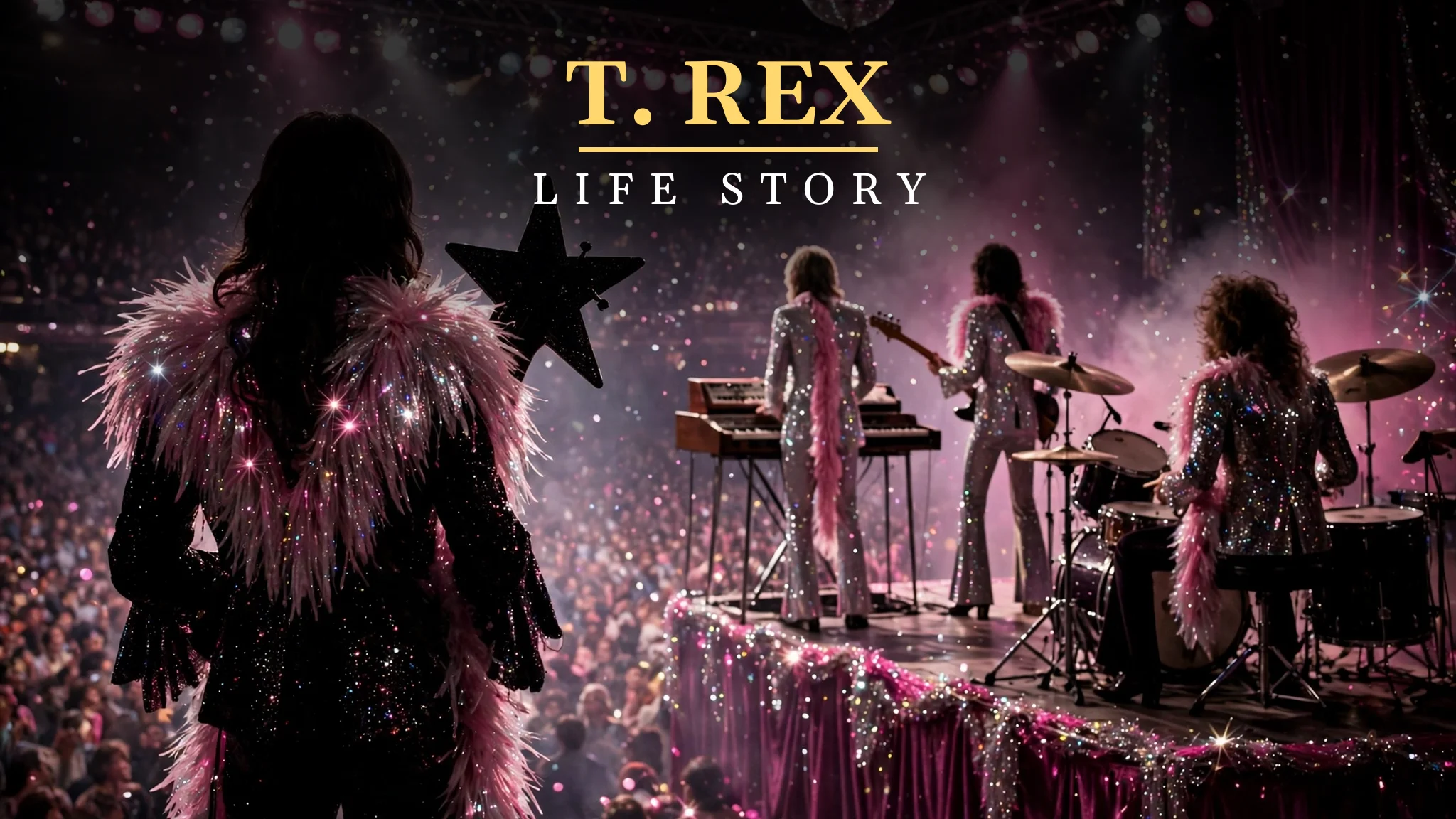
Bolan’s look was just as important as his sound. He wore clothes covered in glitter, satin jackets, feather boas, and platform boots. He put glitter on his face, and he let his dark hair fall over his shoulders. At the time, this was shocking. Most male rock stars dressed in jeans and plain shirts. Bolan dressed like a star from another planet, and young people loved it. The look became known as glam rock, and soon other bands began to copy it. Bolan did not invent every part of glam rock on his own, but he was the person who made it popular, and his image became the image of the whole movement.
The concerts were wild. Fans screamed, fainted, and tried to climb onto the stage. The newspapers wrote about a new craze called T. Rextasy, a word made from the band’s name and the word ecstasy, and it was used to describe the excitement of the fans. The band played to packed halls, and Bolan was treated like a pop king. He enjoyed the fame, and he worked hard to keep it. He wrote songs quickly, he recorded often, and he appeared on television whenever he could. For about two years, T. Rex was the biggest band in Britain, and Bolan was the most famous young man in the country.
The success was not only in Britain. Get It On became a hit in America under the title Bang a Gong, and the band toured the United States. The American success was smaller than the British success, but it was real, and it showed that the band’s sound could travel. Bolan had gone from playing folk music to a handful of people in London clubs to being a star on two continents. It had taken him years of failure and hard work, and now, at twenty-four, he had everything he had dreamed of as a boy in Hackney.
The Slider, the Hits, and the Peak of T. Rextasy
In 1972, T. Rex released the album The Slider, and it was another huge success. The singles from it, Telegram Sam and Metal Guru, both reached number one in Britain, and the album sold in large numbers. The band’s sound had grown richer, with more instruments and a fuller production, but the heart of it was still the same: a strong beat, a catchy riff, and Bolan’s voice. The songs were full of strange words and images, but they were easy to sing along to, and that was the secret of their appeal. A listener did not need to understand every word to enjoy the music.
The band around Bolan had also grown. Mickey Finn was still there, playing percussion, and the rhythm section of Steve Currie on bass and Bill Legend on drums gave the music its drive. The producer Tony Visconti, who had worked with Bolan since the folk years, helped to shape the sound, adding strings and backing vocals that made the records feel bigger. The group worked fast, recording new songs and releasing them while the last ones were still on the charts. It was a busy, exciting time, and the band was at the centre of British pop culture.
Children of the Revolution, another single from 1972, also became a hit, and the band’s concerts grew bigger and louder. Bolan was now a star in the full sense of the word. He was photographed everywhere, he was interviewed in every newspaper, and his face was on the covers of music magazines. Young fans copied his clothes, his hair, and even the glitter on his face. He had become a fashion figure as well as a musician, and that made him even more famous. For a brief period, it seemed as if the success would never end.
But the peak of any fashion is also the moment when it starts to change. By the end of 1972, other bands were making glam rock records, and the public was beginning to look for something new. Bolan kept working, but the hits that had come so easily began to slow down. The Slider was the high point of the band’s commercial success, and it is still remembered as one of the great albums of the 1970s. It captured a moment when one band, led by one unusual singer, seemed to speak for a whole generation of young people who wanted music that was fun, strange, and beautiful.
When the Charts Moved On and the Crowds Grew Smaller
The years after 1973 were harder for T. Rex. The band released new albums, including Tanx and Zinc Alloy and the Hidden Riders of Tomorrow, but the singles did not reach the top of the charts as they once had. The public’s taste was changing, and new bands with different sounds were taking the attention. Bolan’s music stayed close to the style that had made him famous, and some listeners felt that it had not moved forward enough. The crowds at the concerts were still large, but they were not as wild as they had been at the peak of T. Rextasy.
Bolan’s personal life also became more difficult. He had married June Child, who had helped him in the early days of his career, and they had a son, Rolan, born in 1975. The marriage ended, and Bolan began a relationship with Gloria Jones, an American singer who had worked with him. He also drank more and ate poorly, and his health suffered. He put on weight, and his appearance changed, which mattered in a business that cared so much about image. Some of the people around him worried about him, but he kept working, and he kept believing that another big hit was just around the corner.
The band itself changed. Members left, and new players came in. The rhythm section that had driven the early hits broke up, and Bolan worked with different musicians. The records still had moments of brilliance, and Bolan’s talent for writing a catchy tune never left him. But the music business had moved on, and the newspapers were writing about other stars. It is a common story in pop music: the singer who was once the biggest name in the country becomes a smaller figure, playing to smaller crowds, while the world looks elsewhere. Bolan found that hard to accept, because he had once been at the very top.
In the mid-1970s, Bolan moved to the United States for a time, and then he came back to Britain. He tried new ideas, he worked on a television show, and he began to write songs that some listeners felt were stronger than the ones he had made a few years earlier. There were signs that a comeback was possible. A new generation of young musicians, including the punk bands that were starting to appear in London, said that Bolan had influenced them. His name was beginning to matter again, not as a chart star, but as an artist who had changed British music. That respect was real, and it gave him hope for the future.
The Final Year and the Promise of a Comeback
In 1977, Bolan’s career seemed to be turning a corner. He had a new band, a new record deal, and a television series called Marc, in which he performed with other musicians and talked about music. The show was popular with young viewers, and it gave him a regular place on television again. He looked healthier, he seemed more focused, and the people who worked with him said that he was full of plans. He was writing new songs, he was thinking about a new album, and he was talking about touring again. At twenty-nine, he still had time to rebuild his career, and many people believed that he would.
His son Rolan was two years old, and Bolan was a father who loved his boy. He lived in London with Gloria Jones, and the family life gave him a reason to work hard and to stay healthy. The old image of the glitter-covered pop star was still there, but the man behind it had grown up. He had been famous, he had lost some of that fame, and he had learned how hard it was to keep it. The final year of his life was a year of hope, and it is one of the saddest parts of his story that the hope was cut short.
On the night of 16 September 1977, Bolan and Gloria Jones were driving home from a night out in London. Jones was driving, and the car hit a tree in Barnes, in south-west London. Bolan was killed instantly. He was twenty-nine years old. Jones survived, though she was badly hurt. The news shocked Britain. The newspapers and the radio carried the story the next morning, and fans left flowers at the place where the crash had happened. A singer who had once filled the biggest halls in the country was gone in a single night.
The tree where the crash happened became a place of memory for fans, and over the years people have left flowers, messages, and small tributes there. Bolan’s music did not stop being played. The records kept selling, and new listeners kept discovering Electric Warrior and The Slider. The comeback he had been planning never happened, but the songs he had already made were enough to keep his name alive. He had been famous for only a few years, but those few years were enough to change British pop music, and that is why his story is still told today.
What Marc Bolan Left Behind
The legacy of T. Rex is larger than the number of hit singles. Bolan showed that a rock star could be strange, pretty, and poetic, and still make records that millions of people wanted to buy. He helped to create glam rock, and the look he wore on stage influenced singers and bands for decades. The glitter, the satin, the platform boots, and the long hair became part of the language of pop music, and later stars, from David Bowie to the bands of the 1980s, learned from what Bolan had done. He did not invent glam rock alone, but he was the first person to take it to the top of the charts.
His music also lasted. Songs like Get It On, Hot Love, and Children of the Revolution are still played on the radio, in films, and in advertisements. They sound fresh because they are simple and well made. A good guitar riff does not grow old, and a good tune does not need a fashion to support it. New listeners hear the songs without knowing about the 1970s, and they still enjoy them. That is the test of a great pop record, and Bolan’s best records pass it easily. His son Rolan has worked to keep his father’s music alive, and the catalogue of T. Rex has been looked after with care.
Bolan’s story also matters because of how short it was. He was famous at twenty-three, and he was dead at twenty-nine. The six years in between contained a rise, a peak, a fall, and the start of a comeback. It is a reminder that fame can arrive fast and leave fast, and that the work a person does in a short time can matter for a very long time. Marc Bolan is remembered not only for the glitter and the hits, but for the songs themselves, and for the boy from Hackney who believed in his own strange ideas when almost no one else did.
My Take:
When I think about Marc Bolan, the first thing I feel is how unfair his story is. He spent years failing, he finally found the sound that made him a star, he enjoyed it for only a couple of years, and then he died before he could finish the comeback he was working on. That is not a fair life, and I do not think anyone can read his story and feel comfortable about it. But there is something in it that I admire more than I feel sorry for, and that is the way he kept going when nobody was listening. He made records that sold almost nothing. He was in bands that fell apart. He was told, in so many ways, that his music was too strange. And he kept writing. I think that is the real lesson of his life, more than the glitter or the hits. If you believe in something, and you keep working at it, the world can change its mind.
I admire the courage of his look, too. It is easy to forget now how strange it was for a man in 1971 to walk onto a stage covered in glitter, wearing satin and a feather boa, with make-up on his face. That was not a small thing. Britain in the early 1970s was a much more rigid place than it is now, and a man who dressed like that was asking for trouble. Bolan did it anyway, and he did it with joy, not with anger. He did not dress that way to shock people for the sake of it. He dressed that way because it was how he felt inside, and because it made the show more beautiful. I think that kind of honesty is rare, and it is why young people loved him. They saw a person who was not afraid to be himself, and that gave them permission to be themselves, too.
What I love most about his music is how simple it is. Get It On is built on a riff that a child could hum after hearing it once. Hot Love is a song that makes you want to move, even if you do not know all the words. Children of the Revolution has a beat that hits you in the chest. None of these songs are complicated, and none of them try to show off. Bolan understood that a great pop song does not need to be clever. It needs to be true to a feeling, and it needs to be easy to remember. I have listened to many songs that are far more complicated, and I have forgotten most of them. I have never forgotten the opening riff of Get It On, and I think that tells me something about what makes music last.
I also think about the sadness in his story, and I do not want to pretend it is not there. The fall from the top was hard for him, and it is hard to read about. He was a man who had been loved by millions, and then, within a few years, the same newspapers that had praised him were writing about him as if he was finished. That must have hurt. He drank too much, he ate badly, and he lost the sharp look that had made him famous. I feel for him in those years, because he was still the same talented person, but the world had moved on, and he did not know how to move with it. I think many people have felt that way in their own lives, when a job changes, or a skill stops being wanted, or a time passes. Bolan’s story is a famous version of a very common human feeling.
But I also see hope in the last year of his life, and I want to hold on to that. He was getting healthier. He had a television show. He was making new music, and young punk musicians were saying that he had inspired them. He had a small son, and he was a father. It is tempting to think of his life as a tragedy from start to finish, but that is not right. The last year shows a man who was learning, growing, and trying again. He did not give up, even after the charts had turned away from him. He found a new way to be useful, and he found a new audience. I wish he had lived to see where that could have gone. I think he would have had a long second career, not as a chart star, but as a respected artist, a television host, and a father. That is a future that was taken from him, and it is the saddest part of the whole story.
I think about his son Rolan, too, and about what it means to lose a father at the age of two. Rolan never really knew his father, and he has spent his adult life looking after his father’s music. I find that moving, because it shows that a person’s work can keep a family connected across time. Bolan never got to see his son grow up, but his songs are still there, and his son still listens to them. That is a strange kind of immortality, and it is both beautiful and sad. I hope that when Rolan hears Get It On, he hears not just a famous record, but a message from a father who loved music more than anything else in the world.
There is a lesson in Bolan’s story about fame itself, and I think it is an important one. Fame is not a thing you can own. It is a thing that visits you, and it can leave without warning. Bolan was famous, and then he was less famous, and then he was famous again in a different way. He did not control any of that. What he could control was the work: the songs, the shows, the way he treated the people around him. I think the people who last in any field are the ones who focus on the work, not on the fame. Bolan focused on the work for most of his life, and that is why we still talk about him. If he had only chased fame, we would have forgotten him long ago.
I also think about the people around him, and how hard it must have been to watch a friend or a brother fall from the top. Tony Visconti, his producer, worked with him for years, and he helped to make the sound that everyone loved. Mickey Finn stayed with him through the folk years and the glam years. Steve Currie and Bill Legend gave the music its heartbeat. These people are part of the story, and I do not want to forget them. A band is never just one person, even when one person is the star. The sound of T. Rex was the sound of several people working together, and the records would not have been the same without them. I think that is worth remembering, because it is easy to give all the credit to the singer and forget the musicians who stood behind him.
When I listen to Electric Warrior today, I hear a record that still sounds alive. It does not sound old, and it does not sound like a museum piece. It sounds like a band that is having fun, and that fun is contagious. I think that is the best thing I can say about any record. It makes me want to move, it makes me smile, and it makes me feel that the world is a little bit brighter than it was before I pressed play. Bolan had that gift, and it is a rare one. Many musicians are serious and clever, but very few of them can make joy sound so easy. I think that is why his music has survived for more than fifty years, and why it will survive for fifty more.
I also want to say something about the way he died, because it matters. He died in a car crash, at night, on a road in London, and the person driving survived. That is a sudden, violent ending, and it is hard to make sense of it. There is no lesson in it, and no meaning. It was an accident, and accidents do not care about talent or fame. I do not think we should look for a deep message in the crash itself. The message is in the life that came before it: the years of trying, the moment of success, the fall, and the attempt to rise again. That is where the meaning is, not in the tree in Barnes. The tree is just a place where a young man died too soon, and fans leave flowers there because they do not know what else to do with their sadness.
If I could speak to a young person who is trying to make music today, I would tell them to listen to Bolan’s story and to take two things from it. First, be yourself, even if yourself looks strange to other people. Bolan wore glitter when nobody else did, and that is what made him unforgettable. Second, keep working when nobody is listening. Bolan worked for years before anyone cared, and he kept working after the crowds grew smaller. That is not a glamorous lesson, but it is a true one. The people who succeed are not always the most talented. They are often the ones who refuse to stop.
In the end, I think Marc Bolan was a small man with a huge imagination. He came from a modest home in East London, he loved words and guitars, and he built a world out of glitter, riffs, and strange poetry. That world lasted only a few years at the top, but it was bright enough to be remembered for half a century. I am glad that his songs are still played, and I am glad that new listeners keep finding them. He deserved more time, and he deserved a longer life, but the time he had was enough to leave something that will outlast all of us. That is not a bad legacy for a boy from Hackney who once sang folk songs to empty rooms.
I also think about the people who came after Bolan, and about how his influence travelled further than his fame did. The punk bands of the late 1970s, the new wave bands of the 1980s, and the indie bands of the 1990s all learned something from T. Rex, whether they knew it or not. The idea that a pop song could be strange and catchy at the same time, that a singer could wear glitter and still be taken seriously, that a guitar riff could be the whole song: these ideas started with Bolan, and they spread. I find it comforting to think that his influence did not die with him. It went on, quietly, in the music of other people, and it is still going on today.
There is one more thing I want to say, and it is about the way we remember people who die young. It is tempting to turn them into saints, and to forget that they were real people with faults. Bolan was not a saint. He could be difficult, he could be vain, and he made mistakes, especially in the years when his fame was fading. I do not want to pretend otherwise, because pretending would make his story less true. But his faults do not take away from his talent, and they do not take away from the joy his music gave to millions of people. He was a flawed, talented, complicated man, and that is enough. We do not need our heroes to be perfect. We need them to be real, and Bolan was real.
I also think about the way Bolan’s music has been used in films and in advertisements, and about how that has kept his name alive for people who were not even born when he died. When a young person hears Get It On in a film, they do not think about 1971 or about glam rock. They just hear a great song, and they want to know who made it. That is how music travels across time, and it is how a singer who died at twenty-nine can still find new listeners fifty years later. I find that comforting, because it means that good work does not disappear. It waits, and it finds new people, and it keeps on working long after the person who made it is gone.
I think about the tree in Barnes, too, and about the fans who still leave flowers there. It is a small, quiet place, and it is not a grand memorial. But it is a place where people go to remember a singer they loved, and that matters. The fans who leave flowers there are not just mourning a pop star. They are remembering a time in their own lives, a time when they were young, when the music was new, and when the world seemed full of possibility. Bolan’s music is a part of their youth, and the flowers are a way of saying thank you. I find that moving, and I think it is a fitting tribute to a man who gave so much joy in such a short life.
Finally, I want to say that Marc Bolan’s story is a reminder to make the most of the time we have. He was famous for only a few years, and he died at twenty-nine, but he left behind songs that are still played today, and a legacy that is still felt. He did not waste his time, and he did not wait for permission. He wrote songs, he made records, he wore glitter, and he lived the life he wanted to live. That is a lesson for all of us: do not wait, do not hold back, and do not be afraid to be yourself. The time we have is short, and the best thing we can do with it is to make something that matters, and to share it with the world.
Frequently Asked Questions
Who was the lead singer of T. Rex?
Marc Bolan was the lead singer, guitarist, and songwriter of T. Rex. He was born Mark Feld in London in 1947, and he led the band from its folk days as Tyrannosaurus Rex through its glam rock fame in the early 1970s until his death in 1977.
What are the most famous T. Rex songs?
The band’s most famous songs include Ride a White Swan, Hot Love, Get It On, Telegram Sam, Metal Guru, and Children of the Revolution. Get It On was also a hit in America under the title Bang a Gong, and it remains the band’s best-known song outside Britain.
What is glam rock, and what did T. Rex have to do with it?
Glam rock was a style of early 1970s pop music in which singers wore glitter, satin, platform boots, and make-up on stage. T. Rex, led by Marc Bolan, was one of the first bands to make the style popular, and Bolan’s look and sound helped to define the whole movement.
How did Marc Bolan die?
Marc Bolan died in a car crash on 16 September 1977 in Barnes, London, at the age of twenty-nine. The car was being driven by his partner, Gloria Jones, and it hit a tree. Bolan was killed instantly, and Jones survived with serious injuries.
What does the word T. Rextasy mean?
T. Rextasy was a word made by the press in the early 1970s to describe the excitement of T. Rex fans. It combined the band’s name with the word ecstasy, and it was used to describe the screaming crowds and the wild scenes at the band’s concerts.
Did T. Rex have success in America?
Yes, but it was smaller than their success in Britain. Get It On, released in America as Bang a Gong, became a hit there, and the band toured the United States. In Britain, however, the band had many number one singles and was far bigger.
What was T. Rex called before they became famous?
The band began as a folk duo called Tyrannosaurus Rex, with Marc Bolan and percussion player Steve Peregrin Took. In 1970, Bolan shortened the name to T. Rex, added electric instruments, and moved towards the rock sound that made the band famous.


