The Dubliners: The Life Story Behind the Irish Folk Legends
In this post
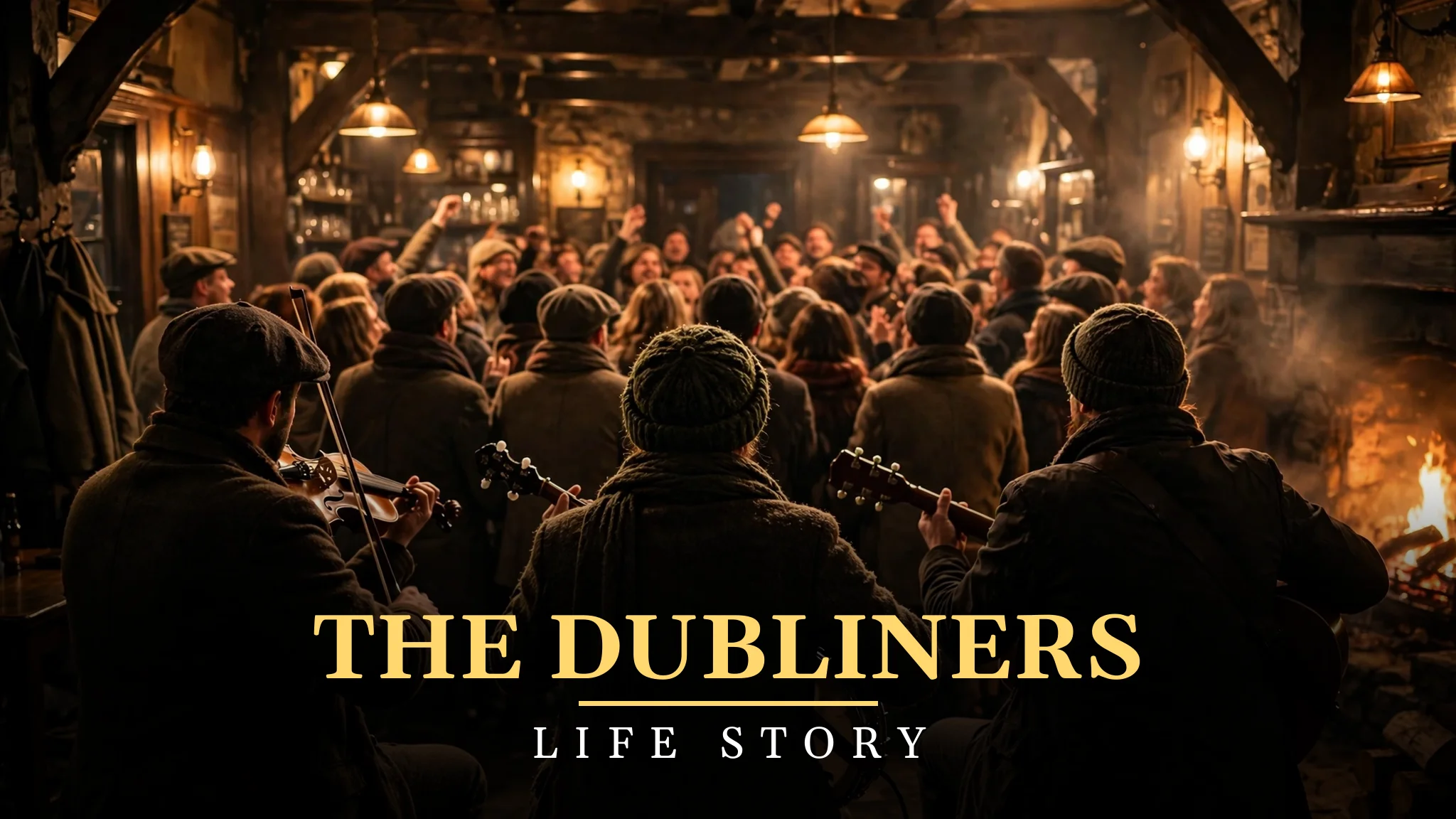
The Dubliners began in a Dublin pub, with a few friends, a few instruments, and no plan to become famous. They played because they loved the songs, because the room was warm, and because the people in front of them wanted to sing along. Fifty years later, they were one of the most loved folk groups in the world, their songs were known in every country where Irish people had settled, and their name had become a shorthand for a certain kind of honest, joyful, unpretentious music.
Their story is the story of a band that never tried to be fashionable. They wore ordinary clothes, they sang in strong Dublin accents, they played traditional instruments, and they sang songs that were sometimes funny, sometimes sad, and sometimes rude. They were not polished, and they did not want to be. They were real, and audiences could tell the difference. From O’Donoghue’s pub to concert halls in London, New York, and Sydney, they carried the same spirit with them, a group of friends making music together.
This is the story of how that happened, of the men who made it, of the songs that lasted, of the losses that changed the band, and of the fifty-year journey that ended only when the last of the original members decided it was time to stop. It is a story about friendship, about Dublin, and about songs that refuse to die.
A Session in O’Donoghue’s
The Dubliners began in 1962, in O’Donoghue’s pub on Merrion Row in Dublin. The pub was a meeting place for musicians, writers, actors, and talkers, and its music sessions were famous. Among the musicians who gathered there were Ronnie Drew, a singer and guitarist with a deep, gravelly voice, Luke Kelly, a young singer and banjo player from Sheriff Street, Barney McKenna, a banjo player known for his skill and his humour, Ciaran Bourke, a singer and musician who played guitar and tin whistle, and John Sheahan, a fiddle player who had studied classical music. They began playing together for fun, and then they began playing together regularly, and then someone suggested they should be a proper band.
They took their name from Dubliners, the book of short stories by James Joyce, one of Ireland’s greatest writers. It was a fitting name, because the band, like Joyce’s book, was about Dublin and its people, about ordinary lives, about work, love, drink, and loss. They were not trying to be literary, but the name gave them a sense of place, and a sense of purpose. They were Dubliners, singing about Dublin, for Dubliners, and for anyone else who wanted to listen.
Their early shows were in pubs and small clubs, and they were informal affairs. The band would play, the audience would sing along, someone would buy a round of drinks, and the night would go on until closing time. There was no stage show, no light show, and no pretence. There was just music, played well, sung with feeling, and shared with friends. That informality became their trademark, and it stayed with them even when they were playing in large concert halls. They always sounded like a group of friends in a pub, even when the pub had become a theatre.
In 1964, they released their first album, The Dubliners with Luke Kelly, and it sold well enough to show that there was an audience for their music beyond Dublin. They began to tour in Britain, playing folk clubs and small halls, and they were welcomed by Irish people living abroad, who heard in their songs a reminder of home. The band was on its way, and none of them quite knew how far it would go.
Two Voices, One Sound
The heart of the Dubliners’ sound was the contrast between their two main singers, Ronnie Drew and Luke Kelly. Ronnie’s voice was deep, rough, and weathered, the voice of a man who had lived a life and had the stories to prove it. Luke’s voice was stronger, clearer, and more powerful, the voice of a younger man with a great range and a great feeling for a ballad. Together, they gave the band a sound that was unmistakable. When Ronnie sang, you listened to the words. When Luke sang, you felt them in your chest.
Barney McKenna’s banjo playing was another key part of the sound. Barney was one of the finest banjo players in Ireland, and his playing gave the band its drive, its lift, and its joy. He was also the band’s joker, a funny, warm man who kept the group laughing through long tours and hard times. Ciaran Bourke brought a gentler voice and a skill on guitar and whistle, and John Sheahan’s fiddle playing added a classical grace to the band’s rougher edges. Together, the five men made a whole that was greater than the sum of its parts.
Their repertoire was wide. They sang traditional ballads, rebel songs, love songs, comic songs, and drinking songs, and they sang them all with the same commitment. They sang The Auld Triangle, a song about prison life in Dublin, The Wild Rover, a song about a man who gives up drinking, and The Black Velvet Band, a comic tale of a young man led astray. They sang songs that had been sung in Ireland for generations, and they made them sound fresh, because they sang them as if they were new.
What made them different from other folk groups was their honesty. They did not smooth out the rough edges of the songs, they did not soften the Dublin accents, and they did not pretend to be something they were not. They were working-class Dublin men singing working-class Dublin songs, and audiences, in Ireland and abroad, loved them for it. They were not stars in the usual sense. They were neighbours who happened to be great musicians.
Seven Drunken Nights and the Charts
In 1967, the Dubliners had a hit that changed their career. Their recording of Seven Drunken Nights, a comic song about a man who comes home drunk for seven nights in a row to find a series of strange things in his house, reached the charts in Britain and Ireland. It was a funny song, with a catchy chorus, and it was played on the radio and on television. The band, who had been playing folk clubs for years, were suddenly pop stars, appearing on Top of the Pops and being recognised in the street.
The success of Seven Drunken Nights brought the Dubliners to a much wider audience, but it also brought them a problem. They were a folk band, not a pop band, and they did not want to be known only for one funny song. They continued to record and to tour, and they made sure that their concerts included the full range of their music, the sad ballads as well as the comic songs, the rebel songs as well as the drinking songs. They were determined not to become a novelty act, and they succeeded, because their live shows were so strong that audiences left knowing they had seen a real band.
Through the late 1960s and into the 1970s, the Dubliners toured constantly, playing in Britain, in Europe, in America, and in Australia. They played in folk clubs, in concert halls, and in theatres, and they were welcomed everywhere by Irish communities abroad. For many Irish emigrants, a Dubliners concert was a chance to hear the songs of home, to sing along, and to feel less far away. The band understood that, and they played with a warmth and a generosity that made every show feel like a homecoming.
They also recorded many albums in these years, and their records sold steadily. They were not a band that chased hits, but they were a band that sold records, year after year, to a loyal audience. Their music was not fashionable, but it was lasting, and that was more important to them than a week at the top of the charts.
The Irish Rover and a New Generation
In the 1980s, the Dubliners found a new audience through a collaboration with a younger band, the Pogues. In 1987, the two bands recorded a version of The Irish Rover together, and it became a hit in Britain and Ireland, reaching the top ten. The recording brought together two generations of Irish folk music, the older Dubliners, with their traditional sound, and the younger Pogues, with their punk energy, and the result was joyful. The two bands toured together, and the Dubliners were introduced to a new generation of fans who had grown up listening to the Pogues.
The collaboration was a reminder that the Dubliners were not a museum piece. They were a living band, still playing, still singing, and still able to connect with young people. Luke Kelly was still their leading singer at the time, though his health was already fragile, and his voice on The Irish Rover was as strong as ever. The song became one of their most loved recordings, and it is still played today.
The 1980s were also a time of loss for the band. Ciaran Bourke, who had been with the group since the start, suffered a brain haemorrhage in 1974 and was unable to perform regularly afterwards, though he remained a member until his death in 1988. Luke Kelly died in 1984, at the age of forty-three, from a brain tumour, and his death was a terrible blow to the band and to Ireland. Ronnie Drew left the band in 1974 and returned later, and the group went through a number of changes in personnel over the years. Yet they carried on, because the music mattered, and because audiences still wanted to hear it.
New singers joined, including Sean Cannon and later Paddy Reilly, and the band continued to tour and record. They were no longer the original five, but they were still the Dubliners, and they still played with the same spirit. Barney McKenna and John Sheahan, two of the original members, remained at the heart of the group, and they kept the band’s sound and its humour alive.
Fifty Years and a Farewell
By the 2000s, the Dubliners were one of the longest-running bands in the world, and they were celebrated as legends of Irish music. They toured the world, they played to packed halls, and they were welcomed as elder statesmen of folk music. Ronnie Drew, who had left and returned, died in 2008, and his death was mourned across Ireland. Barney McKenna, the band’s banjo player and joker, died in 2012, and his death marked a turning point. John Sheahan, the last surviving member of the original group, decided that the band should come to an end.
In 2012, the Dubliners celebrated their fiftieth anniversary with a series of concerts and a tour, and then they brought their story to a close. It was a fitting end to a remarkable career. Fifty years is a long time for any band, and it is an extraordinary time for a band that began in a pub with no plan and no ambition beyond playing good music for friends. They had played in almost every country in the world, they had recorded dozens of albums, and they had given Irish music to millions of people.
The band’s legacy did not end with their final concert. Their recordings are still listened to, their songs are still sung in pubs and at sessions, and new generations of musicians still learn from them. The Dubliners showed that folk music could be popular without being watered down, that a band could be successful without losing its soul, and that friendship and music could sustain a group for half a century.
Their name is now part of Irish culture, and their songs are part of the soundtrack of Irish life. When people think of Irish folk music, they think of the Dubliners, of Ronnie Drew’s gravelly voice, of Luke Kelly’s powerful singing, of Barney McKenna’s banjo, and of a group of friends in a Dublin pub, making music together because they loved it. That image has lasted for sixty years, and it will last for many more.
The Songs That Refuse to Die
What makes the Dubliners matter today is not nostalgia. It is the songs themselves. The Auld Triangle, The Wild Rover, Whiskey in the Jar, The Black Velvet Band, Raglan Road, and Seven Drunken Nights are still sung, still played, and still loved, not because they are old, but because they are good. They tell stories about love, about work, about drink, about prison, about home, and about Ireland, and those stories are still true. A song about a man who comes home drunk is still funny. A song about a prisoner in Dublin is still sad. A song about a lover on Raglan Road is still beautiful.
The band also matters because they gave Irish people abroad a sense of home. For Irish emigrants in London, in New York, in Sydney, and in Toronto, a Dubliners record was a connection to the place they had left. It was a reminder of the pubs, the streets, and the voices of Dublin, and it helped them to feel less alone. That is a powerful gift, and it is one that the band gave freely, for fifty years, to anyone who wanted to listen.
Young musicians still learn the Dubliners’ songs, and they still try to capture the band’s spirit, the rough honesty, the humour, the warmth, and the sense that music is something to be shared, not something to be shown off. The Dubliners did not make music to impress people. They made music to bring people together, and that is why their music still brings people together today, in pubs, in kitchens, and in concert halls around the world.
The Band on Film and on Record
The Dubliners were not only a live band. They were a recording band, and their records tell the story of Irish folk music over fifty years. Their early albums, made in the 1960s, were simple affairs, recorded quickly, with the band playing together in a room, much as they would have played in a pub. Those records captured the band’s energy and their humour, and they sold steadily to an audience that wanted to hear the songs at home. As the years went on, their recordings became more polished, but they never lost the feeling of a live performance, of five men playing together and enjoying it.
They also appeared on television, in Ireland and in Britain, and those appearances brought them to people who had never been to a folk club. A Dubliners performance on television was a joyful thing, with the band smiling, the audience clapping, and the songs ringing out. They were natural television performers, because they were natural performers, and the camera loved them. Their appearance on Top of the Pops with Seven Drunken Nights was a famous moment, a folk band on a pop show, holding their own and winning over a young audience.
The band’s records were also important for Irish people living abroad. In the days before the internet, a Dubliners record was a connection to home, a way to hear the songs of Dublin in a flat in London or a house in New York. Families would play the records at parties, at Christmas, and at gatherings, and the songs became part of family life. That is a special kind of success, not measured in chart positions, but in the number of homes where the music was loved.
In later years, the band’s recordings were reissued, collected, and celebrated, with box sets and compilations that brought their whole career together. New listeners discovered them through those collections, and old listeners returned to them with pleasure. The Dubliners’ discography is now a record of fifty years of Irish music, from the folk revival of the 1960s to the modern era, and it remains one of the most important bodies of work in Irish folk.
The Dubliners and the Folk Revival
The Dubliners were part of a wider folk revival that swept through Ireland, Britain, and America in the 1960s, a movement that brought traditional music back to life after years of being seen as old-fashioned. Young people who had grown up with rock and roll began to discover folk songs, and they found in them an honesty and a directness that pop music often lacked. The Dubliners were at the heart of that revival in Ireland, and they helped to lead it, along with other groups such as the Chieftains and Planxty. They showed that traditional music was not a museum piece, but a living art, and that it could speak to young people as well as to old ones.
Their role in the revival was important because they were not scholars or collectors. They were working-class Dublin men who had grown up with the songs, who had sung them in pubs and at home, and who played them with a naturalness that no academic could match. They did not study folk music. They lived it, and that authenticity made them credible to audiences who were tired of polished, artificial pop. They were the real thing, and people could tell.
The revival also brought the Dubliners into contact with folk singers from other countries, including America, where they toured and where they met musicians who shared their love of traditional songs. Those exchanges enriched their music, and they helped to build a worldwide folk community, a network of singers and players who shared songs across borders. The Dubliners were part of that community, and they contributed to it, by sharing Irish songs with the world and by learning songs from other traditions in return.
The Dubliners’ Humour
The Dubliners were funny, and their humour was a central part of who they were. Their concerts were full of jokes, of stories, and of laughter, and Barney McKenna, in particular, was known as the band’s joker, a man who could make an audience laugh with a single line. Their songs were often funny too, with comic tales of drunken nights, of clever rogues, and of Dublin characters, and they sang those songs with a twinkle in their eye. That humour was not just entertainment. It was a way of looking at life, a way of saying that even hard times can be laughed at, and that laughter is a form of resilience.
Their humour also made their sad songs more powerful, because an audience that has laughed with a singer is more ready to cry with them. The Dubliners understood that balance, between laughter and tears, and they used it in their concerts, moving from a comic song to a sad ballad, and back again, in a way that felt natural. That is a skill that few performers have, and it is one that made their shows special. They were not just musicians. They were entertainers, in the best sense, and they knew how to take an audience on a journey.
My Take:
When I think about the Dubliners, I think about a pub. Not a concert hall, not a stadium, not a television studio, but a pub, with wooden tables, a warm fire, and a group of friends playing music in the corner. That is where they began, and that is where their spirit has always lived, even when they were playing to thousands of people. I admire that, because it is easy to lose yourself when you become famous. It is easy to start believing that you are special, that you need a big show, that you need to be distant from your audience. The Dubliners never did that. They stayed close, they stayed ordinary, and they stayed honest, and that is why people loved them.
I admire their friendship most of all. Five men, from different backgrounds, with different voices and different skills, came together in a pub and stayed together, in one form or another, for fifty years. That is a remarkable thing. Bands usually fall apart after a few years, because of money, because of ego, because of tiredness, or because of success. The Dubliners had all of those pressures, and they still kept going. They argued, they left, they came back, they lost members to illness and death, and they still kept playing. That tells me that their bond was not just about music. It was about friendship, and about a shared love for the songs they sang.
I also admire their honesty as singers. They did not try to sound American, they did not try to sound polished, and they did not try to hide their Dublin accents. They sang as Dubliners, about Dublin, in the voices they had been given. That is a brave choice in a music business that often wants everyone to sound the same. It is also a smart choice, because a voice that sounds like a real place, and a real life, is a voice that people remember. When I hear Ronnie Drew sing, I hear Dublin. When I hear Luke Kelly sing, I hear Dublin. That is a gift, and it is one that the band gave to the world.
What I find sad in their story is the losses. Luke Kelly died at forty-three, Ciaran Bourke suffered a terrible illness and died young, Ronnie Drew died in 2008, and Barney McKenna died in 2012. Each loss took something from the band, and each loss was felt by the fans as well as by the bandmates. It is hard to think about a group that brought so much joy to so many people, and to remember that so many of its members died too young. But that is the truth of life, and the Dubliners, who sang about loss as well as joy, would have understood it. Their songs were always about both, and their lives were too.
I think about the collaboration with the Pogues, and about The Irish Rover, and I love that moment in their story. It was a moment when an older band and a younger band came together, not to compete, but to make music together, and to show that folk music is a living thing, passed from one generation to the next. The Dubliners could have been jealous of the Pogues, or dismissive of their punk energy. Instead, they embraced them, they recorded with them, and they toured with them. That generosity is something I admire a great deal, and it is a lesson for any older artist. Do not fear the young. Work with them, learn from them, and let them learn from you.
I also think about what the Dubliners meant to Irish people living abroad. I have never lived far from home, but I can imagine how it must feel to be in London or New York, missing Dublin, and to hear a Dubliners record and feel, for three minutes, as if you are back in a pub on Merrion Row. That is a powerful thing to give to people, and it is a kind thing, too. The band gave homesick people a piece of home, and they did it without ever making a fuss about it. They just played, and the music did the work.
There is a lesson in their story about staying true to yourself. The Dubliners were offered the chance to become a pop band, to chase hits, to change their sound, and they said no. They kept playing the songs they believed in, in the way they believed in, and they built a career that lasted fifty years. A pop career built on one hit might last a year. A folk career built on honest songs can last a lifetime. I think that is a useful lesson for anyone starting out in music, or in any kind of work. Do not chase fashion. Do the work you believe in, do it well, and do it for a long time, and people will find you.
I also respect the way they ended. Fifty years is enough. John Sheahan, the last original member, could have kept the name going with new musicians, and many bands do that. He chose not to. He chose to bring the story to a close with dignity, to celebrate the fiftieth anniversary, and then to stop. That takes wisdom, and it takes respect for what the band had been. It is better to end well than to go on too long, and the Dubliners ended well. Their final concerts were celebrations, not sad farewells, and that feels right.
For a young reader, I think the lesson of the Dubliners is to find your friends and to make something together. The band began with friendship, and it lasted because of friendship. They were not five strangers brought together by a record company. They were five men who liked each other, who liked the same songs, and who liked playing together. That is the best way to start anything, whether it is a band, a business, or a project. Find people you trust, find something you love, and do it together, for as long as you can.
In the end, I think the Dubliners will be remembered as one of the greatest folk groups the world has ever known, and that is right. But I hope they are also remembered as five friends in a pub, who played music because they loved it, who sang about Dublin because they loved it, and who gave the world fifty years of songs that still make people sing along. That is a beautiful legacy, and it is one that will last as long as people still gather to sing.
I also think about the records, and about how important they were for Irish people far from home. Before the internet, before streaming, a record was a precious thing, and a Dubliners record in a house in London or New York was a piece of Dublin on a shelf. Families played those records at Christmas, at birthdays, and at parties, and the songs became part of their lives. That is a different kind of fame from a week at number one. It is a slow, deep fame, built over years, in thousands of homes, and it lasts longer than any chart position. The Dubliners had that kind of fame, and I think it is the best kind.
I wonder what the original five would have thought if someone had told them, in 1962, that they would still be talked about sixty years later, that their songs would be sung in pubs around the world, and that statues and books and documentaries would celebrate their work. I think they would have laughed, and ordered another round, and gone back to playing. They were not men who planned for fame. They were men who loved to play, and fame came to them because they played well and because they played honestly. That is a healthy way to think about success. Do the work you love, do it well, and let the rest happen as it will.
There is a final thought I want to share, about the sound of their music and why it still moves me. The Dubliners’ sound is not polished, and it is not perfect, and that is why it works. You can hear the breath in the singing, the scrape of the bow on the fiddle, the ring of the banjo, and the laughter between songs. It sounds like real people making real music in a real room, and that is a rare thing in a world of perfect, computer-made records. I love that imperfection, because it reminds me that music is made by people, for people, and that its power comes from its humanity, not from its polish.
I also think about the folk revival, and about the Dubliners’ place in it, and I am struck by how important they were. In the 1960s, traditional music was in danger of being forgotten, of being seen as old-fashioned and irrelevant. The Dubliners, along with a few other groups, saved it, by playing it with energy, with humour, and with pride, and by showing young people that it was worth listening to. That is a remarkable achievement, and it is one that should not be underestimated. They did not just make records. They saved a tradition, and they passed it on to new generations.
I think about the pubs where their songs are still sung, and about the sessions where young musicians play The Auld Triangle or The Wild Rover, and I feel hopeful. Folk music is still alive, and it is still being passed on, because the Dubliners and others like them kept it alive when it could easily have died. That is a legacy that goes beyond charts and awards. It is a legacy of cultural survival, and it is one that Ireland owes them a great debt for.
Finally, I want to say that the Dubliners’ music has given me something precious, a sense of what it means to belong to a place, and to sing about it with love. I have never lived in Dublin, but when I hear their songs, I feel as if I know the city, its streets, its pubs, and its people. That is the power of great folk music, to make a stranger feel at home, and the Dubliners did that for millions of people around the world. I am grateful to them for it, and I will keep listening to their songs, and singing along, for as long as I can.
I also think about their humour, and about how important it was, and I want to say that laughter is underrated in folk music. People think folk music is serious, sad, and political, and sometimes it is, but the Dubliners showed that it can also be funny, and that humour is a form of truth. A comic song about a drunken night tells you as much about Dublin life as a sad ballad about prison, and it does so with a smile. The Dubliners understood that, and they made their audiences laugh, as well as cry, and that balance is why their concerts were so loved.
I think about Barney McKenna once more, and about his role as the band’s joker, and I am glad he was there. Every group needs someone who can make people laugh, who can lighten a long tour, and who can remind everyone not to take themselves too seriously. Barney was that person for the Dubliners, and his banjo playing was brilliant, but his humour was just as important. He kept the band laughing, and he kept their audiences laughing, and that is a gift that should not be forgotten when people talk about the band’s music.
I also think about the next generation of folk singers, and about how the Dubliners’ music will live on through them, and I am hopeful. Young people are still learning their songs, still playing them in pubs, and still discovering them for the first time, and that is how folk music survives. It is passed from one singer to another, from one generation to the next, and it changes a little each time, but its heart stays the same. The Dubliners were part of that chain, and they strengthened it, and the singers who follow them are part of it too. That is a comforting thought.
I think about my own life, and about the songs that have stayed with me, and I realise that the Dubliners’ songs are among them. The Auld Triangle, The Wild Rover, Raglan Road, these are songs I will carry with me, and sing along to, for the rest of my life. That is the power of great folk music, to become part of a person’s life, and to stay there. The Dubliners gave me that gift, and they gave it to millions of others, and I am grateful.
Frequently Asked Questions
When and where did the Dubliners form?
The Dubliners formed in 1962 in O’Donoghue’s pub on Merrion Row in Dublin. The original members were Ronnie Drew, Luke Kelly, Barney McKenna, Ciaran Bourke, and John Sheahan, and they took their name from the book Dubliners by James Joyce.
Who were the two main singers in the Dubliners?
The two main singers were Ronnie Drew, whose voice was deep and gravelly, and Luke Kelly, whose voice was strong, clear, and powerful. Together they gave the band its unmistakable sound, with Ronnie singing many of the rougher ballads and Luke singing many of the best-loved love songs and anthems.
What was the Dubliners’ first big hit?
Their first big hit was Seven Drunken Nights in 1967, a comic song about a man who comes home drunk for seven nights in a row. It reached the charts in Britain and Ireland, brought the band to television, and introduced them to a much wider audience than the folk clubs where they had started.
Did the Dubliners record with the Pogues?
Yes, in 1987 the Dubliners and the Pogues recorded a version of The Irish Rover together, and it became a hit in Britain and Ireland. The collaboration brought together two generations of Irish folk music, and the two bands toured together, introducing the Dubliners to a new, younger audience.
When did Luke Kelly die and how did it affect the band?
Luke Kelly died on 30 January 1984, at the age of forty-three, from a brain tumour. His death was a terrible blow to the band, because his voice and his banjo playing were central to their sound, and the group was never quite the same without him, though they carried on with new singers.
How long did the Dubliners last?
The band lasted for fifty years, from 1962 until 2012, when they celebrated their fiftieth anniversary and brought their story to a close. By then, John Sheahan was the last surviving member of the original group, and he decided it was time to end the band with dignity after the death of Barney McKenna.
What are the Dubliners’ best-known songs?
Their best-known songs include The Auld Triangle, The Wild Rover, Whiskey in the Jar, The Black Velvet Band, Raglan Road, Seven Drunken Nights, and The Irish Rover. These songs are still sung in pubs and at folk sessions around the world, and they remain the core of the band’s legacy.


