The Saw Doctors: The Life Story Behind the Irish Rock Band
In this post
The Saw Doctors are a band that sounds like a night out in the west of Ireland. Their songs are loud, funny, warm, and full of life, and their concerts are less like a performance and more like a party where everyone is invited. They sing about small towns, about roads, about football, about love, and about leaving home, and they sing about them in a way that makes people laugh, sing along, and feel proud of where they come from.
They began in Tuam, a small town in County Galway, in 1986, and they have been going, in one form or another, ever since. They had a number one hit in Ireland with I Useta Lover, they had a famous song called N17 about a road in the west, and they built a following that has stayed with them for decades. They were never a fashionable band, and they never tried to be. They were a band for the people of the west, and for Irish people everywhere, and that was enough.
This is their story, from a small town in Galway to the top of the Irish charts, to tours in Britain and America, to long breaks and happy returns, and to a band that still fills halls with people singing every word. It is a story about friendship, about place, and about songs that make people feel at home.
Two Friends in Tuam
The Saw Doctors were formed in 1986 in Tuam, County Galway, by two friends, Leo Moran and Davy Carton. Leo was a singer and guitarist, Davy was a singer and guitarist, and both men had grown up in the west of Ireland, listening to Irish music, to rock music, and to the songs of their home. They had played in other bands, they had written songs together, and they had a shared idea, to make a band that sounded like Tuam, like Galway, like the west, and to sing about the lives they knew.
Tuam is a small market town, and it was not an obvious place to start a rock band. Dublin and London were where bands were supposed to come from, not a town in Galway. But Leo and Davy did not care about that. They believed that a small town had stories worth singing about, and that people in small towns would recognise themselves in their songs. They were right. The band’s early songs were about local life, about the people they knew, about the pubs they drank in, and about the roads they travelled, and audiences in Galway loved them for it.
The band’s name, the Saw Doctors, came from a nickname for travelling tinkers who sharpened saws, and it suited them. It was a rough, working-class name, with a hint of humour, and it told people that this was not a polished pop band. This was a band of working men, singing working songs, and they were proud of it. The name stuck, and it became one of the most recognisable band names in Irish music.
In their early years, the Saw Doctors played in pubs and clubs across Galway and the west, building a following the slow way, one gig at a time. They were a live band first and foremost, and their shows were energetic, funny, and full of audience participation. People did not just watch the Saw Doctors. They sang with them, they danced with them, and they went home hoarse from shouting along. That live energy became the band’s trademark, and it has stayed with them ever since.
I Useta Lover and a Number One
The Saw Doctors’ breakthrough came in 1990, with the song I Useta Lover. It was a funny, bittersweet song about a man looking back on a past love, and it became a number one hit in Ireland, staying at the top of the charts for nine weeks. It was an extraordinary success for a band from Tuam, and it made them famous across Ireland. The song was played on the radio, in pubs, and at parties, and it became one of the best-known Irish songs of the early 1990s.
The success of I Useta Lover led to a record deal, and in 1991 the band released their first album, If This Is Rock and Roll, I Want My Old Job Back. The album’s title was a joke, a play on the idea that rock and roll was supposed to be rebellious, and it summed up the band’s attitude. They were not rock stars in the usual sense. They were ordinary men who happened to play in a band, and they were happy to say so. The album sold well, and it included songs that became favourites, including N17, a song about the road from Tuam to Galway.
N17 became one of the band’s signature songs, and one of the most loved songs in the west of Ireland. It was about the N17 road, a long, winding road that many people in Galway and Mayo travelled every day, and it captured the feeling of driving home, of missing someone, and of the landscape of the west. The song was later adopted as an anthem by people from the area, and it is still sung at concerts, at football matches, and in pubs across the west. It is a song about a road, but it is really a song about home.
The band toured Ireland and Britain on the back of their success, and they played to larger audiences than ever before. They were no longer just a Galway band. They were a national band, and they were being talked about as one of the best live acts in Ireland. Leo Moran, with his wild hair and his energetic stage presence, and Davy Carton, with his calm, melodic singing, became a well-known partnership, two friends from Tuam who had made it big without leaving home behind.
On the Road in Britain and America
Through the 1990s, the Saw Doctors continued to record and tour, releasing albums such as All the Way from Tuam in 1992, Same Oul’ Town in 1996, and Songs from Sun Street in 1998. Their songs continued to be about the west, about small towns, about football, about love, and about emigration, and their audience continued to grow. They toured in Britain, where Irish communities welcomed them, and in America, where they played to Irish-American audiences who loved their sound.
Their live shows in these years were legendary. The band played long sets, they told jokes, they talked to the audience, and they encouraged everyone to sing along. A Saw Doctors concert was not a quiet affair. It was loud, joyful, and a little chaotic, and that was exactly what people wanted. The band’s humour was a key part of their appeal. They did not take themselves too seriously, and they were happy to laugh at themselves, at their town, and at the music business.
They also became known for their support of Galway football, and for their song The Green and Red of Mayo, which became an anthem for Mayo football fans. The band’s connection to sport, to place, and to community was part of what made them special. They were not a band that sang about abstract ideas. They sang about real things, about the things that mattered to their audience, and that honesty made them trusted.
By the late 1990s, the Saw Doctors were one of the most popular live bands in Ireland, and they had a loyal following that came to see them year after year. They were not a band that chased hits, and they did not need to. Their audience was loyal, their concerts sold out, and their songs were part of everyday life in the west. They had built something lasting, and they had built it on their own terms.
Breaks, Returns, and a Loyal Crowd
Like many bands that have been together for a long time, the Saw Doctors went through periods of change in the 2000s. Members left and joined, the band took breaks, and Leo Moran and Davy Carton pursued other projects. Leo formed a band called Leo and the Line Up, and Davy worked on solo material, but the Saw Doctors always came back together. Their bond, as friends and as musicians, was too strong to break, and their audience was always waiting for them.
In 2010, the band released a new album, The Further Adventures of the Saw Doctors, and they toured again, playing to packed halls in Ireland and Britain. Their concerts were still joyful, still loud, and still full of singalongs, and new fans joined the older ones who had been following them since the 1990s. The band had become a kind of institution in the west, a group that people grew up with, and that they returned to, year after year, like an old friend.
The band also celebrated anniversaries, including twenty-five years together, with special concerts and with a sense of pride in what they had achieved. They had come from a small town in Galway, they had made records, they had toured the world, and they had never lost their connection to home. That was an achievement worth celebrating, and their fans celebrated with them.
In recent years, the Saw Doctors have continued to play, though less often, and they have continued to be loved by their audience. They play at festivals, at special concerts, and at events in Galway and beyond, and their songs, N17, I Useta Lover, and The Green and Red of Mayo, are still sung with passion. They are a band that has lasted because they never pretended to be something they were not, and because their songs are about real life.
Songs About Home
What makes the Saw Doctors matter is their connection to place. They sing about Tuam, about Galway, about the N17 road, about Mayo football, and about the west of Ireland, and they sing about those things with love and with humour. For people from the west, hearing a Saw Doctors song is like hearing a friend talk about home. It is familiar, it is funny, and it is true. That connection to place is rare in modern music, and it is why the band has lasted so long.
They also matter because they showed that a band from a small town could succeed without moving to Dublin or London. They stayed in Tuam, they sang about Tuam, and they built a career from there. That was an inspiring example for other musicians from small places, and it showed that you do not need to leave home to make music that matters. You can stay, you can sing about where you are, and people will listen.
Their humour is another part of their legacy. The Saw Doctors are funny, and they are not afraid to be funny. Their songs make people laugh, their concerts make people laugh, and their interviews make people laugh. In a music world that often takes itself too seriously, that humour is refreshing, and it is part of why people love them. They remind us that music should be joyful, and that a concert should be fun.
Today, the Saw Doctors are regarded as one of Ireland’s best-loved bands, a group that has given the west a voice and given Irish music a sense of humour. Their songs are still played on the radio, still sung in pubs, and still loved by people of all ages. They are a band that has never gone away, and that is the best tribute of all.
The Band’s Humour and Heart
The Saw Doctors have always been funny, and their humour is a central part of who they are. Their songs are full of jokes, of wordplay, and of gentle teasing, and their concerts are full of laughter. Leo Moran, in particular, is known for his stage banter, for the stories he tells between songs, and for the way he involves the audience in the show. A Saw Doctors concert is as much a comedy show as a music show, and the audience loves it. They come to laugh as well as to sing, and they leave feeling happier than when they arrived.
That humour is not just for entertainment. It is a way of looking at the world, a way of saying that life is hard, that work is hard, that love is hard, and that the best response is to laugh, to sing, and to carry on. The band’s songs are funny, but they are also kind. They laugh with people, not at them, and they never punch down. They sing about ordinary people with affection, and that affection is what makes their humour work. It is the humour of friends in a pub, not the humour of a comedian on a stage.
Their heart is in their songs about home, about family, and about community. They sing about mothers, about fathers, about friends, and about the people they grew up with, and they sing about them with love. That love is the other half of their music, the serious side that balances the jokes. A Saw Doctors concert makes you laugh, but it also makes you feel, and that combination is rare and precious.
Galway, Football, and Community
The Saw Doctors are deeply connected to Galway, to its football teams, and to its communities, and that connection is part of what makes them special. They have always supported Galway football, they have played at fundraisers, at club events, and at matches, and they have written songs that celebrate the county and its people. Their song The Green and Red of Mayo, written for the neighbouring county, became an anthem for Mayo supporters, and it is sung with passion at every match. The band’s music is part of the sporting life of the west, and that is a unique achievement for a rock band.
They have also played countless charity concerts, community events, and local fundraisers, giving their time and their music to causes in Galway and beyond. They are not a band that hides away in a studio. They are a band that shows up, that plays for their neighbours, and that gives back to the place that gave them their start. That generosity has earned them a loyalty that money cannot buy, and it is why their audience has stayed with them for decades.
Their connection to community is also why their concerts feel like gatherings rather than performances. People come to see the Saw Doctors with their friends, their families, and their neighbours, and they sing together, they dance together, and they celebrate together. The band is part of the community, and the community is part of the band, and that bond is the strongest thing about them.
The Saw Doctors on Stage
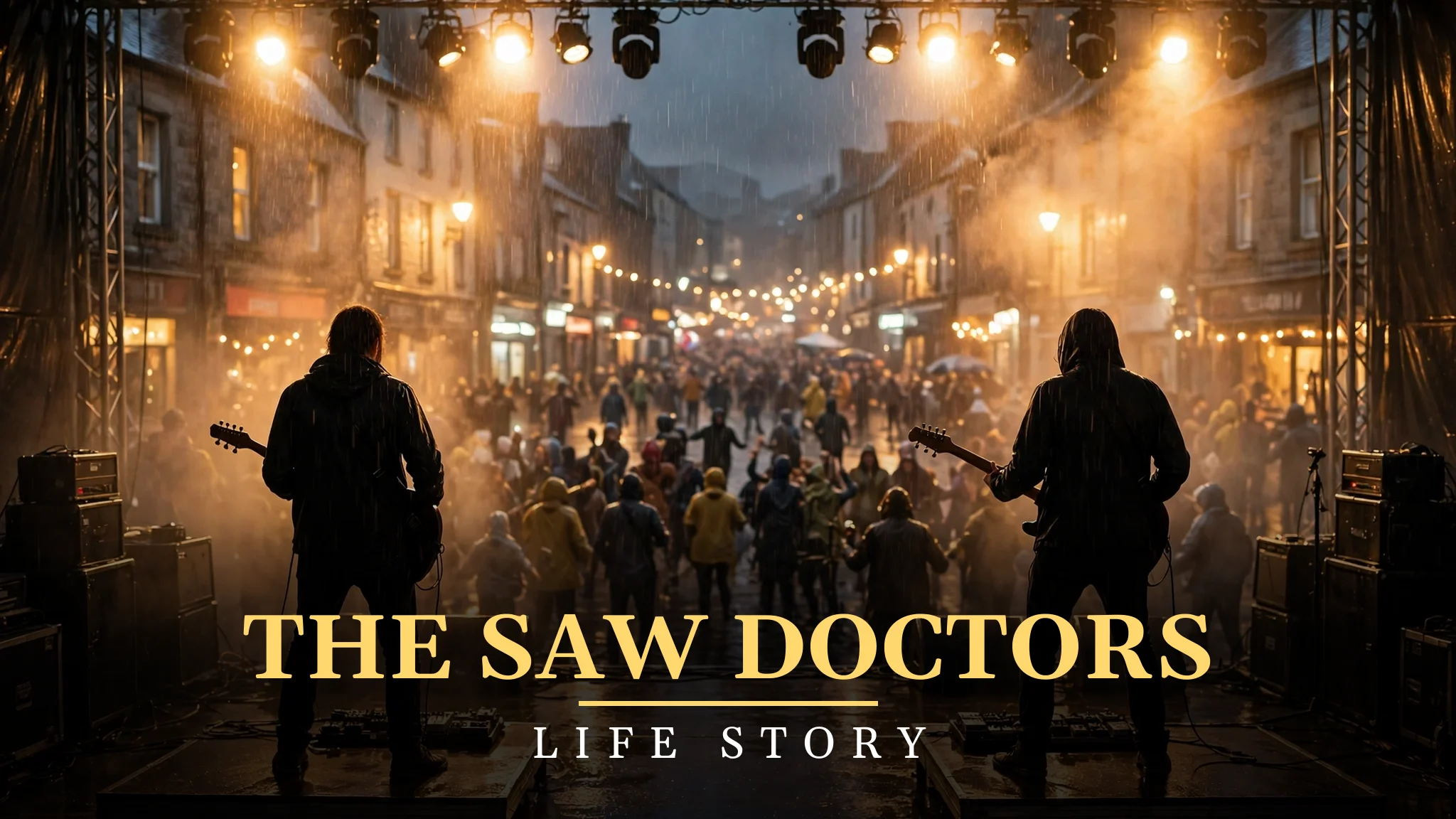
A Saw Doctors concert is an experience that is hard to describe to someone who has never been to one, because it is less like a concert and more like a celebration. The band plays long sets, they tell jokes, they talk to the audience, and they encourage everyone to sing along, and the result is a room full of people who feel as if they are part of the show, not just watching it. Leo Moran is the band’s frontman, with a wild energy and a gift for banter, and Davy Carton is the calm, melodic singer whose voice carries the songs. Together, they make a partnership that has lasted for nearly forty years, and their chemistry on stage is obvious to everyone who sees them.
Their concerts are famous for their singalongs, with audiences joining in on N17, I Useta Lover, and The Green and Red of Mayo, often louder than the band themselves. That participation is not an accident. The Saw Doctors write songs that are meant to be sung together, with simple, memorable choruses and with words that people can remember after hearing them once. They understand that a concert is not a lecture. It is a shared experience, and the audience is part of it. That understanding is why their fans keep coming back, year after year, to sing with them again.
The band have played in venues of all sizes, from small pubs in Galway to large arenas in Britain and America, and they bring the same energy to every show, whether there are fifty people in the room or five thousand. They do not save their best for big crowds. They give everything, every night, because they love to play, and because they respect their audience. That professionalism, combined with their humour and their warmth, is why they have lasted so long, and why their concerts are still joyful events after nearly forty years.
The Saw Doctors and Their Fans
The Saw Doctors have one of the most loyal fanbases in Irish music, and that loyalty is a key part of their story. Their fans have followed them for decades, coming to concerts year after year, singing along to every word, and bringing their children, and then their grandchildren, to see the band. It is a fanbase built on trust, on humour, and on a shared love of the west of Ireland, and it is one of the strongest bonds between a band and its audience in Irish music. The band know their fans by name, they talk to them after shows, and they treat them as friends, not as customers.
That relationship is mutual. The fans support the band, they buy their records, they come to their shows, and they spread the word about them, and the band repay that loyalty by giving everything on stage, by playing the songs people want to hear, and by never taking their audience for granted. It is a partnership, and it has lasted for nearly forty years, through good times and bad, through breaks and reunions, and through changes in the music business. That is a remarkable achievement, and it is one that few bands can match.
Their fans also come from all over the world, from Irish communities in Britain, America, and Australia, who hear in the Saw Doctors’ music a reminder of home. For those fans, a Saw Doctors concert is a homecoming, a chance to hear the songs of Galway, to sing along, and to feel connected to the place they left. That connection is powerful, and it is why the band’s music travels so well, even though it is so rooted in one small town in the west.
My Take:
When I think about the Saw Doctors, I smile. That is the first thing, and it is the most important thing. Their music makes me smile, because it is funny, because it is warm, and because it is full of life. I admire that, because so much music is serious, sad, or angry, and there is a place for all of those things, but there is also a place for music that makes you laugh and sing along. The Saw Doctors fill that place, and they fill it better than almost anyone else in Ireland.
I admire the fact that they came from Tuam, a small town in Galway, and that they stayed true to Tuam. They did not pretend to be from Dublin or London. They sang about the N17 road, about Galway football, about small-town life, and they did it with pride. I think that is a brave and a generous choice. It is easy to sing about big cities and big ideas. It is much harder to sing about a road, a town, and a football team, and to make those things feel important. The Saw Doctors did that, and they made people from the west feel proud of where they come from. That is a wonderful gift to give to people.
I also admire their friendship. Leo Moran and Davy Carton have been friends and bandmates for nearly forty years, and that is a long time to work with someone. They have argued, they have taken breaks, they have done other projects, and they have always come back together. That tells me that their bond is real, and that their music is built on friendship, not just on business. I think that is why their concerts feel so joyful. You can tell that the men on stage like each other, and that they like the audience, and that feeling spreads through the room.
What I love most about their songs is their honesty. I Useta Lover is a funny song, but it is also a sad song, about a man looking back on a love that has ended. N17 is a song about a road, but it is also a song about missing home, about driving, about longing. The Green and Red of Mayo is a song about football, but it is also a song about belonging, about being part of a community. The Saw Doctors take ordinary things and show that they matter, and that is a skill that few songwriters have. They do not need grand subjects. They need a road, a town, and a football team, and that is enough.
I think about their live shows, and about how different they are from a typical rock concert. A Saw Doctors concert is not about watching a star on a distant stage. It is about singing together, laughing together, and being part of something. The band talks to the audience, they tell jokes, they encourage everyone to join in, and the result is a room full of people who feel as if they are part of the band. That is a generous way to perform, and it is one that more bands could learn from. Music is not just about listening. It is about joining in, and the Saw Doctors understand that better than most.
There is a lesson in their story about staying power. The Saw Doctors were never the most fashionable band in Ireland, and they were never the biggest band in the world. But they are still here, still playing, still loved, after nearly forty years, while many fashionable bands have come and gone. That tells me that a loyal audience, built slowly over time, is worth more than a quick hit. If you make music that people love, and you keep making it, and you keep showing up, people will keep coming back. That is a slow way to build a career, but it is a lasting way, and I respect it a great deal.
I also respect the way they have handled breaks and changes. They have not pretended that everything has always been easy. They have taken time off, they have lost members, they have done other things, and they have come back when they were ready. That honesty is refreshing in a business where bands often pretend to be together when they are not, or where they split up in anger and never speak again. The Saw Doctors have been honest about their ups and downs, and they have kept their friendship through them. That is a mature way to run a band, and it is one that has served them well.
For a young reader, I think the lesson of the Saw Doctors is to sing about where you come from, and to be proud of it. You do not need to come from a big city to make music that matters. You can come from a small town, you can sing about its roads, its pubs, and its football team, and people will listen, because they will recognise something true in your songs. The Saw Doctors proved that, and they proved it for nearly forty years. That is an inspiring example for anyone who feels that their home is too small, too ordinary, or too far away to matter. It matters, and your songs about it matter too.
In the end, I think the Saw Doctors will be remembered as one of Ireland’s most loved bands, and that is right. But I hope they are also remembered as two friends from Tuam who made people laugh, who made people sing, and who gave the west of Ireland a soundtrack for its life. That is a beautiful legacy, and it is one that will last as long as people still drive the N17, still support Mayo, and still gather in a pub to sing along.
I also love their connection to football, and to Galway and Mayo, because it shows that music and sport belong together. A song like The Green and Red of Mayo is not just a song. It is an anthem, a flag, a way for thousands of people to say who they are and where they come from. The Saw Doctors understood that, and they gave Mayo supporters a song they could sing with pride. That is a wonderful thing for a band to do, and it is one that few bands ever manage. They did not just make records. They made anthems, and anthems last longer than records.
I think about their humour once more, because it is so central to who they are, and I want to say that humour is underrated in music. People think that serious music is more important than funny music, but I do not agree. Making people laugh is hard, and making people laugh while also making them feel something is even harder. The Saw Doctors do both, and they do it with ease. Their humour is warm, it is kind, and it is rooted in real life, and that is why it works. I hope they keep making people laugh for many years to come.
I also think about their concerts, and about how different they are from a typical rock show, and I want to say that I love that difference. A Saw Doctors concert is not about watching a star from a distance. It is about singing together, laughing together, and being part of something, and that is a generous way to perform. The band gives the audience a role, and the audience takes it, and the result is a room full of people who feel happy, connected, and alive. That is what live music should be, and the Saw Doctors understand it better than most bands.
I think about the N17 road once more, and about how a song about a road can become an anthem, and I am struck by the simplicity of that achievement. The Saw Doctors did not write a song about a grand idea or a famous person. They wrote a song about a road they drove every day, and about the feeling of going home, and that song became one of the most loved songs in the west of Ireland. That tells me that the best songs are often about the simplest things, and that a songwriter who pays attention to everyday life will find more to write about than one who chases grand subjects.
Finally, I want to say that the Saw Doctors have made my life happier, just by existing, and by making music that is funny, warm, and full of life. I have never been to one of their concerts, but I have listened to their records, and I have smiled, and I have sung along, and that is enough. They are a band that reminds me that music should be joyful, that it should bring people together, and that it should celebrate the place you come from. I hope they keep playing for many years to come, and I hope their songs keep making people smile.
I also think about their fans, and about how loyal they are, and I am struck by the bond between the band and their audience. A fanbase that lasts for forty years is not built on hits alone. It is built on trust, on humour, on shared memories, and on a feeling that the band cares about its audience as much as the audience cares about the band. The Saw Doctors have that bond, and it is why their concerts are so joyful. People do not just come to hear songs. They come to be with friends, to sing together, and to celebrate a shared love of the west. That is a beautiful thing, and it is one that more bands should aim for.
I think about the future of the Saw Doctors, and about whether they will keep playing, and I hope they will, for as long as they want to. They are older now, but their songs are still loved, their fans are still loyal, and their concerts are still joyful. Age does not diminish a band like the Saw Doctors, because their music is not about youth. It is about place, about humour, and about community, and those things do not fade with age. They grow stronger, and I hope the band keep sharing them for many years to come.
I also think about the west of Ireland, and about how the Saw Doctors gave it a voice, and I am grateful for that. The west is a beautiful, wild place, with a strong sense of community, and the Saw Doctors captured that in their songs, with humour, with warmth, and with love. Their music is a reminder that where you come from matters, and that the best songs often come from a specific place, not from nowhere. I hope people from the west feel proud when they hear the Saw Doctors, because they should. The band gave them a soundtrack, and it is a good one.
I think about laughter once more, and about how the Saw Doctors make people laugh, and I want to say that laughter is a serious and important thing. In a world that is often sad and difficult, a band that can make a room full of people laugh and sing together is doing something valuable. The Saw Doctors do that, night after night, year after year, and they do it with a generosity and a warmth that is rare. I hope they keep doing it for as long as they can, and I hope their audiences keep laughing and singing along.
I also think about the next generation of musicians in Galway, and about how the Saw Doctors have inspired them, and I am glad for that. Young bands in Tuam and Galway look at the Saw Doctors and see that it is possible to come from a small town, to sing about home, and to succeed, and that gives them courage to try. The Saw Doctors did not just make music for their own generation. They opened a door for the next one, and that is a legacy that will last long after their final concert.
Frequently Asked Questions
Where did the Saw Doctors come from?
The Saw Doctors formed in 1986 in Tuam, County Galway, in the west of Ireland. The band was founded by Leo Moran and Davy Carton, two friends who grew up in the west and wanted to make music about the lives, towns, and roads they knew.
What was the Saw Doctors’ first big hit?
Their first big hit was I Useta Lover in 1990, a funny and bittersweet song about a past love. It reached number one in Ireland and stayed there for nine weeks, making the band famous across the country and leading to their first album.
What is N17 about?
N17 is a song about the N17 road, which runs through Galway and Mayo in the west of Ireland. It captures the feeling of driving along that road, missing home, and thinking about the landscape of the west, and it has become an anthem for people from the area.
What album did the Saw Doctors release first?
Their first album was If This Is Rock and Roll, I Want My Old Job Back, released in 1991. The title was a joke about rock and roll, and the album included I Useta Lover and N17, two of the band’s best-known songs.
Did the Saw Doctors tour outside Ireland?
Yes, they toured in Britain, where Irish communities welcomed them, and in America, where they played to Irish-American audiences. Their live shows were famous for their energy, humour, and audience singalongs, and they built a loyal following abroad as well as at home.
Are the Saw Doctors still playing?
Yes, the band continues to play, though less often than in their peak years. They perform at festivals, special concerts, and events in Galway and beyond, and their songs are still sung with passion by audiences who have followed them for decades.
What is The Green and Red of Mayo?
The Green and Red of Mayo is a song by the Saw Doctors that became an anthem for Mayo football fans. It celebrates the county’s colours, green and red, and its football team, and it is sung with great pride by supporters at matches and concerts.


