The Tragically Hip: The Life Story Behind the Band of Canada
In this post
- Five Friends From Kingston
- Up to Here, Road Apples, and the First Hits
- Fully Completely, Day for Night, and the Peak Years
- Ahead by a Century, Bobcaygeon, and Songs That Became Anthems
- Later Albums, a Loyal Crowd, and a Band That Kept Going
- Gord Downie’s Illness, the Final Concert, and a Nation Watching
- Goodbye to Gord Downie and a Legacy That Lives On
- The Live Show, the Crowd, and the Feeling of Home
- My Take:
The Tragically Hip was not just a band in Canada. They were Canada’s band. For more than thirty years, they sang about Canadian towns, Canadian history, and Canadian life, and they did it in a way that made millions of Canadians feel seen. Their singer, Gord Downie, had a voice that was both strange and beautiful, and his words were full of poetry, mystery, and love for his country. When they played, the whole country listened.
The band began in Kingston, Ontario, in 1984, when five young men who loved rock music decided to play together. Gord Downie sang, Rob Baker played guitar, Gord Sinclair played bass, Johnny Fay played drums, and Paul Langlois played guitar. They were friends, they were students, and they were musicians who wanted to make a sound that was their own. They played in small clubs, they toured in a van, and they built a loyal audience one show at a time, until they became one of the biggest bands in Canadian history.
What makes their story worth telling is the way they stayed true to Canada, even when the music world wanted them to be more American, and the way they faced a terrible ending with grace and with love. Their songs Bobcaygeon, Ahead by a Century, and New Orleans Is Sinking became anthems, their final concert in Kingston in 2016 was watched by millions, and Gord Downie’s death in 2017 broke the heart of a nation. This is the story of a band that belonged to Canada, and of a singer who gave his country a voice.
Five Friends From Kingston
The Tragically Hip began in Kingston, Ontario, in 1984, a small city on Lake Ontario where many students live and where music is part of daily life. Gord Downie, Rob Baker, Gord Sinclair, Johnny Fay, and Paul Langlois were young men who loved rock music, and they met at school and in the local music scene. They were not rich, and they were not famous. They were friends who wanted to play, and they started a band in the way that many young bands start: with a few instruments, a few songs, and a lot of hope.
As young musicians, they played in bars, in clubs, and in small venues around Kingston and Ontario, learning how to play together and how to write songs. They listened to rock, to blues, and to Canadian music, and they tried to find a sound that was their own. It was not easy work. They had little money, they had to travel in a van, and they had to play for crowds who did not always listen. But they kept playing, because they loved the feeling of a loud guitar, a strong drum, and a voice that could tell a story.
The early Hip was a hard-working band, and that work ethic stayed with them for their whole career. They toured constantly, they played in small towns as well as big cities, and they built a reputation as a live band that gave everything on stage. Gord Downie was a special frontman, with a strange and wonderful way of moving, of singing, and of talking to the crowd. He did not act like a normal rock star. He acted like a poet who had found a stage, and the crowd loved him for it.
The years in Kingston mattered because they gave the band a home, a sound, and a sense of identity. They were a Kingston band, and they were proud of it, even when the music business in Canada was small. They did not move to Toronto or Los Angeles to find fame. They stayed close to Kingston, they built their career from there, and they proved that a Canadian band could reach the whole country. That pride in home stayed with them for their whole career.
Up to Here, Road Apples, and the First Hits
In 1989 The Tragically Hip released their first full album, Up to Here, a record that gave them their first hits in Canada. The album included New Orleans Is Sinking, a song about a city in trouble, with a strong riff and a voice that sounded both urgent and calm. The song became a favourite on Canadian radio, and it introduced the Hip to listeners across the country. Up to Here was praised for its energy, and it proved that the band could make a complete record, not only a few good songs.
In 1991 they released Road Apples, an album that continued their rock sound and showed their growth as writers. The album included songs that talked about life on the road, about small towns, and about the feeling of being far from home. Road Apples was a success in Canada, and it gave the band a bigger audience. They toured the album in many cities, and they met fans who knew every word of their songs. Touring taught them how to play the same songs night after night and still make them feel fresh.
These early albums showed that the Hip was not a band that tried to copy American rock. They were a band that sang about Canada, about Canadian places, and about Canadian stories, and that made them special. Their lyrics mentioned towns, rivers, and hockey, and their fans loved those details, because they felt like their own life was in the songs. That connection is rare, and it is one of the reasons the Hip became so loved in Canada.
After Road Apples, the Hip was no longer a secret. They were a band with real albums, a real audience, and a real future. Music magazines wrote about them, radio played their songs, and other artists wanted to work with them. They had moved from a small club in Kingston to the national stage, and they had done it by staying true to a Canadian sound. That is a rare achievement, and it showed that a band can be successful by being itself.
Fully Completely, Day for Night, and the Peak Years
In 1992 The Tragically Hip released Fully Completely, an album that became one of their most loved works. The album included Courage, a song about strength and about facing hard times, and 50 Mission Cap, a song about a hockey player, and Wheat Kings, a song about a young man who was wrongly jailed. Fully Completely was praised for its thoughtful lyrics and its strong rock sound, and it became a classic in Canada. Fans loved the way the album mixed rock with poetry, and they played it again and again.
In 1994 they released Day for Night, an album that was darker and more complex, with songs about love, about loss, and about the modern world. The album included Grace, Too, a long and beautiful song that became a favourite at their live shows. Day for Night showed that the band was not content to repeat Fully Completely. They wanted to grow, even if growth meant taking risks. That willingness to change is a sign of a band that is still alive, and the Hip was still alive.
The peak years after Fully Completely were busy and successful. The Hip released Trouble at the Henhouse in 1996 and Phantom Power in 1998, albums that showed new sounds and new ideas. Phantom Power included Bobcaygeon, a song about a small town in Ontario, with a gentle melody and words about love and about a place that feels like home. Bobcaygeon became one of their most loved songs, and it is still played on Canadian radio today. It showed that the Hip could make a soft song as well as a loud one, and that their range was wide.
During these years, the Hip toured in large arenas, and their shows became famous for their energy and their emotion. Gord Downie was a frontman who gave everything on stage, and the band played with skill and with feeling. Their fans, who called themselves Hip fans with pride, followed them from city to city, and they bought every album. The band had built a loyal audience, and that audience would stay with them for decades.
Ahead by a Century, Bobcaygeon, and Songs That Became Anthems
One of the most loved songs by The Tragically Hip is Ahead by a Century, released in 1996, a song about time, about love, and about the future. The song has a simple, beautiful melody, and Gord Downie’s voice sounds both sad and hopeful. Ahead by a Century became an anthem in Canada, played at weddings, at funerals, and at moments when people needed a song that felt true. It is a song that many Canadians know by heart, and it is still one of the band’s most played tracks.
Bobcaygeon, from Phantom Power, is another anthem, a song about a small town, about a policeman, and about a love that is far away. The song has a gentle, almost country feeling, and it shows a different side of the Hip. It is not a loud rock song. It is a quiet, thoughtful song, and it proved that the band could write about a small place in a way that felt universal. Fans in Bobcaygeon, the real town, loved the song, and fans in other towns loved it too, because they could hear their own town in its words.
These songs became anthems because they talked about Canada in a way that felt real, not like a tourist postcard. They mentioned real places, real people, and real feelings, and they did so with poetry and with honesty. That honesty made the songs last, because a listener can return to them in a different year and find a new meaning in the same words. The Hip did not write about a fantasy Canada. They wrote about the Canada they lived in, and that is why their songs still matter.
The band also became known for their live versions of these songs, which were often longer and more emotional than the studio versions. Gord Downie would change the words, he would talk to the crowd, and he would make each show feel special. That live energy is a big part of why the Hip is so loved, because their fans did not only buy their albums. They went to their shows, they sang along, and they felt part of a community. That community is still alive today, even after the band has ended.
Later Albums, a Loyal Crowd, and a Band That Kept Going
In the 2000s The Tragically Hip released a series of albums that showed they were still writing, still touring, and still loved by their fans. Music @ Work in 2000, In Violet Light in 2002, World Container in 2006, We Are the Same in 2009, Now for Plan A in 2012, and Man Machine Poem in 2016 all showed different sides of the band, from rock to pop to a more thoughtful sound. They were willing to try new ideas, even if some fans preferred their older work. That willingness to change is a sign of a band that is still alive, and the Hip was still alive.
These later albums also showed how well the five musicians worked together. Gord Downie’s voice, Rob Baker’s guitar, Gord Sinclair’s bass, Johnny Fay’s drums, and Paul Langlois’s guitar fit together in a way that felt like a single band. They could play fast, they could play slow, they could change tempo in a single song, and they always sounded like the Hip. That skill is rare, and it is one of the reasons the band is still respected by musicians today. They were not only a popular band. They were a band that other musicians admired.
The Hip also kept touring in Canada, playing in small towns as well as big cities, and their fans followed them with loyalty. They were a band that played for Canada, not only for Toronto or Montreal, and that made them special. A fan in a small town in Ontario could see the Hip in their own town, and that feeling of being seen is a gift. The band understood that, and they kept touring in places that many big bands ignored. That choice built a deep and lasting bond with their audience.
During these years, Gord Downie also worked on solo projects, on poetry, and on other art, and he showed that he was more than a rock singer. He was a writer, a poet, and a thinker, and his solo work gave him a chance to explore ideas that did not fit into a Hip album. That solo work made him a richer artist, and it made his work with the Hip even better, because he brought new ideas back to the band. He was a man who loved to create, and he created in many different ways.
Gord Downie’s Illness, the Final Concert, and a Nation Watching
In May 2016 The Tragically Hip shared sad news with Canada: Gord Downie had been diagnosed with glioblastoma, a serious form of brain cancer, and the band would play one final tour. The news shocked the country, because Downie was not only a singer. He was a voice that many Canadians had grown up with, and the thought of losing him was painful. The band decided to tour one last time, to say goodbye to their fans, and to celebrate their music together.
The final tour, called Man Machine Poem, played in many Canadian cities in the summer of 2016, and it became a national event. Fans bought tickets, they travelled to shows, and they sang along to songs they had loved for decades. The tour was emotional, because everyone knew it might be the last time they would see Gord Downie on stage, and the band played with a feeling that was both sad and joyful. They were saying goodbye, but they were also celebrating a life in music.
The final concert was in Kingston, the band’s home town, on 20 August 2016, and it was watched by millions of people on television and online. The show was broadcast across Canada, and it became one of the most watched events in Canadian history. Gord Downie sang with strength, he talked to the crowd, and he thanked Canada for its love. The final song was Ahead by a Century, and when he sang it, the whole country sang with him. It was a moment that many Canadians will never forget.
After the final concert, Downie worked on a new project called Secret Path, a story about Chanie Wenjack, a young Indigenous boy who died while trying to walk home from a residential school in 1966. Secret Path was an album, a book, and a film, and it was Downie’s way of telling a story that Canada needed to hear. He worked on it with care, and he used his fame to help Canadians learn about the history of Indigenous peoples. That work became one of the most important things he ever did, and it showed that he was not only a singer. He was a man who cared about justice.
Goodbye to Gord Downie and a Legacy That Lives On
Gord Downie died on 17 October 2017, at the age of fifty-three, and Canada mourned him as a national hero. Tributes came from musicians, from politicians, from fans, and from people who had never met him but who had loved his music. The Prime Minister spoke about him, the news covered his death for days, and fans gathered in Kingston and in other cities to remember him. It was a sad end to the story of the Hip, but it was also a moment when Canada came together to honour a man who had given it a voice.
After Downie’s death, the other members of the Hip did not try to replace him. They knew that the Hip was five people, and without Gord, there was no Hip. They worked on other projects, they supported the Gord Downie and Chanie Wenjack Fund, which helps to build understanding between Indigenous and non-Indigenous peoples in Canada, and they kept Downie’s memory alive. That fund is a lasting legacy, and it shows that Downie’s work for justice continues even after his death.
The Hip’s music is still played in Canada every day, on radio, on streaming services, and in homes across the country. Their songs are still sung at weddings, at funerals, and at moments when Canadians need a song that feels true. They began as five friends in Kingston, and they became a band that belonged to a whole country. Their journey is still inspiring to young musicians today, and their songs will keep playing for many years.
Today their place in music is secure. They were inducted into the Canadian Music Hall of Fame, they have won many Juno Awards, and they have fans in every part of Canada who still play their music. They began as a small band in Kingston, and they became a voice that the whole country knows. Their music is Canadian, it is poetic, and it is full of heart, and it will keep playing for many years. That is the heart of their story, and it is why fans still say, with pride, that they love the Hip.
The Live Show, the Crowd, and the Feeling of Home
One of the clearest things about The Tragically Hip is the way their live shows felt like a homecoming. They played in small towns and big cities, and the crowd sang along to songs they had loved for decades. The show was not built on a single star. It was built on five friends playing together, and that feeling made the audience feel like part of the band. A fan who has seen the Hip live will remember the lights, the sound, and the voice of Gord Downie, long after the show ends.
Their songs also live a second life in the lives of fans who play them on long drives, on quiet nights, and on days when they need a song that feels like Canada. Ahead by a Century has been played at weddings, at funerals, and at moments when people needed a song that felt true. That kind of reach does not come from one hit. It comes from years of steady work, from songs that stay true, and from a sound that people return to when they want to feel at home. The Hip has made many such songs, and they will keep being played for years.
The band has also been honoured in Canada in many ways, including induction into the Canadian Music Hall of Fame and many Juno Awards. Those honours are a sign that Canada recognised their work, and they gave the band a new level of respect. They were not only a popular band. They were a band that helped to define Canadian music, and that legacy will last for a long time.
My Take:
I think The Tragically Hip is a band that proves that a country can have a voice, and that voice can be a rock band. When I hear Ahead by a Century, I do not hear a simple rock song. I hear a song about time, about love, and about the future, sung by a man who loved his country deeply. That combination is rare, and it is why the song has lasted for many years. A song that is Canadian and universal at the same time can last longer than a song that is only Canadian, and the Hip made many songs like that.
I admire the way they started. They were five friends in Kingston, they played in small clubs, and they built a career without a big label at first. That path is hard, and many bands would have given up. The Hip did not give up. They kept playing, they kept writing, and they kept believing that their Canadian songs would find an audience. That belief paid off, and it is a lesson for any young band: trust your own music, even when the world tells you to make it more American or more commercial.
What I like most about their music is the poetry. Gord Downie wrote words that were strange, beautiful, and full of mystery, and he sang them in a way that made them feel like a story. His lyrics mentioned hockey, small towns, rivers, and history, and they did so in a way that felt like a poem, not like a simple pop song. That poetry made the Hip different, and it gave their fans a reason to listen again and again, to find new meanings in songs they already loved.
I also think about Bobcaygeon, and how that song became an anthem for a small town. Bobcaygeon is a real place in Ontario, and the song talks about a policeman, about love, and about a place that feels like home. That song is not about a big city or a famous person. It is about a small town, and it shows that a small town can be the subject of a great song. I respect a band that sings about small places, because it tells listeners in small places that their life matters, and that their town matters too.
There is a part of their story that makes me sad, and that is the death of Gord Downie. Losing a singer who was also a poet, a friend, and a voice for a country is a pain that many Canadians felt deeply. Downie was only fifty-three when he died, and he had so much more to give. His death was a loss for music, for Canada, and for the world. I admire the way he faced his illness with grace, and the way he used his final years to tell the story of Chanie Wenjack and to work for justice for Indigenous peoples.
For a young listener, I think the lesson is to be proud of where you come from. The Hip were proud of Kingston, proud of Canada, and proud of their own stories, and that pride made their music special. If you are from a small town, do not be ashamed of it. Sing about it, write about it, and let the world hear it. A small town can hold a big song, and the Hip proved that again and again, in Bobcaygeon, in Wheat Kings, and in many other songs.
I do wonder sometimes if their Canadian focus made it harder for them to become famous outside Canada, because many of their songs mention Canadian places that listeners in other countries do not know. But I think that is also a strength. A band that is true to its home will be loved deeply at home, and that deep love is worth more than a shallow fame in many countries. The Hip were loved deeply in Canada, and that love is a legacy that will last for a long time.
When I think about their final concert in Kingston, I feel a quiet respect for the way they said goodbye. They did not break up in anger, and they did not try to replace Gord Downie. They played a final tour, they celebrated their music, and they ended with respect and with love. That ending is rare in rock music, and it shows how much the five men respected each other. I think that is a beautiful way to end a career, and it is one that other bands could learn from.
I also think about Secret Path, and how important that work was. Downie used his fame to tell a story that Canada needed to hear, about a young Indigenous boy who died while trying to walk home. That story is painful, but it is also necessary, and Downie told it with care and with respect. I admire a singer who uses his platform for justice, and I hope that Secret Path continues to teach Canadians about their history. That work is a legacy that goes beyond music, and it is one that will last.
In the end, I see The Tragically Hip as a band that turned five friends in Kingston into a voice for a country, and that kept that voice alive through fame, through change, and through loss. They turned a small town into a stage, a Canadian story into an anthem, and a final concert into a national moment. They did all of that with skill, with honesty, and with a love of Canada that never faded. I do not need them to be more American or more commercial. I need them to be remembered as they were: a band that sang for Canada, and that Canada sang back to, with all its heart.
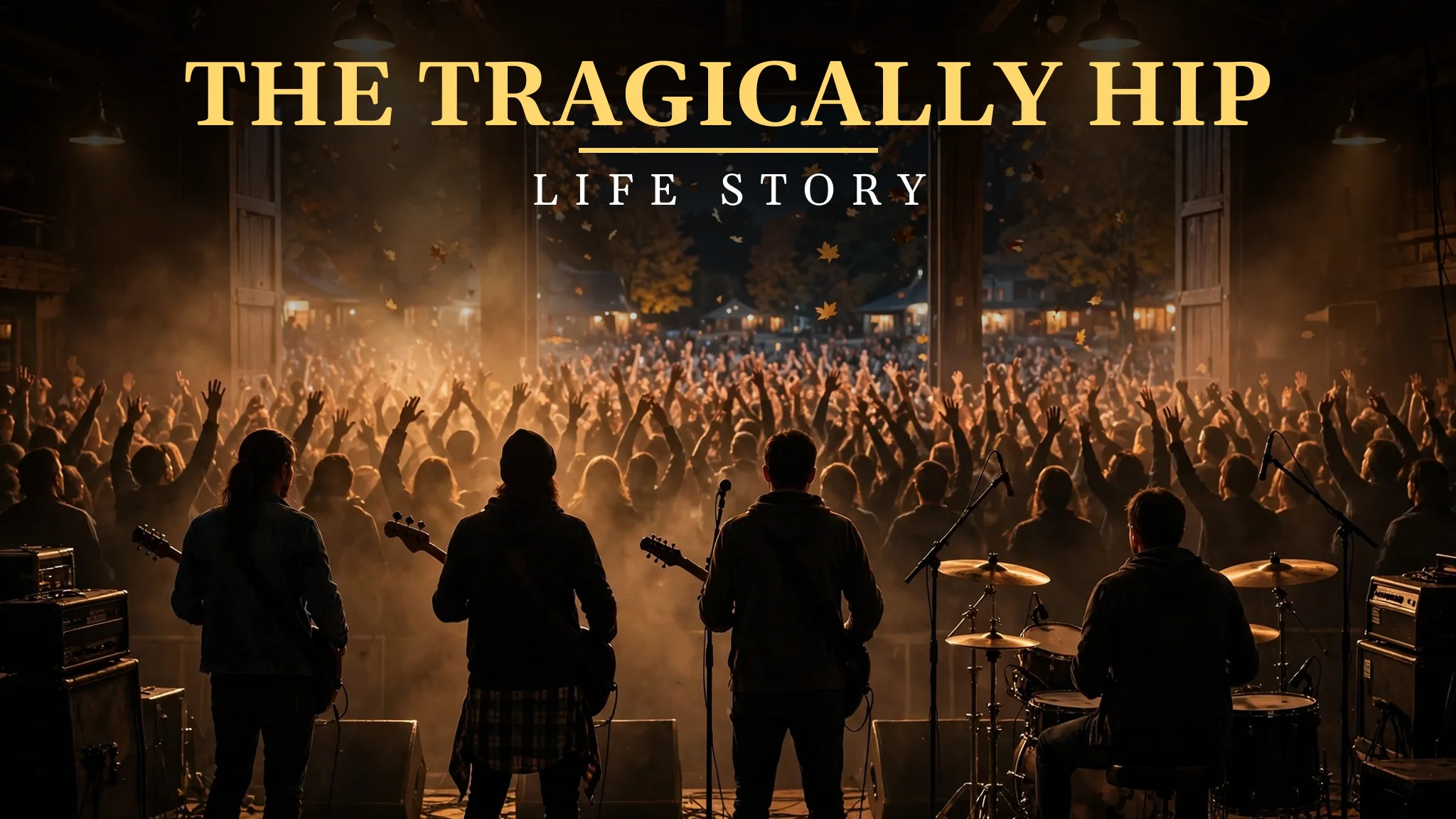
One more thought stays with me. When I hear their music, I think of a barn stage at night, with autumn leaves falling, and a huge crowd singing along. That image is simple, but it is also the heart of their work. They made music for those moments, for the times when we need a song that feels like home. I think we need more music like that, and I am glad the Hip is still playing, even now, in the ears of fans across Canada.
I also keep thinking about Gord Downie, and how his voice and his words will live on. A singer who can write like Downie is rare, and a poet who can sing like Downie is even rarer. He was both, and he gave the Hip a gift that no other band had. I will keep listening to his voice, and I will keep reading his words, because they remind me that music can be both a skill and a story, and that a band can be both a group of friends and a voice for a country.
Finally, I want to say that their story gives hope to young bands who feel that their music is too local, too Canadian, or too different. The Hip felt that too, and they kept going anyway. They made the music they believed in, and Canada eventually believed in it too. That is a hopeful story, and it is one that I will remember. If five friends from Kingston can do that, then many other bands can do it too, and the Hip has shown them the way with their skill, their honesty, and their music.
I will keep their records close, not because they are perfect, but because they are honest. They remind me to think, to listen carefully, and to value music that is made with skill and with heart. In a busy world, that reminder is precious, and I am thankful that five friends from Kingston, with guitars and drums, decided to share their Canadian songs with the rest of us. Their music is a light in a dark barn, and I hope it keeps shining for many years.
I also think about the way their songs help people who are far from home. The Hip sings about Kingston, about Bobcaygeon, and about the places we leave behind, and many listeners have left a home and started a new life in a new city. Their songs speak to those people, because they talk about carrying a home inside you, about remembering a street, and about hoping for a better tomorrow. That message is simple, but it is also deep, and it is one that many people need to hear.
Another thing I admire is their work ethic. They made many albums, they toured for years, and they kept their sound strong and their songs honest. That is a lot of work, and it takes discipline. They did not seem to complain about that work. They seemed to love it, and that love can be heard in the music. A band that loves its work makes better songs, and the Hip is a good example of that truth.
When I listen to their later music, I hear a band that is calm and sure of itself. They are not trying to prove that they are young, and they are not trying to copy a new trend. They are making music that fits their life now, music about love, family, hope, and the future. That calm is a gift, and it makes their later songs feel warm and safe. I think many listeners, especially those who have grown up with them, find comfort in that calm.
I also think about the future, and I hope their music keeps playing for many years. The world changes fast, and rock music changes even faster, but a clear voice and an honest song will always have a place. The Hip has both, and they have the skill to keep being heard in new ways. Whether it is a young listener finding Bobcaygeon for the first time, or an older fan playing Ahead by a Century on a quiet night, their songs will keep finding people who need them.
In the end, I see the Hip as a band that turned five friends in Kingston into a voice for a country, and that kept that voice alive through fame, through change, and through loss. They turned a small town into a stage, a Canadian story into an anthem, and a final concert into a national moment. That is a powerful story, and it is one that I will keep. A song about home can do a big thing, if it is true, and the Hip has proved that again and again.
I will keep listening to their music, because it is Canadian, honest, and full of heart, and because a band that sings about home will always have a place in my life. Their songs remind me that a small town, a river, and a hockey game can all be part of a great song, and that a voice that loves its country can teach the whole world how to sing.
When I think about the Hip one last time, I think about five friends who loved Canada so much that they spent thirty years singing about it, and I think about how that love never faded, even when life was hard, even when the world changed, and even when grief tried to stop them. That love is the heart of their story, and it is why their music still matters today, and why it will keep mattering for a long time, in Kingston and across Canada.
I am thankful for their music, because it reminds me that a home town, a river, and a song about a small place are all worth singing about, and that a band from Kingston can teach the whole world how to love its home, with many voices, many guitars, and one big heart.
Their songs will keep playing in my home, in my car, and in my heart, for many years to come, because true music does not fade, and because a song about home can help a person through a hard day, a long night, and a new beginning in a new place.
When I hear the Hip on a quiet night, I think about how their music carries a feeling of home in a way that few bands can match, and I think about how much Canada needs that feeling. Their songs do not hide from loss, they face it with poetry, and that is why they still help listeners who are remembering a place they love.
I will keep the Hip’s records close, because they remind me that a song about home can be an anthem, and that five friends from Kingston can give a whole country a voice to sing with.
Frequently Asked Questions
Where was The Tragically Hip formed and who were the members?
The Tragically Hip was formed in Kingston, Ontario, in 1984. The members were Gord Downie on vocals, Rob Baker on guitar, Gord Sinclair on bass, Johnny Fay on drums, and Paul Langlois on guitar.
What are The Tragically Hip’s most famous songs?
Their most famous songs include New Orleans Is Sinking, Ahead by a Century, Bobcaygeon, Wheat Kings, Courage, Grace Too, and 50 Mission Cap. Bobcaygeon and Ahead by a Century are still played on Canadian radio every day.
What happened to Gord Downie?
Gord Downie was diagnosed with glioblastoma, a serious brain cancer, in May 2016. The band played a final tour that summer, with a final concert in Kingston on 20 August 2016, and Downie died on 17 October 2017 at the age of fifty-three.
What is Secret Path?
Secret Path is a project by Gord Downie about Chanie Wenjack, a young Indigenous boy who died in 1966 while trying to walk home from a residential school. It is an album, a book, and a film, and it helped Canadians learn about Indigenous history.
When did The Tragically Hip stop playing?
The band played their final tour in 2016 and did not continue after Gord Downie’s death in 2017. The other members have worked on other projects and support the Gord Downie and Chanie Wenjack Fund.
Is The Tragically Hip still loved in Canada today?
Yes, they are still loved across Canada. Their songs are played on radio, on streaming services, and in homes every day, and they are regarded as one of the most important bands in Canadian music history.


