Thelma Ritter: The Life Story Behind Hollywood's Beloved Character Star
In this post
- A Brooklyn Childhood and a Late Start
- All About Eve and a Breakthrough at Forty-Eight
- Rear Window, Pillow Talk, and the Art of the Supporting Role
- A Voice That Sounded Like Real Life
- The Later Years and a Quiet Goodbye
- What Her Life Still Means
- Radio, Theatre, and the Training of a Great Listener
- The Characters She Made Unforgettable
- My Take:
Thelma Ritter was the kind of actress audiences remembered long after the stars had left the screen. She did not play glamorous heroines, and she did not wear beautiful gowns in every scene. She played maids, neighbours, nurses, and working women, and she played them with such truth that people felt they knew her. She had a sharp tongue, a warm heart, and a voice that sounded like a real person talking, not like a movie star reciting lines.
She was born in Brooklyn, and she grew up in a working-class family where life was practical and direct. She came to acting late, after she had already lived a full life as a wife and a mother, and she brought that life experience to every role she played. She was in her forties when Hollywood finally noticed her, and she spent the next twenty years becoming one of the most respected character actresses in American film.
What makes her story worth telling is that she was nominated for the Academy Award six times and never won, yet she is remembered as one of the greats. Her story shows that an award is not the only measure of a career, and that a supporting actress can be the soul of a film. This is the story of a woman who made ordinary people feel extraordinary, simply by playing them honestly.
A Brooklyn Childhood and a Late Start
Thelma Marie Ritter was born on 14 February 1902 in Brooklyn, New York, and she grew up in a working-class neighbourhood where people worked hard and spoke plainly. Her father was a bookkeeper, and her mother was a homemaker, and the family lived a modest and steady life. Thelma was a bright and lively child, with a quick wit and a love of performing, and she took part in school plays and in local theatre productions. She liked to make people laugh, and she liked the feeling of being on a stage, even when the stage was only a school hall.
She attended school in Brooklyn, and she later studied at the American Academy of Dramatic Arts in New York, where she learned the techniques of acting. She was a serious student, and she worked hard at her craft, but she did not go straight into a professional career. She married Joseph Moran in 1927, and she became a mother, raising two children and running a home. For many years, acting was a part of her life that she put aside, while she focused on her family. She did not forget it, but she waited, and that waiting gave her a depth of experience that younger actresses did not have.
When her children were older, she returned to acting, working in radio, in the theatre, and in small stage productions. She was in her forties by then, and she was not a young starlet. She was a woman who had lived, who had raised a family, and who knew what real life looked like. That knowledge showed in her performances, and directors began to notice her. She played women who were tired, funny, wise, and practical, and she played them with a truth that came from her own life.
Her return to acting was not easy. She had to start again, to audition, to take small parts, and to prove herself to people who did not know her name. She did it with patience and with humour, and she did not complain about the late start. She knew that her life experience was her greatest asset, and she used it in every role. She was not trying to be a star. She was trying to be an actress, and that difference mattered to her.
All About Eve and a Breakthrough at Forty-Eight
Thelma Ritter’s film career began in earnest in the late 1940s, when she was cast in Miracle on 34th Street in 1947, in a small and uncredited role, and then in other films where she played supporting parts. But her real breakthrough came in 1950, when she was cast as Birdie Coonan in All About Eve, one of the most famous films in Hollywood history. She played the maid and dresser to the ageing star Margo Channing, played by Bette Davis, and she brought a sharp wit and a weary wisdom to the role that made her stand out even in a film full of great performances.
Birdie is a woman who sees everything, who knows the theatre world inside and out, and who is not fooled by flattery or by ambition. Thelma played her with a dry humour and a directness that audiences loved. She had only a few scenes, but she made each one memorable, and critics praised her for stealing the film from its stars. Her performance earned her an Academy Award nomination for Best Supporting Actress, her first of six nominations, when she was forty-eight years old.
The nomination changed her life. She was no longer an unknown actress. She was a respected character actress, and directors began to seek her out for roles that needed a strong and funny supporting player. She appeared in The Mating Season in 1951, where she played a housekeeper, and she was nominated for an Oscar again. She appeared in With a Song in My Heart in 1952, and in Pickup on South Street in 1953, and she was nominated again and again. She was becoming known as an actress who could be relied upon to make a film better, no matter how small her part was.
She was not a glamorous star, and she did not try to be one. She played working women, and she played them with respect. She understood that a maid, a nurse, or a neighbour could be the most interesting person in a story, if she was played with truth. She brought that understanding to every role, and audiences responded to it. They saw themselves in her characters, and they felt that she was speaking for them.
Rear Window, Pillow Talk, and the Art of the Supporting Role
In the 1950s, Thelma Ritter became one of the most sought-after character actresses in Hollywood, and she appeared in a string of films that are now regarded as classics. In 1954, she played Stella, the nurse and housekeeper, in Rear Window, directed by Alfred Hitchcock and starring James Stewart and Grace Kelly. Stella is a practical and funny woman who takes care of a photographer with a broken leg, and who offers him advice about life and love. Thelma played her with a warmth and a bluntness that made her the heart of the film, and audiences loved her scenes with James Stewart.
She also appeared in The Mating Season, in The Model and the Marriage Broker, and in other films where she played women who were wise, funny, and direct. She was nominated for the Academy Award again for her work in these films, and she became known as an actress who could be counted on to deliver a great performance, no matter how small the role. She was not a star who needed the spotlight. She was a supporting actress who made the stars look better, and who made the film feel real.
In 1959, she appeared in Pillow Talk, a romantic comedy starring Doris Day and Rock Hudson, where she played Alma, a housekeeper with a sharp tongue and a kind heart. Her performance was praised, and she was nominated for an Oscar again, her fifth nomination. She played the role with humour and with a sense of timing that came from years of experience in the theatre and in radio. She knew how to deliver a line, how to pause, and how to make an audience laugh without trying too hard.
She also appeared in Birdman of Alcatraz in 1962, where she played the mother of a prisoner, and she was nominated for an Oscar for the sixth time. She did not win, but the nominations themselves were a sign of respect, and they showed that the industry valued her work. She was a woman who had been nominated six times, and who had never won, yet she was regarded as one of the great character actresses of her generation. That reputation was worth more than any single award.
A Voice That Sounded Like Real Life
Thelma Ritter’s greatest gift was her voice, not only the sound of it, but the way she used it to tell the truth. She spoke like a real person, with a Brooklyn accent, with a dry humour, and with a directness that made her characters feel alive. She did not try to sound elegant or refined. She sounded like a woman who had lived, who had worked, and who knew what life was really like. That honesty was rare in Hollywood, where many actresses were trained to sound polished and perfect.
She was also a great listener on screen. She watched the other actors, she reacted to what they said, and she made the scene feel like a real conversation. That skill came from her years in the theatre and in radio, where listening was as important as speaking. She understood that acting is not only about delivering lines. It is about being present, about responding, and about making the other person look good. She did that in every film she appeared in, and directors loved working with her because of it.
Her personal life was quiet and steady. She remained married to Joseph Moran until her death, and she raised two children, Monica and Joseph. She was a devoted mother and wife, and she balanced her career with her family life in a way that many actresses found difficult. She did not seek publicity, she did not chase fame, and she did not try to be a star. She was content to be an actress, to do good work, and to go home to her family at the end of the day. That steadiness gave her a sense of calm that showed in her performances.
She continued to work in film and television throughout the 1950s and 1960s, appearing in films such as Boeing Boeing, How the West Was Won, and other productions. She was a familiar face to audiences, and she was loved for her warmth, her humour, and her honesty. She was not a young star. She was a woman in her fifties and sixties who was still doing great work, and who was still learning and growing as an actress.
The Later Years and a Quiet Goodbye
In her later years, Thelma Ritter continued to work, though she took on fewer roles. She appeared on television, she worked in the theatre, and she remained a respected figure in the entertainment world. She was honoured with awards for her work, and she was admired by younger actors who saw her as a role model. She was known for her professionalism, her kindness, and her ability to make every scene better, no matter how small her part was.
Her health began to decline in the late 1960s, and she suffered a heart attack in 1969. She died on 5 February 1969 in New York City, at the age of sixty-six, only a few days before her sixty-seventh birthday. Her death was mourned across America, and tributes came from actors, directors, and audiences who had loved her work. She was buried in New York, and her legacy was remembered in the many films she had left behind.
She is remembered today as one of the great character actresses in Hollywood history, and as a woman who was nominated for the Academy Award six times without ever winning. That record is often mentioned when people talk about her, but it does not tell the whole story. She was also a woman who made audiences laugh, who made them feel understood, and who made ordinary people feel important. That is a legacy that does not need an award to be real.
What Her Life Still Means
Thelma Ritter’s story matters because it shows that a supporting actress can be the soul of a film. She did not need to be the star to make a difference. She made a difference by playing real people with honesty and humour, and by making audiences feel that their own lives mattered. That lesson is still relevant today, when so much attention is given to stars and so little is given to the actors who support them.
Her influence can be seen in the work of character actresses who admire her example. She showed that it is possible to build a great career by playing maids, nurses, and neighbours, and that those roles can be just as important as the leading roles. She also showed that it is possible to start late, to raise a family, and to still become a great actress. That is a hopeful message for anyone who feels that they have started too late, or that their best years are behind them.
She is remembered for All About Eve, for Rear Window, for Pillow Talk, and for many other films, but she is also remembered for the way she lived: with humour, with honesty, and with a deep respect for ordinary people. She was an actress who played real life, and that is why her performances still feel fresh today.
Radio, Theatre, and the Training of a Great Listener
Thelma Ritter’s years in radio and in the theatre, before she became a film star, were the foundation of everything she did on screen, and they are worth understanding if we want to understand why her film performances feel so real. Radio taught her to use her voice, to tell a story with sound alone, and to make an audience believe in a character they could not see. She learned how to pause, how to change her tone, and how to let a silence do the work of a line. Those skills, learned in a studio with only a microphone, made her film work stronger, because she knew how to speak clearly, how to be heard, and how to make a line land without shouting it.
The theatre taught her something else: how to listen. On stage, an actor has to listen to the other actors, to respond in real time, and to make a scene feel like a real conversation, not like a rehearsed speech. Thelma was a great listener, and that listening showed in her films. When James Stewart spoke to her in Rear Window, she did not just wait for her turn to speak. She watched him, she reacted, and she made the scene feel alive. That kind of listening is rare, and it is one reason directors loved working with her. She made the stars look better, because she made the scene feel real.
She also learned, in radio and in theatre, how to work quickly and how to adapt. In radio, a show had to be done in a single take, with no room for error, and an actor had to be ready, focused, and professional. In theatre, a play changed every night, depending on the audience, and an actor had to be flexible, to adjust, and to keep going even when something went wrong. Those lessons gave her a professionalism that showed in her film work. She was always prepared, she always knew her lines, and she always brought her best to the set, even when her part was small and her time on screen was short.
Her late start also gave her a different perspective from younger actresses. She had raised children, she had run a home, and she had lived a full life before she became a film star, and that life experience gave her performances a depth that younger actresses could not match. She knew what it was like to be tired, to be worried about money, to be a mother, and to be a wife, and she brought that knowledge to her roles. She played working women, and she played them with respect, because she had been a working woman herself, in her home and in her life, even before she was a working actress. That respect is visible in every performance she gave.
In her later years, she continued to work in the theatre, even when film offered her more money, because she loved the stage and because she believed that an actress should never stop learning. She appeared in plays in New York, she worked with younger actors, and she shared what she had learned about listening, about preparation, and about honesty. She was a teacher as well as a performer, and she took that role seriously, because she believed that the theatre needed new generations of actors who cared about the craft as much as she did. Her influence is still felt today, in the work of character actresses who studied her performances and who learned from her example.
The Characters She Made Unforgettable
Thelma Ritter played many different women in her twenty years in film, and each one felt like a real person, not like a type. In All About Eve, she was Birdie, a maid who saw everything and who was not fooled by ambition. In Rear Window, she was Stella, a nurse who was practical, funny, and wise. In Pillow Talk, she was Alma, a housekeeper with a sharp tongue and a kind heart. In Birdman of Alcatraz, she was a mother who loved her son and who fought for him, even when the world had given up on him. Each of those women was different, yet each one was played with the same honesty, the same humour, and the same respect for ordinary people. She did not play stereotypes. She played people, and she made audiences feel that those people mattered.
Her gift was in the small details: the way she paused before a line, the way she looked at another actor, the way she used her hands, and the way she made a simple line sound like something a real person would say. Those details came from her life, from her years as a wife and a mother, from her work in radio and in theatre, and from her habit of watching people and listening to how they really talked. She was an actress who paid attention, and that attention showed in every performance she gave. Audiences did not need to be told that her characters were real. They could feel it, in the way she spoke, in the way she moved, and in the way she made a small part feel essential to the story.
My Take:
I think Thelma Ritter’s story is one that makes me think about what we value in film, and about who we remember. She was nominated for an Oscar six times and she never won, and yet I think she is one of the most important actresses in this batch. That tells me something about awards, and about how they do not always capture the truth of a career. She did not need an Oscar to be great. She was great because she made people feel seen, and that is a rarer gift than winning a prize.
What moves me most is that she started late. She was a wife and a mother first, and she came back to acting when her children were older, when she was in her forties. I think about how brave that is, to start again at forty, to audition, to take small parts, and to prove yourself to people who do not know your name. She did it, and she did it so well that within a few years she was nominated for an Oscar. That tells me that it is never too late to start, and that life experience is not a disadvantage. It is an advantage, if you know how to use it.
I love her performance in All About Eve, because Birdie is a character who sees everything. She is a maid, she is a dresser, and she is a woman who knows the theatre world better than the stars do. Thelma played her with a dry wit and a weary wisdom that made her unforgettable. I think that role works because Thelma understood Birdie. She understood what it means to work behind the scenes, to watch other people take the credit, and to know the truth about them. She brought that understanding to the role, and it showed.
Rear Window is another film I think about when I think of her. She played Stella, the nurse who takes care of James Stewart’s character, and she made that role the heart of the film. She was funny, she was practical, and she was wise, and she gave the audience a way into the story. I think that is the gift of a great supporting actress. She does not steal the film. She makes the film better, and she makes the stars look better, and she does it without needing to be the centre of attention. That is a generous way to act, and it is a generous way to live.
I also think about her voice, and about how it sounded like real life. She did not try to sound elegant or refined. She sounded like a woman from Brooklyn, like a neighbour, like a friend. I think that honesty is what made audiences love her. They saw themselves in her characters, and they felt that she was speaking for them. In a world where so many actresses were trained to sound perfect, she sounded real, and that realness was her greatest strength.
What I learn from her is that ordinary people matter, and that their stories deserve to be told with respect. She played maids, nurses, and housekeepers, and she played them as if they were the most important people in the film, because in real life, they are. A maid sees everything, a nurse knows what people really need, and a neighbour can tell you the truth when no one else will. She understood that, and she honoured those women in her work. I think that is a lesson for all of us, to pay attention to the people who work behind the scenes, and to value their wisdom.
I also learn from her that a career does not have to be about being a star. It can be about being a good worker, about showing up, about doing the job well, and about making other people look good. She was a supporting actress, and she was proud of it. She did not try to be something she was not. She was herself, and she did her work with honesty and humour, and that was enough. I think that is a powerful message in a world that tells us we must all be stars.
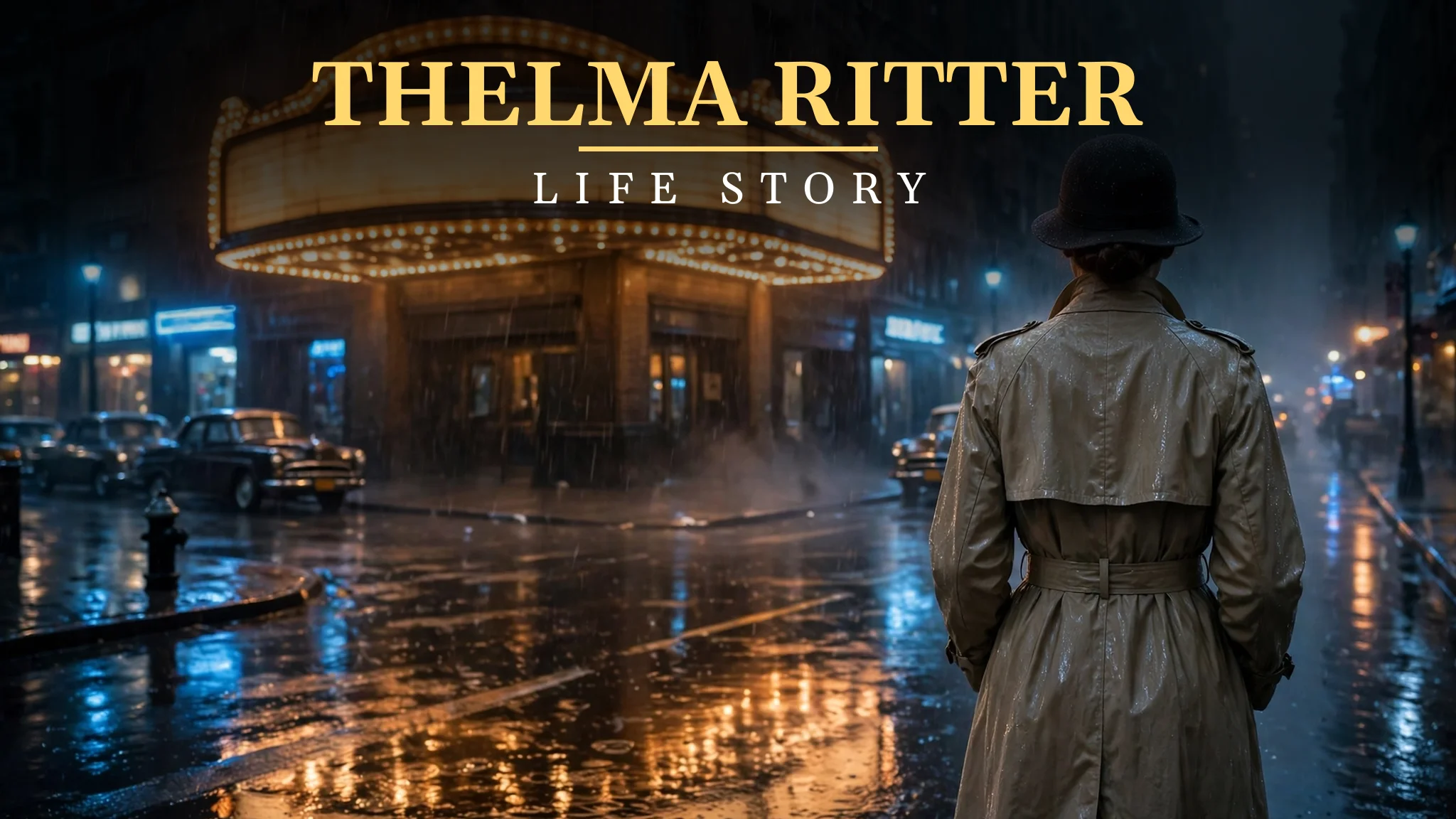
When I think of Thelma Ritter now, I think of a woman in a trench coat on a rainy night street, looking at a glowing theatre marquee. She is not in a hurry. She is thinking about the work, about the character, about the story she is about to tell. That image stays with me, because it captures her patience, her thoughtfulness, and her love for the theatre. She was an actress who prepared, who listened, and who cared, and that care is visible in every performance she gave.
I hope readers who meet her for the first time will watch All About Eve and Rear Window, and I hope they will pay attention to her scenes, and I hope they will see that she was more than a supporting actress. She was a great actress who made ordinary people feel extraordinary, and she did it with humour, honesty, and warmth. That is why I think her story matters, and that is why I think it will still matter many years from now, when the awards have been forgotten and her performances are still there to be seen.
In the end, I think Thelma Ritter teaches us that you do not need to win to be great, and that you do not need to be a star to make a difference. You need to be honest, you need to work hard, and you need to care about the people you play. She did all of those things, and she did them for twenty years, in film after film, and she left a legacy that is still felt today. I will remember her as Birdie, as Stella, as Alma, and as a woman who showed us that ordinary life is worth playing with respect.
I also think about how Thelma Ritter’s story connects to the way we treat supporting actors today, and to how often they are overlooked in favour of stars. She was nominated six times, and she never won, yet she is remembered as one of the greats, because her performances were so honest that they stayed with audiences long after the film ended. I think that is a lesson for anyone who works in a supporting role, in any field, not only in film. You do not need to be the star to make a difference. You need to do your work well, to be honest, and to make the people around you look good. She did that, and her work is still remembered today, even though she never held an Oscar in her hands.
Another thought that stays with me is her marriage, and the way she balanced a career with a family life. She was married to Joseph Moran for more than forty years, until her death, and she raised two children while also building a career that started late and lasted for twenty years. I think that stability gave her a sense of calm that showed in her performances. She was not chasing fame, she was not trying to be a star, and she was not worried about what other people thought of her. She was a wife, a mother, and an actress, and she did all three with care. That steadiness is rare in Hollywood, and it is part of what makes her story so appealing. She was a real person, living a real life, and bringing that real life to her work.
I also wonder what she would think of the way character actresses are treated today, where there are more opportunities for older women, but where the pressure to be young and beautiful is still strong. I think she would tell younger actresses to be themselves, to not try to be something they are not, and to trust that honesty is more important than glamour. She would tell them that a maid, a nurse, or a neighbour can be the most interesting person in a film, if she is played with truth. That advice is simple, but it is true, and it is advice I want to remember, even though I am not an actress. Be yourself, be honest, and trust that your work matters, even if you are not the star.
When I think of Thelma now, I do not only think of All About Eve or Rear Window. I think of a woman in a small radio studio, speaking into a microphone, telling a story with only her voice, and making an audience believe in a character they cannot see. That image stays with me, because it captures her skill, her professionalism, and her love for the craft. She was an actress who learned her trade in radio and in theatre, and who brought that training to film, and who made every role feel real. That is a legacy I admire, and a legacy I am glad to have learned about.
I hope that people who read her story will pay attention to supporting actors, not only to stars, and will understand that a film is made by many people, not only by the leads. She was one of those people, and she made films better, simply by being honest, funny, and real. Her life is proof that you do not need to win to be great, and that you do not need to be a star to make a difference. You need to be yourself, and to do your work well, and that is enough.
I also think about how Thelma Ritter’s characters are remembered today, and how often people who have never seen her films still know her name, because film historians and critics talk about her as one of the greats. She is mentioned in books about Hollywood, in classes about acting, and in lists of the best supporting actresses of all time, and that reputation has lasted for more than fifty years after her death. I think that is a remarkable kind of legacy, one that is built not on fame, but on the quality of her work. She did not need an Oscar to be remembered. She needed to be honest, funny, and real, and she was, in every film she made.
I also want to remember her as a person who started late and still succeeded, because that part of her story is hopeful for anyone who feels that they have missed their chance. She was forty-eight when she was nominated for her first Oscar, and she was a wife and a mother before she was a film star, and she did not let that late start stop her. She used her life experience as her greatest asset, and she proved that a career can begin at any age, if you are willing to work hard and to be yourself. That is a lesson I want to carry with me, and a lesson I hope others will carry too.
I also think about the way she listened, and how that listening made her a better actress and a better person. She listened to other actors, she listened to directors, and she listened to the people around her, and that listening allowed her to respond with honesty and with humour. In a world where many people are too busy talking to listen, her example is a reminder that listening is a form of respect, and that it can make your work, and your life, better. She listened, and she learned, and she shared what she learned with her audiences, simply by being present in every scene she played.
I also think about how Thelma Ritter’s six nominations are remembered today, and how often people mention them when they talk about the greatest actors who never won an Oscar. She is in good company, with many other great performers who were nominated many times without winning, and her name is spoken with respect, not with pity. That respect is the real prize, and it has lasted longer than any single award ceremony. She did not need a statue to be great. She needed to be honest, and she was, in every role she played, from Birdie to Stella to Alma, and that honesty is still remembered today.
Frequently Asked Questions
Why is Thelma Ritter famous if she never won an Oscar?
Thelma Ritter was nominated for the Academy Award for Best Supporting Actress six times, for films including All About Eve, The Mating Season, and Birdman of Alcatraz, but she never won. She is famous because her performances were so honest and memorable that audiences and critics regarded her as one of the great character actresses in Hollywood history, even without an Oscar win.
What was Thelma Ritter’s breakthrough role?
Her breakthrough role was Birdie Coonan in All About Eve in 1950, where she played the maid and dresser to Bette Davis’s character. Her sharp and funny performance earned her first Oscar nomination when she was forty-eight years old. The role showed that she could make a small supporting part feel essential to the film.
What role did Thelma Ritter play in Rear Window?
In Rear Window in 1954, directed by Alfred Hitchcock, she played Stella, the nurse and housekeeper who cares for James Stewart’s character, a photographer with a broken leg. Stella is practical, funny, and wise, and she offers advice about life and love. The role became one of her most beloved performances.
Did Thelma Ritter start acting late in life?
Yes, she studied acting young, but she married in 1927 and raised two children before returning to acting in her forties. She worked in radio and theatre, and then in film, where she was nominated for an Oscar at forty-eight. Her late start gave her performances a depth that came from real life experience as a wife and mother.
How many Oscar nominations did Thelma Ritter receive?
She received six Academy Award nominations for Best Supporting Actress, for All About Eve, The Mating Season, With a Song in My Heart, Pickup on South Street, Pillow Talk, and Birdman of Alcatraz. She never won, but the six nominations are a record of respect from the film industry, and she is still regarded as one of the greats.
When did Thelma Ritter die?
Thelma Ritter was born on 14 February 1902 in Brooklyn, New York, and she died on 5 February 1969 in New York City, at the age of sixty-six. She had worked in film for about twenty years, from the late 1940s to the late 1960s, and she is remembered for her honest and funny supporting roles.


