Tim Burton: The Life Story Behind the Dark Fantasy Director
In this post
- Burbank: The Suburb That Felt Strange
- A Sketchbook Full of Monsters
- CalArts and the Disney Years
- Pee-wee and the First Feature
- Beetlejuice and the Ghost Who Stole the Film
- Batman and the Blockbuster Test
- Edward Scissorhands: The Story He Had to Tell
- The 1990s: Nightmare, Ed Wood, and Sleepy Hollow
- Big Fish, Chocolate, and Sweeney Todd
- Wednesday, Beetlejuice Beetlejuice, and a New Generation
- The Collaborators: Elfman, Depp, and the Circle
- My Take:
Tim Burton has always carried a sketchbook, and the sketchbook has always been the real start of his films. Before there was a script, before there was a cast, before there was a set, there was a drawing: a tall, thin figure with sad eyes, a house that leaned at an impossible angle, a dog with stitches, a girl who could see ghosts. Burton was born in Burbank, California, on 25 August 1958, and he grew up drawing the things that other children found frightening. He turned those drawings into a career that has lasted more than forty years, and into films that millions of people love, from Beetlejuice to Batman, from Edward Scissorhands to Wednesday.
What makes Burton different is that he never learned to draw the way other people draw. His lines are crooked, his figures are stretched, and his worlds are dark, funny, and sad at the same time. He did not change that style to fit Hollywood. He made Hollywood fit his style, and he did it by finding people who understood him, a composer who heard the same music he heard, and actors who could play the strange, gentle characters he drew. His films are not made by one person. They are made by a circle of collaborators, and Burton is at the centre of that circle, still drawing.
He has made big blockbusters and small, personal films, he has worked in live action and in stop-motion animation, and he has directed for cinema and for television. He is a private man who does not talk much about himself, and his films do the talking for him. This is the story of a boy with a sketchbook who became one of the most recognisable directors in the world, and of the drawings that became films.
Burbank: The Suburb That Felt Strange
Burbank is a studio town, home to Warner Bros. and Disney, but for a child, it was a place of neat streets, tidy lawns, and houses that looked much like each other. Burton grew up there, in a suburban house, going to local schools, and spending a great deal of time on his own. He was not a loud child, and he was not a natural joiner of groups. He preferred to draw, to watch films, and to live in his own imagination, where the rules of ordinary life did not apply. The suburb gave him something to react against, a sameness that felt strange to him, and that strangeness became the heart of his films.
He loved the old horror films on television, and he admired Vincent Price, the actor whose voice gave those films their menace and their humour. He loved the stories of Edgar Allan Poe, and he loved the drawings of Dr. Seuss, whose crooked buildings showed him that a made-up world could have its own logic. He put all of it into his sketchbook, and the sketchbook became his world. The drawings were not a phase. They were a language, and Burton was learning to speak it, page by page, year by year.
His teachers did not always know what to make of the work, but one of them recognised that he had real talent, and Burton won a scholarship to the California Institute of the Arts, known as CalArts, a school set up with help from Walt Disney to train animators. For a boy who had drawn alone in his room, CalArts was a revelation. He was suddenly surrounded by other young people who drew strange things, who loved cartoons, and who wanted to make films. He had found his people, and he had found a place where his drawings made sense.
A Sketchbook Full of Monsters
The sketchbook is the key to understanding Burton, because it never left him. He drew as a child, he drew at CalArts, he drew at Disney, and he still draws today. The characters in his films, Edward with scissors for hands, Jack Skellington with a skull for a face, and the Corpse Bride with her blue skin, all began as drawings in a notebook. They were not invented for a film. They were drawn because Burton liked to draw them, and the films came later, when someone asked him what the drawings were about.
The drawings are dark, but they are not cruel. The monsters in Burton’s sketchbook are sad, lonely, and gentle, and they want to be loved. That is why audiences love them too. A monster who wants to be loved is a character that anyone can understand, because everyone has felt lonely, and everyone has wanted to be loved. Burton’s monsters are not frightening in the usual way. They are frightening because they are different, and they are loved because they are honest about being different. That honesty is the heart of his work.
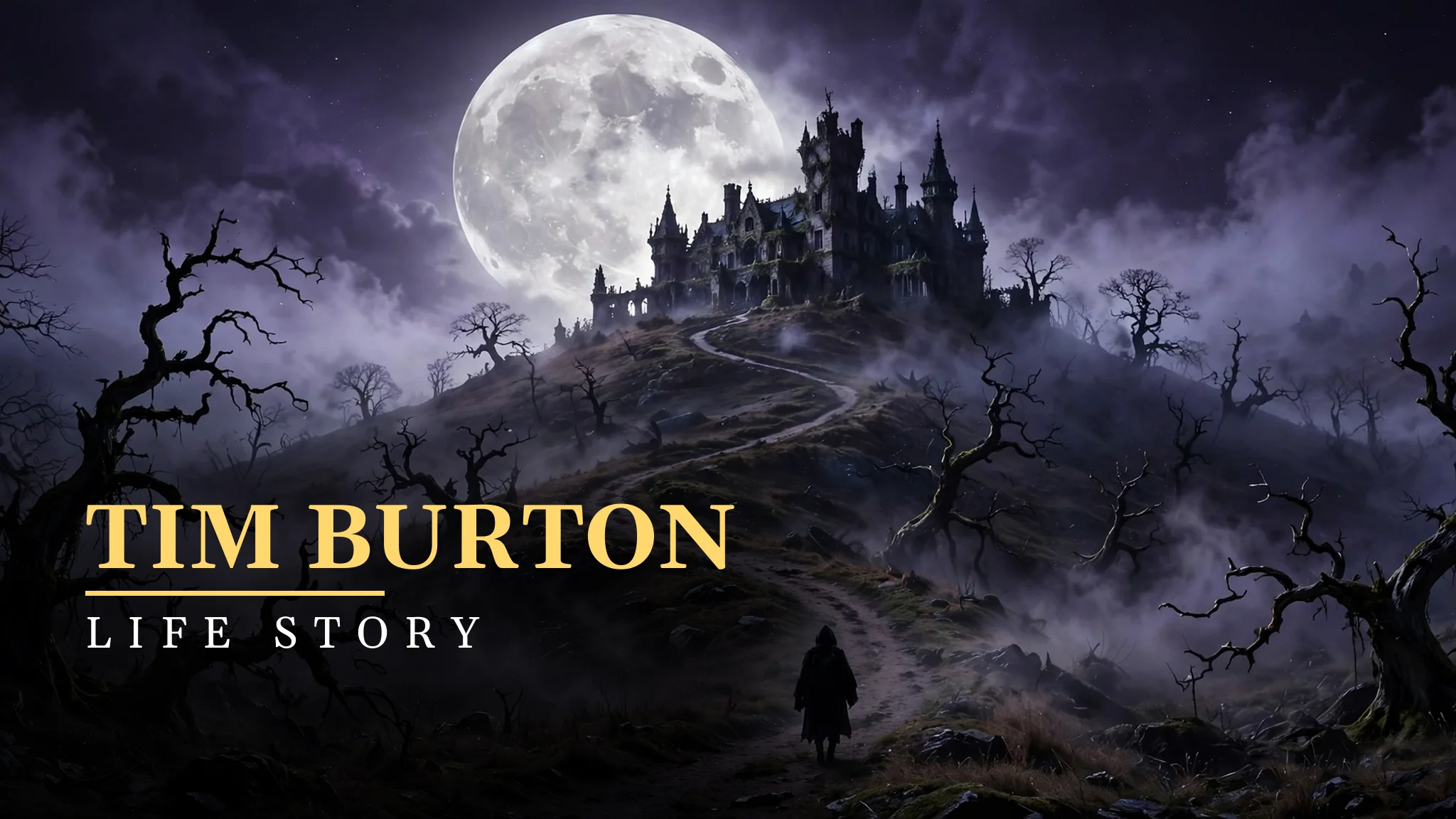
He also drew houses, and the houses are as important as the characters. A Burton house leans, it has a crooked roof, and it sits on a hill, alone, in the fog. It is a house that looks like it has a secret, and it usually does. The house in Edward Scissorhands, the mansion on the hill, is the house Burton drew as a boy, and it is the house he has drawn ever since. It is a place that is frightening and beautiful at the same time, and it is a perfect image for his films, which are frightening and beautiful at the same time.
CalArts and the Disney Years
At CalArts, Burton studied character animation, and he learned the slow, careful craft of making drawings move. Animation is not a quick art. A single minute of film can take hundreds of drawings, and each one must be slightly different from the last. Burton was good at it, but his style was already different from the style Disney was known for. Disney films were bright, warm, and full of cute animals. Burton’s characters were darker, thinner, and sadder, and his stories had a gothic edge. Disney noticed him anyway, and after CalArts he was hired as an animator at Walt Disney Productions.
He worked on The Fox and the Hound and on Tron, and he learned how a big studio worked from the inside. He saw how many people it took to make a film, how much money was involved, and how careful a studio had to be. It was a useful education, but it was also frustrating, because the work he was asked to do was far from the work he wanted to make. He was an animator who wanted to direct, and a storyteller who wanted to tell his own stories, and Disney did not know what to do with him.
While he was at Disney, he began making his own short films in his spare time. The most important was Vincent, a black-and-white stop-motion film from 1982 about a boy who imagines himself as Vincent Price, narrated by Price himself. It was a dream come true for Burton, and it showed the world exactly what kind of filmmaker he was. Vincent was dark, funny, and sad all at once, and it was made with the kind of care that only comes from someone who truly loves the material. Disney also let him make Frankenweenie in 1984, a short live-action film about a boy who brings his dead dog back to life. It was too dark for Disney at the time, but it was a sign of what Burton could do.
Pee-wee and the First Feature
Burton’s first feature film came in 1985, when he was asked to direct Pee-wee’s Big Adventure, a comedy about the childlike character Pee-wee Herman, played by Paul Reubens. It was not an obvious match. Pee-wee was bright, silly, and loud, while Burton was quiet and gothic. But Burton brought his own visual sense to the film, giving it strange sets, odd camera angles, and a dreamlike quality that made it feel different from other comedies. The film was a success, and it showed Hollywood that Burton could direct a feature, handle actors, and finish a project on time.
The music for Pee-wee’s Big Adventure was written by Danny Elfman, a musician Burton had met through the Los Angeles music scene. Elfman had been the frontman of the band Oingo Boingo, and his music was playful, strange, and full of energy. Burton loved it, and the two men began a working relationship that would last for decades. Elfman would write the music for almost every Burton film, and his scores became as much a part of the Burton style as the black-and-white stripes and the crooked houses. It was the beginning of a circle, a group of collaborators who understood Burton, and who helped him build his worlds.
Pee-wee’s Big Adventure also showed that Burton could work with a star. Paul Reubens was a comedian with a strong character, and Burton did not try to change him. He let Reubens be Pee-wee, and he built a world around him. That is a skill that Burton would use again and again, with Michael Keaton, with Johnny Depp, and with many others. He does not force an actor into his world. He finds an actor who already belongs in it, and he lets them play.
Beetlejuice and the Ghost Who Stole the Film
In 1988, Burton made Beetlejuice, a comedy about a dead couple who hire a wild, rude ghost, played by Michael Keaton, to scare away the living family who have moved into their house. It was funny, grotesque, and completely original, with a visual style that mixed horror with cartoon energy. The film was a hit, and it won an Academy Award for makeup, which was fitting, because the makeup in Beetlejuice was part of the joke and part of the horror at the same time. Keaton’s Beetlejuice, with his wild hair and his striped suit, became one of the most famous characters in cinema.
Beetlejuice also introduced Winona Ryder as Lydia Deetz, a pale, serious teenage girl who can see ghosts and who feels out of place in her own family. Lydia was a Burton heroine in the purest sense, quiet, strange, and more at home with the dead than with the living. Audiences loved her, and they loved the film’s refusal to be sensible. Beetlejuice proved that Burton’s childhood tastes could make money, and that a studio could trust him with a bigger budget and a bigger idea.
The success of Beetlejuice changed Burton’s life. He was no longer a promising young animator with odd short films. He was a director with a hit, and Hollywood began offering him projects that other directors would have killed for. He chose carefully, and his next choice would make him one of the most famous directors in the world.
Batman and the Blockbuster Test
In 1989, Burton directed Batman, a film that many people thought would fail. Batman had been a bright, campy television character in the 1960s, and a darker version seemed like a risk. Burton did not see it as a risk. He saw Batman as a character who belonged in the dark, a rich man who dressed as a bat because he was haunted by the murder of his parents, and who fought crime in a city that looked like a nightmare. That was a Burton story, and he knew how to tell it. The film starred Michael Keaton as Batman and Jack Nicholson as the Joker, and it was a huge commercial success, making more money than almost any film of its year.
The look of Batman was as important as its story. Gotham City was a dark, towering place, full of gothic towers, rain, and shadows, and it felt like a city built from Burton’s own drawings. The Batmobile, the costumes, and the sets all carried his signature, and the music by Danny Elfman gave the film a dark, heroic theme that people still recognise today. Burton had taken a studio blockbuster and made it personal, which is a rare achievement in Hollywood. He had also changed the way Hollywood thought about comic book films. Before Batman, superhero films were often treated as children’s entertainment. After Batman, they were treated as serious business.
He returned to the character in 1992 with Batman Returns, which was even darker and stranger, with the Penguin, played by Danny DeVito, and Catwoman, played by Michelle Pfeiffer. Some audiences found it too dark, and some parents complained that it was not suitable for children, but the film was a success, and it showed that Burton would not soften his style to please everyone. He had made Batman his own, and he was willing to live with the consequences. The two Batman films also taught him something about fame and control. A film that big belongs to the studio as much as to the director, and Burton found that he had less freedom than he wanted. He would go on to make big films again, but he would always return to smaller, stranger stories as well, because those were the stories where he felt most free.
Edward Scissorhands: The Story He Had to Tell
In 1990, between the two Batman films, Burton made Edward Scissorhands, the film that many people consider his masterpiece. It was the story of a young man with scissors for hands, created by an inventor who died before he could finish him, and left alone in a gothic mansion on a hill. A kind woman from the suburbs finds him, takes him home, and tries to help him fit into ordinary life. At first the neighbours love him, because he can cut hair and trim hedges in beautiful shapes, but then they turn on him, because he is different, and because difference frightens them. The film starred Johnny Depp as Edward, and it was the beginning of one of the most important partnerships in modern cinema.
Depp was then known mainly as a television actor, and Burton saw in him a quality that other directors had missed, a quiet sadness, a willingness to be strange, and a complete lack of vanity. Depp played Edward without speaking much, letting his face and his hands do the work, and the performance became one of the most loved in film history. The two men would go on to make many films together, and Depp would become Burton’s most frequent leading man. It was a partnership built on trust, and on a shared way of seeing the world.
Edward Scissorhands was also a deeply personal film for Burton. Edward was Burton himself in many ways, a lonely, creative person with strange hands, living in a world that did not know what to do with him. The suburban setting was the Burbank of Burton’s childhood, and the gothic mansion on the hill was the world of his imagination. The film was funny and sad at the same time, and it ended not with a triumph but with a quiet kind of heartbreak, as Edward returned to his mansion and the girl he loved grew old without him. Audiences understood it, and the film became a classic.
The 1990s: Nightmare, Ed Wood, and Sleepy Hollow
In the early 1990s, Burton worked as a producer on The Nightmare Before Christmas, a stop-motion film released in 1993, based on his own story and characters, and directed by Henry Selick. The film was about Jack Skellington, the Pumpkin King of Halloween Town, who discovers Christmas, and it became a cult classic. Its images of Jack, Sally, and the spiral hill are now known all over the world. Burton had created a story that belonged to two holidays at once, and it has been loved by new generations ever since. The film was pure Burton, even though he did not direct it, because the world came from his drawings.
In 1994, he made Ed Wood, a black-and-white film about Edward D. Wood Jr., a real filmmaker from the 1950s who was known for making very low-budget films that were often mocked. Burton did not mock Wood. He treated him with love and respect, as a man who loved making films so much that he kept going even when nobody praised him. Johnny Depp played Wood, and Martin Landau played Bela Lugosi, the old horror star, and Landau won an Academy Award. Ed Wood was not a commercial success, but it was a critical success, and it remains one of Burton’s most loved films. It was also a statement about Burton himself, that loving something is enough reason to make it, even if the world does not understand it yet.
He made Mars Attacks! in 1996, a comedy about Martians invading Earth, and Sleepy Hollow in 1999, a gothic horror film about Ichabod Crane and the Headless Horseman, again starring Depp. Sleepy Hollow was a visual feast, full of fog, dark forests, and twisted trees, and it won an Academy Award for art direction. The 1990s were a decade when Burton made films that were personal, strange, and beautiful, and when he proved that he could work in any genre, as long as the story came from his sketchbook.
Big Fish, Chocolate, and Sweeney Todd
In the early 2000s, Burton’s films became bigger and more emotional. Big Fish, released in 2003, was a fantasy drama about a dying man who tells tall tales about his life, and his son, who tries to work out which parts are true. It starred Ewan McGregor and Albert Finney, and it was a film about storytelling itself, about the way we turn our lives into stories, and the way those stories can be truer than the facts. It was one of Burton’s most warm and human films, and it showed that his style could work in a story that was not about monsters or ghosts, but about a father and a son.
In 2005, he made two films in the same year. The first was Charlie and the Chocolate Factory, based on the book by Roald Dahl, with Johnny Depp as Willy Wonka. It was a bright, strange, and funny film, and it was a huge success. The second was Corpse Bride, a stop-motion animated film about a young man who accidentally marries a dead bride, and it was nominated for an Academy Award for Best Animated Feature. It showed that Burton had not lost his love for the dark, handmade world of animation that had started his career.
In 2007, he made Sweeney Todd: The Demon Barber of Fleet Street, a musical horror film, again starring Depp, with Helena Bonham Carter as Mrs. Lovett. It was dark, bloody, and full of songs, and it won an Academy Award for art direction. It was not a film for everyone, but it was a film that only Burton could have made, because only he could make a story about a murderous barber feel like a tragic love story. During this period, Burton’s personal life was also changing. He had been in a relationship with the actress Helena Bonham Carter for many years, and they had two children, a son and a daughter. Bonham Carter became a regular presence in his films, and their partnership, both personal and professional, became one of the most visible in cinema. They separated in 2014, and both spoke about it with respect.
Wednesday, Beetlejuice Beetlejuice, and a New Generation
In 2010, Burton directed Alice in Wonderland, a new version of the Lewis Carroll story, and it earned more than a billion dollars around the world, the biggest hit of his career. He made Dark Shadows in 2012, and a feature-length Frankenweenie in the same year, a return to his roots, made in black and white, and nominated for an Academy Award. He made Big Eyes in 2014, a drama about the artist Margaret Keane, and Miss Peregrine’s Home for Peculiar Children in 2016, a return to dark fantasy. He made Dumbo in 2019, a live-action version of the Disney film, and a return to the studio where he had started.
The biggest surprise of his later career came in 2022, when he directed several episodes of Wednesday, a Netflix series about Wednesday Addams, the pale, serious daughter from The Addams Family. The series starred Jenna Ortega as Wednesday, and it became a huge hit, watched by millions of people around the world. Burton was the right director for the material, because Wednesday was a Burton heroine in every sense, quiet, strange, and more comfortable with the dark than with the ordinary. The series introduced his style to a new generation, and it proved that he could work in television as well as in film.
In 2024, he returned to one of his earliest successes with Beetlejuice Beetlejuice, a sequel to the 1988 film, with Michael Keaton returning as Beetlejuice and Winona Ryder returning as Lydia, now grown up and a mother herself. The film also starred Jenna Ortega as Lydia’s daughter, and it was a success, showing that the world Burton had created in 1988 still had life in it. It was a rare thing in Hollywood, a sequel made more than thirty years later that felt like a genuine continuation, not a copy. Today, Burton is still working, still drawing, and still making films and television that carry his unmistakable signature. He has influenced a generation of filmmakers, artists, and designers who grew up watching his films, and his legacy is not just the films themselves, but the permission he gave to strange, quiet, creative people to be themselves.
The Collaborators: Elfman, Depp, and the Circle
Burton’s films are not made alone. They are made by a circle of people who have worked with him for decades, and who understand his world. Danny Elfman has written the music for almost all of his films, from Pee-wee’s Big Adventure to Wednesday, and his scores are as much a part of the Burton style as the drawings. Elfman’s music is playful, strange, and sad, all at once, and it gives Burton’s films their emotional colour. Without Elfman, a Burton film would sound different, and it would feel different, and Burton knows it. He has kept working with Elfman for forty years, because the partnership works.
Johnny Depp is the other great collaborator. He has starred in many of Burton’s films, from Edward Scissorhands to Sweeney Todd, and he has become the face of Burton’s heroes, quiet, strange, and gentle. Depp trusts Burton, and Burton trusts Depp, and that trust lets them take risks. Depp can play a character with scissors for hands, or a barber who murders his customers, and he knows that Burton will make it work. It is a partnership built on a shared way of seeing the world, and it is one of the great director-actor partnerships in modern cinema.
The circle also includes designers, costume makers, and animators, people who build Burton’s worlds, who make the crooked houses, the striped suits, and the stop-motion puppets. They are the people who turn a drawing in a sketchbook into a film, and Burton relies on them. He is not a director who does everything himself. He is a director who finds the right people, and who lets them do their best work. That is a generous way to direct, and it is one of the reasons his films feel so complete. They are made by a circle, and the circle has stayed together for decades.
My Take:
I think the first thing to say about Tim Burton is that he never grew out of his sketchbook. Most directors move on from the things they loved as children, and they make films about adult things. Burton did the opposite. He took the horror films, the monster movies, and the strange drawings of his youth, and he turned them into a career. That takes courage, because it means showing the world the part of yourself that is most personal and most easily mocked. He did it anyway, and he kept doing it for forty years. I think that is a lesson for anyone who has ever felt that their tastes are too strange to share. Your strangeness might be the most valuable thing you have.
What I admire most is the sketchbook itself. Burton draws, and the drawings become films, and that is a simple, honest way to work. He does not start with a market, or with a trend, or with what a studio wants. He starts with a drawing, with a character he likes, and he asks what that character’s story is. That is how Edward Scissorhands was born, and how Jack Skellington was born, and how the Corpse Bride was born. They were drawings first, and films second, and that is why they feel so real. They were not invented for a film. They were drawn because Burton loved to draw them, and the love shows.
I also think about Edward Scissorhands a lot, because it is a film that I have watched many times, and it still moves me. Edward is a gentle man with scissors for hands, and the world does not know what to do with him. At first, the neighbours love him, because he is useful, and then they turn on him, because he is different. That is a story about how people treat difference, and it is a true story, because it happens in real life. Burton tells it with kindness, and with sadness, and he does not offer a simple happy ending. Edward returns to his mansion alone, and the girl he loved grows old without him. That is a heartbreaking ending, and it is an honest one, and I respect Burton for it.
There is a part of his work that makes me think about the suburbs. Burton grew up in Burbank, in a neat suburb, and he felt like an outsider there. He put that feeling into his films, into the pastel houses of Edward Scissorhands, and into the tidy streets that hide gossip and fear. He did not hate the suburbs, but he saw something strange in their sameness, and he showed it. I think that is a useful thing for a filmmaker to do, to show us the strangeness in the ordinary. The ordinary is not always safe, and Burton reminds us of that, in a way that is both funny and frightening.
I want to talk about Danny Elfman, because I cannot imagine a Burton film without his music. Elfman’s scores are playful, strange, and sad, and they give Burton’s films their feeling. The music in Edward Scissorhands is gentle and haunting, the music in Batman is dark and heroic, and the music in The Nightmare Before Christmas is full of joy and mischief. Elfman does not just add music to the films. He gives them their emotional colour, and he helps the audience feel what the characters are feeling, even when the characters cannot say it. That is a partnership built on a shared way of seeing the world, and it is one of the great partnerships in film.
I also think about Johnny Depp, and about how important he is to Burton’s films. Depp plays Burton’s heroes, quiet, strange, and gentle men, and he plays them with a complete lack of vanity. In Edward Scissorhands, he barely speaks, and yet the performance is unforgettable. In Ed Wood, he plays a man who is laughed at by the world, and he plays him with warmth instead of mockery. That kind of trust between a director and an actor is rare, and it is one of the reasons those films still feel alive. Burton saw something in Depp that other directors missed, and he gave Depp the roles that made him a star.
If I am honest, I do not love every Burton film equally. I think Mars Attacks! is clever but cold, and I think Planet of the Apes was a mistake, a film where the studio’s needs mattered more than Burton’s vision. I also think Alice in Wonderland, for all its success, relies too much on computer effects, and that the effects sometimes hide the story. I say this not to be unkind, but because I think it is important to be honest about an artist’s work. Burton is at his best when he is personal, when the story comes from something he truly cares about, and he is at his weakest when he is working on a project that does not belong to him. That is true of most directors, but it is especially true of Burton, because his style is so personal.
What I find most interesting about his later career is Wednesday. When the series was announced, I was not sure it would work. Wednesday Addams is a character who had been played many times, and a television series felt like a risk. But Burton understood Wednesday in the same way he understood Edward and Lydia. She is a girl who does not fit in, who is smarter than the people around her, and who refuses to pretend to be normal. Jenna Ortega played her beautifully, and Burton directed the early episodes with the same care he brought to his films. The success of Wednesday proved that Burton’s way of seeing the world still matters to young people, and that his stories are not stuck in the past.
I think about Burton’s childhood a lot when I watch his films. He was a quiet boy in a tidy suburb, drawing monsters in his notebook, and feeling like an outsider. That boy could have grown up to hide his drawings and become someone else. Instead, he became a director who showed his drawings to the world, and the world loved them. That is a hopeful story, and it is one I would tell to any young person who feels different. Your strangeness is not something to be ashamed of. It might be the most valuable thing you have, if you are brave enough to share it.
There is also something I respect about the way Burton handles fame. He is famous, but he is not a celebrity in the usual sense. He does not seek attention, he does not talk about himself very much, and he does not try to be liked by everyone. He lets his work speak for him, and he keeps working, even when a film does not succeed. That is a quiet kind of discipline, and it is one I admire. In a world where so many people want to be famous for being famous, Burton wants to be known for what he makes, and that feels like the right order of things.
I also want to say something about his visual style, because I think it is often dismissed as a gimmick. It is not a gimmick. The crooked houses, the black-and-white stripes, and the pale faces are a language, and Burton uses that language to tell the audience how a character feels. A crooked house tells you that the world inside it is not safe. A pale face tells you that a character is lonely. Stripes tell you that something is both playful and a little frightening. Once you learn to read that language, you see that Burton is not repeating himself. He is using the same words to tell different stories, in the same way a writer uses the same alphabet to write different books.
One film I keep returning to is Ed Wood, because it tells me something about Burton that his bigger films do not. Ed Wood was a man who made bad films with great love, and Burton made a beautiful film about him with great love. That is a generous act. Burton could have mocked Wood, as many people did, but he chose to respect him instead. I think that choice tells you everything about Burton’s character. He believes that loving something is enough, even if you are not the best at it, and even if the world does not understand it. That is a kind belief, and it is one I wish more people shared.
Big Fish is another film I think about often, because it is about a father who tells stories that may not be true, and a son who wants the truth. I have known people like that son, who want facts and dates and proof, and I have known people like that father, who know that a story can be true even if it did not happen exactly as told. Burton sides with the father, gently, and he suggests that the stories we tell about our lives are part of who we are. That is a wise thing for a filmmaker to say, because filmmakers are storytellers too, and they know that a story can reveal a truth that a list of facts cannot.
I also think Burton deserves credit for the way he treats women in his films. Lydia in Beetlejuice, Sally in The Nightmare Before Christmas, and Wednesday in the series are not just love interests or victims. They are strange, clever, and strong in their own ways, and they often see the truth before anyone else does. Lydia can see ghosts when the adults cannot. Sally knows that Jack’s plan will fail before he does. Wednesday solves the mystery while everyone else is confused. Burton gives his female characters intelligence and agency, and that matters, especially in films that could easily have treated them as decoration.
If I had to choose one Burton film to show to someone who had never seen his work, I would choose Edward Scissorhands, because it contains everything he does best. It has the suburb and the mansion, the outsider and the girl who loves him, the humour and the sadness, and the music that makes the whole thing feel like a fairy tale. It is a film that a child can enjoy and an adult can think about, and that is a rare achievement. It is also a film that stays with you after it ends, because the final image of Edward alone in his mansion, cutting ice into snow, is both beautiful and heartbreaking.
I also think about the young artists who watch his films today and feel less alone because of them. A child who draws strange creatures in a notebook, a teenager who feels out of place at school, a young filmmaker who loves horror films that other people call silly: all of them can look at Burton and see proof that a strange imagination can become a life. That proof matters more than any award, because awards are given once and then forgotten, while the feeling of being understood can last for years. Burton gave that feeling to millions of people, and he did it without ever pretending to be someone else.
In the end, I think Tim Burton’s career is a reminder that art does not have to come from the centre of the world. It can come from the edge, from a quiet boy in Burbank who loved monsters, and it can reach millions of people who feel the same way. He kept his own way of seeing things for forty years, through hits and through failures, and he never traded it for an easier path. That steadiness is not a small thing. I hope he keeps making films, because the world still needs directors who see the beauty in the strange, and who remind us that the outsiders are often the most interesting people in the room.
I will keep watching his films, and I will keep thinking about the sketchbook, because the sketchbook is the heart of his work. A drawing, made by a boy in Burbank, became a film, and the film became a part of millions of lives. That is a beautiful thing, and it is a reminder that a small, personal act, like drawing a monster in a notebook, can become something much bigger, if you keep doing it, and if you believe in it. Burton believed, and he kept drawing, and the world is better for it.
I also think his story is a lesson in patience. Burton did not become famous overnight. He worked at Disney, he made short films, he made a first feature that was a modest success, and he built his career slowly, film by film. He did not rush, and he did not give up, and that patience is part of why his films are so good. They were made slowly, with care, and they show it. In a world that tells us to hurry, Burton’s example is a useful one. Take your time, do it properly, and let the work speak for itself.
There is one more thing I want to say, and it is about the circle. Burton’s films are made by a circle of people, Elfman, Depp, and many others, who have worked together for decades. That circle is a reminder that a great career is rarely built alone. It is built with friends, with collaborators, and with people who understand you. Burton found his circle, and he kept it, and that is a beautiful thing. I hope young filmmakers look at him and see that finding your people is as important as finding your style, because your people will help you make your style real.
Finally, I think Burton’s life is a story about being yourself. He was a strange boy, he drew strange things, and he became a director who makes strange films, and he never apologised for it. That is a brave way to live, and it is a way that I admire. I hope I can be a little braver in my own life, and a little more honest about what I love, because Burton shows that honesty, even when it is strange, is better than pretending to be normal. He was himself, and the world loved him for it, and that is a good ending to a good story.
Frequently Asked Questions
When was Tim Burton born?
Tim Burton was born on 25 August 1958 in Burbank, California, in the United States. He grew up in Burbank, studied animation at CalArts, and began his career as an animator at Disney before becoming a film director.
What was Tim Burton’s first feature film?
His first feature film was Pee-wee’s Big Adventure in 1985, a comedy starring Paul Reubens. It was a success and showed Hollywood that Burton could direct a feature film, handle actors, and finish a project on time.
Did Tim Burton direct The Nightmare Before Christmas?
The film was directed by Henry Selick, but it was based on Tim Burton’s story and characters, and Burton produced it. The world of Jack Skellington and Halloween Town came from Burton’s own drawings and ideas, which is why it looks like a Burton film.
Who writes the music for Tim Burton’s films?
Danny Elfman has written the music for almost all of Burton’s films, from Pee-wee’s Big Adventure in 1985 to Wednesday in 2022. His playful, strange, and sad scores are a big part of the Burton style.
What is Tim Burton’s most famous film?
Many people would name Edward Scissorhands from 1990 as his most famous and most loved film, with Johnny Depp as a gentle man with scissors for hands. Beetlejuice from 1988 and Batman from 1989 are also among his best-known works.
What is Tim Burton working on now?
Burton directed episodes of Wednesday, the Netflix series about Wednesday Addams starring Jenna Ortega, which became a huge hit in 2022. In 2024 he returned with Beetlejuice Beetlejuice, a sequel to the 1988 film with Michael Keaton and Winona Ryder.


