Totó la Momposina: The Life Story Behind the Colombian Folk Legend
In this post
- Talaigua Nuevo, Mompox, and a Childhood on the Magdalena River
- The Voice of the Caribbean and the Road to Bogotá
- La Candela Viva and the World Discovers Totó
- Honours, Later Years, and a Voice That Would Not Fade
- What Totó la Momposina Leaves Behind
- The Drums, the Gaita, and the Sound of the Magdalena
- My Take:
On the Caribbean coast of Colombia, where the Magdalena River meets the sea, there is a kind of music that is older than the country itself, music made by drums, by voices, and by feet dancing in the sand. It is called cumbia, and bullerengue, and mapalé, and porro, and for more than sixty years, one voice carried that music to the world: the voice of Totó la Momposina. She was born Sonia Bazanta Vides on 1 August 1940, in Talaigua Nuevo, a small town in the department of Bolívar, near the historic town of Mompox, and she died on 1 August 2023, on her eighty-third birthday, in Bogotá, after a life spent singing the songs of her people.
Her name, Totó la Momposina, means Totó from Mompox, and it tells you where she came from, and what she carried with her. Mompox is a town on the Magdalena River, a place of colonial churches, of river boats, and of music that has been played for centuries, by African, Indigenous, and European hands, mixed together into something that is uniquely Colombian. Totó learned that music as a child, from her family, from her neighbours, and from the festivals of her region, and she spent her life sharing it, first in Colombia, and then in Europe, in North America, and around the world.
She was not a pop star. She did not chase hits, and she did not change her style to fit the fashion of the moment. She sang the old songs, she played the old rhythms, and she taught audiences, in Colombia and abroad, that those songs were not old-fashioned, but alive, powerful, and beautiful. She performed at festivals, she recorded albums, she was honoured with awards, and she became a legend, a woman whose voice is now part of Colombia’s cultural heritage. This is the story of how a girl from a small town on the Magdalena became the voice of Colombian cumbia, and why her death, on her birthday, was mourned across her country.
Talaigua Nuevo, Mompox, and a Childhood on the Magdalena River
Talaigua Nuevo is a municipality in the department of Bolívar, on the Caribbean coast of Colombia, near Mompox, a town that was once one of the most important ports on the Magdalena River. Sonia Bazanta Vides was born there on 1 August 1940, and she grew up in a world of river, of music, and of tradition. Her family was musical, and she learned to sing and to dance as a child, at home, at festivals, and at gatherings, where the music of the region was played by drums, by voices, and by hands clapping in rhythm.
The music she learned was the music of the Colombian Caribbean, a mix of African rhythms, Indigenous melodies, and European instruments, that had been created over centuries by the people who lived along the Magdalena. Cumbia, the most famous of those rhythms, is a dance of courtship, with a woman in a wide skirt, holding a candle, and a man dancing around her, and it is played on drums, on the gaita, a kind of flute, and on the maracas. Bullerengue is a women’s music, sung by women, about love, about work, and about life, and mapalé is a fast, joyful dance of African origin. Totó learned all of them, and she learned them not from a book, but from living them, from dancing them, and from singing them with her family.
Mompox, the town near her birthplace, was once a rich port, and it is now a place of quiet beauty, of colonial houses, and of a culture that has been preserved because the town was isolated for many years. Totó’s name, la Momposina, the woman from Mompox, is a tribute to that town, and to the region it represents. She was proud of her roots, and she spoke about them throughout her life, about the river, about the festivals, and about the music that she learned as a child. She did not try to sound like a singer from Bogotá or from another country. She sounded like a woman from the Magdalena, and that was exactly what her audiences wanted, in Colombia and abroad.
She began to perform as a young woman, singing at local festivals, at celebrations, and at events in her region, and she began to be recognised as a singer with a powerful, distinctive voice, a voice that was strong, warm, and full of the rhythms of her home. She was not a trained, classical singer. She was a folk singer, a singer of the people, and her voice carried the history of her region in every note. That history, and that voice, would become her gift to the world.
The Voice of the Caribbean and the Road to Bogotá
As Totó la Momposina grew older, she began to travel, to perform in other parts of Colombia, and to share the music of the Caribbean coast with audiences who had never heard it. She moved to Bogotá, the capital, and she began to perform there, in theatres, at festivals, and on television, introducing the capital to the rhythms of the coast, and to the songs that had been sung for generations along the Magdalena. Bogotá in those years was a city that was learning about its own country’s music, and Totó was one of the teachers, a woman who brought the Caribbean to the Andes, and who made the capital listen.
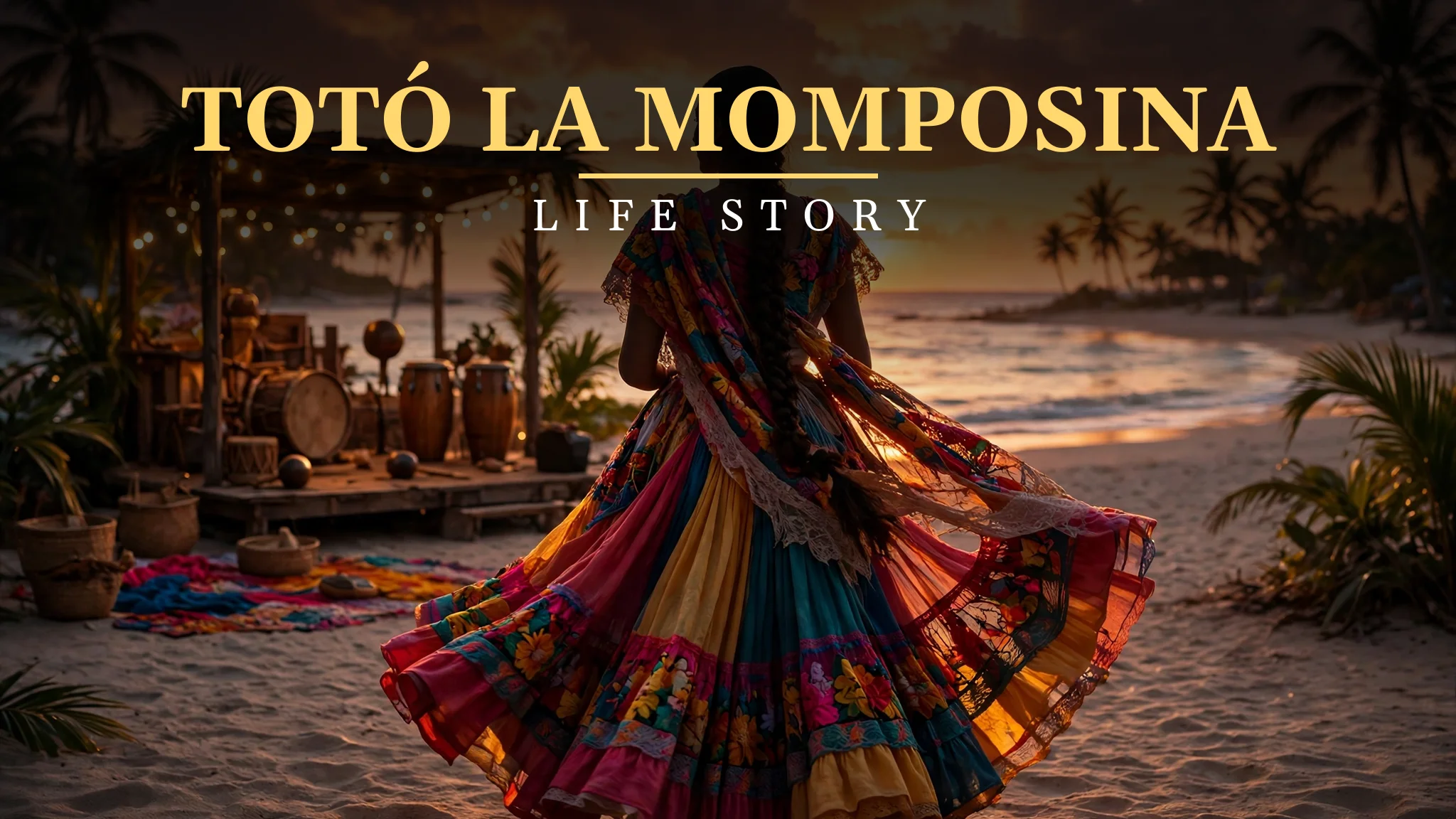
She formed a group, with her family, including her children and her grandchildren, and she toured with them, performing the music of the coast, with drums, with gaitas, and with voices, in a style that was traditional and that was also alive, because it was performed by a family, not by strangers. Her performances were joyful, colourful, and full of energy, with Totó in a wide, flower-patterned dress, dancing, singing, and inviting the audience to join in. She was not a distant star. She was a warm, open, laughing presence, and audiences loved her for it, because she made them feel that they were part of the music, not only listeners to it.
She also began to record, and her recordings spread the music of the Caribbean coast to a wider audience, in Colombia and abroad. She sang cumbia, bullerengue, mapalé, and porro, and she sang them with a voice that was unmistakable, a voice that was both powerful and tender, and that carried the sound of the river, the drums, and the festivals of her childhood. Her music was not pop music, and it was not designed to be a hit. It was folk music, and it was designed to be true, and that truth is what made it last, and what made it loved.
In the 1980s, she became more widely known outside Colombia. She is widely reported to have performed at the ceremony in Stockholm in 1982 when Gabriel García Márquez, the Colombian writer, received the Nobel Prize in Literature, singing the music of the Caribbean coast for an audience that included the King of Sweden and the world’s press. Whether or not every detail of that story is remembered correctly, the fact that it is told about her says something about her place in Colombian culture: she was the voice that Colombia chose to represent itself, on the most important cultural stage in the world, and she sang the songs of her people, with pride, and with joy.
La Candela Viva and the World Discovers Totó
In 1993, Totó la Momposina released La candela viva, an album on the Real World label, the label founded by Peter Gabriel, and the album introduced her to a global audience. The title means “the living flame”, and it is a fitting title for an album that is full of fire, of drums, of voices, and of the rhythms of the Caribbean coast. The album was praised by critics in Europe and in North America, and it was played at world music festivals, and it made Totó a star in the world music scene, a singer whose name was known to people who had never been to Colombia, and who had never heard cumbia before.
The album’s success led to tours, to performances at festivals such as WOMAD, the world music festival founded by Peter Gabriel, and to concerts in Europe, in North America, and in other parts of the world, where audiences who did not speak Spanish danced to her music, and sang along to songs they did not understand, because the rhythm and the voice were enough. Totó was a natural performer on those stages, because she had been performing since she was a child, and because she understood that music is a language that does not need translation, if it is played with heart.
She released other albums in the years that followed, including Carmelina and Tambolero, and she continued to tour, to perform, and to record, always with her family, always with the same rhythms, and always with the same joy. She did not change her style to fit the world music market. She brought the world music market to her style, and she made it listen, and dance, and sing along. That is a rare achievement, and it is a testament to the power of her music, and to the strength of her voice.
Her work also helped to change the way Colombian music was seen abroad. Before Totó, many people outside Colombia knew only salsa, or only the drug trade, and they did not know cumbia, bullerengue, or mapalé. Totó taught them, by singing, by dancing, and by telling the stories behind the songs, and she made them understand that Colombia has a rich, ancient, and beautiful musical tradition, and that it deserves to be heard. She was an ambassador, not only for her music, but for her country, and she carried that role with pride, and with grace.
Honours, Later Years, and a Voice That Would Not Fade
In her later years, Totó la Momposina was honoured in Colombia and abroad, with awards, with tributes, and with recognition of her contribution to Colombian culture. She received honours from the Colombian government, from cultural institutions, and from the music industry, and she was celebrated as a living legend, a woman whose voice had carried Colombian music to the world, and whose work had preserved the traditions of the Caribbean coast for future generations. She accepted those honours with humility, and with gratitude, and she continued to perform, to sing, and to teach, even as she grew older.
She continued to tour with her family, and she continued to perform at festivals in Colombia, including the Festival de la Leyenda Vallenata and other celebrations of Colombian folk music, where she was welcomed as a queen, a matriarch, and a teacher. Young musicians came to her to learn, to listen, and to understand the rhythms she had spent her life preserving, and she taught them, with patience and with joy, because she believed that the music must be passed on, from one generation to the next, or it will be lost. She was not only a singer. She was a keeper of a tradition, and she took that responsibility seriously.
Her health declined in her final years, and she performed less often, but she remained a beloved figure, and her music remained a part of Colombian life, played at festivals, at parties, and in homes across the country. She died on 1 August 2023, on her eighty-third birthday, in Bogotá, and her death was mourned across Colombia, with tributes from the president, from musicians, from cultural leaders, and from ordinary people who had danced to her music and who had loved her voice. It was a fitting, if sad, symmetry, that she died on the day she was born, after a life that had come full circle, from a small town on the Magdalena to the world, and back to Colombia, where she belonged.
Her funeral and her tributes were a celebration of her life, as well as a mourning, with music, with dancing, and with the rhythms she had loved, played in her honour. She was buried as a legend, and she is remembered as a legend, a woman whose voice is now part of Colombia’s heritage, and whose songs will be sung for generations to come.
What Totó la Momposina Leaves Behind
Totó la Momposina’s legacy is the music of the Colombian Caribbean, and the fact that it is now known around the world, and that it is respected, loved, and preserved. She did not invent cumbia, or bullerengue, or mapalé. Those rhythms existed long before she was born, and they were created by the people of the Magdalena, by African, Indigenous, and European hands, over centuries. What she did was to carry them, to sing them, to share them, and to make the world listen, and that is a legacy that is as important as inventing them, because a tradition that is not shared is a tradition that dies.
She also left behind a family of musicians, children and grandchildren who perform with her, and who continue to sing the songs she sang, and to play the rhythms she played, and who will carry her music into the future. She left behind recordings, albums that will be listened to for decades, and that will introduce new audiences to the music of the Caribbean coast. She left behind a reputation, as a woman who was warm, joyful, and proud, and who loved her country, her region, and her music, and who shared that love with everyone she met.
She is remembered in Colombia as a national treasure, a woman whose voice is part of the country’s soul, and whose death was a loss to the whole nation. Young singers who want to sing cumbia, who want to sing bullerengue, and who want to preserve the folk music of Colombia, look to her as an example, as a woman who did it with integrity, with joy, and with a voice that was unmistakable. She proved that folk music is not old-fashioned, that it is alive, and that it can conquer the world, if it is sung with heart.
As long as people in Colombia dance cumbia, as long as they sing bullerengue, and as long as they gather to celebrate the music of the Caribbean coast, Totó la Momposina will be remembered, and her voice will be heard, in the drums, in the gaitas, and in the songs that she loved. She came from Talaigua Nuevo, from a small town on the Magdalena, and she became the voice of a nation, and that is a story worth telling, and a life worth celebrating.
The Drums, the Gaita, and the Sound of the Magdalena
The music that Totó la Momposina sang is made of a few simple instruments, and a great deal of history, and it is worth understanding those instruments, because they are the sound of her life. The most important are the drums, the tambor alegre, the tambor llamador, and the tambora, large, hand-played drums that are made of wood and animal skin, and that are played with the hands, in rhythms that have been passed down for centuries, from Africa, through the Caribbean, to the Magdalena River. When Totó performed, the drums were always there, loud, joyful, and insistent, and they were the heartbeat of her music, the sound that made people dance, even when they did not know the words.
The second instrument is the gaita, a kind of flute made from a cactus stem, with a wax mouthpiece, that is played in cumbia, and that gives the music its high, clear, melancholy sound. The gaita is an Indigenous instrument, and it is one of the oldest in Colombia, and Totó’s music always included it, because it is the sound of the Magdalena, of the river, and of the people who have lived along it for centuries. The maracas, the guache, and the voices complete the sound, with women singing in harmony, with men answering, and with the whole group creating a music that is both simple and complex, both joyful and sad, at the same time.
Totó understood those instruments, not as a musicologist, but as a singer who had grown up with them, who had heard them as a child, and who had played them, danced to them, and sung with them, for her whole life. She did not need to explain them. She needed only to sing, and the drums and the gaita would do the rest, and the audience would understand, because the sound is universal, even if the words are not. That is the power of folk music, and it is the power that Totó carried with her, from Talaigua Nuevo to Bogotá, to London, and to the world, a sound that is ancient, and that is alive, and that will not die, as long as people play the drums, and sing the songs.
She also taught those instruments, and those rhythms, to young musicians, to her children and her grandchildren, and to the students who came to learn from her, because she believed that a tradition must be passed on, or it will be lost. She was patient with her students, she was joyful with them, and she was strict with them, because she knew that the rhythms must be played correctly, or they will lose their meaning. That teaching is part of her legacy, and it is a legacy that will live on, in the drums, in the gaita, and in the voices of the young musicians she taught, who will teach others, in turn, for generations to come.
Young musicians in Bolívar still learn her songs at festivals along the Magdalena, singing them in the same rhythms she sang, with drums made by hand, and with voices that rise over the river at dusk, a living classroom that needs no building, because the river itself is the school, and Totó was one of its greatest teachers, a woman whose lessons are still being sung, long after her voice has fallen silent.
Her recordings are still played on Colombian radio, at festivals, and in homes along the Caribbean coast, and each time a young singer hears her voice, and tries to sing along, the tradition she carried is passed on again, from one voice to another, across the years, across the river, and across the sea, to listeners who never met her, but who know her, through her songs.
My Take:
I think Totó la Momposina was one of the greatest singers Colombia has ever produced, and I say that knowing that she was not a pop star, and that she did not have hit songs on the radio in the way that other singers do. Her greatness was different. It was the greatness of a voice that carried a whole culture, a whole history, and a whole region, and that shared it with the world, without changing it, without softening it, and without apologising for it. I admire that enormously, because it takes a particular kind of courage to sing old songs, in an old style, in front of audiences who have never heard them, and to trust that they will listen, and dance, and understand. She trusted, and they did, and that is a beautiful thing.
What I love most about her is the joy in her music. Cumbia, bullerengue, and mapalé are joyful rhythms, even when the songs are about sadness, because they are music for dancing, for celebrating, and for being together. Totó sang them with a joy that was infectious, with a smile, with a dance, and with an invitation to the audience to join in. I have listened to La candela viva, and I have felt that joy, even though I do not speak Spanish as a first language, and even though I have never been to Mompox. The music does not need translation. It needs only a listener who is willing to feel it, and Totó made it easy to feel it, because she felt it herself, in every note.
I also think about her origins, and about what it means to come from Talaigua Nuevo, from a small town on the Magdalena, and to become a world star. She did not come from Bogotá, from the capital, from the centre. She came from the river, from a place that many Colombians have never visited, and she made the world listen to that place, and to its music. That is a powerful story, and it is a story that should inspire young people from small towns everywhere. You do not have to be born in a big city to be heard. You can be born on a river, in a small town, and you can sing the songs of your home, and the world will listen, if you sing them with truth.
Her role as a keeper of tradition moves me deeply. She was not only a performer. She was a teacher, a matriarch, and a guardian of a musical heritage that is centuries old, and that could easily have been lost, as the world changes, as young people listen to pop and reggaeton, and as the old rhythms fade. Totó kept those rhythms alive, by singing them, by touring with her family, and by teaching young musicians, and she did it with a patience and a love that is rare. I think about how many traditions have been lost because no one cared enough to keep them, and I am grateful that Totó cared, and that she kept hers, and that she shared it, so that it will not be lost.
I also think about the story of her performing for Gabriel García Márquez, at his Nobel Prize ceremony, and about what that story means, even if the details are debated. García Márquez is Colombia’s greatest writer, and Totó is one of its greatest singers, and the idea that they were together, on a stage in Stockholm, with the music of the Caribbean coast filling a hall in Sweden, is a beautiful image, and it says something about Colombia, about its art, about its music, and about its literature, and about the way those arts belong together. Whether or not she sang on that exact day, she sang for Colombia, in the same spirit, throughout her life, and that is what matters.
Her death, on her eighty-third birthday, is a fact that I have thought about a great deal, because it is both sad and strangely fitting. To die on the day you were born, after eighty-three years of singing, is a kind of symmetry, a circle completed, and it feels as if her life had a shape, a beginning and an end that matched. I do not want to be sentimental about death, because death is sad, and her death was mourned by a whole country, but I do think there is something beautiful about a life that ends on the day it began, after a life spent doing what you loved. She sang, she danced, she taught, and she died, on her birthday, in the country she loved, and that is a life that was lived fully.
I think about her family, too, and about the fact that she toured with her children and her grandchildren, and that they continue to perform her music. That is a legacy that is not only about recordings, or awards, or honours. It is about a family, about a tradition passed from one generation to the next, about a grandmother singing with her grandchildren, and about a music that lives, not in a museum, but in a family, in a home, and on a stage. I find that deeply moving, because it suggests that her music will not die with her, but will live on, in the voices of her family, and in the voices of the young musicians she taught. That is a kind of immortality, and it is a kind that is earned, not by fame, but by love.
If I could have asked her one question, I would have asked her what song she loved most, and why, and what it meant to her. I suspect she would have talked about a cumbia, or a bullerengue, about a song from her childhood, about a festival, about her mother, or her grandmother, and I suspect her answer would have been a story, not only a title. I think that is the way folk singers think, in stories, in memories, and in people, and I wish I could have heard her tell that story. I did not, but I have heard her sing, and that is a kind of story, too, a story told in rhythm, in voice, and in joy.
In the end, I come back to the simple fact that Totó la Momposina sang the music of her people, and that she sang it to the world, and that the world listened, and danced, and loved it. She was not a pop star, she was not a celebrity in the usual sense, and she did not need to be. She was a voice, a tradition, and a legend, and she will be remembered as one, for as long as Colombians dance cumbia, and for as long as the Magdalena flows to the sea. She came from a small town, she became a voice, and she became a part of Colombia’s soul, and that is a life worth celebrating, and a career worth remembering.
I also think about the drums, and about what they mean, because a drum is not only an instrument. It is a voice, a heartbeat, and a history, and the drums that Totó played are drums that came from Africa, across the ocean, in the hands of enslaved people, who brought their rhythms with them, and who kept them alive, in a new land, under terrible conditions. When Totó sang with those drums, she was singing a history that is painful, and beautiful, and that deserves to be remembered. I think about that history when I listen to her music, and I feel a sadness, and a joy, at the same time, because the music is joyful, and its history is sad, and both of those feelings are true, and both of them are in the drums. That is a powerful thing, and it is a thing that Totó understood, and that she shared, without ever needing to explain it in words.
Her performances at WOMAD and at other world music festivals also move me, because they show a woman from a small town on the Magdalena, standing on a stage in England, in front of an audience that does not speak Spanish, and making them dance. That is a remarkable image, and it is a reminder that music does not need translation, if it is played with heart. The audience did not understand the words, but they understood the rhythm, they understood the joy, and they understood the voice, and that was enough. I think that is a hopeful message, in a world that is often divided by language, by culture, and by borders, because it says that music can cross those borders, and that a voice from Colombia can be heard, and loved, in England, in North America, and around the world, without losing its Colombian soul.
I think about her children and her grandchildren, too, and about the fact that she toured with them, and that they continue to perform her music. That is a legacy that is not only about recordings, or awards, or honours. It is about a family, about a tradition passed from one generation to the next, about a grandmother singing with her grandchildren, and about a music that lives, not in a museum, but in a family, in a home, and on a stage. I find that deeply moving, because it suggests that her music will not die with her, but will live on, in the voices of her family, and in the voices of the young musicians she taught. That is a kind of immortality, and it is a kind that is earned, not by fame, but by love, and by teaching, and by sharing.
There is also something I want to say about Mompox, and about the town that gave her its name. Mompox is a quiet, beautiful town, a place of colonial houses, of river boats, and of a culture that has been preserved because the town was isolated for many years. Totó’s name, la Momposina, is a tribute to that town, and to the region it represents, and it is a name that she carried with pride, throughout her life, in Colombia and abroad. I have never been to Mompox, but I have heard Totó sing, and I feel as if I have been there, in the music, in the drums, and in the voice, and that is a gift that she gave to people who will never visit her town, but who can hear it, in her songs. That is a beautiful thing, and it is a thing that only a great singer can do.
Finally, I want to say something about the day she died, her eighty-third birthday, and about the symmetry of a life that began and ended on the same day, 1 August, eighty-three years apart. I do not want to be sentimental about death, because death is sad, and her death was mourned by a whole country, but I do think there is something fitting about a life that ends on the day it began, after a life spent doing what you loved. She sang, she danced, she taught, and she died, on her birthday, in the country she loved, and that is a life that was lived fully, and a life that deserves to be celebrated, not only mourned. I will remember her not as a woman who died, but as a voice that lived, and that still lives, in the music of Colombia, and in the hearts of the people who heard her sing.
I also think about the river itself, the Magdalena, and about how it shaped her music, because a river is always moving, always changing, and always the same, and Totó’s voice was like that, always moving, always changing, and always hers, a voice that carried the river with it, wherever it went, and that still carries it, in every recording, in every festival, and in every young singer who learns her songs.
Frequently Asked Questions
Where was Totó la Momposina born and what was her real name?
Totó la Momposina was born Sonia Bazanta Vides on 1 August 1940, in Talaigua Nuevo, Bolívar, near the historic town of Mompox on the Magdalena River. Her stage name means Totó from Mompox.
What kind of music did Totó la Momposina sing?
She sang the folk music of the Colombian Caribbean coast, including cumbia, bullerengue, mapalé, and porro. Her music was made with drums, gaitas, maracas, and voices, in a tradition centuries old.
What is La candela viva?
La candela viva, released in 1993 on the Real World label, is one of Totó la Momposina’s best-known albums, and its title means “the living flame”. The album introduced her music to a global audience and led to tours and festival performances around the world.
Did Totó la Momposina perform outside Colombia?
Yes, she performed at world music festivals including WOMAD, and she toured in Europe, North America, and other parts of the world, sharing the music of the Caribbean coast with audiences who had never heard it before.
When did Totó la Momposina die?
She died on 1 August 2023, on her eighty-third birthday, in Bogotá. Her death was mourned across Colombia, with tributes from the president, from musicians, and from ordinary people who had danced to her music.
Why is Totó la Momposina important to Colombian culture?
She preserved and shared the folk music of the Caribbean coast, carrying cumbia, bullerengue, and mapalé to the world, and she taught younger musicians to keep those traditions alive. She is remembered as a national treasure and a voice of Colombia’s heritage.


