Udo Lindenberg: The Life Story Behind the German Rock Icon
In this post
- Growing Up in Gronau
- Drummer, Singer, and the First Albums
- Sonderzug nach Pankow and the Divided Germany
- The Wall Falls, the Dream Comes True
- MTV Unplugged, Ich mach mein Ding, and a New Peak
- Life in the Hotel Atlantic and the Painter
- The Legacy of Germany’s Coolest Rock Star
- Hamburg, the Harbour, and a Love Letter in Song
- My Take:
Udo Lindenberg is the coolest man in German rock. He wears a hat, he wears dark sunglasses, he wears a leather jacket, and he has a voice that sounds like he has lived a hundred lives. He has been singing in German for more than fifty years, and his songs are part of the country’s history. He sang about love, about Hamburg, about the divided Germany, and about the freedom to be yourself. He is not just a singer. He is a symbol of German rock, a man who never changed his style to please anyone.
His most famous song, Sonderzug nach Pankow, was a joke and a protest at the same time. In 1983, when Germany was divided into East and West, he sang about taking a special train to East Berlin to perform there. It was funny, it was clever, and it was political. The East German government did not let him perform, but the song became a hit, and it showed that music could cross a wall that politics could not.
Udo Lindenberg was born in Gronau, a small town near the Dutch border, in 1946, just after the Second World War. He grew up in a Germany that was rebuilding itself, and he became a drummer, a singer, and a painter. He lives in a hotel in Hamburg, he paints pictures, and he still performs to sold-out arenas in his seventies. This is the story of how a boy from Gronau became a German icon.
Growing Up in Gronau
Udo Gerhard Lindenberg was born on 17 May 1946 in Gronau, a small town in North Rhine-Westphalia, near the border with the Netherlands. He was born just after the Second World War, in a Germany that was broken and rebuilding. His father worked as a plumber, and his mother was a housewife, and the family lived a simple life. Udo was a lively and restless child, and he was always getting into trouble at school. He did not like rules, and he did not like sitting still.
As a boy, Udo loved music. He listened to the radio, he heard American rock and roll, and he dreamed of being a drummer. He began to play the drums, and he found that he had a natural talent for rhythm. He was not a quiet child. He was loud, funny, and full of energy, and he wanted to perform. He played in school bands, he performed at local events, and he began to think of music as his future.
School was not easy for Udo. He was not a good pupil, and he left school early to work as a waiter and to play music. He was a young man who wanted to live, not to study, and he took jobs that let him play music at night. He worked in bars, he played in bands, and he learned the life of a musician from the ground up. It was a hard life, but it was the life he wanted.
In the 1960s, he moved to Hamburg, the city that would become his home. Hamburg was the music capital of Germany, a port city with a lively nightlife, and Udo felt at home there. He played drums in bands, he worked as a session musician, and he met other musicians who would become famous. He was learning his craft, and he was building a reputation as a talented and wild young drummer. The stage was calling him, and he was ready to answer.
Drummer, Singer, and the First Albums
In Hamburg, Udo Lindenberg worked as a drummer for many years. He played in bands, he recorded with other artists, and he learned how the music business worked. He was a good drummer, but he wanted more. He wanted to sing, to write songs, and to be the frontman. He began to write his own songs, in German, about his own life, about Hamburg, and about the people he knew. It was a bold choice, because at the time, most rock music in Germany was sung in English. Singing rock in German was unusual, and many people thought it would not work.
His first albums in the early 1970s were a start, but they did not make him a star. He was building a name, and he was learning how to write songs that people would remember. He formed his backing band, the Panikorchester, which means the Panic Orchestra, and he began to tour. His live shows were wild and funny, and his fans loved his energy. He was not a polished pop star. He was a rock and roll singer who lived the life he sang about.
The breakthrough came in the mid-1970s, with songs that became hits and albums that sold well. Udo Lindenberg became known for his German-language rock, for his humour, and for his honest songs about love and life. He sang about the harbour, about the streets of Hamburg, about girls, about drinking, and about the feeling of being free. His audience grew, and he became one of the most popular singers in Germany.
He also became known for his look. The hat, the sunglasses, the leather jacket, and the cigar became his trademark. He looked like a character from a film, and he played the part perfectly. But behind the look was a serious musician, a man who worked hard, who wrote his own songs, and who cared about his music. He was not a fashion star. He was a rock star, and his style was part of who he was.
Sonderzug nach Pankow and the Divided Germany
In 1983, Udo Lindenberg released one of his most famous songs, Sonderzug nach Pankow, which means Special Train to Pankow, a district of East Berlin. The song was about his wish to perform in East Germany, which was then a separate communist state. He sang, in a playful way, that he wanted to take a train to East Berlin and sing for the people there. The song was funny, but it was also serious. It was about the division of Germany, and about the wish to bring people together through music.
The East German government did not allow him to perform in the East, but the song became a huge hit in West Germany, and it was also heard in the East. It became a symbol of the wish for German unity, and it showed that Udo Lindenberg was not afraid to speak about politics. He was a singer who cared about his country, and who used his music to say something important. The song is still one of his most famous, and it is still played today.
The 1980s were a time of success for Udo Lindenberg. He released hit albums, he toured, and he became a fixture of German music. He also began to paint, and his paintings became another part of his art. He painted colourful pictures, often of himself, of Hamburg, and of the people he loved. His art was like his music: bold, funny, and full of life. He was not just a singer. He was an artist in every sense of the word.
When the Berlin Wall fell in 1989 and Germany was reunited, Udo Lindenberg’s dream came true. He could finally perform in the East, and he did, to huge crowds. It was a moment of joy for him, and for the whole country. The man who had sung about a special train to Pankow could now take that train for real, and he did. His music had been part of the story of German division, and now it was part of the story of German unity.
The Wall Falls, the Dream Comes True
When the Berlin Wall fell on 9 November 1989, Udo Lindenberg’s dream came true. Germany was reunited, and he could finally perform in the East, in the cities he had sung about for years. He toured the former East Germany, he performed to huge crowds, and he was welcomed as a hero. It was a moment of joy, not just for him, but for the whole country. The man who had sung about a special train to Pankow could now take that train for real, and he did, with his band, his hat, and his sunglasses.
The 1990s were a time of change for Udo Lindenberg. He continued to make music, he toured, and he remained a popular star, but the world had changed. Germany was one country again, and the music scene was changing, with new styles and new stars. Udo did not change his style to follow fashion. He stayed true to his rock and roll, to his German songs, and to his look. His fans stayed loyal, because they knew that Udo was Udo, and that he would never sell out.
He also continued to paint, and his paintings became more and more popular. He painted colourful pictures, often of himself, of Hamburg, of the harbour, and of the people he loved. His art was exhibited in galleries, and it was bought by collectors. He was not just a singer. He was an artist, and his paintings were as bold and as funny as his music. He was a man who expressed himself in many ways, and he did it all with the same energy and the same joy.
He also became a mentor to young musicians, and he supported new artists in Hamburg and beyond. He knew the music business, he knew the pressures, and he wanted to help the next generation. He was a legend, but he was also a generous man, who shared his experience and his love of music with others. His influence on German rock was huge, and young musicians looked up to him as a role model, a man who had stayed true to himself for decades.
The 1990s and 2000s were also a time of personal growth for Udo. He had lived a wild life, with parties, with drinking, and with the excesses of rock and roll, and he began to take better care of himself. He stopped drinking, he focused on his health, and he found a new energy. He was a man who had lived hard, and who had learned to live better. It was a change that his fans noticed, and they respected him for it.
MTV Unplugged, Ich mach mein Ding, and a New Peak
In 2011, Udo Lindenberg released MTV Unplugged, a live album recorded without electric instruments, and it became one of the biggest successes of his career. The album featured his classic songs, performed with acoustic guitars, a piano, and a small band, and it showed a new side of him. His voice, which had always been rough, sounded warm and intimate, and his songs took on a new beauty. The album went to number one in Germany, and it won awards. It was a triumph, and it proved that Udo was still at the top, even in his sixties.
The success of MTV Unplugged led to a new peak in his career. He toured with the unplugged show, he performed in large venues, and his fans, old and new, came to see him. Young people who had not been born when Sonderzug nach Pankow was released discovered his music, and they loved it. He was a star who had been famous for forty years, and he was still relevant, still loved, and still making great music. It was a remarkable achievement.
In 2008, he had released the song Ich mach mein Ding, which means I Do My Thing, and it became an anthem. The song was about being yourself, about not letting others tell you what to do, and about living your life on your own terms. It was a perfect song for Udo, because it described his whole life. He had always done his own thing, he had never followed fashion, and he had never let anyone change him. The song became one of his most loved, and it is still played today.
He also released the album Stark wie zwei in 2008, and it was a success. The album included duets with other German singers, and it showed that Udo was respected by his peers. He was not just a solo star. He was a musician who other musicians wanted to work with, a man whose talent was recognised by everyone in German music. His career was a story of longevity, of staying true, and of growing better with age.
In the 2010s, he continued to tour, to paint, and to make music. He was a man in his seventies, still performing, still singing, and still wearing his hat and sunglasses. He was a legend, and his concerts were events, with fans of all ages coming to see him. He was not a nostalgia act. He was a living artist, still creating, still performing, and still inspiring his fans. His energy had not faded, and his voice had not lost its power.
Life in the Hotel Atlantic and the Painter
Udo Lindenberg lives in the Hotel Atlantic in Hamburg, a famous hotel on the Alster lake, and he has lived there for decades. It is a unique way to live, and it has become part of his legend. He has a suite in the hotel, he works there, he paints there, and he receives guests there. It is his home, his studio, and his office, all in one place. He is a man who lives in a hotel, and he loves it. It suits his life as a rock star, a traveller, and an artist who is always on the move, even when he is at home.
His painting has become a major part of his life. He paints every day, and his pictures are colourful, bold, and full of life. He paints himself, he paints Hamburg, he paints the harbour, and he paints the people he loves. His art is exhibited in galleries, it is sold to collectors, and it is loved by his fans. He is not just a singer who paints as a hobby. He is a serious artist, with a style of his own, and his paintings are as much a part of his legacy as his songs.
He is also known for his generosity. He has supported charities, he has helped young musicians, and he has used his fame to do good. He is a man who cares about Hamburg, about Germany, and about the world, and he speaks about the things that matter to him. He is not a politician, but he is a citizen who cares, and he uses his voice to speak about tolerance, about freedom, and about kindness. His fans respect him for it, because they know he is sincere.
His personal life has been private, and he has kept it that way. He has never married, and he has lived his life on his own terms. He is a man who values freedom, who does not want to be tied down, and who has chosen a life that suits him. He is a rock star, an artist, and a free spirit, and he has lived that life for more than seventy years. It is a life that few people could live, but it is the life he chose, and he has lived it fully.
Today, Udo Lindenberg is a legend in Hamburg and in Germany. He is a man who has been singing for more than fifty years, who has painted for decades, and who has lived in a hotel for most of his adult life. He is a unique figure, a man who cannot be copied, and who has inspired generations of musicians and artists. His story is far from over, and he continues to work, to paint, and to perform, with the same energy he had as a young drummer in Gronau.
The Legacy of Germany’s Coolest Rock Star
Udo Lindenberg’s legacy is one of the greatest in German music. He is the man who made German-language rock popular, who sang about Hamburg, about love, and about freedom, and who did it with a style that was all his own. His songs, from Sonderzug nach Pankow to Ich mach mein Ding, are part of German culture, and they will be sung for generations to come. He is a rock star, a painter, and an icon, and his place in German history is secure.
His influence on German music is huge. He showed that rock could be sung in German, that it could be funny, political, and poetic, and that it could reach millions of people. He opened doors for other German rock singers, and he proved that you do not need to sing in English to be a star. Young musicians in Germany look up to him, and they learn from his example. He is a pioneer, and his legacy is a legacy of freedom, of honesty, and of staying true to yourself.
He is also a symbol of Hamburg, the city he loves. He sings about the harbour, about the Reeperbahn, about the Alster, and about the people of Hamburg, and his songs are part of the city’s soul. He is a Hamburger, and he is proud of it. His hotel, his paintings, and his music are all part of Hamburg, and Hamburg is part of him. He is a man who belongs to a city, and a city that belongs to him.
Today, Udo Lindenberg is a legend, a man in his late seventies who is still working, still painting, and still singing. He is a national treasure, and his music is a part of Germany’s soul. He is a man who turned a boyhood in Gronau into a lifetime of rock and roll, who turned a hat and sunglasses into an icon, and who turned his voice into a comfort for millions. That is a legacy that few singers in the world can match, and it is why he will be remembered as one of the greatest German rock stars of all time.
Hamburg, the Harbour, and a Love Letter in Song
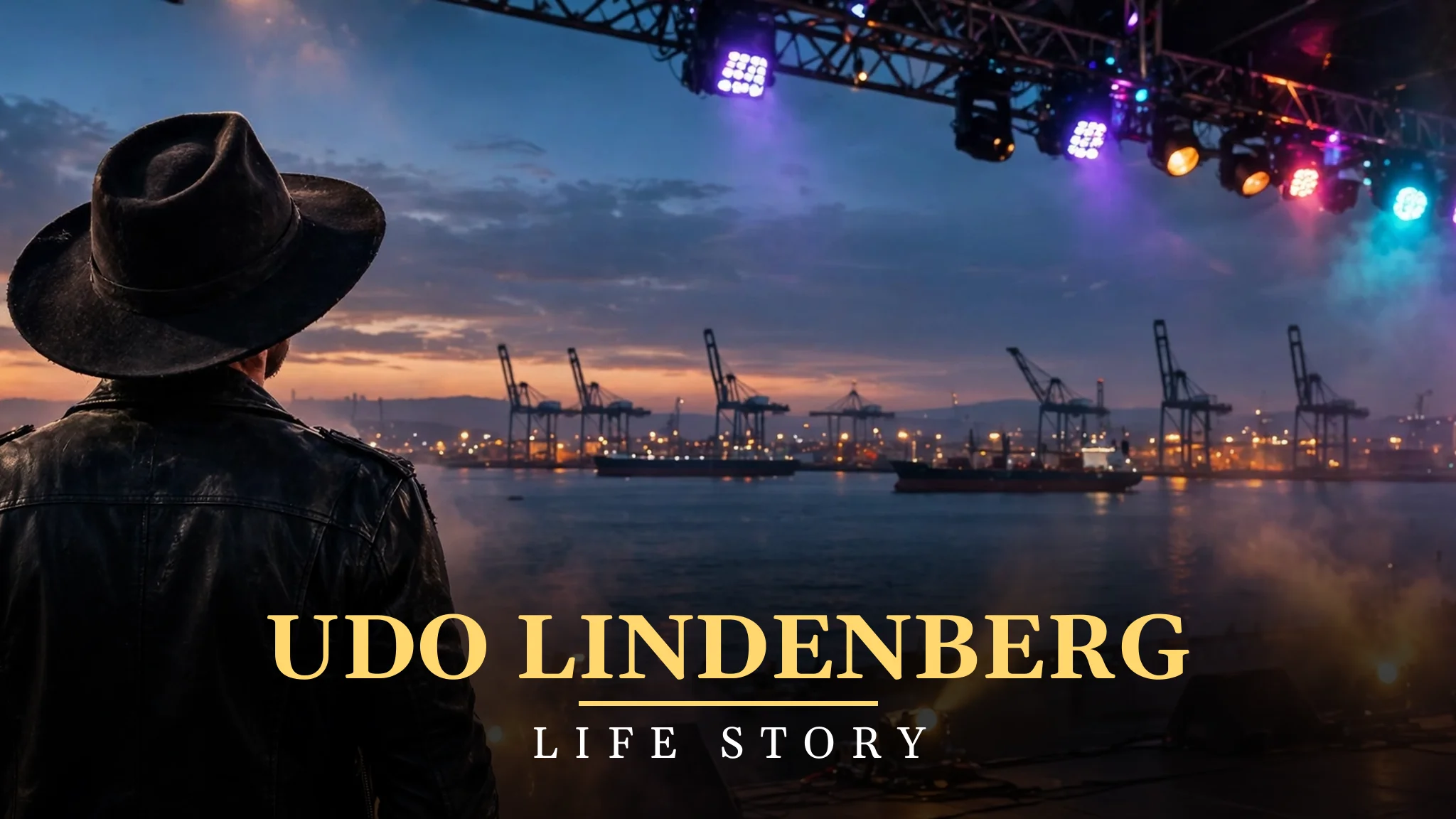
Udo Lindenberg’s music is inseparable from Hamburg, the city he loves and the city that made him. He sings about the harbour, about the ships, about the Reeperbahn, about the Alster lake, and about the people who live there. His songs are a love letter to Hamburg, written over fifty years, and they have become part of the city’s identity. When people think of Hamburg, they think of Udo, with his hat and his sunglasses, standing by the water, singing about home. That connection between an artist and a city is rare, and it is beautiful.
Hamburg is a port city, a place where the world arrives by ship, and Udo’s music carries that feeling of openness, of travel, and of freedom. He is a man of the harbour, a man who loves the sea, the ships, and the sailors, and his songs are full of that world. He sings about the Elbe, about the docks, and about the nights in St. Pauli, and his fans in Hamburg feel that he is singing about their home, about their streets, and about their lives. That is why they love him so much. He is not just a singer. He is a Hamburger, and he is proud of it.
He has also become a symbol of the city, with his paintings of Hamburg, his concerts in the city, and his life in the Hotel Atlantic. He is a part of Hamburg’s culture, a living landmark, and a man who has given the city a voice. Tourists come to Hamburg and ask about Udo, fans visit the Hotel Atlantic, and his songs play in bars and clubs across the city. He is a legend who belongs to a place, and that place belongs to him. It is a fair trade, and it is a beautiful one.
His love for Hamburg also shows in his generosity. He supports local musicians, he helps young artists in the city, and he uses his fame to promote Hamburg’s culture. He is not a star who forgot his home. He is a star who celebrates it, every day, in every song, and in every painting. That loyalty to home is a lesson for any artist. Your home is not a limitation. It is a source of inspiration, and Udo Lindenberg proves it with every song he sings about Hamburg.
My Take:
When I think about Udo Lindenberg, the first thing I feel is a smile. He is a man who wears a hat, dark sunglasses, and a leather jacket, and who looks like he has just stepped out of a film. He is cool, he is funny, and he is completely himself. He has never tried to be anyone else, and he has never changed his style to please the music business. That is a rare and admirable thing. In a world where stars change their image every year, Udo has stayed Udo for fifty years, and that consistency is a form of courage.
I admire his voice, because it is a voice that is rough, warm, and full of life. When he sings, you can hear Hamburg in his voice, the harbour, the streets, and the people. He sings in German, with a feeling that is hard to describe, and his songs are about real life, about love, about the city, and about freedom. His voice is not a perfect voice, but it is a true voice, and that is why people love it. He sounds like a man who has lived, who has loved, and who has seen the world, and that experience comes through in every song.
What moves me most is the story of Sonderzug nach Pankow, and the way a funny song became a political statement. He sang about taking a train to East Berlin, and he did it with humour, but the song was also serious. It was about a divided country, about people who wanted to be together, and about the power of music to cross a wall. The East German government did not let him perform, but the song was heard, and it became a symbol of hope. That is the power of music, to say what politics cannot say, and to bring people together when politicians keep them apart. Udo understood that, and he used his music wisely.
I also think about his decision to sing rock in German, when everyone else was singing in English. That was a bold choice, because many people thought German was not a language for rock music. Udo proved them wrong. He showed that German could be cool, funny, poetic, and powerful, and he opened the door for other German rock singers. He did not copy American or British music. He made German music, about German life, and he made it great. That is a lesson for any artist. Your own language, your own city, and your own life are enough, if you use them honestly.
There is something sad in his story, too, and it is the years he spent living a wild life. He drank, he partied, and he lived hard, as many rock stars do, and it took a toll on his health. He has spoken about it honestly, and he has changed his life, stopping drinking and taking better care of himself. I respect him for that change, because it is not easy to change a life you have lived for decades. He did it, and he found a new energy, and his later career, with MTV Unplugged and Ich mach mein Ding, was one of his best periods. That shows that it is never too late to change, and that a new chapter can be even better than the old one.
I respect the way he lives in the Hotel Atlantic, and the way he paints. It is a unique life, and it is completely his own. He does not live in a big house in the suburbs. He lives in a hotel, he paints every day, and he works from his suite. That is a life that suits an artist, a life of freedom, of creativity, and of not being tied down. It is a reminder that there is no one right way to live. You can live in a hotel, you can paint, you can sing, and you can be happy, if that is the life you choose. Udo chose his life, and he lives it fully.
When I think about his painting, I think about the many talents a person can have. He is not just a singer. He is a drummer, a songwriter, and a painter, and he is good at all of them. His paintings are colourful, bold, and full of life, just like his music. He is an artist in every sense of the word, and he expresses himself in many ways. That is inspiring, because it shows that you do not have to do one thing. You can do many things, and you can do them well, if you work hard and if you care.
I also think about his work with young musicians, and about the way he helps the next generation. He knows the music business, he knows the pressures, and he shares his experience with young artists in Hamburg. He is a legend who gives back, and that is a generous thing to do. He is not a star who is afraid of competition. He is a star who wants to help others succeed. That is a sign of confidence, and it is a sign of kindness. He has been through the highs and the lows, and he wants to help others avoid the lows.
For a young reader, I think the lesson of Udo Lindenberg’s life is to do your own thing, to be yourself, and to never let anyone change you. His song Ich mach mein Ding says it all. He does his own thing, he lives his own life, and he sings his own songs. He did not follow fashion, he did not copy others, and he did not sell out. He stayed true to himself for fifty years, and that is why he is a legend. If you want to be remembered, be yourself, work hard, and do not let the world change you. That is a powerful lesson, and Udo Lindenberg is proof that it works.
In the end, I think Udo Lindenberg teaches us that cool is not about clothes or sunglasses. Cool is about being yourself, about not caring what others think, and about living your life with honesty and with joy. He is cool because he is free, because he sings what he wants, because he paints what he wants, and because he lives where he wants. He is a free spirit, and his music is the sound of freedom. I admire him for that, and I think Germany is lucky to have a rock star who is as free and as honest as he is.
One more thought stays with me. When I hear Ich mach mein Ding, I feel the power of a simple message: do your own thing. It is a message that everyone needs to hear, especially young people who are under pressure to be like everyone else. Udo is saying, be yourself, do what you love, and do not let anyone stop you. That is a message of freedom, and it is a message that has guided his whole life. I hope young people listen to it, and I hope they find the courage to do their own thing, just like Udo did.
I also keep thinking about Hamburg, and about the way Udo sings about his city. He loves Hamburg, the harbour, the streets, and the people, and his songs are a love letter to the city. That is a beautiful thing, to love your home so much that you sing about it for fifty years. It reminds me that home matters, that a city can be a part of who you are, and that singing about your home is a way of saying thank you. Udo has said thank you to Hamburg many times, in many songs, and Hamburg has said thank you back, by loving him.
Finally, I think about what his story means for German unity. He sang about a divided Germany, he dreamed of performing in the East, and when the Wall fell, his dream came true. His music was part of the story of division, and it was part of the story of unity. That is a powerful thing, to have your songs woven into the history of your country. Udo Lindenberg is not just a singer. He is a part of German history, and his songs will be remembered as long as Germany remembers the Wall, the division, and the joy of coming together again.
I also think about Hamburg, and about the way he sings about his city. He loves the harbour, the ships, and the people, and his songs are a love letter to Hamburg. That is a beautiful thing, to love your home so much that you sing about it for fifty years. It reminds me that home matters, that a city can be a part of who you are, and that singing about home is a way of saying thank you. Udo has said thank you to Hamburg many times, and Hamburg has said thank you back, with love.
Another thing I admire is his drumming, and the way it shaped his music. He started as a drummer, and he understands rhythm, timing, and the heartbeat of a song. That understanding makes his music feel alive, with a pulse that you can feel in your body. He is not just a singer. He is a musician who understands music from the inside, from the drums up, and that knowledge makes his songs stronger. I respect that, and I think it is one of the reasons his music has lasted so long.
I think about his paintings, and about the many talents a person can have. He is a singer, a drummer, a songwriter, and a painter, and he is good at all of them. His paintings are colourful, bold, and full of life, just like his music. He is an artist in every sense of the word, and he expresses himself in many ways. That is inspiring, because it shows that you do not have to do one thing. You can do many things, and you can do them well, if you work hard and if you care.
There is also a lesson in his story about changing your life. He lived hard, he drank, and he partied, and then he changed, he stopped drinking, and he found a new energy. That change was not easy, but it was worth it, and his later career was one of his best periods. It shows that it is never too late to change, and that a new chapter can be even better than the old one. I hope people who are struggling remember that, and find the courage to change, just as Udo did.
I also respect his generosity to young musicians in Hamburg. He knows the music business, he knows the pressures, and he shares his experience with the next generation. That is a generous thing to do, and it shows that he cares about the future of German music, not just about his own career. He is a legend who gives back, and that is a beautiful thing. The young artists he helps will remember his kindness, and they will carry it with them.
Finally, I think about what his story means for freedom. He sang about a divided Germany, he dreamed of performing in the East, and when the Wall fell, his dream came true. His music was part of the story of division and unity, and his songs will be remembered as long as Germany remembers that history. He is not just a singer. He is a part of German history, and his legacy is secure. I admire him for that, and I think Germany is lucky to have a rock star who is as free and as honest as Udo Lindenberg.
I also think about the way he has stayed true to Hamburg, singing about the harbour, the ships, and the people for fifty years. That loyalty to home is rare, and it is beautiful. He did not leave Hamburg for London or New York. He stayed, he lived in a hotel on the Alster, and he made Hamburg his world. That is a reminder that home is not a limitation. It is a source of inspiration, and Udo Lindenberg proves it with every song he sings about his city.
In the end, I believe Udo Lindenberg will be remembered as Germany’s coolest rock star, a man in a hat and sunglasses who sang in German, painted colourful pictures, and lived life on his own terms. He did his own thing for fifty years, and he never let anyone change him. That is a legacy of freedom, and it is one that will inspire anyone who wants to be themselves, no matter what the world says.
Frequently Asked Questions
Why is Udo Lindenberg famous for his hat and sunglasses?
The wide-brimmed hat, dark sunglasses, and leather jacket became his trademark look in the 1970s. He has worn them for fifty years, and they are now a symbol of German rock, instantly recognisable to fans across the country.
What is Sonderzug nach Pankow about?
Sonderzug nach Pankow, released in 1983, is a playful song about taking a special train to East Berlin to perform there, when Germany was still divided. The East German government did not allow the concert, but the song became a hit and a symbol of the wish for unity.
Where does Udo Lindenberg live?
He has lived for decades in a suite at the Hotel Atlantic in Hamburg, on the Alster lake. The hotel is his home, his studio, and his office, where he paints, writes, and receives guests.
How did Udo Lindenberg make a comeback in his sixties?
His MTV Unplugged album in 2011, recorded with acoustic instruments, went to number one in Germany and won awards. It showed a warm and intimate side of his music and brought him a new generation of fans.
What does Ich mach mein Ding mean?
Ich mach mein Ding means I Do My Thing, and the song from 2008 is about being yourself and living life on your own terms. It became an anthem for Udo, describing his whole career of never following fashion or letting others change him.
Was Udo Lindenberg a drummer before he was a singer?
Yes, he started as a drummer in Hamburg in the 1960s, playing in bands and working as a session musician. He later began to sing and write his own German-language rock songs, forming the Panikorchester as his backing band.


