Vanessa Paradis: The Life Story Behind France's Pop Star
In this post
- Saint-Maur-des-Fossés and a Family of Artists
- Joe le taxi and Fame at Fourteen
- Serge Gainsbourg, Lenny Kravitz and the Albums
- Noce blanche and the César Award
- La fille sur le pont and the Films of the 1990s
- Café de Flore, Chanel and the Muse
- Johnny Depp, Family Life and the Paris Years
- Divinidylle, Love Songs and the Later Albums
- The Singer, the Actress and the French Icon
- Paradis on Stage and the Live Voice
- My Take:
Vanessa Paradis was born on 22 December 1972 in Saint-Maur-des-Fossés, a suburb to the south-east of Paris, and she was famous before she was old enough to drive. At fourteen, she released Joe le taxi, a song about a taxi driver in Paris, and it became a number one hit in France and a hit across Europe, making her one of the youngest pop stars the country had ever produced. The song’s success was so sudden and so large that it could easily have swallowed her whole, and for many child stars it would have. Paradis did something different. She survived the fame, she grew up in public, and she built a career that has lasted for nearly forty years, as a singer, as an actress, as a model for Chanel, and as a figure who is, for many French people, simply part of the landscape of their lives.
Her career is unusual because it contains several careers at once. As a singer, she has released albums with Serge Gainsbourg, with Lenny Kravitz, and with Benjamin Biolay, moving from teenage pop to mature, sophisticated French song. As an actress, she won a César for her first major film role, Noce blanche, in 1989, and she has worked with directors including Patrice Leconte and Jean-Marc Vallée. As a model, she has been the face of Chanel since 1991, one of the longest associations between a fashion house and a single muse. And as a public figure, she was for fourteen years the partner of Johnny Depp, with whom she had two children, Lily-Rose and Jack. This is the story of a girl who became famous at fourteen and who, against all the odds, became an adult artist on her own terms.
Saint-Maur-des-Fossés and a Family of Artists
Saint-Maur-des-Fossés is a quiet, leafy suburb on the Marne river, a place where Parisian families have lived for generations, and it was an ordinary setting for an extraordinary childhood. Paradis’s parents, André and Corinne, were both interior designers, and the house she grew up in was full of art, music and conversation. Her uncle, Didier Pain, was an actor, and the family had connections to the world of performance that made the idea of a career on stage seem less distant than it would have seemed to most children. She was a lively, confident child, and she began performing early, appearing on television as a young girl and showing a natural ease in front of a camera that casting directors and record producers both noticed.
The family’s artistic background mattered because it gave Paradis a sense of what a creative life actually involves. She did not grow up thinking that fame was a fairy tale. She grew up around people who made things, who worked at their craft, and who understood that talent has to be developed. That grounding helped her later, when the fame of Joe le taxi could have distorted her sense of herself. She had a family that treated her as a person rather than as a product, and that distinction, though it sounds simple, is what separates the child stars who survive from those who do not. Saint-Maur-des-Fossés also gave her a base to return to, a place that was not the music business, and she has kept that connection to ordinary life throughout her career.
Joe le taxi and Fame at Fourteen
Joe le taxi was released in 1987, when Paradis was fourteen years old, and it was written by Franck Langolff, with lyrics by Étienne Roda-Gil. The song is a light, jazzy portrait of a Paris taxi driver who knows the city by night, and it has a melody that is impossible to forget once you have heard it. It spent eleven weeks at number one in France, and it charted across Europe, reaching listeners in Britain, Germany, Spain and beyond. For a fourteen-year-old girl, the scale of the success was overwhelming. She was on television, on the radio, and in the newspapers, and she was being asked to perform a song about a nightlife she was too young to know. The experience was strange, and she has spoken in later years about how odd it felt to be famous for a song that was, in some ways, about an adult world.
The success of Joe le taxi also created a problem that would follow her for years: the public saw her as a teenage pop star, and it was hard for them to see her as anything else. She recorded an album, M and J, in 1988, and a second, Variations sur le même t’aime, in 1990, with songs written by Serge Gainsbourg, but the shadow of the first hit was long. Many singers who have a huge hit at fourteen never escape it, and the music industry is full of teenagers who were famous for a summer and then forgotten. Paradis escaped that fate, but it took time, and it took a series of deliberate choices about the music she made and the people she worked with. Joe le taxi remains her best-known song, and she still performs it, but it is now one song among many in a long career, rather than the whole story.
Serge Gainsbourg, Lenny Kravitz and the Albums
The most important musical relationship of Paradis’s early career was with Serge Gainsbourg, the great French songwriter who wrote the songs for her second album, Variations sur le même t’aime, released in 1990. Gainsbourg was one of the most important figures in French popular music, and his decision to work with a seventeen-year-old Paradis was a sign of how seriously he took her talent. The album was more sophisticated than her debut, with lyrics that played with language and melodies that owed more to French chanson than to teenage pop. Gainsbourg died in 1991, and the album became, in effect, his last major work, which gives it a special place in French music history. For Paradis, it was a turning point, because it showed the public that she was not only a pop singer. She was an interpreter of serious songs.
Her next album, Vanessa Paradis, released in 1992, was produced by Lenny Kravitz, the American rock star, and it included Be My Baby, a song that became a hit across Europe. The collaboration with Kravitz was unexpected, because he was a rock musician and she was a French pop singer, but it worked, and the album showed a new side of her voice: warmer, more soulful, and more confident. Later albums continued that pattern of working with interesting collaborators. Bliss, released in 2000, was a mature, reflective record. Divinidylle, released in 2007, was one of her most successful albums, and it included songs that became staples of French radio. Love Songs, released in 2013 and written with Benjamin Biolay, was a late-career highlight, a collection of elegant, melancholy songs that showed a singer in full command of her art.
Noce blanche and the César Award
Paradis’s acting career began almost as early as her singing career, and her first major film role was in Noce blanche, released in 1989, in which she played Mathilde, a seventeen-year-old schoolgirl who has an affair with her married teacher. The role was controversial, because of the age of the character and the nature of the story, and it required a performance of real maturity from a sixteen-year-old actress. Paradis delivered it, and she won the César Award for Most Promising Actress in 1990, the French equivalent of the Oscars. The award was a statement: she was not only a singer who acted. She was an actress in her own right, and the French film industry took her seriously from that moment on.
The César also changed the way the public saw her. A pop star who wins a major acting award is no longer only a pop star, and Noce blanche gave Paradis a second career that would run alongside the music for decades. She chose her film roles carefully, working with respected directors and avoiding the kind of lightweight comedies that might have paid well but would have damaged her reputation. That care with her choices is one of the defining features of her career, in both music and film. She has never been in a hurry, she has never taken a role simply because it was offered, and she has been willing to wait for the right project. Noce blanche was the proof that the patience would pay off.
La fille sur le pont and the Films of the 1990s
After Noce blanche, Paradis built a film career that was deliberately varied, taking roles in comedies, dramas and romances, and working with directors who were known for their visual style. One of her best-known films is La fille sur le pont, released in 1999 and directed by Patrice Leconte, in which she played Adèle, a young woman who is saved from suicide by a knife thrower, played by Daniel Auteuil, and who becomes his assistant in a travelling circus act. The film is shot in black and white, it is romantic and melancholy, and Paradis’s performance is light, funny and sad by turns. It remains one of her most loved films, and it showed that she could carry a film as a leading actress, not only as a singer who acted.
The 1990s also saw her in films such as Élisa in 1995 and Un amour de sorcière in 1997, and she continued to work steadily through the decade, balancing film with music and with her growing public profile. She was not a prolific actress, and she never tried to be. She took one film at a time, and she chose roles that interested her, rather than roles that would keep her in the headlines. That approach meant that her filmography is smaller than that of many actresses of her generation, but it also means that it contains very few weak films. Each one was chosen, and each one added something to her reputation. La fille sur le pont is the best example of that approach, and it is the film that most French viewers would name first if asked about her acting.
Café de Flore, Chanel and the Muse
In 2011, Paradis gave one of her best film performances in Café de Flore, directed by the Canadian Jean-Marc Vallée, in which she played Jacqueline, a single mother in 1960s Paris raising a son with Down syndrome. The role required a performance of great emotional range, and Paradis delivered it, earning a Genie Award nomination in Canada and some of the best reviews of her career. The film was a reminder that, more than twenty years after Noce blanche, she was still growing as an actress, and that her best work might still be ahead of her. She also appeared in Un monstre à Paris in 2011, voicing the character Lucille in the animated musical, and in Yoga Hosers in 2016, directed by Kevin Smith, a small, playful role that showed her sense of humour.
Alongside the films, Paradis has had one of the longest relationships in fashion history. She became the face of Chanel in 1991, appearing in advertisements for the Coco perfume, and she has remained associated with the house ever since, appearing in campaigns for handbags, lipstick and perfume over more than three decades. The association began when she was eighteen, and it has lasted because she embodies something that Chanel values: a mixture of French elegance and a rebellious, slightly boyish charm. She is not a conventional model, and that is the point. Chanel chose her because she looked like herself, not like a fashion plate, and the partnership has become one of the defining features of her public image. For many people outside France, the Chanel advertisements are how they first saw her, and the image of the young woman in the black bottle campaign has become part of fashion history.
Johnny Depp, Family Life and the Paris Years
Paradis’s personal life became a subject of worldwide attention when she began a relationship with the American actor Johnny Depp in 1998. The couple met in Paris, they lived together in France, and they had two children: Lily-Rose, born in 1999, and Jack, born in 2002. For fourteen years, they were one of the most famous couples in the world, and yet they lived a life that was, by Hollywood standards, remarkably private. They raised their children in France, away from the Los Angeles spotlight, and they rarely appeared together in public. Paradis has always been protective of her family, and she has spoken about the importance of giving her children a normal childhood, even when their father was one of the most famous actors on earth.
The relationship ended in 2012, and the separation was handled with a discretion that is rare in celebrity life. Neither Paradis nor Depp spoke publicly about the reasons, and both asked for privacy for their children. Paradis later married the French writer and director Samuel Benchetrit in 2018, in a small ceremony in Saint-Simeon, and she has continued to live in France, working steadily in music and film. Her daughter Lily-Rose has since become an actress and model in her own right, and Paradis has spoken about her pride in her children’s choices. The family story is an important part of her life, but it is not the whole story, and she has always insisted that her work, not her relationships, is what defines her.
Divinidylle, Love Songs and the Later Albums
The second half of Paradis’s singing career is, in many ways, more interesting than the first, because it shows an artist who has found her own voice. Divinidylle, released in 2007, was a commercial and critical success, and it included songs such as Divine Idylle and Dès que j’te vois, which became staples of French radio. The album was warm, melodic and confident, and it showed a singer who was comfortable with her own style, no longer trying to prove herself to anyone. She toured the album extensively, and the live shows were praised for their intimacy and their musical quality, with Paradis performing with a band that gave the songs room to breathe.
Love Songs, released in 2013 and written with Benjamin Biolay, was an even more mature record, a collection of songs about love in all its forms, from joy to heartbreak, performed with a restraint and an elegance that only comes with experience. The album was nominated for awards, and it was praised by critics as one of the best French albums of the year. It also showed that Paradis, at forty, was making the best music of her career, which is a rare achievement for a singer who became famous at fourteen. Most pop stars peak early and fade. Paradis peaked late, and she is still making music that matters, which is the best answer to anyone who thought Joe le taxi would be the whole story.
The Singer, the Actress and the French Icon
Vanessa Paradis’s place in French culture is hard to overstate. She is one of the few artists who is known to every generation in France, from the teenagers who heard Joe le taxi in 1987 to the young listeners who discovered Love Songs in 2013. She is a singer, an actress and a fashion icon, and she has succeeded in all three fields without ever seeming to chase success. Her career is a model of patience, of careful choices, and of the belief that an artist can grow up in public without losing herself. She has never had a scandal, she has never had a public breakdown, and she has never stopped working, and that steadiness is, in itself, an achievement.
Her legacy is also a reminder that French popular music has its own tradition, distinct from the English-language pop that dominates the world. Paradis sings in French, she works with French songwriters, and her albums are part of the chanson tradition that runs from Édith Piaf through Serge Gainsbourg to the present day. She has carried that tradition into the twenty-first century, and she has done so without compromising it for an international audience. That is a brave choice, and it is why she is respected in France in a way that few pop stars are. She is not a global superstar in the English-speaking sense. She is something rarer: a national treasure, and a living one, still making music, still acting, and still, after nearly forty years, surprising people.
Paradis on Stage and the Live Voice
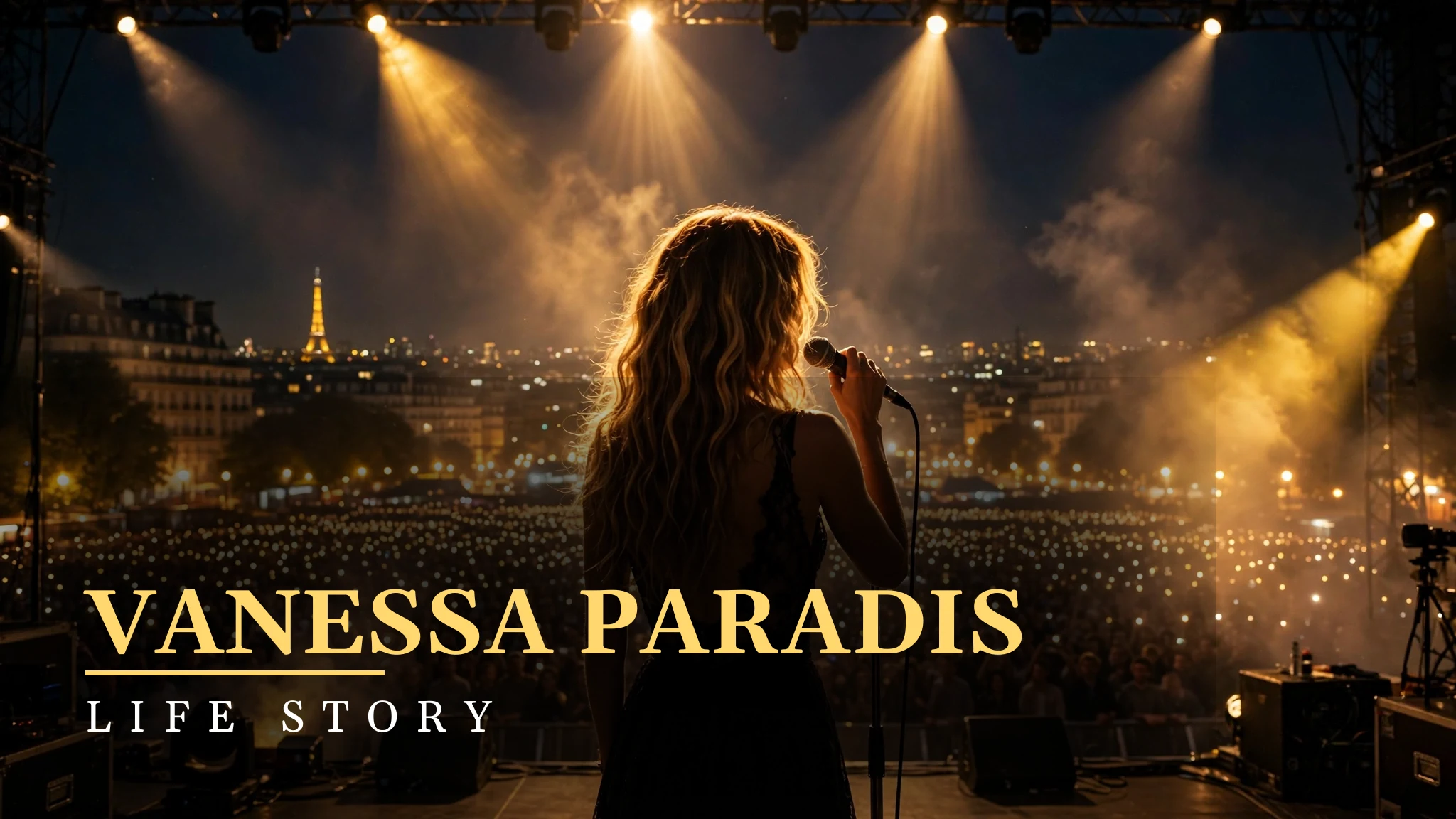
Paradis has always been a compelling live performer, and her concerts are an important part of her reputation in France. On stage she is relaxed, funny and warm, talking to the audience between songs and letting the band stretch out, and the shows have a intimacy that is rare for a singer of her fame. She has toured her albums extensively, including the Divinidylle tour in 2007 and 2008, which was recorded and released as a live album, and her concerts are known for their musical quality, with skilled musicians and arrangements that give the songs space. A live Paradis show is not a spectacle. It is a singer and a band, playing songs that the audience knows by heart, and the simplicity is the point.
The live voice is also where her growth as a singer is most audible. On record, her voice is light and precise. On stage, it is warmer and more expressive, with a freedom that comes from years of performing. She sings the old songs, including Joe le taxi, without irony, and she sings the new songs with the confidence of someone who knows they are good. The audience responds to that confidence, and the concerts have become gatherings of fans who have followed her for decades, from the teenagers of 1987 to the adults of today. That continuity, of a singer and an audience growing up together over decades, is one of the loveliest things about her career, and it is why her live shows are treasured across France.
She has also appeared in advertising and in fashion photography throughout her career, and those images, from the early Chanel campaigns to the recent ones, form a visual record of a woman growing up in public with unusual grace. The photographs show a teenager, a young mother, and a mature artist, and they tell the same story as the music: a life lived in the open, without apology.
My Take:
When I think about Vanessa Paradis, the first thing that strikes me is how unlikely her survival is. A fourteen-year-old girl has a number one hit, becomes famous across Europe, and is then expected to grow up in public without losing her mind or her talent. Most do not. Paradis did, and the reason is worth understanding. She had a family that treated her as a person, she had a sense of what she wanted, and she was willing to wait. She did not chase every offer. She did not try to stay famous at any cost. She made records when she had something to say, she took film roles when they interested her, and she lived her life in France, away from the worst of the celebrity machine. That patience is the foundation of the whole career, and it is why she is still working at fifty while so many of her contemporaries have disappeared.
Joe le taxi is the song that most people know, and it deserves to be known, but it is worth listening to it again as an adult, because it is a better song than its reputation suggests. The melody is light and jazzy, the lyrics are witty, and Paradis’s voice, even at fourteen, has a clarity and a charm that is hard to fake. It is a song about Paris at night, about a taxi driver who knows the city’s secrets, and it captures something real about the city. It is also a song that could have trapped her, because it is so associated with youth that it is hard to imagine the singer growing up. She did grow up, and the fact that she still performs the song, without embarrassment and without irony, says something good about her. She is not ashamed of the song that made her. She owns it, and that ownership is a form of confidence.
The Gainsbourg album, Variations sur le même t’aime, is the record I would point to if someone asked me when Paradis became a serious artist. Gainsbourg was not a man who worked with just anyone, and his decision to write for a seventeen-year-old was a sign that he heard something in her voice that others had missed. The songs are more sophisticated than anything she had recorded before, with wordplay, irony and a melancholy that suits her voice perfectly. It is also, sadly, Gainsbourg’s last major work, because he died in 1991, and that gives the album a poignancy that it would not otherwise have. Listening to it now, you can hear a great songwriter handing his craft to a young singer, and you can hear the young singer rising to the occasion. It is a beautiful record, and it deserves to be better known outside France.
Her acting is the part of the career that English-speaking audiences most often miss, and that is a shame, because it is genuinely good. Noce blanche won her a César, and La fille sur le pont is a lovely film, romantic and sad in the way that French cinema does best. Café de Flore, from 2011, is the performance I would recommend to anyone who doubts her as an actress, because it asks her to play a mother in the 1960s raising a son with Down syndrome, and she does it with a rawness and a tenderness that is completely convincing. She does not act like a singer who is trying to act. She acts like an actress, and the distinction matters. Her film career is smaller than her music career, but it is full of good choices, and it is the reason she is respected in France as a complete artist rather than only as a pop star.
The Chanel association is interesting for a different reason, because it shows how Paradis’s image has worked over three decades. She became the face of Coco perfume in 1991, when she was eighteen, and she has remained associated with Chanel ever since, which is an extraordinary run in fashion. The reason it has lasted is that she embodies something that Chanel values: a French elegance that is also a little rebellious, a little boyish, and a little bit rock and roll. She does not look like a conventional model, and that is why the partnership works. Chanel did not choose a mannequin. It chose a person, and the person has stayed interesting for thirty years. That is a rare achievement in fashion, and it is a sign of how carefully Paradis has managed her public image.
Her relationship with Johnny Depp is the part of her life that the tabloid press has always been most interested in, and it is the part that she has always been least willing to discuss. That refusal is, I think, admirable. She and Depp were together for fourteen years, they had two children, and they lived in France, away from Hollywood, and when the relationship ended, they did so quietly. She has never given an interview about the breakup, and she has never used it to promote her work. That discretion is unusual, and it is a sign of a person who values her private life more than publicity. It is also a sign of a mother who wanted to protect her children, and that instinct is worth respecting. The family story is part of her life, but it is not her work, and she has always kept the two separate.
Divinidylle and Love Songs are the albums I return to most, because they show a singer at the height of her powers. Divinidylle, from 2007, is warm and melodic, and it contains some of her best-loved songs. Love Songs, from 2013, is more reflective, a collection of songs about love that is elegant and melancholy and beautifully sung. Together, they prove that Paradis’s best work came in her thirties and forties, not in her teens, which is the opposite of the usual pop story. Most singers who become famous at fourteen are finished by thirty. Paradis was just getting started, and that is because she treated singing as a craft to be developed rather than as a gift to be spent. The later albums are the reward for that patience, and they are the reason her career is worth taking seriously as a whole.
There is also something to say about her voice, because it is a distinctive instrument. It is light, clear, and slightly husky, with a French accent that gives even a simple melody a particular colour. She does not have a big, powerful voice, and she does not try to pretend that she does. She sings quietly, precisely, and with feeling, and that restraint is what makes her performances so effective. A loud voice can fill a room. A quiet voice can make a room listen, and Paradis’s voice does that. It is a voice that suits the chanson tradition, in which the words matter as much as the melody, and in which a singer is an interpreter rather than a show-off. That tradition is the heart of French popular music, and Paradis is one of its best living representatives.
Her place in French culture is the final thing worth noting, because it is hard to explain to someone who does not live in France. She is not a global superstar in the English-speaking sense, and she has never tried to be. She is a French artist, singing in French, working in French cinema, and living in France, and she is loved in France in a way that is hard to describe. She is part of the furniture of French life, a person whose songs and films are woven into the memories of several generations. That kind of fame is deeper than the fame of a global pop star, because it is rooted in a place and a language, and it does not depend on the charts. It depends on belonging, and Paradis belongs to France in a way that few artists do.
For a new listener, I would suggest a simple path. Start with Joe le taxi, because it is the essential song, then listen to Be My Baby, then move to Divinidylle and Love Songs, and then watch La fille sur le pont and Café de Flore. That order takes you from the teenage pop star to the mature singer and actress, and it shows the arc of a career that has lasted for nearly forty years. If you only have time for one song, make it Divine Idylle, because it is the sound of Paradis at her best, confident, melodic and entirely herself. If you only have time for one film, make it La fille sur le pont, because it is romantic, beautiful and funny, and it shows what she can do as an actress.
One more thought: Paradis’s career is a useful answer to anyone who thinks that fame at a young age is always a disaster. It can be, and often is, but it does not have to be, if the artist has a family that protects her, a sense of what she wants, and the patience to wait for the right work. Paradis had all three, and the result is a career that is still going strong at fifty. She is a reminder that growing up in public is hard, but it is not impossible, and that the artists who survive it are often the ones who were never in a hurry. She was never in a hurry, and she is still here, making music and making films, and that is an achievement worth celebrating.
Finally, I would say this: Vanessa Paradis matters not only for what she has made but for what she represents. She represents a French tradition of popular music that is elegant, literate and melodic, and she has carried that tradition into the twenty-first century without compromising it. She represents the possibility of a long, varied career in an industry that usually rewards only the young and the loud. And she represents the idea that an artist can be famous and private at the same time, that she can live her life on her own terms, and that she can let the work speak for itself. That is a rare combination, and it is why, after nearly forty years, she is still one of the most admired artists in France.
There is a last detail that stays with me, which is the way she has handled the attention that comes with being the mother of Lily-Rose Depp. She has spoken about her daughter’s career with pride, but she has never tried to manage it or to use it, and she has let Lily-Rose make her own choices. That restraint is a sign of a good parent, and it is also a sign of an artist who understands that the next generation has to find its own way. Paradis found her own way at fourteen, and she has kept finding it ever since. Her daughter is now finding hers, and the fact that Paradis is content to watch, rather than to direct, says everything about the kind of person she is.
Her touring history also deserves a mention, because it shows a singer who has always been willing to do the work. The Divinidylle tour took her across France and beyond, and the live album that followed captured a performer at ease with her audience. Touring is hard, unglamorous work, and it is the part of a singer’s life that the public sees least. Paradis has done it steadily for decades, and the fact that her concerts are still praised for their warmth and quality is a sign of a professional who takes the job seriously. A singer who only makes records is half a singer. Paradis is the whole thing, on record and on stage.
One last thing: Paradis has never tried to be anyone other than herself, and in an industry that rewards reinvention, that steadiness is itself a kind of bravery. She sings in French, she lives in France, and she makes exactly the work she wants to make. The world can come to her, or not, and either way she will still be singing. That is the sound of an artist who is free.
Frequently Asked Questions
When was Vanessa Paradis born?
Vanessa Paradis was born on 22 December 1972 in Saint-Maur-des-Fossés, a suburb south-east of Paris, France.
How old was Vanessa Paradis when Joe le taxi came out?
She was fourteen years old. Joe le taxi was released in 1987 and spent eleven weeks at number one in France.
Did Vanessa Paradis win a César Award?
Yes. She won the César Award for Most Promising Actress in 1990 for her role as Mathilde in Noce blanche, released in 1989.
Who wrote songs for Vanessa Paradis?
Serge Gainsbourg wrote the songs for her 1990 album Variations sur le même t’aime. Lenny Kravitz produced her 1992 album Vanessa Paradis, and Benjamin Biolay worked with her on Love Songs in 2013.
Was Vanessa Paradis married to Johnny Depp?
No, they were never married. Paradis and Johnny Depp were partners from 1998 to 2012 and had two children, Lily-Rose and Jack. She later married Samuel Benchetrit in 2018.
What is Vanessa Paradis’s connection to Chanel?
Paradis became the face of Chanel in 1991, appearing in advertisements for Coco perfume. She has remained associated with the fashion house for more than three decades.


