Vicente Fernández: The Life Story Behind Mexico's Ranchera King
In this post
Vicente Fernández was the King of Ranchera Music, a title that no one else has ever held, and a title that he earned, not by birth, but by a lifetime of singing, of working, and of loving the music of Mexico. He was a poor boy from a small village in Jalisco who became the most famous ranchera singer in the world, a man whose voice was heard in every home in Mexico, whose songs were sung at every party, and whose name was spoken with love and with respect, from the smallest village to the largest city. He was not just a singer. He was a symbol of Mexico itself.
He was born in Huentitán el Alto, a small village near Guadalajara, and he grew up in poverty, working as a carpenter, as a bricklayer, and as a singer in the streets, before he became famous. He sang in restaurants, in bars, and on the radio, until the world heard him and loved him. His story is the story of a poor boy who became a king, not a king of money, but a king of the people’s hearts, and that is a rarer and more beautiful kind of royalty.
What makes his story worth telling is not only the fame. It is the love, the deep and lasting love that Mexico still feels for him, even after his death in 2021. His songs are still sung, his films are still watched, and his name is still spoken with affection, as if he were still alive. He died at eighty-one, after a long and remarkable life, but he did not fade. He became a legend, and legends do not die. They live in the songs, in the films, and in the hearts of the people who loved them.
A Poor Boy From Huentitán el Alto
Vicente Fernández was born on 17 February 1940 in Huentitán el Alto, a small village in the state of Jalisco, near Guadalajara. Huentitán in those years was a poor place, with dirt roads, with small houses, and with a life shaped by hard work, by the land, and by the music of the region. A boy growing up there learned to be strong, to be practical, and to dream of a bigger world, and Vicente learned those lessons well. He was the son of Ramón Fernández, a rancher, and Paula Gómez, and he grew up in a family that had little money, but a great deal of love and music.
As a boy, he loved to sing. He sang in the streets, in the markets, and at family gatherings, and he sang with a voice that was strong, warm, and full of feeling. He also loved the films of Pedro Infante, the great singer and actor, and he dreamed of becoming like him, a singer who could make people laugh and cry, and who could be loved by a whole country. He practised, he sang, and he looked for chances to show what he could do, even when those chances were small.
He left school early, and he worked at many jobs, as a carpenter, as a bricklayer, as a painter, and as a singer in restaurants and bars, learning the hard way what it meant to be poor in Mexico. He also worked as a cashier, and he sang for tips, for food, and for the joy of it. He was a young man with a dream, a dream of singing, of acting, and of a better life, and he worked hard to make that dream real. He did not have money, he did not have connections, and he did not have a famous name. He had his voice, his guitar, and his determination, and he used them.
The years in Huentitán mattered because they gave him a deep understanding of the poor, of the workers, and of the ordinary people of Mexico. He was one of them, and he never forgot it, even when he became famous and rich. When he later sang El Rey, a song about a man who has nothing but his pride, he was not acting. He was remembering, because he had lived that life, he had worked with his hands, and he had known what it meant to be poor. That is why his songs feel so real, and why the audience loved him so much.
He also learned the value of hard work in those years. A poor boy must be patient, must work hard, and must take pride in his work, even when the work is small. Vicente brought that same patience and pride to his singing, and it served him well. He was not a star who arrived overnight. He was a worker who learned his trade, who practised every day, and who earned his place, one song at a time, one performance at a time, until the whole country knew his name.
Mexico City, Radio, and the Long Road to Fame
Vicente Fernández moved to Mexico City in the 1960s, hoping to find work as a singer, and the move was a brave one. Mexico City was a big, noisy, and competitive place, and a young man from Jalisco had to fight to be heard. Vicente fought, and he was heard, because his voice was too good to ignore. He sang on the radio, in the famous programme Amanecer ranchero, and he began to record songs, and his records started to sell. He sang rancheras, the traditional songs of Mexico, with a voice that was strong, warm, and full of pride, and the audience loved him for it.
He also began to act in films, taking small roles at first, in productions that taught him how a camera worked, how a set worked, and how an actor had to behave to be trusted by a director. He learned quickly, and he showed that he had a natural talent for acting as well as for singing. He played in films such as La ley del monte, El arracadas, and many others, in which he played a charro, a cowboy, a man of the land, and he did it with a natural grace that the audience loved. He was not just a singer who acted. He was a real actor, one who could make the audience laugh and cry.
The years in Mexico City were long and hard ones. He did not become famous overnight. He worked for many years, singing in bars, in restaurants, and on the radio, before he had his first big hit. That long road was a gift, even if it did not feel like one at the time, because it taught him patience, it taught him discipline, and it taught him to love his audience, even when the audience was small. He learned to sing for ten people as if they were ten thousand, and that is a skill that few singers ever learn.
His first big hit came with the song Volver, volver, a song about a man who wants to return to the woman he loves, and the song became a classic, still sung today at every party in Mexico. After that, the hits came one after another, El Rey, Por tu maldito amor, Estos celos, La ley del monte, and many others, each one adding to his fame, and each one showing a different side of his talent. He was becoming the King of Ranchera Music, and he was earning that title, one song at a time.
By the 1970s, he was one of the most famous singers in Mexico, and he was ready for the next chapter of his life, a chapter that would take him to the top of his profession, and that would make him a legend. He had learned the craft, he had earned the trust of his audience, and he had grown from a poor boy from Huentitán into a mature singer with real talent. The road had been long, but it had been worth it, and the best years were still ahead of him.
El Rey, Volver Volver, and the King of Ranchera
The songs that made Vicente Fernández a legend are songs that every Mexican knows by heart. El Rey, released in the 1970s, is a song about a man who has nothing, no money, no throne, no crown, but who is still a king, because he has his pride, his dignity, and his freedom. Vicente sang it with a power that made the audience feel it, and the song became an anthem, sung at parties, in bars, and in homes across Mexico, and around the world. It is a song that speaks to the poor, to the workers, and to anyone who has ever felt that they have nothing, but that they still have themselves.
Volver, volver is another classic, a song about a man who wants to return to the woman he loves, who begs her to take him back, and who sings with a pain that is both personal and universal. Vicente sang it with a warmth and a tenderness that made the audience cry, and the song became one of the most loved in Mexican music. It is still sung today, at weddings, at funerals, and at every gathering where Mexicans come together to sing, and it is a song that will never be forgotten.
Por tu maldito amor, Estos celos, La ley del monte, and many other songs added to his legend, each one a story of love, of loss, of pride, and of the heart. He sang them with mariachi, with a full band, with a voice that filled the room, and the audience sang along, because they knew the words, because they had lived the feelings, and because Vicente sang them as if they were his own. That is the mark of a great singer: he makes a song feel personal, even when it is sung by millions of people.
He also recorded more than eighty albums in his career, a remarkable number, and he sold millions of records, in Mexico, in the United States, and in Latin America. He won Latin Grammy Awards, he was honoured by the Mexican government, and he was loved by audiences who came to his concerts in their thousands, to hear him sing, to sing along, and to celebrate the music of Mexico. He was not just a singer. He was a king, and his kingdom was the hearts of his people.
The ranchera years were the peak of his career, but they were also a long stretch of work, lasting for more than fifty years. He did not have a single hit and then fade. He had hit after hit, album after album, concert after concert, and he kept going, with the same energy, the same voice, and the same love for his audience, until the very end. That is a rare achievement, and it is one that few singers ever reach.
Films, Los Tres Potrillos, and a Life on the Ranch
Vicente Fernández also became a film star, playing the charro, the Mexican cowboy, in more than thirty films, including La ley del monte, El arracadas, and El hijo del pueblo. His films were popular, especially in Mexico and in Latin America, and they showed him as a man of the land, a man who was strong, who was proud, and who loved his country. He played those roles with a natural grace, because he was a man of the land himself, a man from Jalisco, who understood the life he was playing.
He built a ranch, Los Tres Potrillos, near Guadalajara, named after his three sons, Vicente Jr., Gerardo, and Alejandro, and it became his home, his refuge, and his kingdom. The ranch was a place of horses, of mariachi, of family, and of music, and Vicente loved it deeply. He lived there, he worked there, and he welcomed his family and his friends there, and it became a symbol of his success, a poor boy who had built a ranch, a home, and a life, through hard work and through music.
He was married to María del Refugio Abarca, known as Cuquita, for more than fifty years, and their marriage was one of the longest and most loved in Mexican entertainment. They had four children, Vicente Jr., Gerardo, Alejandro, and Alejandra, and they built a family together, a family that became famous in its own right. Alejandro became a singer, following in his father’s footsteps, and the Fernández family became a dynasty, a family of singers, each one different, each one talented, and each one shaped by Vicente’s example.
His personal life was lived largely in the public eye, but he handled it with dignity, speaking when he wanted to speak, and keeping his private life private when he wanted to keep it that way. He was a family man, a man who loved his wife, his children, and his grandchildren, and who worked hard to provide for them, and to give them a good life. That love for family is part of his legend, and it is one of the reasons he is still loved today.
Through all of this, he kept singing, and he kept working, until his final years, when illness forced him to slow down. He did not stop. He kept singing when he could, kept being with his family, and kept sharing his love for music with his fans, with an honesty and a courage that inspired many people. That is a remarkable achievement, and it is one that his fans will never forget.
The Final Concert and a Farewell
In 2016, Vicente Fernández gave his final concert, a farewell performance at the Estadio Azteca in Mexico City, in front of more than eighty thousand people, and watched by millions more on television. It was a night of music, of emotion, and of love, as he sang his greatest songs, one after another, for the last time, and the audience sang along, cried, and cheered. It was a fitting end to a career that had lasted for more than fifty years, a career that had begun in the streets of Huentitán and ended in the largest stadium in Mexico.
After the farewell concert, he retired from the stage, but he did not retire from life. He lived on his ranch, Los Tres Potrillos, with his family, and he was honoured by the Mexican government, by the music industry, and by the public, for his long career. He was no longer performing, but he was still El Rey, and that name still meant something to millions of people. He had become a symbol of Mexican music itself, a man who had lived its history and who had helped to make it.
He faced health problems in his final years, as many older people do, and he was hospitalised in 2021, after a fall at his ranch. His family spoke about his health with care, and his fans followed the news with concern. He faced those problems with the same strength he had always shown, and he kept his dignity, even when he was ill. He was a fighter, and he fought until the end, with the support of his family and the love of his fans.
Vicente Fernández died on 12 December 2021 in Guadalajara, at the age of eighty-one, after a long and remarkable life. His death was mourned across Mexico, and tributes came from singers, actors, and politicians, all of whom had known a different side of the same man. He was remembered as a great singer, as a father, as a husband, and as a king, and his funeral was a moment of national sadness. Mexico had lost its greatest ranchera singer, and the loss was felt by everyone who had ever heard him sing.
His legacy lives on in his songs, in his films, and in his family. El Rey, Volver volver, Por tu maldito amor, and many other songs are still sung, still played, and still loved, and his son Alejandro continues his work, singing ranchera and pop, and honouring his father’s memory. He built a life that will last, and he built it with talent, with work, and with love, and that is a legacy that few singers ever achieve.
A King Who Will Never Be Forgotten
The legacy of Vicente Fernández is the legacy of a king, a man who ruled not with power, but with his voice, with his songs, and with his love for Mexico. He showed the world that a poor boy from a small village could become the most famous singer in his country, through hard work, through talent, and through a deep love for his people. He did not inherit his fame. He earned it, one song at a time, one concert at a time, and he kept it, through good times and hard times, for more than fifty years.
His work also shows the power of ranchera music, the traditional music of Mexico, a music that speaks of love, of loss, of pride, and of the land. Vicente was the greatest singer of that music, and he helped to make it famous around the world. He sang it with a voice that was strong, warm, and full of feeling, and he made the audience feel it, in their hearts, in their homes, and in their lives. That is a remarkable achievement, and it is one that still matters today.
As new generations of Mexican singers come forward, they will look at Vicente Fernández and see a path. They will see that a career can last, that a singer can be loved for more than fifty years, and that music can be a life’s work, not just a job. That is a valuable lesson, and it is one that his life teaches well. He is a reminder that the best singers are not always the youngest or the prettiest. Sometimes, they are the ones who have worked the hardest, who have sung the longest, and who have loved their audience the most.
His song Estos celos also deserves a closer look, because it is a song about jealousy, about a man who is tormented by the thought that the woman he loves might love someone else, and Vicente sang it with a pain that was both personal and universal. The song became a classic, still sung today at parties, in bars, and in homes, and it shows his ability to sing about a difficult emotion, jealousy, with honesty, without making the man seem weak, but making him seem human. That is a great talent, to sing about jealousy, about love, and about pain, and to make the audience feel it, as if it were their own.
My Take:
When I think about Vicente Fernández, I think about a king. Not a king with a crown, but a king with a voice, a man who ruled the hearts of his people through his songs. That is a beautiful kind of royalty, and it is a rare kind. He was not born a king. He was born poor, in a small village, and he became a king, through hard work, through talent, and through a deep love for Mexico. I admire that a great deal, because it shows that a person does not have to be born great to become great. They can become great, through work, through patience, and through love.
I admire his voice, and I mean that in a serious way. His voice was strong, warm, and full of pride, and it made each song feel like an anthem. When he sang El Rey, it did not feel like a performance. It felt like a man telling the truth about himself, a man who has nothing but his pride, and who is proud of that pride. That is a powerful thing, and it is one that few singers can do. He did not just sing the notes. He sang the feeling behind the notes, and that is why his songs have lasted for so many years.
I also admire the way he stayed true to ranchera music, even when pop music became more popular, even when other singers crossed over to new styles. He sang ranchera, he loved ranchera, and he honoured it, for more than fifty years. That loyalty matters, because it shows that a person can love a tradition, can keep it alive, and can make it famous, without abandoning it. He did not follow fashion. He followed his heart, and his heart was ranchera, and that is a beautiful thing.
What I find sad in his story is that he worked so hard for so long, and that he gave so much, and that he died at eighty-one, after a fall, after illness, and after a long life of work. I think about his final years, and about how hard it must have been to stop singing, to leave the stage, and to face illness, after a lifetime of performing. He faced it with strength, and with dignity, and I respect that, but I also feel sad for him, and for his family, who lost a husband, a father, and a grandfather, and for Mexico, which lost its king.
I think about his childhood, growing up poor in Huentitán, working as a carpenter, singing in the streets, and about how that childhood shaped him. He never forgot where he came from, and he never pretended to be something he was not. He was a poor boy who became a king, and he stayed a poor boy at heart, a man who loved ordinary people, who understood them, and who spoke to them in their own language. That is a beautiful way to live, and it is one I admire a great deal. Many stars forget where they came from. Vicente never did.
I also think about his marriage to Cuquita, a marriage that lasted for more than fifty years, and about how rare that is, especially for a famous singer. Fifty years is a long time, in any life, and it is a very long time in the world of entertainment. I do not think their marriage was perfect, because no marriage is perfect, but I do think it was real, and that it lasted because both of them worked at it. They built a family, they raised four children, and they built a ranch, a home, and a life together. That staying matters, and it tells me more about his character than any award ever could.
If I have a criticism, it is not really a criticism of Vicente himself. It is a sadness that the music business sometimes used him too hard, giving him too many concerts, too many albums, and too little rest. He recorded more than eighty albums, and he performed thousands of concerts, and that is an enormous amount of work. I wonder if he was tired, if he needed a break, and if the pressure of being a king wore him down. I do not know, and I do not want to guess. But I do think that a man who works that hard deserves rest, and I wish he had been given more of it.
I think about his final concert, at the Estadio Azteca, in front of eighty thousand people, and about how powerful that must have been. To stand on a stage, to hear thousands of voices singing your songs back to you, is a remarkable experience, and it is one that few singers ever have. Vicente had it, again and again, and he earned it, through hard work, through talent, and through a deep love for his audience. That is a beautiful thing, and it is one I admire. His farewell was not a sad ending. It was a celebration, a night of music, of love, and of gratitude.
The lesson I take from him is about staying true to who you are. He was a ranchera singer, a man from Jalisco, a poor boy who became a king, and he was all of those things at once, without pretending to be something else. He did not become rich and forget the poor. He became famous and stayed close to the people who loved him. That is a lesson for anyone, in any job, in any country: do not forget where you came from, and do not forget the people who helped you get where you are. Vicente never forgot, and that is why he is still loved.
I also think about the audience, the millions of people who listened to him, in Mexico, in the United States, and around the world, and who loved his songs. For them, he was not just a singer. He was a voice that spoke to their hearts, a man who sang about love, about loss, and about pride, in a way that felt personal. That is a special kind of fame, and it is a special kind of trust. I think Vicente understood that trust, and I think he tried to honour it, in every song, in every concert, and in every album, until the very end.
In the end, I see Vicente Fernández as the King of Ranchera Music, a man who lived a long life and who left a long legacy. He was a singer, a father, a husband, and a king, and he was all of those things with a warmth and a generosity that few people ever achieve. I admire him for it, and I feel sad that he is gone, but I am glad that his work is there, in the songs that people still sing, and that new generations will keep discovering him, as El Rey, as the voice of Volver volver, and as the king of Mexico.
I keep returning to the idea of El Rey, the song about a man who has nothing but his pride. That is a story that Mexico loves, because it is a story of dignity, a story that says a poor man can be a king, if he has pride, if he has courage, and if he has himself. Vicente lived that story, and he proved that it was true. I find that hopeful, and I find it beautiful, and I think it is a message that still matters today, when many poor people in Mexico still dream of a better life. Vicente’s life tells them that the dream is possible, and that hard work, talent, and pride can make it real.
There is also something I respect about the way he built his ranch, Los Tres Potrillos, and named it after his three sons. That is a father’s love, made into a place, a home, a kingdom, and it is a beautiful thing. He did not just build a career. He built a family, a home, and a legacy, all at once, and he did it with the same hard work he brought to his singing. That is a complete life, a life that was lived fully, and a life that is worth remembering.
Finally, I think his story teaches me that a short life can be a full life, and that a long life can be a full life too. Vicente lived for eighty-one years, and he lived them fully, with work, with love, with music, and with joy, and he left behind a legacy that has lasted, and that will last for many years to come. That is a remarkable achievement, and it is one that I admire. Vicente Fernández was El Rey, and he will always be El Rey, and I am glad that his story is told, so that new generations can learn from it, and can be inspired by it, as I have been.
I think about the horses, and about the ranch, Los Tres Potrillos, and about how Vicente loved horses, loved the land, and loved the life of a charro, a Mexican cowboy. He was not just a singer who dressed as a charro for the stage. He was a man of the land, a man from Jalisco, who understood horses, who rode them, and who lived among them. That understanding is visible in his films, in his concerts, and in his life, and it is one of the reasons his fans trusted him. He was not pretending. He was himself, a charro, a rancher, and a singer, all at once.
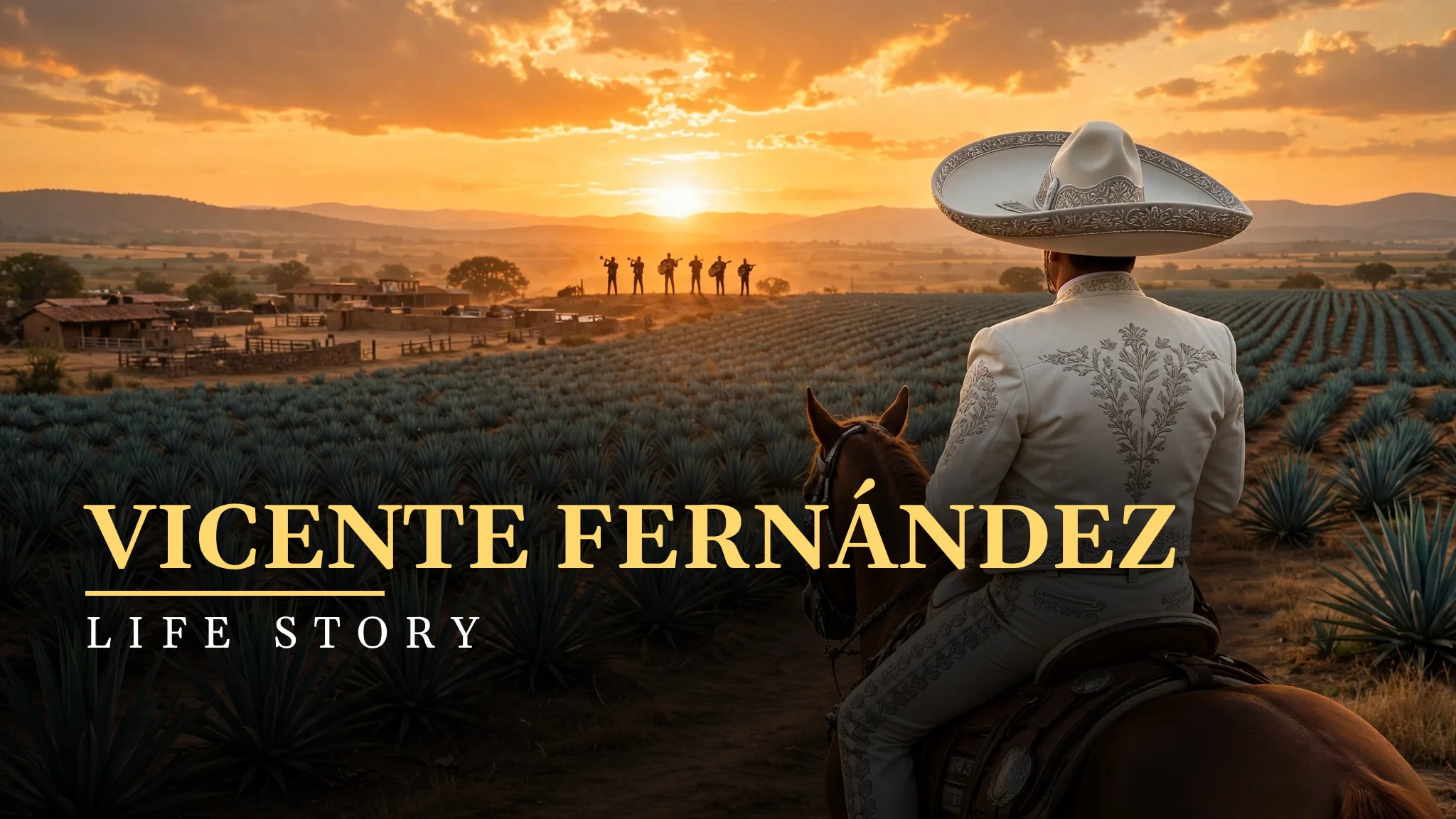
There is something about his charro suit that I keep imagining, a beautiful, embroidered suit, with a sombrero, with boots, and with a pride that is visible in every stitch. He wore it with dignity, not as a costume, but as a uniform, as a sign of who he was, and where he came from. That is a powerful image, and it is one that Mexico still loves, because it represents the best of Mexican culture, the pride, the tradition, and the beauty of the charro. Vicente wore it well, for more than fifty years, and he made it his own.
I also think about the eighty albums, and about how remarkable that number is, eighty albums, in a career of more than fifty years, each one a collection of songs, each one a labour of love, and each one a gift to his audience. Most singers record ten albums, or twenty, and they are proud of it. Vicente recorded eighty, and he sang each one with the same energy, the same voice, and the same love for his audience. That is an enormous amount of work, and it is a sign of a man who loved to sing, who loved his work, and who never grew tired of it.
When I think about his final concert, at the Estadio Azteca, I imagine eighty thousand people, singing along, crying, and cheering, and I think about how powerful that must have been, for Vicente, for his family, and for Mexico. It was not just a concert. It was a farewell, a celebration, and a thank you, from a king to his people, and from his people to their king. That is a beautiful way to end a career, and it is one that few singers ever have. Vicente had it, and he earned it, through more than fifty years of singing, and of loving his audience.
Finally, I want to say that I respect the way he lived his life, from a poor boy in Huentitán to the King of Ranchera Music, without forgetting where he came from, and without forgetting the people who loved him. He built a ranch, he built a family, he built a career, and he built a legacy, all with hard work, with talent, and with love, and that is a complete life, a life that was lived fully, and a life that is worth remembering. He was El Rey, and he will always be El Rey, and I am glad that his story is told, so that new generations can learn from it, and can be inspired by it, as I have been.
Frequently Asked Questions
Who was Vicente Fernández and why is he called El Rey?
Vicente Fernández was a Mexican ranchera singer known as the King of Ranchera Music. He earned the title through more than fifty years of singing, with famous songs such as El Rey, Volver volver, and Por tu maldito amor.
When and where was Vicente Fernández born?
Vicente Fernández was born on 17 February 1940 in Huentitán el Alto, Jalisco, Mexico. He grew up in a poor family, worked as a carpenter and bricklayer, and began singing on the radio before becoming famous.
What is Vicente Fernández’s most famous song?
Vicente Fernández’s most famous song is El Rey, a song about a man who has nothing but his pride. He is also known for Volver volver, Por tu maldito amor, Estos celos, and La ley del monte.
Where was Vicente Fernández’s ranch?
Vicente Fernández built a ranch called Los Tres Potrillos near Guadalajara, Jalisco, named after his three sons. The ranch was his home, and it became a symbol of his success and his family life.
When did Vicente Fernández give his final concert?
Vicente Fernández gave his final concert in 2016 at the Estadio Azteca in Mexico City, in front of more than eighty thousand people. It was a farewell performance after more than fifty years on stage.
When did Vicente Fernández die?
Vicente Fernández died on 12 December 2021 in Guadalajara, at the age of eighty-one. His death was mourned across Mexico, where he is remembered as the greatest ranchera singer in the country’s history.


