Vin Diesel: The Life Story Behind Fast and Furious
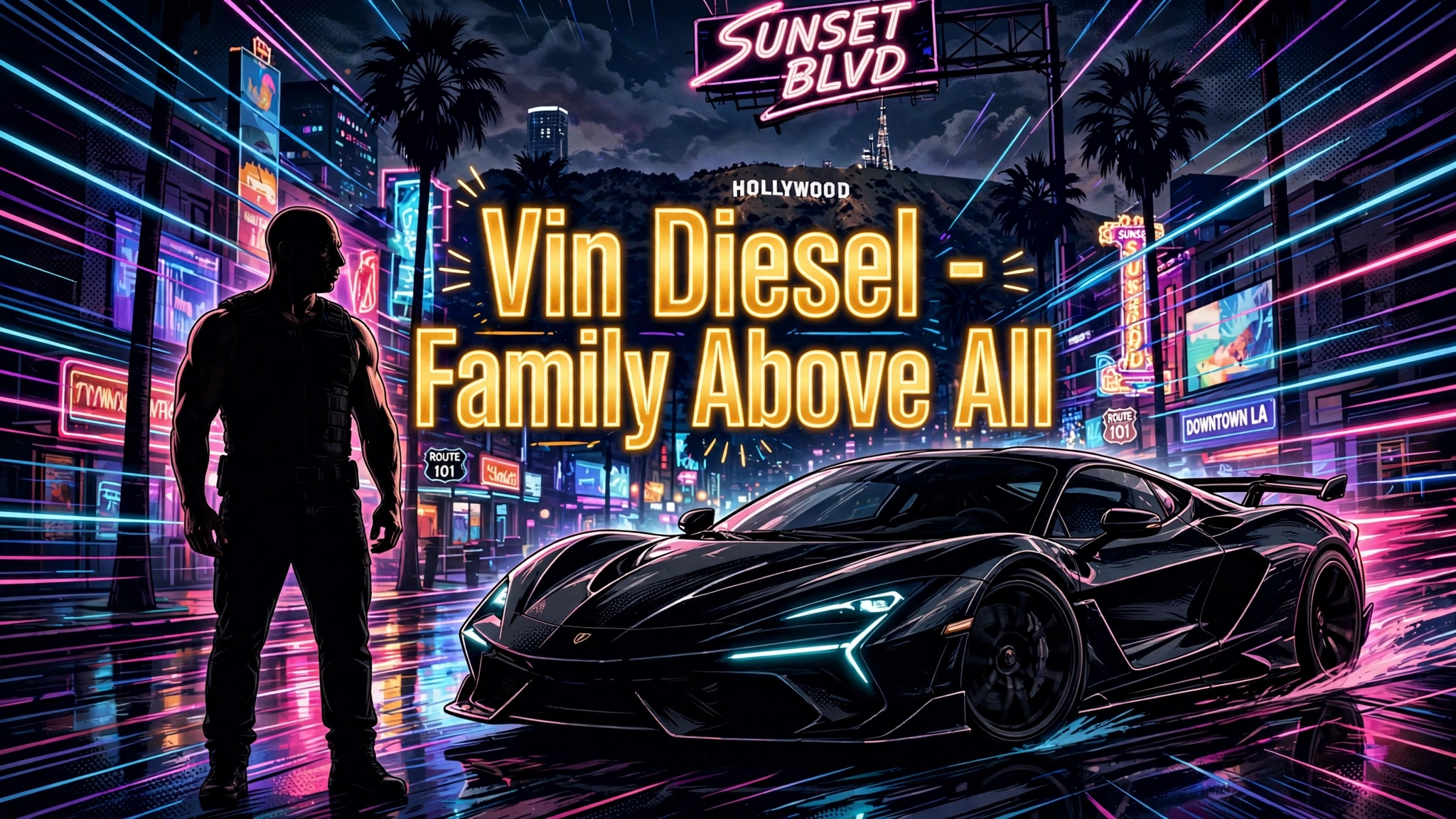
In this post
Mark Sinclair was born on 18 July 1967 in Alameda County, California, and he grew up in New York City, in an apartment in Greenwich Village, with his mother, Delora Sinclair, who worked as an astrologer, and his stepfather, Irving H. Vincent, who managed a theatre. He has a fraternal twin brother, Paul, who works as a film editor, and he has a younger brother and sister from his mother’s side. He never knew his biological father, and he has spoken about that fact openly, not as a wound but as a question that shaped his childhood. He was raised in a theatre, in the most literal sense: his stepfather ran the Theatre for the New City, a well-known off-Broadway theatre in New York, and the young Mark spent his childhood backstage, watching actors rehearse, watching sets being built, and learning that a play was not magic but work.
His first experience of acting came by accident, and it is a story he has told many times. When he was seven years old, he and some friends broke into the Theatre for the New City, intending to vandalise it, and they were caught by the theatre’s artistic director, Crystal Field. Instead of calling the police, Field offered them a deal: if they came back every day after school and helped out at the theatre, she would not press charges, and she would let them appear in a play. Mark took the deal, and he appeared in a children’s play called Dinosaur Door, written by Barbara Garson, and he discovered that he loved being on stage. It was not a conventional start to an acting career, but it was a fitting one for a man who would later build his career on loyalty, on family, and on the idea that a group of people who work together can become a family.
He attended Hunter College in New York, where he studied English, and he worked as a bouncer at nightclubs in New York, including the Tunnel, a famous club in Manhattan, while he tried to become an actor. The bouncer work gave him a physique and a presence, and it also gave him a practical education in how people behave when they are angry, drunk, or frightened, an education that would later show up in his performances. He also began to write, and he wrote a short film called Multi-Facial in 1995, a semi-autobiographical film about a multiracial actor auditioning for roles in New York and being told that he was not black enough, not white enough, not Latino enough for any of them. The film was a personal statement, and it was also a practical one: if the industry would not give him a role that fitted him, he would make one himself.
Multi-Facial, Saving Private Ryan and the First Break
Multi-Facial was selected for the Cannes Film Festival in 1995, and it was noticed by the director Steven Spielberg, who was casting Saving Private Ryan, his film about the D-Day landings in the Second World War. Spielberg had seen Multi-Facial, and he was impressed by the young actor who had written and directed it, and he offered him a role in Saving Private Ryan, playing Private Adrian Caparzo, a soldier who is killed early in the film while trying to save a child. It was a small role, but it was in a film directed by one of the most respected directors in the world, and it gave Diesel his first experience of a major Hollywood production. He has said that Spielberg taught him a great deal during the filming, particularly about how to work with a camera, and about how to trust a director. The film won five Academy Awards, and it made Diesel visible to casting directors in Hollywood for the first time.
After Saving Private Ryan, Diesel took a series of roles that showed his range. In 1999 he voiced the Iron Giant in the animated film The Iron Giant, a film about a boy who befriends a giant robot, and his voice work in the film was praised for its warmth and its sadness. The film was not a commercial success when it was released, but it became a cult favourite, and Diesel’s performance as the Giant, a character who says very little and who learns what it means to be good, became one of the most loved voice performances in animation. In 2000 he played Richard B. Riddick in Pitch Black, a science fiction film about a group of survivors who crash-land on a planet where the sun is about to be eclipsed and the creatures who live in the dark are about to come out. Riddick was a convict, a murderer, a man with eyes that could see in the dark, and Diesel played him with a menace and a humour that made the character the most interesting part of the film. Pitch Black was a modest success, but it established Riddick as a character that audiences wanted to see again, and it gave Diesel a franchise of his own.
The following year, in 2001, he played Dominic Toretto in The Fast and the Furious, a film about street racers in Los Angeles who are also thieves, and the role would change his life. Toretto was a man who lived by a code, who valued family above everything, and who drove a car as if it were an extension of his body, and Diesel played him with a stillness and a gravity that made the character feel like a patriarch rather than a criminal. The film was a commercial success, earning more than two hundred million dollars worldwide, and it launched a franchise that would become one of the most successful in film history. Diesel did not return for the second film, 2 Fast 2 Furious in 2003, because he did not like the script, and he chose instead to make xXx in 2002, playing Xander Cage, an extreme sports athlete recruited by the government to become a spy. xXx was also a commercial success, and it gave Diesel a second franchise, but it was The Fast and the Furious that would define his career.
Family, Fast Cars and the Franchise That Never Stopped
Diesel returned to The Fast and the Furious franchise in 2009, with Fast & Furious, the fourth film in the series, and he has been at the centre of it ever since. The series changed over the years, from a film about street racing in Los Angeles to a global action franchise about a family of thieves, spies and drivers who save the world, and Diesel’s character, Dominic Toretto, changed with it, from a street racer to a father, a husband, and a leader. The films became bigger, more expensive, and more successful, with Furious 7 in 2015 earning more than one and a half billion dollars worldwide, and with the series as a whole earning more than seven billion dollars. The success was not only commercial. The series became a cultural phenomenon, particularly in Latin America, in Asia, and in the Middle East, where the themes of family, loyalty and honour resonated with audiences in a way that many Hollywood films did not.
The franchise was also marked by tragedy. In November 2013, Paul Walker, who played Brian O’Conner, Toretto’s best friend and brother-in-law, was killed in a car crash in California, at the age of forty. Walker had been a central part of the series since the first film, and his death shocked the cast, the crew, and the audience. Diesel was deeply affected by Walker’s death, and he has spoken about it in interviews and on social media, describing Walker as a brother and as a part of his family. Furious 7, which was in production when Walker died, was completed with the help of Walker’s brothers, Caleb and Cody, who stood in for him in some scenes, and the film ended with a tribute to Walker, set to the song See You Again by Wiz Khalifa and Charlie Puth, a scene that became one of the most emotional moments in the history of the franchise. Diesel has said that the loss of Walker changed the way he thought about the series, and about his own life, and that the theme of family in the films became more personal after that.
Diesel’s work outside the Fast & Furious franchise has been varied, and it has shown a different side of him. He returned to Riddick in 2004 with The Chronicles of Riddick, and again in 2013 with Riddick, and he has spoken about his desire to make a fourth Riddick film. He played the title role in The Last Witch Hunter in 2015, a fantasy film about an immortal witch hunter, and he played Ray Garrison in Bloodshot in 2020, a film based on the Valiant comic book, in which he played a soldier who is brought back to life with superpowers. He also voiced Groot, the tree-like alien, in Guardians of the Galaxy in 2014, and in the Avengers films, a role that required him to say only three words, I am Groot, in different tones, and to make the audience understand what Groot meant by them. The role was a joke, in a way, but it was also a serious piece of voice acting, and it made Groot one of the most popular characters in the Marvel films.
A Producer, a Father and a Man Who Built His Own Studio
Diesel is not only an actor. He is a producer, and he founded his own production company, One Race Films, in 1995, the same year he made Multi-Facial. The company has produced many of his films, including the Fast & Furious series, the Riddick films, and xXx, and it has given him a degree of control over his career that few actors possess. He has also produced films for other actors, and he has used the company to develop projects that he wants to make, including a film about Hannibal, the Carthaginian general, a project he has been trying to make for years. The producing work matters because it shows that Diesel is not only a performer. He is a businessman, and he understands the industry in a way that many actors do not. He knows how a film is financed, how it is marketed, and how it is sold, and he has used that knowledge to build a career that is not dependent on any single studio or any single director.
Away from the screen, Diesel is known for his privacy, and for his devotion to his family. He has been in a relationship with the Mexican model Paloma Jiménez since 2007, and they have three children together: Hania, Vincent and Pauline, the last of whom was named after Paul Walker. He rarely talks about his family in interviews, and he does not post photographs of his children on social media, a choice that reflects his belief that his children deserve a private life. He is also known for his love of Dungeons & Dragons, the role-playing game, which he has played since he was a teenager, and for his habit of writing, of working on scripts and stories in his spare time. He has said that he wants to direct a film one day, and that he has been preparing for it for years, by watching directors, by learning how a film is made, and by producing his own work.
What remains, after almost thirty years in front of a camera, is a career that is hard to summarise in a single sentence. Diesel started as a child who broke into a theatre, he became a writer and director of a short film about being too mixed-race for Hollywood, he became a soldier in Saving Private Ryan, a robot in The Iron Giant, a convict in Pitch Black, and a street racer in The Fast and the Furious. He built a franchise that has earned billions of dollars, he lost a friend and a brother in Paul Walker, and he kept going, making films, producing them, and raising a family. He is not a conventional actor, and he has never tried to be one. He is a man who built his own career, on his own terms, and who did it by understanding that family, in a film and in life, is the thing that lasts.
Riddick: The Franchise He Refused to Let Go
Pitch Black was not supposed to be a franchise, and Riddick was not supposed to be a hero, but Diesel saw something in the character that the studio did not, and he fought for him for more than a decade. Riddick is a convict, a murderer, a man who has been in prison for most of his life, and who has eyes that were surgically altered so that he can see in the dark. He is not a good man, and he does not pretend to be one, but he has a code, and he keeps it, and audiences responded to that honesty. Diesel played him in Pitch Black in 2000, in The Chronicles of Riddick in 2004, and in Riddick in 2013, and each film was made with more difficulty than the last, because the studio did not always believe in the character. Diesel put his own money into Riddick, mortgaging his house to finance the film, because he believed in it and because he did not want to let the character go. That is not a business decision. That is a personal one, and it tells you a great deal about how Diesel works. He does not make films because a studio tells him to. He makes them because he cares about them, and he is willing to risk his own money to prove it.
The Riddick films are also interesting because they show a different side of Diesel’s acting. In the Fast & Furious films, he is Dominic Toretto, a patriarch, a man who speaks in a deep, slow voice and who is always in control. In the Riddick films, he is a loner, a man who talks to himself, who is sarcastic, who is funny in a dark way, and who is always one step ahead of the people who are trying to kill him. The two characters could not be more different, and Diesel plays them both with the same commitment, which is a reminder that he is not only a franchise star. He is an actor who can play a hero and a villain, a father and a convict, and make both of them believable.
Groot: Three Words and a Whole Performance
The role of Groot in Guardians of the Galaxy, which Diesel first played in 2014, is one of the strangest and most impressive pieces of acting in modern film, and it is easy to miss how hard it is. Groot is a tree-like alien who can only say three words: I am Groot. That is all. He cannot say anything else, and yet the audience understands him, laughs with him, cries for him, and loves him, because Diesel changes the tone, the rhythm and the emotion of those three words in every scene. When Groot says I am Groot to mean I love you, it sounds different from when he says it to mean I am angry, and the audience knows the difference without being told. That is voice acting at its highest level, and it is a skill that Diesel learned from his work as the Iron Giant, where he also played a character who said very little and who communicated through tone and timing.
Groot also became one of the most popular characters in the Marvel films, and he appeared in Guardians of the Galaxy Vol. 2 in 2017, in Avengers: Infinity War in 2018, in Avengers: Endgame in 2019, and in Guardians of the Galaxy Vol. 3 in 2023, as well as in the Disney+ series I Am Groot. The character was merchandised, imitated, and loved by children around the world, and Diesel’s voice became instantly recognisable. He has said that he records Groot’s lines in several languages, including Spanish, French and Portuguese, so that audiences in different countries can hear Groot in their own language, and that he does it because he respects the audience. That attention to detail is typical of Diesel, and it is one of the reasons that Groot, a character who says only three words, became one of the most beloved characters in the Marvel universe.
The Voice, the Body and the Way He Works
There is a physical quality to Diesel’s acting that is easy to overlook, because it looks so natural, but it is the result of years of work. He is a large man, with a deep voice and a stillness that makes him seem larger on screen than he is in life, and he uses that stillness deliberately. Dominic Toretto does not move quickly, he does not shout, he does not gesture wildly. He stands still, he looks at the person he is talking to, and he speaks slowly, and the audience listens because the stillness is powerful. That is a technique that Diesel learned in the theatre, where an actor has to hold a stage without moving, and it is a technique that he has used in every role, from Riddick to Groot to Toretto. It is also why his performances feel different from the performances of other action stars, who often rely on movement and noise. Diesel relies on presence, and presence is a harder thing to fake.
His voice is another part of the story. It is deep, gravelly, and instantly recognisable, and it is one of the most distinctive voices in Hollywood. He has used it in animation, in video games, and in live action, and it has become a trademark. But the voice is not only a sound. It is a tool, and Diesel uses it to show emotion, to show anger, to show love, and to show grief, often without changing the words. When Toretto says family, the word means something different in every film, because Diesel says it differently each time, and the audience hears the difference. That is acting, and it is acting of a high order, even if it does not look like the acting that wins awards. It is the kind of acting that makes a franchise last for twenty-five years, and that makes an audience come back, film after film, to hear a man say the same word in a new way.
My Take:
Vin Diesel is the actor I think about when people say that a franchise cannot be art, because he has spent twenty-five years proving that a franchise can be about something real, and that something is family. The Fast & Furious films are, on the surface, about cars, about races, about heists, about saving the world. Underneath that, they are about a group of people who have chosen each other, who have made a family out of loyalty rather than blood, and who will do anything for each other. That is not a marketing slogan. It is the story that Diesel has been telling since the first film in 2001, and it is the story that audiences around the world have responded to, in Latin America, in Asia, in the Middle East, in places where family is not a word but a way of life. Diesel understood that before anyone else in Hollywood did, and he built a franchise on it.
I think the most interesting thing about Diesel is that he was not supposed to be a movie star. He was a multiracial actor in New York in the 1990s, and the industry did not know what to do with him. He was told that he was not black enough, not white enough, not Latino enough for the roles that were available, and he was offered parts that did not fit him. Instead of waiting for the industry to change, he made his own film, Multi-Facial, in 1995, a short film about an actor auditioning for roles and being told that he did not fit any of them. The film was selected for Cannes, and it was seen by Steven Spielberg, who cast him in Saving Private Ryan. That is a remarkable story, and it is one that tells you everything you need to know about Diesel. He did not wait to be discovered. He discovered himself, and he made the industry come to him.
What I admire about his career is the control he has kept over it. He founded One Race Films in 1995, and he has produced many of his own films, including the Fast & Furious series, the Riddick films, and xXx. That is not a vanity project. It is a business decision, and it is a smart one. An actor who produces his own films does not have to wait for a studio to offer him a role. He can make the role himself, and he can choose the people he works with. Diesel has used that control to keep the Fast & Furious franchise going for twenty-five years, to bring back characters, to tell stories about family, and to make films that reflect what he believes in. He has also used it to make Riddick, a film that the studio did not want to make, by putting his own money into it, by mortgaging his house. That is not a safe choice. That is a choice made by a man who believes in a character and who is willing to risk something for him.
The death of Paul Walker in 2013 is the moment that changed the franchise, and it is the moment that changed Diesel, and I think it is worth talking about honestly. Walker played Brian O’Conner, Toretto’s best friend and brother-in-law, and he was a central part of the series from the first film. When he died in a car crash, at the age of forty, the cast and the crew were devastated, and Diesel was devastated in a way that was visible to the public. He spoke about Walker as a brother, he named his daughter Pauline after him, and he has kept Walker’s memory alive in the films ever since. Furious 7 ended with a tribute to Walker, set to the song See You Again, and the scene became one of the most emotional moments in the history of the franchise. I do not think that tribute was a marketing decision. I think it was a genuine expression of grief, and it is why the film resonated with audiences in a way that a normal action film never could. The audience was not only watching a film. They were watching a group of people say goodbye to a friend, and they felt it because it was real.
I also want to talk about Groot, because it is the role that best shows what Diesel can do as an actor, and it is the role that most people overlook. Groot says only three words, I am Groot, and Diesel makes the audience understand what Groot means by changing the tone, the rhythm and the emotion of those three words. When Groot says I am Groot to mean I love you, it sounds different from when he says it to mean I am angry, and the audience knows the difference without being told. That is voice acting at its highest level, and it is a skill that Diesel learned from his work as the Iron Giant, where he also played a character who said very little and who communicated through tone and timing. The fact that he records Groot’s lines in several languages, so that audiences in different countries can hear Groot in their own language, is typical of Diesel. He respects the audience, and he does the work, even when the work is invisible.
There is a criticism of Diesel that I hear sometimes, and I want to be fair about it. Some people say that he is not a good actor, that he only plays one character, that he mumbles, that he relies on his muscles and his voice rather than on real acting. I understand where that criticism comes from, particularly if you are used to actors who change their appearance and their voice for every role. But I think the criticism misses what Diesel is doing. He does not play one character. He plays Dominic Toretto, who is a patriarch, and Riddick, who is a loner, and Groot, who is a tree, and the Iron Giant, who is a robot, and each of them is different. The fact that they are all played by the same man, with the same voice, is not a limitation. It is a sign that Diesel understands his own instrument, and that he uses it in different ways for different characters. A singer who sings in one voice is not a bad singer. He is a singer who knows his voice, and Diesel knows his.
His stillness is another thing that I think is underrated. Dominic Toretto does not move quickly, he does not shout, he does not gesture wildly. He stands still, he looks at the person he is talking to, and he speaks slowly, and the audience listens because the stillness is powerful. That is a technique that Diesel learned in the theatre, where an actor has to hold a stage without moving, and it is a technique that he has used in every role. It is also why his performances feel different from the performances of other action stars, who often rely on movement and noise. Diesel relies on presence, and presence is a harder thing to fake. When he says family, the word means something different in every film, because he says it differently each time, and the audience hears the difference.
I also think about his background, because it is part of who he is in a way that is easy to miss. He grew up in Greenwich Village, in a theatre, with a stepfather who ran a theatre and a mother who worked as an astrologer. He broke into that theatre when he was seven years old, and he was caught, and instead of being punished, he was offered a role in a play. That is a remarkable start to a life, and it is a start that explains a great deal about Diesel. He learned, at seven, that a theatre is a place where people work together, where a group of strangers can become a family, and where a boy who breaks in can be given a chance. He has carried that lesson with him ever since, into the Fast & Furious films, into One Race Films, into his own family. The idea that a group of people who work together can become a family is not a slogan for him. It is a memory, and it is the foundation of everything he has built.
Looking at the whole picture, from Multi-Facial to Furious 7 to Groot, what I take from Vin Diesel is that a career is not given to you. It is built, film by film, choice by choice, and it is built by understanding what you believe in and by refusing to let anyone else tell you what you are. Diesel believed in family, he believed in Riddick, he believed in Groot, and he built a career on those beliefs, even when the industry did not understand them. He is still working, still producing, still playing Dominic Toretto, and still surprising people who think they know what he can do. The next film, whatever it is, will be worth watching, not because it will be a perfect film, but because it will be a film made by a man who believes in what he is doing, and who has spent thirty years proving that belief is enough to build a career on.
One more thing I want to add is about the global reach of the Fast & Furious films, because it is easy to underestimate how important that reach is. The series has earned more than seven billion dollars worldwide, and a large part of that money has come from outside the United States, from Latin America, from Asia, from the Middle East, from countries where Hollywood films do not always succeed. The reason, I think, is that the films speak a language that is understood everywhere: the language of family, of loyalty, of honour, of a group of people who will do anything for each other. Diesel understood that language, because he grew up in a theatre where a group of strangers became a family, and he built a franchise on it. That is not a marketing strategy. It is a human truth, and it is why the films have lasted for twenty-five years, when most franchises last for five.
Finally, I think about what Diesel’s story means for actors who do not fit the usual categories. When he started, he was told that he was not black enough, not white enough, not Latino enough, and that there was no role for him. He did not accept that. He made his own film, he wrote his own role, and he proved that an actor who does not fit a category can create a category of his own. That is a lesson that is still relevant, and it is a lesson that Diesel proved, not by complaining, but by working. He worked as a bouncer, he worked in the theatre, he wrote, he directed, he produced, and he built a career that no one else could have built for him. That is a rare achievement, and it is one that will last long after the cars have stopped racing and the credits have rolled. Vin Diesel is not only a movie star. He is a man who built his own career, on his own terms, and who did it by believing in family, in loyalty, and in the idea that a group of people who work together can become something more than the sum of their parts.
That is the measure I keep returning to with Diesel. Not the box office, not the size of the cars, not the number of films in the franchise, but the consistency of the belief. Film after film, he has told the same story, in different ways, about a family that chooses each other, and he has told it with the same conviction, even when the films around that story became bigger, louder and more expensive. The story has not changed, because Diesel has not changed, and that is why audiences still believe him when he says the word family, twenty-five years after he first said it.
Frequently Asked Questions
How did Vin Diesel become famous?
He became known through his short film Multi-Facial and Saving Private Ryan, then became a global star as Dominic Toretto in The Fast and the Furious in 2001.
Is Vin Diesel’s real name Vin Diesel?
No. He was born Mark Sinclair, and he took the stage name Vin Diesel, with Vin from his stepfather’s name Vincent and Diesel from his energetic personality.
Is Vin Diesel in Guardians of the Galaxy?
Yes. He voices Groot, the tree-like alien who only says three words, in the Guardians of the Galaxy films.
What happened to Paul Walker?
Paul Walker, Diesel’s co-star and close friend, died in a car accident in 2013, and Diesel named his daughter Pauline in his honour.
How many Fast and Furious films is Vin Diesel in?
He has played Dominic Toretto in ten Fast and Furious films, from the first in 2001 to Fast X in 2023.
Is Vin Diesel married?
He is in a long-term relationship with Paloma Jimenez, and they have three children together.


