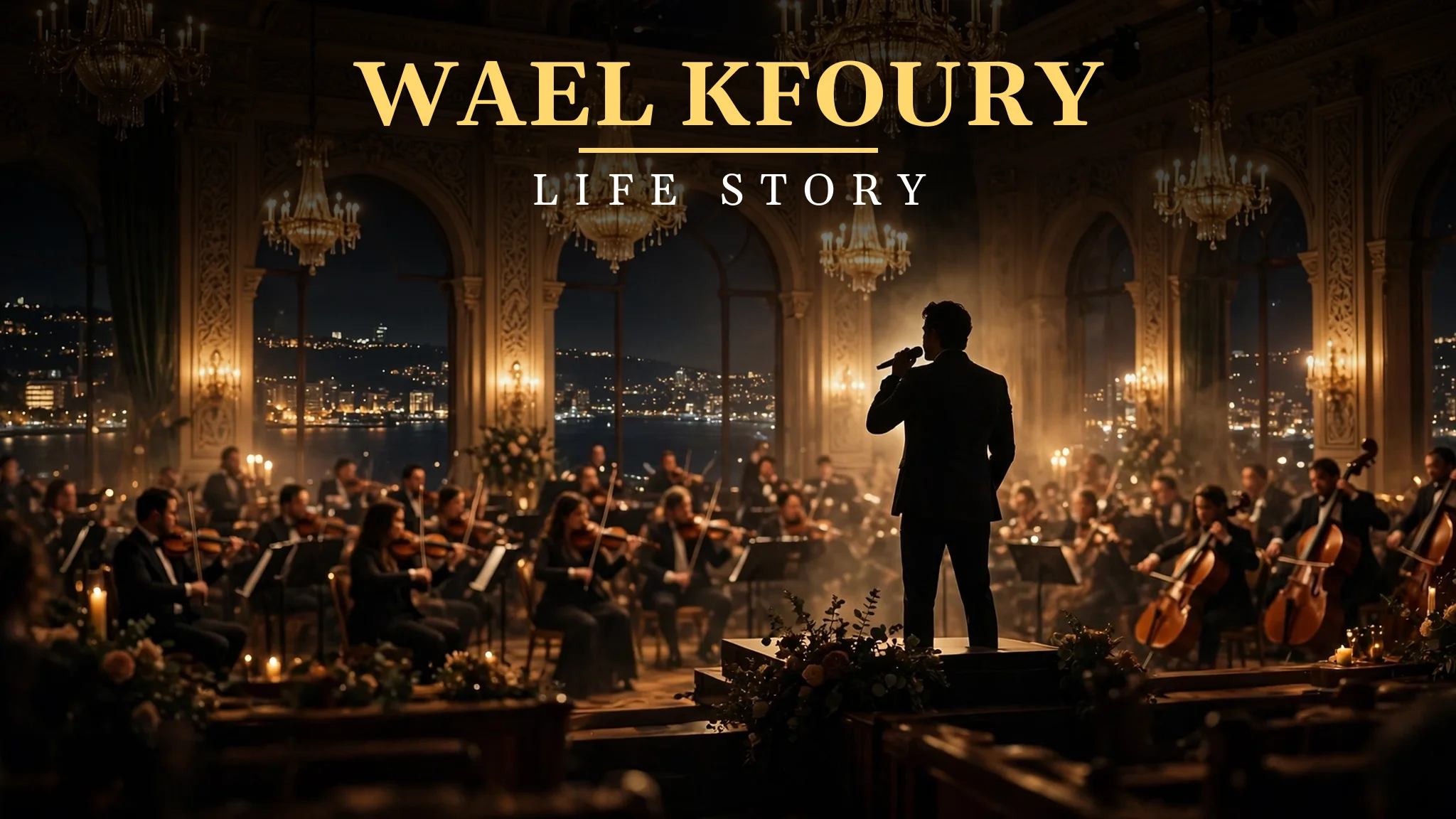
Wael Kfoury: The Life Story Behind Lebanon's King of Romance
In this post
- A Boy From Zahle Who Loved to Sing
- Studio El Fan and the First Chance to Be Heard
- Shafouha, Omri Kello, and the Songs That Defined Him
- The King of Romance on Stages Across the Arab World
- Marriage, Family, and the Private Man Behind the Songs
- Zahle’s Poets: The Words Behind the Songs
- The Later Albums and the Songs of the 2010s
- The King of Romance in His Later Years
- My Take:
Wael Kfoury is called the king of romance in Lebanon, and the title fits him. His voice is smooth, his songs are gentle, and for more than thirty years he has sung about love in a way that makes listeners feel as if he is singing to them alone. He is not a loud singer, and he does not need to be. His strength is in the quiet power of a melody, in the way a single line can hold a whole feeling, and in the patience of a career built on good songs rather than on noise.
He was born in Zahle, a city in the Bekaa Valley of Lebanon, known for its poetry, its food, and its proud people. Zahle is a place where music and words matter, and a boy growing up there would hear songs at home, at weddings, and in the streets. Wael heard those songs, and he learned to love them. He was not born into a famous family, and he did not have a clear road to stardom. He had a voice, and he had a willingness to work, and he took those two things to a television contest that changed his life.
This is the story of that voice, from a city of wine and poetry in the Bekaa to a contest stage in Beirut, from a gold medal to a career that made lovers weep, and from a young singer to a man whose songs are played at weddings across the Arab world. It is a story about romance, but it is also a story about staying true to a sound when the world around you keeps changing.
A Boy From Zahle Who Loved to Sing
Wael Kfoury was born Michel Émile Kfoury on 14 September 1974 in Zahle, Lebanon. Zahle sits in the Bekaa Valley, between mountains, and it is known as the city of wine and poetry, a place where people take pride in their words and their songs. Growing up there in the 1970s and 1980s meant growing up during a hard time for Lebanon, when the country was living through a long civil war. Yet even in hard times, music remained a part of daily life, at home, at church, at family gatherings, and on the radio.
His family was a normal Lebanese family, and his early years were shaped by home, by school, and by the sounds of Lebanese music. He heard the great singers of Lebanon, the voices that filled the radio, and he heard the songs of the Bekaa, with their strong rhythms and their proud words. He was drawn to singing, and he sang at home and among friends, learning how his voice sounded and how it felt to hold a note. He was not a child star, and he did not perform on big stages as a boy. He was a young man who loved to sing, and who kept that love alive while life went on around him.
School and study mattered, but music kept calling him. He listened to the singers who were popular in Lebanon, and he tried to understand what made a song last. He noticed that the songs people remembered were not always the loudest ones. They were the ones with a clear melody, with words that said something true, and with a voice that sounded honest. That lesson stayed with him, and it shaped the way he later chose his songs.
As a teenager, he began to think seriously about a career in music. That was not an easy dream in Lebanon in those years. The country was at war, the music business was uncertain, and a young singer had to find a way to be heard. Wael did not have money or connections, but he had a voice, and he had the courage to try. He sang at small gatherings, he practised, and he waited for a chance to show what he could do. That chance came in the form of a television contest, and he was ready for it.
Zahle stayed with him throughout his life. Even after he became famous, he spoke of his home city with pride, and his songs carried something of its spirit, a mix of romance and strength, of tenderness and pride. A singer who remembers where he comes from sings differently from one who forgets, and Wael’s songs have always carried the sound of Zahle in them, even when they are played far from Lebanon.
Studio El Fan and the First Chance to Be Heard
In 1992, Wael Kfoury took part in Studio El Fan, the famous Lebanese television talent show that had launched many careers. He was eighteen years old, and he stood before judges and a television audience to sing. He won the gold medal in his category, and that win changed his life. Studio El Fan was not only a contest. It was a door, and for a young singer from Zahle, it was the door to the music world. Winning it meant that producers, radio stations, and audiences would take him seriously.
The win gave him a recording contract, and it gave him a name. People in Lebanon began to know who Wael Kfoury was, and they waited to hear what he would do next. He did not rush. He worked on his first songs, he learned how a studio works, and he began to build the sound that would become his own. A first album after a contest win is a hard thing, because the audience expects much, and the singer must prove that the win was not luck. Wael took that challenge seriously.
His first album, Ma Wa3adtak, arrived in the early 1990s, and it introduced a voice that sounded like Zahle itself: clear, strong, and full of poetry. The songs were gentle, the melodies were clear, and Wael sang them the way a man from the Bekaa sings, with feeling and with pride. Listeners in Lebanon heard those songs on the radio, and they recognised something real in them, a singer who was not copying Cairo or the Gulf, but singing his own home. The record found its audience slowly, first in Zahle, then in Beirut, then across the Arab world, carried by people who played it in their cars and at their weddings.
He also learned how to perform. A television contest is one thing, but a live concert is another. A singer must hold a stage for a whole evening, must talk to the crowd, must sing slow songs and faster songs, and must keep the audience with him from the first note to the last. Wael learned those skills by performing, by watching other singers, and by listening to his audience. He was not a showman who relied on tricks. He relied on his voice and his songs, and that reliance served him well.
The years after Studio El Fan were years of learning. He made more records, he sang at weddings and in concert halls, and his name travelled, first across Lebanon, then across the Arab world. He was building a life, song by song, and he was learning that a romantic singer must earn belief. His listeners had to feel that when he sang about love, he meant it, and Wael earned that feeling by singing with honesty, year after year.
Shafouha, Omri Kello, and the Songs That Defined Him
The songs that made Wael Kfoury a star are now classics of Lebanese music. Shafouha w’Saro Y’oulou, a song about people who saw a loved one and began to talk, became one of his best-known early hits, and it showed his gift for a melody that stays in the mind. The song was played on the radio, at parties, and at weddings, and it made his name known to people who had not followed his contest win. It was a song about love and gossip, about the way people watch lovers, and listeners recognised their own lives in it.
Omri Kello, which means all my life, became another of his defining songs, and it is still one of the songs most linked with his name. It is a love song, sung with a warmth that makes it feel personal, as if the singer is speaking to one person alone. The song’s success showed that Wael had found his true subject. He was not a singer of many subjects. He was a singer of love, and he sang about it with a depth that few others could match. His fans came to expect that from him, and he gave it to them, album after album.
Bahebak Ana Kteer, which means I love you so much, added to his list of romantic favourites, and it became a song played at weddings and anniversaries across the Arab world. The song’s simple words and gentle melody made it easy to love, and Wael’s voice carried it without force. He did not need to shout his love. He sang it quietly, and the quiet made it stronger. That is a rare skill, and it is one of the reasons his songs last.
More songs came, and each one taught him something new. Ya Dalli Ya Rouhi and Law Hobna Ghalta joined Shafouha on the radio, and his name became the one people mentioned when they talked about Lebanese love songs. His records sold steadily, his halls filled, and his voice became the sound of romance in the Arab world. He sang in Beirut, in Cairo, in Amman, and in the cities of Europe and America where Arab families had settled, and the people who came to hear him had grown up with his songs, singing his words back to him as if they were their own.
The 1990s and the 2000s were the years when his name became a fixture of Arab romantic music, and they taught him how a long career is kept. A singer must keep recording, must keep performing, and must keep the faith of listeners who have many new voices to choose from. Wael kept all three, and he did it without changing his sound to chase a fashion. He remained a romantic singer, and his listeners remained with him because they knew what his voice stood for.
The King of Romance on Stages Across the Arab World
By the 2000s, a Wael Kfoury concert had a feeling all its own. He sang in Beirut, in Dubai, in Cairo, and in Amman, and his audiences came to listen, not only to dance. He stood at the microphone with an orchestra behind him, he sang his ballads with a calm that made the whole hall fall silent, and between songs he spoke to the crowd, telling them what a song meant to him. That intimacy is hard to create in a large hall, and it is why his fans stayed loyal for decades, because they felt he was singing to them, not at them.
He also sang for Arab audiences far from home, in Paris, in London, and in North American cities where Lebanese families had settled. Those concerts had a different feeling, because the audience was not only listening to music. It was remembering home, and Wael’s voice was the sound of that home. He understood that, and he sang to it, choosing songs that made the crowd feel close to Zahle and to Lebanon, even when they were thousands of miles away.
He also became a familiar face on television, appearing on music shows and in interviews, and his calm manner made him a favourite with audiences. He did not seek controversy, and he did not use his fame to start arguments. He spoke about his music, about his home city, and about the songs he loved, and that quiet dignity earned him respect. In a music world where many stars depend on drama, Wael depended on his songs, and that choice kept his reputation clean.
His albums continued through the 2000s and 2010s, and each one added new love songs to his catalogue. He worked with composers and lyricists who understood his style, and he chose songs that fitted his voice. He did not record songs that did not suit him, and he did not chase a sound that was not his own. That discipline is hard for a singer, because the music world is always offering new trends, but Wael kept his focus, and his fans trusted him for it.
He also became a judge and a mentor on television music shows, where younger singers looked to him for advice. His experience, his calm, and his knowledge of the romantic song made him a natural guide, and viewers saw a different side of him, not only the singer on stage but a man who understood music deeply and who cared about the next generation. That role added to his standing, and it showed that his place in Lebanese music was not only as a performer but as a keeper of its traditions.
Through these years, his voice remained his greatest gift. It did not lose its warmth, and it did not lose its clarity. He took care of it, he performed with discipline, and he chose his concerts with care. A singer’s voice is his work, and Wael protected his, which is why he could keep singing at a high level for more than thirty years.
Marriage, Family, and the Private Man Behind the Songs
Wael Kfoury’s private life has been a subject of public interest, but he has tried to keep it as private as he can. He married Angela Bechara in 2011, and the couple had two daughters, Michele and Milana. For a time, his family life seemed settled, and his fans were happy to see the king of romance living the love he sang about. He spoke of his daughters with warmth, and he tried to protect them from the public eye, keeping their lives away from cameras and headlines.
The marriage later ended in divorce, in 2019, and the separation was widely reported in the Arab press. It was a hard time for Wael, and he spoke little about it in public. He did not use the divorce to gain attention, and he did not speak badly of his former wife. He kept his dignity, and he focused on his work and on his daughters. That restraint earned him respect, because a public divorce can easily become a public fight, and Wael chose not to make it one.
His daughters have remained important to him, and he has spoken about fatherhood as one of the most meaningful parts of his life. A singer who sings about love must also live it, and fatherhood gave him a new kind of love to sing about, a love that is quiet, steady, and unconditional. His fans have seen that side of him, and they have responded with warmth, because it shows that the romantic singer is also a real man with a real family.
He has also faced hard times on the road. In 2023, he was reported to have been in a car accident, and the news worried his fans across the Arab world. He recovered, and he returned to performing, but the accident was a reminder that a singer’s life, with its travel and its late nights, carries risks. Wael handled the attention with calm, and he thanked his fans for their concern, and he went back to work.
Through the ups and downs of his private life, his music remained his anchor. He kept recording, kept performing, and kept singing about love, even when his own love life was hard. That is a difficult thing to do, and it takes strength. A singer who sings about love while his own heart is hurting must find a way to be honest without falling apart, and Wael found that way, song after song.
Zahle’s Poets: The Words Behind the Songs
Wael Kfoury comes from Zahle, and Zahle is a city of poets. The Bekaa Valley has produced writers, singers, and orators for generations, and a boy growing up there learns that words matter, that a well-chosen line can move a room, and that a song is only as good as its lyrics. Wael learned that lesson early, and it shaped his whole career. He did not choose songs only for their melodies. He chose them for their words, and he worked with lyricists who wrote in the Lebanese dialect with a poet’s care.
His songs are full of simple, direct words, and that simplicity is deceptive. A line like the ones in Omri Kello sounds easy, but it is hard to write a love song that says something true in a few words. Wael’s lyricists understood that, and he understood it too, which is why he refused songs whose words felt empty. A romantic singer who sings empty words will soon be forgotten, because the audience hears the emptiness. Wael’s audience heard fullness, and they stayed.
The Bekaa’s poetic tradition also gave him a way of speaking about love that was proud rather than pleading. His songs do not beg. They declare, they remember, and they stand tall, like the mountains around Zahle. That pride is part of his appeal, because a listener who hears a proud love song feels proud too. It is a different kind of romance from the soft, sad songs of other singers, and it made Wael distinct. His love was not weak. It was strong, and it asked to be respected.
He also learned from the great Lebanese poets and singers who came before him, listening to their records, reading their words, and understanding how a song could carry a whole culture. Zahle’s poets wrote about wine, about love, about the valley, and about home, and Wael’s songs carry those same subjects, in a modern voice. That continuity matters, because it connects his music to a tradition that is older than he is, and his fans feel that connection, even if they cannot name it.
The words behind his songs are the reason they last. A melody can be forgotten, but a true line is remembered, and Wael’s songs are full of true lines. Couples quote them at weddings, lovers write them in messages, and listeners hum them without thinking. That is the work of poetry, and Wael, the boy from Zahle, became one of its finest singers.
The Later Albums and the Songs of the 2010s
Wael Kfoury’s later albums are often overlooked, and that is a pity, because they show a singer who kept growing. In the 2010s he released new songs and new records, working with composers from Zahle and from Beirut, and he sang in the Lebanese dialect with the same warmth. Those songs did not always reach the top of the charts, because the charts had changed, and because a calm voice competes with many loud ones, but they were loved by the listeners who had followed him since Studio El Fan, and they showed that he was still recording, still choosing, still singing.
His later singles also showed his range. He sang songs of love, songs of longing, and songs that mixed the old romantic sound with new touches, and each one carried his voice at the centre, clear and warm. A singer who keeps recording into his forties is a singer who loves the work, not only the fame, and Wael kept recording because he loved it. His fans noticed, and they thanked him for it, because a new Wael song, even a quiet one, was a gift.
The streaming years changed how his music travelled. His songs now move on phones, not only on CDs, and a young listener in Paris can find Omri Kello in seconds. That is a different world from the one he entered in 1992, and it asks a singer to keep releasing, to keep being heard, and to keep his name alive in a feed that never stops. Wael has done that, not by chasing every trend, but by staying himself, by singing Zahle the way he always has, and by trusting that a true voice will be found.
What his later years show is that a calm voice can last, and that romance does not go out of fashion. Young singers from Zahle look at him and see that they do not have to shout to be heard. They can sing softly, choose their words with care, and be loved for it. That is a lesson Wael teaches without saying a word, simply by being himself, a boy from Zahle who became a star and never stopped singing about love.
The King of Romance in His Later Years
Wael Kfoury is now in his fifties, and his voice has not lost its warmth. He still stands at the microphone, still sings Omri Kello, and the hall still falls quiet, because a true melody in a loud world is noticed. His concerts now have a different shape, smaller halls, warmer lights, and an audience that has grown up with him, but the feeling is the same. He sings, the crowd sings back, and for a few hours the room is full of romance.
His daughters, Michele and Milana, are part of his later story. They grew up watching their father on stage, and Wael has spoken about how much they mean to him. That love is something many fathers know, and it is why his fans feel close to him. He is not only a star. He is a father who worked, who travelled, and who came home, and that is a life many of his listeners live themselves.
The reported car accident in 2023 was a frightening moment, and his return to the stage after it showed his strength. A singer who is hurt and comes back sings differently, with a knowledge that a young singer cannot have, and Wael’s later performances carry that knowledge. His audience heard it, and they welcomed him back, because a voice they loved had been silent for a while, and they were glad to hear it again.
What he will be remembered for is not one song. It is the proof that a man can build a thirty-year career on love, on poetry, and on calm, without shouting, without chasing every trend, and without losing himself. Young Lebanese romantic singers look at him and see that they do not have to be loud to be heard. They can sing softly, choose their words with care, and be loved for it. That is a legacy, and it is still growing, every time his voice fills a hall and the crowd sings along.
My Take:
I think Wael Kfoury is a singer who proves that quiet can be stronger than loud. I have heard many singers who try to impress with power, with high notes, with big gestures, and I often forget their songs a day later. Wael is different. He sings gently, he sings clearly, and his songs stay with me. When I hear Omri Kello, I do not think about technique. I think about the feeling, about a love that lasts a whole life, and about the way a simple melody can hold that feeling. That is a gift, and it is rarer than a powerful voice.
What I admire most about him is his patience. He won Studio El Fan in 1992, and he did not become a star in one night. He built his career album by album, song by song, and he waited for the audience to trust him. That patience is not common in music, where many young singers want everything at once. Wael waited, and he worked, and when his great songs arrived, they felt earned. I respect that kind of career far more than a career that begins with one lucky hit and ends a year later.
I also think about Zahle, and about what it means to be from a city known for poetry. A poet chooses words with care, and a singer from Zahle should do the same. Wael does. His songs do not waste words. They say what they mean, in clear Arabic, with a melody that fits the words. I think that care comes from his home, from a place where words matter, and I am glad he did not lose it when he became famous. Fame can make a singer careless, but Wael stayed careful, and his songs show it.
His title, the king of romance, makes me think about what romance really means. It does not mean only flowers and sweet words. It means staying, it means being honest, it means loving someone through hard times. Wael’s songs understand that, and they do not promise that love is easy. They promise that love is worth it, and that is a truer promise. When he sings Bahebak Ana Kteer, I believe him, because the song is not only about the joy of love. It is about the depth of it, about a love that is so strong it fills a whole life. I think his audience believes him for the same reason.
I want to be honest about something I find less strong in his career. He has stayed very close to one kind of song, the romantic ballad, and his albums can sound alike to a listener who hears them all at once. The tempos stay slow, the themes stay close to love, and the sound does not change much from one album to the next. I understand why he did it, because his audience loves that sound, and changing it would be a risk. But I also think a few more risks, a few songs that stepped outside the love-song world, would have shown us another side of him. A singer who only sings about love can become a beautiful voice in a narrow room, and I would have liked to hear him step into a wider room now and then.
That said, I do not think the repetition is a fault in the way some critics might say. Love is a wide subject, and Wael finds different corners of it in each song. One song is about people who gossip about lovers, another is about a love that lasts a whole life, another is about loving someone so much that words are not enough. Those are different feelings, and he sings them differently, even if the style stays close. I think a listener who pays attention will hear the differences, and I think his fans do pay attention, because they sing the words back to him at concerts, and they know which song is which.
His private life makes me think about the gap between a singer’s songs and his own life. He sang about love, he married, he had two daughters, and then his marriage ended. That is a sad story, and I feel sympathy for him, because a divorce is hard for anyone, and harder still when it is reported in the press. I admire the way he handled it, with dignity and with silence, without turning it into a public fight. He protected his daughters, and he protected his own peace, and that is a brave choice. A singer can sing about love while his own heart is hurting, and Wael did that, and I think his songs became deeper because of it.
I also think about the car accident in 2023, and about how quickly his fans worried. That worry tells me something about his place in people’s lives. When a singer’s songs are played at your wedding, when they are part of your family’s memories, you feel as if you know him, and you worry when he is hurt. I am glad he recovered, and I am glad he returned to the stage, because his voice is needed, and because his audience missed him.
When I compare him with other Lebanese singers, I see that his strength is not drama. Other singers are known for big shows, for powerful voices, for bold choices. Wael is known for warmth, for calm, and for a voice that sounds like a conversation. I think that is a harder strength to build, because drama is easy to notice, but warmth is easy to miss, and it takes time to earn. Wael earned it over thirty years, and his audience trusts him because of it.
I think about the younger singers who watched him on television, who saw him as a judge and a mentor, and who learned from his calm. They learned that a star does not have to shout, that a singer can be respected without being loud, and that a career can be built on good songs. That is a valuable lesson, and I hope they carry it into their own work. The music world needs more singers like Wael, singers who trust their voice and their songs, and who do not need controversy to be heard.
If I had to choose one song to explain Wael Kfoury to someone who had never heard Lebanese music, I would choose Omri Kello, because it holds everything he does best in one place. It is gentle, it is honest, it is about a love that lasts, and it is sung with a warmth that makes the listener feel understood. I would tell that person to listen to it quietly, at night, and to notice how the melody stays with them after it ends. That staying power is the mark of a good song, and Wael has made many songs that stay.
In the end, I think Wael Kfoury’s story teaches a simple lesson that I want to remember. You do not have to be the loudest, the fastest, or the most shocking to build a career that lasts. You have to be honest, you have to work steadily, and you have to sing about what you truly feel. Wael did that, and his songs are still sung at weddings, still played on the radio, and still loved across the Arab world. A career built on love songs, sung with warmth and patience, is a career that earns its place, and I am glad his place is secure.
Zahle’s poetry is something I keep coming back to when I think about Wael Kfoury, because it explains his songs in a way that nothing else does. A city of poets teaches a singer that words are not decoration. They are the song itself, and a melody is only a way of carrying them. Wael learned that, and his songs prove it. When I hear Omri Kello, I do not only hear a tune. I hear a line that says, in a few words, what a whole life of love means, and that line stays with me after the music ends. That staying power is poetry, and Wael is its singer.
His daughters, Michele and Milana, are another part of his story that stays with me. He sang about love for years, and then he became a father, and love took on a new meaning. A father who sings love songs understands love differently from a young man who only dreams of it. He knows it is patient, it is daily, and it asks for presence. I think his later songs carry that knowledge, a warmth that comes from living with love, not only singing about it. His fans heard that warmth, even if they could not name it, and they loved him more for it.
The car accident in 2023 worried me when I read about it, because a singer’s life is full of travel, of late nights, of roads between cities, and an accident can end a career in a moment. I am glad Wael recovered, and I am glad he returned to the stage, because his voice is needed. I also think the accident reminded his fans how much they loved him, because worry is a form of love, and the whole Arab world worried about him that week. A singer who is worried about by millions is a singer who matters, and Wael matters.
If a young singer asked me what to learn from Wael Kfoury, I would say three things. First, choose your words as carefully as your melodies, because words last. Second, sing quietly when the song asks for quiet, because a whisper can be stronger than a shout. Third, remember your city, because it is the source of your sound. Wael did all three, and his career is the proof that they work. He is still here, still singing, still the king of romance, and that is a lesson worth remembering.
His concerts abroad are something I think about often, because they show what a singer means to people who live far from home. A Lebanese family in Paris or in London hears Wael sing, and for a few hours they are back in Zahle, at a wedding, on the radio, in a car with the windows down. That feeling, of being home without travelling, is a gift, and Wael gives it. I think that is why his audiences abroad are so emotional, and why they sing along so softly. They are not only enjoying a show. They are remembering who they are, and Wael’s voice helps them remember.
I also think about the poets of Zahle, and about how a singer honours the words he sings. Wael did not treat a song as a melody only. He treated it as a poem, and he sang it with a respect that the poets could feel. That is a rare thing in pop music, and it is why his songs have lasted. A melody fades, but a poem, sung well, stays, and Wael’s songs stay because he gave them words worth remembering. That is a lesson for any singer: choose your words with care, because your voice will carry them for decades.
His daughters are something I think about often, because they show what a singer’s life means at home. Michele and Milana grew up watching their father on stage, and Wael has spoken about how much they mean to him. That love is something many fathers know, and it is why his fans feel close to him. He is not only a star. He is a father who worked, who travelled, and who came home, and that is a life many of his listeners live themselves. I respect him for keeping that part of his life private, and for protecting his children from the noise of fame.
I also think about his return after the reported accident, and about what it means to come back. A singer who is hurt and returns sings differently, with a knowledge that a young singer cannot have, and Wael’s later performances carry that knowledge. His audience heard it, and they welcomed him back, because a voice they loved had been silent for a while, and they were glad to hear it again. That welcome is a gift, and it is one that Wael earned by being honest, by being calm, and by singing with a warmth that his audience trusts.
Frequently Asked Questions
Where was Wael Kfoury born?
Wael Kfoury was born Michel Émile Kfoury on 14 September 1974 in Zahle, in the Bekaa Valley of Lebanon. Zahle is known as a city of wine and poetry, and he has spoken of his home city with pride throughout his career.
How did Wael Kfoury become famous?
He became famous by winning the gold medal on the Lebanese talent show Studio El Fan in 1992, when he was eighteen. The win gave him a recording contract and introduced him to audiences across Lebanon and the Arab world.
What are Wael Kfoury’s most famous songs?
His most famous songs include Shafouha w’Saro Y’oulou, Omri Kello, Bahebak Ana Kteer, Ya Dalli Ya Rouhi, and Law Hobna Ghalta. Omri Kello is the song most often linked with his name.
Why is Wael Kfoury called the king of romance?
He earned the title because his career is built on romantic love songs, sung with a warm and gentle voice, that are played at weddings and anniversaries across the Arab world. His calm style and his choice of love as his main subject made the title fit.
Was Wael Kfoury married?
Yes, he married Angela Bechara in 2011, and they had two daughters, Michele and Milana. The marriage later ended in divorce in 2019, and Wael has kept much of his private life away from the public eye since then.
Is Wael Kfoury still performing?
Yes, he continues to perform and release music, and his older songs are still played widely in Lebanon and across the Arab world. His concerts still draw large audiences who sing his love songs along with him.


