Warda: The Life Story Behind Algeria's Rose of Arab Song
In this post
- A Girl Singing in Her Father’s Cabaret in Paris
- Beirut, Algeria, and the Young Singer Finding Her Way
- Cairo, Baligh Hamdi, and the Golden Years
- A Voice That Returned Again and Again
- Algeria’s Rose and a National Treasure
- A Farewell in Cairo and the Songs That Stay
- The Songs That Never Left the Radio
- My Take:
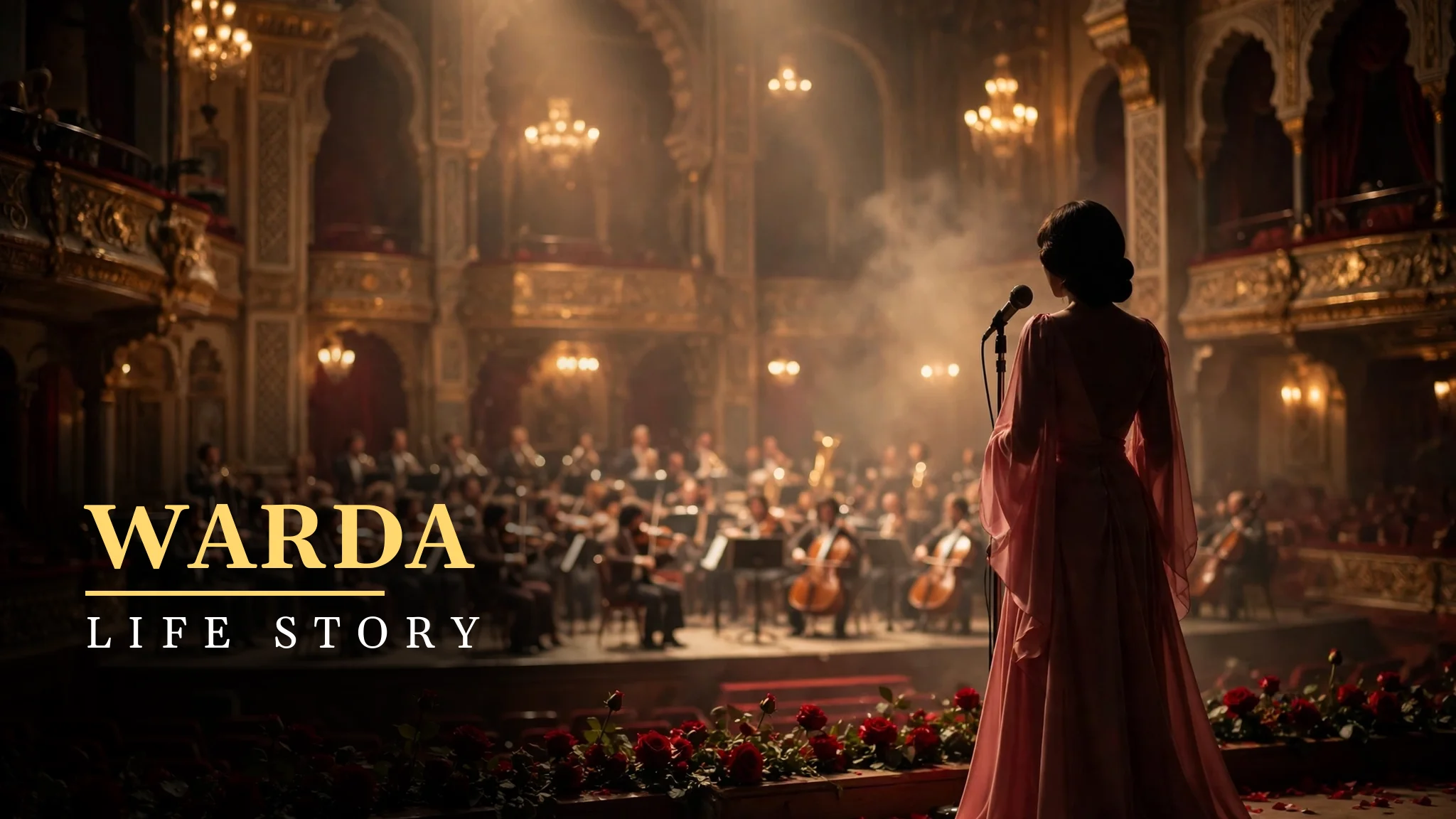
Warda was known as the rose of Arab song, a name that fitted her perfectly, because her voice was beautiful, her presence was graceful, and her songs were loved across the whole Arab world for more than half a century. She was born in France to an Algerian father and a Lebanese mother, she sang as a child in her father’s cabaret in Paris, and she went on to become one of the greatest singers of her generation, with a career that took her from Beirut to Cairo, from Algeria to the concert halls of the Arab world. Her songs, such as “Batwanes Beek” and “Harramt Ahebak”, are still played today, and they are still sung by people who were not alive when she first recorded them.
What makes Warda’s story so rich is the journey itself. She did not belong to one country. She belonged to many, to Algeria through her father, to Lebanon through her mother, to France through her birth, and to Egypt through the music that made her famous. That mix of cultures gave her a voice that could speak to listeners in many places, and it gave her a life that was full of movement, of love, of loss, and of return. She retired and came back, she married and parted, and she kept singing, through all of it, with a voice that seemed to grow deeper and more beautiful with age.
She died in 2012, in Cairo, and her death was mourned across the Arab world, because she had been a voice for a whole generation, a singer whose songs were part of weddings, of radio, and of daily life. This is the story of how a girl who sang in a Paris cabaret became Warda, the rose of Arab song.
A Girl Singing in Her Father’s Cabaret in Paris
Warda Al-Jazairia was born on 22 July 1939 in Puteaux, a suburb of Paris, in France, to an Algerian father and a Lebanese mother. Her father ran a cabaret in Paris, a place where Arab music was played for the North African community in France, and Warda grew up inside that world, hearing singers, musicians, and audiences from a very young age. The cabaret was not a grand concert hall. It was a small, warm place, full of smoke and music, where people came to forget their homesickness and to hear the songs of their homeland, and Warda learned her first lessons about singing there, by listening and by joining in.
As a child she began to sing in her father’s cabaret, and the audiences who heard her were struck by the power and the beauty of her voice, even though she was so young. She sang the songs of the great Arab singers, and she sang them with a feeling that was unusual for a child, as if she already understood the love and the longing in the words. Her father encouraged her, and the cabaret gave her a stage, a place to practise, and a first audience that loved her. Those early years were her school, and the lessons she learned there, about how to hold a crowd, how to feel a song, and how to make an audience listen, stayed with her for the rest of her life.
Her family life was shaped by the mix of cultures she was born into. Her father was Algerian, from a country that was then fighting for its independence from France, and her mother was Lebanese, from a country with its own rich musical tradition. Warda grew up with both, hearing Arabic in different dialects, eating food from both countries, and learning to move between worlds without thinking about it. That ability to move between worlds would become a key part of her career, allowing her to sing for audiences in many countries and to be claimed as their own by many peoples.
The Paris of her childhood was a city full of migrants, of people who had left their homes and who carried their music with them, and Warda’s cabaret was a small piece of that world. She learned that music could be a home for people who were far from home, and that a song could bring a room full of strangers together. That lesson, learned as a child, would guide her whole life, as she sang for audiences who were far from home, in Paris, in Beirut, and in Cairo.
By the time she was a teenager, Warda was already known as a talented young singer, and the word was spreading beyond her father’s cabaret. She had a voice that was ready for a bigger stage, and she had the confidence that comes from singing in front of a live audience since childhood. The next step was to leave Paris and to find that bigger stage, and the journey would take her first to Lebanon, the country of her mother, and then to the wider Arab world.
Beirut, Algeria, and the Young Singer Finding Her Way
In her youth Warda moved to Lebanon, where she began to build a career as a singer in the Arab world, performing on radio and on stage and recording songs that introduced her to a wider audience. Beirut in those years was a centre of Arab culture, a city where music, poetry, and film met, and a young singer with a beautiful voice could find work and recognition. Warda sang in Beirut, and she learned the craft of recording, of working with composers and musicians, and of building a repertoire that would carry her through a long career. Those years were a time of learning, and they gave her the professional skills she would need in Egypt.
She also spent time in Algeria, the country of her father, where she was welcomed as a daughter of the nation, and where her singing took on a new meaning. Algeria was fighting for and then building its independence, and a singer who carried the country’s name, Al-Jazairia means “the Algerian”, was a symbol of that new nation. Warda’s connection to Algeria was not only a matter of blood. It was a matter of identity, and she carried it with pride, singing for Algerian audiences and becoming a cultural figure in the country her father had left.
The years in Beirut and Algeria were not easy, and they were not a straight path to fame. Warda had to work hard, to take what opportunities came, and to build her reputation song by song, in a music world that was full of talented singers and fierce competition. She faced the usual challenges of a young woman in that world, where a singer is judged on her voice, her looks, and her behaviour, and where the pressure to succeed can be intense. She met those challenges with a quiet determination, focusing on her singing and letting her voice speak for her.
During this period she married and started a family, and for a time she stepped back from her career, as many women singers of her generation did, to focus on her home and her children. That decision, to pause a rising career for family life, is one that many women understand, and it shows the choices that singers of her era had to make, choices that male singers rarely faced. Warda’s pause was not the end of her story. It was a chapter, and the next chapter would bring her back to music with a new depth and a new power.
By the end of this period, Warda had learned a great deal about herself and about her art. She had sung in Paris, in Beirut, and in Algeria, she had built a reputation, and she had lived a life that gave her songs a new emotional weight. She was ready for the next stage, and that stage would be Egypt, the centre of Arab music, where the greatest singers of her generation made their names.
Cairo, Baligh Hamdi, and the Golden Years
Warda’s great period came in Egypt, where she moved in the 1970s and where she worked with the composer Baligh Hamdi, one of the most important figures in Arab music. Baligh Hamdi was a genius of melody, a man who wrote songs for the greatest singers of Egypt, and his partnership with Warda produced some of the most beautiful songs in the history of Arab music. Their collaboration was both professional and personal, and they married in 1973, a union that brought together two of the most talented people in Arab music, and that produced songs that are still loved today.
Among the songs from this period are “Batwanes Beek”, a song whose title means “I miss you”, and which became one of Warda’s signature works, a slow, emotional track that shows off the full range and power of her voice. The song is a masterpiece of Arab pop, with a melody that is both simple and deep, and with lyrics that speak about longing in a way that every listener understands. It was played on radio across the Arab world, and it became a song that people associated with Warda for the rest of her life.
Another famous song from this time is “Harramt Ahebak”, which means “I have forbidden myself to love you”, a dramatic song about a love that cannot be, and which Warda sang with a passion that made it unforgettable. The song’s melody, written by Baligh Hamdi, is one of his finest, and Warda’s performance of it is a lesson in how to sing a love song, with control, with feeling, and with a voice that can move from a whisper to a cry in a single line. These songs, and others like “Akdib Aleik” and “Fi Youm Wa Leila”, made Warda one of the leading singers of Egypt, and they secured her place in the history of Arab music.
Her life in Cairo was a life of fame, of concerts, of recordings, and of a public that adored her. She performed in the great halls of Egypt, she appeared on television, and she became a household name, not only in Egypt but across the Arab world. Her voice was heard on radio in every country, and her songs were sung at weddings, in homes, and in cars, becoming part of the daily life of millions of people. She was no longer a young singer from Paris. She was Warda, the rose of Arab song, and her name was known everywhere.
The marriage to Baligh Hamdi ended in divorce in 1979, after six years, and the end of that partnership was a sad moment, both personally and musically, because their collaboration had produced such beautiful work. Warda continued to sing after the divorce, and she worked with other composers, but the songs she made with Baligh Hamdi remained the heart of her repertoire, and they are the songs that most people remember when they think of her. The golden years in Cairo were the peak of her career, and they gave her a legacy that would last for the rest of her life.
A Voice That Returned Again and Again
Warda’s career had a pattern of return, of stepping back and then coming back to music with renewed energy, and that pattern is part of what makes her story so interesting. After her divorce, she continued to sing, but she also took time away, and she returned to the stage in later years with a voice that had grown deeper and more mature. Those returns were welcomed by her fans, who had missed her, and they showed that her audience had not forgotten her, even when she was away. A singer who can leave and return is a singer whose work has a lasting place in people’s hearts.
In the 1990s and 2000s she continued to perform, to record, and to appear at concerts and festivals, and her later work showed a singer who was comfortable with her legacy and who was still capable of moving an audience. She sang her old hits, and she sang new songs, and the combination reminded listeners of the full range of her career, from the young girl in Paris to the great star of Cairo. Her voice had changed with age, becoming richer and more textured, but the feeling in it remained, and a listener who heard her sing in her later years could still hear the girl who had sung in her father’s cabaret.
She also became a figure of respect in the Arab music world, a senior singer whose opinion mattered, and whose presence at an event gave it weight. Younger singers looked up to her, and they sought her advice and her approval, knowing that she had lived through the golden age of Arab music and that she carried its traditions with her. That role, as a keeper of a tradition, is one that many great singers take on in their later years, and Warda filled it with grace.
Her personal life in these years was quieter, and she kept it largely private, focusing on her family and her music rather than on public controversy. She had lived a full life, with love, with loss, and with fame, and she had learned to value the simple things, the songs, the audiences, and the moments when her voice filled a hall and made people feel. That simplicity, after a life of great drama, is a sign of wisdom, and it is one of the reasons her fans loved her to the end.
By the time she reached her seventies, Warda was recognised as one of the greatest Arab singers of all time, a woman whose voice had defined a generation, and whose songs were part of the cultural heritage of the Arab world. She had come a long way from the cabaret in Paris, and she had done it by staying true to her voice, her culture, and her art.
Algeria’s Rose and a National Treasure
Warda’s connection to Algeria remained a central part of her identity throughout her life, and she was claimed by Algeria as one of its own, a daughter who had carried the country’s name to the world. The name Al-Jazairia, which she used as part of her stage name, means “the Algerian”, and it was a statement of pride, a reminder that her roots were in Algeria even though she was born in France and made her fame in Egypt. That pride was returned by Algerians, who loved her songs and who saw in her a symbol of their culture, a voice that spoke for their country in the wider Arab world.
She performed in Algeria, she was honoured there, and she remained a figure of national importance, even when she lived in Cairo. Her songs were played on Algerian radio, and her name was known to every Algerian family, as a singer who belonged to them. That kind of national love is a rare thing, and it is a sign of how deeply her music had entered the life of a country. She was not only a singer. She was a treasure, a rose that Algeria had given to the Arab world, and that the Arab world had loved in return.
Her legacy in Algeria is still alive today, with young singers listening to her records and learning from her voice, and with audiences remembering her concerts and her songs. She showed that an Algerian singer could reach the highest levels of Arab music, and that a woman from the diaspora could become a national icon. That example matters, because it tells young Algerians that their culture is valued, and that their voices can be heard far beyond their own borders.
A Farewell in Cairo and the Songs That Stay
Warda died on 17 May 2012 in Cairo, at the age of 72, and her death was mourned across the Arab world, from Algeria to Egypt, from Lebanon to the Gulf. The news was met with tributes from singers, from composers, and from fans, all of whom spoke about what her voice had meant to them, and about the loss of a singer who had been a part of their lives for decades. Her funeral in Cairo was attended by many, and her body was taken to Algeria for burial, a final journey home to the country of her father, a fitting end for a singer who had lived between worlds.
The grief that followed her death was a measure of her importance. She was not only a famous singer. She was a voice that had been part of weddings, of radio, of family life, and of the daily soundtrack of millions of people, and her absence was felt as a personal loss by listeners who had never met her. That kind of love is the highest tribute a singer can receive, and Warda received it in full, from a whole generation that had grown up with her songs.
Her songs remain, and they are still played today, on radio, on streaming platforms, and at gatherings where people sing along to “Batwanes Beek” and “Harramt Ahebak” as if they were new. The voice that sang them is gone, but the recordings keep it alive, and new listeners discover her every year, finding in her music a beauty that has not faded with time. That is the true legacy of a great singer, that her work outlives her, and that it continues to move people long after she has left the stage.
The Songs That Never Left the Radio
One of the clearest signs of Warda’s greatness is how long her songs stayed on the radio, and how often they are still played today. A hit song usually fades after a year or two, but Warda’s best songs, “Batwanes Beek”, “Harramt Ahebak”, and “Akdib Aleik”, have been played for decades, in every Arab country, on radio stations that have changed their formats many times. That kind of staying power is rare, and it tells us something about the quality of the music. These are not songs that relied on a fashion or a trend. They relied on a melody, a voice, and a feeling, and those things do not go out of fashion.
The songs also travelled in a way that few Arab songs did, because they were sung by a voice that could be understood in many dialects, and because their themes, love, longing, and loss, are universal. A listener in Morocco, in Iraq, or in the Gulf could hear a Warda song and feel that it was written for them, even though the singer was Algerian and the composer was Egyptian. That universality is the mark of great art, and it is the reason her music is still part of the shared culture of the Arab world, a culture that is often divided by borders but united by song.
Young singers today still learn from her records, studying the way she holds a note, the way she moves from a soft verse to a powerful chorus, and the way she makes a simple lyric feel deep. That study is a form of respect, and it is also a form of survival, because a tradition lives only if new singers learn it. Warda’s songs are a school for Arab singers, and they will keep teaching as long as there are young voices who want to learn how to sing with feeling.
My Take:
I think Warda’s voice is one of the most beautiful I have ever heard about, and I say that knowing that I have not heard every singer in the world. There is something about the way her songs are described, the warmth, the depth, the feeling, that makes me want to listen to them again and again, even though I know they were recorded decades ago. A great voice does not age, and Warda’s voice, as it is preserved on her recordings, still sounds fresh, still sounds alive, and still sounds like a person singing about love as if it were the most important thing in the world. I think that is the mark of a true artist, that her work does not belong only to her own time, but to every time that follows.
What I admire most about her is the journey, the movement from Paris to Beirut to Algeria to Cairo, and the way she carried her identity with her through all of it. She was born in France, she had an Algerian father and a Lebanese mother, and she became famous in Egypt, and none of those facts cancelled out the others. She was all of them at once, and she sang for all of them at once, and that ability to belong to many places is a gift that many people in the modern world need. We live in a time when people move, when families are spread across countries, and when a person can be from more than one place, and Warda’s life shows that such a life can be a source of strength, not a source of confusion.
Her early years in her father’s cabaret interest me deeply, because they show how a child’s talent can be nurtured by a family that loves music. She was not sent to a formal school to learn to sing. She learned by listening, by singing in a small room full of people who loved Arab music, and by practising in front of a live audience. That kind of education is different from a classroom, and it is in some ways better, because it teaches a singer how to feel a song and how to hold a crowd, lessons that no textbook can teach. I think about the young girl singing in that cabaret, and I wonder if she knew how far her voice would take her. She probably did not, and that innocence is part of the beauty of her story.
The partnership with Baligh Hamdi is the part of her career I think about most, because it shows what can happen when two great talents meet. He was a composer of genius, and she was a singer of genius, and together they made songs that are still loved today, songs like “Batwanes Beek” and “Harramt Ahebak” that have become part of the heritage of Arab music. I think about how rare such a partnership is, and how lucky Warda was to find it, and how lucky Baligh Hamdi was to find a voice that could carry his melodies. Their marriage ended, as many marriages do, but the music they made together did not end, and it will not end, because it is preserved in recordings that will outlive both of them.
I am also struck by the way she stepped back from her career for family life, and then returned to it with a new depth. That decision, to pause a rising career for her children, is one that many women understand, and it is a decision that is often judged harshly by a world that expects a singer to keep working without a break. Warda made the choice, and she lived with it, and when she returned, her voice had a new weight, a new feeling that came from having lived a life outside the stage. I respect that choice, because it shows that a career is not the only thing that matters, and that a singer can be a mother and an artist at the same time, even if the world makes it hard.
Her connection to Algeria moves me, because it shows how a person can carry a country in her name and in her heart, even when she was born far from it. She called herself Al-Jazairia, the Algerian, and she was proud of that name, and Algeria was proud of her in return. That mutual pride is a beautiful thing, and it is a reminder that identity is not only about where you were born. It is also about where your family comes from, about the music you love, and about the name you choose to carry. Warda chose Algeria, and Algeria chose her, and that choice shaped her whole life.
I think about her later years, when she returned to the stage again and again, and I admire the courage it takes to keep singing when you are older, when your voice has changed, and when the music world has moved on to younger stars. Many singers stop when the fame fades, because they cannot bear to be less famous than they once were. Warda kept singing, not because she needed the fame, but because she loved the music and because her fans still wanted to hear her. That is a different kind of courage, the courage to keep doing what you love even when the spotlight has moved, and I think it is a lesson for anyone who has ever been afraid of getting older.
If I am honest, I do not know every song she recorded, and I do not pretend that every track was perfect. Some of her later work may not have the same power as her golden years with Baligh Hamdi, and that is normal for any singer with a career that lasted for decades. The point is not that every song was a masterpiece. The point is that she kept singing, kept performing, and kept her connection with her audience, and that the best of her work, the songs from Cairo, remains among the finest Arab music ever made. A career is judged by its peaks, and Warda’s peaks were very high indeed.
Her death in 2012 saddens me, because she was a voice that had been part of so many lives, and her absence was felt as a personal loss by people who had never met her. I think about the funeral in Cairo, and about her body being taken to Algeria for burial, a final journey home, and I find that image deeply moving. She lived between worlds, and in death she returned to the country of her father, as if her life had come full circle. That is a fitting end for a singer who carried Algeria in her name, and it is a reminder that home, in the end, is where we are laid to rest.
I want to say something about the title “rose of Arab song”, because it is a beautiful title, and it fits her in a way that many titles do not. A rose is beautiful, but it is also strong, with thorns that protect it, and Warda was both beautiful and strong. Her voice was soft and warm, but her life was not soft. She faced the challenges of a woman in a tough music world, she faced love and loss, and she kept going. The rose is a good symbol for her, because it captures both the beauty and the strength, and it is a title she earned, not one that was given to her lightly.
When I think about young singers today, I hope they listen to Warda and learn from her, not only about how to sing, but about how to live a life in music. She shows that a singer can be from many places, can love many cultures, and can stay true to her voice through all of it. She shows that a career can have pauses and returns, and that a voice can grow deeper with age rather than fading away. Those are valuable lessons, and they are lessons that Warda’s life teaches without a single lecture, simply by the example of how she lived.
In the end, I think Warda’s story is about a voice that refused to be forgotten, a voice that travelled from a small cabaret in Paris to the great halls of Cairo, and that is still heard today, on radios and on phones, by people who were not alive when she first sang. That is the true test of a singer, that her work outlives her, and Warda passes that test with ease. I will keep listening to her songs, and I will keep thinking about the girl in the cabaret who became the rose of Arab song, because her story reminds me that music can carry a person across borders, across decades, and across a whole life, and that the journey is worth making.
I hope her songs keep being discovered by new listeners, and I hope young Arab singers today know her name and understand what she achieved. She was not only a great voice. She was a bridge between countries, between generations, and between the old Arab music and the new, and bridges like that are rare and precious. Her life is a reminder that a singer can be more than a performer. She can be a keeper of a culture, a voice for a people, and a rose that keeps blooming long after the singer herself has gone.
I also think about the radio, and about how a song can become part of a whole culture simply by being played again and again, year after year. Warda’s songs did that, and they became part of the air that Arab listeners breathe, a sound that is always there, even when no one is paying attention to it. That kind of presence is a rare achievement, and it is one that no amount of marketing can buy. It comes only from songs that are truly good, and from a voice that is truly loved. Warda had both, and her songs will keep playing for as long as there are radios and phones to play them on.
Finally, I want to say that her story reminds me that a life in music is not only about fame, but about the people who listen. Warda’s fans were not only in concert halls. They were in homes, in cars, and at weddings, and they carried her songs with them through their own lives, through love and loss, through joy and grief. A singer who can be part of so many lives is a singer who has done something truly important, and Warda did that, quietly and beautifully, for more than fifty years. I am grateful for her voice, and I hope it keeps singing for many years to come.
I also think about the way her songs will age, and about whether a young listener ten years from now will still feel the longing in “Batwanes Beek”. I believe they will, because Warda’s best songs are not built on a fashion that fades. They are built on a beautiful voice, a deep melody, and a feeling of love that does not go out of date, and those things travel well across time. A love song, sung truly, will mean as much to a young Arab listener in ten years as it does today, because the feeling behind it does not change. That is the test of a great song, and Warda’s best work passes it with ease.
One last thought stays with me, about the city of Paris itself, with its cabarets, its lights, and its Arab community, and about how a singer can carry a whole childhood in her voice. Warda carried Paris with her, in her sound and in her memory, and when listeners in other countries hear her songs, they hear a little of that childhood too. That is a beautiful thing for a singer to do, to make a place audible, and her songs will keep doing it, long after she has gone.
Frequently Asked Questions
When was Warda born?
Warda Al-Jazairia was born on 22 July 1939 in Puteaux, France, to an Algerian father and a Lebanese mother. She grew up in Paris, where her father ran a cabaret.
What is Warda’s most famous song?
“Batwanes Beek” is one of her best-known songs, a romantic track whose title means “I miss you”. “Harramt Ahebak” and “Akdib Aleik” are also among the songs her fans know best.
Who was Baligh Hamdi in Warda’s life?
Baligh Hamdi was a famous Egyptian composer who worked closely with Warda in the 1970s and wrote many of her best songs. They married in 1973 and divorced in 1979, but their musical partnership remains one of the most celebrated in Arab music.
Why is Warda called the rose of Arab song?
She is called the rose of Arab song because of the beauty of her voice and her graceful presence, and because her songs were loved across the Arab world for more than fifty years. The name captures both her beauty and her lasting place in Arab music.
When did Warda die?
Warda died on 17 May 2012 in Cairo, Egypt, at the age of 72. She was buried in Algeria, the country of her father, after a funeral in Cairo.
What does Al-Jazairia mean in Warda’s name?
Al-Jazairia means “the Algerian” in Arabic, and Warda used it as part of her stage name to show her pride in her Algerian roots through her father.


