What Is Democracy? Explained Simply
In this post
- The Core Idea: Power Belongs to the People
- Voting: The Heart of Democracy
- Rights That Democracy Protects
- The Rule of Law and Separation of Powers
- Democracy in Everyday Life
- The Challenges Facing Democracy Today
- Democracy and the Media: Why a Free Press Matters
- Democracy in Schools and Workplaces: Practising Every Day
- Democracy and Young People: The Next Generation
- My Take:
Democracy is a word we hear every day, in the news, in school, and in conversations about politics. But what does it actually mean? In its simplest form, democracy means rule by the people. It comes from two Greek words: “demos”, meaning people, and “kratia”, meaning power or rule. A democracy is a system in which the people choose their leaders, in which those leaders must follow the law, and in which the people have rights that the government cannot take away.
That definition is simple, but democracy in practice is more complex. It is not only about voting every few years. It is about free speech, free press, fair courts, the right to protest, the right to practise your religion, and the right to be treated equally under the law. It is about a government that can be criticised, that can be voted out, and that must explain its decisions. This guide explains democracy in simple words, how it works, what it protects, and why it matters in everyday life.
The Core Idea: Power Belongs to the People
The core idea of democracy is that power belongs to the people, not to a king, a dictator, or a small group. In a democracy, the people choose who governs them, usually by voting in free and fair elections. The leaders who are chosen serve for a fixed period, and then they must face the voters again. If the voters are not happy, they can choose someone else. That ability to change the government peacefully, through a vote, is one of the most important features of democracy.
This idea was first practised in ancient Athens, in Greece, more than two thousand years ago, where adult male citizens could vote in an assembly. That early democracy was limited — women, slaves, and foreigners could not vote — but the idea that ordinary people should have a say in how they are governed was revolutionary, and it has spread around the world since then. Today, most countries claim to be democracies, though the reality varies widely, and some countries that call themselves democracies do not hold free and fair elections.
In a modern democracy, the people do not vote on every decision directly. Instead, they elect representatives — members of parliament, presidents, mayors, and councillors — who make decisions on their behalf. This is called representative democracy, and it is the most common form of democracy in the world. A smaller form, called direct democracy, exists in some places, where citizens vote directly on laws or on important questions, through a referendum. Switzerland is a well-known example of a country that uses referendums regularly.
Voting: The Heart of Democracy
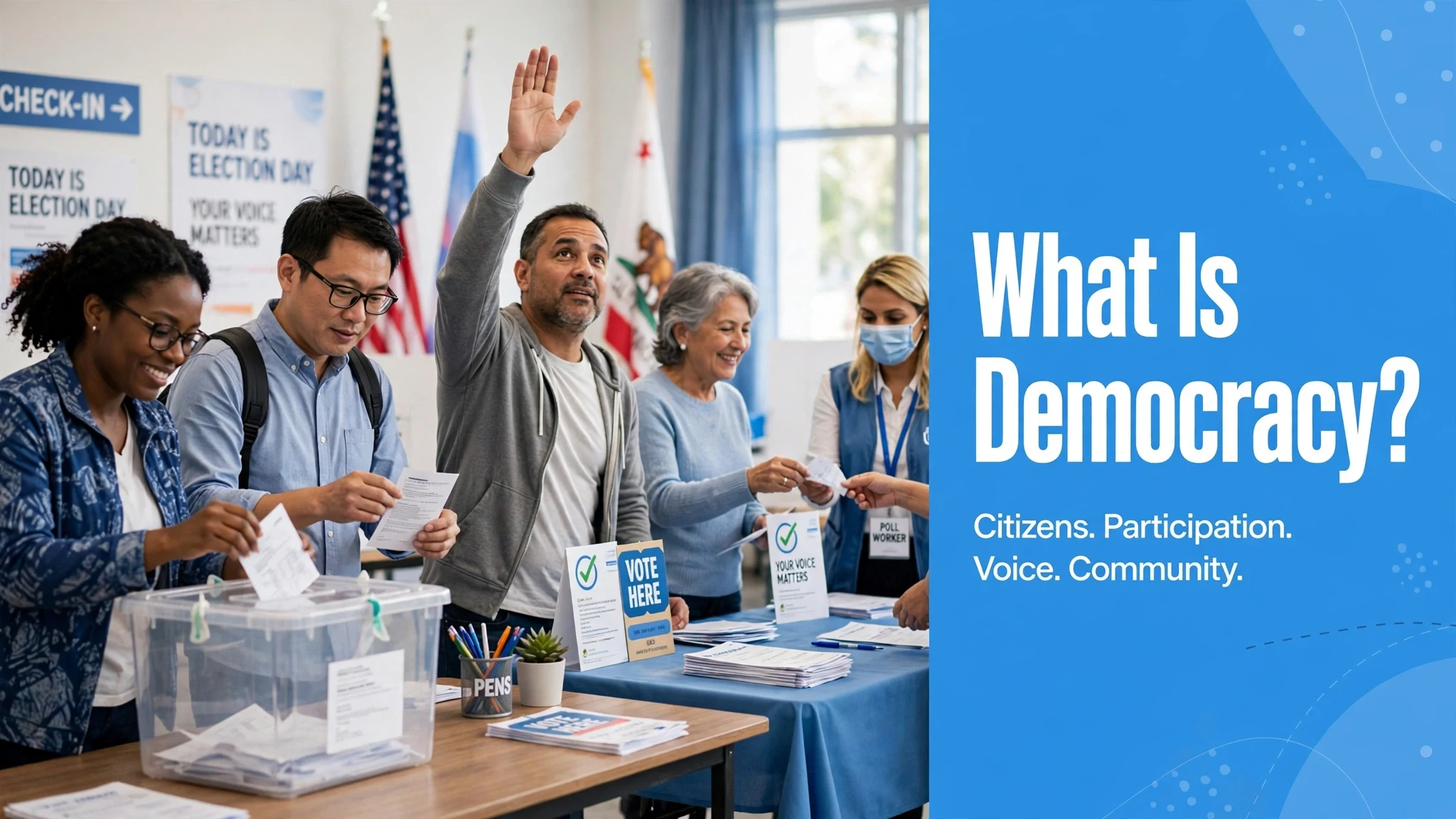
Voting is the most visible part of democracy, and it is the way most people take part. In a free and fair election, every adult citizen has the right to vote, the vote is secret, and the result is counted honestly. Voters choose between candidates and parties, based on their policies, their character, and their record. The candidate or party that wins the most votes, according to the rules of the system, forms the government or takes office.
For an election to be democratic, it must be free and fair. That means that anyone who is eligible can vote, that no one is prevented from voting because of their race, religion, gender, or opinions, that candidates can campaign freely, that the media can report on the election, and that the result is respected, even by the losers. International observers, independent election commissions, and a free press all help to ensure that elections are fair, and their absence is a warning sign that a democracy may be in trouble.
Voting is not only a right; it is also a responsibility. A democracy works best when many people vote, when they inform themselves about the candidates, and when they take part in the debate. Low turnout — when few people vote — can mean that a government is chosen by a small minority, and that the voices of many people are not heard. That is why many democracies encourage voting, make it easy to register, and teach young people about the importance of taking part.
Rights That Democracy Protects
Democracy is not only about voting; it is about the rights that make voting meaningful. The most important of these is freedom of speech: the right to express your opinions, to criticise the government, and to share information, without fear of punishment. Without free speech, an election is meaningless, because voters cannot hear different opinions, and the government cannot be challenged.
Freedom of the press is closely linked to free speech. A free press — newspapers, television, radio, and online media that are not controlled by the government — can investigate, report, and hold leaders to account. When the press is free, corruption is more likely to be exposed, mistakes are more likely to be corrected, and the public is better informed. When the press is controlled, the public hears only what the government wants them to hear.
Other rights protected by democracy include freedom of assembly, the right to gather peacefully and to protest, freedom of religion, the right to practise your faith or to have no faith, and the right to a fair trial, the right to be treated equally under the law and to have your case heard by an independent court. These rights are often written down in a constitution, or in a bill of rights, and they are protected by courts that are independent of the government.
The Rule of Law and Separation of Powers
A key principle of democracy is the rule of law: the idea that everyone, including the government and the leaders, must follow the law. No one is above the law, and the law applies equally to all. That means a president or a prime minister can be investigated, can be taken to court, and can be removed from office if they break the law. It also means that citizens have a right to know what the law is, and to challenge a law they believe is unfair.
To make the rule of law work, democracies usually separate power into three branches: the legislature, which makes the laws (parliament or congress), the executive, which carries out the laws (the government, led by a president or prime minister), and the judiciary, which interprets the laws (the courts). Each branch checks the others, so that no single branch becomes too powerful. A parliament can question the government, a court can strike down a law that violates the constitution, and a government can propose laws but cannot make them alone. This system is called the separation of powers, and it is designed to prevent the concentration of power in one person’s hands.
The separation of powers does not mean that the branches never disagree; in fact, disagreement is normal, and it is a sign that the system is working. A court that disagrees with a government, a parliament that rejects a government proposal, or a press that criticises a leader are all examples of democracy in action, not of democracy failing.
Democracy in Everyday Life
Democracy is not only about elections and parliaments; it affects everyday life in many ways. It affects whether you can speak freely, whether you can practise your religion, whether you can start a business, whether your children can go to school, and whether you can get fair treatment from the police and the courts. In a democracy, you have the right to complain, to protest, to join a group, and to ask questions, and those rights are protected by law.
Democracy also affects how decisions are made in smaller places: in a school, in a workplace, in a community, and in a family. A school council that lets students vote, a workplace that listens to its workers, and a community that holds a public meeting are all examples of democratic principles in action. Learning to listen, to debate, to respect different opinions, and to accept the result of a vote are skills that are useful in everyday life, not only in politics.
That is why democracy is often taught in schools, not only as a political system, but as a way of living together. A democratic classroom is one where students can ask questions, where they can disagree respectfully, and where they can take part in decisions. Those habits, learned early, help to create citizens who will take part in democracy as adults.
The Challenges Facing Democracy Today
Democracy faces many challenges in the world today. In some countries, leaders have been elected democratically and then have used their power to weaken the courts, to control the media, or to change the rules so that they cannot be voted out. This is sometimes called democratic backsliding, and it is a reminder that democracy is not guaranteed; it must be defended by citizens, by institutions, and by the rule of law.
Other challenges include misinformation, where false information spreads quickly online and makes it harder for voters to make informed decisions, and low turnout, where many people, especially young people, do not vote. There is also the challenge of inequality, where some people have far more wealth and influence than others, and where that influence can affect politics. And there is the challenge of making democracy work for everyone, including minorities, women, and people who have historically been excluded from power.
These challenges are serious, but they are not new, and democracy has faced them before. The answer to each challenge is not to give up on democracy, but to strengthen it: by protecting free speech and a free press, by making voting easier, by teaching young people about democracy, and by holding leaders to account. Democracy is not a finished system; it is a work in progress, and it depends on the people who live in it.
Democracy and the Media: Why a Free Press Matters
A free press is often called the fourth estate, after the three branches of government, because it plays a vital role in democracy that no other institution can replace. Journalists investigate, they ask questions, they report on what the government does, and they give a voice to people who might otherwise not be heard. Without a free press, voters cannot make informed decisions, corruption can go unnoticed, and leaders can act without being challenged. That is why attacks on journalists, whether through violence, through censorship, or through laws that restrict reporting, are a warning sign for democracy.
The media landscape is changing, with social media, online news, and citizen journalism playing a larger role. That change brings both opportunities and risks: more voices can be heard, but false information can also spread quickly. In a democracy, citizens need to be able to tell reliable news from unreliable news, to check a claim before sharing it, and to support journalism that is accurate and independent. Media literacy — the ability to read the news critically — is now as important as the right to vote, because a voter who is misinformed cannot make a good decision.
Democracy in Schools and Workplaces: Practising Every Day
Democracy is not only practised in parliaments and polling stations; it is practised in schools, in workplaces, and in communities, every day. A school council that lets students vote on an issue, a workplace that asks its workers for their views, and a community group that holds a public meeting are all examples of democratic habits in action. Those habits matter, because they teach people to listen, to debate, to respect different opinions, and to accept the result of a vote, even when they disagree with it. A child who learns those habits at school is more likely to practise them as an adult, and a worker who is listened to at work is more likely to feel that their voice matters in politics too. Democracy is therefore not only a system of government; it is a way of living together, and it is learned in small places, long before a person casts their first vote in an election.
Democracy and Young People: The Next Generation
Young people are often told that they are the future of democracy, but they are also its present: they can vote when they reach voting age, they can join a political party, they can volunteer, and they can speak out on issues that matter to them. In many countries, young people vote at lower rates than older people, not because they do not care, but because they feel that politics does not listen to them, or that the issues they care about — education, jobs, climate, and housing — are not taken seriously. That is a problem for democracy, because a system that does not hear young voices is a system that will not serve them. Schools, families, and politicians all have a role in changing that, by teaching young people how democracy works, by listening to what they say, and by showing them that their vote and their voice can make a real difference.
My Take:
My honest view is that democracy is the best system we have for living together, not because it is perfect, but because it is the only system that allows us to change our minds, to correct our mistakes, and to remove leaders who have failed us, without violence. A dictatorship may be efficient, and it may make decisions quickly, but it cannot be questioned, it cannot be voted out, and it cannot admit that it was wrong. Democracy is slower, messier, and more frustrating, but it has a built-in way to fix itself, and that is its greatest strength. I would rather live in a democracy that argues, that debates, and that sometimes gets it wrong, than in a system where no one is allowed to argue at all.
I also believe that democracy is not only about voting; it is about the habits that make voting meaningful. Listening to someone you disagree with, reading a newspaper that challenges your views, accepting the result of an election even when your candidate loses, and treating other people with respect even when you disagree with them — these are democratic habits, and they are as important as the vote itself. A country can hold elections and still not be democratic, if its citizens do not practise those habits, and if its leaders do not respect them. I think we should teach those habits, in schools, in families, and in communities, because they are the foundation on which democracy stands.
Another point I care about is the right to criticise the government. In a democracy, criticising a leader is not disloyalty; it is a duty. A government that cannot be criticised cannot be improved, and a citizen who is afraid to speak is not free. I respect people who criticise their government thoughtfully, who point out mistakes, and who propose alternatives, because they are helping democracy to work. I am suspicious of leaders who call criticism unpatriotic, or who try to silence journalists, because that is a sign that they are afraid of being held to account. A confident leader welcomes criticism; a fearful leader tries to stop it.
On the subject of voting, my view is that it is a privilege that should not be wasted. Many people in the world have fought, and some have died, for the right to vote, and many people today still do not have it. To have the right and not to use it is to give away a power that others would value highly. I understand that voting can feel pointless, especially when the choice is between candidates you do not like, or when you feel that nothing changes. But even a small vote, cast thoughtfully, is a statement that you count, that your voice matters, and that you expect to be heard. I would urge everyone who can vote to do so, and to do so with knowledge, not only with habit.
I also think that democracy needs to be defended, not only by politicians, but by ordinary people. That defence does not require heroism; it requires small, everyday actions: reading reliable news, checking a claim before sharing it, voting, contacting a representative, and standing up for the rights of others, even when you disagree with them. Those actions, repeated by many people, are what keep a democracy alive. If we stop doing them, democracy will weaken, not in a single dramatic moment, but slowly, quietly, until one day we notice that the freedom we took for granted is gone. I do not want that to happen, and I believe it will not happen if we remember that democracy belongs to us, not only to the people we elect.
Finally, I believe that democracy is worth believing in, even when it disappoints us. It will disappoint us, because it is made of people, and people make mistakes. But it is also the system that allows us to hope, to argue, to change, and to build a better future together. That hope is not naive; it is practical, because it is based on the idea that ordinary people, given information, given rights, and given a vote, can make good decisions, and can learn from the bad ones. That is why I will keep voting, keep speaking, and keep defending democracy, not because it is perfect, but because it is the best chance we have to live freely and fairly together. Democracy is also learned in small places — in a school council, in a workplace meeting, in a community group — and those small practices matter as much as the vote itself, because they teach us to listen, to debate, and to accept a result we disagree with. A citizen who has practised those habits is a citizen who will make democracy work.
I also want to add a word about the media, because a democracy without a free press is a democracy in name only. Journalists who investigate, who ask difficult questions, and who report what they find are doing a public service, even when their reporting is uncomfortable for those in power. I think citizens should support that work, by reading reliable news, by paying for journalism when they can, and by defending the right of journalists to work without fear. A free press is not a luxury; it is a necessity, and losing it is one of the first steps towards losing democracy itself.
One more thought is about misinformation, because it is one of the greatest challenges facing democracy today. False information spreads quickly online, and it can change how people vote, how they think about their neighbours, and how they trust their institutions. The answer is not censorship, but education: teaching people to check a claim, to look for a reliable source, and to think before sharing. That skill, media literacy, is now as important as reading and writing, and it should be taught in schools, in families, and in communities. A voter who can tell truth from falsehood is a voter who can make democracy work.
A final thought on young people: they are not only the future of democracy, they are its present, and a democracy that does not listen to them will not serve them. If you are young, your vote matters, your voice matters, and your questions matter, even when the answers are slow to come. Ask, vote, speak, and keep asking, because that persistence is what keeps democracy honest, and it is what will shape the country you will live in for the rest of your life.
Frequently Asked Questions
What is democracy in simple words?
Democracy means rule by the people. Citizens choose their leaders by voting in free and fair elections, leaders must follow the law, and people have rights, such as free speech and a fair trial, that the government cannot take away.
What is the difference between democracy and dictatorship?
In a democracy, leaders are chosen by voting, can be voted out, and must follow the law. In a dictatorship, one person or a small group holds power without free elections, and citizens cannot criticise the government or change it by voting.
Why is voting important in a democracy?
Voting is how citizens choose their leaders and influence decisions. It gives people a voice, it holds leaders to account, and it allows a government to be changed peacefully if voters are not happy with it.
What rights does democracy protect?
Democracy protects freedom of speech, freedom of the press, freedom of assembly, freedom of religion, and the right to a fair trial, among others. These rights are often written in a constitution and protected by independent courts.
What is the rule of law?
The rule of law means that everyone, including the government and its leaders, must follow the law. No one is above the law, and the law applies equally to all citizens.
Can democracy fail?
Yes. Democracy can weaken if leaders undermine courts, control the media, or change election rules to stay in power, a process called democratic backsliding. It is defended by citizens, by independent institutions, and by respect for the rule of law.