Why Do I Feel Stuck When I Have Too Much to Do
In this post
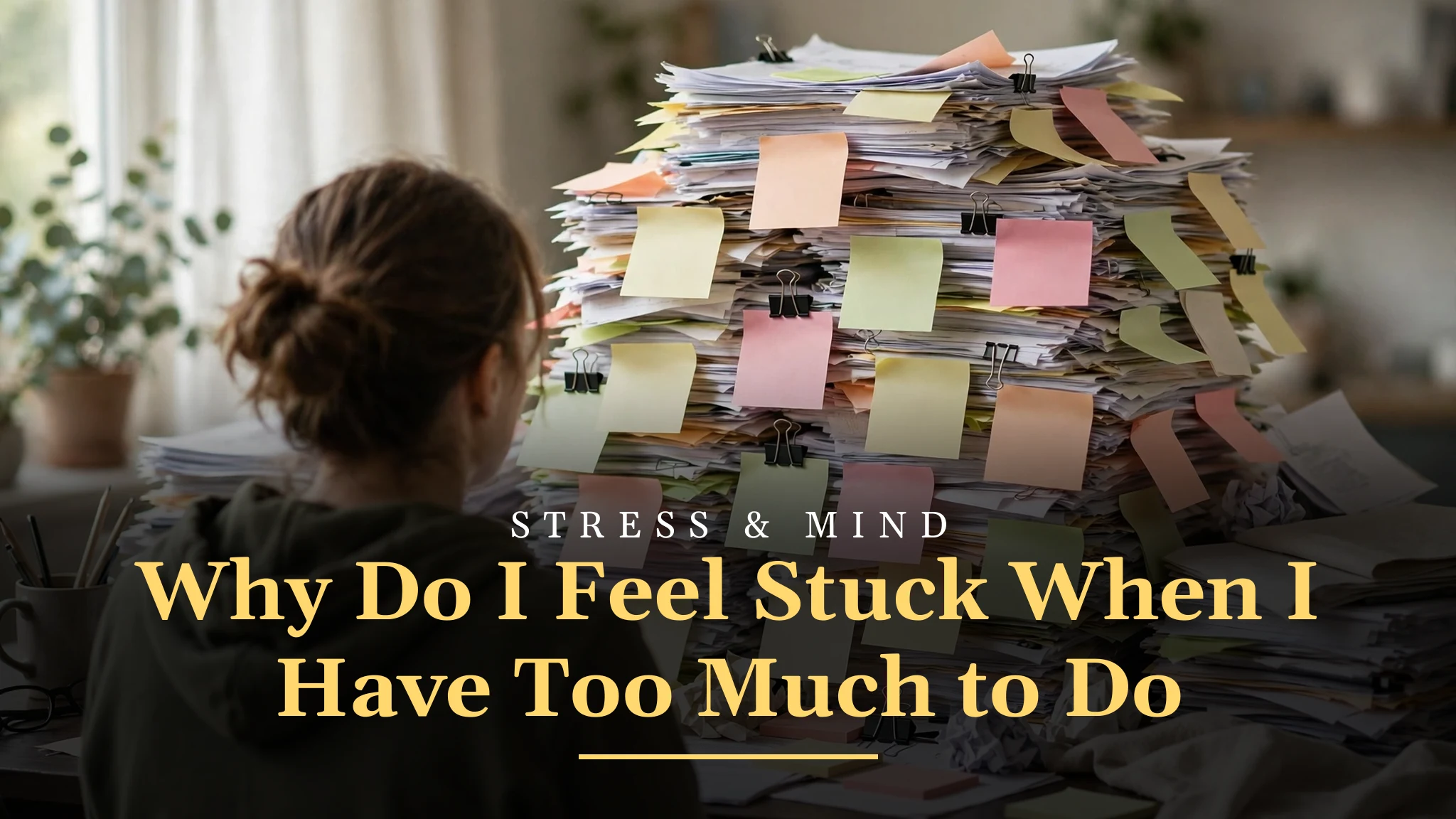
You know the feeling. You have a long list of things to do, and instead of starting, you sit and stare at it. You check your phone. You make a cup of tea. You tidy something that did not need tidying. You tell yourself you will start in five minutes, and then an hour passes and nothing has moved. You are not lazy. You are not stupid. You are stuck, and the strange part is that having more to do seems to make it harder to do anything at all. This article explains why that happens, in plain words, and what you can do about it, one small step at a time.
Most people have felt this at some point. A student with exams, assignments, and a part-time job. A parent with housework, shopping, school runs, and bills to pay. A worker with emails, meetings, and deadlines all arriving on the same day. The list grows, the mind feels full, and the body seems to freeze. It helps to know that this is a common human response, not a personal failure. Your mind is not refusing to work. It is trying to deal with too many demands at once, and it does not know where to begin. Once you understand that, the way forward becomes clearer. You do not need more willpower. You need a smaller first step, a clearer order, and a little room to breathe.
What Feeling Stuck Really Means
Feeling stuck is not the same as feeling lazy. A lazy person does not care about the work and does not want to do it. A stuck person usually cares a great deal and wants to do the work, but cannot get moving. The mind keeps going over the list, the body stays still, and the gap between wanting to start and actually starting grows wider. That gap is painful, because you can see what needs doing, you know it matters, and yet you cannot seem to take the first step. The longer you sit in that gap, the worse you feel, and the worse you feel, the harder it becomes to move. It is a circle, and breaking it is the whole point of this article.
Stuck often comes with a mix of feelings, not just one. There is worry about the work itself, worry about time running out, worry about doing it badly, and worry about what other people will think. There is also tiredness, because a full mind is tiring even when the body has done nothing. And there is a sense of guilt, because you feel you should be working and you are not. These feelings pile up on top of each other. You are not just facing a list of tasks. You are facing a list plus worry plus tiredness plus guilt, and that is a much heavier load than the list alone.
It helps to name what is happening without judging yourself for it. Say to yourself, in plain words: I have too much to do, I do not know where to start, and my mind feels full. That is an honest description, and it is kinder than calling yourself lazy or useless. When you name the problem clearly, it becomes smaller. It is no longer a vague feeling that something is wrong with you. It is a specific situation: too many tasks, no clear order, a tired mind. Specific problems can be solved. Vague shame cannot.
Feeling stuck also comes and goes. Some days you can look at the same list and start at once. Other days the same list feels impossible. That change does not mean you are unreliable. It means your energy, your sleep, your mood, and the size of the list all change from day to day. A list that is manageable on a fresh Monday morning can feel crushing on a tired Thursday evening. Understanding that helps you be fair to yourself. You are not failing on the hard days. You are facing a harder combination of circumstances, and you need a gentler plan on those days.
Why a Long List Freezes the Mind
A short list is easy to hold in your mind. Three tasks, in order, one after the other. You can see the first one, do it, and move to the next. A long list is different. Ten, fifteen, or twenty tasks do not fit neatly in your mind at once. They crowd each other, they compete for attention, and they make it hard to see which one comes first. Your mind keeps jumping from one task to another, weighing them, comparing them, and worrying about all of them at the same time. That jumping is tiring, and it leaves no energy for actually doing the work.
Part of the problem is choice. When you have one task, there is no choice to make. You do it. When you have twenty tasks, every moment is a choice. Should I answer the email first, or clean the house, or start the report, or pay the bill? Each choice feels important, and each choice means putting the other nineteen aside for now. That is hard, because you worry that you are choosing the wrong one. So instead of choosing, you choose nothing. You sit with the whole list, thinking about all of it, and doing none of it. The list itself has become the work, and the real work has not started.
Another part of the problem is size. Many tasks on a long list are not single tasks at all. They are projects in disguise. Write a report is not one step. It is thinking, gathering information, writing a draft, checking it, and sending it. Clean the house is not one step. It is many rooms, many jobs, many decisions. When you look at a task like that, your mind sees a mountain, not a step, and a mountain is too big to climb in one go. It is natural to turn away from it. The task needs to be broken down before it can be started, and until someone breaks it down, it will keep looking impossible.
There is also the weight of unfinished things. Every unfinished task on your list is a small open loop in your mind. Your mind keeps returning to it, reminding you that it is not done, even when you are trying to do something else. One open loop is easy to carry. Twenty open loops are heavy. They fill your thoughts, they interrupt your rest, and they make it hard to concentrate on the one task in front of you. That is why a long list can feel exhausting even before you have done any work. Your mind has already been working hard, just carrying the list around.
The Role of Worry, Tiredness and Pressure
Worry makes stuckness worse in a very direct way. When you worry about a task, you imagine it going wrong. You imagine missing the deadline, doing it badly, or being judged for it. Those imagined problems feel real, and they make the task feel bigger and more dangerous than it actually is. A simple email becomes a test of your worth. A household chore becomes a sign that you are falling behind in life. When a task carries that much emotional weight, it is natural to avoid it. Avoiding it brings a short feeling of relief, but the task is still there, and the worry grows, so the next time you look at it, it feels even bigger.
Tiredness plays a similar role. A tired mind finds it harder to plan, to choose, and to start. If you slept badly, if you have been working for many hours, or if you have been dealing with worry for days, your mind has less energy left for new work. Starting a task needs a small burst of energy, the energy to decide, to stand up, to open the document, to pick up the phone. When you are tired, that burst is hard to find. You are not refusing to work. You are running on empty. Rest, food, water, and a short break are not luxuries in that state. They are the fuel you need before you can start.
Pressure from other people adds another layer. When someone is waiting for your work, when a deadline is close, or when a family member is upset that something is not done, the pressure can feel like a weight on your chest. A little pressure can help you focus. A lot of pressure can freeze you. You start thinking about the person waiting, about what they will say, about what will happen if you fail, and all of that thinking takes the place of doing. It is also common to feel pressure from yourself. Many people set very high standards and then feel stuck because they cannot meet them at once. They want the work to be perfect, so they do not start it at all. A perfect plan that never starts is less useful than an imperfect start that actually moves.
It is important to see these three, worry, tiredness, and pressure, as separate from the tasks themselves. The tasks may be ordinary. The worry, tiredness, and pressure are what make them feel impossible. If you can reduce even one of them, the tasks become easier. A short rest reduces tiredness. Talking to someone reduces worry. Asking for more time, or telling someone honestly that you need a day, can reduce pressure. You do not have to fix everything at once. Reducing one part of the load is often enough to let you start.
Why Starting Feels Harder Than Doing
Almost everyone who feels stuck discovers the same strange truth once they finally begin: the work itself is easier than the thought of the work. Starting is the hardest part. Once you are ten minutes into a task, your mind settles, your hands know what to do, and the worry fades into the background. The task that looked like a mountain from the outside turns out to be a series of small steps, and each step is manageable. The problem was never the work itself. The problem was the moment before the work, when you had to choose, to begin, and to face the size of the whole list at once.
There is a reason for this. Before you start, your mind is dealing with the whole list, the whole project, and all the worry that comes with it. After you start, your mind only has to deal with the one small step in front of you. That is a much smaller job. Your attention narrows to the email you are writing, the room you are cleaning, the paragraph you are drafting. The rest of the list is still there, but it is no longer in the centre of your mind. You are doing, not planning, and doing is usually calmer than planning.
This is why the first step should be as small as possible. Do not start with write the whole report. Start with open the document and write the title. Do not start with clean the whole house. Start with clear the kitchen table. Do not start with answer all the emails. Start with answer the shortest one. A tiny first step does two things. First, it is so small that your mind does not resist it. Second, once you have done it, you have started, and starting changes everything. You are no longer a person staring at a list. You are a person who has done one thing, and one thing often leads to the next.
It also helps to give yourself permission to do a bad first version. Many people get stuck because they want the first version to be good. They want the email to sound perfect, the room to look perfect, the report to be perfect from the first line. That standard is too high for a first step. A first draft is meant to be rough. A first attempt at cleaning is meant to be partial. You can improve things later, but you cannot improve something that does not exist. Starting badly is better than not starting at all, because a rough start can be fixed, while a perfect plan in your head cannot.
Simple Ways to Make the List Smaller
The most useful thing you can do with a long list is to make it smaller, on paper, before you try to do anything. Take a piece of paper and write down everything that is on your mind. Do not try to organise it yet. Just get it out of your head and onto the page. This alone often brings relief, because your mind no longer has to carry the whole list. The paper carries it now. You can look at it, and it is smaller than it felt inside your head. It is still long, but it is visible, and visible things are easier to deal with than invisible worries.
Next, cross out anything that does not need doing today. Many long lists are full of tasks that are not urgent. They are things you would like to do, things that can wait until next week, or things that someone else could do. Be honest with yourself. If a task can wait, let it wait. If a task is not really yours, say so. If a task is a wish rather than a duty, put it on a separate list for later. Your goal is not to do everything. Your goal is to find the three or four things that truly matter today, and to let the rest wait without guilt.
Then, order what is left. Pick the one task that matters most, or the one that is most urgent, and put it first. Pick the next one and put it second. You do not need a perfect order. You need an order that is good enough to start. If two tasks seem equally important, choose the smaller one first, because finishing something small gives you energy for the next task. If one task is blocking other tasks, do that one first, because it will clear the way. The exact order matters less than having an order at all. An order turns a crowd of tasks into a line, and a line can be followed one step at a time.
Finally, break the first task into its smallest step. If the task is to pay a bill, the smallest step is to find the bill. If the task is to cook dinner, the smallest step is to decide what to cook. If the task is to call someone, the smallest step is to find their number. Write that small step down, do it, and tick it off. Ticking off a step, even a tiny one, tells your mind that you are moving. That feeling of movement is the opposite of feeling stuck, and it grows with each small step you finish.
Rest, Sleep and Energy Through the Day
Feeling stuck is often worse at certain times of day, and that pattern is worth noticing. Many people feel stuck in the late afternoon, when energy is low, or late at night, when they are tired but still thinking about unfinished work. Others feel stuck first thing in the morning, when the whole day stretches ahead and the list feels endless. If you notice when you feel most stuck, you can plan around it. Do the hardest task when you have the most energy, often in the morning for many people, and leave easier tasks for the low-energy times. Do not try to start a big task when you are already exhausted. That is setting yourself up to fail.
Sleep matters more than most people admit. A night of poor sleep makes the next day’s list feel heavier. Your mind is slower, your patience is shorter, and small tasks feel bigger. If you have been sleeping badly for several nights, the stuck feeling may be partly a sleep problem, not a work problem. Going to bed at a regular time, avoiding screens late at night, and giving yourself time to wind down are not luxuries. They are part of keeping your mind able to work. A rested mind can start. A tired mind often cannot, no matter how much you tell it to try harder.
Food and water matter too, in a simple way. If you have not eaten for hours, or if you have only eaten sweet snacks, your energy will dip and your concentration will fade. A proper meal, some water, and a short walk can change how a list feels. This is not about a special diet. It is about giving your body the basic fuel it needs to think clearly. Many people try to push through tiredness and hunger, thinking that will save time. It usually costs time, because a tired, hungry mind works slowly and makes mistakes that need fixing later.
Short breaks are also part of the answer, not a distraction from it. Working without a break for hours makes the mind stale. A five-minute break, a short walk, a glass of water, a few minutes of fresh air, can restore enough energy to start again. The break should be short and deliberate, not an hour of scrolling through a phone that leaves you more tired than before. A real break rests the mind. A phone break often fills it with more noise. Learn the difference, and use real breaks when you feel stuck.
When the Feeling Keeps Coming Back
For most people, feeling stuck is occasional. It comes with a busy week, a deadline, or a difficult period, and it passes when the pressure eases. But for some people, it keeps coming back, week after week, even when the list is not especially long. If that is happening to you, it is worth paying closer attention. It may be that your life is consistently overloaded, and the list is not the problem. The problem is that there is too much to do, day after day, with too little rest. In that case, the answer is not a better list. The answer is to look at the load itself, and to ask what can be reduced, shared, or let go.
It may also be that worry or low mood is making every task feel heavier than it is. When a person feels low for a long time, even small tasks can feel impossible. Getting out of bed, answering a message, or cooking a meal can feel like climbing a mountain. That is not laziness. It is a sign that the mind is carrying a heavy load, and it needs support, not criticism. If you notice that you feel stuck most days, that you have lost interest in things you used to enjoy, that you feel tired all the time, or that you feel hopeless about the future, those are signs worth taking seriously.
Talking to someone is the most useful first step in that situation. Talk to a family member, a friend, or a health professional. You do not need to have the perfect words. You can start with the plain truth: I feel stuck most days, and I do not know why. A conversation will not fix everything, but it breaks the isolation that makes stuckness worse. It also gives you a fresh view. Someone else may see that your load is too heavy, or that you need rest, or that you need help with a specific problem, in a way that you cannot see from inside the feeling.
There is no shame in asking for help, and there is no shame in feeling stuck. It is a human experience, and it is far more common than people admit, because most people hide it. They pretend they are coping, they work late, they smile, and they feel stuck inside. The more honestly we talk about it, the easier it becomes to deal with. If the feeling keeps coming back, do not just try harder with the same list. Step back, look at the bigger picture, and ask for support. That is not giving up. That is dealing with the real problem instead of the surface one.
My Take:
If you ask me what I really think about feeling stuck when you have too much to do, I would say it is one of the most misunderstood feelings there is, and I say that because I have felt it myself and I have watched good, hard-working people blame themselves for it. They call themselves lazy, they call themselves useless, they wonder what is wrong with them, and none of those labels are true. A lazy person does not care. A stuck person cares too much, and cares about too many things at once. That is the whole difference, and it matters, because the cure for laziness and the cure for stuckness are not the same. Laziness needs a push. Stuckness needs a smaller step, a clearer order, and a kinder voice in your own head.
I think the first thing to understand is that a long list is not just a list. It is a weight. Each unfinished task is a small voice in your mind saying, remember me, do me, do not forget me. One voice is easy to live with. Twenty voices are not. They talk over each other, they interrupt your rest, and they make it hard to hear your own thoughts. When people tell me they cannot concentrate, I often think it is not a concentration problem at all. It is a crowd problem. Their mind is crowded with unfinished things, and there is no quiet space left to think in. The answer is not to concentrate harder. The answer is to empty some of the crowd onto paper, to choose one voice to listen to first, and to let the others wait their turn.
I also think we make the problem worse by the way we talk about work. We praise people who do a lot, who never rest, who answer emails at midnight, who carry impossible loads without complaining. We call that dedication, and we make people feel that if they cannot do the same, they are failing. I do not think that is fair, and I do not think it is wise. A person who does a lot but feels stuck and miserable is not succeeding. A person who does less, but does it calmly and finishes it, is doing far better. I would rather do three things well than twenty things badly, and I would rather feel calm at the end of the day than feel guilty about the seventeen things I did not do. That is not a lack of ambition. It is a realistic view of what a human being can do in one day.
In my view, the hardest moment is always the start, and I think that is the part people should focus on most. I have noticed in my own life that once I start, the work is rarely as bad as I feared. The email takes ten minutes, not an hour. The room takes twenty minutes, not the whole afternoon. The call I was dreading takes five minutes and the person is friendly. The fear lives before the work, not inside it. So I have learned to make the start as small as I possibly can. I do not tell myself to write the report. I tell myself to open the document. I do not tell myself to clean the house. I tell myself to clear one table. That tiny start is a trick, but it is an honest trick, because it works with the way my mind actually behaves instead of fighting it.
I also believe in the power of a bad first version, and I think this is something schools never teach us properly. At school, a rough draft felt like a failure. In real life, a rough draft is the only way anything gets done. The first email does not need to be perfect. The first attempt at a task does not need to impress anyone. It needs to exist. Once it exists, you can fix it, improve it, or ask someone to check it. But you cannot fix a blank page. I would tell anyone who feels stuck to give themselves permission to do it badly first. Write the messy version. Clean one corner. Make the short call. Perfection is the enemy of starting, and starting is the whole battle.
There is another point I want to make, about rest, because I think we treat rest as a reward for finishing work, when it should be part of the work itself. People tell themselves, I will rest when the list is done. But the list is never done. There is always another task, another email, another chore. So they never rest, they get more tired, and they feel more stuck. I think that logic is backwards. Rest is what makes work possible. A short break, a proper meal, a good night’s sleep, these are not luxuries you earn after work. They are the fuel that lets you work at all. If you feel stuck, the answer might not be to try harder. It might be to rest for twenty minutes, eat something proper, drink some water, and then try again with a fresher mind.
I also want to say something about asking for help, because I think pride stops many people from doing it. They feel that asking for help means they have failed, or that they are a burden. I do not see it that way. Asking for help is a practical skill, like any other. If a task is too big for one person, sharing it is sensible, not shameful. If you do not know how to do something, asking someone who does is faster than struggling alone for hours. If you feel overwhelmed most days, talking to someone is not a sign of weakness. It is a sign that you are dealing with the real problem instead of pretending it is not there. I have learned that the people who cope best are not the ones who never need help. They are the ones who ask for it early, before a small problem becomes a large one.
I think we should also be honest about the fact that some lives are simply overloaded, and no list system will fix that. If you are working long hours, looking after family, managing a house, and trying to keep up with everything else, you may feel stuck because there genuinely is too much to do. In that case, the answer is not a better app or a cleverer method. The answer is to look honestly at the load and to ask what can be reduced, delayed, shared, or let go. That is a hard conversation to have, with yourself and with others, but it is an honest one. Doing less, on purpose, is not failure. It is a choice to live within your real limits, and that choice protects your health and your peace of mind.
If a friend came to me and said they felt stuck, I would not give them a lecture about discipline. I would sit with them, I would ask them to write the whole list on paper, and I would help them cross out what can wait. Then I would ask them to pick one small task, the smallest one, and do it together, or at least to start it while I was there. I would tell them to tick it off, to feel that small win, and then to pick the next one. I would also tell them to stop at a sensible time, to eat, to rest, and to come back tomorrow. I would not expect them to finish everything in one day, because nobody can. I would expect them to move a little, and a little movement is enough to break the freeze.
Finally, I want to say this to anyone who feels stuck right now. You are not broken. You are not lazy. You are a person with too much on your mind, and your mind is doing its best to cope. Be kind to yourself in the way you would be kind to a friend in the same position. You would not call your friend useless. You would not tell them to just try harder. You would help them make the list smaller, you would tell them to start with one tiny step, and you would remind them to rest. Do the same for yourself. Write it down, choose one small step, do it badly if you have to, tick it off, and then take a breath. Tomorrow, do it again. That is how stuck people get moving, not in one great leap, but in small, steady steps, one at a time, until the list is smaller and the mind is quieter again.
I also think it is worth saying that feeling stuck is not a sign that you are bad at planning. Many of the most organised people I know feel stuck regularly, because they are the ones who take on the most, who notice the most, and who care the most about doing things properly. The person who feels nothing is usually the person who has stopped caring. So if you feel stuck, take it as a sign that you care, and that your standards are high, and then ask whether those standards are fair for one day. A fair standard is to do what you can today, to do it as well as you reasonably can, and to let the rest wait. An unfair standard is to expect yourself to finish everything, perfectly, without rest. Nobody can meet that standard, and trying to meet it will only leave you more stuck tomorrow.
Another thing I have learned is that the stuck feeling often hides a decision you have been avoiding. Sometimes the list is long because you have not decided what matters most. Sometimes a task sits on the list for weeks, not because it is hard, but because you do not really want to do it, or you are not sure it is worth doing, or you are waiting for someone else to decide. In those cases, the way forward is not to work harder on the task. It is to make the decision. Either do it, drop it, ask for help with it, or give it a proper date in the future and stop carrying it every day. A decision, even a decision to let something go, frees up space in your mind. And freed space is what lets you start the next thing.
I want to add a word about evenings, because that is when stuckness often feels worst. You come home tired, the day’s work is unfinished, tomorrow’s list is already forming in your mind, and you feel guilty for resting. I think evenings need a clear ending. Write down tomorrow’s first task, put the list away, and let the day end. The list will still be there in the morning, and you will face it better after rest than you will face it tonight while you are exhausted. Rest is not the opposite of work. Rest is the part of the day that makes tomorrow’s work possible. If you steal rest to worry about work, you pay for it twice, once in the evening and once in the morning when you are too tired to start.
I also think it helps to remember that other people feel this way too, even the ones who look calm and organised from the outside. The colleague who always seems on top of things probably has a list that worries them as well. The friend who posts about a tidy house probably had a stuck morning before they started. Knowing that does not make your list shorter, but it does make the shame smaller, and shame is often the heaviest part of the load. You are not the only person sitting in front of a list, unable to start. You are one of many, and most of them get moving again with the same small steps I have described here.
There is one more habit I would recommend, and it is a simple one: at the end of each day, write down one thing you did, even if it is small. Not ten things, not the whole list, just one. I answered one email. I cleaned one room. I made one call. That single line is a record that the day was not wasted, even if most of the list is still there. Over a week, those lines add up, and they tell a truer story than the feeling of being stuck tells. The feeling says you did nothing. The record says you did something every day. Trust the record. It is more honest than the feeling, and it will keep you going on the days when the feeling is loudest.
Frequently Asked Questions
Is why do i feel stuck when i have too much to do a normal part of everyday life?
Yes, it is very normal. Most people feel stuck from time to time when they have too much to do, because a long list makes it hard for the mind to choose where to start. It does not mean you are lazy or that something is wrong with you. It usually means the load is too large, the order is unclear, or you are tired, and any of those can make starting feel hard.
How long does why do i feel stuck when i have too much to do usually last in a normal day?
It varies. For many people it lasts for a short while, perhaps an hour or part of a morning, until they take one small step and the feeling eases. On a very busy or tiring day it can last longer, especially if the list keeps growing. Once you start the first small task, the stuck feeling usually fades quite quickly, because doing is calmer than worrying about the whole list at once.
Can why do i feel stuck when i have too much to do affect sleep and rest?
Yes, it can. A long unfinished list often stays in your mind at night, making it hard to relax and fall asleep. Worry about tomorrow’s tasks can keep you awake, and poor sleep then makes the next day feel even harder. Writing the list down before bed, choosing the first task for tomorrow, and giving yourself permission to stop for the day can help your mind settle.
What is the simplest way to handle why do i feel stuck when i have too much to do?
Write everything down on paper, cross out what does not need doing today, and pick one small task to start with. Break that task into its smallest first step, do that step, and tick it off. A small, clear start is far more useful than staring at the whole list and trying to do everything at once.
Does why do i feel stuck when i have too much to do feel the same for everyone?
No, it does not feel the same for everyone. Some people feel worried, others feel tired or guilty, and some feel frozen and unable to move. Differences in sleep, energy, workload, and personal pressure mean the same long list can feel manageable to one person and overwhelming to another on the same day. What helps is also different for each person, so it is worth noticing what works for you.
When should I talk to someone about why do i feel stuck when i have too much to do?
If the feeling comes back most days, if it lasts for weeks, or if it comes with low mood, constant tiredness, loss of interest in things you used to enjoy, or trouble sleeping, it is sensible to talk to someone you trust, such as a family member, a friend, or a health professional. General information can never replace advice about one person’s situation, and asking for support is a sensible step, not a sign of failure.
Sources
- NHS — Mental Health
- World Health Organization — Mental Health
- Centers for Disease Control and Prevention — Mental Health
- Healthline — Mental Health
- Mayo Clinic — Stress
This article is general information only. It is not medical advice and it does not diagnose, treat, or cure anything. For personal concerns, speak to a qualified health professional.


